Head-to-head test
EcoFlow DELTA 2 vs Jackery HomePower 1000 Plus v2
Same 1,024Wh, same 1,800W, $170 apart (on last listed prices), and almost everything the extra $170 buys is either a decade away or a load you won't plug in.
Full profiles: EcoFlow DELTA 2 → · Jackery HomePower 1000 Plus v2 →

Written by Ian SchneiderUpdated
Solar & Off-Grid Tester, Station Arena Test Desk
Spec deltas
These two hold the same 1,024Wh and put out the same 1,800W continuous, and one of them costs $170 more (on last listed prices). The DELTA 2 is $499 (last listed price), the HomePower 1000 Plus v2 is $669, and across every load list we model they deliver the identical 870Wh of usable energy and make or miss each scenario by the same margin.
What the extra money buys is real, just narrow. The Jackery brings 900W more surge headroom (3,600W against 2,700W), a cycle rating twice as high, 3.2 fewer pounds, and 140W of USB-C instead of 100W. What it does not buy is one extra watt-hour or one extra watt of continuous output, which is unusual for a gap this size.
The one place it earns the premium outright is fan noise, and that happens to be the DELTA 2's most-cited flawA1A2. If this box is going to sit in your living room through a two-day outage, the money is well spent. If it lives in a garage, a truck bed or a campsite, take the DELTA 2 and put the $170 (on last listed prices) toward a panel.
What the Numbers Reveal
Each conclusion stated first — the numbers behind it on one line, the full analysis below.
That leaves a $170 gap (on last listed prices) with nothing to attach itself to. A third more money buys no additional runtime, no additional load capability, and no additional coverage on any scenario these units are sold for. It buys build details: a bigger surge ceiling, a lighter shell, a faster USB-C port, a higher number on the cycle line.
DELTA 2: 1,024Wh, 1,800W continuous, $499 (last listed price)HomePower 1000 Plus v2: 1,024Wh, 1,800W continuous, $669All six modeled scenarios return 870Wh usable for both units and identical coverage percentages
Why it mattersIf your list is a fridge, lights, phones and a laptop, the cheaper box does the identical job and the decision is already made.
rated cycles
Then check when it pays. Twice a week is how most of these units actually get used, and at that rate even the DELTA 2's rating stretches to 28.8 years. Nobody holds a 1kWh power station for three decades. The cycle ratings also aren't quoted to a common end-of-life retention point across brands, so the doubling is a direction rather than a clean multiplier, which makes a savings horizon that was already theoretical a little softer still.
DELTA 2 rated 3,000 cycles; HomePower 1000 Plus v2 rated 6,000Cost per lifetime kWh: $0.16 for the DELTA 2, $0.11 for the Jackery, from 3,072 and 6,144 total lifetime kWhAt weekend use (twice a week) the DELTA 2's rating runs 28.8 years; the Jackery's runs 57.7
Why it mattersOnly a buyer who genuinely cycles this thing every day for years collects on the Jackery's longevity, and that buyer has usually already outgrown 1,024Wh.
The headroom is a shop-and-heavy-appliance spec, not a blackout spec. One reviewer only made the Jackery blink by starting a 14-inch bandsaw whose surge got close to its 3,600W rating, and it recovered and kept the saw runningB1; a 12,000 BTU window air conditioner ran for hours without stressing itB13. Those are the loads that separate a 2x inverter from a 1.5x one. A refrigerator compressor and a few lamps are not.
DELTA 2 surges to 2,700W, a 1.5x ratio over its 1,800W continuousHomePower 1000 Plus v2 surges to 3,600W, a 2x ratioThe largest startup draw in any modeled scenario is 400W, and both units start every scenario's peak
Why it mattersIf a window AC, a well pump or a table saw is on your list, the $170 (on last listed prices) buys the one thing on this page that can't be argued away. If it isn't, it doesn't.
An outage load sits well above 120W, so the DELTA 2's known weakness turns up in exactly the situation people buy these for: a fridge and some lamps, all night, fan on. That's the honest case for spending more. It's undercut by the fact that nobody has measured either unit's noise, EcoFlow said it intended to address the fan in firmwareA4, and the Jackery's quiet is still a manufacturer claim with one week of anecdote behind it.
The DELTA 2's fans trigger above 120W and run continuously at roughly 48 to 55dB at full loadA118 months of published testing across outages, camping and home-office use behind the DELTA 2A3The HomePower 1000 Plus v2 is roughly 11 days old with two week-long hands-on tests and no owner data at allB0B18
Why it mattersIf the box lives where you sleep, pay the $170 (on last listed prices) for the quieter claim. If it lives in the garage, you are paying a premium to avoid a noise you'll never be in the room to hear.
The specific dimensions that decide these two units — everything else is a tie.
Lifetime Value
Selected because: Identical 1,024Wh packs at $499 (last listed price) and $669, so the whole case for the Jackery rests on what its 6,000-cycle rating is actually worth to you.
Eleven cents a kilowatt-hour against sixteen. That is the Jackery's cost argument in full, and it comes from a single line: 6,000 rated cycles against 3,000, which turns $669 into 6,144 lifetime kWh and $499 (last listed price) into 3,072. The arithmetic is clean. The calendar is where it gets awkward, because at two uses a week even the DELTA 2's rating stretches to 28.8 years.
So the real question isn't which unit is cheaper per unit of energy. It's whether you'll still own the thing when the savings arrive. The person who cycles a power station daily for a decade is usually the person who needed 3kWh in the first place, and everyone else is paying $170 (on last listed prices) today against a payback that lands after the box is obsolete.
Your Life, Your Pick
Selected because: Both units return the same 870Wh usable and the same coverage on all six load lists, which is the clearest proof that capacity is not what separates them.
Six load lists, and the two units return the same answer on every one. The same 870Wh usable, the same 41% of a camping weekend, the same 775Wh short of an eight-hour outage, the same 19% of a van-life day. That isn't a quirk of the model. It's what happens when two boxes hold identical energy and push identical watts.
The only row that splits is the CPAP night, and it splits precisely because capacity stops mattering there: both cover the 320Wh load with 550Wh untouched, so the box itself becomes the decision. Every other line is a tie, which is the strongest single argument on this page for buying the cheaper one.
What the Specs Don't Tell You
Selected because: Fan behavior, surge headroom and warranty terms are where these two actually diverge, and one of them you would hear all night.
rated cycles
The DELTA 2's fans come on above roughly 120W and run continuously at full loadA1, and at 1,200W of charging one reviewer put them at gaming-laptop volumeA2. An outage load is well above 120W. So the DELTA 2's known weakness shows up in exactly the situation these units get bought for, which is the best case anybody can make for the Jackery.
Against that, the Jackery's quiet is a claim rather than a result. Its 30dB is a manufacturer floor, and the only hands-on account of the fan calls it a low-frequency hum under heavy startup loadsB3. The surge and switchover gaps are real too, 3,600W against 2,700W and a rated 10ms against 20ms, but neither binds on anything these units are asked to do here. Both start every scenario's peak, and the biggest startup draw in the set is 400W.
Growth Path
Selected because: Both accept expansion batteries, so the question is not whether you can grow but what growing costs on each platform.
solar input
Both take expansion batteries, so the checkbox is a tie and shouldn't decide anything. The costs behind the checkbox are not a tie. Jackery's expansion cable is a proprietary part at $70 before you have bought a batteryB7, and adding capacity doesn't lift the 1,800W continuous ceilingB19. You get a longer night, not a bigger load list.
That matters because expansion is one of the arguments people use to talk themselves into the more expensive unit. Price the whole path on both platforms first, cable included, and see whether the $170 (on last listed prices) base-unit gap survives it.
Brand Trust
Selected because: App quality, community size and platform age split hard here: the DELTA 2 is an established model and the HomePower 1000 Plus v2 was announced in late August.
The DELTA 2 has been through 18 months of published testing across outages, camping trips and daily home-office use, and its flaws are known and repeatedly describedA0A1A3. The HomePower 1000 Plus v2 was announced in late August, and its whole record is two week-long hands-ons on samples Jackery supplied, one of which says outright that it isn't finishedB0B18. A premium for the newer unit is a premium paid before anyone knows what breaks.
On software the gap runs opposite to the price. EcoFlow's app rates 4.6 on iOS against Jackery's 2.3 to 3.3, and EcoFlow's Reddit community is roughly 31,000 people against Jackery's 2,000, which matters the night you need someone who has already solved your problem. Jackery's counter is the shelf: Costco, Home Depot and Best Buy all carry it, and with both companies' support records a retailer's return window is worth more than a warranty argument.
Strengths & trade-offs
EcoFlow DELTA 2
Strengths
- +Faster solar charging
Trade-offs
- –Shorter-lived battery — rated for 3,000 charge cycles vs the HomePower 1000 Plus v2's 6,000, so it wears out sooner.
Jackery HomePower 1000 Plus v2
Strengths
- +Lighter by 3.2 lb
- +Rated for 6,000 charge cycles — much longer battery lifespan
Trade-offs
- –No major technical downsides compared to rival.
Will It Power Your Gear?
Scenario math and per-appliance runtimes, modeled from the spec record.
Scenario verdicts
We ran the math on six real-world scenarios. Here's which unit survives your actual life.
SCN-01 · 2 nights · needs 2,100Wh
Weekend Camping
Two nights off-grid with essential comfort
Neither unit
Neither unit covers this scenario's 2,100Wh: the DELTA 2 comes up 1,230Wh short (about 41% covered), the HomePower 1000 Plus v2 1,230Wh (41%). Treat this as partial cover — enough for the essentials in it, not the whole list.
Battery budget usedlower = more headroom
LOAD Phone Charger 15W×6h · LED Lights 40W×8h · Box Fan 75W×14h · CPAP Machine 40W×16h
SCN-02 · 8 hours · needs 1,645Wh
8-Hour Blackout
Keep the essentials running through a night without power
Neither unit
Neither one finishes eight hours. The load list comes to 1,645Wh against 870Wh of usable energy, leaving both exactly 775Wh short, which is roughly four of the eight hours at full draw. Plan around it rather than ruling them out: drop to a fridge, a couple of lamps and phones and either box covers the night comfortably. The difference isn't how far you get, it's which fan you listen to while you get there.
Battery budget usedlower = more headroom
LOAD Fridge 150W×8h · Router + Modem 20W×8h · LED Lights (4 bulbs) 40W×6h · Phone Charger 15W×3h
SCN-03 · 8 hours · needs 320Wh
CPAP Overnight
Sleep therapy without interruption — the #1 medical use case
Either unit
A CPAP pulls about 40W, so eight hours is 320Wh and both units end the night with 550Wh of usable capacity untouched. The percentages are a formality. What decides it is the box on the nightstand, and the HomePower takes that on the things you notice at 3 a.m.: 3.2 pounds less to shift between bedroom and closet, and a rated 10ms handoff if it's sitting between your machine and a wall outlet that might fail. Be fair to the DELTA 2 here though, because 40W is a long way below the load that gives either fan a reason to work.
Battery budget usedlower = more headroom
LOAD CPAP Machine 40W×8h
SCN-04 · 8 hours · needs 910Wh
Remote Workday
Full work day off-grid without power anxiety
Neither unit
Forty watt-hours. That's the entire distance between finishing a remote workday and not, and both units miss by exactly the same forty: 910Wh of load against 870Wh usable. Dim the monitor for the last hour, or let the laptop finish on its own battery, and either box gets you to five o'clock. This is not a scenario that should influence which one you buy.
Battery budget usedlower = more headroom
LOAD Laptop 60W×8h · External Monitor 30W×8h · Router + Modem 20W×8h · Phone Charger 15W×2h
SCN-05 · 4 hours · needs 670Wh
Tailgate Party
Game day power for the crew
Either unit
Both handle game day easily. Since capacity isn't the deciding factor, weight is: at 23.8 lbs the HomePower 1000 Plus v2 is the one you'll be glad you brought. Fan noise under load is worth a listen too — it's audible in the lulls between songs.
Battery budget usedlower = more headroom
LOAD Blender 400W×0.5h · LED TV (55") 80W×4h · Bluetooth Speaker 15W×4h · Phone Charger (×3) 45W×2h
SCN-06 · 24 hours · needs 4,685Wh
Van Life Daily
A full day of mobile living — the ultimate endurance test
Neither unit
Neither unit covers this scenario's 4,685Wh: the DELTA 2 comes up 3,815Wh short (about 19% covered), the HomePower 1000 Plus v2 3,815Wh (19%). This is well outside what either unit is for; the right answer here is a larger station, not a choice between these two.
Battery budget usedlower = more headroom
LOAD Mini-Fridge 150W×24h · Laptop 60W×4h · Phone Charger 15W×3h · LED Lights 40W×5h · Fan 75W×8h
The Load Test
RUNTIME = (Wh × 0.85) ÷ LOAD
None of the scenarios above exactly yours? Build it. Toggle what you'd plug in; both units are tested against the combined draw.
Essentials
Comfort & Convenience
High-Draw Appliances
Test duration
8h
Continuous draw
205W
Projected runtime
Dead heat — both run this 205W load for roughly 4.2h. Pick on price, weight, or ports.
Planning for more than this? Describe your whole setup and get it sized →
Modeled from the spec record — same math as the tables below. Methodology
Runtime by appliance
Real-world runtime estimates for common appliances, modeled at 85% inverter efficiency.¹
Essentials
The basics you need runningscale 0–58hComfort & Convenience
Makes off-grid life actually enjoyablescale 0–11.6hHigh-Draw Appliances
These reveal the real limitsscale 0–0.9h¹ Runtime = (capacity × 0.85) ÷ appliance watts. Within each group, all bars share one time scale (the group's longest runtime), so lengths are comparable across appliances; identical runtimes collapse into a single blue/orange bar. Actual runtime varies with battery age, temperature, and simultaneous loads — see methodology.
Conclusion
September 7, 2026
Verdict withdrawn: the DELTA 2 is no longer sold
We picked the DELTA 2, but it's been discontinued (EcoFlow now points buyers to the DELTA 3). The HomePower 1000 Plus v2 is still on sale, but that alone doesn't make it our pick. The comparison below is still accurate if you own either one.
Editor-assigned confidence, based on cited owner research and spec analysis.
Written by Ian Schneider, Solar & Off-Grid Tester · Station Arena Test Desk · Updated September 7, 2026
Black Friday · 38 days out
Price to beat:HomePower 1000 Plus v2 $669
We have never seen it discounted, so any real cut would be a first.
Measured Data
Benchmark scores and the full spec record, side by side.
Benchmark scores
Full specifications
ᵈ Derived: price ÷ rated capacity. See the data behind our comparisons →
Comparison ToolAdd more power stations, side by sideOpen Tool →How these numbers are produced
Numeric verification
Every figure on this page traces to our spec database or arithmetic on it — no estimated numbers.
Owner claims
Statements about owner experience are cited to published reviews — see Sources & Research Notes below.
Runtime model
Runtime = (rated capacity × 0.85 inverter efficiency) ÷ device wattage. Solar recharge estimates assume panels deliver 70% of rated output. Cold weather, battery age, and stacked loads reduce real-world results.
Power Score
Computed from 14 published spec dimensions, weighted per use-case bench. Higher is better; a unit must meet a bench's minimum threshold to be rated.
See the full weight table and data sourcing on our methodology page →Class ranking (the star rating)
Each unit's star score is a category ranking, not customer reviews — no buyer opinions feed it. We score every station on size-independent quality (value, output, portability, endurance, ports, warranty, and more), then percentile-rank it against the other units in its capacity class, so a class-leading compact unit and a class-leading whole-home unit can both earn 5★. Here, DELTA 2 rates 4.1/5 (50th percentile of 27 Everyday-class units), and HomePower 1000 Plus v2 rates 4.7/5 (85th percentile of 27 Everyday-class units).
How the class ranking is computed →Test Notes & Caveats
Hidden gotchas and advantages we spotted that you won't find on the product page.
Two Best-Case Numbers, Not Two Measurements
The 50dB and 30dB on this page are both manufacturer floors, meaning the quietest each fan gets, usually in a capped quiet mode, and not what you'll hear with a fridge on the output. Read the spread as a direction rather than a measured gap: the DELTA 2 is the louder box under load, and that's where it gives ground. Neither figure has been checked by anyone outside the two companies, so if quiet is the whole reason you're buying, it's a spec to verify in person rather than on a page.
Surge Power: Inverter Quality Indicator
The HomePower 1000 Plus v2 has a 2× surge-to-continuous ratio vs the DELTA 2's 1.5×, and the higher absolute ceiling with it — 3,600W against 2,700W. At 2× it clears the 2× rule of thumb for absorbing motor startups — fridges, AC compressors and power tools briefly draw 2-3× their rated wattage. What decides whether a given motor starts is the ceiling, not the ratio: the DELTA 2 still surges to 2,700W, so check the startup draw of the heaviest thing you plan to run against that figure rather than assuming it trips.
UPS Switchover: ≤10ms vs ≤20ms
Both list a UPS mode, at different rated speeds. The HomePower 1000 Plus v2 is rated ≤10ms — quick enough on paper that desktop PCs and routers should ride through, treating that as the rating it is. The DELTA 2 is rated ≤20ms — fine on paper for routers and most electronics; the fussiest PC power supplies sit right at this line. If a computer with unsaved work is the thing being protected, the stated class is worth the attention; nothing here is a lab result.
Five Years Each, but Only One Needs a Form
Both list five years, so on the surface coverage is a wash. The difference is how you get there. The Jackery's five is three years standard plus two more you have to claim by registering the unit, so register it the week it arrives or you own a three-year warranty. And the per-dollar spread beside this, $100 of purchase price per covered year against $134, is the price gap wearing a different hat rather than a difference in terms.
Twice the Cycles, on Two Different Yardsticks
The HomePower 1000 Plus v2 is rated for 6,000 cycles against the DELTA 2's 3,000, and that single line is the biggest input to every cost-per-lifetime-kWh figure on this page. Hold two things alongside it. Cycle ratings are quoted to each manufacturer's own end-of-life retention point, and those points are not standardized across brands, so the doubling is a direction rather than a clean multiplier. And check when it pays: at two uses a week the DELTA 2's own rating runs 28.8 years. Neither pack is what's going to make you replace this box.
Ownership Analysis
What happens after you buy — true cost of ownership, brand trust, and growth potential.
Lifetime value
Service lifeyears at one full cycle per day
Lifetime energy delivered
Cost per delivered kWh
│ warranty ends · Reaching the cycle rating means ~80% capacity remains — degraded, not dead.
Analyst note
The DELTA 2 is no longer sold, so there is no price to work its cost per kWh from, and this comparison doesn't quote one. On what you can actually buy today, the HomePower 1000 Plus v2 works out at $0.11/kWh over its rated life. If you already own the DELTA 2, the hardware comparison still holds: over its rated life the DELTA 2 delivers about 3,072 kWh and the HomePower 1000 Plus v2 about 6,144 kWh.
Brand trust
EcoFlow
Ecosystem
Largest in portable power — 12-15 models across DELTA Pro, DELTA 3, and RIVER 3 series, plus solar panels and smart home panels
Support
US-based phone/email/chat support (1-800-368-8604). Experiences are polarized — many report hassle-free prepaid-label replacements, but others report long waits and refurbished units sent for new claims. Pro tip: buying from Costco or Amazon gives you a stronger return safety net.
Community
Largest community in the space — Reddit r/Ecoflow_community (~31K members), multiple Facebook groups, and an official community forum
App experience
Rated 4.6/5 iOS (~8,400 ratings) · 4.2/5 Android (~17,000 ratings)
Unique strength
Fastest-charging technology (X-Stream), deepest product ecosystem, and most active innovation cadence. At the top of the range sit two whole-home paths: the TITAN line, one 5 kWh unit that grows to 30 kWh, and the DELTA Pro Ultra platform, which stacks batteries and inverters further — flagship paths, not line-wide features.
Worth knowing
Tested subscription paywalls for advanced app features in early 2025 before community backlash paused the plan. No parts or service offered out of warranty.
Jackery
Ecosystem
12-15+ models across Explorer (portable) and HomePower (home backup) series, plus SolarSaga panel ecosystem and innovative form factors
Support
US-based support but widely criticized. Reddit reports describe slow/dismissive responses, scripted AI agents, strict receipt requirements for warranty claims, and refurbished replacements for clearly defective units. Strongly recommended: buy from Costco or Amazon for return protection.
Community
Smallest community of the major brands — Reddit r/Jackery has ~2,000 members. YouTube presence is solid due to brand recognition.
App experience
Rated 2.3-3.3/5 iOS and Android — the weakest app experience of the major brands. Multiple confusing apps (Jackery app vs Jackery Home) and mandatory login even offline.
Unique strength
Highest brand recognition and widest retail distribution (Costco, Home Depot, Best Buy, Amazon). The "Toyota" of power stations — dependable, proven, wide availability. Innovative form factors like the Solar Gazebo and Solar Mars Bot.
Worth knowing
A couple of older models still ship NMC chemistry with a shorter rated lifespan, so check the cycle rating on the specific unit — though most of the current line has moved to LFP. Generally perceived as overpriced for the specs offered compared to newer competitors. App experience is significantly behind rivals.
Analyst note
Both brands share the same weak spot, and it isn't the hardware. EcoFlow's support record is polarized, with prepaid-label replacements on one side and long waits and refurbished units on the other; Jackery's is worse, with strict receipt requirements for warranty claims and refurbished replacements for clearly defective units. The practical answer is identical either way: buy from Costco or Amazon so a return window sits between you and a warranty argument. Where they genuinely split is software, and it runs opposite to the price. EcoFlow's app rates 4.6 on iOS against Jackery's 2.3 to 3.3, and Jackery makes you log in even to control the unit standing in front of you.
Growth path
DELTA 2
EXPANDABLESupports EcoFlow expansion batteries, so you can add capacity later without replacing the base unit — useful if your needs may climb past 1,024Wh.
Accepts up to 500W of solar. Suitable for a 1-2 panel setup.
Generous port selection supports complex multi-device setups.
Expansion batteries are EcoFlow-specific. You're investing in the EcoFlow ecosystem.
HomePower 1000 Plus v2
EXPANDABLESupports Jackery expansion batteries, so you can add capacity later without replacing the base unit — useful if your needs may climb past 1,024Wh.
Accepts up to 400W of solar. Suitable for a 1-2 panel setup.
Adequate ports for most setups, but heavy users may want a power strip.
Expansion batteries are Jackery-specific. You're investing in the Jackery ecosystem.
Realistic full solar rechargeat 70% of rated panel output — see methodology
Analyst note
Growth only counts if you can still buy in, and the DELTA 2 is no longer sold (EcoFlow points owners to the DELTA 3). That leaves the HomePower 1000 Plus v2: it starts at 1,024Wh and takes Jackery expansion batteries, so the ceiling moves if your needs do. The DELTA 2's expandability still matters if you already own one, but it isn't a reason to pick it over the HomePower 1000 Plus v2.
What Owners Report
Patterns from published owner reports and long-term reviews — every claim cited to its source below.
EcoFlow DELTA 2
The DELTA 2 has enough time on the market for the picture to have settled, and it's a good picture with one recurring complaintA0. Eighteen months of testing through power outages, camping trips and daily home-office use produced fast charging, reliable LiFePO4 behavior and working expandabilityA3. The complaint is the fan. It triggers at anything above 120W and runs continuously at roughly 48 to 55dB at a 1,500 to 1,800W load, so medical equipment drawing more than 120W in a bedroom becomes a choice between the noise and an extension cord out the doorA1.
At 1,200W of charging one reviewer described the fans as sounding like a gaming laptop, and noted you can drop the charge rate in the app to quiet themA2. EcoFlow indicated it planned to address fan noise in a firmware update, as it had for other models after releaseA4. That was the state of play when the review was written, and no one has published a measurement showing it landed, so treat the noise as present until you hear otherwise.
“When charging at 1200W the fans sound like a gaming laptop, though you can lower the charging speed in the app to silence it.”
Sources
portablepowerlab.com
Jackery HomePower 1000 Plus v2
There is no owner data on the HomePower 1000 Plus v2 yet. The unit is roughly 11 days old, and searches across Reddit, the solar forums, YouTube and the retail listings returned nothing specific to this SKU, only press writeups, deals posts and coverage of the non-Plus siblingB0. What does exist is two week-long hands-on tests, one of them on a unit Jackery supplied and explicitly described by its reviewer as incompleteB18. Read all of it as a first impression rather than a track record.
Both testers found genuine headroom in the 1,800W inverter. Four LED shop lights, a standing sander and an old Craftsman drill press ran without dramaB2; so did a 12,000 BTU window air conditioner for hours, a dishwasher on normal mode, a rice cooker and a VitamixB13B14B15. One reviewer took the unit above its 1,800W continuous rating and ran the pack down to 1% without troubleB12. The single load that made it stumble was a 14-inch bandsaw whose startup surge got close to the 3,600W ceiling, and it recovered and got the saw hummingB1. Fan noise stayed a low-frequency hum rather than a whine even under those loadsB3.
Three flags that don't appear on a spec sheet. Emergency charging is app-only with no control on the box, which one tester called a friction point even while finding the app quick to pair and easy to useB4B5. The solar inputs use Jackery's DC8020 connectors rather than the XT60 family, so existing panels need an adapterB6. And if you're cross-checking specs online, be careful which page you trust: one widely-read review's spec table carries figures from the non-Plus HomePower 1000 v2, including three AC outlets and 1,500W sustained output, that contradict Jackery's own manual for this unitB11.
“The power station finally blinked when I attempted to run a 14-inch bandsaw, where the surge wattage must have gotten close to the 3,600W maximum it's rated for. Even still, the unit recovered and got the saw humming along.”
Sources
gearjunkie.com · cleantechnica.com · gearbrain.com
Sources & Research Notes
Every owner claim in this report is traceable to a published source. The bracketed references above resolve here.
Recurring owner themes
- Fan noise under moderate-to-high load is the dominant, repeatedly-cited complaint; the fan spins up above ~120W. [DELTA 2 · 3 entries]
- Two independent week-long hands-on tests both found the 1,800W inverter has real headroom: shop tools, a 12,000 BTU window AC, a dishwasher and kitchen appliances all ran without strain, and one reviewer pushed past the 1,800W rating and drained to 1%. [HomePower 1000 Plus v2 · 5 entries]
- The only load that made the unit stumble was a 14-inch bandsaw's startup surge, which it recovered from; nothing else in either test approached the surge ceiling. [HomePower 1000 Plus v2 · 2 entries]
- The Jackery app pairs easily and adds remote control, timers and time-of-use scheduling, but Emergency Charging is app-only with no hardware control, which the reviewer called a friction point. [HomePower 1000 Plus v2 · 2 entries]
- Both reviewers rated portability and the fold-down handle a genuine advantage at roughly 24 lb, though one wanted a shoulder strap for carrying it any distance. [HomePower 1000 Plus v2 · 2 entries]
- Buying into the expansion path carries caveats reviewers flagged independently: a $70 proprietary expansion cable, and expansion that adds kWh without lifting the 1,800W continuous ceiling. [HomePower 1000 Plus v2 · 2 entries]
- GearJunkie's spec table and pros list carry figures that match the non-Plus HomePower 1000 v2 (three AC outlets, USB-C 100W, 1,500W sustained, 4,000+ cycles, 23 lb 6.4 oz), while CleanTechnica's independently stated figures match Jackery's manual (four outlets, 1,800W/3,600W, 6,000 cycles, 23.8 lb). Do not adjudicate specs from GearJunkie. [HomePower 1000 Plus v2 · 2 entries]
- Everything available is a launch-window first impression on a supplied sample after about a week. No timed UPS switchover, no timed wall-charge, no measured dB, no idle drain, no cold weather, no longevity. [HomePower 1000 Plus v2 · 3 entries]
- A1
“Fans trigger at anything above 120 watts; at maximum load (1,500–1,800W) they run continuously at ~48–55 dB. Powering medical equipment above 120W in a bedroom means listening to the fans or running an extension cable out of the room.”
portablepowerlab.com — EcoFlow Delta 2 Review: 6 Months of Real Use; PCWorld — EcoFlow Delta 2 review · 2026 · [negative]
- A2
“When charging at 1200W the fans sound like a gaming laptop, though you can lower the charging speed in the app to silence it.”
PCWorld — EcoFlow Delta 2 power station review · 2026 · [mixed]
- A3
“After 18 months of real-world testing through multiple power outages, camping trips, and daily home-office use, the unit earned recognition for fast charging, reliable LiFePO4 battery chemistry, and expandability.”
portablepowerlab.com — EcoFlow Delta 2 Review: 6 Months of Real Use · 2026 · [positive]
- A4
“EcoFlow officials indicated they plan to address the fan noise in an upcoming firmware update, as they have for other models after release.”
portablepowerlab.com — EcoFlow Delta 2 Review · 2026 (dated claim — may be partially addressed) · [mixed]
- B1
“The power station finally blinked when I attempted to run a 14-inch bandsaw, where the surge wattage must have gotten close to the 3,600W maximum it's rated for. Even still, the unit recovered and got the saw humming along.”
gearjunkie.com — "Can It Run a Bandsaw? Testing the Jackery HomePower 1000 Plus V2 in an Off-Grid Shop: Review" (Nick Belcaster) · 2026-08 · [mixed]
- B2
“Four LED shop lights easily ran off the HomePower 1000 Plus V2. The heavy lifting started when I revved up a standing sander, and then again when powering my ancient Craftsman drill press.”
gearjunkie.com — "Can It Run a Bandsaw? Testing the Jackery HomePower 1000 Plus V2 in an Off-Grid Shop: Review" (Nick Belcaster) · 2026-08 · [positive]
- B3
“Even under those heavy startup loads, fan noise remained surprisingly subdued. Cooling fans kick in quickly under sustained high draws, but they maintain a low-frequency hum rather than a whine, allowing you to work nearby or keep it running in a living area without distraction.”
gearjunkie.com — "Can It Run a Bandsaw? Testing the Jackery HomePower 1000 Plus V2 in an Off-Grid Shop: Review" (Nick Belcaster) · 2026-08 · [positive]
- B4
“The ability to emergency charge the unit is a real boon, but it's only available to use through the Jackery app. Not the worst thing in the world, but requiring the app to toggle some functionality doesn't excite me.”
gearjunkie.com — "Can It Run a Bandsaw? Testing the Jackery HomePower 1000 Plus V2 in an Off-Grid Shop: Review" (Nick Belcaster) · 2026-08 · [negative]
- B5
“I found the Jackery app to pair quickly and to be easy to use. From the app, you can control the unit remotely, including toggling ports on and off and setting timers for when you would like certain appliances to come on and off.”
gearjunkie.com — "Can It Run a Bandsaw? Testing the Jackery HomePower 1000 Plus V2 in an Off-Grid Shop: Review" (Nick Belcaster) · 2026-08 · [positive]
- B6
“Jackery's choice to use the DC8020 ports instead of industry-standard XT60/XT60i connections makes things just a little harder for those who make a lot of power from the sun... it does mean adapting whatever is coming out of your panel.”
gearjunkie.com — "Can It Run a Bandsaw? Testing the Jackery HomePower 1000 Plus V2 in an Off-Grid Shop: Review" (Nick Belcaster) · 2026-08 · [negative]
- B7
“Those considering buying the Home Power 1000 Plus V2 with the intention of expanding it down the road should be aware: the expansion cable from Jackery is a proprietary design and will run you $70.”
gearjunkie.com — "Can It Run a Bandsaw? Testing the Jackery HomePower 1000 Plus V2 in an Off-Grid Shop: Review" (Nick Belcaster) · 2026-08 · [negative]
- B11
“Specs table: "Ports: USB-C 30W, USB-C 100W, USB-A 18W, 3 AC plugs, 1 car"; "Weight 23 lbs., 6.4 oz."; Pros: "Better sustained AC output of 1,500W"; body: "Rated for roughly 4,000+ charge cycles before dropping to 70% capacity."”
gearjunkie.com — "Can It Run a Bandsaw? Testing the Jackery HomePower 1000 Plus V2 in an Off-Grid Shop: Review" (Nick Belcaster). DATA-INTEGRITY FLAG, not owner commentary. · 2026-08 · [mixed]
- B12
“The battery also seems to be conservatively rated, having already taken it to a little above the 1800 W continuous rating and run the capacity all the way down to 1%.”
cleantechnica.com — "Jackery Adds Capability & Expandability To New HomePower 1000 Plus v2 Portable Battery" (Larry Evans) · 2026-08 · [positive]
- B13
“I ran a 12,000 BTU Midea U window air conditioner for hours... However, it offered so little challenge to the battery that I got bored and tried it on something else.”
cleantechnica.com — "Jackery Adds Capability & Expandability To New HomePower 1000 Plus v2 Portable Battery" (Larry Evans) · 2026-08 · [positive]
- B14
“I washed a load of laundry with our compact washing machine, but it didn't present much of a challenge. In the kitchen, I used it with my rice cooker and Vitamix blender, and the battery didn't break a sweat.”
cleantechnica.com — "Jackery Adds Capability & Expandability To New HomePower 1000 Plus v2 Portable Battery" (Larry Evans) · 2026-08 · [positive]
- B15
“I just ran my dishwasher on normal mode with the battery and, while water heating is energy intensive, the HomePower 1000 Plus v2 seems up to the task.”
cleantechnica.com — "Jackery Adds Capability & Expandability To New HomePower 1000 Plus v2 Portable Battery" (Larry Evans) · 2026-08 · [positive]
- B18
“I received a HomePower 1000 Plus v2 last week for evaluation and haven't had the ability to test it fully yet... Jackery supplied me with the main unit, without the accompanying solar panels or expansion batteries.”
cleantechnica.com — "Jackery Adds Capability & Expandability To New HomePower 1000 Plus v2 Portable Battery" (Larry Evans). Reviewer's own disclosure of sample supply and limited test scope. · 2026-08 · [mixed]
- B19
“Capacity expansion does not raise the main unit's 1,800W continuous output. [The base model is] better suited to keeping selected essentials running than backing up an entire house.”
gearbrain.com — "Jackery HomePower 1000 Plus V2: What Buyers Should Know" (Mark Westlake). NOTE: GearBrain explicitly states it has NOT conducted hands-on testing; this is editorial analysis of the spec sheet, not field experience. · 2026-08 · [mixed]
Research compiled September 7, 2026.
Who Should Buy Which
Buy the DELTA 2 if you…
- →You're assembling an outage kit for a fridge, some lamps and a phone charger, and it lives in a basement or garage between blackouts. Same energy, same watts, $170 (on last listed prices) still in your pocket.
- →You already own solar panels. The DELTA 2 takes 500W of input against the Jackery's 400W, and Jackery's DC8020 solar ports mean adapting whatever comes out of your existing arrayB6.
- →You'd rather own two things than one nicer thing. The $170 (on last listed prices) saved is a real down payment on a panel or a second unit, and either adds more capability than any single spec on this page.
Buy the HomePower 1000 Plus v2 if you…
- →There's a motor on your load list: a window AC compressor, a shop tool, a well pump. The 3,600W surge ceiling sits 900W above the DELTA 2's, and a 12,000 BTU window air conditioner ran on it for hours without complaintB13.
- →The unit is going to live in the room where you sleep or work through outages, and you would rather not spend a blackout negotiating with a fan.
- →You'll actually cycle it hard. At daily use its rating runs 16.4 years against 8.2, and it's 3.2 pounds lighter every single time you move it.
If neither fits
If your real requirement is van life or a multi-day outage, close both tabs. The van-life load list comes to 4,685Wh and 1,024Wh covers 19% of it, which isn't a unit you plan around, it's a unit you keep running out of. Start at 2kWh, buy the panels at the same time, and skip the upgrade you'd otherwise be making in six months.
The Bottom Line
Take the DELTA 2 and keep the $170 (on last listed prices). Two boxes holding the same 1,024Wh and pushing the same 1,800W cannot be separated by capacity, and six scenarios prove it: identical usable energy, identical shortfalls, identical coverage. What the Jackery adds is 900W of surge headroom the loads these units get bought for never reach, and a cycle rating that cashes out somewhere around year 29 of weekend use.
The honest exception is noise, and it's a real one. The DELTA 2's fan is its most-cited flaw and it spins up above roughly 120WA1A2, which is precisely the load an outage puts on it. If this box is going to spend a two-day blackout in your living room, spend the extra and don't feel bad about it. Everywhere else, in the garage, the truck bed, the campsite, the cheaper unit is doing the same job and you're one panel closer to a better kit.
Frequently Asked Questions
Answers drawn from the spec record and cited owner research.
Is the Jackery HomePower 1000 Plus v2 worth $170 more (on last listed prices) than the EcoFlow DELTA 2?
For most buyers, no. The two hold the same 1,024Wh and deliver the same 1,800W continuous, so the extra money buys build details rather than capability: 900W more surge headroom, 3.2 fewer pounds, 140W USB-C instead of 100W, and a higher cycle rating. It becomes worth it if you're starting motor loads near the DELTA 2's 2,700W surge ceiling, or if the unit will live in a room you sleep in.
Which one is quieter?
On paper the Jackery, but neither figure is a measurement. Both brands publish a best-case floor, 30dB for the HomePower against 50dB for the DELTA 2, and a floor describes a quiet mode rather than a fridge on the output. What is documented is that the DELTA 2's fans trigger above about 120W and run continuously at full load, while the one week-long hands-on of the Jackery described its fan as a low-frequency hum even under heavy startup draws.
Can either one run my refrigerator through a blackout?
Yes, and neither will carry your whole list for eight hours. A typical 8-hour outage load comes to 1,645Wh, both units deliver 870Wh usable, and both land 775Wh short, which is about four of the eight hours at the full load list. Cut back to a fridge, lights and phones and either one covers the night. The DELTA 2 will be doing it with its fan running, since anything above roughly 120W spins it up.
Does the Jackery really last twice as long?
On its rating, yes: 6,000 cycles against 3,000, which works out to 16.4 years of daily use against 8.2. Two caveats worth holding. Cycle ratings are quoted to each manufacturer's own end-of-life retention point and those points aren't standardized between brands, so read the doubling as a direction rather than a clean multiplier. And at two uses a week the DELTA 2's rating already runs 28.8 years, which is longer than anyone keeps a 1kWh power station.
Should I wait for more reviews of the HomePower 1000 Plus v2?
If you're leaning Jackery, yes. It was announced in late August and the entire field record is two week-long hands-on tests on samples the company supplied, with no owner reports at all. What exists is encouraging: shop tools, a 12,000 BTU window AC, a dishwasher and a load of laundry all ran without strain. But nobody has independently timed its UPS switchover, measured its fan, or run it through a winter.
Brand matchup
EcoFlow vs Jackery: measured across every matchup →Where to buy
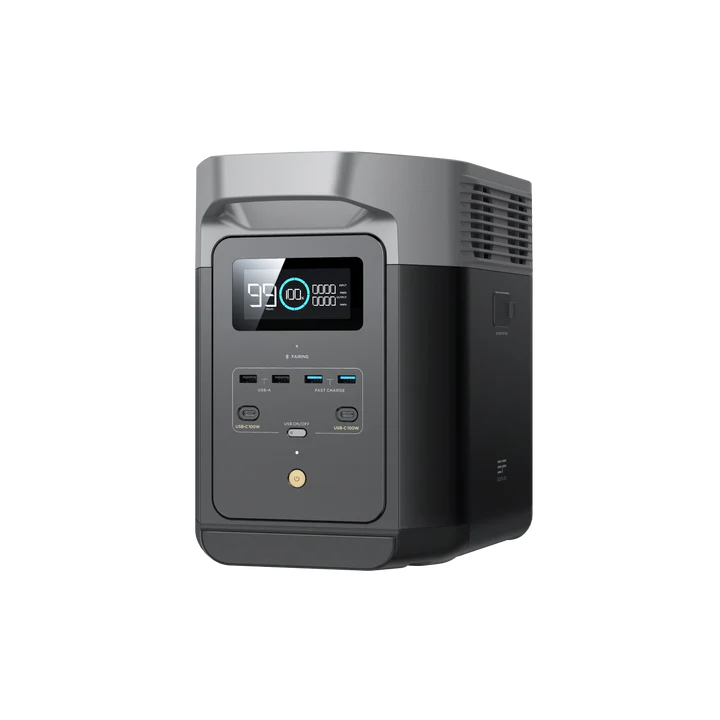
EcoFlow DELTA 2
No longer sold

Jackery HomePower 1000 Plus v2
$669.00
$669.00 · direct from Jackery
Last checked 16 days ago. Prices move — check before you buy.
Prices may vary by retailer and are subject to change.