Head-to-head test
DJI Power 1000 vs Goal Zero Yeti 3000X
Three times the capacity, more than four times the price, and the cheap box has the stronger inverter — so this is only a hard call if 870Wh doesn't get you through the night.
Full profiles: DJI Power 1000 → · Goal Zero Yeti 3000X →

Written by Gunner GustafsonUpdated
Whole-Home Backup Tester, Station Arena Test Desk

Superseded — buy the V2
DJI has superseded the Power 1000 with the Power 1000 V2 — same $699, with 2,600W output against 2,200W. The original may still be purchasable while stock lasts, but unless it is meaningfully discounted, buy the V2.
Power 1000 V2 · $699.00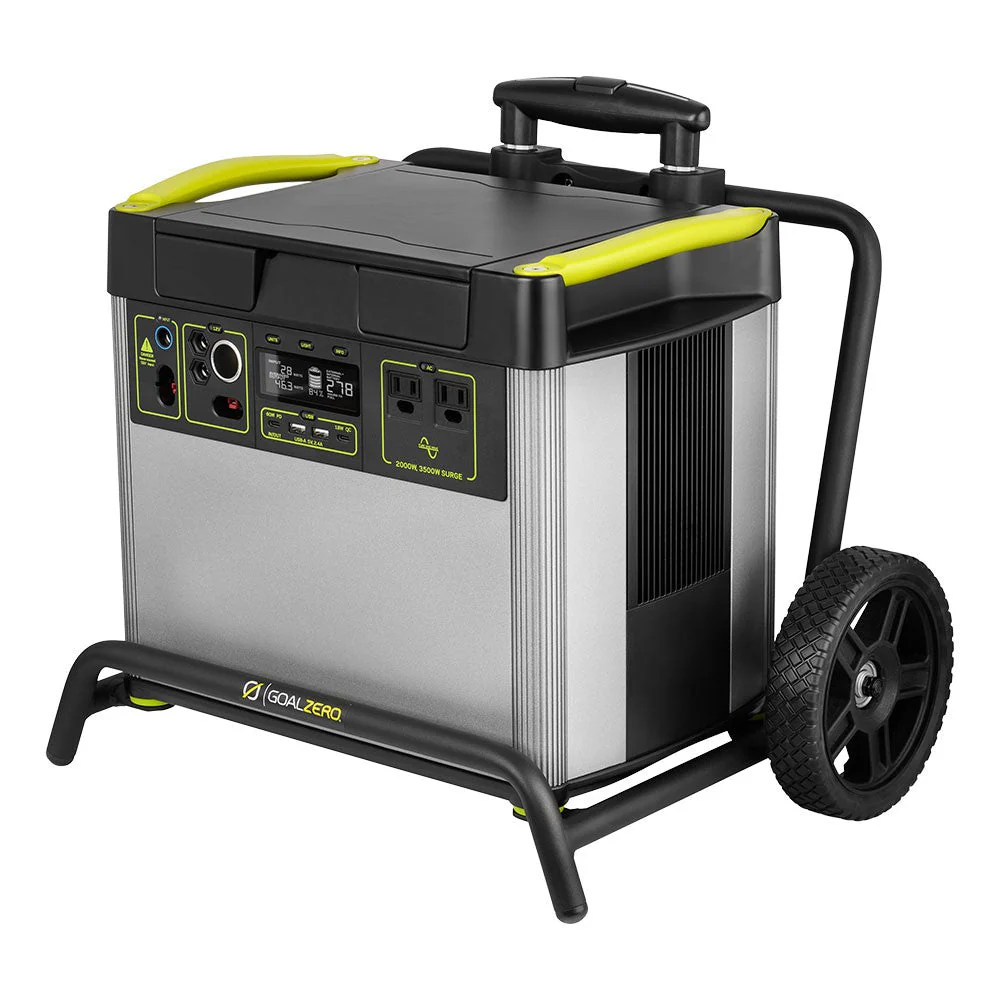
$2,999.95 · direct from Goal Zero
Last checked 1 day ago. Prices move — check before you buy.
Spec deltas
The Power 1000 costs $699 and holds 1,024Wh. The Yeti 3000X costs $3,000 and holds 3,032Wh. That's the entire case for the Yeti, and it's a real one: after inverter losses you're choosing between 870Wh and 2,577Wh of usable energy, and no amount of clever spec-reading turns the smaller number into the bigger one.
Everything else runs the other way. The $699 unit has the stronger inverter, 2,200W continuous against 2,000W and 4,400W of surge against 3,500W. It pushes 140W over USB-C where the Yeti manages 60W. It carries a five-year warranty against two, switches to battery in 20ms where the 3000X has no UPS mode at all, and weighs 28.7 lbs instead of 69.78. It's the better machine in every dimension except the one you're probably here for.
So run the gate before you run the comparison. If your longest session fits inside 870Wh, buy the Power 1000 and keep the difference. If it doesn't, the Power 1000 is out no matter how good it is, and the real question stops being which of these two and starts being whether a 500-cycle battery from an older generation is how you want to buy 3,032Wh. We don't think it is.
What the Numbers Reveal
Each conclusion stated first — the numbers behind it on one line, the full analysis below.
Capacity
Three Power 1000s cost $2,097 and stack to 3,072Wh, which is more stored energy than the Yeti holds for roughly $900 less. That's rarely a practical answer, because three boxes don't pool into one 2,000W outlet and you'd be running three cords. But it prices the thing you're actually paying Goal Zero for, and it isn't watt-hours. It's watt-hours behind a single plug.
Power 1000: $699 for 1,024Wh, so $699 divided by 1,024 is $0.68 per watt-hourYeti 3000X: $3,000 for 3,032Wh, so $0.99 per watt-hourThe Yeti adds 2,008Wh over the Power 1000 (3,032 minus 1,024) for $2,301 more ($3,000 minus $699)
Why it mattersIf you want capacity and don't need it unified, the 3000X is the expensive way to get it. If you need one box feeding one circuit, that premium is what you're buying, and you should know that's what it is.
continuous output
Compressors are what break inverters. A fridge, a chest freezer, a window AC all spike two to three times their running draw for the half-second they start, and that spike is what trips a unit, not the steady load afterward. So the extra $2,301 buys duration and only duration. The Yeti runs your fridge longer; the Power 1000 is the one more likely to start it, and it held 2,400W for twenty minutes without complainingA2.
Power 1000: 2,200W continuous, 4,400W surgeYeti 3000X: 2,000W continuous, 3,500W surgeOne test ran the Power 1000 at 2,400W, above its rating, for twenty minutes with no shutdownA2
Why it mattersIf your worry is whether it will start, the cheap one is the safer buy. Pay for the Yeti only if your worry is whether it will last the night.
AC charging on the Power 1000 runs about 70 minutes to full, roughly 50 to 80%A3, which changes what running dry means. In the rolling pattern most people actually get, off for two hours and back for three, the small unit refills between rounds and the desktop never reboots once. In a genuine all-night outage it's the wrong tool and the Yeti's capacity is the right one.
Power 1000: 20ms switchover to batteryYeti 3000X: no UPS mode and no switchover figureAn 8-hour blackout models at 1,645Wh, which is 189% of the DJI's 870Wh usable and 64% of the Yeti's 2,577Wh
Why it mattersBuy the DJI if your outages are short, frequent, and full of things you don't want restarting. Buy capacity if your outages are the eight-hour kind.
rated cycles
Cycled daily, 500 cyclesB1 comes to about 1.4 years before the Yeti is down to 80% capacity, which is shorter than the two-year warranty printed on the box. Used on weekends, twice a week, the same rating stretches to 4.8 years and the unit stops being disposable and becomes merely expensive. Same battery, two completely different products, and the only variable is you.
Power 1000 rated at 4,000 cycles; Yeti 3000X rated at 500 cycles to 80% capacityB1Lifetime throughput: 4,096 kWh for the Power 1000, 1,516 kWh for the YetiWarranty: five years on the DJI, two on the Yeti
Why it mattersWeekend user: the cycle gap is a footnote and you can ignore it. Daily cycler, whether that's a van, a cabin or a job site: the Yeti is a $3,000 consumable and you should not buy it.
The specific dimensions that decide these two units — everything else is a tie.
Your Life, Your Pick
Selected because: Four of the six loads we model need more than the 870Wh the Power 1000 can actually deliver, so start here: this section is the buy/don't-buy gate.
The Remote Workday is where this gets uncomfortable for the DJI. A day of laptop, monitor, phone and lights comes to 910Wh and the Power 1000 has 870Wh to give after inverter losses. It misses by 40 watt-hours. That's a rounding error on paper and a dark monitor at half past four in practice, which is why close enough isn't a category here.
Watch what the percentages are measured against. Every figure in this section is a share of usable capacity, nameplate times 0.85, not of the number printed on the case. The Yeti clears the weekend camp at 81% and the eight-hour blackout at 64% with real margin left over. The Power 1000 clears the CPAP night at 37% and the tailgate at 77%. Those are the two shapes of buyer this page gets, and they barely overlap.
Lifetime Value
Selected because: $699 across 4,000 rated cycles against $3,000 across 500 puts these two more than ten to one apart on cost per lifetime kilowatt-hour.
cost / lifetime kWh
Look at what a year of warranty coverage costs. The DJI spreads $699 across five years, or $140 a year. The Yeti spreads $3,000 across two, or $1,500 a year. You're paying more than ten times as much annually for the manufacturer to stand behind the thing.
Cycle them on weekends, twice a week, and the DJI's rating runs 38.5 years against the Yeti's 4.8. Nobody keeps a power station for 38 years, and that's exactly the finding: the DJI's battery will not be what retires it, and the Yeti's will. Spread across the calendar it's five cents a day of ownership against a dollar seventy-one.
What the Specs Don't Tell You
Selected because: The Power 1000 switches to battery in 20ms and the Yeti 3000X has no UPS mode at all, which outweighs any capacity number if you're protecting a desktop.
rated cycles
The UPS card is the one most people skim past. The Power 1000 hands off to battery in 20ms, fast enough that a desktop, a router or a CPAP never registers that the grid left. The Yeti 3000X has no UPS mode. It's a battery you plug into, not one that sits between the wall and your gear, so everything connected still goes dark at the moment of the cut. If the reason you started shopping is that your power flickers and your PC reboots, that single line settles this, and it settles it toward the cheaper unit.
The noise card cuts the other way, and gently. DJI publishes 23dB for the Power 1000; Goal Zero publishes nothing for the 3000X. An undisclosed number isn't a loud one, and a published number isn't a measured one. Neither figure came off our meter. Let it break a tie, don't let it make the decision.
Portability & Form Factor
Selected because: 28.7 lbs you carry with one hand. 69.78 lbs you wheel, and only to rooms without stairs between them.
weight
41 lbs separates these two, and it's the difference between an object you move and an object you site. The Power 1000 at 28.7 lbs goes into a trunk one-handed and up a flight of stairs without a plan. The Yeti at 69.78 lbs is a two-person lift or a wheeled one, and one reviewer calls the included roll cart essential to moving it at allB2.
That matters most in the two places these actually get used and nobody photographs: a basement during an outage, and the back of a vehicle. The DJI goes where you need it. The Yeti goes where you can roll it, which in a house with stairs means one floor.
Growth Path
Selected because: The Yeti can grow past 3,032Wh and the Power 1000 is sealed at 1,024Wh, so it's worth knowing what each of those actually costs you.
solar input
The Yeti's growth path is real, and the sealed Power 1000 has no answer to it. 1,024Wh is the ceiling, permanently. DJI does sell expandable models, but they're different SKUs in the line, not an accessory you add to this one. If you know your needs are climbing, that's the single best reason on this page to hesitate before buying the cheap unit.
Then look at what it grows into. Goal Zero's expansion runs on lead-acid Tank batteries, and one reviewer's account is unflattering: roughly half of what you bolt on is usable, and connecting it halves the onboard lithium as wellB4. The ceiling is genuinely higher than the Power 1000's. Getting there means paying twice for the privilege of throwing some of it away.
Strengths & trade-offs
DJI Power 1000
Strengths
- +Costs $2,301 less
- +Lighter by 41.1 lb
- +Higher AC output
- +Longer warranty
- +Faster solar charging
- +Rated for 4,000 charge cycles — much longer battery lifespan
Trade-offs
- –Sealed capacity — the Yeti 3000X can add batteries to grow past 1,024Wh; this one can't.
Goal Zero Yeti 3000X
Strengths
- +Larger battery capacity
Trade-offs
- –Substantially more expensive (+$2,301) than the Power 1000.
- –Significantly heavier (+41.1 lbs), making it harder to move.
- –Shorter-lived battery — rated for 500 charge cycles vs the Power 1000's 4,000, so it wears out sooner.
Will It Power Your Gear?
Scenario math and per-appliance runtimes, modeled from the spec record.
Scenario verdicts
We ran the math on six real-world scenarios. Here's which unit survives your actual life.
SCN-01 · 2 nights · needs 2,100Wh
Weekend Camping
Two nights off-grid with essential comfort
Yeti 3000X
Two nights of fridge, lights and devices adds up to 2,100Wh, and the Power 1000 has 870Wh of usable energy. It isn't close, and no amount of load management closes a gap that size. The Yeti finishes the weekend at 81% used with reserve still in the tank, which is precisely the job it exists for.
Battery budget usedlower = more headroom
LOAD Phone Charger 15W×6h · LED Lights 40W×8h · Box Fan 75W×14h · CPAP Machine 40W×16h
SCN-02 · 8 hours · needs 1,645Wh
8-Hour Blackout
Keep the essentials running through a night without power
Yeti 3000X
The Yeti takes this on duration: 1,645Wh against 2,577Wh usable leaves it at 64%, while the Power 1000 would need nearly twice what it holds. Worth naming what the DJI still does better here, though. It's the only one of the two that keeps a desktop alive at the moment the grid cuts. It just can't keep it alive all evening.
Battery budget usedlower = more headroom
LOAD Fridge 150W×8h · Router + Modem 20W×8h · LED Lights (4 bulbs) 40W×6h · Phone Charger 15W×3h
SCN-03 · 8 hours · needs 320Wh
CPAP Overnight
Sleep therapy without interruption — the #1 medical use case
Either unit
Both, easily. 320Wh is 37% of the Power 1000's usable energy and 12% of the Yeti's, so capacity isn't the question, and that's the whole point. Break the tie on the two specs that matter at 3 a.m.: the DJI weighs 28.7 lbs so it can live on the nightstand side of the room, and it's the only one that switches to battery fast enough that a grid blip doesn't wake the machine. Take the Power 1000.
Battery budget usedlower = more headroom
LOAD CPAP Machine 40W×8h
SCN-04 · 8 hours · needs 910Wh
Remote Workday
Full work day off-grid without power anxiety
Yeti 3000X
910Wh of laptop, monitor and phones against 870Wh of usable energy. The Power 1000 misses by 40 watt-hours, which is a rounding error that still ends with a dark screen before the day does. The Yeti covers the same day at 35% and never thinks about it.
Battery budget usedlower = more headroom
LOAD Laptop 60W×8h · External Monitor 30W×8h · Router + Modem 20W×8h · Phone Charger 15W×2h
SCN-05 · 4 hours · needs 670Wh
Tailgate Party
Game day power for the crew
Yeti 3000X
The Yeti wins on reserve: 670Wh is 26% of what it holds against 77% of the Power 1000's. Both finish the game, the Yeti just finishes it barely touched. Whether that leftover margin is worth wheeling 69.78 lbs across a parking lot is the actual question in front of you.
Battery budget usedlower = more headroom
LOAD Blender 400W×0.5h · LED TV (55") 80W×4h · Bluetooth Speaker 15W×4h · Phone Charger (×3) 45W×2h
SCN-06 · 24 hours · needs 4,685Wh
Van Life Daily
A full day of mobile living — the ultimate endurance test
Neither unit
Neither. A full day of van living models at 4,685Wh, which is 182% of the Yeti's usable capacity and more than five times the Power 1000's. This is the load where portable power stations stop being the answer and a properly installed 12V house bank with alternator charging starts being it.
Battery budget usedlower = more headroom
LOAD Mini-Fridge 150W×24h · Laptop 60W×4h · Phone Charger 15W×3h · LED Lights 40W×5h · Fan 75W×8h
The Load Test
RUNTIME = (Wh × 0.85) ÷ LOAD
None of the scenarios above exactly yours? Build it. Toggle what you'd plug in; both units are tested against the combined draw.
Essentials
Comfort & Convenience
High-Draw Appliances
Test duration
8h
Continuous draw
205W
Projected runtime
For this load: Yeti 3000X runs 12.6h vs 4.2h.
$2,999.95 list · direct from Goal Zero
Modeled from the spec record — same math as the tables below. Methodology
Runtime by appliance
Real-world runtime estimates for common appliances, modeled at 85% inverter efficiency.¹
Essentials
The basics you need runningscale 0–171.8hComfort & Convenience
Makes off-grid life actually enjoyablescale 0–34.4hHigh-Draw Appliances
These reveal the real limitsscale 0–2.6h¹ Runtime = (capacity × 0.85) ÷ appliance watts. Within each group, all bars share one time scale (the group's longest runtime), so lengths are comparable across appliances; identical runtimes collapse into a single blue/orange bar. Actual runtime varies with battery age, temperature, and simultaneous loads — see methodology.
Conclusion
August 9, 2026
Verdict: the Power 1000
Take the Power 1000 unless your longest single session needs more than 870Wh, and check that before anything else on this page. Below that line it wins on everything that isn't capacity: 2,200W continuous and 4,400W surge against the Yeti's 2,000W and 3,500W, 140W USB-C against 60W, five years of warranty against two, a 20ms switchover the 3000X doesn't have at all, and 28.7 lbs against 69.78. Above that line the Power 1000 is simply disqualified. But the Yeti 3000X isn't automatically the answer either, because $3,000 buys a 500-cycle NMC packB1 that reaches 80% capacity inside its own warranty under daily use. Weekend-cadence buyers who need 3,032Wh behind one outlet and already own Goal Zero gear have a case. Everyone else should buy the DJI, or buy a current-generation battery in the size they actually need.
Editor-assigned confidence, based on cited owner research and spec analysis.
List prices as of August 9, 2026. The links below open DJI's and Goal Zero's current prices.
$699.00 · direct from DJI
Last checked 1 day ago. Prices move — check before you buy.
or check the Yeti 3000X price$2,999.95 list
Written by Gunner Gustafson, Whole-Home Backup Tester · Station Arena Test Desk · Updated August 9, 2026
Measured Data
Benchmark scores and the full spec record, side by side.
Benchmark scores
Not rated for both units (minimum threshold unmet): UPS, CPAP, Camping.
Full specifications
ᵈ Derived: price ÷ rated capacity. See the data behind our comparisons →
Comparison ToolAdd more power stations, side by sideOpen Tool →How these numbers are produced
Numeric verification
Every figure on this page traces to our spec database or arithmetic on it — no estimated numbers.
Owner claims
Statements about owner experience are cited to published reviews — see Sources & Research Notes below.
Runtime model
Runtime = (rated capacity × 0.85 inverter efficiency) ÷ device wattage. Solar recharge estimates assume panels deliver 70% of rated output. Cold weather, battery age, and stacked loads reduce real-world results.
Power Score
Computed from 14 published spec dimensions, weighted per use-case bench. Higher is better; a unit must meet a bench's minimum threshold to be rated.
See the full weight table and data sourcing on our methodology page →Class ranking (the star rating)
Each unit's star score is a category ranking, not customer reviews — no buyer opinions feed it. We score every station on size-independent quality (value, output, portability, endurance, ports, warranty, and more), then percentile-rank it against the other units in its capacity class, so a class-leading compact unit and a class-leading whole-home unit can both earn 5★. Here, Power 1000 rates 3.8/5 (31st percentile of 27 Everyday-class units), and Yeti 3000X rates 3.3/5 (1st percentile of 26 Large-class units).
How the class ranking is computed →Test Notes & Caveats
Hidden gotchas and advantages we spotted that you won't find on the product page.
Yeti 3000X: 69.8 lbs Is a Commitment
At 69.8 lbs, this is manageable but not fun to move. That's heavier than a large checked suitcase. How much it costs you depends on whether it rolls — wheels and a telescoping handle change the job completely at this weight, and our spec record doesn't track them, so look at the product photos before you plan on carrying it from the car.
The Power 1000 Is Sealed, and That's a Real Cost
1,024Wh is the ceiling, and it's permanent. There's no expansion battery for this model, so size it for your worst night up front rather than planning to add capacity later. The Yeti's ability to grow past 3,032Wh is a genuine advantage the cheaper unit simply cannot answer. Just look closely at what Goal Zero's expansion actually adds before you count on it.
Only One of These Catches the Outage
The Power 1000 hands off to battery in 20ms, quick enough that a desktop, a router or a CPAP never registers that the grid left. The Yeti 3000X has no UPS mode at all. It's a battery you plug into, not one that sits between the wall and your gear, so anything connected still goes dark at the moment of the cut and comes back only when you plug it in again. If flickering power is why you started shopping, this card is the comparison.
Warranty: 5 Years vs 2
The Power 1000 is covered for 5 years against the Yeti 3000X's 2 years. The Power 1000's figure is a maximum rather than a guarantee — it depends on buying from DJI's own store, which is where the full five years is advertised. An underrated factor if you're keeping this unit for years.
500 Cycles Against 4,000
Cycled daily, the Yeti's 500-cycle rating works out to about 1.4 years before it's down to 80% capacity, which is shorter than the two-year warranty that came with it. At weekend cadence it stretches to 4.8 years, a different product entirely. Both figures are manufacturer ratings rather than anything measured, and DJI's 4,000 is the optimistic end of what it claims, so read the gap as a direction rather than a promise.
One Published Number, One Blank
DJI lists 23dB for the Power 1000. Goal Zero lists nothing for the 3000X, and an undisclosed number means unknown, not loud. Neither figure came off our own meter, so this belongs in the tiebreak column: useful for choosing between two units you'd be happy with either way, not for picking one over the other.
Full record above — the Test Desk pick is the Power 1000.
Check Power 1000 price →or check the Yeti 3000X priceOwnership Analysis
What happens after you buy — true cost of ownership, brand trust, and growth potential.
Lifetime value
Service lifeyears at one full cycle per day
Lifetime energy delivered
Cost per delivered kWh
│ warranty ends · Reaching the cycle rating means ~80% capacity remains — degraded, not dead.
Analyst note
The Power 1000 wins on both sticker price and long-term value. At $0.17/kWh over its lifetime, it's meaningfully cheaper to own. Clear value winner.
Delivers each lifetime kWh for $1.81 less — check the Power 1000 price →
Brand trust
DJI
Ecosystem
Four power stations, all of them since 2024, in a lineup that's still moving fast. DJI's current range lists a Power 1000 V2 rather than this unit, which is worth knowing if buying the current revision matters to you.
Support
The repair and support network came ready-made from the drone business, which is a real asset most new entrants don't have. What's missing is a power-station-specific track record. The reputation here is inherited, not yet earned in this category.
Community
There's no power station community to speak of. Questions land in r/dji, roughly a quarter-million people talking mostly about drones, so expect to solve problems through DJI support rather than a forum thread.
App experience
Rated 3.5/5 iOS and Android (DJI Home app ratings reflect entire DJI ecosystem including drones/cameras, not power-station-specific). Users report the on-device screen is more reliable than the app.
Unique strength
Quiet operation is the line's signature, 23 to 30dB published across the range, backed by 700-plus battery patents out of drone R&D. If you already own DJI gear, the SDC ports charge drone batteries faster than anything else will.
Worth knowing
There's no built-in solar charge controller. The 800W solar rating needs a separate proprietary adapter, so treat solar input as an accessory purchase rather than a spec you already own. Expansion exists on the Power 2000 and the 1000 V2, not on this unit.
Goal Zero
Ecosystem
Tight and coherent: five or six power stations plus Alta coolers, Nomad and Ranger panels, and vehicle integration kits that genuinely work together. If you're already inside it, that counts for something real.
Support
US-based in Salt Lake City, owned by NRG Energy. Premium support was historically the thing that justified premium pricing, and recent service experience has slipped from that standard, with long waits and tickets that sit. Buy this on the hardware, not on the service story.
Community
Small and loyal, strongest in overlanding and preparedness circles. The official forums were shuttered recently, which scattered a lot of accumulated knowledge into unofficial groups.
App experience
Rated 4.4/5 iOS (~1,200 ratings) but recent reviews skew negative — recurring connectivity issues, crashes, and stability problems.
Unique strength
Goal Zero invented this category and still builds like it, with IPX4 weather resistance and construction meant to live in a truck bed. The Yeti-Ready ecosystem is the most integrated thing in portable power.
Worth knowing
Goal Zero is the most expensive brand per watt-hour in the category, and the 3000X is an older Li-ion NMC design rather than LFP. You're paying a heritage premium on last-generation chemistry.
Analyst note
One brand has the track record and the ecosystem, the other has the newer engineering and the warranty. Goal Zero's difficulty is that its premium was always partly a support premium, and support is the part that's slipped. DJI's difficulty is that nobody yet knows how its power stations age. Five years of warranty against two is DJI putting money where that uncertainty sits.
Growth path
Power 1000
FIXED CAPACITYFixed at 1,024Wh, with no expansion — so size it for your needs up front rather than planning to add capacity later.
Accepts up to 800W of solar. Suitable for a 1-2 panel setup.
Adequate ports for most setups, but heavy users may want a power strip.
Yeti 3000X
EXPANDABLESupports Goal Zero expansion batteries, so you can add capacity later without replacing the base unit — useful if your needs may climb past 3,032Wh.
Accepts up to 600W of solar. Suitable for a 1-2 panel setup.
Adequate ports for most setups, but heavy users may want a power strip.
Expansion batteries are Goal Zero-specific. You're investing in the Goal Zero ecosystem.
Realistic full solar rechargeat 70% of rated panel output — see methodology
Analyst note
The Power 1000 is sealed at 1,024Wh, which is fine if that covers you. The Yeti 3000X starts at 3,032Wh and can grow beyond it with Goal Zero expansion batteries — real headroom the Power 1000 doesn't have if your needs climb toward partial-home backup.
What Owners Report
Patterns from published owner reports and long-term reviews — every claim cited to its source below.
DJI Power 1000
The field material on the Power 1000 is review coverage rather than years of ownership, because DJI arrived in power stations recently and the sentiment we have is directionalA1A4. What's there is consistent, though. One test ran it at 2,400W, above its 2,200W rating, for twenty minutes with no shutdown and no alarmA2. AC charging comes in around 70 minutes to full, about 50 minutes to 80%, with the fan barely audible while it does itA3.
The pattern that keeps recurring is a week of camping: a 45W compressor fridge, phones, laptops, LED lights, plus drone pilots who like fast-charging DJI batteries while the unit runs everything elseA4. Reviewers describe it as near-silent under normal loads, only becoming noticeable past 1,500W, and even then as a soft whooshA1. That's a narrower evidence base than we'd like behind a five-year warranty, and it's worth saying out loud.
“Whisper-quiet operation — one of the quietest power stations in its class, nearly silent under normal loads; sound only becomes noticeable past 1,500W, and even then it's a soft whoosh rather than the high-pitched whirring you'd get from BLUETTI or EcoFlow.”
Sources
thesolarlab.com · trailandkale.com · offgridbenchmark.com · superfashion.us · dronexl.co
Goal Zero Yeti 3000X
The recurring complaint about the Yeti 3000X is its chemistry, not its build. It's Li-ion NMC rated for 500 cycles to 80% capacity, where LiFePO4 units are rated past 3,000B1. Weight is the second theme: roughly 70 pounds, with the included roll cart described as essential rather than optionalB2. The headline specs do check out against our listing, at 3,032Wh with a 2,000W inverter and 3,500W surgeB3.
Expansion is where the coverage turns sharpest. The Tank system uses lead-acid batteries that allow only about 50% usable capacity, and connecting one halves the lithium capacity already in the unitB4. Nobody disputes that the 3000X holds a lot of energy. The criticism is about how long it holds it and what it costs to add more.
“A roughly 70-pound unit that comes with a roll cart, essential to move it around.”
Sources
poweredportablesolar.com · bestgeneratorsolar.com · shopsolarkits.com · rei.com · goalzero.com · protoolreviews.com
Sources & Research Notes
Every owner claim in this report is traceable to a published source. The bracketed references above resolve here.
Recurring owner themes
- Standout quiet operation (quieter than EcoFlow/BLUETTI), robust real-world output above its rating, and appeal to drone pilots and campers are the consistent themes. [Power 1000 · 3 entries]
- Large NMC capacity but a crippling 500-cycle rating, heavy weight (roll cart needed), and a limited lead-acid expansion path are the recurring points. [Yeti 3000X · 3 entries]
- A1
“Whisper-quiet operation — one of the quietest power stations in its class, nearly silent under normal loads; sound only becomes noticeable past 1,500W, and even then it's a soft whoosh rather than the high-pitched whirring you'd get from BLUETTI or EcoFlow.”
thesolarlab.com / trailandkale.com — DJI Power 1000 review · 2026 · [positive]
- A2
“Tested at 2,400W — slightly above its 2,200W output rating — for 20 minutes and handled it without loud noise or automatic shut-offs.”
offgridbenchmark.com / superfashion.us — DJI Power 1000 review · 2026 · [positive]
- A3
“AC charging takes about 70 minutes from 0% to 100% (about 50 minutes to 80%), and during full-speed charging the fan barely makes a sound.”
thesolarlab.com — DJI Power 1000 review · 2026 · [positive]
- A4
“Over a week-long camping trip it powered a 45W compressor fridge, phones, laptops, and LED lights; it's also a favorite of drone pilots for fast-charging DJI batteries while running other devices.”
offgridbenchmark.com / dronexl.co — DJI Power 1000 review · 2026 · [positive]
- B1
“Its biggest drawback is the Li-ion NMC battery rated for only 500 cycles to 80% capacity, where LiFePO4 power stations last 3,000+ cycles.”
poweredportablesolar.com / bestgeneratorsolar.com — Yeti 3000X review · 2026 · [negative]
- B2
“A roughly 70-pound unit that comes with a roll cart, essential to move it around.”
shopsolarkits.com / rei.com — Yeti 3000X review · 2026 · [mixed]
- B3
“3,032Wh capacity with a 2,000W continuous inverter and 3,500W surge.”
goalzero.com / protoolreviews.com — Yeti 3000X specifications · 2026 · [positive]
- B4
“Expandable via the Goal Zero Tank system, but the Tank uses lead-acid batteries that allow only ~50% usable capacity and halve the onboard lithium capacity when connected — a limited expansion path.”
poweredportablesolar.com — Yeti 3000X / Tank review · 2026 · [negative]
Research compiled August 9, 2026.
Who Should Buy Which
Buy the Power 1000 if you…
- →Your house flickers and you're tired of the desktop rebooting mid-document. The 20ms switchover means the router, the modem and the PC never notice, and a 320Wh CPAP night is 37% of what this unit can deliver.
- →You camp with a fridge and a pile of phones rather than an induction cooktop. 28.7 lbs goes in the trunk alongside the cooler, and a roughly 70-minute wall chargeA3 means you top it up over lunch somewhere with an outlet.
- →You already fly DJI. Fast-charging drone batteries off the same box while it runs your laptop is the one ecosystem argument on this page that actually pays outA4.
- →You want the cheapest route to a battery that's still working in a decade. $699 with five years of warranty works out to $140 per covered year.
This is you — check the Power 1000 price
Buy the Yeti 3000X if you…
- →You need 2,000Wh or more behind a single outlet a handful of times a year, and it lives in a garage or a truck bed where 69.78 lbs never has to go upstairs.
- →You're already inside the Goal Zero ecosystem, with Yeti-Ready coolers, vehicle kits and Nomad panels, and one more piece that talks to the rest is worth real money to you.
- →Your use is seasonal, not daily. At weekend cadence the 500-cycle ratingB1 stretches to 4.8 years, which is a genuinely different product from the same box cycled every night.
If neither fits
If you're running a van or a full-time off-grid setup, close this tab: that load models at 4,685Wh a day, which is 182% of even the Yeti's usable capacity, and you want a properly installed 12V house bank with alternator charging instead of any portable box. And if you need roughly 3,000Wh but you'll cycle it more than a couple of times a week, buy a current-generation LFP unit in that size class. The capacity is right, the 500-cycle chemistryB1 isn't, and at $3,000 you shouldn't have to choose between the two.
The Bottom Line
Buy the Power 1000 unless 870Wh of usable energy won't cover your longest session. It's the stronger inverter, the lighter box, the longer warranty, and the only one of the two that catches a blackout without dropping the load, at $699. The Yeti 3000X wins the capacity argument and loses every other one on the page.
If you do need the capacity, be clear-eyed about what the Yeti's version costs: a pack rated for 500 cyclesB1 that hits 80% inside its own two-year warranty under daily use, bought at the wrong end of a more-than-ten-to-one gap in lifetime energy cost. That's not automatically an argument for the smaller unit. It's an argument for looking past both of these at a current-generation battery in the size you actually need. The good news is the gate is cheap to check: add up your longest night, and if it lands under 870 watt-hours, this was a $699 decision all along.
Frequently Asked Questions
Answers drawn from the spec record and cited owner research.
Can the DJI Power 1000 actually run a fridge?
Starting one, comfortably. 2,200W continuous and 4,400W of surge is more headroom than the Yeti 3000X's 2,000W and 3,500W, and compressors need that headroom in the half-second they start, not while they run. The limit is duration rather than capability: 870Wh usable is what you have to spend. Reviewers ran a 45W compressor fridge alongside phones, laptops and lights across a week of camping.
Does the Goal Zero Yeti 3000X work as a UPS for my computer?
No. The 3000X has no UPS mode, so treat it as a battery you plug into rather than one that stands between the wall and your desk. When the grid drops, everything connected drops with it. The Power 1000 switches over in 20ms, fast enough that a desktop doesn't notice, so if UPS behaviour is why you're shopping this comparison is already over.
Is the Yeti 3000X worth more than four times the price for three times the capacity?
Only if you need that energy behind one outlet. The 2,008Wh it adds over the Power 1000 costs $2,301, which is about $1.15 per added watt-hour, more than the Yeti's own $0.99 blended rate and nearly double the DJI's $0.68. You're not paying for watt-hours at that point. You're paying to have all of them on one plug, and that's a real thing to want, just an expensive one.
How long does the Yeti 3000X battery actually last?
500 charge cycles to 80% capacity is the rating. Cycled every day that's about 1.4 years; used on weekends it's 4.8 years. The Power 1000 is rated at 4,000 cycles, so the two units end up in different categories of lifespan despite sitting in the same shopping cart. Match the number to how often you'll actually drain it.
Which one is quieter?
Probably the DJI, but don't buy on it. DJI publishes 23dB, and reviewers describe the unit as near-silent below about 1,500W, including at full charging speed. Goal Zero publishes no figure at all for the 3000X, which means unknown rather than bad. Neither number is a measurement we took, so use noise to break a tie, not to pick a winner.
Check Power 1000 price →
Brand matchup
DJI vs Goal Zero: measured across every matchup →Where to buy
DJI Power 1000Pick
$699.00
$699.00 · direct from DJI
Last checked 1 day ago. Prices move — check before you buy.
Goal Zero Yeti 3000X
$2,999.95
$2,999.95 · direct from Goal Zero
Last checked 1 day ago. Prices move — check before you buy.
Prices may vary by retailer and are subject to change.