Head-to-head test
BLUETTI Pioneer Na vs Goal Zero Yeti 700
Both land near a dollar a watt-hour, so price isn't the axis here. The question is whether your load list needs a 1,500W outlet or your back needs the 19.3-pound box.
Full profiles: BLUETTI Pioneer Na → · Goal Zero Yeti 700 →

Written by Ian SchneiderUpdated
Solar & Off-Grid Tester, Station Arena Test Desk

$899.00 · direct from BLUETTI
Last checked 1 day ago. Prices move — check before you buy.
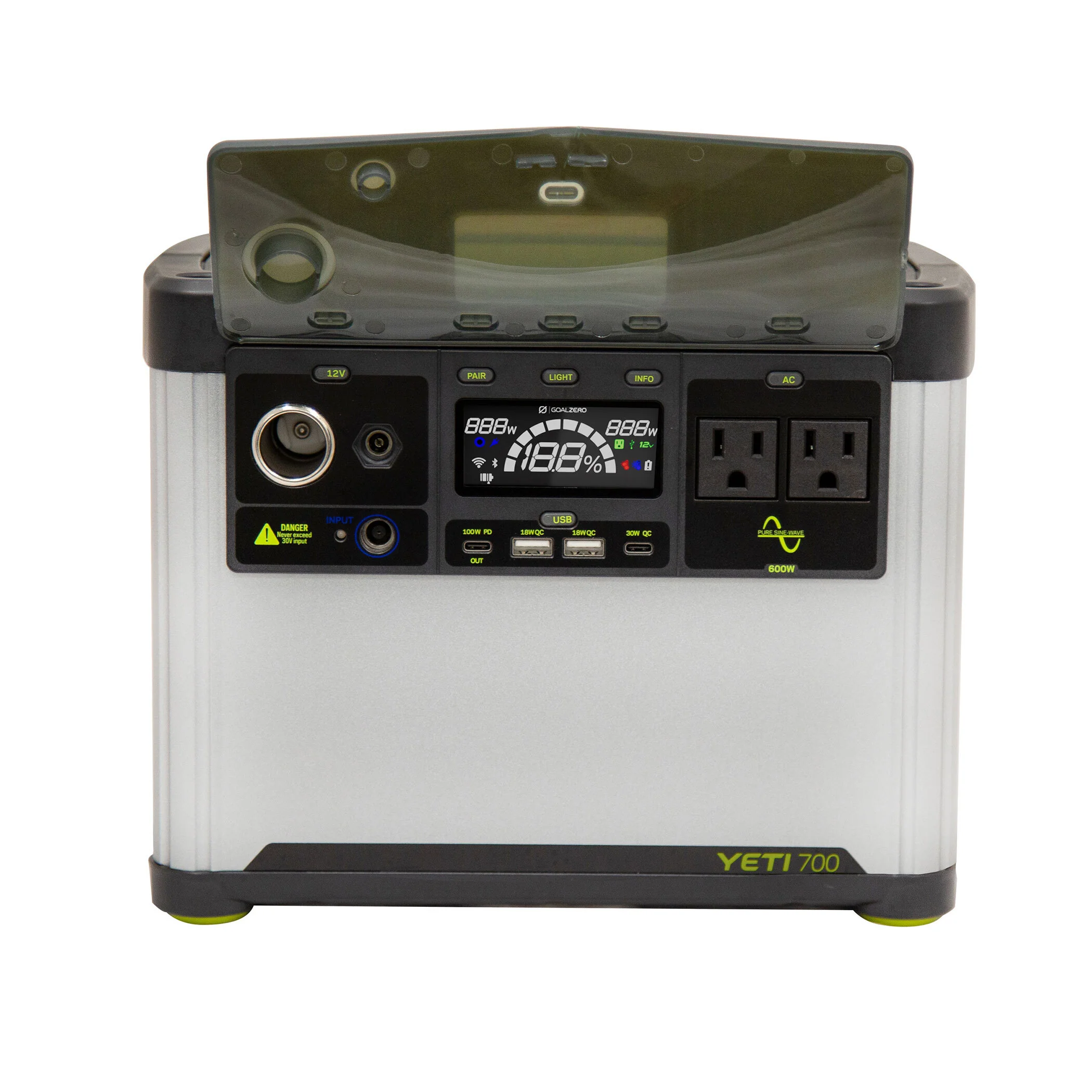
$699.95 · direct from Goal Zero
Last checked 1 day ago. Prices move — check before you buy.
Spec deltas
The Pioneer Na costs $199 more and gives you a 1,500W outlet instead of a 600W one. That's the trade in a sentence, and it's the reason to buy it, because on the money-per-energy axis these two are the same box. A dollar a watt-hour for the BLUETTI, three cents more for the Goal Zero. You aren't paying a premium for the bigger unit. You're buying more of it at the same rate.
What the extra capacity does not buy is a scenario win. Run both against the six load profiles on this page and they fail the same four: weekend camping, an eight-hour blackout, a remote workday, van life. Both cover a CPAP night with room left. The 223Wh separating them flips exactly one line on the board, the tailgate. If you're buying the Pioneer Na for runtime, you should be buying something bigger instead.
So the case for the BLUETTI is what it can start and how fast it refills, not how long it lasts. 2,250W of surge against 1,000W. 500W of solar input against 200W. Sodium-ion cells that charge and discharge in cold deep enough to stop lithium, and did it in real-world testing rather than a spec sheetA2. The case for the Yeti is shorter and just as legitimate: 19.3 pounds, $700, five years of warranty, and the honest fact that if your list is a laptop, a phone and a CPAP, it does that job exactly as well as the box weighing almost twice as much.
What the Numbers Reveal
Each conclusion stated first — the numbers behind it on one line, the full analysis below.
continuous output
Which means the money is buying the outlet, not the hours. Reviewers put the Pioneer Na on fridges, routers, laptops and power toolsA1; the Yeti's own coverage frames it as a light, simple, quick-trip charger that is explicitly not the most powerful or capable unit aroundB3. You're choosing between two batteries that run out at roughly the same time and two inverters that are 900W apart.
Pioneer Na 900Wh against Yeti 700 677Wh, a 223Wh gapOf six load profiles, both units fall short on four (weekend camping 2,100Wh, 8-hour blackout 1,645Wh, remote workday 910Wh, van life 4,685Wh) and both cover the 320Wh CPAP nightTailgate Party at 670Wh is the only profile either one wins: 88% of what the Pioneer Na delivers against 116% of what the Yeti does1,500W continuous and 2,250W surge against 600W and 1,000W
Why it mattersIf your load list tops out at a laptop, a phone and a CPAP, the extra $199 buys nothing you'll ever use. If a compressor or a motor is on the list, the Yeti isn't in the running.
Cost / Wh
So the Yeti's genuine advantage isn't financial at all. It's 17.7 pounds. That's the difference between a unit you carry from the car in one hand and one you set down where it's going and leave there. Goal Zero isn't selling cheaper energy. It's selling less of it, in a package you'll actually pick up.
$1.00 per Wh for the Pioneer Na against $1.03 for the Yeti 700Both packs rated 4,000 cyclesA3B1, putting lifetime energy at 25 cents a kilowatt-hour against 26 cents37 lb against 19.3 lb
Why it mattersAnyone deciding this on price is reading the wrong column. Decide on weight and outlet size; the dollars per watt-hour come out the same either way.
solar input
900Wh at 500W is about two hours of strong sun. 677Wh at 200W is about three and a half. The bigger battery is also the quicker one to fill: a third more energy in a bit over half the time, which inverts what everyone assumes about small units being the nimble ones. Testers also clock the Pioneer Na at 80% in roughly 35 minutes on AC and solarA3.
The 8-hour blackout list wants 1,645Wh; the Pioneer Na holds 900Wh and the Yeti holds 677Wh500W solar input against 200WNeither unit expands, so the capacity you buy is the ceiling
Why it mattersIf you're buying for outages rather than outings, the 500W input matters more than the 223Wh, and it's the Pioneer Na's most underrated number.
Everything else on this page is more or less of the same thing: more watts, more solar, more pounds. Cold isn't like that. In a freezing garage one of these takes a charge and the other waits for the weatherA2, and no amount of ruggedness on the outside changes what's happening in the cells.
The Pioneer Na is the first sodium-ion portable power stationA1, with chemistry that charges and discharges in deep sub-freezing cold lithium can't match, confirmed in real-world testingA2The Yeti 700 runs LiFePO4 as part of Goal Zero's 6th-generation familyB1B4The Yeti's cold-weather credential is an IPX4 rating and a rugged outdoor buildB2
Why it mattersWinter cabin, ice fishing, an unheated garage in February. If the unit lives somewhere that freezes, this is the entire comparison and the rest of the page is a footnote.
The specific dimensions that decide these two units — everything else is a tie.
Your Life, Your Pick
Selected because: Both units clear a 320Wh CPAP night and both fall short of weekend camping, an 8-hour blackout, a remote workday and van life, so the board turns on one load: the 670Wh tailgate.
Four of the six profiles beat both of these units, which is the most useful thing this board says. Weekend camping wants 2,100Wh. Van life wants 4,685Wh. You aren't buying either of those nights with a 900Wh box, and choosing correctly between these two doesn't change it.
What's left is the narrow band where they differ, and the 670Wh tailgate is the whole of it: 88% of what the Pioneer Na actually delivers against 116% of what the Yeti does. The Yeti's 677Wh label reads like it clears that load. It doesn't, once you count what a pack gives you under load rather than what's printed on the lid. That gap between label and delivery is the best argument on this page against shopping by capacity alone.
Portability & Form Factor
Selected because: 37 lb against 19.3 lb is the Goal Zero's real argument, and it's a better one than its price.
weight
The Pioneer Na weighs almost twice what the Yeti does, 37 pounds against 19.3. Those aren't two versions of the same carry. 19.3 pounds is one hand from the tailgate to the picnic table. 37 pounds is two hands, and you'll put it down where it's going to live and leave it there.
That sounds minor and it decides more purchases than the spec sheet suggests. The Yeti's coverage describes it as lightweight and simple and aimed squarely at people who prioritize carrying itB3, while the Pioneer Na's own reviews flag bulk for the capacity as its main trade-off alongside a modest 900WhA4. If the unit moves more often than it works, buy the 19.3 pounds and stop reading.
Lifetime Value
Selected because: $1.00 per watt-hour against $1.03: the $199 gap is a size difference, not a discount.
cost / lifetime kWh
A dollar a watt-hour buys the same energy from either company. Both packs carry a 4,000-cycle ratingA3B1, which lands lifetime energy at 25 cents a kilowatt-hour for the Pioneer Na and 26 for the Yeti. Close enough that you should stop treating this as a price comparison. What the extra $199 buys is 892 more lifetime kilowatt-hours, at the same rate you paid for the first 2,708.
The one place the money genuinely diverges is coverage. Three years on the BLUETTI against five on the Goal Zero works out to $300 a warranty year versus $140. That's a real gap and the clearest number here arguing for the Yeti.
What the Specs Don't Tell You
Selected because: One unit publishes 45 dB under load and charges below freezing; the other publishes no noise figure at all but carries two more years of warranty.
Only one of the four cards is flagged as a warning, and it's about a number that doesn't exist. Goal Zero publishes no noise rating for the Yeti 700. BLUETTI publishes 45 dB under load for the Pioneer Na. Neither figure tells you which unit is quieter. What they tell you is which one you can evaluate before you pay, and if this is going next to a bed, that's the whole difference.
The card cutting against our pick is the warranty: five years from Goal Zero against three from BLUETTI, with no reframe available that makes it go away. The card cutting the other way is chemistry. Sub-freezing charging is the only spec here that's binary rather than a matter of degree, and it belongs to the Pioneer Na.
Brand Trust
Selected because: A five-year warranty is only worth the service desk behind it, and both of these desks have problems.
A five-year warranty is a promise, and a promise needs somebody to answer the email. Goal Zero is US-based out of Salt Lake City with the deepest heritage in this category, and its support has slid: long waits, unanswered email, tickets sitting for weeks, and the official community forums shuttered. The extra two years are still worth having. Just don't price them as if they were the old Goal Zero's two years.
BLUETTI's service is no better and arguably worse, the most inconsistent in the space, email-driven across a China time-zone gap, with troubleshooting runarounds and offers of a discount on a new unit in place of a repair. One practical hedge: buying direct from BLUETTI produces better outcomes than a third-party order. Neither company's support desk is a reason to choose it here, so pick on the hardware and buy from the manufacturer either way.
Strengths & trade-offs
BLUETTI Pioneer Na
Strengths
- +Larger battery capacity
- +Higher AC output
- +Faster solar charging
Trade-offs
- –Significantly heavier (+16.7 lbs), making it harder to move.
Goal Zero Yeti 700
Strengths
- +Costs $199 less
- +Lighter by 16.7 lb
- +Longer warranty
Trade-offs
- –Weaker inverter (-900W) limits appliance compatibility.
Will It Power Your Gear?
Scenario math and per-appliance runtimes, modeled from the spec record.
Scenario verdicts
We ran the math on six real-world scenarios. Here's which unit survives your actual life.
SCN-01 · 2 nights · needs 2,100Wh
Weekend Camping
Two nights off-grid with essential comfort
Neither unit
A full weekend's list runs 2,100Wh and the larger of these two holds 900. This isn't close for either one, and it's the clearest signal on the page that if camping is why you're shopping, you're shopping a size too small. Both will get you a night. Neither gets you a weekend.
Battery budget usedlower = more headroom
LOAD Phone Charger 15W×6h · LED Lights 40W×8h · Box Fan 75W×14h · CPAP Machine 40W×16h
SCN-02 · 8 hours · needs 1,645Wh
8-Hour Blackout
Keep the essentials running through a night without power
Neither unit
Eight hours of essentials wants 1,645Wh. The Pioneer Na brings 900Wh and the Yeti brings 677Wh, so this is a shortfall for both and the only real question is whether you shorten the list or refill mid-outage. That's where 500W of solar input against 200W earns the price gap: two hours of good sun puts the Pioneer Na back at full while the Yeti is still filling. Neither of these is a whole-house answer. They're a fridge-and-phones answer.
Battery budget usedlower = more headroom
LOAD Fridge 150W×8h · Router + Modem 20W×8h · LED Lights (4 bulbs) 40W×6h · Phone Charger 15W×3h
SCN-03 · 8 hours · needs 320Wh
CPAP Overnight
Sleep therapy without interruption — the #1 medical use case
Either unit
Both of these coast through a 320Wh CPAP night, so this is the load neither unit has to think about. Break the tie on what you'll actually notice at 3 a.m. instead: BLUETTI publishes 45 dB under load for the Pioneer Na and Goal Zero publishes no figure at all for the Yeti 700. Capacity isn't the spec here. Sound is, and only one of them will tell you in advance what it sounds like.
Battery budget usedlower = more headroom
LOAD CPAP Machine 40W×8h
SCN-04 · 8 hours · needs 910Wh
Remote Workday
Full work day off-grid without power anxiety
Neither unit
Neither one finishes the day, and the Pioneer Na misses by inches: 910Wh wanted against 900Wh on the lid. Plan on a top-up either way. With 500W of solar input against 200W, a sunny lunch break is a meaningful refill for the Pioneer Na and a trickle for the Yeti.
Battery budget usedlower = more headroom
LOAD Laptop 60W×8h · External Monitor 30W×8h · Router + Modem 20W×8h · Phone Charger 15W×2h
SCN-05 · 4 hours · needs 670Wh
Tailgate Party
Game day power for the crew
Pioneer Na
The one load on this board that separates them, and it separates them by less than the labels suggest. 670Wh wanted, 677Wh printed on the Yeti, and it still comes up short once you count what a pack delivers under load rather than what's on the lid. The Pioneer Na covers it with room left, and with 1,500W on tap instead of 600W it can run something that heats. If your tailgate is a speaker and a phone charger, ignore all of this and take the lighter one.
Battery budget usedlower = more headroom
LOAD Blender 400W×0.5h · LED TV (55") 80W×4h · Bluetooth Speaker 15W×4h · Phone Charger (×3) 45W×2h
SCN-06 · 24 hours · needs 4,685Wh
Van Life Daily
A full day of mobile living — the ultimate endurance test
Neither unit
Neither unit covers this scenario's 4,685Wh: the Pioneer Na comes up 3,920Wh short (about 16% covered), the Yeti 700 4,110Wh (12%). This is well outside what either unit is for; the right answer here is a larger station, not a choice between these two.
Battery budget usedlower = more headroom
LOAD Mini-Fridge 150W×24h · Laptop 60W×4h · Phone Charger 15W×3h · LED Lights 40W×5h · Fan 75W×8h
The Load Test
RUNTIME = (Wh × 0.85) ÷ LOAD
None of the scenarios above exactly yours? Build it. Toggle what you'd plug in; both units are tested against the combined draw.
Essentials
Comfort & Convenience
High-Draw Appliances
Test duration
8h
Continuous draw
205W
Projected runtime
For this load: Pioneer Na runs 3.7h vs 2.8h.
$899 list · direct from BLUETTI
Modeled from the spec record — same math as the tables below. Methodology
Runtime by appliance
Real-world runtime estimates for common appliances, modeled at 85% inverter efficiency.¹
Essentials
The basics you need runningscale 0–51hComfort & Convenience
Makes off-grid life actually enjoyablescale 0–10.2hHigh-Draw Appliances
These reveal the real limitsscale 0–0.8h¹ Runtime = (capacity × 0.85) ÷ appliance watts. Within each group, all bars share one time scale (the group's longest runtime), so lengths are comparable across appliances; identical runtimes collapse into a single blue/orange bar. Actual runtime varies with battery age, temperature, and simultaneous loads — see methodology.
Conclusion
August 2, 2026
Verdict: the Pioneer Na, on Power Score margin
Take the Pioneer Na at $899. The $199 between these two isn't a premium: both sit near a dollar per watt-hour and within a penny of each other on lifetime energy cost, so you're buying more of the same thing at the same rate rather than paying up for a badge. What the money actually gets you is a 1,500W outlet with 2,250W of surge instead of 600W and 1,000W, 500W of solar input instead of 200W, and sodium-ion cells that charge in deep cold lithium can't takeA2. The extra 223Wh is close to irrelevant; both units fall short on four of the six load profiles here and both coast through the CPAP night. Buy the Yeti 700 instead if the unit's job is to be carried. 19.3 pounds against 37 is a real advantage, and its five-year warranty against three is the one number on this page that clearly favors Goal Zero.
Editor-assigned confidence, based on cited owner research and spec analysis.
List prices as of August 2, 2026. The links below open BLUETTI's and Goal Zero's current prices.
$899.00 · direct from BLUETTI
Last checked 1 day ago. Prices move — check before you buy.
or check the Yeti 700 price$699.95 list
Written by Ian Schneider, Solar & Off-Grid Tester · Station Arena Test Desk · Updated August 2, 2026
Measured Data
Benchmark scores and the full spec record, side by side.
Benchmark scores
Full specifications
ᵈ Derived: price ÷ rated capacity. See the data behind our comparisons →
Comparison ToolAdd more power stations, side by sideOpen Tool →How these numbers are produced
Numeric verification
Every figure on this page traces to our spec database or arithmetic on it — no estimated numbers.
Owner claims
Statements about owner experience are cited to published reviews — see Sources & Research Notes below.
Runtime model
Runtime = (rated capacity × 0.85 inverter efficiency) ÷ device wattage. Solar recharge estimates assume panels deliver 70% of rated output. Cold weather, battery age, and stacked loads reduce real-world results.
Power Score
Computed from 14 published spec dimensions, weighted per use-case bench. Higher is better; a unit must meet a bench's minimum threshold to be rated.
See the full weight table and data sourcing on our methodology page →Class ranking (the star rating)
Each unit's star score is a category ranking, not customer reviews — no buyer opinions feed it. We score every station on size-independent quality (value, output, portability, endurance, ports, warranty, and more), then percentile-rank it against the other units in its capacity class, so a class-leading compact unit and a class-leading whole-home unit can both earn 5★. Here, Pioneer Na rates 3.9/5 (37th percentile of 20 Compact-class units), and Yeti 700 rates 3.6/5 (16th percentile of 20 Compact-class units).
How the class ranking is computed →Test Notes & Caveats
Hidden gotchas and advantages we spotted that you won't find on the product page.
45 dB, And They Told You
45 dB under load isn't silent, and you'll know the Pioneer Na is running if it's on the nightstand. The useful part isn't the number, it's that BLUETTI prints one. You get to decide whether 45 dB bothers you before you pay, which is more than the other side of this comparison offers.
Pioneer Na: Charges Below Freezing
The Pioneer Na uses sodium-ion cells, which keep accepting a charge in sub-freezing cold. Lithium batteries (LiFePO4 and NMC) can't — charging below ~32°F/0°C plates lithium and permanently damages the cells, so the Yeti 700 has to warm up first. A genuine edge for cold-climate cabins, winter van life, and unheated-garage backup.
Five Years to Three, Goal Zero's Best Card
This is the comparison our pick loses outright. Goal Zero backs the Yeti 700 for five years against BLUETTI's three, which prices out at $140 a warranty year versus $300. If coverage length is how you buy hardware, that's a legitimate reason to take the Yeti and we're not going to talk you out of it.
Goal Zero Doesn't Publish One
No noise rating for the Yeti 700 means no promise in either direction. It isn't evidence the unit is loud, it's evidence you find out after the box is open. For a bedroom, a CPAP or a tent that matters more than it looks on a spec sheet, because every other number in this comparison you can check before you spend the money.
Full record above — the Test Desk pick is the Pioneer Na.
Check Pioneer Na price →or check the Yeti 700 priceOwnership Analysis
What happens after you buy — true cost of ownership, brand trust, and growth potential.
Lifetime value
Service lifeyears at one full cycle per day
Lifetime energy delivered
Cost per delivered kWh
│ warranty ends · Reaching the cycle rating means ~80% capacity remains — degraded, not dead.
Analyst note
The Yeti 700 is cheaper to buy, but the Pioneer Na is cheaper to own. At $0.25/kWh over its lifetime vs $0.26/kWh, the Pioneer Na's higher cycle life and capacity make each dollar go further over the years. One thing to know reading the table: both carry the same 4,000-cycle rating, so the lifetime rows are sticker price and capacity in disguise — the wear horizon is identical and decides nothing here.
Brand trust
BLUETTI
Ecosystem
One of the broadest lineups — 15-20+ models from budget (AC2A) to flagship portable (Apex 300, 2764.8Wh). Includes specialized products: vehicle solar hubs, sodium-ion cold-weather units, and balcony storage systems.
Support
The most inconsistent support in the space. Heavily email-based with China timezone delays. Some users get smooth, efficient service; others report weeks of troubleshooting runarounds, being offered discounts on new units instead of repairs, and confusing third-party purchase claim processes. Buying direct from Bluetti's website tends to produce better support outcomes.
Community
Active and growing — Reddit r/bluetti has a dedicated community. Second-largest after EcoFlow in engagement.
App experience
Rated 4.5/5 iOS and Android — tied for best app experience in the category. V3.0 UI redesign was well-received.
Unique strength
Among the best capacity-to-price ratios available — several Elite and Apex units are the lowest $/Wh in the catalog. Widest product diversity including industry-firsts like sodium-ion cold-weather units and dual solar+alternator vehicle hubs. LFP across the rest of the range, though rated cycle life spans 2,500 (EB3A) to 6,000, and it varies WITHIN the Elite range rather than tracking it — the Elite 300 and Elite 200 V2 are rated 6,000 while the Elite 30 V2, Elite 10 Mini, Elite 320 and Elite 400 are rated 3,000+ and the Elite 100 V2 4,000+, so check the specific model. Dual-voltage (120V/240V) in flagships.
Worth knowing
Customer support inconsistency is the #1 risk factor. Older/discontinued units may become unrepairable — no spare parts policy for some models. Some reports of erratic communication from support agents.
Goal Zero
Ecosystem
Focused — a compact current line (6th-gen Yeti and Yeti Pro series), the previous-gen X series now out of stock across every model on Goal Zero's own store (checked 2026-09-13: 200X, 500X, 1000X, 1500X, 3000X, 6000X, some listed only as open-box), so buying one new means finding retailer stock, Sherpa power banks for the under-100Wh tier, plus Alta coolers, Nomad/Ranger solar panels, and vehicle integration kits
Support
US-based company (Salt Lake City, owned by NRG Energy). Historically considered premium support, but 2025-2026 reports describe long wait times, unresponsive email communication, and tickets going unaddressed for weeks. The "premium support justifies premium pricing" argument is weakening.
Community
Small but loyal — strong following in overlanding and preparedness communities. Official community forums were recently shuttered, frustrating long-time users.
App experience
Rated 4.4/5 iOS (~1,200 ratings) but recent reviews skew negative — recurring connectivity issues, crashes, and stability problems.
Unique strength
Pioneer of the portable power market — strongest brand heritage. US-based company with ruggedized, weather-resistant designs (IP ratings vary by model). Integrated "Yeti-Ready" ecosystem with coolers, lights, and vehicle kits.
Worth knowing
Typically the priciest brand per watt-hour — though individual pairings vary, and on some pages the Yeti is the cheaper energy. Support quality has declined from its "premium" standard. Perceived as competitively stagnant vs. faster-innovating Chinese competitors. Reliability reports on newer models are concerning.
Analyst note
Goal Zero is the heritage name here and BLUETTI is the volume one, and the honest read is that neither service desk should tip your decision. The app might. BLUETTI's rates 4.5 across iOS and Android after a UI redesign, while Goal Zero's sits at 4.4 on iOS with recurring connectivity and stability problems. An app you only open during an outage is one whose reliability you discover at the worst possible moment.
Growth path
Pioneer Na
FIXED CAPACITYFixed at 900Wh, with no expansion — so size it for your needs up front rather than planning to add capacity later.
Accepts up to 500W of solar. Suitable for a 1-2 panel setup.
Adequate ports for most setups, but heavy users may want a power strip.
Yeti 700
FIXED CAPACITYFixed at 677Wh, with no expansion — so size it for your needs up front rather than planning to add capacity later.
Accepts up to 200W of solar. Limited to a single portable panel.
Adequate ports for most setups, but heavy users may want a power strip.
Realistic full solar rechargeat 70% of rated panel output — see methodology
Analyst note
Neither expands, and that's no knock on either — each is a complete unit at a fixed size. Buy the capacity that covers your needs now (the Pioneer Na gives you the larger ceiling); you can't add to either later.
What Owners Report
Patterns from published owner reports and long-term reviews — every claim cited to its source below.
BLUETTI Pioneer Na
Field coverage on the Pioneer Na is review-desk work rather than long-term ownership, which is what you'd expect from the first sodium-ion power station on the marketA1. The cold claim is the one that got tested and held: the chemistry charges and discharges in deep sub-freezing conditions lithium can't match, and it did so in real-world testingA2. Longevity lines up too, with 4,000+ cycles, a roughly ten-year estimated life, and 80% charge in about 35 minutes on AC and solar at 86% efficiencyA3.
The consistent criticism is the shape of the thing. Reviewers like the build and the glove-friendly tactile buttons, then in the same breath call 900Wh modest and the package bulky for what it holdsA4. Nobody has it running a house. They have it running laptops, fridges, routers and power toolsA1, which is exactly the band it was built for.
“The world's first sodium-ion portable power station — 900Wh, 1,500W output (2,250W surge) — enough for laptops, fridges, routers, and power tools.”
Sources
techradar.com · backuppowerhub.com · popsci.com · phonearena.com · trustedreviews.com · thesolarlab.com · scotsman.com
Goal Zero Yeti 700
The Yeti 700's coverage is consistent and narrow: light, simple, made for quick camping trips and device charging, and explicitly not the most powerful or capable unit in the classB3. That isn't a rival's framing, it's how the reviews describe it on its own termsB3.
The durability half is stronger. It's a 6th-generation LiFePO4 Yeti rated for 4,000+ cycles and over ten years of daily useB1B4, carrying an IPX4 rating and a build meant for rough outdoor conditionsB2. Long-term ownership data is thin; what exists is review-desk and manufacturer material rather than years of field wearB1B2B3B4. The cycle rating and chemistry, though, are the same generation as everything else modern at this size.
“A 6th-generation 677Wh compact power station on upgraded LiFePO4 chemistry rated for 4,000+ cycles — daily use for over 10 years.”
Sources
goalzero.com · amazon.com · campingsolar.us · outdoorgearlab.com
Sources & Research Notes
Every owner claim in this report is traceable to a published source. The bracketed references above resolve here.
Recurring owner themes
- Sodium-ion delivers standout deep-cold operation and 4,000+ cycle longevity; trade-offs are modest capacity and some bulk. [Pioneer Na · 3 entries]
- Modern LFP (4,000+ cycles), IPX4 ruggedness, and light, simple portability are the highlights; modest power and capacity. [Yeti 700 · 3 entries]
- A1
“The world's first sodium-ion portable power station — 900Wh, 1,500W output (2,250W surge) — enough for laptops, fridges, routers, and power tools.”
techradar.com / backuppowerhub.com — Pioneer Na review · 2026 · [positive]
- A2
“Standout cold-weather performance — its sodium-ion chemistry is designed to charge and discharge in deep sub-freezing cold that lithium can't match, and the claims held up in real-world testing.”
popsci.com / phonearena.com — Pioneer Na review · 2026 · [positive]
- A3
“Over 4,000 charge cycles and an estimated 10-year lifespan; reaches 80% charge in about 35 minutes with AC and solar, with 86% efficiency.”
trustedreviews.com / thesolarlab.com — Pioneer Na review · 2026 · [positive]
- A4
“Solid build with glove-friendly tactile buttons and ports; the trade-offs are a modest 900Wh capacity and some bulk for that capacity.”
techradar.com / scotsman.com — Pioneer Na review · 2026 · [mixed]
- B1
“A 6th-generation 677Wh compact power station on upgraded LiFePO4 chemistry rated for 4,000+ cycles — daily use for over 10 years.”
goalzero.com / amazon.com — Yeti 700 · 2026 · [positive]
- B2
“Carries an IPX4 water-resistance rating and can handle extreme temperatures — a rugged, outdoor-ready design.”
goalzero.com / campingsolar.us — Yeti 700 review · 2026 · [positive]
- B3
“Ideal for quick camping trips and device charging — not the most powerful or capable, but lightweight and simple, appealing to portability-focused users.”
outdoorgearlab.com — Yeti 700 review · 2026 · [mixed]
- B4
“Part of Goal Zero's 6th-gen LiFePO4 Yeti family — a modern LFP replacement for the older NMC X-series.”
goalzero.com — Yeti 6th-gen family · 2026 · [positive]
Research compiled August 2, 2026.
Who Should Buy Which
Buy the Pioneer Na if you…
- →The unit lives somewhere that freezes: an unheated garage, a winter cabin, a truck bed in February. Sodium-ion charges in cold that stops lithiumA2, and nothing else on this page competes with that.
- →Your load list has a compressor or a motor on it. 1,500W continuous with 2,250W of surge runs fridges, routers, laptops and power toolsA1. 600W with 1,000W of surge doesn't.
- →You're buying for outages, not outings. 500W of solar input refills 900Wh in about two hours of strong sun, which matters far more on day three of a blackout than 223Wh of extra capacity ever will.
- →You want a known quantity at the bedside. 45 dB under load, published before you buy.
Buy the Yeti 700 if you…
- →You carry it more than you use it. 19.3 pounds is a one-handed walk from the car and 37 is not, and if the unit spends its life moving, that settles it.
- →Your list is a laptop, a phone, a couple of lights and a CPAP. Both cover the 320Wh CPAP night with room left, and only one of them costs $700.
- →You want the longer backstop. Five years against three, $140 a warranty year against $300, the clearest pro-Yeti number here.
- →It's going to get rained on. IPX4 and a build meant for weatherB2.
If neither fits
Anyone who looked at the load profiles and saw their own night among the four that beat both units. Weekend camping wants 2,100Wh, more than double the Pioneer Na's capacity, and van life wants 4,685Wh, five times it. Neither box expands, so the ceiling you buy is the ceiling you keep. If that's your situation, stop shopping 700Wh units and start around 2,000Wh, where one unit covers the load instead of two of these covering half of it.
The Bottom Line
Buy the Pioneer Na. Not because it's the bigger battery, since the extra 223Wh moves one line on the scenario board and it isn't the line most people are shopping for. Buy it because at $1.00 a watt-hour against $1.03 you're paying the same rate either way, and at that rate the $199 gets you two and a half times the inverter, two and a half times the solar input, and cells that charge in cold that stops lithiumA2.
The Yeti's case is real and it's short: 19.3 pounds, five years of warranty, $700. If the unit's job is to be carried and its load list is a laptop and a CPAP, that's the right box and you can close this tab. Everyone else is buying an outlet, not a battery, and the Pioneer Na has the bigger one.
Frequently Asked Questions
Answers drawn from the spec record and cited owner research.
Is the BLUETTI Pioneer Na worth $199 more than the Goal Zero Yeti 700?
If you need the outlet, yes. If you need the runtime, no. The two cost nearly the same per watt-hour, $1.00 against $1.03, so the extra money isn't a premium, it's simply a bigger unit at the same rate. What it actually buys is a 1,500W inverter instead of 600W, 500W of solar input instead of 200W, and sodium-ion cells that charge below freezing. The extra 223Wh flips only one of six load profiles.
Which one is better for a CPAP?
Both run a 320Wh CPAP night with capacity to spare, so decide on noise rather than watt-hours. BLUETTI publishes 45 dB under load for the Pioneer Na; Goal Zero publishes no noise figure at all for the Yeti 700. If the unit sits two feet from your head, a known number beats an unknown one. That said, the load itself is comfortably inside either box.
Can either of these run a refrigerator?
The Pioneer Na's 1,500W continuous and 2,250W surge cover it, and reviewers list fridges among what it runs. The Yeti 700's 600W continuous with 1,000W of surge is a much tighter ceiling, and its coverage frames it as a quick-trip, device-charging unit rather than an appliance one. A compressor also draws well above its rated wattage the instant it starts, which is what eats into 1,000W of surge headroom.
How long does each take to recharge from solar?
From empty in strong sun, the Pioneer Na needs about two hours at its 500W input and the Yeti 700 about three and a half at 200W. The bigger battery is the faster one to fill, which is the opposite of what most people assume. On AC and solar together, testers put the Pioneer Na at 80% in roughly 35 minutes.
Can either one be expanded with an extra battery later?
No. Both are fixed, at 900Wh for the Pioneer Na and 677Wh for the Yeti 700, with no add-on battery available for either. That isn't a mark against them; they're complete units at a set size rather than platforms. It does mean you should buy the capacity you need now, and if you expect your needs to grow, the answer isn't picking the more expandable of these two. There isn't one. It's buying bigger up front.
Where to buy
BLUETTI Pioneer NaPick
$899.00
$899.00 · direct from BLUETTI
Last checked 1 day ago. Prices move — check before you buy.
Goal Zero Yeti 700
$699.95
$699.95 · direct from Goal Zero
Last checked 1 day ago. Prices move — check before you buy.
Prices may vary by retailer and are subject to change.