Head-to-head test
BLUETTI Pioneer MD AC180T vs Goal Zero Yeti 1500 (6th Gen)
The Pioneer's hot-swap batteries are a genuine trick no sealed unit can copy, but on every spec that actually pushes power out — surge, solar, cycles, even weight — the Yeti quietly wins, and it's the cheaper one to own besides.
Full profiles: BLUETTI Pioneer MD AC180T → · Goal Zero Yeti 1500 (6th Gen) →

Written by Ian SchneiderUpdated
Solar & Off-Grid Tester, Station Arena Test Desk
Spec deltas
Start with the number that starts your appliances: the Yeti surges to 3,600W, the Pioneer to 2,700W. Both run a fridge or a well pump once it's going, but the 900W of extra headroom decides which one starts that compressor comfortably while other things are already drawing.
The Pioneer isn't here to lose on paper, though. Its B70 packs pull out and hot-swap during operation, so you can drop in a fresh battery without the lights blinking — the one capability on this page that no sealed box, the Yeti included, can match. It's also $200 cheaper and, unusually for its class, publishes an honest 45 dBA noise figure the Yeti leaves blank.
So this is modularity versus muscle. For most buyers the muscle wins: more surge, more solar, more cycles, less weight, less cost over a decade. The Pioneer earns the cross-over only if your use case is specifically about swapping packs and never going dark while you do it.
What the Numbers Reveal
Each conclusion stated first — the numbers behind it on one line, the full analysis below.
continuous output
The Yeti starts that compressor with room to spare even while a few hundred watts of other load is already running; the Pioneer starts it fine on its own but has far less margin to start it alongside anything else.
Yeti surge 3,600W over 2,000W continuousPioneer surge 2,700W over 1,800W continuousFridge and AC compressors pull 2-3x their rated draw at startup
Why it mattersIf your outage plan is a fridge plus a couple of other things kicking on unpredictably, the Yeti's surge margin is the spec that keeps everything running.
What the swap system uniquely delivers isn't raw capacity — the Yeti starts with more — it's continuity: you can run indefinitely by rotating charged packs through, never dropping the load, and split a 58.4 lb unit into pieces you can actually carry.
Pioneer B70 packs hot-swap during operationA1Pioneer starts at 1,433Wh; Yeti at 1,505WhYeti is sealed with no expansion
Why it mattersExtended off-grid users who value uninterrupted power and distributable weight get something real here; anyone just chasing more watt-hours should notice the Yeti already has them.
rated cycles
The Yeti's 900W solar ceiling refills a full bank in a single strong afternoon where the Pioneer's 500W stretches the same job across more of the day — and the Yeti costs less per lifetime kWh while doing it.
Yeti: 4,000 cycles, $0.25 per lifetime kWh, 900W solarPioneer: 3,000 cycles, $0.30 per lifetime kWh, 500W solarBoth fully recharge from the wall in roughly an hourA3B2
Why it mattersSolar-first and off-grid buyers feel the input gap every clear day; buyers who only ever recharge from a wall outlet can treat recharge as a tie and decide on other specs.
The specific dimensions that decide these two units — everything else is a tie.
Lifetime Value
Selected because: Yeti is cheaper per lifetime kWh and carries 1,000 more cycles despite the higher sticker.
cost / lifetime kWh
The Yeti carries the higher price tag and the lower cost of ownership at the same time. It works out to $0.25 per lifetime kWh against the Pioneer's $0.30, because 4,000 cycles spread the purchase across more energy than the Pioneer's 3,000 do. The $200 you save buying the Pioneer is real, but it's front-loaded — the Yeti quietly earns it back over the years you actually use the thing.
Both are 5-year-warranty LFP units built to outlast a decade of weekends, so nobody here is buying disposable. This is a gap measured in cents per kilowatt-hour, not in whether the battery survives, and it leans Yeti.
PowerScore Breakdown
Selected because: Where the Yeti's edge lives — more continuous watts and a higher surge ceiling.
overall power score
The Yeti's higher score is not abstract: it delivers 2,000W continuous to the Pioneer's 1,800W and peaks 900W higher on surge. That's the difference between a unit that shrugs off a hair dryer or a microwave running near its rating and one that's closer to its ceiling doing the same job.
The Pioneer's inverter is perfectly capable for everyday appliances, and its 20ms transfer is a hair quicker than the Yeti's 25ms. But when the question is how much you can throw at it at once, the Yeti has the wider mouth.
Growth Path
Selected because: The Pioneer's one structural advantage: hot-swap modularity vs the sealed Yeti.
solar input
This is the Pioneer's section, and it's a good one. Two B70 packs slot in and out, hot-swappable while the unit runs, which means two things a sealed box can't offer: functionally unlimited runtime if you keep charged packs cycling through, and a 58.4 lb unit that comes apart into carryable pieces.
The catch is where it starts. At 1,433Wh the Pioneer begins below the Yeti's 1,505Wh, so your first expansion purchase is partly just catching up to a capacity the Yeti ships with. The swap system is worth buying for continuity and weight distribution — not as a shortcut to more total energy than the sealed Yeti already holds.
Brand Trust
Selected because: Cross-brand: BLUETTI's value-and-app strength vs its support lottery, against Goal Zero's US brand and slipping support.
BLUETTI gives you the broadest lineup in the category and the best-rated app in it, at the best capacity-per-dollar going. The asterisk is support: it's the most inconsistent in the space, heavily email-based with timezone lag, and your odds improve noticeably if you buy direct rather than through a third party.
Goal Zero is the US-based heritage brand with genuinely rugged, weather-resistant hardware, but its once-premium support has slipped through 2025-2026 into long waits and unanswered tickets, and it remains the pricier badge per watt-hour. Neither support story is a clean win; pick the failure mode you'd rather manage.
Strengths & trade-offs
BLUETTI Pioneer MD AC180T
Strengths
- +Costs $701 less
Trade-offs
- –Shorter-lived battery — rated for 3,000 charge cycles vs the Yeti 1500 (6th Gen)'s 4,000, so it wears out sooner.
Goal Zero Yeti 1500 (6th Gen)
Strengths
- +Lighter by 5.6 lb
- +Larger battery capacity
- +Higher AC output
- +Faster solar charging
- +Rated for 4,000 charge cycles — much longer battery lifespan
Trade-offs
- –Substantially more expensive (+$701) than the Pioneer MD AC180T.
Will It Power Your Gear?
Scenario math and per-appliance runtimes, modeled from the spec record.
Scenario verdicts
We ran the math on six real-world scenarios. Here's which unit survives your actual life.
SCN-01 · 2 nights · needs 2,100Wh
Weekend Camping
Two nights off-grid with essential comfort
Neither unit
Neither unit covers this scenario's 2,100Wh: the Pioneer MD AC180T comes up 882Wh short (about 58% covered), the Yeti 1500 (6th Gen) 821Wh (61%). Either gets you most of the way, so this is a scenario you plan around rather than one you should rule them out for.
Battery budget usedlower = more headroom
LOAD Phone Charger 15W×6h · LED Lights 40W×8h · Box Fan 75W×14h · CPAP Machine 40W×16h
SCN-02 · 8 hours · needs 1,645Wh
8-Hour Blackout
Keep the essentials running through a night without power
Neither unit
Neither unit covers this scenario's 1,645Wh: the Pioneer MD AC180T comes up 427Wh short (about 74% covered), the Yeti 1500 (6th Gen) 366Wh (78%). Either gets you most of the way, so this is a scenario you plan around rather than one you should rule them out for.
Battery budget usedlower = more headroom
LOAD Fridge 150W×8h · Router + Modem 20W×8h · LED Lights (4 bulbs) 40W×6h · Phone Charger 15W×3h
SCN-03 · 8 hours · needs 320Wh
CPAP Overnight
Sleep therapy without interruption — the #1 medical use case
Either unit
Either one runs a CPAP overnight on a quarter of its capacity, so capacity isn't the question — noise at the bedside is. The Pioneer publishes 45 dBA under load; the Yeti leaves its figure blank, so the buyer 18 inches away is planning around a number only one of them prints.
Battery budget usedlower = more headroom
LOAD CPAP Machine 40W×8h
SCN-04 · 8 hours · needs 910Wh
Remote Workday
Full work day off-grid without power anxiety
Either unit
Both clear a 910Wh workday with more than half the tank to spare, so break the tie at the desk: the Yeti's 140W USB-C runs a laptop at full speed off a single cable, where the Pioneer's 100W has to ration a hungry machine.
Battery budget usedlower = more headroom
LOAD Laptop 60W×8h · External Monitor 30W×8h · Router + Modem 20W×8h · Phone Charger 15W×2h
SCN-05 · 4 hours · needs 670Wh
Tailgate Party
Game day power for the crew
Either unit
Both handle game day easily. Since capacity isn't the deciding factor, weight is: at 52.8 lbs the Yeti 1500 (6th Gen) is the one you'll be glad you brought. Fan noise under load is worth a listen too — it's audible in the lulls between songs.
Battery budget usedlower = more headroom
LOAD Blender 400W×0.5h · LED TV (55") 80W×4h · Bluetooth Speaker 15W×4h · Phone Charger (×3) 45W×2h
SCN-06 · 24 hours · needs 4,685Wh
Van Life Daily
A full day of mobile living — the ultimate endurance test
Neither unit
Neither unit covers this scenario's 4,685Wh: the Pioneer MD AC180T comes up 3,467Wh short (about 26% covered), the Yeti 1500 (6th Gen) 3,406Wh (27%). Treat this as partial cover — enough for the essentials in it, not the whole list.
Battery budget usedlower = more headroom
LOAD Mini-Fridge 150W×24h · Laptop 60W×4h · Phone Charger 15W×3h · LED Lights 40W×5h · Fan 75W×8h
The Load Test
RUNTIME = (Wh × 0.85) ÷ LOAD
None of the scenarios above exactly yours? Build it. Toggle what you'd plug in; both units are tested against the combined draw.
Essentials
Comfort & Convenience
High-Draw Appliances
Test duration
8h
Continuous draw
205W
Projected runtime
For this load: Yeti 1500 (6th Gen) runs 6.2h vs 5.9h.
Sold on Amazon
Planning for more than this? Describe your whole setup and get it sized →
Modeled from the spec record — same math as the tables below. Methodology
Runtime by appliance
Real-world runtime estimates for common appliances, modeled at 85% inverter efficiency.¹
Essentials
The basics you need runningscale 0–85.3hComfort & Convenience
Makes off-grid life actually enjoyablescale 0–17.1hHigh-Draw Appliances
These reveal the real limitsscale 0–1.3h¹ Runtime = (capacity × 0.85) ÷ appliance watts. Within each group, all bars share one time scale (the group's longest runtime), so lengths are comparable across appliances; identical runtimes collapse into a single blue/orange bar. Actual runtime varies with battery age, temperature, and simultaneous loads — see methodology.
Conclusion
July 18, 2026
Verdict: the Yeti 1500 (6th Gen)
Take the Yeti 1500 6th Gen unless zero-downtime battery swaps are the feature you're shopping for. It out-surges the Pioneer 3,600W to 2,700W, nearly doubles solar input to 900W, carries 1,000 more cycles, and still comes in lighter — while costing less per lifetime kWh. The Pioneer answers with one thing the Yeti can't do at any price: hot-swap its B70 packs so power never drops during a battery change, and it does it for $200 less up front. That's a real card for continuous off-grid use, but it's a narrow one against everything the Yeti does better.
Editor-assigned confidence, based on cited owner research and spec analysis.
List prices as of July 18, 2026. The links below open BLUETTI's and Goal Zero's current prices.
Sold on Amazon · today’s price is on the listing
or check the Pioneer MD AC180T price$799.00 list
Written by Ian Schneider, Solar & Off-Grid Tester · Station Arena Test Desk · Updated July 18, 2026
Black Friday · 38 days out
Price to beat:Pioneer MD AC180T $799
We have never seen it discounted, so any real cut would be a first.
Measured Data
Benchmark scores and the full spec record, side by side.
Benchmark scores
Full specifications
ᵈ Derived: price ÷ rated capacity. See the data behind our comparisons →
Comparison ToolAdd more power stations, side by sideOpen Tool →How these numbers are produced
Numeric verification
Every figure on this page traces to our spec database or arithmetic on it — no estimated numbers.
Owner claims
Statements about owner experience are cited to published reviews — see Sources & Research Notes below.
Runtime model
Runtime = (rated capacity × 0.85 inverter efficiency) ÷ device wattage. Solar recharge estimates assume panels deliver 70% of rated output. Cold weather, battery age, and stacked loads reduce real-world results.
Power Score
Computed from 14 published spec dimensions, weighted per use-case bench. Higher is better; a unit must meet a bench's minimum threshold to be rated.
See the full weight table and data sourcing on our methodology page →Class ranking (the star rating)
Each unit's star score is a category ranking, not customer reviews — no buyer opinions feed it. We score every station on size-independent quality (value, output, portability, endurance, ports, warranty, and more), then percentile-rank it against the other units in its capacity class, so a class-leading compact unit and a class-leading whole-home unit can both earn 5★. Here, Pioneer MD AC180T rates 3.6/5 (19th percentile of 27 Everyday-class units), and Yeti 1500 (6th Gen) rates 3.4/5 (4th percentile of 27 Everyday-class units).
How the class ranking is computed →Test Notes & Caveats
Hidden gotchas and advantages we spotted that you won't find on the product page.
Pioneer MD AC180T: 45dB Published
45dB is about as loud as a running refrigerator. It is BLUETTI's own rating rather than a reading on a shared bench — makers differ on whether they quote a best case or a figure under load, so treat it as a starting point rather than what you would hear at a bedside. For most people, fan noise around 45dB and up is where sleep starts to suffer.
Yeti 1500 (6th Gen): Fixed Capacity
The Yeti 1500 (6th Gen) is sealed at 1,505Wh — a complete unit, and already larger than the Pioneer MD AC180T's 1,433Wh. By contrast the Pioneer MD AC180T's packs slide out, so you can carry a charged spare and swap it in mid-use — that buys runtime away from a socket, not a bigger reserve.
Pioneer MD AC180T: Power Lifting to 2,700W
The Pioneer MD AC180T has BLUETTI's Power Lifting mode, which runs a resistive appliance rated up to 2,700W from its 1,800W inverter. It does that by delivering less power than the appliance asks for, not more than the inverter has: the heater still works, it just heats more slowly. Two things follow. BLUETTI scopes the mode to purely resistive loads — a heater, a kettle, an incandescent lamp — so it does nothing for a fridge compressor, a pump or a power tool, and this record publishes no surge figure at all, so read the mode as a resistive-load feature rather than as starting ability. And it is not a reason to size down, because running a load that big from 1,433Wh is a short session either way. Genuinely useful if a heater or a kettle is why you're buying; beside the point otherwise. The Yeti 1500 (6th Gen) publishes no equivalent.
UPS Switchover: ≤15ms vs ≤20ms
Both list a UPS mode, at different rated speeds. The Yeti 1500 (6th Gen) is rated ≤15ms — fine on paper for routers and most electronics; the fussiest PC power supplies sit right at this line. The Pioneer MD AC180T is rated ≤20ms — fine on paper for routers and most electronics; the fussiest PC power supplies sit right at this line. If a computer with unsaved work is the thing being protected, the stated class is worth the attention; nothing here is a lab result.
Warranty: No Difference
Both units carry the same 5-year warranty, so coverage isn't a tiebreaker here. The Pioneer MD AC180T's figure is a maximum rather than a guarantee — it depends on buying direct from BLUETTI or registering the unit, since reseller purchases carry a shorter term. Worth saying because the per-dollar framing can suggest otherwise: the Pioneer MD AC180T works out at 6.3 years of cover per $1,000 spent against the Yeti 1500 (6th Gen)'s 3.3, but that spread is the price gap, not the terms.
Battery Lifespan in Real Years
The Yeti 1500 (6th Gen) is rated for 4,000 cycles vs 3,000. In real life: at daily use, that's 11 vs 8.2 years. At weekend use (twice a week), it's 38 vs 29 years. After hitting the cycle limit, the battery doesn't die — it drops to ~80% of original capacity, which is still very usable.
The Yeti won't print its noise number
The Pioneer rates itself at 45 dBA under load; Goal Zero publishes nothing for the Yeti. In hands-on use the Yeti's fans stay quiet until you push the inverter hard, then become noticeable in a quiet room. That's fine behavior, but on the pricier unit you're inferring it rather than reading it off the box.
Full record above — the Test Desk pick is the Yeti 1500 (6th Gen).
Check Yeti 1500 (6th Gen) price →or check the Pioneer MD AC180T priceOwnership Analysis
What happens after you buy — true cost of ownership, brand trust, and growth potential.
Lifetime value
Service lifeyears at one full cycle per day
Lifetime energy delivered
Cost per delivered kWh
│ warranty ends · Reaching the cycle rating means ~80% capacity remains — degraded, not dead.
Analyst note
The Pioneer MD AC180T wins on both sticker price and long-term value. At $0.19/kWh over its lifetime, it's meaningfully cheaper to own. Clear value winner.
Brand trust
BLUETTI
Ecosystem
The broadest lineup in the category, from budget units to multi-kWh flagships, all standardized on LFP.
Support
The most inconsistent support in the space, largely email-based with timezone lag; buying direct tends to produce better outcomes than third-party channels.
Community
Active and growing — Reddit r/bluetti has a dedicated community. Second-largest after EcoFlow in engagement.
App experience
Rated 4.5/5 iOS and Android — tied for best app experience in the category. V3.0 UI redesign was well-received.
Unique strength
Best capacity-per-dollar on the market, paired with the best-rated app in the category.
Worth knowing
Support inconsistency is the single biggest risk factor here — weigh it before buying through a marketplace.
Goal Zero
Ecosystem
A focused Yeti lineup plus a matched ecosystem of coolers, solar panels, and vehicle kits.
Support
US-based and historically premium, but 2025-2026 reports describe long waits and tickets going unanswered for weeks.
Community
Small but loyal — strong following in overlanding and preparedness communities. Official community forums were recently shuttered, frustrating long-time users.
App experience
Rated 4.4/5 iOS (~1,200 ratings) but recent reviews skew negative — recurring connectivity issues, crashes, and stability problems.
Unique strength
Genuine brand heritage and ruggedized, weather-resistant hardware built to take abuse.
Worth knowing
It remains the pricier badge per watt-hour, and the old premium-support argument has weakened.
Analyst note
BLUETTI is the value-and-features play with a support lottery attached; Goal Zero is the US-brand, rugged-hardware play at a premium, with its own recent slip in support. Neither gives you a clean support story, so choose the risk you'd rather own.
Growth path
Pioneer MD AC180T
SWAPPABLEThe battery packs slide out and swap like power-tool batteries: run one flat, drop in a charged one, keep going with no wait to recharge. That makes runtime a question of how many packs you own and are willing to carry, not how big the unit is. What it does not do is raise the 1,433Wh the unit itself holds.
Accepts up to 500W of solar. Suitable for a 1-2 panel setup.
Adequate ports for most setups, but heavy users may want a power strip.
Not applicable (no expansion available).
Yeti 1500 (6th Gen)
FIXED CAPACITYFixed at 1,505Wh, with no expansion — so size it for your needs up front rather than planning to add capacity later.
Accepts up to 900W of solar. Suitable for a 1-2 panel setup.
Generous port selection supports complex multi-device setups.
Realistic full solar rechargeat 70% of rated panel output — see methodology
Analyst note
Neither unit's own capacity can grow. The Yeti 1500 (6th Gen) is sealed at 1,505Wh. The Pioneer MD AC180T holds 1,433Wh too, but its packs slide out, so you can carry a charged spare and swap it in rather than waiting on a recharge — useful if you're away from power for long stretches, and irrelevant if you aren't.
What Owners Report
Patterns from published owner reports and long-term reviews — every claim cited to its source below.
BLUETTI Pioneer MD AC180T
The hot-swap system is the unit reviewers keep coming back to: two B70 packs you can pull and replace while it runs, keeping power up through the change as long as you're not swapping under heavy loadA1. Its 1,800W inverter handled the everyday appliance list in testing — coffee makers, laptops, TVs, microwavesA2 — and it charges fast, hitting 80% in about 45 minutes and full in roughly an hour and a bitA3.
The trade-offs are physical and financial. At 58.4 lb loaded it's a heavy unit, though the removable packs let you carry it in pieces, and reviewers grade it a solid B while noting the modular design pushes the price up and the individual batteries aren't lightA4.
“Owner-swappable batteries that can be hot-swapped during operation without interrupting power to devices (avoid swapping above a moderate load); two slots for hot-swappable B70 packs.”
Sources
bluettipower.com · dustinabbott.net · bestgeneratorsolar.com · rv.com · amazon.com · techradar.com · solarreviews.com
Goal Zero Yeti 1500 (6th Gen)
The Yeti's most reassuring field note is what it did during a winter storm: the cutover from wall power to battery held cleanly and kept a modem and router running without interruptionB5. That's the UPS behavior you actually buy one of these for. The honest counterweight is noise — the fans become audible as you push the inverter toward its 2,000W ceiling, not loud but present in a quiet roomB1, and Goal Zero doesn't publish a figure the way BLUETTI's 45 dBA does.
The build earns its reputation, with an aluminum enclosure that survived rocky roads and speed bumps without complaintB6. Temper it with two things: this is a March-2026 release so long-term data is thin, and a few REI buyers report real failures — one unit that stopped taking any charge inputB10 and connectivity issues after a firmware updateB11.
“When pushing the inverter near its 2,000W limit, the internal cooling fans become audible — not loud, but noticeable in a quiet room.”
Sources
exploreandrenovate.com · wattsourcer.com
Sources & Research Notes
Every owner claim in this report is traceable to a published source. The bracketed references above resolve here.
Recurring owner themes
- The hot-swappable modular B70 battery system is the standout — enabling continuous power and distributable weight; the trade-offs are a price premium and heavy individual batteries. [Pioneer MD AC180T · 2 entries]
- Real-world charging speed, CPAP endurance, and UPS backup performance consistently match or beat Goal Zero's marketing claims in hands-on tests, though solar recharge time runs slower than advertised once conditions aren't ideal. [Yeti 1500 (6th Gen) · 4 entries]
- Reviewers flag the unit's price and near-60-lb weight as barriers, and its proprietary 6mm port ecosystem plus incompatibility with older Yeti Tank batteries as an ecosystem lock-in concern. [Yeti 1500 (6th Gen) · 2 entries]
- A minority of REI buyers report serious reliability failures (total charging failure across all input types) paired with unsatisfying customer service, plus firmware-update-triggered connectivity problems — a contrast to the otherwise positive professional-review consensus. [Yeti 1500 (6th Gen) · 2 entries]
- A1
“Owner-swappable batteries that can be hot-swapped during operation without interrupting power to devices (avoid swapping above a moderate load); two slots for hot-swappable B70 packs.”
bluettipower.com / dustinabbott.net — AC180T review · 2026 · [positive]
- A2
“The 1,800W output covers nearly all common appliances — coffee makers, laptops, TVs, microwaves, and induction cooktops.”
bestgeneratorsolar.com / rv.com — AC180T review · 2026 · [positive]
- A3
“Reaches 80% charge in about 45 minutes and fully charges in roughly 1.1 hours.”
amazon.com / techradar.com — AC180T review · 2026 · [positive]
- A4
“58.4 lbs fully loaded, but the removable B70 batteries let you lighten or distribute the load; reviewers grade it a B, noting the swappable-battery design drives the price up and the individual batteries are heavy.”
solarreviews.com / rv.com — AC180T review · 2026 · [mixed]
- B1
“When pushing the inverter near its 2,000W limit, the internal cooling fans become audible — not loud, but noticeable in a quiet room.”
exploreandrenovate.com — "Goal Zero Yeti 1500 Worth Buying? Honest Pros & Cons Analysis" · 2026 · [mixed]
- B2
“A full charge from 0 to 100% completes in just over an hour via wall power.”
Popular Science — "Goal Zero Yeti 1500 6G review: A rugged portable power station that isn't afraid to get dirty" · 2026 · [positive]
- B5
“The transition from mains to power bank worked seamlessly as you'd hope — it kept the modem and router running through a winter storm.”
Popular Science — "Goal Zero Yeti 1500 6G review: A rugged portable power station that isn't afraid to get dirty" · 2026 · [positive]
- B6
“The aluminum enclosure gives a premium, tool-like feel, and the unit survived rocky roads and over the seemingly endless number of speed bumps without issue.”
Popular Science — "Goal Zero Yeti 1500 6G review: A rugged portable power station that isn't afraid to get dirty" · 2026 · [positive]
- B10
“The unit stopped accepting charges via 120VAC, solar, and 12V inputs, resulting in complete system failure, and the owner reported less than satisfactory customer service from Goal Zero.”
REI customer reviews — Goal Zero Yeti 1500 Portable Power Station product page (review aggregate) · unknown · [negative]
- B11
“Experienced connectivity and charging issues after a firmware update.”
REI customer reviews — Goal Zero Yeti 1500 Portable Power Station product page (review aggregate) · unknown · [negative]
Research compiled July 18, 2026.
Who Should Buy Which
Buy the Pioneer MD AC180T if you…
- →Extended off-grid users who want to rotate charged B70 packs through and never drop the load during a swap.
- →Anyone who'd rather carry a heavy unit in two pieces than one 58.4 lb block.
- →Budget-tight buyers who want $200 back and a published 45 dBA noise number to plan around.
Buy the Yeti 1500 (6th Gen) if you…
- →Outage planners running a fridge, pump, or other compressor load that needs the 3,600W surge margin.
- →Solar-first and off-grid buyers who want the 900W input and the faster refill it brings.
- →Long-haul owners who'll keep it a decade and let the 4,000-cycle battery undercut the Pioneer on cost.
If neither fits
If your real target is a full camping weekend past 2,000Wh or daily van-life draw near 4,700Wh, both units fall short on one charge — step up to the 2,000-3,000Wh class rather than splitting these two.
The Bottom Line
The Yeti wins the power argument on its own terms: a 3,600W surge ceiling, 900W of solar, 1,000 more cycles, and a lower cost per lifetime kWh, in a lighter box. Those are the specs that decide whether it starts your loads and what it costs you across ten years.
The Pioneer's answer is narrow but honest — hot-swap packs that keep power up through a battery change, $200 saved, and a noise figure Goal Zero won't print. Buy it if that continuity is your use case. For everyone else, the Yeti is the stronger unit and the cheaper one to keep.
Frequently Asked Questions
Answers drawn from the spec record and cited owner research.
Which is better for running a fridge or well pump in an outage?
The Yeti, on surge margin. It peaks at 3,600W against the Pioneer's 2,700W, and compressors briefly pull two to three times their rated draw at startup. Both run the appliance once it's going, but the Yeti has far more room to start it while other loads are already on.
What's the real point of the Pioneer's swappable batteries?
Continuity and carryability, not raw capacity. You can hot-swap a fresh B70 pack in while the unit runs, so power never drops, and you can split its 58.4 lb into pieces you can actually lift. Just note it starts at 1,433Wh, below the Yeti's 1,505Wh, so the first expansion pack mostly buys back capacity the Yeti already includes.
Is the Yeti quieter than the Pioneer?
Hard to say cleanly, because Goal Zero doesn't publish a noise spec while BLUETTI rates the Pioneer at 45 dBA under load. Both get audible as you push them toward their inverter ceilings. If a known, planned-for noise figure matters — say for a bedside CPAP setup — the Pioneer at least tells you the number.
Which one is cheaper to own over time?
The Yeti, despite costing $200 more up front. Its 4,000-cycle battery spreads the purchase to about $0.25 per lifetime kWh against the Pioneer's $0.30 across 3,000 cycles. The Pioneer wins at the register; the Yeti wins over the decade you use it.
Can I expand either of these?
Only the Pioneer. Its B70 packs are hot-swappable and the platform expands, while the Yeti 1500 6th Gen is sealed at 1,505Wh with no expansion path. If growing capacity later is a firm requirement, the Pioneer is the only one of the two that does it.
Where to buy

BLUETTI Pioneer MD AC180T
$799.00
$799.00 · direct from BLUETTI
Last checked 16 days ago. Prices move — check before you buy.
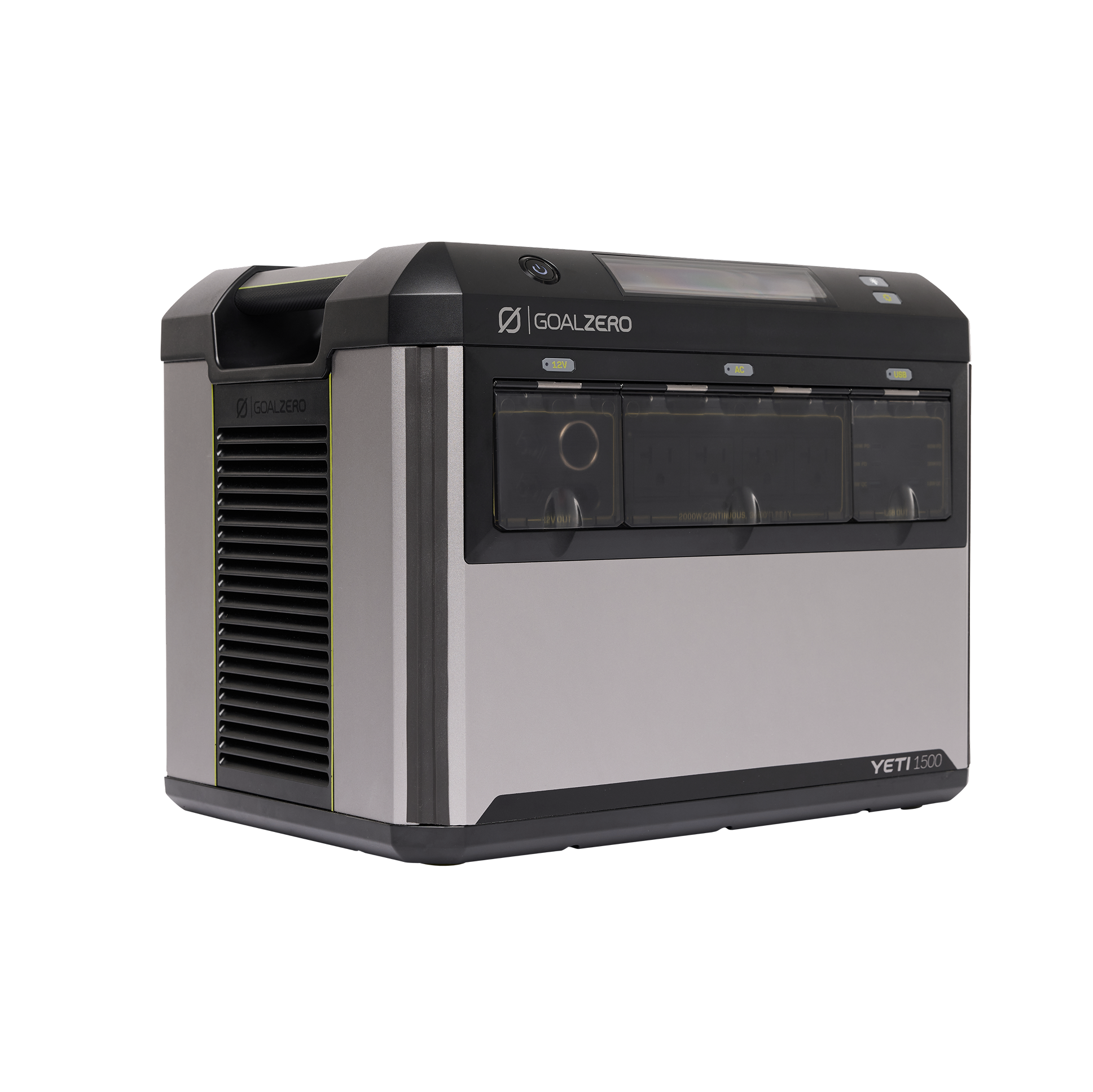
Goal Zero Yeti 1500 (6th Gen)Pick
Sold on Amazon · today’s price is on the listing
Prices may vary by retailer and are subject to change.