Head-to-head test
BLUETTI Elite 300 vs Jackery Explorer 5000 Plus
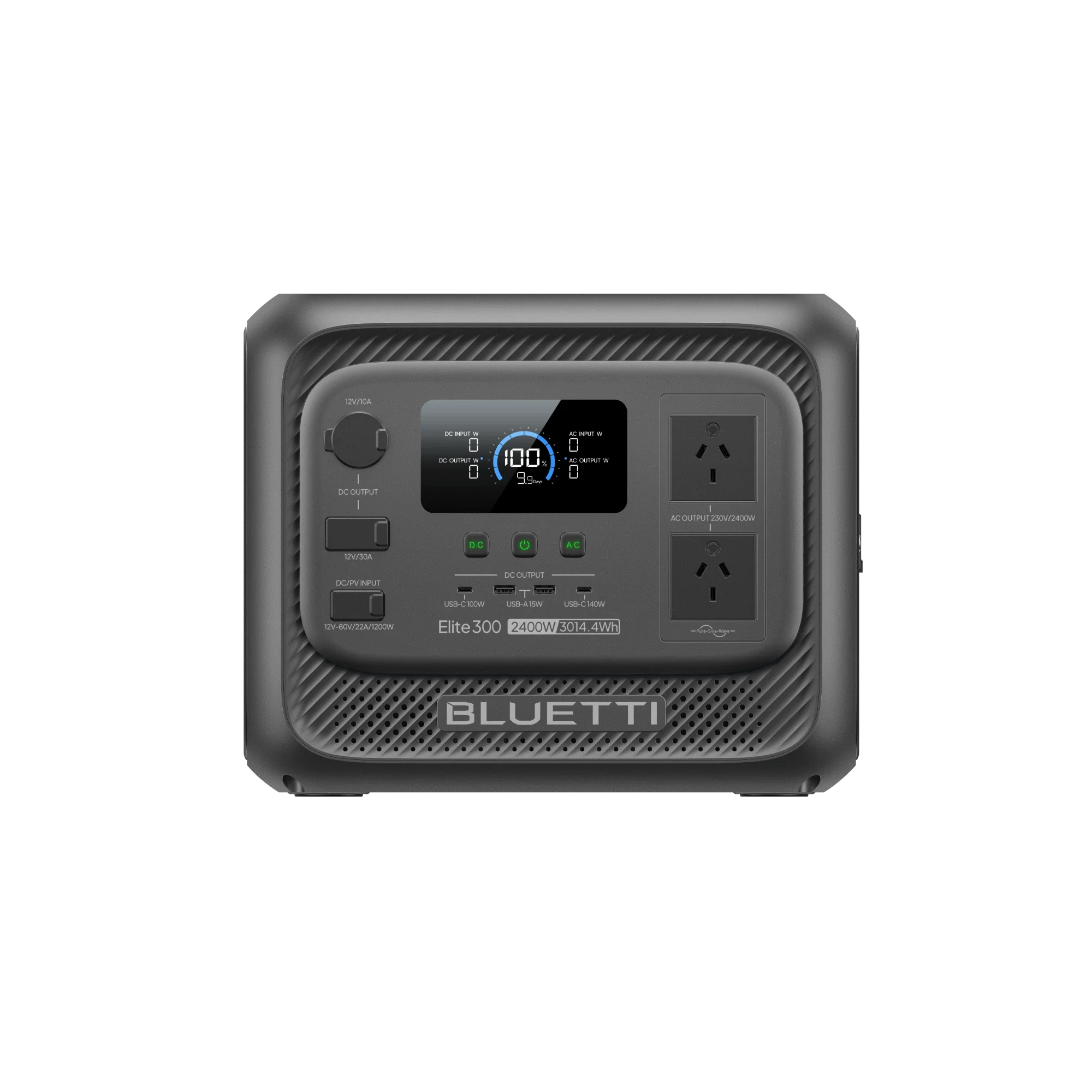
These aren't two sizes of one product — the Elite 300 is 58 pounds you carry, the Explorer 5000 Plus is 134.5 pounds you install and leave — so the whole decision is one question: does your job actually need more than 3,014Wh, or not?
Full profiles: BLUETTI Elite 300 → · Jackery Explorer 5000 Plus →

Written by Gunner GustafsonUpdated
Whole-Home Backup Tester, Station Arena Test Desk
$1,099.00 · direct from BLUETTI
down from $1,199 · 8% below usual
Last checked 1 day ago. Prices move — check before you buy.

$3,499.00 · direct from Jackery
Last checked 1 day ago. Prices move — check before you buy.
Spec deltas
Take the Elite 300 — unless you already know your power needs run bigger than a single 3,014Wh box. At $1,199 it's less than half the price of the Explorer 5000 Plus at $3,149, and at 58 pounds it's a unit one person carries out to the truck. The Explorer is 134.5 pounds: a two-person lift you position once and treat as furniture.
That weight isn't a knock — it's a category. The Explorer 5000 Plus is a 5,040Wh, 7,200W machine that expands toward whole-home backupB0B1; the Elite 300 is the smallest 3kWh unit made by volume, certified as of early 2026A2, at 58 pounds. They overlap on the spec sheet and almost nowhere in real life. One goes camping; the other backs up your house.
For the everyday jobs — a weekend of camping, a tailgate, an eight-hour blackout, a CPAP at 2 a.m. — the Elite covers them, costs less to buy, and stores energy at half the price per lifetime kilowatt-hour. The Explorer earns its premium only when the job genuinely outgrows 3kWh. If that's you, it's worth every pound. If it's not, you'd be paying $1,950 more to haul around energy you won't use.
What the Numbers Reveal
Each conclusion stated first — the numbers behind it on one line, the full analysis below.
weight
The Elite doesn't just win the take-along scenarios by default — it earns them on capacity too, clearing a full camping weekend (2,100Wh) with 462Wh left and a tailgate (670Wh) with 1,892Wh to spare. The Explorer's 5,040Wh is real, but it comes wrapped in 76.5 extra pounds, and for anything mobile that's capacity you paid for and can't bring.
Elite 300: 58 lbsExplorer 5000 Plus: 134.5 lbs, stationary appliance with wheelsWeekend Camping needs 2,100Wh; Elite finishes at 82% with 462Wh to spareTailgate needs 670Wh; Elite has 1,892Wh to spare
Why it mattersIf your power station ever travels, stop reading here and buy the Elite — the weight gap settles it before capacity even enters the room.
rated cycles
The twist is that the Explorer actually delivers more total energy over its life, 20,160 kWh to 18,086, because each of its cycles empties a bigger battery. So the Explorer isn't a bad place to store energy — it's that you pay twice the price per kilowatt-hour and $1,950 more at the register for headroom you only cash in if your loads are big enough to need it.
Elite 300: $0.07 per lifetime kWh, $1,199, 6,000 cyclesExplorer 5000 Plus: $0.14 per lifetime kWh, $3,149, 4,000 cyclesExplorer total lifetime energy 20,160 kWh vs Elite 18,086 kWh
Why it mattersIf 3,014Wh covers your longest stretch off the grid, the Explorer is the expensive way to store power you'll never draw.
continuous output
This is the Explorer's real case, and it's a different product's case: multi-day outages, a well pump or a 240V range, a path that expands toward whole-home backup. None of that is the Elite's job, and no amount of portability or cost-per-kWh substitutes for capacity you don't have when the outage runs into day two.
Explorer 5000 Plus: 5,040Wh base, expandable, 7,200W outputElite 300: 3,014Wh fixed, 2,400W output8-Hour Blackout: Explorer ends at 38% used with 2,639Wh left; Elite at 64% with 917WhVan Life needs 4,685Wh: Explorer covers ~92%, Elite ~55%
Why it mattersBacking up a house or riding out multi-day outages is the one clear reason to pay the Explorer's premium — and to accept its weight.
The specific dimensions that decide these two units — everything else is a tie.
Portability & Form Factor
Selected because: The clearest gap between them: 58 pounds you carry versus 134.5 pounds you install once. It decides half the use cases before capacity is even discussed.
weight
Start with the number that ends most of these comparisons: 58 pounds against 134.5. The Elite 300 is certified the smallest 3kWh unit by volumeA2, a genuine one-person carry that goes in a trunk and comes out at the campsite. The Explorer 5000 Plus ships with real wheels and a sliding suitcase handle because it has toB3 — at 134.5 pounds it's a two-person lift the engine bluntly calls a semi-permanent appliance. You site it once, in the garage or the utility room, and it stays there.
That single fact quietly disqualifies the Explorer from half of what people buy these units for. It's not that it can't power a campsite — its 5,040Wh laughs at a weekend — it's that getting 134.5 pounds to the campsite is the problem capacity can't solve. If the unit stays home, the weight is irrelevant. If it doesn't, the weight is the whole story.
Lifetime Value
Selected because: At $0.07 per lifetime kWh against $0.14, the Elite stores energy at half the cost — and costs $1,950 less to buy. This is where the money actually goes.
cost / lifetime kWh
Seven cents a kilowatt-hour against fourteen. Over its rated life the Elite 300 stores energy at half the cost of the Explorer 5000 Plus, and it gets there two ways: it costs well under half as much to buy ($1,199 to $3,149), and it's rated for 6,000 charge cycles to the Explorer's 4,000. Read that once and the money question is basically answered — per unit of energy, the Elite is the cheaper box to own, by a factor of two.
The honest footnote is that the Explorer delivers more total energy over its life — 20,160 kWh to the Elite's 18,086 — because every one of its cycles empties a bigger battery. So it isn't overpriced for what it is; it's simply a larger, pricier machine whose per-kWh math can't beat a smaller one that costs well under half as much and lasts half again as long. You don't buy the Explorer to save money. You buy it for capacity.
Growth Path
Selected because: The Explorer starts at 5,040Wh and expands toward partial-home backup; the Elite is sealed at 3,014Wh. The one axis where paying more genuinely buys more.
solar input
Here's the one axis where spending more actually buys more. The Elite 300 is sealed at 3,014Wh — a complete system, not a starter, but a hard ceiling. The Explorer 5000 Plus starts at 5,040Wh and takes expansion batteriesB1, and at this scale that path points toward partial-home backup rather than just a bigger camp battery. If your needs are static and fit under 3kWh, the sealed box is a feature: nothing to add, nothing to fail. If your needs are climbing — a bigger rig, a house you want to back up — only one of these two follows you.
One catch worth knowing before you lean on that headroom: one owner found that when the Explorer is wired to an automatic transfer switch and discharging, it can only be recharged by solar until grid power returnsB4. That's exactly the mode you'd depend on in a long outage — so if whole-home backup is the plan, size your solar to match and don't assume you can top it off any other way mid-event.
Your Life, Your Pick
Selected because: Split down the middle: the Elite takes camping and tailgates on portability, the Explorer takes long blackouts and heavy workdays on capacity. Concrete proof of who each is for.
Run the two through six real nights and they split cleanly along the portability/capacity line. The Elite takes Weekend Camping and the Tailgate — not because the Explorer's battery is too small (it's more than double either need) but because you can't get 134.5 pounds to either. The Explorer takes the 8-Hour Blackout and the Remote Workday, where nobody's carrying anything and its reserve does the talking: it ends a blackout night 38% drained with 2,639Wh banked against the Elite's 64% and 917Wh — a little over half a second night versus about 1.6 more.
Two scenarios refuse to pick a side, and both are honest. A CPAP pulls about 40W, so both units cover the night on a rounding error of their capacity and it comes down to price, weight, and fan noise. And Van Life's 4,685Wh daily draw beats them both — the Elite covers about 55%, the Explorer about 92% — so if you're living off one of these full-time, plan on solar or a second battery either way. Neither wins there; the Explorer is just less short.
Brand Trust
Selected because: Two very different support stories — BLUETTI's inconsistent and email-based, Jackery's US-based but weak — and the buy-direct or buy-from-Costco workarounds worth knowing before a claim.
Neither brand's support is a selling point, which is worth flagging on a purchase this size. With BLUETTI the reliable move is to buy direct rather than through a reseller; with Jackery it's to buy through Costco or Amazon so you're covered by their returns. Both pieces of advice exist for the same reason: you don't want to be the buyer discovering the support process during your first failure.
Everything else roughly cancels. BLUETTI's app is among the best in the category and Jackery's among the weakest, but you buy one of these for the battery, not the phone screen, and both are established names with real communities behind them. If you'll never contact support, treat this section as noise. If you're the type who wants a human when something fails at year three, neither will thrill you — and the cheaper unit at least lowers what's at stake.
Strengths & trade-offs
BLUETTI Elite 300
Strengths
- +Costs $1,950 less
- +Lighter by 76.5 lb
- +Rated for 6,000 charge cycles — much longer battery lifespan
Trade-offs
- –Weaker inverter (-4,800W) limits appliance compatibility.
- –Sealed capacity — the Explorer 5000 Plus can add batteries to grow past 3,014.4Wh; this one can't.
Jackery Explorer 5000 Plus
Strengths
- +Larger battery capacity
- +Higher AC output
- +Faster solar charging
Trade-offs
- –Substantially more expensive (+$1,950) than the Elite 300.
- –Significantly heavier (+76.5 lbs), making it harder to move.
- –Very heavy unit that may be difficult for one person to lift.
- –Shorter-lived battery — rated for 4,000 charge cycles vs the Elite 300's 6,000, so it wears out sooner.
Will It Power Your Gear?
Scenario math and per-appliance runtimes, modeled from the spec record.
Scenario verdicts
We ran the math on six real-world scenarios. Here's which unit survives your actual life.
SCN-01 · 2 nights · needs 2,100Wh
Weekend Camping
Two nights off-grid with essential comfort
Elite 300
This one's decided at the trunk, not the campsite. The Explorer 5000 Plus has more than enough battery for a weekend — its problem is that 134.5 pounds isn't going camping. The Elite 300 covers the 2,100Wh with 462Wh to spare and, crucially, fits in the car. Portable power has to be portable first.
Battery budget usedlower = more headroom
LOAD Phone Charger 15W×6h · LED Lights 40W×8h · Box Fan 75W×14h · CPAP Machine 40W×16h
SCN-02 · 8 hours · needs 1,645Wh
8-Hour Blackout
Keep the essentials running through a night without power
Explorer 5000 Plus
Both make it through the night, but they finish it very differently. The Explorer 5000 Plus ends 38% used with 2,639Wh in reserve — about 1.6 more nights like it — while the Elite 300 is 64% down with 917Wh, a little over half of a second night. If your outages tend to stop at bedtime, either's fine. If they spill into day two, the Explorer's reserve is the entire argument.
Battery budget usedlower = more headroom
LOAD Fridge 150W×8h · Router + Modem 20W×8h · LED Lights (4 bulbs) 40W×6h · Phone Charger 15W×3h
SCN-03 · 8 hours · needs 320Wh
CPAP Overnight
Sleep therapy without interruption — the #1 medical use case
Either unit
A CPAP is about 40W for eight hours, so both cover the night with room to spare and capacity decides nothing. Fan noise would — but Elite 300 doesn't publish a figure, so there's nothing to hold it to. Buy on price, weight, and whether you can live with a fan you haven't heard.
Battery budget usedlower = more headroom
LOAD CPAP Machine 40W×8h
SCN-04 · 8 hours · needs 910Wh
Remote Workday
Full work day off-grid without power anxiety
Explorer 5000 Plus
The Explorer 5000 Plus clears the workday at 21% used, banking 3,374Wh — late work, extra calls, or a second laptop charge without arithmetic. The Elite 300 at 36% also finishes, with 1,652Wh of slack for the unplanned.
Battery budget usedlower = more headroom
LOAD Laptop 60W×8h · External Monitor 30W×8h · Router + Modem 20W×8h · Phone Charger 15W×2h
SCN-05 · 4 hours · needs 670Wh
Tailgate Party
Game day power for the crew
Elite 300
The Explorer 5000 Plus at 134.5 lbs is not a take-along — it rolls off a truck bed if it travels at all, so this scenario belongs to the Elite 300 by default — and it earns it, covering the 670Wh with 1,892Wh to spare. Capacity was never the Explorer 5000 Plus's problem here; getting to a tailgate was.
Battery budget usedlower = more headroom
LOAD Blender 400W×0.5h · LED TV (55") 80W×4h · Bluetooth Speaker 15W×4h · Phone Charger (×3) 45W×2h
SCN-06 · 24 hours · needs 4,685Wh
Van Life Daily
A full day of mobile living — the ultimate endurance test
Neither unit
Neither one covers a full off-grid day here, so don't let the winner-take-all framing fool you: this 4,685Wh draw beats them both. The Explorer 5000 Plus gets you about 92% of the way, the Elite 300 about 55%. Living in the van full-time means solar or a second battery regardless — the Explorer just leaves you a smaller gap to fill.
Battery budget usedlower = more headroom
LOAD Mini-Fridge 150W×24h · Laptop 60W×4h · Phone Charger 15W×3h · LED Lights 40W×5h · Fan 75W×8h
The Load Test
RUNTIME = (Wh × 0.85) ÷ LOAD
None of the scenarios above exactly yours? Build it. Toggle what you'd plug in; both units are tested against the combined draw.
Essentials
Comfort & Convenience
High-Draw Appliances
Test duration
8h
Continuous draw
205W
Projected runtime
For this load: Explorer 5000 Plus runs 20.9h vs 12.5h.
$3,149 list · direct from Jackery
Modeled from the spec record — same math as the tables below. Methodology
Runtime by appliance
Real-world runtime estimates for common appliances, modeled at 85% inverter efficiency.¹
Essentials
The basics you need runningscale 0–285.6hComfort & Convenience
Makes off-grid life actually enjoyablescale 0–57.1hHigh-Draw Appliances
These reveal the real limitsscale 0–4.3h¹ Runtime = (capacity × 0.85) ÷ appliance watts. Within each group, all bars share one time scale (the group's longest runtime), so lengths are comparable across appliances; identical runtimes collapse into a single blue/orange bar. Actual runtime varies with battery age, temperature, and simultaneous loads — see methodology.
Conclusion
August 30, 2026
Verdict: the BLUETTI Elite 300
Buy the Elite 300 unless you have a specific reason not to. It costs $1,199 to the Explorer's $3,149, weighs 58 pounds against 134.5, is rated for 6,000 charge cycles to the Explorer's 4,000, and stores energy at half the lifetime cost — $0.07 per kilowatt-hour versus $0.14 — and it covers the everyday jobs people buy portable power for with margin to spare. The Explorer 5000 Plus wins exactly one job: when you need more than 3,014Wh, 240V and 7,200W outputB1, or an expandable path toward whole-home backup, it's the only one of the two that goes there, and its price and weight are the cost of that reach. Most buyers cross-shopping these two don't have that job.
Today the Elite 300 is $1,099, $100 under its typical $1,199. The verdict weighs typical prices, not today's. Prices checked 1 day ago.
Editor-assigned confidence, based on cited owner research and spec analysis.
List prices as of August 30, 2026. The links below open BLUETTI's and Jackery's current prices.
$1,099.00 · direct from BLUETTI
down from $1,199 · 8% below usual
Last checked 1 day ago. Prices move — check before you buy.
or check the Explorer 5000 Plus price$3,499.00 list
Written by Gunner Gustafson, Whole-Home Backup Tester · Station Arena Test Desk · Updated August 30, 2026
Measured Data
Benchmark scores and the full spec record, side by side.
Benchmark scores
Not rated for both units (minimum threshold unmet): UPS, RV Living, Tailgating, Apartment Balcony.
Full specifications
ᵈ Derived: price ÷ rated capacity. See the data behind our comparisons →
Comparison ToolAdd more power stations, side by sideOpen Tool →How these numbers are produced
Numeric verification
Every figure on this page traces to our spec database or arithmetic on it — no estimated numbers.
Owner claims
Statements about owner experience are cited to published reviews — see Sources & Research Notes below.
Runtime model
Runtime = (rated capacity × 0.85 inverter efficiency) ÷ device wattage. Solar recharge estimates assume panels deliver 70% of rated output. Cold weather, battery age, and stacked loads reduce real-world results.
Power Score
Computed from 14 published spec dimensions, weighted per use-case bench. Higher is better; a unit must meet a bench's minimum threshold to be rated.
See the full weight table and data sourcing on our methodology page →Class ranking (the star rating)
Each unit's star score is a category ranking, not customer reviews — no buyer opinions feed it. We score every station on size-independent quality (value, output, portability, endurance, ports, warranty, and more), then percentile-rank it against the other units in its capacity class, so a class-leading compact unit and a class-leading whole-home unit can both earn 5★. Here, Elite 300 rates 4.6/5 (76th percentile of 26 Large-class units), and Explorer 5000 Plus rates 4.8/5 (87th percentile of 16 Home Backup-class units).
How the class ranking is computed →Test Notes & Caveats
Hidden gotchas and advantages we spotted that you won't find on the product page.
134.5 Pounds Is a Place, Not a Purchase
The Explorer 5000 Plus weighs 134.5 pounds. That's a two-person lift, and once it's positioned you won't want to move it, so plan its home before it arrives. The wheels and suitcase handle make it rollable on flat ground, but stairs, truck beds, and back seats are out. Decide where it lives, and let it live there.
The Elite's Ceiling Is Real — and Fine for Most
Here's the Elite 300's one genuine limitation: it's sealed at 3,014Wh, and that's the ceiling. No expansion port, no second battery, no growth path — outgrow it and your upgrade is a whole new unit. For a buyer whose needs are steady and fit under 3kWh, that's not a flaw, it's one less thing to manage. But if you can feel your needs climbing toward home backup, this is the Explorer 5000 Plus's opening, and it's a real one.
UPS Switchover: ≤10ms vs ≤20ms
Both list a UPS mode, at different rated speeds. The Elite 300 is rated ≤10ms — quick enough on paper that desktop PCs and routers should ride through, treating that as the rating it is. The Explorer 5000 Plus is rated ≤20ms — fine on paper for routers and most electronics; the fussiest PC power supplies sit right at this line. If a computer with unsaved work is the thing being protected, the stated class is worth the attention; nothing here is a lab result.
Warranty: No Difference
Both units carry the same 5-year warranty, so coverage isn't a tiebreaker here. Both figures are maximums rather than guarantees: BLUETTI's depends on buying direct from BLUETTI or registering the unit, since reseller purchases carry a shorter term; Jackery's on registering the unit with Jackery, which is what extends the base term to the full period. Worth saying because the per-dollar framing can suggest otherwise: the Elite 300 works out at 4.2 years of cover per $1,000 spent against the Explorer 5000 Plus's 1.6, but that spread is the price gap, not the terms.
Battery Lifespan in Real Years
The Elite 300 is rated for 6,000 cycles vs 4,000. In real life: at daily use, that's 16.4 vs 11 years. At weekend use (twice a week), it's 58 vs 38 years. One caution reading years across different sizes: a cycle is 3,014Wh on the Elite 300 and 5,040Wh on the Explorer 5000 Plus, so count lifetime energy — roughly 18,086 kWh against 20,160 kWh over the rated life. After hitting the cycle limit, the battery doesn't die — it drops to ~80% of original capacity, which is still very usable.
One of These Publishes a Noise Number; One Doesn't
The Explorer 5000 Plus lists 30dB; the Elite 300 lists nothing. That isn't proof the Elite is louder — it means there's no figure to hold it to, and the Explorer's 30dB is a spec-sheet floor rather than a measurement you'll hear under load. If this unit is going in a bedroom or running a CPAP two feet from your head, that missing number matters: find a hands-on noise report for the Elite before you commit, or plan to audition it yourself.
Full record above — the Test Desk pick is the Elite 300.
Check Elite 300 price →or check the Explorer 5000 Plus priceOwnership Analysis
What happens after you buy — true cost of ownership, brand trust, and growth potential.
Lifetime value
Service lifeyears at one full cycle per day
Lifetime energy delivered
Cost per delivered kWh
│ warranty ends · Reaching the cycle rating means ~80% capacity remains — degraded, not dead.
Analyst note
The Elite 300 wins on both sticker price and long-term value. At $0.07/kWh over its lifetime, it's meaningfully cheaper to own. Clear value winner. One caution on the lifespan row: the Elite 300 takes longer to reach its cycle rating, but a cycle moves a different amount of energy on each unit — the Explorer 5000 Plus still delivers more over its shorter horizon (20,160 vs 18,086 kWh). Years measure wear, not usefulness.
Brand trust
BLUETTI
Ecosystem
One of the broadest lineups — 15-20+ models from budget (AC2A) to flagship portable (Apex 300, 2764.8Wh). Includes specialized products: vehicle solar hubs, sodium-ion cold-weather units, and balcony storage systems.
Support
The honest weak spot. BLUETTI's service is heavily email-based and inconsistent — some buyers sail through, others hit timezone lag and runaround. The reliable lever is buying direct from BLUETTI rather than a reseller, which tends to produce cleaner outcomes on a claim.
Community
Active and growing — r/bluetti is the second-largest brand community after EcoFlow, which helps when you want a real-world answer fast.
App experience
Rated 4.5/5 iOS and Android — tied for best app experience in the category. V3.0 UI redesign was well-received.
Unique strength
Among the best capacity-per-dollar in the category, one of the broadest lineups anywhere, and an app rated about 4.5/5 — tied for the best in the class. The Elite line's LFP cells and 6,000-cycle rating sit at the top of that catalog.
Worth knowing
Support inconsistency is the number-one risk with BLUETTI. Buy direct, register the unit, and keep your paperwork — the gap between a smooth and a painful support experience often traces back to where you bought it.
Jackery
Ecosystem
12-15+ models across Explorer (portable) and HomePower (home backup) series, plus SolarSaga panel ecosystem and innovative form factors
Support
US-based, which sounds reassuring, but the service reputation is weak — expect scripted responses and strict receipt requirements on a warranty claim. The common hedge is to buy through Costco or Amazon so you inherit their return protection on top of Jackery's.
Community
The smallest community of the major brands, so troubleshooting leans on official channels and YouTube more than a busy subreddit.
App experience
Rated 2.3-3.3/5 iOS and Android — the weakest app experience of the major brands. Multiple confusing apps (Jackery app vs Jackery Home) and mandatory login even offline.
Unique strength
The most recognized name in power stations and the widest retail presence — Costco, Home Depot, Best Buy, Amazon. The 'Toyota' of the category: proven, everywhere, easy to buy and easy to return.
Worth knowing
The app is the weakest of the major brands (multiple confusing apps, mandatory login even offline), and pricing tends to run high for the specs. Buy it for the capacity, the distribution, and the return convenience — not the software.
Analyst note
Two very different service stories that mostly cancel out. BLUETTI is inconsistent but fixable by buying direct; Jackery is US-based but best bought through a big retailer for return cover. Neither brand's support is a reason to choose one over the other — and neither is a reason to relax. On this pair the brand column is a wash, and the decision stays where it started: weight and capacity.
Growth path
Elite 300
FIXED CAPACITYFixed at 3,014Wh — a sealed, complete system rather than a starting point. There's no expansion port, so that figure is the ceiling: check it against your longest unplugged stretch before you buy.
Accepts up to 1,200W of solar. Enough for a serious multi-panel array.
Adequate ports for most setups, but heavy users may want a power strip.
Explorer 5000 Plus
EXPANDABLESupports Jackery expansion batteries, so you can add capacity later without replacing the base unit — useful if your needs may climb past 5,040Wh.
Accepts up to 4,000W of solar. Enough for a serious multi-panel array.
Adequate ports for most setups, but heavy users may want a power strip.
Expansion batteries are Jackery-specific. You're investing in the Jackery ecosystem.
Realistic full solar rechargeat 70% of rated panel output — see methodology
Analyst note
The Elite 300 is sealed at 3,014Wh, which is fine if that covers you. The Explorer 5000 Plus starts at 5,040Wh and can grow beyond it with Jackery expansion batteries — real headroom the Elite 300 doesn't have if your needs climb toward partial-home backup.
What Owners Report
Patterns from published owner reports and long-term reviews — every claim cited to its source below.
BLUETTI Elite 300
The Elite 300 is new — a 2026 BLUETTI flagship — so the field record is early rather than deep, but what's there is consistentA0. Reviewers place its 3,014Wh pack in the same premium LFP cell tier as the Elite 100 V2, 200 V2, and Apex 300, rated 6,000 cycles to 80%A1, and the standout is the packaging: certified the world's smallest 3kWh unit by volume, under 58 pounds and only about 2 kg heavier than the smaller Elite 200 V2 — light enough to actually move for its classA2A3. Early owners report strong real-world results across home backup, RV, and off-grid useA4. There's nothing yet on long-term durability, simply because the unit hasn't been out long enough to have a long term.
“3,014Wh of premium LiFePO4 rated for 6,000+ cycles to 80% — over 16 years of daily use — the same cell tier used in the Elite 100 V2, Elite 200 V2, and Apex 300.”
Sources
backuppowerhub.com · trustedreviews.com · rv.com · thetechnologyman.com · exspenditure.com · reviewed.com · camerajabber.com
Jackery Explorer 5000 Plus
The Explorer 5000 Plus reviews well, and by more hands: it scores 9.3/10 in independent testing and delivers on its headline specs — 5,040Wh, 7,200W, 240V, expandable toward 60kWhB1B2. The build draws specific praise despite the mass — reviewers single out real wheels, one of the sturdiest sliding suitcase handles they've seen, and side handles built for a two-person liftB3. The one field caveat that matters for its marquee use case: an owner wiring it to an automatic transfer switch found that, while discharging, it recharges only from solar until the grid returnsB4 — a real constraint if you're leaning on it as home backup during a long outage.
“A 5,040Wh LiFePO4 battery with 7,200W output and 240V, expandable up to 60kWh (E5000 Plus battery packs and dual units).”
Sources
jackery.com · offgridbenchmark.com · thesolarlab.com · batteryskills.com
Sources & Research Notes
Every owner claim in this report is traceable to a published source. The bracketed references above resolve here.
Recurring owner themes
- 6,000-cycle LFP longevity, a class-leading compact size for 3kWh, and strong real-world performance are the standout praise. [Elite 300 · 3 entries]
- Large 5,040Wh LFP capacity, 7,200W/240V output, big expandability (to 60kWh), and a well-built wheeled design earn strong scores; heavy at ~134 lbs. [Explorer 5000 Plus · 3 entries]
- A1
“3,014Wh of premium LiFePO4 rated for 6,000+ cycles to 80% — over 16 years of daily use — the same cell tier used in the Elite 100 V2, Elite 200 V2, and Apex 300.”
backuppowerhub.com / trustedreviews.com — Elite 300 review · 2026 · [positive]
- A2
“Certified as the world's smallest 3kWh portable power station by volume (as of January 2026), fitting a chassis closer to a standard 2kWh unit, at just under 58 lbs.”
backuppowerhub.com / rv.com — Elite 300 review · 2026 · [positive]
- A3
“Only about 2 kg heavier than the Elite 200 V2 and not dramatically larger, so it's still manageable to move around for a 3kWh unit.”
thetechnologyman.com / exspenditure.com — Elite 300 review · 2026 · [positive]
- A4
“Multiple 2026 owner reviews report strong real-world performance across home backup, RV, and off-grid use.”
reviewed.com / camerajabber.com — Elite 300 owner reviews · 2026 · [positive]
- B1
“A 5,040Wh LiFePO4 battery with 7,200W output and 240V, expandable up to 60kWh (E5000 Plus battery packs and dual units).”
jackery.com / offgridbenchmark.com — Explorer 5000 Plus review · 2026 · [positive]
- B2
“Scores 9.3/10 in testing; at ~$2,879 (MSRP $4,299) it delivers 5,040Wh and 7,200W.”
offgridbenchmark.com / thesolarlab.com — Explorer 5000 Plus review · 2026 · [positive]
- B3
“Weighs about 134 lbs but has real wheels, one of the sturdiest sliding suitcase handles reviewers have seen, and multiple side handles for team lifting; a compact, well-built design.”
batteryskills.com — Explorer 5000 Plus review · 2026 · [positive]
- B4
“One owner flagged a limitation: when hooked to an automatic transfer switch and discharging, it can only be recharged by solar input until grid power returns.”
offgridbenchmark.com owner review — Explorer 5000 Plus · 2026 · [mixed]
Research compiled August 30, 2026.
What Owners Actually Report
Drawn from 28 comments on independent review channels — not from retailer reviews, which skew to the first week of ownership. Each line is our summary of one commenter's claim, linked to the original. We record what they said, including where it contradicts the spec sheet.
BLUETTI Elite 300
25 claims from 17 comments · 10 from owners · 2 with figures
- Other
- 8 · 24% negative
- Price & value
- 5 · 14% negative
- Expandability
- 3 · 100% negative
- Solar input
- 5 · 84% negative
- UPS switchover
- 1 · 0% negative
What owners complain about
No ability to add an expansion battery, so he must go DIY to reach 8kWh for his camper.
Expandabilityowner12 agreedsource →
Says the F3000 is more capable than the Elite 300.
Other7 agreedsource →
Still dislikes the 60V panel voltage limit on the Elite 300.
Solar input1 agreedsource →
What owners praise
Bought the Elite 300 under $1,000 as a good balance for a city dweller without a big solar setup.
Price & valuemeasuredowner4 agreedsource →
Calls it hands down the best overall camping power station thanks to its small footprint.
Otherownersource →
His own testing shows the Bluetti does not throttle AC output in pass-through mode.
UPS switchoverownersource →
Jackery Explorer 5000 Plus
28 claims from 11 comments · 27 from owners · 5 with figures
- Runtime
- 4 · 61% negative
- Warranty & support
- 5 · 72% negative
- Durability
- 4 · 100% negative
- Price & value
- 3 · 71% negative
- App & firmware
- 4 · 83% negative
What owners complain about
Proprietary expansion batteries cost $2500+ for 5-6kWh versus $800-1000 server rack packs.
Expandabilitymeasuredowner8 agreedsource →
Paid $2,700 and warns buyers away from the unit entirely.
Price & valuemeasuredowner5 agreedsource →
Unit had several out-of-box issues that a firmware update only partly fixed.
Durabilityowner8 agreedsource →
What owners praise
Uses it to charge EVs and a PHEV and for peak shaving through a transfer switch.
Runtimeowner24 agreedsource →
Jackery replied daily, replaced the unit and paid shipping both ways at no cost.
Warranty & supportowner8 agreedsource →
Really quiet and with soft start runs his 2-ton home AC with no problem.
Noiseowner8 agreedsource →
Claims are weighted by how specific they are, whether the commenter owns the unit, and how many readers agreed. Comments that mention a product under a rival's review count for more, because the commenter had no reason to be there. This is what buyers report, not our test results — for measurements we ran ourselves, see the methodology.
Who Should Buy Which
Buy the Elite 300 if you…
- →You camp, tailgate, or want a grab-and-go unit for the occasional blackout, and 3,014Wh comfortably covers your longest unplugged stretch — this is the one you can actually carry to where the power's needed.
- →You want the lowest cost to own. At $0.07 per lifetime kilowatt-hour and $1,199 up front, nothing about the Explorer's per-kWh math catches it.
- →You're running a CPAP, or keeping the unit in a bedroom or apartment, and value a 58-pound footprint you can move room to room — just audition the fan first, since BLUETTI doesn't publish a noise figure.
Buy the Explorer 5000 Plus if you…
- →You're backing up a house, a well pump, or 240V appliances, or you expect outages that run past a single evening — the 5,040Wh base and expandable path are the reason to pay the premiumB1.
- →You need serious output, not just capacity: 7,200W starts and holds heavy loads and multiple big appliances at once that the Elite's 2,400W can't.
- →You want one machine you install and forget, so the 134.5-pound weight is a non-issue because it's never going to move anyway.
If neither fits
If your draw looks like full-time van or off-grid living — think the roughly 4,685Wh Van Life load — neither of these covers a full day on its own (the Elite gets about 55%, the Explorer about 92%), and you should be shopping a dedicated house battery or a solar-plus-storage setup sized to your real consumption, not a portable box you'll drain by dinner.
The Bottom Line
Take the Elite 300. It costs $1,199 to the Explorer's $3,149, weighs 58 pounds to 134.5, lasts 6,000 cycles to 4,000, and stores energy at half the lifetime cost — and it covers camping, tailgates, blackouts, and CPAP nights with margin. For the buyer cross-shopping these two, that's the whole case.
The Explorer 5000 Plus isn't beaten so much as aimed elsewhere. When the job is a house to back up, a 240V appliance to run, or an outage that runs into a second day, it's the only one of the two that reaches — and its weight stops mattering the moment you stop trying to lift it. Know which of those buyers you are before you spend, and the choice makes itself: if it moves, buy the Elite; if it stays and grows, buy the Jackery.
Frequently Asked Questions
Answers drawn from the spec record and cited owner research.
Is the Jackery Explorer 5000 Plus worth almost twice the price of the Elite 300?
Only if you need what the extra money buys: more than 3,014Wh, 240V and 7,200W output, or a path that expands toward whole-home backup. For camping, tailgates, blackouts, or CPAP use, the Elite 300 does the job for $1,199 and costs half as much per lifetime kilowatt-hour. The Explorer's premium is capacity and expandability, not everyday performance.
Which one is better for camping and tailgating?
The Elite 300, easily. At 58 pounds it's a one-person carry; the Explorer 5000 Plus is 134.5 pounds and effectively stationary. The Elite covers a full camping weekend of about 2,100Wh with capacity to spare, so the Explorer's bigger battery is just capacity you can't get to the site.
Which power station lasts longer?
In cycles, the Elite 300 — 6,000 charge cycles to the Explorer's 4,000, roughly 16 years of daily use against 11. But because the Explorer's battery is larger, it moves more total energy over its life, about 20,160 kWh to 18,086. If you care about years of service, the Elite; if you care about lifetime kilowatt-hours, the Explorer edges it. Either way both settle to about 80% capacity at the cycle limit rather than dying.
Can the Elite 300 back up my house?
Partly, and only briefly. It's sealed at 3,014Wh with 2,400W output, which covers essentials — fridge, lights, phones, a CPAP — for a night, but it can't run 240V appliances and it can't expand. For real home backup, especially anything past one evening or involving a well pump or a range, the Explorer 5000 Plus is built for it and the Elite isn't.
Is the Explorer 5000 Plus too heavy to be practical?
Only if you plan to move it often. At 134.5 pounds it's a two-person lift, but it ships with real wheels and a sturdy suitcase handle, so rolling it across a garage or driveway is easy — carrying it upstairs or loading it into an SUV is not. Treat it as an appliance you position once, not a unit you tote around.
Brand matchup
BLUETTI vs Jackery: measured across every matchup →Where to buy
BLUETTI Elite 300Pick
$1,099.00
$1,099.00 · direct from BLUETTI
down from $1,199 · 8% below usual
Last checked 1 day ago. Prices move — check before you buy.
Jackery Explorer 5000 Plus
$3,499.00
$3,499.00 · direct from Jackery
Last checked 1 day ago. Prices move — check before you buy.
Prices may vary by retailer and are subject to change.