Head-to-head test
BLUETTI Elite 300 vs Jackery Explorer 1500 v2
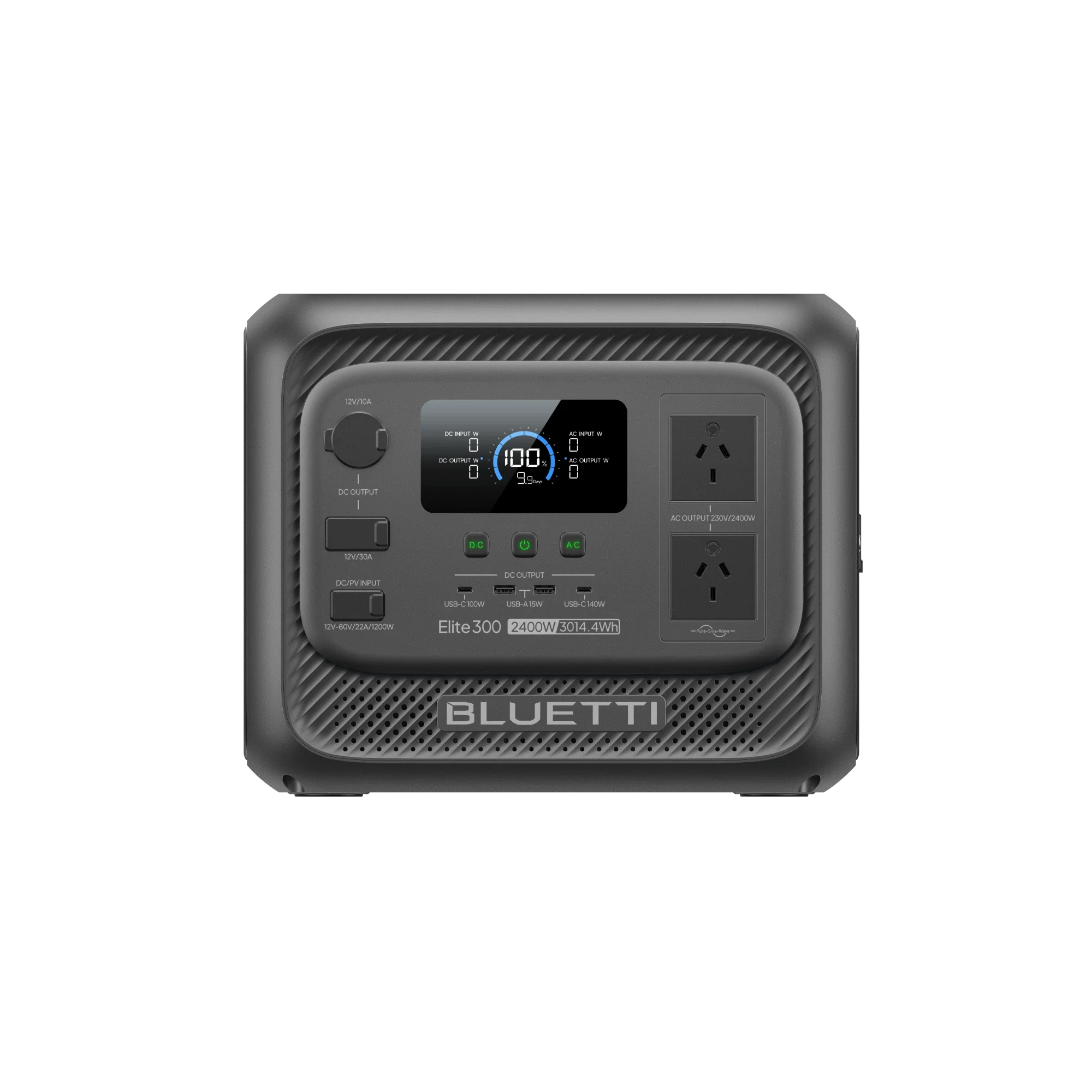
The Elite 300 costs $250 more and is the cheaper unit to own — double the capacity, triple the solar, and two thousand more cycles bring its lifetime energy cost to six cents a kilowatt-hour against the Jackery's eleven — so the Jackery only wins if you truly can't clear $949 or lift 58 pounds.
Full profiles: BLUETTI Elite 300 → · Jackery Explorer 1500 v2 →

Written by Gunner GustafsonUpdated
Whole-Home Backup Tester, Station Arena Test Desk
$1,099.00 · direct from BLUETTI
down from $1,199 · 8% below usual
Last checked 1 day ago. Prices move — check before you buy.

$949.00 · direct from Jackery
Last checked 1 day ago. Prices move — check before you buy.
Spec deltas
The Elite 300 costs $250 more than the Jackery Explorer 1500 v2 and is the cheaper unit to own — that's the paradox this page resolves. It holds 3,014 watt-hours against the Jackery's 1,536, runs 6,000 charge cycles against 4,000, and spreads its price across so much more delivered energy that the engine puts its lifetime cost at six cents a kilowatt-hour, against the Jackery's eleven.
The capacity gap isn't abstract. The two scenarios people actually buy a large station for — a weekend of camping around 2,100Wh, an 8-hour blackout around 1,645Wh — both fall in the dead zone above the Jackery's 1,536Wh and below the Elite's 3,014. One unit covers your outage. The other gets you about two-thirds of the way through it and then goes quiet.
The Jackery earns its place on two honest counts. It's $250 cheaper, which is real money, and at 32 pounds it's 26 lighter than the Elite's 58 — the difference between a one-hand carry and a two-hand, bent-knee lift. It's also the only one here that tells you how loud it is: 30dB, where the Elite's spec sheet stays silent. If budget or portability is the hard constraint, that's your unit. Otherwise the Elite wins going away.
What the Numbers Reveal
Each conclusion stated first — the numbers behind it on one line, the full analysis below.
That gap is the whole decision. A camping weekend and a full blackout are the reasons people spend four figures on a power station, and the Jackery clears neither — it gets you roughly two-thirds through and stops, which during an actual outage is the two-thirds that doesn't count.
Elite 300 holds 3,014Wh; Explorer 1500 v2 holds 1,536WhWeekend Camping needs about 2,100Wh; the Elite covers it and the Jackery does not8-Hour Blackout needs about 1,645Wh; the Elite covers it and the Jackery does not
Why it mattersIf you're buying this for home backup or a real off-grid weekend, the capacity gap isn't a preference — it's the line between a unit that does the job and one that almost does.
rated cycles
Six cents against eleven. The Elite's 3,014Wh and 6,000 cycles add up to 18,086 kilowatt-hours over its life against the Jackery's 6,144, so the $250 premium spreads across nearly three times the energy. You pay more once and less every time you use it after that.
Elite 300 costs $1,199; Explorer 1500 v2 costs $949 — $250 moreEngine lifetime cost: $0.06 per kWh for the Elite vs $0.11 for the JackeryElite 300 runs 6,000 cycles; Explorer 1500 v2 runs 4,000
Why it mattersAnyone who plans to keep and use this for years should read the lifetime cost, not the sticker — on that horizon the Elite is the value pick, not the splurge.
solar input
In a multi-day outage the recharge is the survival spec, not the capacity. The Elite pulls back a full day's worth of use from a morning of strong sun on 1,200W of panels; the Jackery's 400W ceiling turns the same refill into an all-day crawl for a smaller battery. The bigger unit is also the faster one to bring back from empty.
Elite 300 accepts 1,200W solar input; Explorer 1500 v2 accepts 400WElite 300 holds 3,014Wh; Explorer 1500 v2 holds 1,536Wh
Why it mattersOff-grid and extended-outage buyers should weight the 1,200W solar ceiling heavily — it's what keeps a big battery useful past day one.
weight
Fifty-eight pounds is a two-hand, bent-knee, don't-do-it-on-the-stairs lift; the Jackery you pick up in one hand. And for a unit that might sit in a bedroom, the Elite's undisclosed noise is a genuine unknown, where the Jackery commits to 30dB on paper. These are the Elite's real weaknesses, and they're worth naming before the capacity case buries them.
Elite 300 weighs 58 lb; Explorer 1500 v2 weighs 32 lb — 26 lb lighterExplorer 1500 v2 is rated 30dB; the Elite 300 does not disclose a noise figure
Why it mattersIf you'll move this often or park it beside a bed, the Jackery's lighter, quantified-quiet body is the better fit — the Elite asks you to accept weight and a noise question mark for its capacity.
The specific dimensions that decide these two units — everything else is a tie.
Your Life, Your Pick
Selected because: The camping and blackout jobs fall exactly in the gap between the two capacities — the clearest signal on the page.
The Elite wins every scenario both units can attempt, but the two that decide the purchase are camping and the blackout. Camping wants about 2,100Wh and the blackout about 1,645Wh, and both land above the Jackery's 1,536Wh — so the Elite finishes them and the Jackery doesn't. On the smaller jobs, a CPAP night or a remote workday, both run fine and the Elite simply carries more spare.
Only one scenario defeats them both: van life daily, at about 4,685Wh, is more than even the Elite's 3,014Wh covers in a day. If that's your life, you're looking at a larger system or a dedicated solar setup — but for everything short of full-time van dwelling, the Elite is the one that clears the bar.
Lifetime Value
Selected because: The $0.06 vs $0.11 inversion — pricier unit, cheaper to own — is the counterintuitive core.
cost / lifetime kWh
Six cents a kilowatt-hour against eleven. The Elite starts with nearly double the capacity and 2,000 more cycles, so it delivers 18,086 kilowatt-hours over its life to the Jackery's 6,144 — and the $250 premium spreads thin across all of it. State that once and the sticker gap stops looking like a gap.
Per warranty year the two diverge the other way — $220 for the Elite against $140 — because both carry five years and the Elite simply costs more up front. But a 6,000-cycle battery isn't a five-year purchase; the honest horizon is the cells', and across that horizon the Elite is the cheaper unit by a wide margin. Warranty-year math flatters the Jackery; lifetime math tells the truth.
What the Specs Don't Tell You
Selected because: Four cards fire, including the honest catch: the Elite's undisclosed noise level.
rated cycles
Four cards fire, and the most useful one is the Elite's, not the Jackery's: the Elite doesn't disclose a noise level at all. That's flagged as a warning, and it should be — for a unit you might run in a living room, silence on the spec sheet is a real gap in what you can know before buying, not a point in its favor.
The rest lean the Elite's way. Its switchover is line-interactive at under 10ms against the Jackery's under-20ms standby, which matters if you're backing a desktop or a NAS. And the cycle-life card underlines the same 6,000-vs-4,000 story the lifetime cost already told. The Elite's one honest ding here is noise disclosure; everything else in this section reinforces its lead.
Portability & Form Factor
Selected because: The Jackery's strongest case lives here — 26 lb lighter — and it deserves a fair hearing.
weight
This is the Jackery's best section. At 32 pounds it's 26 lighter than the 58-pound Elite — a one-hand carry against a two-hand, watch-your-back lift — and for a unit that gets moved between a truck, a campsite, and a garage, that difference is felt on every trip. Credit where it's due: the Elite is certified the smallest 3kWh unit by volume, so it's dense for its capacity, but dense and light aren't the same thing.
The question is what the weight buys. The Elite's 26 extra pounds are 1,478 more watt-hours and 2,000 more cycles — not dead weight, but capacity you're carrying. If you rarely move it and you need the capacity, that's an easy trade. If you're hauling it constantly and 1,536Wh covers your jobs, the Jackery's lighter body is the honest win.
Brand Trust
Selected because: Cross-brand pair with different support models and app track records.
BLUETTI's app is among the best-rated in the category, and the Elite 300 sits at the top of one of the widest lineups in the space — the same 6,000-cycle LFP cell tier runs through its flagship models. The standing risk is support: heavily email-based with timezone delays and outcomes that swing case to case, with direct purchases generally faring better than third-party ones.
Jackery counters with retail ubiquity — it's the easy Costco or Best Buy buy, and that in-store return window is the real backstop for a brand whose direct support draws criticism for slow, scripted replies. Its app is the weakest of the majors, though. If you want the polished app and the bigger ecosystem, that's BLUETTI; if you want the easiest return and the most familiar name, that's Jackery.
Strengths & trade-offs
BLUETTI Elite 300
Strengths
- +Larger battery capacity
- +Higher AC output
- +Faster solar charging
- +Rated for 6,000 charge cycles — much longer battery lifespan
Trade-offs
- –Significantly heavier (+26 lbs), making it harder to move.
Jackery Explorer 1500 v2
Strengths
- +Costs $250 less
- +Lighter by 26 lb
Trade-offs
- –Shorter-lived battery — rated for 4,000 charge cycles vs the Elite 300's 6,000, so it wears out sooner.
Will It Power Your Gear?
Scenario math and per-appliance runtimes, modeled from the spec record.
Scenario verdicts
We ran the math on six real-world scenarios. Here's which unit survives your actual life.
SCN-01 · 2 nights · needs 2,100Wh
Weekend Camping
Two nights off-grid with essential comfort
Elite 300
A full camping weekend wants about 2,100Wh — the Elite covers it on roughly 82% of usable capacity, and the Jackery can't reach it at all. If off-grid weekends are why you're buying, this scenario alone settles it toward the Elite.
Battery budget usedlower = more headroom
LOAD Phone Charger 15W×6h · LED Lights 40W×8h · Box Fan 75W×14h · CPAP Machine 40W×16h
SCN-02 · 8 hours · needs 1,645Wh
8-Hour Blackout
Keep the essentials running through a night without power
Elite 300
This is the one that decides the page. An 8-hour blackout runs about 1,645Wh, and the Jackery's 1,536Wh comes up just short while the Elite finishes with roughly a third of its battery still in reserve. Close only counts if the lights stay on, and here they don't for the Jackery.
Battery budget usedlower = more headroom
LOAD Fridge 150W×8h · Router + Modem 20W×8h · LED Lights (4 bulbs) 40W×6h · Phone Charger 15W×3h
SCN-03 · 8 hours · needs 320Wh
CPAP Overnight
Sleep therapy without interruption — the #1 medical use case
Either unit
A CPAP is about 40W for eight hours, so both cover the night with room to spare and capacity decides nothing. Fan noise would — but Elite 300 doesn't publish a figure, so there's nothing to hold it to. Buy on price, weight, and whether you can live with a fan you haven't heard.
Battery budget usedlower = more headroom
LOAD CPAP Machine 40W×8h
SCN-04 · 8 hours · needs 910Wh
Remote Workday
Full work day off-grid without power anxiety
Elite 300
The Elite 300 clears the workday at 36% used, banking 1,652Wh — late work, extra calls, or a second laptop charge without arithmetic. The Explorer 1500 v2 at 70% also finishes, with 396Wh of slack for the unplanned.
Battery budget usedlower = more headroom
LOAD Laptop 60W×8h · External Monitor 30W×8h · Router + Modem 20W×8h · Phone Charger 15W×2h
SCN-05 · 4 hours · needs 670Wh
Tailgate Party
Game day power for the crew
Elite 300
Both handle game day; the Elite 300 keeps more in reserve (26% used vs 51%). Tailgating is a light load, though, so the number you'll feel is weight: 32 lbs for the Explorer 1500 v2 against 58 lbs for the Elite 300, from the trunk to the setup spot.
Battery budget usedlower = more headroom
LOAD Blender 400W×0.5h · LED TV (55") 80W×4h · Bluetooth Speaker 15W×4h · Phone Charger (×3) 45W×2h
SCN-06 · 24 hours · needs 4,685Wh
Van Life Daily
A full day of mobile living — the ultimate endurance test
Neither unit
Neither wins this one: full-time van life runs about 4,685Wh a day, past even the Elite's 3,014Wh. It's a genuine tie in that both fall short — if this is your daily reality, look at a larger fixed system rather than either portable here.
Battery budget usedlower = more headroom
LOAD Mini-Fridge 150W×24h · Laptop 60W×4h · Phone Charger 15W×3h · LED Lights 40W×5h · Fan 75W×8h
The Load Test
RUNTIME = (Wh × 0.85) ÷ LOAD
None of the scenarios above exactly yours? Build it. Toggle what you'd plug in; both units are tested against the combined draw.
Essentials
Comfort & Convenience
High-Draw Appliances
Test duration
8h
Continuous draw
205W
Projected runtime
For this load: Elite 300 runs 12.5h vs 6.4h.
$1,199 list · direct from BLUETTI
Modeled from the spec record — same math as the tables below. Methodology
Runtime by appliance
Real-world runtime estimates for common appliances, modeled at 85% inverter efficiency.¹
Essentials
The basics you need runningscale 0–170.8hComfort & Convenience
Makes off-grid life actually enjoyablescale 0–34.2hHigh-Draw Appliances
These reveal the real limitsscale 0–2.6h¹ Runtime = (capacity × 0.85) ÷ appliance watts. Within each group, all bars share one time scale (the group's longest runtime), so lengths are comparable across appliances; identical runtimes collapse into a single blue/orange bar. Actual runtime varies with battery age, temperature, and simultaneous loads — see methodology.
Conclusion
July 16, 2026
Verdict: the Elite 300, on Power Score margin
The Elite 300 holds 3,014Wh to the Jackery's 1,536 — nearly double — and that's the spec that settles it, because the two jobs people buy a big battery for both land in the gap between them. Weekend camping (about 2,100Wh) and an 8-hour blackout (about 1,645Wh) are jobs only the Elite finishes; the Jackery taps out short of each. The Elite also runs 6,000 cycles to 4,000, takes 1,200W of solar to the Jackery's 400, and its longer life plus bigger battery drop its lifetime cost to six cents a kilowatt-hour against eleven — the pricier unit is the cheaper one to own. The Jackery's honest wins are real and narrow: it's $250 cheaper, 26 pounds lighter, and it publishes a 30dB noise figure the Elite doesn't disclose at all. If your ceiling is $949 or your back is the constraint, take the Jackery. If you're buying a battery to cover a blackout, buy the Elite.
Today the Elite 300 is $1,099, $100 under its typical $1,199. The verdict weighs typical prices, not today's. Prices checked 1 day ago.
Editor-assigned confidence, based on cited owner research and spec analysis.
List prices as of July 16, 2026. The links below open BLUETTI's and Jackery's current prices.
$1,099.00 · direct from BLUETTI
down from $1,199 · 8% below usual
Last checked 1 day ago. Prices move — check before you buy.
or check the Explorer 1500 v2 price$949.00 list
Written by Gunner Gustafson, Whole-Home Backup Tester · Station Arena Test Desk · Updated July 16, 2026
Measured Data
Benchmark scores and the full spec record, side by side.
Benchmark scores
Not rated for both units (minimum threshold unmet): CPAP, Camping.
Full specifications
ᵈ Derived: price ÷ rated capacity. See the data behind our comparisons →
Comparison ToolAdd more power stations, side by sideOpen Tool →How these numbers are produced
Numeric verification
Every figure on this page traces to our spec database or arithmetic on it — no estimated numbers.
Owner claims
Statements about owner experience are cited to published reviews — see Sources & Research Notes below.
Runtime model
Runtime = (rated capacity × 0.85 inverter efficiency) ÷ device wattage. Solar recharge estimates assume panels deliver 70% of rated output. Cold weather, battery age, and stacked loads reduce real-world results.
Power Score
Computed from 14 published spec dimensions, weighted per use-case bench. Higher is better; a unit must meet a bench's minimum threshold to be rated.
See the full weight table and data sourcing on our methodology page →Class ranking (the star rating)
Each unit's star score is a category ranking, not customer reviews — no buyer opinions feed it. We score every station on size-independent quality (value, output, portability, endurance, ports, warranty, and more), then percentile-rank it against the other units in its capacity class, so a class-leading compact unit and a class-leading whole-home unit can both earn 5★. Here, Elite 300 rates 4.6/5 (76th percentile of 26 Large-class units), and Explorer 1500 v2 rates 3.8/5 (27th percentile of 27 Everyday-class units).
How the class ranking is computed →Test Notes & Caveats
Hidden gotchas and advantages we spotted that you won't find on the product page.
Line-Interactive Under 10ms vs Standby Under 20ms
The Elite switches over in under 10 milliseconds, line-interactive; the Jackery in under 20, standby. Both are quick enough for most electronics, but if you're backing a desktop, a NAS, or anything that reboots on a blink, the Elite's faster transfer is the safer margin.
Same Five Years, Different Value Behind It
Both carry a 5-year warranty, so per warranty year the cheaper Jackery looks better on paper ($140 vs $220). But the warranty covers the same window while the Elite's battery is built to run far past it — the five-year figure understates how long the Elite keeps working.
6,000 Cycles vs 4,000, in Real Years
The Elite's 6,000-cycle rating against the Jackery's 4,000 is the engine behind its lower lifetime cost. Both last many years at a normal use pace, but the Elite delivers far more total energy before it fades — which is exactly why it lands cheaper per kilowatt-hour despite the higher price.
The Elite 300 Doesn't Publish a Noise Figure
This is the Elite's one honest gap on the page. The Jackery commits to 30dB; the Elite's spec sheet stays silent, so you're going in without a number. That's not evidence it's loud, but for a unit that might live in a living room, it's a real unknown worth weighing.
Full record above — the Test Desk pick is the Elite 300.
Check Elite 300 price →or check the Explorer 1500 v2 priceOwnership Analysis
What happens after you buy — true cost of ownership, brand trust, and growth potential.
Lifetime value
Service lifeyears at one full cycle per day
Lifetime energy delivered
Cost per delivered kWh
│ warranty ends · Reaching the cycle rating means ~80% capacity remains — degraded, not dead.
Analyst note
The Explorer 1500 v2 is cheaper to buy, but the Elite 300 is cheaper to own. At $0.07/kWh over its lifetime vs $0.15/kWh, the Elite 300's higher cycle life and capacity make each dollar go further over the years.
Brand trust
BLUETTI
Ecosystem
One of the broadest lineups — 15-20+ models from budget (AC2A) to flagship portable (Apex 300, 2764.8Wh). Includes specialized products: vehicle solar hubs, sodium-ion cold-weather units, and balcony storage systems.
Support
The most inconsistent support in the space. Heavily email-based with China timezone delays. Some users get smooth, efficient service; others report weeks of troubleshooting runarounds, being offered discounts on new units instead of repairs, and confusing third-party purchase claim processes. Buying direct from Bluetti's website tends to produce better support outcomes.
Community
Active and growing — Reddit r/bluetti has a dedicated community. Second-largest after EcoFlow in engagement.
App experience
Rated 4.5/5 iOS and Android — tied for best app experience in the category. V3.0 UI redesign was well-received.
Unique strength
The Elite 300 tops one of the widest lineups in the category and shares its 6,000-cycle LFP cell tier with BLUETTI's flagships, backed by a top-rated app.
Worth knowing
BLUETTI's support is its weak point and it's inconsistent; if you ever need a claim, buying direct tends to go smoother than a third-party purchase.
Jackery
Ecosystem
12-15+ models across Explorer (portable) and HomePower (home backup) series, plus SolarSaga panel ecosystem and innovative form factors
Support
US-based support but widely criticized. Reddit reports describe slow/dismissive responses, scripted AI agents, strict receipt requirements for warranty claims, and refurbished replacements for clearly defective units. Strongly recommended: buy from Costco or Amazon for return protection.
Community
Smallest community of the major brands — Reddit r/Jackery has ~2,000 members. YouTube presence is solid due to brand recognition.
App experience
Rated 2.3-3.3/5 iOS and Android — the weakest app experience of the major brands. Multiple confusing apps (Jackery app vs Jackery Home) and mandatory login even offline.
Unique strength
The most familiar name on the shelf and an easy Costco or Best Buy buy, which doubles as a return-window safety net a criticized direct-support team can't provide.
Worth knowing
Jackery's app is the weakest of the major brands and can force a login even offline, so remote monitoring is the one column BLUETTI clearly wins.
Analyst note
BLUETTI brings the deeper ecosystem and the better app; Jackery brings retail ubiquity and the in-store return protection that offsets its shaky direct support. For these two specific units the decision is capacity and price, not brand — but if app control matters, lean BLUETTI, and if an easy return matters, lean Jackery.
Growth path
Elite 300
FIXED CAPACITYFixed at 3,014Wh — a sealed, complete system rather than a starting point. There's no expansion port, so that figure is the ceiling: check it against your longest unplugged stretch before you buy.
Accepts up to 1,200W of solar. Enough for a serious multi-panel array.
Adequate ports for most setups, but heavy users may want a power strip.
Explorer 1500 v2
FIXED CAPACITYFixed at 1,536Wh, with no expansion — so size it for your needs up front rather than planning to add capacity later.
Accepts up to 400W of solar. Suitable for a 1-2 panel setup.
Adequate ports for most setups, but heavy users may want a power strip.
Realistic full solar rechargeat 70% of rated panel output — see methodology
Analyst note
Neither expands, and that's no knock on either — each is a complete unit at a fixed size. Buy the capacity that covers your needs now (the Elite 300 gives you the larger ceiling); you can't add to either later.
What Owners Report
Patterns from published owner reports and long-term reviews — every claim cited to its source below.
BLUETTI Elite 300
The Elite 300's defining claim is longevity: 3,014Wh of premium LiFePO4 rated for 6,000-plus cycles to 80%, which reviewers put at over 16 years of daily use — the same cell tier BLUETTI uses in the Elite 100 V2, Elite 200 V2, and Apex 300A1. Multiple 2026 owner reviews report strong real-world performance across home backup, RV, and off-grid useA4.
For a 3kWh unit it's unusually manageable. It's certified the world's smallest 3kWh portable station by volume as of January 2026, fitting a chassis closer to a standard 2kWh unit at just under 58 poundsA2. Reviewers note it's only about 2kg heavier than the Elite 200 V2 and not dramatically larger, so it stays movable for its class — heavy, but not the two-person job the capacity might suggestA3.
“3,014Wh of premium LiFePO4 rated for 6,000+ cycles to 80% — over 16 years of daily use — the same cell tier used in the Elite 100 V2, Elite 200 V2, and Apex 300.”
Sources
backuppowerhub.com · trustedreviews.com · rv.com · thetechnologyman.com · exspenditure.com · reviewed.com · camerajabber.com
Jackery Explorer 1500 v2
Against a 58-pound unit, the Jackery's headline field note is weight: reviewers call it the world's lightest 1.5kWh LFP station at about 32 pounds, and that class-leading portability is its defining featureB1. Its seven simultaneous outputs draw specific praise too — three AC outlets for larger appliances, dual USB-C for fast device charging, and a DC car port so 12V accessories don't tie up an AC outletB2.
On value it's the consensus pick of its class. At $949 reviewers call it the lightest, fastest-charging, and lowest cost-per-watt 1.5kWh LFP station on the market, with a full charge in roughly an hourB3. It earns an 8.7/10 as the most cost-efficient path to serious LFP capacity for buyers who don't need a rugged, waterproof bodyB4.
“The world's lightest 1.5kWh LFP power station at about 32 lbs — class-leading weight is one of its defining features.”
Sources
backuppowerhub.com · jackery.com · portablepowernerd.com
Sources & Research Notes
Every owner claim in this report is traceable to a published source. The bracketed references above resolve here.
Recurring owner themes
- 6,000-cycle LFP longevity, a class-leading compact size for 3kWh, and strong real-world performance are the standout praise. [Elite 300 · 3 entries]
- Class-leading light weight, a versatile 7-port layout, fast ~64-minute charging, and the lowest cost-per-watt in its class are the consistent praise. [Explorer 1500 v2 · 3 entries]
- A1
“3,014Wh of premium LiFePO4 rated for 6,000+ cycles to 80% — over 16 years of daily use — the same cell tier used in the Elite 100 V2, Elite 200 V2, and Apex 300.”
backuppowerhub.com / trustedreviews.com — Elite 300 review · 2026 · [positive]
- A2
“Certified as the world's smallest 3kWh portable power station by volume (as of January 2026), fitting a chassis closer to a standard 2kWh unit, at just under 58 lbs.”
backuppowerhub.com / rv.com — Elite 300 review · 2026 · [positive]
- A3
“Only about 2 kg heavier than the Elite 200 V2 and not dramatically larger, so it's still manageable to move around for a 3kWh unit.”
thetechnologyman.com / exspenditure.com — Elite 300 review · 2026 · [positive]
- A4
“Multiple 2026 owner reviews report strong real-world performance across home backup, RV, and off-grid use.”
reviewed.com / camerajabber.com — Elite 300 owner reviews · 2026 · [positive]
- B1
“The world's lightest 1.5kWh LFP power station at about 32 lbs — class-leading weight is one of its defining features.”
backuppowerhub.com / jackery.com — Explorer 1500 v2 review · 2026 · [positive]
- B2
“Seven simultaneous outputs is genuinely useful: three AC outlets cover larger appliances, dual USB-C ports support fast charging for phones and laptops, and the DC car output handles 12V accessories without burning an AC outlet.”
portablepowernerd.com / backuppowerhub.com — Explorer 1500 v2 review · 2026 · [positive]
- B3
“At $699 it's the lightest, fastest-charging, and lowest cost-per-watt 1.5kWh LFP station on the market, undercutting comparable LFP units, with a roughly 64-minute full charge.”
backuppowerhub.com — Explorer 1500 v2 review · 2026 · [positive]
- B4
“Earns 8.7/10; for buyers who don't need rugged or waterproof features, it's the most cost-efficient path to serious LFP capacity in 2026.”
backuppowerhub.com / portablepowernerd.com — Explorer 1500 v2 review · 2026 · [positive]
Research compiled July 16, 2026.
Who Should Buy Which
Buy the Elite 300 if you…
- →You're buying for home backup or a real off-grid weekend — the Elite's 3,014Wh clears both the 2,100Wh camping job and the 1,645Wh blackout that the Jackery can't finish.
- →You'll keep it for years and lean on solar during outages — 6,000 cycles and a 1,200W solar ceiling make it both the cheaper unit to own long-term and the faster one to refill from empty.
Buy the Explorer 1500 v2 if you…
- →Your ceiling is around $949, full stop — the Jackery is $250 cheaper and still a serious LFP unit, just a smaller one.
- →You move it constantly or run it in a bedroom — at 32 pounds it's a one-hand carry, 26 lighter than the Elite, and it's the only one here that publishes a 30dB noise figure.
If neither fits
If your real load is full-time van life at roughly 4,685Wh a day, neither finishes it — even the Elite's 3,014Wh comes up short before nightfall. That's a job for a larger system or a dedicated solar-and-battery setup sized for daily off-grid living, not a single portable station.
The Bottom Line
Take the Elite 300. It costs $250 more and it's the cheaper unit to own — six cents a kilowatt-hour against eleven — and more to the point, its 3,014Wh clears both the camping weekend and the blackout that leave the Jackery's 1,536Wh two-thirds finished and silent. When the whole reason to buy is covering an outage, buy the one that covers it.
The Jackery's case is honest and narrow. If $949 is the hard ceiling, or if 58 pounds is a non-starter and you need something you can one-hand and trust to run quiet at the bedside, it's a genuinely good unit at its size. Just know you're buying it for the price and the carry, not the capacity — because on capacity, it's not close.
Frequently Asked Questions
Answers drawn from the spec record and cited owner research.
The Elite 300 costs $250 more — how is it the cheaper option?
Over its life, not at checkout. The Elite holds nearly double the capacity (3,014Wh vs 1,536) and runs 6,000 cycles to the Jackery's 4,000, so it delivers 18,086 lifetime kilowatt-hours against 6,144 and its price spreads across all of them. That works out to six cents per kWh versus the Jackery's eleven — the higher sticker buys a lower cost per use.
Which one can actually get me through a blackout?
The Elite 300. A typical 8-hour blackout across a fridge, lights, and devices runs about 1,645Wh, and the Jackery's 1,536Wh taps out just short of that while the Elite's 3,014Wh has room to spare. If home backup is the reason you're buying, the capacity gap is the deciding factor.
Is the Elite 300 too heavy to move around?
It's a two-hand lift at 58 pounds, but manageable for a 3kWh unit — it's certified the smallest 3kWh station by volume, so it's dense rather than sprawling. If you'll move it often, the 32-pound Jackery is far easier to carry; if it mostly stays put for backup or RV use, the Elite's weight is a fair trade for double the capacity.
Which is quieter to run overnight?
The Jackery publishes 30dB; the Elite 300 doesn't disclose a noise figure at all. That doesn't make the Elite loud, but it does make it an unknown, which matters if the unit will sit in a bedroom. For a guaranteed-quiet bedside unit, the Jackery is the safer call.
Do I need the Elite's 1,200W solar, or is the Jackery's 400W enough?
It depends on outage length. For topping up between short uses, the Jackery's 400W is fine. For a multi-day outage where you're recharging daily, the Elite's 1,200W ceiling pulls a full day's use back from a morning of sun, while the 400W input turns the same job into an all-day crawl.
Brand matchup
BLUETTI vs Jackery: measured across every matchup →Where to buy
BLUETTI Elite 300Pick
$1,099.00
$1,099.00 · direct from BLUETTI
down from $1,199 · 8% below usual
Last checked 1 day ago. Prices move — check before you buy.
Jackery Explorer 1500 v2
$949.00
$949.00 · direct from Jackery
Last checked 1 day ago. Prices move — check before you buy.
Prices may vary by retailer and are subject to change.