Head-to-head test
BLUETTI Elite 300 vs BLUETTI EP900 + 2×B500
The gap between $1,199 and $10,298 doesn't buy a better battery, it buys a connection to your breaker panel, and if every load you care about ends in a plug you never need that connection.
Full profiles: BLUETTI Elite 300 → · BLUETTI EP900 + 2×B500 →

Written by Gunner GustafsonUpdated
Whole-Home Backup Tester, Station Arena Test Desk
$1,099.00 · direct from BLUETTI
down from $1,199 · 8% below usual
Last checked 1 day ago. Prices move — check before you buy.

$10,298.00 · direct from BLUETTI
Last checked 1 day ago. Prices move — check before you buy.
Spec deltas
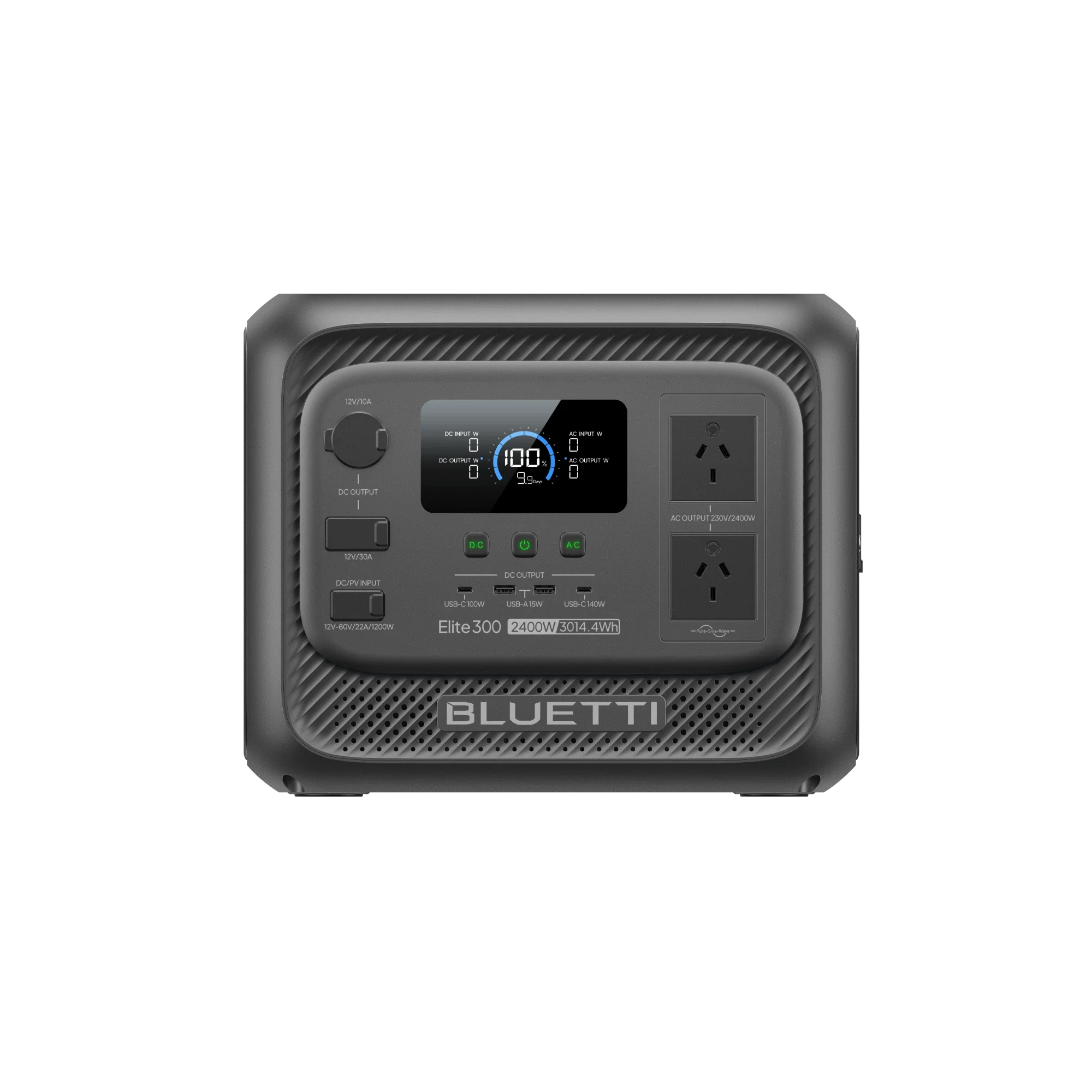
The Elite 300 costs $1,199 and weighs 58 lbs. The EP900 with two B500 batteries costs $10,298 and weighs 343 lbs, a figure our record gives as a system total covering the inverter and its battery modules rather than any one box. These aren't two versions of the same product. They're two different purchases that happen to both store electricity.
What the extra money buys is reach. The EP900 is a wired-in home system that transfers from grid to battery in 10 milliseconds and is built around a washer, a dryer, a heater, a refrigeratorB1B3. None of those hand a plug to the Elite 300, which is why its 2,400W continuous rating isn't the thing holding it back. Reach, not watts.
So the useful question isn't which unit is better. It's whether you're doing an electrical project. If you are, the Elite 300 was never a candidate and you should be reading about panel sizing instead. If you aren't, the Elite 300 covers the blackout, the campsite and the workday with capacity to spare, and the stack's advantage is headroom you'd never touch.
What the Numbers Reveal
Each conclusion stated first — the numbers behind it on one line, the full analysis below.
continuous output
The Elite 300's surge ceiling is double its continuous rating, 4,800W against 2,400W, which is genuine startup headroom for anything with a cord. Its transfer time is the same 10ms the EP900 listsB3. What it can't do is present itself to a breaker panel. Identical milliseconds protect very different things: on the Elite 300, whatever you remembered to plug in; on the EP900, the circuits themselves.
Elite 300: 2,400W continuous, 4,800W surgeEP900 + 2×B500: 7,600W continuous, with no surge figure in our recordThe EP900 platform is described as a whole-home system running a washer, dryer, heater and refrigeratorB1Both units list a 10ms grid-to-battery transfer
Why it mattersIf you can walk your house and point at the loads you want backed up, and they all end in a plug, the stack's extra output is a capability you have no way to connect to.
weight
That changes what the price tag means. $10,298 is the hardware line, and the platform material this record draws on prices complete systems separately from installationB4, so the real number waits on an electrician's quote you haven't got yet. The Elite 300's 58 lbs is a decision you can reverse on a Saturday. You can put it in the car, decide the garage was the wrong room, and move it.
EP900 + 2×B500 is listed at 343 lbs and 9,920Wh, both as system totals with no per-box figureB500 modules are 4,960Wh eachB2, and 4,960 × 2 = 9,920, so the two batteries account for all of the capacity and the EP900 inverter is a third chassis holding none of itElite 300: 58 lbsThe platform's own pricing material is explicit that installation is separateB4
Why it mattersIf you can't already say which wall it goes on and who's wiring it, you aren't ready to buy the EP900 stack at any price.
cost / lifetime kWh
That leaves warranty as the only real longevity difference on the page, and warranty is coverage, not chemistry. Ten years is worth having. At $1,030 per covered year against $240, with the same 6,000-cycle cells underneath both units, it isn't worth choosing on.
Both units are rated for 6,000 cyclesElite 300: $0.40 per Wh. EP900 + 2×B500: $1.04 per WhLifetime cost lands at $0.07 and $0.17 per kWh respectivelyWarranty: 5 years on the Elite 300, 10 years on the stack, at $240 and $1,030 per covered year
Why it mattersDon't read the lifetime-value table as a second, independent argument for the Elite 300. There's one argument, and it's the purchase price.
The specific dimensions that decide these two units — everything else is a tie.
Portability & Form Factor
Selected because: 58 lbs against a 343 lb system total: one of these is a box you carry, the other is hardware you site once.
weight
Fifty-eight pounds is a two-hands, bent-knees lift into a trunk, and BLUETTI got 3,014Wh into a chassis the record credits as the smallest 3kWh portable by volume as of January 2026A2. You can put it in the car. More to the point, you can change your mind about where it lives.
The 343 lbs on the other side is a system figure spanning the inverter and both battery modules, with no per-box number anywhere in our record, so read it as a pallet arriving rather than something you pick up. The card that fires on it says to plan your placement carefully, which undersells the moment: placement is the purchase. Once the stack is mounted and wired, its address is as fixed as your water heater's.
Lifetime Value
Selected because: $1,199 against $10,298, with both units rated for the same 6,000 cycles, which is exactly why the per-kWh table can't reorder them.
cost / lifetime kWh
Eight Elite 300s at $1,199 each come to $9,592, against $10,298 for the stack, and eight of them hold 8 × 3,014Wh, or 24,112Wh, against the stack's 9,920Wh. That comparison is unfair in precisely the way that explains the price: not one of those eight boxes can talk to your breaker panel, and the stack canB1. You are paying for a connection and a single point of control, not for stored energy.
Read the table's own arithmetic skeptically while you're here. Both units carry the same 6,000-cycle rating, so the years-of-service figures come out identical, 16.4 years of daily cycling for each, even though one holds 3,014Wh and the other 9,920Wh. Those year counts have no capacity term in them at all. Use the price and the cycle rating. Ignore the calendar.
Your Life, Your Pick
Selected because: The EP900 stack takes five of the six scenarios and ties the sixth, and two of those five are scenarios it can't physically attend.
The scenario model has no class for an installed system, and it shows here. Weekend Camping and Tailgate Party score every unit as though it drove itself to the site, and the EP900 stack wins both on capacity headroom while being 343 lbs of wired-in hardware. It takes a camping scenario it cannot attend. Read the sweep as a capacity ranking, because a capacity ranking is all it is.
Strip the two travel scenarios and the picture goes quiet. The Elite 300 covers the eight-hour blackout with 917Wh still in reserve against a 1,645Wh load, and the remote workday with 1,652Wh spare against 910Wh. Its one outright failure is Van Life Daily, where 4,685Wh a day against 2,562Wh usable leaves it 2,123Wh short. That isn't a close call, and it's the honest limit of a 3,014Wh box.
What the Specs Don't Tell You
Selected because: Five cards fire on this pair, and the two that decide anything are where the 343 lbs goes and the fact that only one of these units publishes a noise figure.
The two cards worth your attention point in opposite directions. One is about a decision made once with an electrician standing there. The other is about a number that doesn't exist: the stack publishes 50dB and the Elite 300 publishes nothing, and an unpublished figure is not a quiet one. If the unit is going in a bedroom, that absence is the thing to resolve before you buy, and no card on this page can resolve it for you.
One spec on the stack's record we won't argue from: it lists 9,000W of solar input, which is exactly the inverter figure the platform material quotes for the EP900B1. Two identical numbers in adjacent fields is how a spec gets copied into the wrong slot, so treat that solar ceiling as unverified and don't buy on it. The Elite 300's refill we can price honestly. 3,014Wh against a 1,200W solar ceiling is about two and a half hours of ideal sun, and 'ideal' is doing real work in that sentence.
Strengths & trade-offs
BLUETTI Elite 300
Strengths
- +Costs $9,099 less
- +Lighter by 285 lb
Trade-offs
- –Weaker inverter (-5,200W) limits appliance compatibility.
- –Sealed capacity — the EP900 + 2×B500 can add batteries to grow past 3,014.4Wh; this one can't.
BLUETTI EP900 + 2×B500
Strengths
- +Larger battery capacity
- +Higher AC output
- +Longer warranty
- +Faster solar charging
Trade-offs
- –Substantially more expensive (+$9,099) than the Elite 300.
- –Significantly heavier (+285 lbs), making it harder to move.
- –Very heavy unit that may be difficult for one person to lift.
Will It Power Your Gear?
Scenario math and per-appliance runtimes, modeled from the spec record.
Scenario verdicts
We ran the math on six real-world scenarios. Here's which unit survives your actual life.
SCN-01 · 2 nights · needs 2,100Wh
Weekend Camping
Two nights off-grid with essential comfort
Elite 300
The stack finishes the weekend at 25% used against the Elite 300's 82%, so on headroom it wins clearly. The Elite 300 still passes: 2,100Wh of load against 2,562Wh usable leaves 462Wh, the last 18% of what it had. Wide enough for the weekend you planned, thin enough that a second unplanned night isn't in the budget.
Battery budget usedlower = more headroom
LOAD Phone Charger 15W×6h · LED Lights 40W×8h · Box Fan 75W×14h · CPAP Machine 40W×16h
SCN-02 · 8 hours · needs 1,645Wh
8-Hour Blackout
Keep the essentials running through a night without power
EP900 + 2×B500
Both ride it out. The load is 1,645Wh, the Elite 300 has 2,562Wh usable and ends with 917Wh, and the stack ends with 6,787Wh. What the stack's win actually buys is a second and a third night, which matters if your outages come from ice storms rather than from a squirrel. For one evening, the Elite 300's reserve is not the constraint.
Battery budget usedlower = more headroom
LOAD Fridge 150W×8h · Router + Modem 20W×8h · LED Lights (4 bulbs) 40W×6h · Phone Charger 15W×3h
SCN-03 · 8 hours · needs 320Wh
CPAP Overnight
Sleep therapy without interruption — the #1 medical use case
Either unit
Neither unit is troubled: a 320Wh night is 12% of the Elite 300's usable capacity and 4% of the stack's, so capacity settles nothing. The tiebreak is where each one lives. The stack publishes 50dB but gets wired into a utility space and won't be in the room. The Elite 300 publishes no noise figure and is the one that would sit beside the bed. The unit with the known number is the one you won't hear.
Battery budget usedlower = more headroom
LOAD CPAP Machine 40W×8h
SCN-04 · 8 hours · needs 910Wh
Remote Workday
Full work day off-grid without power anxiety
EP900 + 2×B500
910Wh of desk work leaves the Elite 300 with 1,652Wh of its 2,562Wh usable still in hand, so nearly a second day of the same work before it needs anything. The stack ends the day at 11% used and wins the scenario on that headroom. The Elite 300 also carries a 140W USB-C port, which means the laptop charges at full speed without its own brick taking up an outlet.
Battery budget usedlower = more headroom
LOAD Laptop 60W×8h · External Monitor 30W×8h · Router + Modem 20W×8h · Phone Charger 15W×2h
SCN-05 · 4 hours · needs 670Wh
Tailgate Party
Game day power for the crew
Elite 300
670Wh is a light afternoon, and the Elite 300 ends it with 1,892Wh of its 2,562Wh usable untouched. The stack wins at 8% used against 26%, a wider margin on a load that neither unit noticed.
Battery budget usedlower = more headroom
LOAD Blender 400W×0.5h · LED TV (55") 80W×4h · Bluetooth Speaker 15W×4h · Phone Charger (×3) 45W×2h
SCN-06 · 24 hours · needs 4,685Wh
Van Life Daily
A full day of mobile living — the ultimate endurance test
Neither unit
The Elite 300's one outright failure. A 4,685Wh day against 2,562Wh usable leaves it 2,123Wh short, and no amount of careful use closes a gap that size. The stack covers the day and still has 3,747Wh spare, though a van is the one address a wired-in system can't follow you to.
Battery budget usedlower = more headroom
LOAD Mini-Fridge 150W×24h · Laptop 60W×4h · Phone Charger 15W×3h · LED Lights 40W×5h · Fan 75W×8h
The Load Test
RUNTIME = (Wh × 0.85) ÷ LOAD
None of the scenarios above exactly yours? Build it. Toggle what you'd plug in; both units are tested against the combined draw.
Essentials
Comfort & Convenience
High-Draw Appliances
Test duration
8h
Continuous draw
205W
Projected runtime
For this load: EP900 + 2×B500 runs 41.1h vs 12.5h.
$10,298 list · direct from BLUETTI
Modeled from the spec record — same math as the tables below. Methodology
Runtime by appliance
Real-world runtime estimates for common appliances, modeled at 85% inverter efficiency.¹
Essentials
The basics you need runningscale 0–562.1hComfort & Convenience
Makes off-grid life actually enjoyablescale 0–112.4hHigh-Draw Appliances
These reveal the real limitsscale 0–8.4h¹ Runtime = (capacity × 0.85) ÷ appliance watts. Within each group, all bars share one time scale (the group's longest runtime), so lengths are comparable across appliances; identical runtimes collapse into a single blue/orange bar. Actual runtime varies with battery age, temperature, and simultaneous loads — see methodology.
Conclusion
August 9, 2026
Verdict: the BLUETTI Elite 300
Buy the Elite 300 at $1,199 unless you can name the hardwired circuits you're backing up. Both units are BLUETTI LFP rated for 6,000 cycles and both list a 10ms grid-to-battery transfer, so the EP900 stack's $10,298 isn't buying better cells or a faster switch. It's buying 9,920Wh sitting behind a permanent connection to the house, able to carry appliances a portable can't reachB1B3. That's a real capability and it's the only reason on this page to spend the difference. If your backup list is a fridge, a router, some lamps and phones, the Elite 300 walks out of the eight-hour blackout scenario with 917Wh still in it, and you keep the difference between $1,199 and $10,298.
Today the Elite 300 is $1,099, $100 under its typical $1,199. The verdict weighs typical prices, not today's. Prices checked 1 day ago.
Editor-assigned confidence, based on cited owner research and spec analysis.
List prices as of August 9, 2026. The links below open BLUETTI's current price.
$1,099.00 · direct from BLUETTI
down from $1,199 · 8% below usual
Last checked 1 day ago. Prices move — check before you buy.
or check the EP900 + 2×B500 price$10,298.00 list
Written by Gunner Gustafson, Whole-Home Backup Tester · Station Arena Test Desk · Updated August 9, 2026
Measured Data
Benchmark scores and the full spec record, side by side.
Benchmark scores
Not rated for both units (minimum threshold unmet): UPS, RV Living, Solar Generator, Tailgating, Apartment Balcony.
Full specifications
ᵈ Derived: price ÷ rated capacity. See the data behind our comparisons →
Comparison ToolAdd more power stations, side by sideOpen Tool →How these numbers are produced
Numeric verification
Every figure on this page traces to our spec database or arithmetic on it — no estimated numbers.
Owner claims
Statements about owner experience are cited to published reviews — see Sources & Research Notes below.
Runtime model
Runtime = (rated capacity × 0.85 inverter efficiency) ÷ device wattage. Solar recharge estimates assume panels deliver 70% of rated output. Cold weather, battery age, and stacked loads reduce real-world results.
Power Score
Computed from 14 published spec dimensions, weighted per use-case bench. Higher is better; a unit must meet a bench's minimum threshold to be rated.
See the full weight table and data sourcing on our methodology page →Class ranking (the star rating)
Each unit's star score is a category ranking, not customer reviews — no buyer opinions feed it. We score every station on size-independent quality (value, output, portability, endurance, ports, warranty, and more), then percentile-rank it against the other units in its capacity class, so a class-leading compact unit and a class-leading whole-home unit can both earn 5★. Here, Elite 300 rates 4.6/5 (76th percentile of 26 Large-class units), and EP900 + 2×B500 rates 3.7/5 (21st percentile of 29 Whole-Home / Off-Grid-class units).
How the class ranking is computed →Test Notes & Caveats
Hidden gotchas and advantages we spotted that you won't find on the product page.
EP900 + 2×B500: 343 lbs Is a Placement, Not a Lift
The 343 lbs is the system total for the inverter and its battery modules, and there's no per-box figure anywhere in our record, so nobody is carrying this in one go regardless of how many friends turn up. It arrives as a stack, gets mounted, and gets commissioned. Plan for a wall and an electrician's morning rather than for a strong back. Where it goes is effectively where it stays.
EP900 + 2×B500: 50dB, and Which Room Hears It
50dB under load is a real number, and it matters less than the room it's in. This is wired-in hardware that lives in a garage, a basement or a utility closet, so the 50dB is usually behind a door. Ask about it if the only wall you have is shared with a bedroom, and ask harder if that's also where you'll be sleeping through a long outage. A long outage is exactly when the fan has work to do.
Elite 300: The Ceiling Is the Whole Product
Sealed at 3,014Wh with no expansion port, and this page has a scenario where that bites: a 4,685Wh day against 2,562Wh usable leaves it 2,123Wh short. That's the honest catch against our pick, stated before you have to find it. The counterweight is that the EP900's growth path runs through battery modules that wire to the inverter, so it only exists for someone doing the installation in the first place. If you're not, expandable isn't a feature you can actually buy.
Warranty: 10 Years vs 5
The EP900 + 2×B500 is covered for 10 years against the Elite 300's 5 years. The cheaper Elite 300 does buy more warranty per dollar (4.2 years per $1,000 against 1), but that is a statement about price, not about coverage — if a fault appears in year 6, only one of these is still covered. The Elite 300's figure is a maximum rather than a guarantee — it depends on buying direct from BLUETTI or registering the unit, since reseller purchases carry a shorter term. An underrated factor if you're keeping this unit for years.
Elite 300: Noise Level Not Disclosed
The EP900 + 2×B500 publishes its noise level (50dB); the Elite 300 doesn't publish one. That isn't evidence the Elite 300 is louder — it means there's no figure to hold it to, and no way to compare the two on this without hearing them. If you're buying for a bedroom, a CPAP, or an apartment, treat the EP900 + 2×B500's 50dB as the only published number on the table — a spec-sheet figure, not a measurement — and look for hands-on reports of the Elite 300 before deciding.
Full record above — the Test Desk pick is the Elite 300.
Check Elite 300 price →or check the EP900 + 2×B500 priceOwnership Analysis
What happens after you buy — true cost of ownership, brand trust, and growth potential.
Lifetime value
Service lifeyears at one full cycle per day
Lifetime energy delivered
Cost per delivered kWh
│ warranty ends · Reaching the cycle rating means ~80% capacity remains — degraded, not dead.
Analyst note
The Elite 300 wins on both sticker price and long-term value. At $0.07/kWh over its lifetime, it's meaningfully cheaper to own. Clear value winner. One thing to know reading the table: both carry the same 6,000-cycle rating, so the lifetime rows are sticker price and capacity in disguise — the wear horizon is identical and decides nothing here.
Delivers each lifetime kWh for $0.10 less — check the Elite 300 price →
Growth path
Elite 300
FIXED CAPACITYFixed at 3,014Wh — a sealed, complete system rather than a starting point. There's no expansion port, so that figure is the ceiling: check it against your longest unplugged stretch before you buy.
Accepts up to 1,200W of solar. Enough for a serious multi-panel array.
Adequate ports for most setups, but heavy users may want a power strip.
EP900 + 2×B500
EXPANDABLESupports BLUETTI expansion batteries, so you can add capacity later without replacing the base unit — useful if your needs may climb past 9,920Wh.
Accepts up to 9,000W of solar. Enough for a serious multi-panel array.
Limited ports. You'll likely need a power strip or splitter.
Expansion batteries are BLUETTI-specific. You're investing in the BLUETTI ecosystem.
Realistic full solar rechargeat 70% of rated panel output — see methodology
Analyst note
The Elite 300 is sealed at 3,014Wh, which is fine if that covers you. The EP900 + 2×B500 starts at 9,920Wh and can grow beyond it with BLUETTI expansion batteries — real headroom the Elite 300 doesn't have if your needs climb toward partial-home backup.
What Owners Report
Patterns from published owner reports and long-term reviews — every claim cited to its source below.
BLUETTI Elite 300
The Elite 300's file is launch-window review coverage, not a long-term owner record, and it's worth knowing that before you weigh it. What's in there is consistent: 6,000-cycle LFP cells shared with the Elite 100 V2, Elite 200 V2 and Apex 300A1, a chassis credited as the world's smallest 3kWh portable by volume as of January 2026 at just under 58 lbsA2, and only about 2 kg more to shift around than the Elite 200 V2A3. The line about strong real-world performance across home backup, RV and off-grid use traces to review sites rather than to owners a year inA4, so treat it as a first-impressions consensus rather than a durability finding.
Nothing in that file speaks to fan behaviour. All four entries run to cells, size and weightA1A2A3A4, and the Elite 300 publishes no noise figure either, so if you're buying it for a bedroom you're buying without evidence on the one spec that would settle it.
“3,014Wh of premium LiFePO4 rated for 6,000+ cycles to 80% — over 16 years of daily use — the same cell tier used in the Elite 100 V2, Elite 200 V2, and Apex 300.”
Sources
backuppowerhub.com · trustedreviews.com · rv.com · thetechnologyman.com · exspenditure.com · reviewed.com · camerajabber.com
BLUETTI EP900 + 2×B500
Treat the EP900 file as vendor material rather than owner experience. Its own coverage note says it describes the EP900 platform and is shared across every ep900-N-b500 configuration, and the entries trace back to BLUETTI's own pages and to press writeups built from themB1B2B4. The single owner line in it, that the grid-to-battery transfer is completely unnoticeable, reaches us through a press piece rather than from the ownerB3.
It also disagrees with our spec record in ways you should know about before you lean on anything you read in a roundup. The file quotes the EP900 inverter at 9,000WB1 where our listing for this build says 7,600W, and the expansion story it tells, up to roughly 39.6kWh across eight B500 modules, describes the platform's ceiling rather than the two-battery system priced on this pageB2. Neither is a reason to distrust the hardware. Both are reasons to buy from the spec sheet for the exact configuration you're ordering.
“A whole-home system: one EP900 inverter provides up to 9,000W (18,000W with two units), enough to run a washer, dryer, heater, and refrigerator.”
Sources
bluettipower.com · bestgeneratorsolar.com · mightygenerators.com · bgr.com · offgridsource.com
Sources & Research Notes
Every owner claim in this report is traceable to a published source. The bracketed references above resolve here.
Recurring owner themes
- 6,000-cycle LFP longevity, a class-leading compact size for 3kWh, and strong real-world performance are the standout praise. [Elite 300 · 3 entries]
- Whole-home 9,000W output, large B500 expandability (to ~39.6kWh), 10ms UPS, and solar off-grid capability are the standout features. [EP900 + 2×B500 · 3 entries]
- A1
“3,014Wh of premium LiFePO4 rated for 6,000+ cycles to 80% — over 16 years of daily use — the same cell tier used in the Elite 100 V2, Elite 200 V2, and Apex 300.”
backuppowerhub.com / trustedreviews.com — Elite 300 review · 2026 · [positive]
- A2
“Certified as the world's smallest 3kWh portable power station by volume (as of January 2026), fitting a chassis closer to a standard 2kWh unit, at just under 58 lbs.”
backuppowerhub.com / rv.com — Elite 300 review · 2026 · [positive]
- A3
“Only about 2 kg heavier than the Elite 200 V2 and not dramatically larger, so it's still manageable to move around for a 3kWh unit.”
thetechnologyman.com / exspenditure.com — Elite 300 review · 2026 · [positive]
- A4
“Multiple 2026 owner reviews report strong real-world performance across home backup, RV, and off-grid use.”
reviewed.com / camerajabber.com — Elite 300 owner reviews · 2026 · [positive]
- B1
“A whole-home system: one EP900 inverter provides up to 9,000W (18,000W with two units), enough to run a washer, dryer, heater, and refrigerator.”
bluettipower.com / bestgeneratorsolar.com — EP900 + B500 guide · 2026 · [positive]
- B2
“With B500 batteries (4,960Wh each), capacity expands from 9.9kWh up to about 39.6kWh with eight B500 modules — weeks of essential backup.”
bluettipower.com / mightygenerators.com — EP900 + B500 · 2026 · [positive]
- B3
“A fast UPS switches from grid to battery within 10 milliseconds; one owner reported the transfer is completely unnoticeable during outages.”
bgr.com / owner review — EP900 + B500 · 2026 · [positive]
- B4
“Built on reliable LiFePO4 cells; tied to solar, an owner said they can virtually go off-grid and minimize utility bills. Complete systems run roughly $14,500-$15,000 excluding installation.”
bgr.com / offgridsource.com — EP900 + B500 review · 2026 · [positive]
Research compiled August 9, 2026.
Who Should Buy Which
Buy the Elite 300 if you…
- →You want backup for the things with plugs: the fridge, the router, a couple of lamps, phones, a laptop. The Elite 300 leaves the eight-hour blackout scenario with 917Wh still in it against a 1,645Wh load.
- →You rent, or you might move. Fifty-eight pounds goes in the car. A wired-in system stays with the house.
- →You work off a truck or a tailgate and want one box that does all of it. The 140W USB-C port runs a laptop at full speed without a second brick, and at 670Wh a tailgate barely registers against a 3,014Wh battery.
- →You want the cheapest honest route to 6,000-cycle LFP: $0.40 per Wh against $1.04.
Buy the EP900 + 2×B500 if you…
- →Your backup list has hardwired appliances on it. A washer, a dryer, a heater and a refrigerator are the loads this platform is built aroundB1, and no portable reaches them at any capacity.
- →You already have an electrician scheduled, a wall picked, and a budget that treats $10,298 as the hardware line rather than the totalB4.
- →You expect to add capacity later. The B500 modules keep going past this two-battery buildB2, and that path only exists for someone doing the installation anyway.
- →You want one system covering the whole house instead of a box you carry to whichever room needs it, and the $1.04 per Wh is a price you've already made peace with.
If neither fits
Two readers should close this tab. If you're running a CPAP and not much else, a 320Wh night is 12% of the Elite 300's usable capacity and 4% of the stack's, and a sub-1kWh unit does that job for a fraction of either price. And if you're living in a van at 4,685Wh a day, the Elite 300 comes up 2,123Wh short while the stack doesn't travel at all. That buyer wants a purpose-built 12V house bank with DC-to-DC alternator charging, not a portable and not a home ESS.
The Bottom Line
Take the Elite 300 at $1,199 unless you can name the hardwired circuits you're backing up. Same brand, same 6,000-cycle LFP chemistry, same 10ms transfer on paper. The difference the money buys is a permanent connection to the house, and either you need that or you don't.
If you do need it, the EP900 stack is the only one of these two that's even in the conversation, and you should be budgeting for an electrician alongside the $10,298. If you don't, the Elite 300 clears the blackout with reserve left, weighs 58 lbs, and leaves the rest of the money where it was. Buy the Elite 300 and spend the difference on something that isn't a battery.
Frequently Asked Questions
Answers drawn from the spec record and cited owner research.
Can the Elite 300 back up my whole house?
No, and capacity isn't the reason. Whole-house backup means feeding your breaker panel, and the Elite 300 is a plug-in box: it powers what you can physically plug into it, up to 2,400W continuous. The EP900 platform is the one built to sit between the grid and your circuits. If your goal is that the lights come back on by themselves, the Elite 300 is the wrong tool at any size.
Is the EP900 with two B500 batteries worth the extra money over an Elite 300?
Only if you need the wiring. $10,298 against $1,199 buys 9,920Wh instead of 3,014Wh plus a permanent connection to the house, and installation sits on top of that hardware price. If you were going to plug things in either way, the difference is buying headroom and a wall mount you didn't need.
Which one is quieter if it's going in a bedroom?
Unknown, and that's the honest answer. The stack is rated 50dB under load and the Elite 300 publishes no figure at all, which is not evidence that it's louder. The practical asymmetry is placement: a wired-in system lives in a garage or utility space, and the portable is the one that would end up beside the bed. Look for hands-on reports of the Elite 300 before you commit it to a bedroom.
Do both of these really switch over in 10 milliseconds?
Both list 10ms, so on paper it's a tie. What differs is what sits behind the switch. On the Elite 300 it protects the devices you plugged in; on the EP900 it protects the circuits it's wired to, which is why the platform's material frames it as whole-home UPS. Same number, very different blast radius.
Can I start with an Elite 300 and expand it later?
No. The Elite 300 is sealed at 3,014Wh with no expansion port, so the upgrade path is a second unit. The EP900 side takes additional B500 batteries beyond the two priced here. That's a genuine difference, but it only pays off if you're committing to an installed system, because the expansion batteries wire to the inverter rather than to anything portable.
Where to buy
BLUETTI Elite 300Pick
$1,099.00
$1,099.00 · direct from BLUETTI
down from $1,199 · 8% below usual
Last checked 1 day ago. Prices move — check before you buy.
BLUETTI EP900 + 2×B500
$10,298.00
$10,298.00 · direct from BLUETTI
Last checked 1 day ago. Prices move — check before you buy.
Prices may vary by retailer and are subject to change.