Head-to-head test
BLUETTI Elite 10 Mini vs DJI Power 1000
On at least one load here, the Elite 10 Mini doesn't lose by running dry — it loses by tripping its own 200W outlet with most of its 128Wh still sitting unused, and that's a different kind of losing than everything else on this page.
Full profiles: BLUETTI Elite 10 Mini → · DJI Power 1000 →

Written by Wenny ZhengUpdated
Portable Power Tester, Station Arena Test Desk
$113.00 · direct from BLUETTI
down from $119 · 5% below usual
Last checked 1 day ago. Prices move — check before you buy.

Superseded — buy the V2
DJI has superseded the Power 1000 with the Power 1000 V2 — same $699, with 2,600W output against 2,200W. The original may still be purchasable while stock lasts, but unless it is meaningfully discounted, buy the V2.
Power 1000 V2 · $699.00Spec deltas
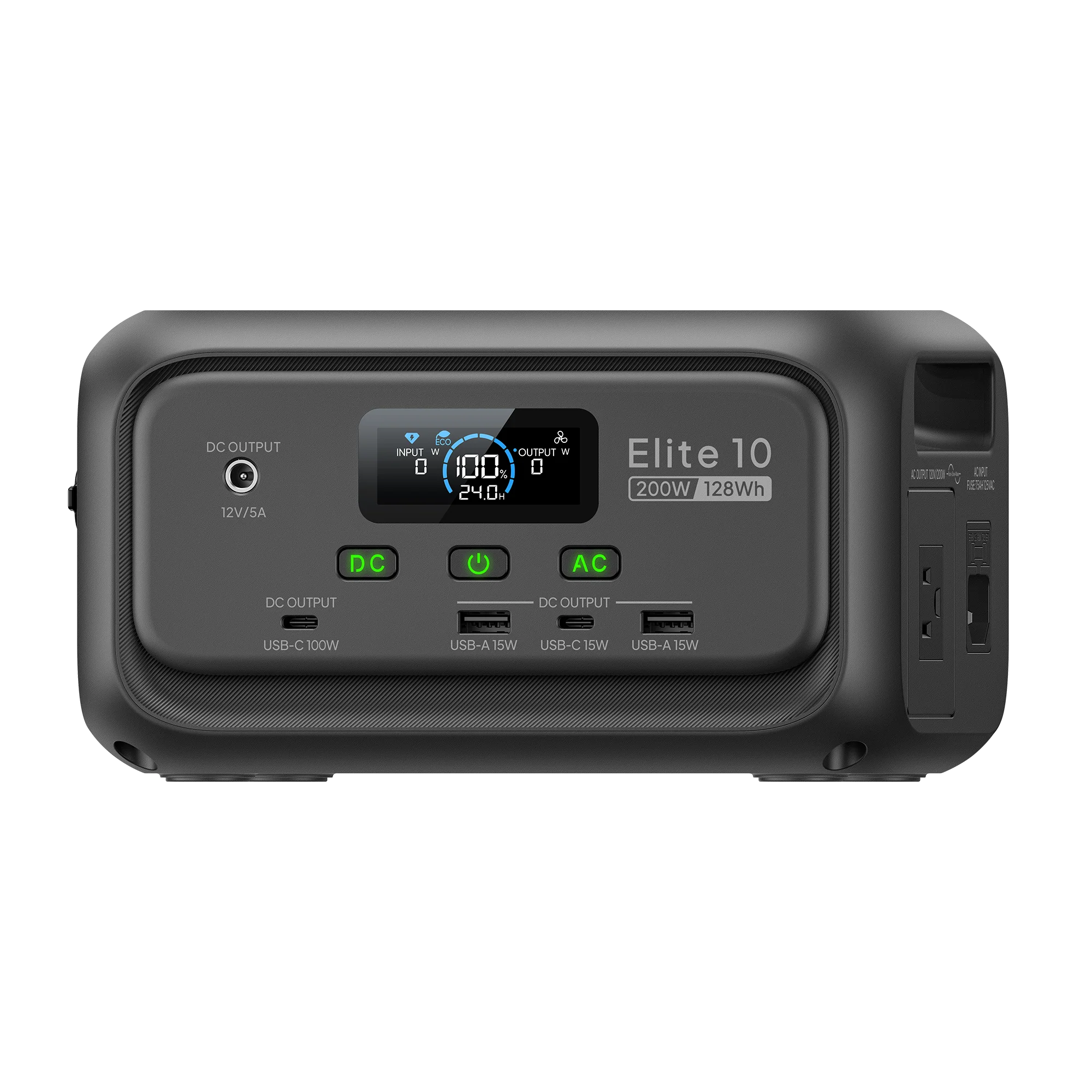
The BLUETTI Elite 10 Mini and the DJI Power 1000 sit on the same comparison page and almost nowhere else. The Mini is a 128Wh, 3.97-lb charger for $119; the Power 1000 is a 1,024Wh, 28.7-lb station for $699 — 896Wh more capacity and nearly 6 times the price, before a single scenario runs.
That gap shows up as two different kinds of losing. Push the Mini past its 200W outlet (300W on a surge) and it doesn't slowly drain — it refuses the load outright, sometimes with most of the 128Wh still in reserve. Push it past its total energy, which is most of what this page tests, and it just runs out, the ordinary way. The Power 1000 rarely does either: a 2,200W outlet and 8 times the capacity clear all but the biggest asks in this test.
Four of the six scenarios here are 'neither' — this pair gets asked to do jobs neither one is built for, and no amount of brand loyalty changes that. Of the two that do resolve, the Power 1000 wins both. That's not the Mini failing as a product; it's a $119 pocket charger being tested against a full power station's homework.
What the Numbers Reveal
Each conclusion stated first — the numbers behind it on one line, the full analysis below.
continuous output
The Mini can lose a scenario two different ways: by running out of Wh, or by refusing to start a device that draws more than 200W (300W surge) at all, regardless of what's left in the tank. Tailgate Party is the second kind of loss.
Elite 10 Mini: 200W continuous / 300W surge outputDJI Power 1000: 2,200W continuous / 4,400W surge outputTailgate Party needs 670Wh; the Elite 10 Mini cannot handle it (p1CanHandle: false)
Why it mattersAnyone shopping by watt-hours alone should check the outlet rating too, since a device that won't start doesn't care how much charge is left.
cost / lifetime kWh
That comparison only pays off if enough cycles actually get run through the battery to reach its rated life; someone topping off a phone twice a week never earns back the extra $580, they're just paying for capacity and cycles they won't use.
Elite 10 Mini: $119, 128Wh, 3,000 cycles, $0.31 per lifetime kWhDJI Power 1000: $699, 1,024Wh, 4,000 cycles, $0.17 per lifetime kWhPower 1000 costs $580 more upfront, nearly 6 times the Mini's price
Why it mattersBuy on lifetime cost-per-kWh only if you'll run the battery hard enough to earn back that gap, and buy on sticker price otherwise.
Typical price
That's not a knock on the Power 1000 — a year of coverage on a 1,024Wh station protects a lot more hardware than a year on a 128Wh brick — but it means longer warranty and better warranty value aren't the same claim here.
Elite 10 Mini: $119 over a 3-year warranty, about $40 per covered yearDJI Power 1000: $699 over a 5-year warranty, about $140 per covered yearPower 1000's warranty runs 2 years longer than the Mini's
Why it mattersDon't let the extra 2 years alone justify the price gap when the warranty should be judged on what it protects, not just its length.
28.7 lbs for 1,024Wh and a 2,200W outlet is a normal weight in the power-station class the Power 1000 actually competes in — it isn't a light unit, it's a station-class weight for a station-class job, and stacking it against a 3.97-lb pocket charger is a category comparison, not a fair fight on weight alone.
Elite 10 Mini: 3.97 lbsDJI Power 1000: 28.7 lbsDJI Power 1000: 1,024Wh capacity, 2,200W continuous output
Why it mattersDecide which category you actually need before comparing weight at all, since a jacket-pocket charger and a station you set down are different purchases, not two points on the same scale.
The specific dimensions that decide these two units — everything else is a tie.
Your Life, Your Pick
Selected because: Six real-world loads make the size mismatch concrete — four are neither, two are clean Power 1000 wins, and the failure modes differ (energy vs wattage).
Four of six scenarios here return 'neither,' and that's the most honest verdict this page can give: Weekend Camping, an 8-Hour Blackout, a Remote Workday, and Van Life Daily all ask for more energy than either unit holds, some by an enormous margin. The Mini isn't a rounding error short on any of them — depending on the scenario, it would need somewhere between 8 and 43 times its own usable capacity to get there.
The two scenarios that do resolve are instructive in different ways. CPAP Overnight is a clean energy win for the Power 1000, using about 37% of what's usable with the Mini nowhere close. Tailgate Party is the more interesting failure: the Mini can lose that one on wattage before it ever runs low on charge, because a 200W outlet (300W surge) simply won't start whatever single device in the setup draws more than that. That's a different kind of losing than running flat, and it's worth knowing which one you're planning around.
Portability & Form Factor
Selected because: 3.97 lbs vs 28.7 lbs is the actual axis of this comparison — pocket charger vs full station, and DJI shouldn't be sold as light.
weight
3.97 lbs against 28.7 — the Power 1000 weighs more than 7 times what the Mini does, and it's a two-hands lift where the Mini is a one-hand, into-the-jacket-pocket object. That's not a knock on the Power 1000; at 1,024Wh and a 2,200W outlet, 28.7 lbs is a normal, even reasonable, weight for what it's carrying.
The comparison only turns unflattering if you measure the Power 1000 against the Mini's category instead of its own. It isn't a light unit and shouldn't be marketed as one — it's a station you set down for the weekend, not a charger you forget is in your bag. Buy on the category you actually need, and the weight gap stops being a demerit for either side.
Lifetime Value
Selected because: Nearly 6x the upfront price but the cheaper cost-per-lifetime-kWh; worth separating those two claims honestly.
cost / lifetime kWh
The Power 1000 costs nearly 6 times as much to buy ($699 against $119) and is also the cheaper unit per kWh over its life, $0.17 against the Mini's $0.31. Those are two different claims, and only one of them matters if you won't cycle the battery hard enough to reach its rated life.
Warranty economics cut the other way in raw dollars: spread each price over its covered term and the Mini runs about $40 a year against the Power 1000's $140, even though the Power 1000's warranty runs 2 years longer. None of this reverses the headline — the Power 1000 is the cheaper energy over a full lifetime — it just means 'cheaper to own' and 'cheaper to buy' point in opposite directions here, and it's worth being honest about which one applies to you.
What the Specs Don't Tell You
Selected because: Five cards fire (noise, surge ratio, UPS, warranty, cycle life) and several invert the obvious size story.
rated cycles
Two of these cards invert what you'd expect from the size difference alone. The bigger, heavier unit is the quiet one, and the pocket-sized one is the faster switcher in UPS mode — neither result follows from capacity or price, and both are worth knowing before you assume 'bigger' predicts every spec.
The warranty and cycle-life cards add a similar wrinkle to the value story: the Power 1000's coverage is longer and its battery is rated for more total cycles, but neither gap is as dramatic, dollar for dollar or year for year, as the nearly 6x price difference between the two units. The surge-to-rated ratio is the one card that plainly favors the Power 1000 on build quality, independent of anything to do with size.
Brand Trust
Selected because: Cross-brand pair; DJI's generated caveat needs correcting for this specific unit, and BLUETTI's support inconsistency is worth flagging.
BLUETTI's support has a real track record of inconsistency — good outcomes for some buyers, weeks-long runarounds for others — which matters less on a $119 unit you might not bother sending back than it would on a $699 one. DJI's support inherits its reputation from a much larger drone business, but the power-station side of that has only about two years of real-world track record to point to.
Neither brand risk should decide this purchase on its own. The bigger factors here are still what each unit actually does — capacity, output, and the scenarios each one covers — with brand trust as a tiebreaker only if you're genuinely on the fence between the two price tiers.
Strengths & trade-offs
BLUETTI Elite 10 Mini
Strengths
- +Costs $580 less
- +Lighter by 24.7 lb
Trade-offs
- –Weaker inverter (-2,000W) limits appliance compatibility.
- –Shorter-lived battery — rated for 3,000 charge cycles vs the Power 1000's 4,000, so it wears out sooner.
DJI Power 1000
Strengths
- +Larger battery capacity
- +Higher AC output
- +Longer warranty
- +Faster solar charging
- +Rated for 4,000 charge cycles — much longer battery lifespan
Trade-offs
- –Substantially more expensive (+$580) than the Elite 10 Mini.
- –Significantly heavier (+24.7 lbs), making it harder to move.
Will It Power Your Gear?
Scenario math and per-appliance runtimes, modeled from the spec record.
Scenario verdicts
We ran the math on seven real-world scenarios. Here's which unit survives your actual life.
SCN-01 · 2 nights · needs 2,100Wh
Weekend Camping
Two nights off-grid with essential comfort
Neither unit
Needs 2,100Wh for the weekend, and neither unit is close. The Mini would need about 19 times what it actually holds; the Power 1000 needs nearly 2.5 times its own. This is a job for a bigger battery, solar input, or a vehicle running alongside camp, not either unit here alone.
Battery budget usedlower = more headroom
LOAD Phone Charger 15W×6h · LED Lights 40W×8h · Box Fan 75W×14h · CPAP Machine 40W×16h
SCN-02 · 8 hours · needs 1,645Wh
8-Hour Blackout
Keep the essentials running through a night without power
Neither unit
Needs 1,645Wh to ride out the outage. The Mini needs roughly 15 times its usable capacity to get there; the Power 1000 needs almost twice its own. An 8-hour whole-home blackout outgrows both of these units, and by a wide margin even for the larger one.
Battery budget usedlower = more headroom
LOAD Fridge 150W×8h · Router + Modem 20W×8h · LED Lights (4 bulbs) 40W×6h · Phone Charger 15W×3h
SCN-03 · 8 hours · needs 320Wh
CPAP Overnight
Sleep therapy without interruption — the #1 medical use case
Power 1000
Needs 320Wh for the night. The Mini would need about 3 times what it can hold, so it doesn't make it past a few hours. The Power 1000 covers the whole night using about 37% of what's usable, with more than half its capacity still in reserve.
Battery budget usedlower = more headroom
LOAD CPAP Machine 40W×8h
SCN-04 · 8 hours · needs 910Wh
Remote Workday
Full work day off-grid without power anxiety
Neither unit
Needs 910Wh across the day. The Mini isn't close, needing more than 8 times its usable capacity. The Power 1000 comes right to the edge of its own limit, needing about 5% more than its 1,024Wh actually provides once the usual charging losses and safety margin are factored in — a full workday of laptop, monitor, and peripherals sits right at this unit's ceiling.
Battery budget usedlower = more headroom
LOAD Laptop 60W×8h · External Monitor 30W×8h · Router + Modem 20W×8h · Phone Charger 15W×2h
SCN-05 · 4 hours · needs 670Wh
Tailgate Party
Game day power for the crew
Power 1000
Needs 670Wh for the day. The Mini runs out, and likely before its battery is what actually gives up — a tailgate setup often includes at least one device (a blender, a larger speaker, a hot plate) that draws more than its 200W outlet (300W surge) can deliver at all, regardless of charge remaining. The Power 1000's 2,200W outlet has no such ceiling to hit, and finishes the day at about 77% of what's usable.
Battery budget usedlower = more headroom
LOAD Blender 400W×0.5h · LED TV (55") 80W×4h · Bluetooth Speaker 15W×4h · Phone Charger (×3) 45W×2h
SCN-06 · 24 hours · needs 4,685Wh
Van Life Daily
A full day of mobile living — the ultimate endurance test
Neither unit
Needs 4,685Wh a day of heavy, sustained use. Neither unit is in range: the Mini would need on the order of 43 times its usable capacity, and the Power 1000 needs more than 5 times its own. Daily van-life power at this level runs on multiple large batteries, solar, or the vehicle's alternator, not a single unit from this pair.
Battery budget usedlower = more headroom
LOAD Mini-Fridge 150W×24h · Laptop 60W×4h · Phone Charger 15W×3h · LED Lights 40W×5h · Fan 75W×8h
SCN-07 · an afternoon · needs 100Wh
Afternoon Off-Grid
Phones and a speaker at the park, beach, or campsite — the small-unit job description
Either unit
This row is here for the Elite 10 Mini's class of job: phones and a speaker, 100Wh across an afternoon. Both cover it — the Elite 10 Mini finishes at 92% used, and the Power 1000 barely notices it. For this job the Power 1000's extra capacity is dead weight, not headroom; take the Elite 10 Mini at 4 lbs and leave the rest at home.
Battery budget usedlower = more headroom
LOAD Phone Charger (×2) 30W×2h · Bluetooth Speaker 10W×4h
The Load Test
RUNTIME = (Wh × 0.85) ÷ LOAD
None of the scenarios above exactly yours? Build it. Toggle what you'd plug in; both units are tested against the combined draw.
Essentials
Comfort & Convenience
High-Draw Appliances
Test duration
8h
Continuous draw
205W
Projected runtime
Only the Power 1000 can start this 205W load.
Modeled from the spec record — same math as the tables below. Methodology
Runtime by appliance
Real-world runtime estimates for common appliances, modeled at 85% inverter efficiency.¹
Essentials
The basics you need runningscale 0–58hComfort & Convenience
Makes off-grid life actually enjoyablescale 0–11.6hHigh-Draw Appliances
These reveal the real limitsscale 0–0.9h¹ Runtime = (capacity × 0.85) ÷ appliance watts. Within each group, all bars share one time scale (the group's longest runtime), so lengths are comparable across appliances; identical runtimes collapse into a single blue/orange bar. Actual runtime varies with battery age, temperature, and simultaneous loads — see methodology.
Conclusion
July 28, 2026
Verdict: the Power 1000, on Power Score margin
DJI's Power 1000 wins every axis that actually separates these two: it's the cheaper energy over a lifetime ($0.17 per kWh against the Mini's $0.31), it's the only one to win either of the two scenarios that resolve to a winner at all (CPAP Overnight, Tailgate Party), and its power score is more than double the Mini's (3,099 against 1,480). The honest catch is the price: nearly 6 times as much upfront, for a unit that's also more than 7 times the weight. And four of six scenarios in this test are 'neither' because they ask for more energy than either box holds. Buy the Power 1000 for anything approaching station-scale power; buy the Mini only if the job really is just phones and a laptop, where the Power 1000's extra capacity and cost buy nothing.
Today the Elite 10 Mini is $113, $6 under its typical $119. The verdict weighs typical prices, not today's. Prices checked 1 day ago.
Editor-assigned confidence, based on cited owner research and spec analysis.
List prices as of July 28, 2026. The links below open BLUETTI's and DJI's current prices.
$699.00 · direct from DJI
Last checked 1 day ago. Prices move — check before you buy.
or check the Elite 10 Mini price$113.00 list
Written by Wenny Zheng, Portable Power Tester · Station Arena Test Desk · Updated July 28, 2026
Measured Data
Benchmark scores and the full spec record, side by side.
Benchmark scores
Not rated for both units (minimum threshold unmet): RV Living, Home Backup, CPAP, Solar Generator, Tailgating, Food Truck, Camping.
Full specifications
ᵈ Derived: price ÷ rated capacity. See the data behind our comparisons →
Comparison ToolAdd more power stations, side by sideOpen Tool →How these numbers are produced
Numeric verification
Every figure on this page traces to our spec database or arithmetic on it — no estimated numbers.
Owner claims
Statements about owner experience are cited to published reviews — see Sources & Research Notes below.
Runtime model
Runtime = (rated capacity × 0.85 inverter efficiency) ÷ device wattage. Solar recharge estimates assume panels deliver 70% of rated output. Cold weather, battery age, and stacked loads reduce real-world results.
Power Score
Computed from 14 published spec dimensions, weighted per use-case bench. Higher is better; a unit must meet a bench's minimum threshold to be rated.
See the full weight table and data sourcing on our methodology page →Class ranking (the star rating)
Each unit's star score is a category ranking, not customer reviews — no buyer opinions feed it. We score every station on size-independent quality (value, output, portability, endurance, ports, warranty, and more), then percentile-rank it against the other units in its capacity class, so a class-leading compact unit and a class-leading whole-home unit can both earn 5★. Here, Elite 10 Mini rates 4.1/5 (48th percentile of 22 Personal-class units), and Power 1000 rates 3.8/5 (31st percentile of 27 Everyday-class units).
How the class ranking is computed →Test Notes & Caveats
Hidden gotchas and advantages we spotted that you won't find on the product page.
The Bigger Unit Is the Quiet One
Elite 10 Mini measures 45dB under load; Power 1000 measures 23dB. Bigger inverters usually mean bigger fans and more noise, and that pattern flips here — the full-size station is the quieter machine by a wide, easily audible margin.
Surge Headroom: 1.5x vs 2x
The Mini surges to 300W against a 200W rating, a 1.5x cushion. The Power 1000 surges to 4,400W against 2,200W rated, a full 2x. More surge headroom relative to the rated number generally signals a more overbuilt inverter, with more margin for the split-second spike a motor or compressor pulls at startup.
The Smaller Unit Switches Faster
Elite 10 Mini's UPS mode switches in under 10ms, line-interactive grade. Power 1000 takes under 20ms, standby grade. Both are fast enough to keep a laptop or router running through a blip, but on this one spec, the smaller unit is technically ahead.
Cheaper Per Warranty Year, Not Cheaper Overall
Spread the price over the coverage term: the Mini runs about $40 a covered year (3 years on $119), the Power 1000 about $140 a covered year (5 years on $699). The Power 1000's warranty runs 2 years longer, but the Mini is the cheaper warranty in raw dollars per year — a different question from which unit is the better overall buy.
1,000 More Cycles, a Few More Years
3,000 rated cycles against 4,000. Cycled daily, that's 8.2 years for the Mini against 11 for the Power 1000, 2.8 more years. Cycled weekends-only, both stretch past 28 years, with the Power 1000 still ahead by nearly 10. Either battery will outlast the electronics you're running off it.
Full record above — the Test Desk pick is the Power 1000.
Check Power 1000 price →or check the Elite 10 Mini priceOwnership Analysis
What happens after you buy — true cost of ownership, brand trust, and growth potential.
Lifetime value
Service lifeyears at one full cycle per day
Lifetime energy delivered
Cost per delivered kWh
│ warranty ends · Reaching the cycle rating means ~80% capacity remains — degraded, not dead.
Analyst note
The Elite 10 Mini is cheaper to buy, but the Power 1000 is cheaper to own. At $0.17/kWh over its lifetime vs $0.31/kWh, the Power 1000's higher cycle life and capacity make each dollar go further over the years.
Delivers each lifetime kWh for $0.14 less — check the Power 1000 price →
Brand trust
BLUETTI
Ecosystem
One of the broadest lineups — 15-20+ models from budget (AC2A) to flagship portable (Apex 300, 2764.8Wh). Includes specialized products: vehicle solar hubs, sodium-ion cold-weather units, and balcony storage systems.
Support
The most inconsistent support in the space. Heavily email-based with China timezone delays. Some users get smooth, efficient service; others report weeks of troubleshooting runarounds, being offered discounts on new units instead of repairs, and confusing third-party purchase claim processes. Buying direct from Bluetti's website tends to produce better support outcomes.
Community
Active and growing — Reddit r/bluetti has a dedicated community. Second-largest after EcoFlow in engagement.
App experience
Rated 4.5/5 iOS and Android — tied for best app experience in the category. V3.0 UI redesign was well-received.
Unique strength
Among the best capacity-to-price ratios available — several Elite and Apex units are the lowest $/Wh in the catalog. Widest product diversity including industry-firsts like sodium-ion cold-weather units and dual solar+alternator vehicle hubs. LFP across the rest of the range, though rated cycle life spans 2,500 (EB3A) to 6,000, and it varies WITHIN the Elite range rather than tracking it — the Elite 300 and Elite 200 V2 are rated 6,000 while the Elite 30 V2, Elite 10 Mini, Elite 320 and Elite 400 are rated 3,000+ and the Elite 100 V2 4,000+, so check the specific model. Dual-voltage (120V/240V) in flagships.
Worth knowing
Customer support inconsistency is the #1 risk factor. Older/discontinued units may become unrepairable — no spare parts policy for some models. Some reports of erratic communication from support agents.
DJI
Ecosystem
New entrant (2024) — five power station models to date: Power 500, Power 1000 (since superseded by the V2 but still sold), Power 1000 V2, Power 1000 Mini, Power 2000. Buying a "Power 1000" listing? Check which revision it actually ships.
Support
Leveraging DJI's established global support and repair center network from the drone business. Generally positive reputation inherited from drone operations, but limited power-station-specific track record.
Community
No dedicated power station community yet. Discussions happen within r/dji (~250K members, mostly drone users). Very small power-specific presence on Facebook and forums.
App experience
Rated 3.5/5 iOS and Android (DJI Home app ratings reflect entire DJI ecosystem including drones/cameras, not power-station-specific). Users report the on-device screen is more reliable than the app.
Unique strength
Runs quiet — 23-30dB published on most of the range (manufacturer best-case figures), at the quiet end of the category; our record carries no figure for the Power 1000 V2. Fast wall charging, quickest on the Power 1000 V2 at ~56 min — that figure is the V2's, not the whole line's. 700+ battery patents from drone R&D. SDC ports for ultra-fast DJI drone charging. Premium industrial design and build quality. LFP batteries rated for 4,000+ cycles.
Worth knowing
DJI's power-station line is barely two years old, even though the parent company has been building battery tech for drones for more than a decade. This unit needs a separate solar adapter since there's no built-in charge controller, and its SDC fast-charge ports are DJI's own connector, most useful if you're already charging drone batteries.
Analyst note
BLUETTI's catalog runs wide, budget to flagship, on the strength of a capacity-to-price reputation the Elite 10 Mini's $119 tag backs up. DJI's four-model lineup is younger and pricier, and it's betting on quiet running and fast charging rather than catalog breadth to make its case.
Growth path
Elite 10 Mini
FIXED CAPACITYFixed at 128Wh, with no expansion — so size it for your needs up front rather than planning to add capacity later.
Accepts up to 100W of solar. Limited to a single portable panel.
Limited ports. You'll likely need a power strip or splitter.
Power 1000
FIXED CAPACITYFixed at 1,024Wh, with no expansion — so size it for your needs up front rather than planning to add capacity later.
Accepts up to 800W of solar. Suitable for a 1-2 panel setup.
Adequate ports for most setups, but heavy users may want a power strip.
Realistic full solar rechargeat 70% of rated panel output — see methodology
Analyst note
Neither expands, and that's no knock on either — each is a complete unit at a fixed size. Buy the capacity that covers your needs now (the Power 1000 gives you the larger ceiling); you can't add to either later.
What Owners Report
Patterns from published owner reports and long-term reviews — every claim cited to its source below.
BLUETTI Elite 10 Mini
Field reports on the Elite 10 Mini are consistent about what it's for: a 128Wh LiFePO4 brick with a real AC outlet plus dual USB-C, one at 100W PD, built for gadgets rather than appliancesA1. Owners say it recharges quickly for its size and holds up in UPS mode with a sub-10ms switchoverA2. The capacity gets described in real terms — enough to keep a phone topped up many times over, get a laptop through a charge or so, and run a small light for an evening, but nobody's pointing it at a fridge or a power toolA3. At its current $119 price, the dual USB-C setup gets singled out as the feature people actually use day to dayA4.
“A 128Wh LiFePO4 mini power station with a 200W AC outlet plus dual USB-C (100W PD and 18W), two USB-A, and a 12V DC port.”
Sources
bluettipower.com · macrumors.com · backuppowerhub.com · geardiary.com · outdoortechlab.com · irishexaminer.com · 9to5toys.com · cleantechnica.com
DJI Power 1000
The recurring theme on the Power 1000 is how quiet it runs — reviewers call it one of the quietest stations in its class, noticeable only under heavy load and even then more of a soft whoosh than a whirB1. Independent testing has pushed it past its rated output for extended stretches without shutting down or getting loud about itB2. Recharge reports are similarly positive: quick to fill, and quiet doing itB3. In the field, owners describe running a small compressor fridge alongside phones, laptops, and lighting over a multi-day trip, and drone pilots have adopted it specifically to fast-charge flight batteries while still powering everything elseB4.
“Whisper-quiet operation — one of the quietest power stations in its class, nearly silent under normal loads; sound only becomes noticeable past 1,500W, and even then it's a soft whoosh rather than the high-pitched whirring you'd get from BLUETTI or EcoFlow.”
Sources
thesolarlab.com · trailandkale.com · offgridbenchmark.com · superfashion.us · dronexl.co
Sources & Research Notes
Every owner claim in this report is traceable to a published source. The bracketed references above resolve here.
Recurring owner themes
- Palm-sized LFP mini unit with a real AC outlet, fast charging, sub-10ms UPS, and dual USB-C — for gadgets, not appliances. [Elite 10 Mini · 3 entries]
- Standout quiet operation (quieter than EcoFlow/BLUETTI), robust real-world output above its rating, and appeal to drone pilots and campers are the consistent themes. [Power 1000 · 3 entries]
- A1
“A 128Wh LiFePO4 mini power station with a 200W AC outlet plus dual USB-C (100W PD and 18W), two USB-A, and a 12V DC port.”
bluettipower.com / macrumors.com — Elite 10 Mini review · 2026 · [positive]
- A2
“Reaches a full charge in about 70 minutes — one of the fastest in the sub-200Wh segment — and supports UPS mode with an under-10ms switchover.”
backuppowerhub.com / geardiary.com — Elite 10 Mini review · 2026 · [positive]
- A3
“128Wh is enough to charge a laptop 1-2 times, a phone 10-12 times, or run a 10W LED lamp about 13 hours; not for appliances, fridges, or power tools.”
outdoortechlab.com / irishexaminer.com — Elite 10 Mini review · 2026 · [mixed]
- A4
“Launched at $119 (down from $199); owners highlight the dual USB-C setup as a most-used feature — a palm-sized companion for drives and short trips.”
9to5toys.com / cleantechnica.com — Elite 10 Mini review · 2026 · [positive]
- B1
“Whisper-quiet operation — one of the quietest power stations in its class, nearly silent under normal loads; sound only becomes noticeable past 1,500W, and even then it's a soft whoosh rather than the high-pitched whirring you'd get from BLUETTI or EcoFlow.”
thesolarlab.com / trailandkale.com — DJI Power 1000 review · 2026 · [positive]
- B2
“Tested at 2,400W — slightly above its 2,200W output rating — for 20 minutes and handled it without loud noise or automatic shut-offs.”
offgridbenchmark.com / superfashion.us — DJI Power 1000 review · 2026 · [positive]
- B3
“AC charging takes about 70 minutes from 0% to 100% (about 50 minutes to 80%), and during full-speed charging the fan barely makes a sound.”
thesolarlab.com — DJI Power 1000 review · 2026 · [positive]
- B4
“Over a week-long camping trip it powered a 45W compressor fridge, phones, laptops, and LED lights; it's also a favorite of drone pilots for fast-charging DJI batteries while running other devices.”
offgridbenchmark.com / dronexl.co — DJI Power 1000 review · 2026 · [positive]
Research compiled July 28, 2026.
Who Should Buy Which
Buy the Elite 10 Mini if you…
- →Buy the Elite 10 Mini if what you actually need is a phone-and-laptop charger that lives in a bag or a glovebox, not a power station. At $119 and 3.97 lbs, it does one job — keep small devices alive — for a fraction of the Power 1000's price.
- →It's also the right call if UPS switchover speed matters more to you than raw capacity — its sub-10ms switchover is technically the faster of the two, useful for protecting something sensitive to even a brief power blip.
Buy the Power 1000 if you…
- →Buy the Power 1000 if you need actual station-class power. It's the only one of these two that covers a CPAP overnight or a tailgate's worth of gear, and it finishes the Tailgate Party run with real headroom to spare, about 77% of what's usable.
- →It's also the buy if you'll run it hard enough to make the lifetime economics matter — $0.17 per kWh over its life against the Mini's $0.31 — and if you want the quieter machine in the room despite being the much bigger one.
This is you — check the Power 1000 price
If neither fits
Skip both if the real number is an 8-hour blackout, a full weekend of camping, or daily van life — every one of those needs more energy than either unit holds, some by more than 40 times over. That's a job for a larger single station, or a multi-battery and solar setup, not a $119 charger or a $699 station stretched past what it can give.
The Bottom Line
The Power 1000 wins this one, and not because the Elite 10 Mini is a bad $119 charger — it's because four of six real-world loads here need more energy than either unit holds, and of the two that do resolve, the Power 1000 covers both while the Mini can't touch either. Nearly 6 times the price buys 8 times the capacity, a 2,200W outlet that starts what the Mini's 200W can't, and a lifetime cost of $0.17 per kWh against $0.31.
If the real need is a pocket charger for a phone and a laptop, buy the Mini and keep the other $580 — that's paying for capacity that would go unused. If the need is something that can run a CPAP overnight or carry a tailgate's worth of gear, the Power 1000 is the one that shows up. Just don't buy it expecting a light travel companion: at 28.7 lbs, it's a station you set down, not one you forget you're carrying.
Frequently Asked Questions
Answers drawn from the spec record and cited owner research.
Can the DJI Power 1000 run a CPAP all night?
Yes. A CPAP Overnight load of 320Wh uses about 37% of the Power 1000's usable capacity, leaving more than half in reserve for a bad night or a second day without recharging. The Elite 10 Mini can't cover the same night — its 128Wh would need to be roughly 3 times bigger to get there.
Why is the smaller BLUETTI unit louder than the bigger DJI station?
Because size and fan noise don't track together here. The Elite 10 Mini measures 45dB under load against the Power 1000's 23dB, so the full-size station is the quieter machine by a wide, easily audible margin — likely down to fan and enclosure design rather than anything about capacity.
Is the DJI Power 1000 worth nearly 6 times the price of the Elite 10 Mini?
Only if you need what the extra money buys: 8 times the capacity, 11 times the continuous output, and coverage for scenarios like CPAP Overnight and Tailgate Party that the Mini can't touch. If the real use case is topping off a phone and a laptop, the Mini does that job for a fraction of the cost, and the Power 1000's extra capacity just goes unused.
Why would the BLUETTI Elite 10 Mini fail at a tailgate if the DJI Power 1000 doesn't?
Partly on wattage, not just energy. The Mini's outlet is rated for 200W continuous (300W surge), and a single higher-draw device in a typical tailgate setup — a blender, a bigger speaker, a hot plate — can exceed that and simply won't start, no matter how full the battery is. The Power 1000's 2,200W outlet doesn't have that ceiling, and still finishes the day with about 23% of its usable capacity left over.
Which one has the better warranty?
The Power 1000's 5-year warranty is longer than the Mini's 3-year warranty in absolute terms. But spread each price over its covered term and the Mini is the cheaper warranty in raw dollars per year, about $40 against the Power 1000's $140, since the coverage increase doesn't scale with the much larger price gap. Longer coverage and better warranty value aren't quite the same claim here.
Check Power 1000 price →
Brand matchup
BLUETTI vs DJI: measured across every matchup →Where to buy
BLUETTI Elite 10 Mini
$113.00
$113.00 · direct from BLUETTI
down from $119 · 5% below usual
Last checked 1 day ago. Prices move — check before you buy.
DJI Power 1000Pick
$699.00
$699.00 · direct from DJI
Last checked 1 day ago. Prices move — check before you buy.
Prices may vary by retailer and are subject to change.