Head-to-head test
BLUETTI Apex 300 vs DJI Power 500
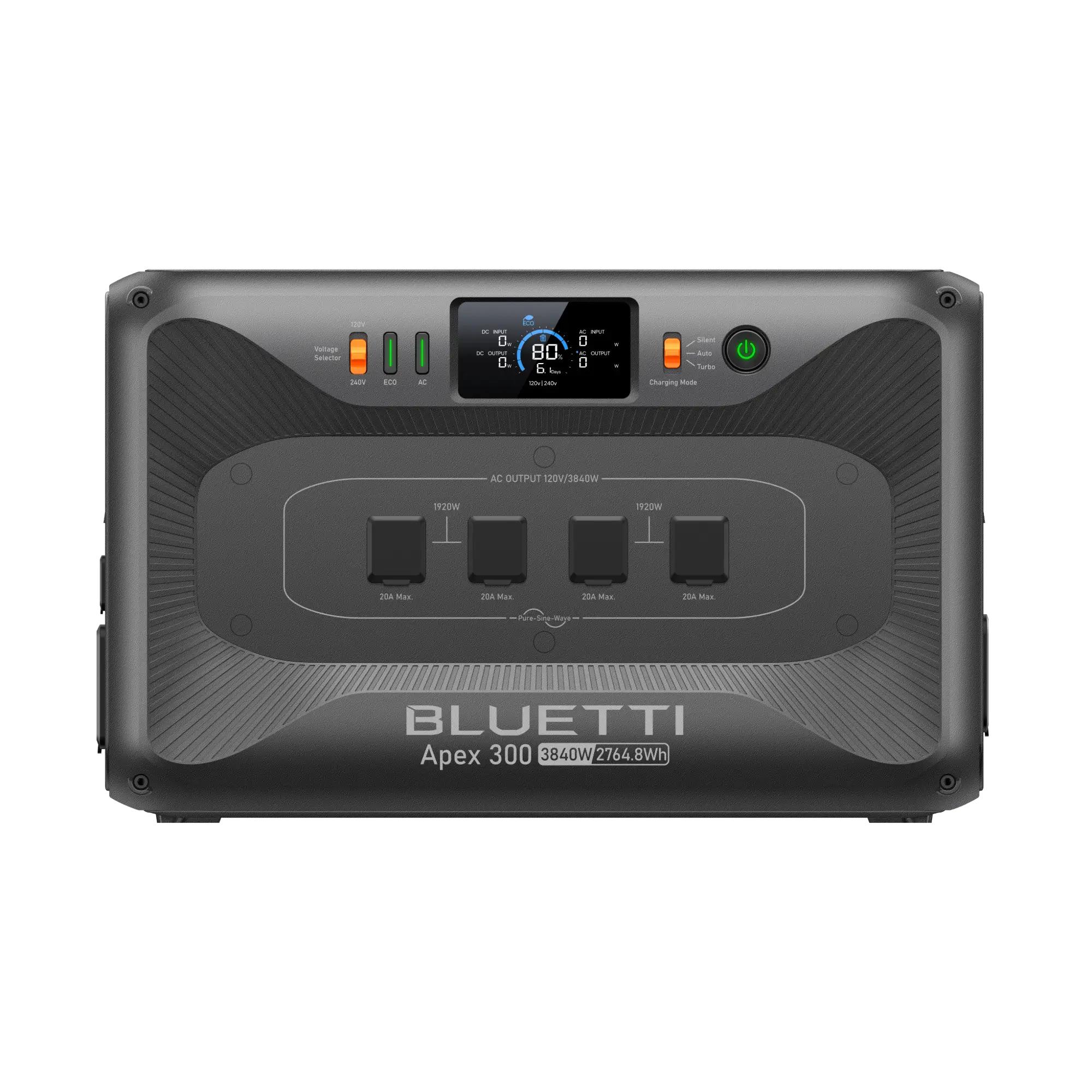
Buy the Power 500 for a CPAP and nothing else; buy the Apex for everything else on this page, and expect to pay $1,400 and carry 67.68 more pounds for the privilege.
Full profiles: BLUETTI Apex 300 → · DJI Power 500 →

Written by Ian SchneiderUpdated
Solar & Off-Grid Tester, Station Arena Test Desk
$1,499.00 · direct from BLUETTI
down from $1,699 · 12% below usual
Last checked 1 day ago. Prices move — check before you buy.

$299.00 · direct from DJI
Last checked 1 day ago. Prices move — check before you buy.
Spec deltas
Run the numbers and the split lands almost exactly where the price tag suggests: the Apex 300 is a 2,764.8Wh station built to survive a blackout or a full weekend off-grid, and the Power 500 is a 512Wh unit built to keep a CPAP running for one night and not much else. Five of the six real-world loads this site scores need more than the Power 500 holds. Only one doesn't.
That one is CPAP Overnight, where the Power 500 covers the full 320Wh draw using about three-quarters of its battery — a complete answer if that's the only job on the list. Everywhere else the gap isn't close: Weekend Camping needs 483% of the Power 500's capacity, an 8-hour blackout needs 378%. In practice that means draining and recharging the unit several times over, mid-trip, which defeats the point of a backup unit in the first place.
None of that makes the Power 500 a bad product. At $299 against the Apex's $1,699, it's not pretending to be a blackout box — though on cost per lifetime kWh it's the Apex, with its 6,000-cycle cell, that comes out ahead. What the Power 500 can't do is manufacture capacity it doesn't have — and the rest of this page is about what that capacity costs when you do need it.
What the Numbers Reveal
Each conclusion stated first — the numbers behind it on one line, the full analysis below.
Capacity
The Apex isn't heavy because BLUETTI built it inefficiently. It's heavy because it's carrying 5.4 times the energy, at a slightly better weight-to-capacity ratio than the unit you'd call light. There's no version of 2,764.8Wh that weighs 16 lbs. The physics doesn't allow it.
Apex 300 weighs 83.78 lbs and holds 2,764.8WhPower 500 weighs 16.1 lbs and holds 512Wh
Why it mattersStop weighing the 83.78 lbs against the Power 500's 16.1 and start weighing it against whether you actually need 2,764.8Wh. That's the only question the number can answer.
Add almost anything to a CPAP-only trip — a light, a fan, a phone charging all weekend — and you've likely crossed the line where the Power 500 can no longer finish on the charge it started with.
CPAP Overnight needs 320Wh and the Power 500 covers it at 74% of its capacityTailgate Party needs 670Wh and the Power 500 would need 154% of its capacity
Why it mattersA reader whose only real load is CPAP backup can stop at the Power 500. A reader stacking even one more device onto that same trip should assume they've crossed into Apex territory.
continuous output
Compressors and motors draw two to three times their rated wattage for a moment at startup. The Power 500 can't absorb any of that overshoot, so a load that looks like it fits inside 1,000W on paper can still trip the unit the instant it switches on.
Apex 300 surges to 7,680W against a 3,840W rated outputPower 500 surges to 1,000W against its own 1,000W rated output
Why it mattersAnyone planning to run a fridge, a space heater, or anything else with a motor or heating element should treat the Power 500's 1,000W as a hard ceiling with zero margin, not a target to run up against.
cost / lifetime kWh
Scale absorbs almost all of the apparent premium. The Apex isn't a worse deal per unit of energy delivered, it's just a much bigger total commitment. Rejecting it as overpriced doesn't hold up once you price the energy instead of the box.
Apex 300 costs $1,699 and works out to $0.10 per lifetime kWh over 6,000 cyclesPower 500 costs $299 and works out to $0.15 per lifetime kWh over 4,000 cycles
Why it mattersA reader dismissing the Apex on value grounds is arguing against the wrong number. The real question is capacity need, not cost efficiency, because on cost efficiency these two are nearly tied.
The specific dimensions that decide these two units — everything else is a tie.
Your Life, Your Pick
Selected because: Selected because: the Apex 300 fully covers five of six real-world loads on one charge and the Power 500 fully covers one, CPAP Overnight — so this is the section that tells you whether the smaller unit even works for your plans.
Five of six is the score, but the shape of the miss matters more than the count. The Power 500 doesn't fall a little short on Weekend Camping or an 8-hour blackout — it needs 483% and 378% of its own capacity, which in practice means draining and recharging it three or four times over mid-trip. CPAP Overnight is the exception: at 74% of its battery, the Power 500 actually finishes the job.
Van Life Daily is where size stops being the answer at all. A 4,685Wh daily draw asks for 199% of even the Apex's capacity — at that point you're not choosing between these two units, you're designing a charging system around solar panels or an alternator, and this comparison stops being useful.
Lifetime Value
Selected because: Selected because: the Apex costs $1,699 against the Power 500's $299, yet it's the cheaper of the two per lifetime kWh — $0.10 versus $0.15 — so the sticker gap badly overstates how much more expensive the Apex actually is to run.
cost / lifetime kWh
$1,699 against $299 is a $1,400 gap on the sticker, but divide each by what it delivers over its life and the story flips: $0.10 per kWh for the Apex against $0.15 for the Power 500, over 6,000 and 4,000 cycles respectively. The Apex is the cheaper energy of the two, not the dearer one.
Where the two really separate is the cost of a weekend, not a kilowatt-hour. Run the Apex on a weekend-only routine and it costs about 14 cents a day; the Power 500 runs about 2 cents. Twelve cents a day is nothing against $1,400 upfront if you actually need 2,764.8Wh on tap, and real money if you don't.
Portability & Form Factor
Selected because: Selected because: 83.78 lbs against 16.1 lbs is the literal cost of carrying 2,764.8Wh instead of 512Wh, and the Apex is the one you're deciding whether to lift, not just buy.
weight
83.78 lbs against 16.1 — a 67.68-lb gap — is a two-hands, bent-knees lift for the Apex, not something you swing out of a trunk one-handed the way you would the Power 500. That's a real, physical difference in who can move this thing alone and how often you'll actually want to.
Handle placement matters as much as total weight. The Apex ships as one box you maneuver into place and mostly leave there; the Power 500 at 16.1 lbs is the one you'd actually grab on the way out the door for a quick trip. Size the unit to how often it needs to move, not just how much it needs to hold.
Growth Path
Selected because: Selected because: the Power 500 is sealed at 512Wh for good, while the Apex can add BLUETTI expansion batteries past 2,764.8Wh if your needs keep climbing.
solar input
The Power 500 is what you buy when 512Wh is the ceiling, not a floor — there's no expansion path, so whatever it holds today is what it'll hold for as long as you own it. The Apex starts at 2,764.8Wh and can climb higher with BLUETTI's expansion batteries if that number ever needs to move.
That headroom only has value if you're actually going to use it. A buyer certain their needs are fixed gets nothing extra from the Apex's expandability. It's the buyer whose needs might grow toward partial-home backup who's paying for optionality, not just today's capacity.
What the Specs Don't Tell You
Selected because: Selected because: the Power 500's 1,000W surge ceiling matches its 1,000W rated output with zero headroom, while the Apex doubles its rated 3,840W to 7,680W for startup spikes.
rated cycles
Surge headroom is the one gotcha most likely to bite: the Power 500's 1,000W ceiling has zero margin above its rated output, while the Apex doubles its 3,840W rating to 7,680W for startup spikes — real margin if a compressor or motor is on the load list. The 45dB-versus-25dB noise gap matters most for CPAP Overnight, the one scenario where the Power 500 is also the quieter box to sleep next to.
The rest is closer to a footnote. Both units carry a 5-year warranty, and the switchover gap — under 10ms for the Apex against under 20ms for the Power 500 — is fast enough on both sides that it won't matter to anything without its own battery backup already doing the real work.
Strengths & trade-offs
BLUETTI Apex 300
Strengths
- +Larger battery capacity
- +Higher AC output
- +Faster solar charging
- +Rated for 6,000 charge cycles — much longer battery lifespan
Trade-offs
- –Substantially more expensive (+$1,400) than the Power 500.
- –Significantly heavier (+67.7 lbs), making it harder to move.
- –Very heavy unit that may be difficult for one person to lift.
DJI Power 500
Strengths
- +Costs $1,400 less
- +Lighter by 67.7 lb
Trade-offs
- –Weaker inverter (-2,840W) limits appliance compatibility.
- –Sealed capacity — the Apex 300 can add batteries to grow past 512Wh; this one can't.
- –Shorter-lived battery — rated for 4,000 charge cycles vs the Apex 300's 6,000, so it wears out sooner.
Will It Power Your Gear?
Scenario math and per-appliance runtimes, modeled from the spec record.
Scenario verdicts
We ran the math on six real-world scenarios. Here's which unit survives your actual life.
SCN-01 · 2 nights · needs 2,100Wh
Weekend Camping
Two nights off-grid with essential comfort
Apex 300
The Apex covers the full 2,100Wh weekend using 89% of its charge — one trip, no recharge. The Power 500 would need 483% of its own capacity, which in practice means drained, recharged, and drained again more than four times over, assuming there's even an outlet at the campsite. This is the scenario the Apex is built for.
Battery budget usedlower = more headroom
LOAD Phone Charger 15W×6h · LED Lights 40W×8h · Box Fan 75W×14h · CPAP Machine 40W×16h
SCN-02 · 8 hours · needs 1,645Wh
8-Hour Blackout
Keep the essentials running through a night without power
Apex 300
An eight-hour blackout needs 1,645Wh. The Apex covers it at 70% of capacity with room for the next outage. The Power 500 needs 378% of its own — the better part of four full charges — and a blackout is exactly the scenario where you can't just plug in and wait, because the power being out is the whole problem.
Battery budget usedlower = more headroom
LOAD Fridge 150W×8h · Router + Modem 20W×8h · LED Lights (4 bulbs) 40W×6h · Phone Charger 15W×3h
SCN-03 · 8 hours · needs 320Wh
CPAP Overnight
Sleep therapy without interruption — the #1 medical use case
Power 500
The Apex wins this one on paper — 320Wh of CPAP draw is 14% of its charge, barely a dent. But the Power 500 clears it too, using about three-quarters of its own battery for one night. If CPAP backup is the entire job, the smaller unit is a complete answer; the Apex's edge here is headroom you may never use.
Battery budget usedlower = more headroom
LOAD CPAP Machine 40W×8h
SCN-04 · 8 hours · needs 910Wh
Remote Workday
Full work day off-grid without power anxiety
Apex 300
The Power 500 doesn't finish — 435Wh usable against the 910Wh this needs leaves it 475Wh short, about 48% of the scenario covered. The Apex 300 covers it with 1,440Wh to spare.
Battery budget usedlower = more headroom
LOAD Laptop 60W×8h · External Monitor 30W×8h · Router + Modem 20W×8h · Phone Charger 15W×2h
SCN-05 · 4 hours · needs 670Wh
Tailgate Party
Game day power for the crew
Apex 300
The Power 500 doesn't finish — 435Wh usable against the 670Wh this needs leaves it 235Wh short, about 65% of the scenario covered. The Apex 300 covers it with 1,680Wh to spare.
Battery budget usedlower = more headroom
LOAD Blender 400W×0.5h · LED TV (55") 80W×4h · Bluetooth Speaker 15W×4h · Phone Charger (×3) 45W×2h
SCN-06 · 24 hours · needs 4,685Wh
Van Life Daily
A full day of mobile living — the ultimate endurance test
Neither unit
Neither unit gets through a 4,685Wh van-life day on one charge — the Apex would need 199% of its capacity, the Power 500 over ten times its own. That's a solar-and-alternator sizing problem, not a pick-the-bigger-box problem. Anyone actually living this scenario is comparing the wrong two products.
Battery budget usedlower = more headroom
LOAD Mini-Fridge 150W×24h · Laptop 60W×4h · Phone Charger 15W×3h · LED Lights 40W×5h · Fan 75W×8h
The Load Test
RUNTIME = (Wh × 0.85) ÷ LOAD
None of the scenarios above exactly yours? Build it. Toggle what you'd plug in; both units are tested against the combined draw.
Essentials
Comfort & Convenience
High-Draw Appliances
Test duration
8h
Continuous draw
205W
Projected runtime
For this load: Apex 300 runs 11.5h vs 2.1h.
$1,699 list · direct from BLUETTI
Modeled from the spec record — same math as the tables below. Methodology
Runtime by appliance
Real-world runtime estimates for common appliances, modeled at 85% inverter efficiency.¹
Essentials
The basics you need runningscale 0–156.7hComfort & Convenience
Makes off-grid life actually enjoyablescale 0–31.3hHigh-Draw Appliances
These reveal the real limitsscale 0–2.4h¹ Runtime = (capacity × 0.85) ÷ appliance watts. Within each group, all bars share one time scale (the group's longest runtime), so lengths are comparable across appliances; identical runtimes collapse into a single blue/orange bar. Actual runtime varies with battery age, temperature, and simultaneous loads — see methodology.
Conclusion
August 1, 2026
Verdict: the Apex 300, on Power Score margin
Buy the Apex 300 unless your only real load is a CPAP overnight, a laptop, or other small electronics — in that narrow case, the Power 500 does the job at a third of the weight and a fraction of the price. The Apex fully covers five of the six scenarios this site scores; the Power 500 fully covers one. That gap comes down to raw capacity, 2,764.8Wh against 512Wh, not brand or build quality. At $1,699 against $299, the Apex costs $1,400 more and weighs 83.78 lbs against 16.1 — real money and real pounds, but the price of capacity you'll actually use, not a markup.
Today the Apex 300 is $1,499, $200 under its typical $1,699. The verdict weighs typical prices, not today's. Prices checked 1 day ago.
Editor-assigned confidence, based on cited owner research and spec analysis.
List prices as of August 1, 2026. The links below open BLUETTI's and DJI's current prices.
$1,499.00 · direct from BLUETTI
down from $1,699 · 12% below usual
Last checked 1 day ago. Prices move — check before you buy.
or check the Power 500 price$299.00 list
Written by Ian Schneider, Solar & Off-Grid Tester · Station Arena Test Desk · Updated August 1, 2026
Measured Data
Benchmark scores and the full spec record, side by side.
Benchmark scores
Not rated for both units (minimum threshold unmet): RV Living, Home Backup, CPAP, Tailgating, Food Truck, Apartment Balcony, Camping.
Full specifications
ᵈ Derived: price ÷ rated capacity. See the data behind our comparisons →
Comparison ToolAdd more power stations, side by sideOpen Tool →How these numbers are produced
Numeric verification
Every figure on this page traces to our spec database or arithmetic on it — no estimated numbers.
Owner claims
Statements about owner experience are cited to published reviews — see Sources & Research Notes below.
Runtime model
Runtime = (rated capacity × 0.85 inverter efficiency) ÷ device wattage. Solar recharge estimates assume panels deliver 70% of rated output. Cold weather, battery age, and stacked loads reduce real-world results.
Power Score
Computed from 14 published spec dimensions, weighted per use-case bench. Higher is better; a unit must meet a bench's minimum threshold to be rated.
See the full weight table and data sourcing on our methodology page →Class ranking (the star rating)
Each unit's star score is a category ranking, not customer reviews — no buyer opinions feed it. We score every station on size-independent quality (value, output, portability, endurance, ports, warranty, and more), then percentile-rank it against the other units in its capacity class, so a class-leading compact unit and a class-leading whole-home unit can both earn 5★. Here, Apex 300 rates 5.0/5 (99th percentile of 26 Large-class units), and Power 500 rates 4.6/5 (74th percentile of 20 Compact-class units).
How the class ranking is computed →Test Notes & Caveats
Hidden gotchas and advantages we spotted that you won't find on the product page.
83.78 Lbs Is the Price of the Capacity
This isn't a design flaw — it's 2,764.8Wh of battery, and battery has mass. At about 33 watt-hours per pound (2,764.8 ÷ 83.78), the Apex is actually slightly denser than the Power 500's 31.8 (512 ÷ 16.1), so the weight buys real capacity rather than padding. The honest question isn't whether 83.78 lbs is heavy — it's a two-hands, bent-knees lift, and yes it is — it's whether you need what those pounds hold.
45dB vs 25dB Matters Most at 3 A.M.
Under load, the Apex runs at 45dB against the Power 500's 25dB. For camping or a daytime blackout that's background noise. For CPAP Overnight — the one scenario where the Power 500 is actually large enough on its own — it's also the quieter box to have a few feet from your head.
Sealed at 512Wh, No Trapdoor to More
There's no accessory, hub, or add-on battery that takes the Power 500 past 512Wh — what you buy is what you'll have in three years. The Apex can add BLUETTI expansion batteries past its 2,764.8Wh base if a growing setup ever needs it. Only relevant if you expect to need more later; irrelevant if 512Wh already covers the job.
One Has Surge Headroom. One Doesn't.
The Apex's inverter surges to 7,680W against a 3,840W rating — double headroom for a compressor or motor kicking on. The Power 500 surges to exactly 1,000W, the same as its rated output, with no cushion for startup draw beyond what it's already delivering. Anything with a motor or heating element close to that ceiling is a real risk on the smaller unit.
UPS Switchover: ≤10ms vs ≤20ms
Both list a UPS mode, at different rated speeds. The Apex 300 is rated ≤10ms — quick enough on paper that desktop PCs and routers should ride through, treating that as the rating it is. The Power 500 is rated ≤20ms — fine on paper for routers and most electronics; the fussiest PC power supplies sit right at this line. If a computer with unsaved work is the thing being protected, the stated class is worth the attention; nothing here is a lab result.
Warranty: No Difference
Both units carry the same 5-year warranty, so coverage isn't a tiebreaker here. Both figures are maximums rather than guarantees: BLUETTI's depends on buying direct from BLUETTI or registering the unit, since reseller purchases carry a shorter term; DJI's on buying from DJI's own store, which is where the full five years is advertised. Worth saying because the per-dollar framing can suggest otherwise: the Power 500 works out at 16.7 years of cover per $1,000 spent against the Apex 300's 2.9, but that spread is the price gap, not the terms.
Battery Lifespan in Real Years
The Apex 300 is rated for 6,000 cycles vs 4,000. In real life: at daily use, that's 16.4 vs 11 years. At weekend use (twice a week), it's 58 vs 38 years. One caution reading years across different sizes: a cycle is 2,765Wh on the Apex 300 and 512Wh on the Power 500, so count lifetime energy — roughly 16,589 kWh against 2,048 kWh over the rated life. After hitting the cycle limit, the battery doesn't die — it drops to ~80% of original capacity, which is still very usable.
Full record above — the Test Desk pick is the Apex 300.
Check Apex 300 price →or check the Power 500 priceOwnership Analysis
What happens after you buy — true cost of ownership, brand trust, and growth potential.
Lifetime value
Service lifeyears at one full cycle per day
Lifetime energy delivered
Cost per delivered kWh
│ warranty ends · Reaching the cycle rating means ~80% capacity remains — degraded, not dead.
Analyst note
The Power 500 is cheaper to buy, but the Apex 300 is cheaper to own. At $0.1/kWh over its lifetime vs $0.15/kWh, the Apex 300's higher cycle life and capacity make each dollar go further over the years.
Brand trust
BLUETTI
Ecosystem
One of the broadest lineups — 15-20+ models from budget (AC2A) to flagship portable (Apex 300, 2764.8Wh). Includes specialized products: vehicle solar hubs, sodium-ion cold-weather units, and balcony storage systems.
Support
BLUETTI's support is the least consistent in the category, ranging from fast and effective to multi-week troubleshooting loops — outcomes tend to run smoother buying direct from BLUETTI than through a third party.
Community
Active and growing — Reddit r/bluetti has a dedicated community. Second-largest after EcoFlow in engagement.
App experience
Rated 4.5/5 iOS and Android — tied for best app experience in the category. V3.0 UI redesign was well-received.
Unique strength
Among the best capacity-to-price ratios available — several Elite and Apex units are the lowest $/Wh in the catalog. Widest product diversity including industry-firsts like sodium-ion cold-weather units and dual solar+alternator vehicle hubs. LFP across the rest of the range, though rated cycle life spans 2,500 (EB3A) to 6,000, and it varies WITHIN the Elite range rather than tracking it — the Elite 300 and Elite 200 V2 are rated 6,000 while the Elite 30 V2, Elite 10 Mini, Elite 320 and Elite 400 are rated 3,000+ and the Elite 100 V2 4,000+, so check the specific model. Dual-voltage (120V/240V) in flagships.
Worth knowing
The expansion path that lets the Apex grow past 2,764.8Wh runs through BLUETTI's own hub and battery accessories. Budget for those as part of owning the unit, not as a free add-on later.
DJI
Ecosystem
New entrant (2024) — five power station models to date: Power 500, Power 1000 (since superseded by the V2 but still sold), Power 1000 V2, Power 1000 Mini, Power 2000. Buying a "Power 1000" listing? Check which revision it actually ships.
Support
DJI is new to power stations — four models since 2024 — but it inherits the drone division's established global repair network, a longer support track record than the power-station side alone would suggest.
Community
No dedicated power station community yet. Discussions happen within r/dji (~250K members, mostly drone users). Very small power-specific presence on Facebook and forums.
App experience
Rated 3.5/5 iOS and Android (DJI Home app ratings reflect entire DJI ecosystem including drones/cameras, not power-station-specific). Users report the on-device screen is more reliable than the app.
Unique strength
Runs quiet — 23-30dB published on most of the range (manufacturer best-case figures), at the quiet end of the category; our record carries no figure for the Power 1000 V2. Fast wall charging, quickest on the Power 1000 V2 at ~56 min — that figure is the V2's, not the whole line's. 700+ battery patents from drone R&D. SDC ports for ultra-fast DJI drone charging. Premium industrial design and build quality. LFP batteries rated for 4,000+ cycles.
Worth knowing
There's no dedicated power-station community around DJI yet. If you want a large owner forum to troubleshoot with, BLUETTI's is the more established one.
Analyst note
A support hiccup costs more on a $1,699 unit than a $299 one, which makes BLUETTI's inconsistent track record the one brand factor worth weighing before committing to the bigger box.
Growth path
Apex 300
EXPANDABLESupports BLUETTI expansion batteries, so you can add capacity later without replacing the base unit — useful if your needs may climb past 2,765Wh.
Accepts up to 2,400W of solar. Enough for a serious multi-panel array.
Generous port selection supports complex multi-device setups.
Expansion batteries are BLUETTI-specific. You're investing in the BLUETTI ecosystem.
Power 500
FIXED CAPACITYFixed at 512Wh, with no expansion — so size it for your needs up front rather than planning to add capacity later.
Accepts up to 300W of solar. Limited to a single portable panel.
Adequate ports for most setups, but heavy users may want a power strip.
Realistic full solar rechargeat 70% of rated panel output — see methodology
Analyst note
The Power 500 is sealed at 512Wh, which is fine if that covers you. The Apex 300 starts at 2,765Wh and can grow beyond it with BLUETTI expansion batteries — real headroom the Power 500 doesn't have if your needs climb toward partial-home backup.
What Owners Report
Patterns from published owner reports and long-term reviews — every claim cited to its source below.
BLUETTI Apex 300
This is a new unit, launched in mid-to-late 2025, so there's essentially no long-term owner history yet — most of what exists comes from press reviewers who tested it shortly after unboxing rather than owners who've lived with it for monthsA5A6A8. Treat what follows as an early picture, not a settled one.
Reviewers consistently flag that the Apex ships without USB or DC ports on its face, pushing you toward BLUETTI's Hub D1 accessory to get them backA7A10A11. The weight shows up in the field too: one reviewer said it's so heavy they could hardly carry it a few feet or lift it onto a tableA8, while another called the handles and modular design manageable despite the bulkA6.
On firmware, multiple forum posts describe update-related glitches — a unit stuck in Backup mode, a charging error after an update, Bluetooth disconnectsA1A2A3. These read as early-firmware issues on a brand-new product rather than hardware faults, but there isn't yet a long enough track record to call them fully resolved.
“I was using Bluetti-bt until the latest Bluetti firmware update. I then started having disconnects.”
DJI Power 500
The ledger here is thin too, but for a different reason — DJI is a brand-new entrant to power stations rather than an unproven unit from an established maker, and what coverage exists comes from established review sites rather than deep long-term owner threadsB1B2B3.
What's there is positive and specific: reviewers ran a sustained 905W load without issue and found it more efficient in testing than DJI's own larger Power 1000B3. It's also genuinely light in hand at around 16 lbs, easy to move alone, per early reviewsB2.
One thing worth flagging: it ships with just a wall plug, no solar adapter or car-charging cable included, so budget for those separately if you plan to charge it off-gridB4.
“A 512Wh LFP battery with up to 1,000W output; the automotive-grade LFP cells are rated up to 3,000-4,000 cycles for roughly a 10-year lifespan.”
Sources
dji.com · thesolarlab.com · techradar.com · views-sounds.com · t3.com
Sources & Research Notes
Every owner claim in this report is traceable to a published source. The bracketed references above resolve here.
Recurring owner themes
- Multiple owners report firmware updates causing app glitches, mode-lock issues, error codes, or Bluetooth/Home Assistant disconnects shortly after updating. [Apex 300 · 4 entries]
- Reviewers consistently flag the lack of built-in USB/DC ports as a design tradeoff requiring costly add-on accessories (Hub D1, Hub A1). [Apex 300 · 4 entries]
- The unit's extreme weight (~85 lbs) is repeatedly described as making it barely 'portable' and hard to carry alone. [Apex 300 · 2 entries]
- Light, efficient LFP unit with strong real-world output and drone-pilot appeal; the caveat is minimal included accessories. [Power 500 · 3 entries]
- A1
“I updated my Apex 300 to the latest firmware yesterday. Now it's stuck in 'Backup' mode... Now when I go into the app to try to change it back, it flashes to...”
BLUETTI Community forum — 'Apex 300 stuck in Backup mode after last firmware update' · 2025-11 · [negative]
- A2
“When the system reached 97% charge, I decided to install the firmware updates. After the update completed, the charging stopped and I received Error 004.”
BLUETTI Community forum — 'Error E004 Apex 300' · 2025-11 · [negative]
- A3
“I was using Bluetti-bt until the latest Bluetti firmware update. I then started having disconnects.”
GitHub bluetti-official/bluetti-home-assistant issue #95 — 'APEX 300 and Hub A! now working' · 2026-05 · [mixed]
- A5
“Some units sound like small jet engines under load, but the Apex 300's fans are relatively tame.”
Techspective — 'Bluetti Apex 300 with B300K Review' · 2025-09 · [positive]
- A6
“It's heavy, no question, but the handles and modular battery design make it manageable.”
Techspective — 'Bluetti Apex 300 with B300K Review' · 2025-09 · [mixed]
- A7
“Not having DC or USB ports on the face is a tradeoff. The Hub D1 solves the problem—but it's an additional $300 accessory that you then have to bolt on after the fact.”
Techspective — 'Bluetti Apex 300 with B300K Review' · 2025-09 · [negative]
- A8
“In fact, it's so heavy I can hardly carry it more than a few feet at a time and have been unable to lift it onto a table.”
T3 — 'Bluetti Apex 300 review: transform your off-grid life' · 2025-11 · [negative]
- A10
“The Bluetti app is still a little sluggish compared to the EcoFlow or Anker apps, but it lets you toggle power modes, monitor stats, and tweak settings from a distance.”
TheSolarLab — 'Bluetti Apex 300 Review: Cheap, Practical Home Backup?' · unknown · [mixed]
- A11
“That Bluetti D1 Power Hub that gives you your DC and USB ports costs about $300, which is a steep price for what you're getting.”
TheSolarLab — 'Bluetti Apex 300 Review: Cheap, Practical Home Backup?' · unknown · [negative]
- B1
“A 512Wh LFP battery with up to 1,000W output; the automotive-grade LFP cells are rated up to 3,000-4,000 cycles for roughly a 10-year lifespan.”
dji.com / thesolarlab.com — Power 500 review · 2026 · [positive]
- B2
“Weighs only about 7.3 kg, making it easy to transport.”
dji.com / techradar.com — Power 500 review · 2026 · [positive]
- B3
“In testing it ran a 905W load and briefly handled a 1,500W surge above its 1,000W rating; reviewers found it outperformed the larger DJI Power 1000 in efficiency testing.”
thesolarlab.com / views-sounds.com — Power 500 review · 2026 · [positive]
- B4
“Reviews are positive overall, though one noted it ships with only a wall plug — no solar adapters or car-charging cables included.”
t3.com / techradar.com — Power 500 review · 2026 · [mixed]
Research compiled August 1, 2026.
What Owners Actually Report
Drawn from 37 comments on independent review channels — not from retailer reviews, which skew to the first week of ownership. Each line is our summary of one commenter's claim, linked to the original. We record what they said, including where it contradicts the spec sheet.
BLUETTI Apex 300
36 claims from 23 comments · 18 from owners · 6 with figures
- Price & value
- 10 · 8% negative
- Solar input
- 6 · 53% negative
- Inverter & surge
- 2 · 0% negative
- Build quality
- 2 · 0% negative
- Runtime
- 2 · 100% negative
What owners complain about
TV, router, Tablo and Firestick drain it from 100% in 7-9 hours; runtime figures are lies.
Runtimemeasuredownersource →
Dropping to a 60V PV max is a deal killer versus the 150V per string they run on the AC300.
Solar inputowner1 agreedsource →
App is portrait-only.
App & firmwareownersource →
What owners praise
Two paralleled units give 7,680W and run dryer, 2-ton AC or oven plus fridges and sump pump.
Inverter & surgemeasuredowner5 agreedsource →
$2,600 for two units plus $659 for the Hub A1 was worth the extra over the Anker.
Price & valuemeasuredowner5 agreedsource →
Three Apex 300s with a Hub A1 give him 18kW solar input and 12kW output.
Solar inputmeasuredownerafter 1 months10 agreedsource →
DJI Power 500
16 claims from 14 comments · 7 from owners · 3 with figures
- Price & value
- 5 · 6% negative
- Inverter & surge
- 2 · 0% negative
- Runtime
- 3 · 32% negative
- Solar input
- 2 · 0% negative
- Durability
- 1 · 0% negative
What owners complain about
Wishes he could get one in Barbados.
Shipping6 agreedsource →
512Wh will not run a household fridge for 24 hours; maybe around six.
Runtime46 agreedsource →
550 euro in Europe without any accessories is far too high.
Price & value4 agreedsource →
What owners praise
Ran an electric blanket and streaming overnight with plenty left for morning coffee.
Runtimeowner5 agreedsource →
A semi driver runs a microwave off it in a truck with no inverter; worth its weight in gold.
Inverter & surgeowner15 agreedsource →
For $179 more than the Anker he got a far more usable product at $379.
Price & valuemeasuredowner1 agreedsource →
Claims are weighted by how specific they are, whether the commenter owns the unit, and how many readers agreed. Comments that mention a product under a rival's review count for more, because the commenter had no reason to be there. This is what buyers report, not our test results — for measurements we ran ourselves, see the methodology.
Who Should Buy Which
Buy the Apex 300 if you…
- →You're planning for an actual blackout — the kind that lasts the better part of a day and needs the fridge, the router, and a few lights running together, not just phones charging.
- →You camp for the whole weekend, not just a night, and don't want to hunt for an outlet to keep a cooler and lights alive into day two.
- →You already expect to need more capacity later — the expansion path to BLUETTI's add-on batteries is real headroom the Power 500 can't offer at any price.
Buy the Power 500 if you…
- →CPAP backup is genuinely the whole job — one night, no fridge, no lights, and 512Wh gets you through it with a little room to spare.
- →You want something you'll actually grab on the way out the door — 16.1 lbs that fits in a backpack, not a box you plan a lift around.
- →You're charging phones, a laptop, and small electronics on a budget, and $299 covers it without paying for capacity you'll never draw down.
If neither fits
If you're trying to run a fridge, lights, and a fan through a full day off-grid — the Van Life Daily load this page scores at 4,685Wh — neither of these covers it on one charge. That's a solar-plus-alternator system question, not a which-station question. Look at a larger expandable platform built around continuous input, not a single box's stored capacity.
The Bottom Line
Five of six scenarios go to the Apex, and the one the Power 500 wins is CPAP Overnight — the single load small enough that 512Wh was always going to be plenty. Everywhere else the Power 500 isn't a little short; it needs 154% to 483% of its own capacity, which in the real world means recharging mid-trip or not finishing the job at all.
The Apex's 83.78 lbs and $1,699 aren't flaws to explain away. They're what 2,764.8Wh actually costs, in dollars and in pounds, and the lifetime cost-per-kWh math says you're not even overpaying for it. Buy the Power 500 if CPAP backup is genuinely the whole list. Buy the Apex if it isn't.
Frequently Asked Questions
Answers drawn from the spec record and cited owner research.
Can the DJI Power 500 run a CPAP all night?
Yes. A CPAP overnight draws about 320Wh, which uses roughly 74% of the Power 500's 512Wh capacity, finishing the night with a little charge to spare. If CPAP backup is the only job on the list, the Power 500 is sized correctly for it.
Is the BLUETTI Apex 300 worth it over a smaller power station?
Only if you need more than 512Wh of backup. The Apex fully covers five of the six real-world scenarios this site scores — Weekend Camping, an 8-Hour Blackout, a Remote Workday, a Tailgate Party, and CPAP Overnight — while the Power 500 fully covers just CPAP Overnight. If your plans include any of the other four, the Apex is the one that finishes the job; if they don't, you'd be paying $1,400 more for capacity you won't use.
How much heavier is the BLUETTI Apex 300 than the DJI Power 500?
83.78 lbs against 16.1 lbs — about 5.2 times heavier. That's a two-hands, bent-knees lift for the Apex versus a one-hand carry for the Power 500. The gap tracks capacity, not inefficiency: the Apex holds 2,764.8Wh against the Power 500's 512Wh, 5.4 times the energy, at a slightly better watt-hours-per-pound ratio.
Can either of these handle a full day of van life or off-grid living?
No. A van-life day this site scores at 4,685Wh needs 199% of the Apex's capacity and over ten times the Power 500's, so neither covers it on a single charge. That load calls for a system built around continuous solar or alternator input, not a single station's stored capacity, regardless of which of these two you'd otherwise pick.
Does the DJI Power 500 have surge protection for something like a fridge?
Not really. Its 1,000W surge rating is identical to its 1,000W running rating, so there's no buffer for a compressor or motor's startup spike. The Apex surges to 7,680W against a 3,840W rating, double the headroom, which makes it the safer choice for anything with a motor or heating element.
Brand matchup
BLUETTI vs DJI: measured across every matchup →Where to buy
BLUETTI Apex 300Pick
$1,499.00
$1,499.00 · direct from BLUETTI
down from $1,699 · 12% below usual
Last checked 1 day ago. Prices move — check before you buy.
DJI Power 500
$299.00
$299.00 · direct from DJI
Last checked 1 day ago. Prices move — check before you buy.
Prices may vary by retailer and are subject to change.