Head-to-head test
BLUETTI Apex 300 + B300K vs BLUETTI EP500Pro
Bluetti's newer Apex 300 + B300K undercuts its own older EP500Pro by $900 while beating it on capacity, output, warranty, and expandability, so the EP500Pro only holds up if one integrated wheeled cabinet and a year-plus track record outweigh a two-box stack that wins nearly everywhere on paper.
Full profiles: BLUETTI Apex 300 + B300K → · BLUETTI EP500Pro →

Written by Gunner GustafsonUpdated
Whole-Home Backup Tester, Station Arena Test Desk
Spec deltas
The Apex 300 + B300K costs $900 less than the EP500Pro, holds 410Wh more, and outputs 840W more, and that's before you reach the warranty. Bluetti's newer platform undercuts its own older flagship on nearly every line of the spec sheet.
Where the EP500Pro shows zero years of coverage, the Apex carries five. Where the EP500Pro is sealed at 5,120Wh, the Apex starts at 5,530Wh and takes expansion batteries past it. Where the EP500Pro switches over in 20ms, the Apex does it in 10. On price, capacity, output, surge, weight, warranty, expandability, and UPS speed, the same unit keeps winning.
So the EP500Pro's case can't be about specs, and it isn't. It's one integrated cabinet you wheel into place instead of a two-part stack you assemble, and it's the model with a real logbook: a reviewer ran one a year and a half with no drift from newB1, where the Apex is new enough that its field record is still mostly test units. That's the trade, a proven, self-contained box against a cheaper, bigger, better-specced kit.
What the Numbers Reveal
Each conclusion stated first — the numbers behind it on one line, the full analysis below.
Typical price
Usually you pay up for capacity or coverage; the Apex hands you 410Wh more and five years of warranty while charging $900 less. Spread across the battery's life that's $0.13 a lifetime kilowatt-hour against the EP500Pro's $0.20, so the newer unit costs less to buy and less every year you keep it.
Apex 300 + B300K is $2,599 with a 5-year warranty; EP500Pro is $3,499 with noneApex holds 5,530Wh; EP500Pro holds 5,120Wh
Why it mattersFor anyone weighing these on value, the Apex closes the argument before features enter it, more battery, more warranty, less money.
For AC home backup that never bites, six outlets is what a fridge, a heater, and a few lamps plug into. For anyone who lives on USB-C and DC, the Apex's real entry price is $2,599 plus a hub, and even then one reviewer pulled a measly 8W from the B300K's own USB-CA6. The EP500Pro's ports are already in the box.
The Apex 300 base ships with six AC outlets but no USB or DC portsA1adding them needs a Hub D1 accessory at roughly $300A2the EP500Pro has USB and DC built into the cabinet
Why it mattersIf your loads are AC, ignore the hub and take the savings; if you charge laptops and devices straight off USB-C, price the Hub D1 in before you call the Apex cheaper.
A stack near 149 lb that you assemble and a sealed cabinet you wheel into place do the same job differentlyA5, and only one of them has been watched for eighteen months without drifting from newB1. For a set-and-forget home unit that has to work in the outage you didn't schedule, a proven record is worth something the spec sheet can't show.
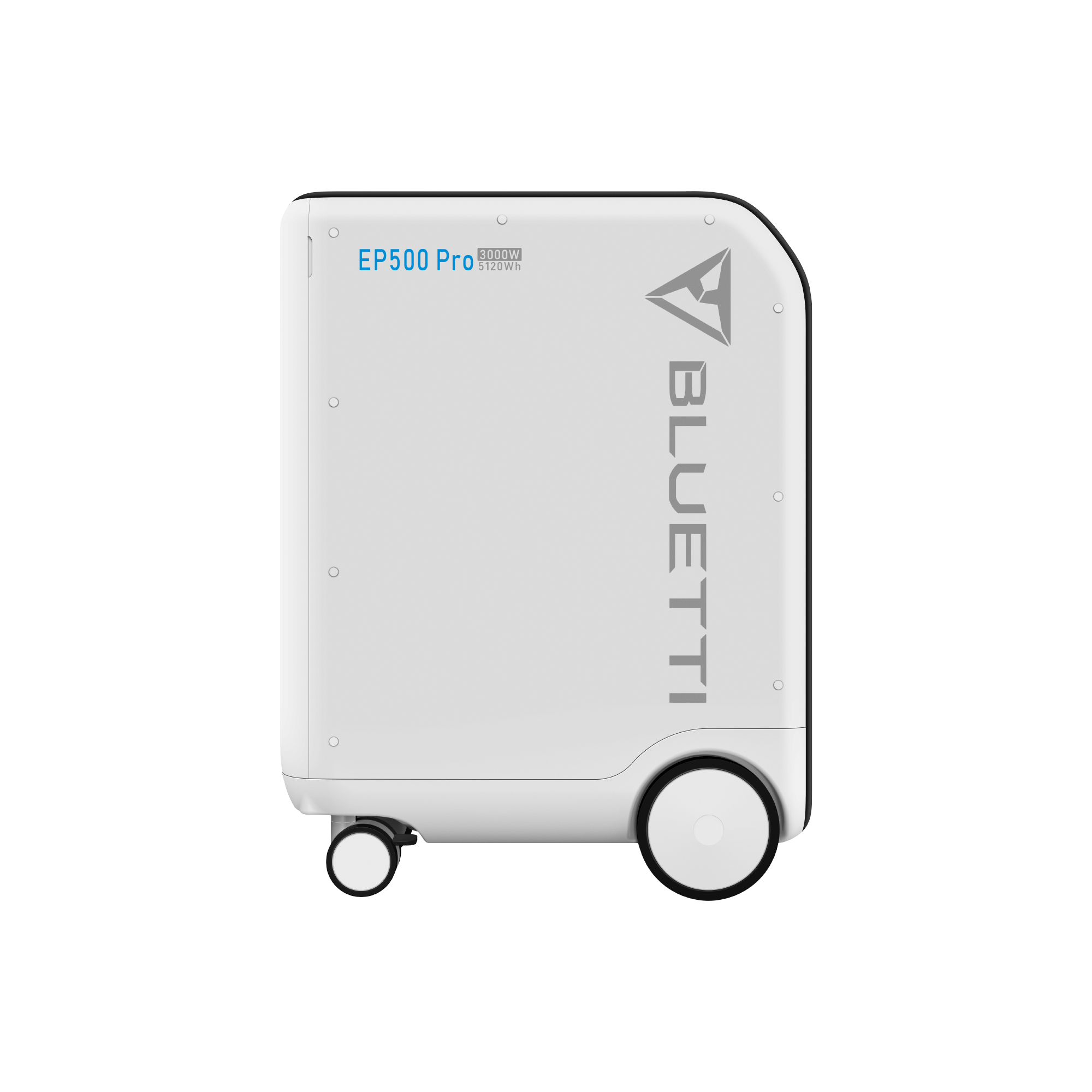
The EP500Pro is a single integrated wheeled cabinet; the Apex 300 + B300K is a stack of roughly 149 lb you assembleA5the EP500Pro has a documented year and a half in the fieldB1the Apex is new, its record still mostly reviewer test units
Why it mattersBuyers who value one integrated, road-tested box over maximum specs are the EP500Pro's real audience, and it's a legitimate one.
The specific dimensions that decide these two units — everything else is a tie.
Lifetime Value
Selected because: The Apex is cheaper to buy and to own on every axis, $0.13 vs $0.20 and $900 less up front, plus warranty.
cost / lifetime kWh
The Apex delivers 19,354 lifetime kilowatt-hours for $2,599, which works out to $0.13 each; the EP500Pro delivers 17,920 for $3,499, or $0.20. The newer unit stores more energy over its life and costs less to buy it, so it wins the cost-to-own math from both ends at once.
Warranty widens the same gap. The Apex's five years pencil out to about $520 per year of coverage; the EP500Pro carries none. On a purchase this size, with a brand whose support runs hot and cold, five years of coverage against zero is not a rounding error, it's part of the price.
PowerScore Breakdown
Selected because: The 1,176-point gap captures the Apex's edge in capacity, output, and surge in one figure.
overall power score
The Apex scores 6,552 to the EP500Pro's 5,376, a 1,176-point gap, and unlike the identical-battery siblings elsewhere in this lineup, here the number is earned across the board: more capacity, more output at 3,840W to 3,000W, and more surge at 7,680W to 6,000W. The newer platform simply does more.
None of that changes what a home unit feels like in a light blackout, where both coast. It changes the ceiling. When you stack a heater, a microwave, and a well pump's startup, the Apex's extra output and surge are the margin between running the list and tripping on it.
Growth Path
Selected because: Apex expands past 5,530Wh where the EP500Pro is sealed at 5,120Wh, real headroom toward partial-home backup.
The EP500Pro is sealed at 5,120Wh, a complete unit with no way to add to it later. The Apex starts at 5,530Wh and takes B300K expansion batteries beyond that, so if your needs drift toward partial-home backup, only one of these two has anywhere to go.
The honest wrinkle is that the Apex's growth is also the source of its two-box shape. Expansion means another battery in the stack, not more capacity in one cabinetA11. If you love the idea of growing but hate the idea of a taller stack, that tension is real, but it's a tension the sealed EP500Pro doesn't even offer you the option of.
What the Specs Don't Tell You
Selected because: Weight, the Apex's disclosed 45dB, UPS speed, and expansion all fire; the port catch lives in the chains.
rated cycles
Most flags lean the Apex's way. It's lighter at roughly 149 lb to 187, it cuts over faster at 10ms to 20ms, and it takes expansion where the EP500Pro can't. The one flag that lands on the Apex is noise: it publishes 45dB under load, about a running refrigerator, while the EP500Pro lists no figure at all.
That noise disclosure cuts both ways worth naming. The EP500Pro hiding its number is a fair knock, but a published 45dB isn't silent either, so read it as the Apex being honest about a fan you'd hear a few feet away, not as the EP500Pro being proven quieter. Neither is a spec you settle from the sheet alone.
Strengths & trade-offs
BLUETTI Apex 300 + B300K
Strengths
- +Costs $900 less
- +Lighter by 38.2 lb
- +Larger battery capacity
- +Higher AC output
- +Rated for 6,000 charge cycles — much longer battery lifespan
Trade-offs
- –Very heavy unit that may be difficult for one person to lift.
BLUETTI EP500Pro
Strengths
- Solid all-rounder with standard specs.
Trade-offs
- –Substantially more expensive (+$900) than the Apex 300 + B300K.
- –Significantly heavier (+38.2 lbs), making it harder to move.
- –Weaker inverter (-840W) limits appliance compatibility.
- –Very heavy unit that may be difficult for one person to lift.
- –Sealed capacity — the Apex 300 + B300K can add batteries to grow past 5,120Wh; this one can't.
- –Shorter-lived battery — rated for 3,500 charge cycles vs the Apex 300 + B300K's 6,000, so it wears out sooner.
Will It Power Your Gear?
Scenario math and per-appliance runtimes, modeled from the spec record.
Scenario verdicts
We ran the math on six real-world scenarios. Here's which unit survives your actual life.
SCN-01 · 2 nights · needs 2,100Wh
Weekend Camping
Two nights off-grid with essential comfort
Neither unit
Scoring these two at a campsite is a category error: neither travels — the Apex 300 + B300K is 148.8 lbs and the EP500Pro 187 lbs, and at those weights they roll off a truck bed if they go anywhere at all. The 2,100Wh here is trivial for either — it's the going that doesn't happen. If you need power away from the building, you're shopping the wrong class.
Battery budget usedlower = more headroom
LOAD Phone Charger 15W×6h · LED Lights 40W×8h · Box Fan 75W×14h · CPAP Machine 40W×16h
SCN-02 · 8 hours · needs 1,645Wh
8-Hour Blackout
Keep the essentials running through a night without power
Either unit
Both clear a night of essentials with room to spare, the Apex at 35% of capacity, the EP500Pro at 38%, so the night itself is a tie. Break it on what comes after: the Apex carries a 5-year warranty and can bolt on another battery for the next outage, where the EP500Pro's answer is a sealed box with no coverage behind it.
Battery budget usedlower = more headroom
LOAD Fridge 150W×8h · Router + Modem 20W×8h · LED Lights (4 bulbs) 40W×6h · Phone Charger 15W×3h
SCN-03 · 8 hours · needs 320Wh
CPAP Overnight
Sleep therapy without interruption — the #1 medical use case
Either unit
A CPAP is about 40W for eight hours, so both of these cover the night several times over — capacity isn't the question here. What would separate them is fan noise, but EP500Pro doesn't publish a figure, so there's nothing to hold it to. Buy on price, weight, and whether you can live with a fan you haven't heard.
Battery budget usedlower = more headroom
LOAD CPAP Machine 40W×8h
SCN-04 · 8 hours · needs 910Wh
Remote Workday
Full work day off-grid without power anxiety
Either unit
Both power your workstation all day without strain. The EP500Pro lists 100W of USB-C for direct laptop charging; the Apex 300 + B300K carries no USB-C at all, so a laptop there goes through the inverter and you are carrying its brick.
Battery budget usedlower = more headroom
LOAD Laptop 60W×8h · External Monitor 30W×8h · Router + Modem 20W×8h · Phone Charger 15W×2h
SCN-05 · 4 hours · needs 670Wh
Tailgate Party
Game day power for the crew
Neither unit
Scoring these two at a tailgate is a category error: neither travels — the Apex 300 + B300K is 148.8 lbs and the EP500Pro 187 lbs, and at those weights they roll off a truck bed if they go anywhere at all. The 670Wh here is trivial for either — it's the going that doesn't happen. If you need power away from the building, you're shopping the wrong class.
Battery budget usedlower = more headroom
LOAD Blender 400W×0.5h · LED TV (55") 80W×4h · Bluetooth Speaker 15W×4h · Phone Charger (×3) 45W×2h
SCN-06 · 24 hours · needs 4,685Wh
Van Life Daily
A full day of mobile living — the ultimate endurance test
Apex 300 + B300K
This is the one scenario that separates them, and it goes to the Apex. A full van day needs 4,685Wh; the Apex covers it at 100% of usable capacity while the EP500Pro comes up short at 108%. It's close, and neither is comfortable, so plan on daily solar either way, but only the bigger battery actually finishes the day.
Battery budget usedlower = more headroom
LOAD Mini-Fridge 150W×24h · Laptop 60W×4h · Phone Charger 15W×3h · LED Lights 40W×5h · Fan 75W×8h
The Load Test
RUNTIME = (Wh × 0.85) ÷ LOAD
None of the scenarios above exactly yours? Build it. Toggle what you'd plug in; both units are tested against the combined draw.
Essentials
Comfort & Convenience
High-Draw Appliances
Test duration
8h
Continuous draw
205W
Projected runtime
For this load: Apex 300 + B300K runs 22.9h vs 21.2h.
$2,599 list · direct from BLUETTI
Planning for more than this? Describe your whole setup and get it sized →
Modeled from the spec record — same math as the tables below. Methodology
Runtime by appliance
Real-world runtime estimates for common appliances, modeled at 85% inverter efficiency.¹
Essentials
The basics you need runningscale 0–313.3hComfort & Convenience
Makes off-grid life actually enjoyablescale 0–62.7hHigh-Draw Appliances
These reveal the real limitsscale 0–4.7h¹ Runtime = (capacity × 0.85) ÷ appliance watts. Within each group, all bars share one time scale (the group's longest runtime), so lengths are comparable across appliances; identical runtimes collapse into a single blue/orange bar. Actual runtime varies with battery age, temperature, and simultaneous loads — see methodology.
Conclusion
July 18, 2026
Verdict: the Apex 300 + B300K
Take the Apex 300 + B300K unless you specifically want one sealed, proven cabinet. Bluetti's newer platform is $900 cheaper at $2,599 to $3,499, holds more at 5,530Wh to 5,120Wh, pushes more at 3,840W to 3,000W, carries a 5-year warranty against the EP500Pro's none, expands where the EP500Pro is sealed, and switches over faster as a UPS, 10ms to 20ms. It's cheaper to own by a wide margin too, $0.13 per lifetime kilowatt-hour against $0.20. The EP500Pro's honest answers are real but narrower: it's a single integrated unit on wheels rather than a two-box stack, and it's the one with a documented year and a half in the fieldB1, where the Apex is new enough that its record is mostly reviewer test units. Two catches keep the Apex from a runaway: its base ships without USB or DC ports and wants a roughly $300 Hub D1 to add themA1A2, and it's a stack you assemble, not a cabinet you roll in. For AC home backup, none of that outweighs $900 saved and more of everything.
Editor-assigned confidence, based on cited owner research and spec analysis.
List prices as of July 18, 2026. The links below open BLUETTI's current price.
$2,599.00 · direct from BLUETTI
Last checked 16 days ago. Prices move — check before you buy.
or check the EP500Pro price$3,499.00 list
Written by Gunner Gustafson, Whole-Home Backup Tester · Station Arena Test Desk · Updated July 18, 2026
Black Friday · 38 days out
Prices to beat:Apex 300 + B300K $2,599EP500Pro $3,499
We have never seen either discounted, so any real cut would be a first.
Measured Data
Benchmark scores and the full spec record, side by side.
Benchmark scores
Not rated for both units (minimum threshold unmet): Solar Generator.
Full specifications
ᵈ Derived: price ÷ rated capacity. See the data behind our comparisons →
Comparison ToolAdd more power stations, side by sideOpen Tool →How these numbers are produced
Numeric verification
Every figure on this page traces to our spec database or arithmetic on it — no estimated numbers.
Owner claims
Statements about owner experience are cited to published reviews — see Sources & Research Notes below.
Runtime model
Runtime = (rated capacity × 0.85 inverter efficiency) ÷ device wattage. Solar recharge estimates assume panels deliver 70% of rated output. Cold weather, battery age, and stacked loads reduce real-world results.
Power Score
Computed from 14 published spec dimensions, weighted per use-case bench. Higher is better; a unit must meet a bench's minimum threshold to be rated.
See the full weight table and data sourcing on our methodology page →Class ranking (the star rating)
Each unit's star score is a category ranking, not customer reviews — no buyer opinions feed it. We score every station on size-independent quality (value, output, portability, endurance, ports, warranty, and more), then percentile-rank it against the other units in its capacity class, so a class-leading compact unit and a class-leading whole-home unit can both earn 5★. Here, Apex 300 + B300K rates 4.2/5 (53rd percentile of 20 Home Backup-class units), and EP500Pro rates 3.5/5 (11th percentile of 20 Home Backup-class units).
How the class ranking is computed →Test Notes & Caveats
Hidden gotchas and advantages we spotted that you won't find on the product page.
Lighter, But Still Not a Solo Carry
The Apex stack is roughly 149 lb to the EP500Pro's 187, so it's the lighter of the two by a real margin. Don't read that as portable. Both are two-person moves that live where you set them, and the EP500Pro at least travels as one piece instead of a base and a battery you stack.
The Apex Is the Loud One Here
Give the EP500Pro this: the Apex is the audible unit of the two. It's rated 45dB under load, about a running refrigerator, while the EP500Pro publishes no figure at all. In a utility room that's nothing. A few feet from where you sleep, a running-fridge hum is the kind of thing you notice at 2 a.m. It's the one comfort spec the cheaper, better-specced Apex loses.
Sealed at 5,120Wh vs Room to Grow
The EP500Pro is a complete, sealed unit at 5,120Wh, plenty if that covers you. The Apex starts higher at 5,530Wh and takes B300K expansion batteries beyond it, real headroom toward partial-home backup. The catch is that growth is where the Apex's two-box shape comes from, you're stacking, not filling one cabinet.
Apex 300 + B300K: Power Lifting to 7,680W
The Apex 300 + B300K has BLUETTI's Power Lifting mode, which runs a resistive appliance rated up to 7,680W from its 3,840W inverter. It does that by delivering less power than the appliance asks for, not more than the inverter has: the heater still works, it just heats more slowly. Two things follow. BLUETTI scopes the mode to purely resistive loads — a heater, a kettle, an incandescent lamp — so it does nothing for a fridge compressor, a pump or a power tool, and this record publishes no surge figure at all, so read the mode as a resistive-load feature rather than as starting ability. And it is not a reason to size down, because running a load that big from 5,530Wh is a short session either way. Genuinely useful if a heater or a kettle is why you're buying; beside the point otherwise. Our record for the EP500Pro carries no Power Lifting figure, only a 6,000W surge peak, which is a different rating, so check BLUETTI's own spec sheet before reading this as something the EP500Pro lacks.
UPS Switchover: ≤10ms vs ≤20ms
Both list a UPS mode, at different rated speeds. The Apex 300 + B300K is rated ≤10ms — quick enough on paper that desktop PCs and routers should ride through, treating that as the rating it is. The EP500Pro is rated ≤20ms — fine on paper for routers and most electronics; the fussiest PC power supplies sit right at this line. If a computer with unsaved work is the thing being protected, the stated class is worth the attention; nothing here is a lab result.
Warranty: No Difference
Both units carry the same 5-year warranty, so coverage isn't a tiebreaker here. Both figures are maximums rather than guarantees — they depend on buying direct from BLUETTI or registering the unit, since reseller purchases carry a shorter term. Worth saying because the per-dollar framing can suggest otherwise: the Apex 300 + B300K works out at 1.9 years of cover per $1,000 spent against the EP500Pro's 1.4, but that spread is the price gap, not the terms.
Battery Lifespan in Real Years
The Apex 300 + B300K is rated for 6,000 cycles vs 3,500. In real life: at daily use, that's 16.4 vs 9.6 years. At weekend use (twice a week), it's 58 vs 34 years. After hitting the cycle limit, the battery doesn't die — it drops to ~80% of original capacity, which is still very usable.
EP500Pro: Noise Level Not Disclosed
The Apex 300 + B300K publishes its noise level (45dB); the EP500Pro doesn't publish one. That isn't evidence the EP500Pro is louder — it means there's no figure to hold it to, and no way to compare the two on this without hearing them. If you're buying for a bedroom, a CPAP, or an apartment, treat the Apex 300 + B300K's 45dB as the only published number on the table — a spec-sheet figure, not a measurement — and look for hands-on reports of the EP500Pro before deciding.
Full record above — the Test Desk pick is the Apex 300 + B300K.
Check Apex 300 + B300K price →or check the EP500Pro priceOwnership Analysis
What happens after you buy — true cost of ownership, brand trust, and growth potential.
Lifetime value
Service lifeyears at one full cycle per day
Lifetime energy delivered
Cost per delivered kWh
│ warranty ends · Reaching the cycle rating means ~80% capacity remains — degraded, not dead.
Analyst note
The Apex 300 + B300K wins on both sticker price and long-term value. At $0.08/kWh over its lifetime, it's meaningfully cheaper to own. Clear value winner.
Delivers each lifetime kWh for $0.12 less — check the Apex 300 + B300K price →
Growth path
Apex 300 + B300K
EXPANDABLESupports BLUETTI expansion batteries, so you can add capacity later without replacing the base unit — useful if your needs may climb past 5,530Wh.
Accepts up to 2,400W of solar. Enough for a serious multi-panel array.
Limited ports. You'll likely need a power strip or splitter.
Expansion batteries are BLUETTI-specific. You're investing in the BLUETTI ecosystem.
EP500Pro
FIXED CAPACITYFixed at 5,120Wh — a sealed, complete system rather than a starting point. There's no expansion port, so that figure is the ceiling: check it against your longest unplugged stretch before you buy.
Accepts up to 2,400W of solar. Enough for a serious multi-panel array.
Adequate ports for most setups, but heavy users may want a power strip.
Realistic full solar rechargeat 70% of rated panel output — see methodology
Analyst note
The EP500Pro is sealed at 5,120Wh, which is fine if that covers you. The Apex 300 + B300K starts at 5,530Wh and can grow beyond it with BLUETTI expansion batteries — real headroom the EP500Pro doesn't have if your needs climb toward partial-home backup.
What Owners Report
Patterns from published owner reports and long-term reviews — every claim cited to its source below.
BLUETTI Apex 300 + B300K
The most-repeated note on the Apex isn't about power, it's about ports. Reviewers flag that the base unit ships with its AC outlets and high-voltage connectors but no USB or DCA1, and that the Hub D1 accessory that adds them runs about $300, a steep ask for what it isA2. One reviewer got a measly 8W of USB-C charging out of the B300K itselfA6. If you run devices straight off USB, that's the gap to price in.
The praise is genuine where it lands. One tester called it one of the few systems that could actually replace a generator, no noise or fumesA4, and clocked an astonishing recharge, ready to go again in under an hourA12. Past ports, the caveats are weight and youth: it's a stack most people won't move aloneA14, and it's new enough that this is early-review testimony, not a years-deep owner record.
“The Apex 300 doesn't have USB ports, DC ports, or much of anything beyond its six AC plugs and high-voltage connectors.”
Sources
thesolarlab.com · techspective.net · digitalreviews.net · thesolarpit.com · cleantechnica.com · trustedreviews.com · bluettipower.com
BLUETTI EP500Pro
The recurring worry on the EP500Pro isn't the hardware, it's what happens when you need help. Reviewers found customer service hard to reachB4, and an owner who bought one used hit error code 006 and a dead unit, then learned Bluetti wouldn't support a non-original buyerB10. Against the Apex's five-year warranty, the EP500Pro's zero coverage and Bluetti's uneven support are the real ownership risk here.
The hardware itself reports well. Power stays rock-solid even at high loadB9, and the long-term read is stable, still working superbly a year and a half onB1. The knocks are small and about the interface: the display shows no runtime estimate and washes out in direct sunB5. Buy it for the integrated, proven box, and go in knowing support is the part that may test your patience.
“After 1.5 years, the system still works superbly — there's still plenty of battery capacity, and it all seems to be operating how it did from the beginning.”
Sources
cleantechnica.com · freshlycharged.com · trustedreviews.com · diysolarforum.com · technicaltrendy.com
Sources & Research Notes
Every owner claim in this report is traceable to a published source. The bracketed references above resolve here.
Recurring owner themes
- Reviewers consistently flag that the base Apex 300 has no USB/DC ports and requires a separate paid Hub D1 accessory, which some feel is overpriced for what it offers. [Apex 300 + B300K · 3 entries]
- Multiple sources note the extreme weight/bulk of the stacked Apex 300 + B300K system, making 'portable' a stretch despite handles/trolley options. [Apex 300 + B300K · 2 entries]
- Reviewers praise fast recharge and the system's ability to genuinely replace a generator for home backup and heavy loads like washers/dryers. [Apex 300 + B300K · 4 entries]
- Reviewers repeatedly flag the EP500 Pro's 180+ lb weight as making it essentially immovable without its wheels, needing two people to shift it upstairs. [EP500Pro · 2 entries]
- Long-term owners report the EP500 Pro holds its charge and function well after a year-plus in storage, with minimal capacity loss. [EP500Pro · 2 entries]
- The app and display are called out as limited on real-time detail (no runtime estimate, no output scheduling) despite solid core power performance. [EP500Pro · 2 entries]
- A1
“The Apex 300 doesn't have USB ports, DC ports, or much of anything beyond its six AC plugs and high-voltage connectors.”
thesolarlab.com — Bluetti Apex 300 Review: Cheap, Practical Home Backup? · unknown (2025/2026) · [mixed]
- A2
“That Bluetti D1 Power Hub that gives you your DC and USB ports costs about $300, which is a steep price for what you're getting.”
thesolarlab.com — Bluetti Apex 300 Review: Cheap, Practical Home Backup? · unknown (2025/2026) · [negative]
- A4
“It's one of the few systems I've tested that feels like it could genuinely replace a generator, without the noise, fumes, or maintenance.”
techspective.net — Bluetti Apex 300 with B300K Review · 2025-09-21 · [positive]
- A5
“Stacked, you're near 150 pounds of lithium iron phosphate and inverter muscle—movable with the built-in handles or a trolley... but not something you'll casually lug to a picnic.”
techspective.net — Bluetti Apex 300 with B300K Review · 2025-09-21 · [mixed]
- A6
“I just wonder why Bluetti did not include a USB-C port with some decent output, like 100 or 140W as I only got a measly 8W charge out of it for my phone.”
digitalreviews.net — Bluetti B300K Expansion Battery Review · 2025-12 · [negative]
- A11
“You can see, that whilst this works in a very roundabout way, it is not as neat and efficient as having a proper B300K battery to double the capacity.”
digitalreviews.net — Bluetti Apex 300 Power Station Tests (Australia) Part II · 2025-09 · [mixed]
- A12
“During my testing, the recharge speed was astonishing. In under an hour, I had a system ready to go again.”
thesolarpit.com — Bluetti Apex 300 Review · 2025-10-28 · [positive]
- A14
“As will you: it weighs in at 38kg, and is probably much too big and heavy for most people to carry alone.”
trustedreviews.com — Bluetti Apex 300 Review · 2025-10-10 · [negative]
- B1
“After 1.5 years, the system still works superbly — there's still plenty of battery capacity, and it all seems to be operating how it did from the beginning.”
cleantechnica.com — BLUETTI EP500 Pro — 1½ Years Later · 2025-03 · [positive]
- B4
“Customer service is difficult to get in contact with.”
freshlycharged.com — Bluetti EP500Pro Review: This Thing is Big and Smart! · unknown · [negative]
- B5
“The display does not show the estimated run time, and it gets washed out in direct sunlight.”
freshlycharged.com — Bluetti EP500Pro Review: This Thing is Big and Smart! · unknown · [negative]
- B9
“Power output is rock-solid and very stable, even at high load.”
trustedreviews.com — Bluetti EP500Pro Review: A staggering amount of power · unknown · [positive]
- B10
“A used EP500 Pro threw error code 006 (SPS voltage low) and wouldn't charge or power any ports; Bluetti refused support since the owner wasn't the original buyer.”
diysolarforum.com — "help with my bluetti ep500pro" thread · unknown · [negative]
Research compiled July 18, 2026.
Who Should Buy Which
Buy the Apex 300 + B300K if you…
- →Value-first home-backup buyers: $900 less than the EP500Pro for 410Wh more battery, 840W more output, and a 5-year warranty the EP500Pro doesn't offer.
- →Anyone who wants room to grow. The Apex starts at 5,530Wh and takes B300K expansion batteries; the EP500Pro is sealed at 5,120Wh.
- →AC-load users who don't need built-in USB or DC and will happily skip the Hub D1, the port gap that's the Apex's one real asteriskA1.
Buy the EP500Pro if you…
- →Buyers who want one integrated wheeled cabinet instead of a two-box stack they assembleA5.
- →Anyone who charges devices straight off built-in USB and DC and doesn't want to buy a roughly $300 hub to get themA2.
- →Owners who weight a proven year-and-a-half track recordB1 over a newer unit's bigger numbers.
If neither fits
Full-time van life at 4,685Wh a day is the load that separates them: only the Apex clears it, and only just, at 100% of usable capacity. If that's you, neither is a coast, you're committing to daily solar and probably a second battery. And if you want built-in ports, expandability, and a warranty all in one sealed box, neither quite delivers, that exact combination lives elsewhere in Bluetti's lineup.
The Bottom Line
The Apex 300 + B300K is the better buy on the math that matters: $900 less than the EP500Pro, more capacity, more output, a 5-year warranty against none, and $0.13 per lifetime kilowatt-hour to the EP500Pro's $0.20. Bluetti's newer platform beats its older flagship almost everywhere you look.
The EP500Pro isn't beaten so much as out-generationed, and it keeps two honest advantages: it's one integrated wheeled cabinet instead of a stack you assemble, and it's the model with a real year and a half in the fieldB1. Take the EP500Pro for the proven, self-contained box. Take the Apex for more of everything at less money, and price in the Hub D1 if you live on USB.
Frequently Asked Questions
Answers drawn from the spec record and cited owner research.
Is the Apex 300 + B300K better than the EP500Pro?
On specs and price, clearly. It's $900 cheaper, holds 5,530Wh to the EP500Pro's 5,120Wh, outputs 3,840W to 3,000W, adds a 5-year warranty, and expands where the EP500Pro is sealed. The EP500Pro's counter is that it's one integrated wheeled cabinet with a proven year-and-a-half record, not a two-box stack. For most AC home-backup buyers, the Apex's advantages win.
Why is the newer Apex cheaper than the older EP500Pro?
Newer cell and platform economics. The Apex 300 + B300K lands at $2,599 to the EP500Pro's $3,499 while holding more energy, which is why it's also cheaper to own at $0.13 per lifetime kilowatt-hour against $0.20. Bluetti's newer designs generally push more capacity per dollar than its older flagships.
Does the Apex 300 really ship with no USB ports?
The base unit comes with AC outlets and high-voltage connectors but no USB or DC ports. To add them you buy the Hub D1 accessory, roughly $300. If your loads are AC, that never matters; if you charge devices straight off USB-C, factor the hub into the Apex's real price.
Which has a better warranty, the Apex or the EP500Pro?
The Apex, decisively: five years against the EP500Pro's none. That gap matters more than usual here because Bluetti's support is inconsistent and the EP500Pro's coverage is zero. One owner who bought a used unit couldn't get support at all. Five years of coverage is real reassurance on a purchase this size.
Is the EP500Pro still worth buying over the Apex?
Only for specific reasons. If you want a single sealed cabinet on wheels rather than a two-part stack, built-in ports without a roughly $300 hub, or a model with a documented long-term track record, the EP500Pro earns its place. If you're buying on capacity, output, warranty, or price, the Apex wins each one.
Where to buy

BLUETTI Apex 300 + B300KPick
$2,599.00
$2,599.00 · direct from BLUETTI
Last checked 16 days ago. Prices move — check before you buy.
BLUETTI EP500Pro
$3,499.00
$3,499.00 · direct from BLUETTI
Last checked 16 days ago. Prices move — check before you buy.
Prices may vary by retailer and are subject to change.