Head-to-head test
BLUETTI AC300 + 4×B300 vs BLUETTI EP500Pro
BLUETTI AC300 + 4×B300 vs BLUETTI EP500Pro: same 3,000W inverter, same 6,000W surge, same 2,400W solar input, same 3,500-cycle rating. The only real difference is 12,288Wh against 5,120Wh, and the bigger stack costs less per watt-hour. Take the stack unless 5,120Wh already covers your longest unplugged stretch.
Full profiles: BLUETTI AC300 + 4×B300 → · BLUETTI EP500Pro →

Written by Gunner GustafsonUpdated
Whole-Home Backup Tester, Station Arena Test Desk
Spec deltas
These two are the same machine at two sizes. Same 3,000W inverter, same 6,000W surge ceiling, same 2,400W of solar input, same 3,500-cycle pack rating, same 100W USB-C, and both switch over in no worse than 20ms. What separates them is 12,288Wh against 5,120Wh, and $5,596 against $3,499.
That makes the arithmetic unusually clean and unusually backwards: the bigger system is the cheaper battery. Nearly two and a half times the energy for a bit over one and a half times the price, which is forty-six cents a watt-hour against sixty-eight. Nothing else on the spec sheet overturns that, because nothing else on the spec sheet is different.
So the verdict turns on one question, and it is not a spec question. Will you ever spend 12,288Wh? If your week cycles a pack deeply and often, take the stack and collect the per-watt-hour discount. If 5,120Wh clears your longest unplugged stretch, the EP500Pro is the unit and the $2,097 difference stays in your pocket.
What the Numbers Reveal
Each conclusion stated first — the numbers behind it on one line, the full analysis below.
Capacity
Now bring in the load most of these units are bought for. An eight-hour blackout draws 1,645Wh, which is 16% of the stack's 10,445Wh of usable capacity. A rate is not a rebate: you only collect thirteen cents a kilowatt-hour by pushing 43,008 kWh through the pack, and a unit that handles two outages a year and sits at full charge the rest of the time never touches the other 84%.
AC300 + 4×B300: $5,596 for 12,288Wh, which is forty-six cents a watt-hourEP500Pro: $3,499 for 5,120Wh, which is sixty-eight cents a watt-hourBoth packs carry the same 3,500-cycle rating, so lifetime energy is 43,008 kWh against 17,920 kWh
Why it mattersIf you cycle a battery deeply most days, the stack is simply the cheaper purchase. If you are buying standby insurance, the $2,097 gap between $5,596 and $3,499 buys watt-hours that will spend a decade doing nothing.
The EP500Pro is sealed at 5,120Wh with no expansion port, so a buyer who lands in that 93% has no remedy except a second unit. The stack finishes the identical day at 45% used with 5,760Wh spare and still has ports left. A spec that only just clears is a spec you outgrow the first time you add a load.
A full van day needs 4,685WhEP500Pro: 5,120Wh on the label, 4,352Wh after the flat 15% conversion allowance we apply to every unitAC300 + 4×B300: 10,445Wh usable against the same day
Why it mattersAnyone whose daily draw is within a few hundred watt-hours of 4,352Wh should stop treating the EP500Pro as the cheaper option and start treating it as the one that might not finish.
Held for a full day, 60W is 1,440Wh, roughly 12% of 12,288Wh. On grid power that is invisible, because the unit tops itself back up between outages. In a cabin you visit monthly, or on solar through a bad week, it is a standing charge you pay before a single one of your own loads.
A reviewer measured close to 60W of idle draw on the AC300 with its AC output on and nothing plugged inA2The same test lost about 8% of the battery over four idle hoursA3That measurement was taken on an AC300 carrying a single B300, not on this four-module stackA0A12This system holds 12,288Wh and is stationary, sited once and left armed
Why it mattersIf this is going to sit armed as house backup, keep it plugged in. If it is going to sit unattended off-grid, budget the head unit's idle draw before you budget the fridge.
The specific dimensions that decide these two units — everything else is a tie.
Lifetime Value
Selected because: $5,596 buys 43,008 lifetime kWh and $3,499 buys 17,920, and that ratio decides this matchup before anything else on the page gets a vote.
cost / lifetime kWh
Thirteen cents a lifetime kilowatt-hour against twenty. That is the larger, more expensive system coming in cheaper per unit of energy than the smaller one, and it happens for a dull structural reason: both packs are rated for the same 3,500 cycles, so lifetime energy tracks capacity exactly and the stack has 12,288Wh of it against 5,120Wh.
The catch is that a rate is not a rebate. You redeem thirteen cents a kilowatt-hour by running 43,008 kWh through the thing, which means a daily-cycling life: a van, an off-grid cabin, a workshop, a house that leans on it. Buy it to sit armed in a basement for the two outages a year your street gets and the discount never arrives, while the $2,097 you paid over the EP500Pro sits in the corner at full charge.
Your Life, Your Pick
Selected because: Five of our six loads fit inside 5,120Wh without strain; the sixth is where the EP500Pro stops and the decision actually gets made.
Five of the six loads we run fit inside the EP500Pro without drama. An eight-hour blackout leaves it at 38% used, a remote workday at 21%, a CPAP night at 7%. On those rows the stack's extra 7,168Wh is capacity you are paying to keep in reserve, and reserve is worth exactly what your worst night says it is worth.
The sixth row is the one to read twice. A full van day wants 4,685Wh and the EP500Pro's usable figure is 4,352Wh, so it ends 333Wh short with about 93% of the day covered, even though its 5,120Wh label would have cleared it. If your daily number lives anywhere near there, you are buying a unit whose answer depends on which figure you trust. The stack covers the same day at 45% used and there is nothing to argue about.
Portability & Form Factor
Selected because: Neither unit moves once it is sited, so 367.2 lbs against 187 lbs is a question about a doorway and a delivery day, not about a trunk.
weight
367.2 lbs against 187 lbs sounds like the stack's problem until you look at the shape of it. The EP500Pro is one cabinet, and a cabinet goes through a doorway and down a flight of stairs as a single object or not at all; two reviewers describe 180-plus pounds as effectively immovable without its wheels, with two fit people struggling on stairsB7B11. The AC300 system is a head unit plus four battery modules, so its bigger number arrives in pieces and is assembled where it will live.
Neither one is going in a trunk, which makes this a delivery-day question rather than a weekly one. Measure the doorway, pick the corner, and then never think about the weight again.
Growth Path
Selected because: The EP500Pro's 5,120Wh is a ceiling and the AC300's 12,288Wh is a floor, which changes what each one is worth to a buyer whose needs are still moving.
Shop the EP500Pro as a finished appliance rather than a starting point. It is sealed at 5,120Wh, that number either covers your longest unplugged stretch or it does not, and the only upgrade path is a second unit sitting beside the first. The AC300 system is the opposite kind of object: already at 12,288Wh, still taking expansion batteries, and the only configuration on this page pointing at partial-home backup rather than one circuit.
Worth saying out loud, because it cuts against the pick: expandable and single-point-of-failure are the same architecture seen from two angles. Every watt-hour in the stack hangs off one AC300 head unit, while the sealed cabinet keeps its inverter and its cells in one box with one thing to own. If that trade appeals more than headroom does, it is a real reason to take the smaller unit.
What the Specs Don't Tell You
Selected because: Two cards fire here, weight and the EP500Pro's fixed capacity, and both mean something different for a cabinet that never leaves the utility room.
Both cards that fire here are about living with these units, not about buying them. The weight note reads as a warning about relocation, which is the wrong frame for two stationary boxes: you move each of these once, on the day it arrives. The fixed-capacity note is the one with teeth, because 5,120Wh is a number you can outgrow and a number you cannot change.
Two things the cards do not cover. A reviewer with the AC300's AC output on and nothing plugged in measured close to 60W of idle draw, about 8% of the pack over four idle hoursA2A3, and that 8% was measured on an AC300 carrying a single B300 rather than on this four-module stackA0A12. Held for a day, 60W is 1,440Wh, roughly 12% of 12,288Wh: nothing on grid power, a slow leak in a cabin you visit monthly. Separately, one owner reported his AC300 head unit failing outright and relayed a BLUETTI support reply saying the model is discontinued and parts are no longer stockedA9A10. We have not confirmed that against BLUETTI's own store, so read it as one account rather than policy, and do not buy either of these on the assumption that a repair will be available in year eight.
Strengths & trade-offs
BLUETTI AC300 + 4×B300
Strengths
- +Larger battery capacity
Trade-offs
- –Substantially more expensive (+$2,097) than the EP500Pro.
- –Significantly heavier (+180.2 lbs), making it harder to move.
- –Very heavy unit that may be difficult for one person to lift.
BLUETTI EP500Pro
Strengths
- +Costs $2,097 less
- +Lighter by 180.2 lb
- +Longer warranty
Trade-offs
- –Very heavy unit that may be difficult for one person to lift.
- –Sealed capacity — the AC300 + 4×B300 can add batteries to grow past 5,120Wh; this one can't.
Will It Power Your Gear?
Scenario math and per-appliance runtimes, modeled from the spec record.
Scenario verdicts
We ran the math on six real-world scenarios. Here's which unit survives your actual life.
SCN-01 · 2 nights · needs 2,100Wh
Weekend Camping
Two nights off-grid with essential comfort
Neither unit
Neither of these is going camping. 367 lbs and 187 lbs are both numbers about where a unit lives, not where it goes, and the 2,100Wh a weekend actually needs is a rounding error for either pack. If the power has to leave the building, you are on the wrong page.
Battery budget usedlower = more headroom
LOAD Phone Charger 15W×6h · LED Lights 40W×8h · Box Fan 75W×14h · CPAP Machine 40W×16h
SCN-02 · 8 hours · needs 1,645Wh
8-Hour Blackout
Keep the essentials running through a night without power
AC300 + 4×B300
Eight hours is the easy part and both walk it. The stack finishes at 16% used with enough left for five more nights like it; the EP500Pro finishes at 38%, with about one and a half. Outages that end by morning do not separate these two. Outages that do not, do.
Battery budget usedlower = more headroom
LOAD Fridge 150W×8h · Router + Modem 20W×8h · LED Lights (4 bulbs) 40W×6h · Phone Charger 15W×3h
SCN-03 · 8 hours · needs 320Wh
CPAP Overnight
Sleep therapy without interruption — the #1 medical use case
Either unit
A CPAP pulls about 40W, so a night is 320Wh and both of these treat that as a rounding error at 3% and 7% used. Capacity decides nothing here. Fan noise would, except neither unit has a published noise figure to hold it to, so the call comes down to price, mass, and whether you can live eighteen inches from a fan you have not heard.
Battery budget usedlower = more headroom
LOAD CPAP Machine 40W×8h
SCN-04 · 8 hours · needs 910Wh
Remote Workday
Full work day off-grid without power anxiety
AC300 + 4×B300
The AC300 + 4×B300 clears the workday at 9% used, banking 9,535Wh — late work, extra calls, or a second laptop charge without arithmetic. The EP500Pro at 21% also finishes, with 3,442Wh of slack for the unplanned.
Battery budget usedlower = more headroom
LOAD Laptop 60W×8h · External Monitor 30W×8h · Router + Modem 20W×8h · Phone Charger 15W×2h
SCN-05 · 4 hours · needs 670Wh
Tailgate Party
Game day power for the crew
Neither unit
A 400W peak is nothing for a 3,000W inverter and 670Wh is nothing for either pack, so the loads are not the problem. The tailgate is. One of these is 367 lbs and the other is 187, and neither is getting lifted over a bumper. Bring something suitcase-sized and leave these two where they are.
Battery budget usedlower = more headroom
LOAD Blender 400W×0.5h · LED TV (55") 80W×4h · Bluetooth Speaker 15W×4h · Phone Charger (×3) 45W×2h
SCN-06 · 24 hours · needs 4,685Wh
Van Life Daily
A full day of mobile living — the ultimate endurance test
AC300 + 4×B300
This is the row where the EP500Pro's label and its usable figure disagree. 5,120Wh on the sticker clears the 4,685Wh a full van day needs; 4,352Wh after the flat 15% conversion allowance does not, leaving it 333Wh short at about 93% of the day. The stack covers the same day at 45% used with 5,760Wh spare. A day you finish 93% of is a day you finish in the dark.
Battery budget usedlower = more headroom
LOAD Mini-Fridge 150W×24h · Laptop 60W×4h · Phone Charger 15W×3h · LED Lights 40W×5h · Fan 75W×8h
The Load Test
RUNTIME = (Wh × 0.85) ÷ LOAD
None of the scenarios above exactly yours? Build it. Toggle what you'd plug in; both units are tested against the combined draw.
Essentials
Comfort & Convenience
High-Draw Appliances
Test duration
8h
Continuous draw
205W
Projected runtime
For this load: AC300 + 4×B300 runs 51h vs 21.2h.
$5,596 list · direct from BLUETTI
Planning for more than this? Describe your whole setup and get it sized →
Modeled from the spec record — same math as the tables below. Methodology
Runtime by appliance
Real-world runtime estimates for common appliances, modeled at 85% inverter efficiency.¹
Essentials
The basics you need runningscale 0–696.3hComfort & Convenience
Makes off-grid life actually enjoyablescale 0–139.3hHigh-Draw Appliances
These reveal the real limitsscale 0–10.4h¹ Runtime = (capacity × 0.85) ÷ appliance watts. Within each group, all bars share one time scale (the group's longest runtime), so lengths are comparable across appliances; identical runtimes collapse into a single blue/orange bar. Actual runtime varies with battery age, temperature, and simultaneous loads — see methodology.
Conclusion
September 13, 2026
Verdict: the BLUETTI AC300 + 4×B300
Take the AC300 with four B300s if you are actually going to use it. It carries 12,288Wh against the EP500Pro's 5,120Wh for $5,596 against $3,499, which is nearly two and a half times the energy for a bit over one and a half times the price, and because both packs share the same 3,500-cycle rating that advantage carries straight through to lifetime cost. It is also the only one of the two that finishes a 4,685Wh van day, and the only one with expansion ports left. This is a seven rather than a nine for three honest reasons: 5,120Wh clears five of our six loads, every module in the stack depends on one AC300 head unit, and $2,097 is real money to spend on reserve you may never touch. If your longest unplugged stretch fits inside 4,352Wh of usable capacity, buy the EP500Pro and stop reading.
Editor-assigned confidence, based on cited owner research and spec analysis.
List prices as of September 13, 2026. The links below open BLUETTI's current price.
$5,596.00 · direct from BLUETTI
Last checked 16 days ago. Prices move — check before you buy.
or check the EP500Pro price$3,499.00 list
Written by Gunner Gustafson, Whole-Home Backup Tester · Station Arena Test Desk · Updated September 13, 2026
Black Friday · 38 days out
Prices to beat:AC300 + 4×B300 $5,596EP500Pro $3,499
We have never seen either discounted, so any real cut would be a first.
Measured Data
Benchmark scores and the full spec record, side by side.
Benchmark scores
Full specifications
ᵈ Derived: price ÷ rated capacity. See the data behind our comparisons →
Comparison ToolAdd more power stations, side by sideOpen Tool →How these numbers are produced
Numeric verification
Every figure on this page traces to our spec database or arithmetic on it — no estimated numbers.
Owner claims
Statements about owner experience are cited to published reviews — see Sources & Research Notes below.
Runtime model
Runtime = (rated capacity × 0.85 inverter efficiency) ÷ device wattage. Solar recharge estimates assume panels deliver 70% of rated output. Cold weather, battery age, and stacked loads reduce real-world results.
Power Score
Computed from 14 published spec dimensions, weighted per use-case bench. Higher is better; a unit must meet a bench's minimum threshold to be rated.
See the full weight table and data sourcing on our methodology page →Class ranking (the star rating)
Each unit's star score is a category ranking, not customer reviews — no buyer opinions feed it. We score every station on size-independent quality (value, output, portability, endurance, ports, warranty, and more), then percentile-rank it against the other units in its capacity class, so a class-leading compact unit and a class-leading whole-home unit can both earn 5★. Here, AC300 + 4×B300 rates 3.3/5 (1st percentile of 29 Whole-Home / Off-Grid-class units), and EP500Pro rates 3.5/5 (11th percentile of 20 Home Backup-class units).
How the class ranking is computed →Test Notes & Caveats
Hidden gotchas and advantages we spotted that you won't find on the product page.
Weight: an installation, not a lift
Neither of these is a lift, so stop reading the number as one. The EP500Pro's 187 lbs is a single cabinet, and a single cabinet goes up the stairs whole or it does not go up at all. The stack's 367.2 lbs arrives as a head unit plus four battery modules, which means the heavier system is the one that climbs stairs in trips. Either way you make this decision once, on delivery day, and then the thing stays exactly where you put it.
EP500Pro: fixed at 5,120Wh
5,120Wh is the ceiling, which is fine if it sits above your longest unplugged stretch and expensive if it does not, because the only upgrade is a second unit beside the first. The stack starts at 12,288Wh and still has ports. Here is the part that cuts the other way, though: everything you add hangs off one AC300 head unit, so expandable and one-box-to-fail are the same architecture described twice. The sealed cabinet buys less headroom and fewer pieces to go wrong.
Warranty: 5 Years vs 4
The EP500Pro is covered for 5 years against the AC300 + 4×B300's 4 years. The EP500Pro's figure is a maximum rather than a guarantee — it depends on buying direct from BLUETTI or registering the unit, since reseller purchases carry a shorter term. An underrated factor if you're keeping this unit for years.
Full record above — the Test Desk pick is the AC300 + 4×B300.
Check AC300 + 4×B300 price →or check the EP500Pro priceOwnership Analysis
What happens after you buy — true cost of ownership, brand trust, and growth potential.
Lifetime value
Service lifeyears at one full cycle per day
Lifetime energy delivered
Cost per delivered kWh
│ warranty ends · Reaching the cycle rating means ~80% capacity remains — degraded, not dead.
Analyst note
The EP500Pro is cheaper to buy, but the AC300 + 4×B300 is cheaper to own. At $0.13/kWh over its lifetime vs $0.20/kWh, the AC300 + 4×B300's higher cycle life and capacity make each dollar go further over the years. One thing to know reading the table: both carry the same 3,500-cycle rating, so the lifetime rows are sticker price and capacity in disguise — the wear horizon is identical and decides nothing here.
Growth path
AC300 + 4×B300
EXPANDABLESupports BLUETTI expansion batteries, so you can add capacity later without replacing the base unit — useful if your needs may climb past 12,288Wh.
Accepts up to 2,400W of solar. Enough for a serious multi-panel array.
Adequate ports for most setups, but heavy users may want a power strip.
Expansion batteries are BLUETTI-specific. You're investing in the BLUETTI ecosystem.
EP500Pro
FIXED CAPACITYFixed at 5,120Wh — a sealed, complete system rather than a starting point. There's no expansion port, so that figure is the ceiling: check it against your longest unplugged stretch before you buy.
Accepts up to 2,400W of solar. Enough for a serious multi-panel array.
Adequate ports for most setups, but heavy users may want a power strip.
Realistic full solar rechargeat 70% of rated panel output — see methodology
Analyst note
The EP500Pro is sealed at 5,120Wh, which is fine if that covers you. The AC300 + 4×B300 starts at 12,288Wh and can grow beyond it with BLUETTI expansion batteries — real headroom the EP500Pro doesn't have if your needs climb toward partial-home backup.
What Owners Report
Patterns from published owner reports and long-term reviews — every claim cited to its source below.
BLUETTI AC300 + 4×B300
Read the AC300 field record with one correction in mind: most of it describes a smaller machine than this page prices. The reviews and forum posts carrying the useful detail were run on an AC300 with a single B300 attached, so the recharge from near empty in just over an hourA4, the 31-hour fridge runA11 and the close-to-50-pounds complaintA12 all belong to that configuration rather than to a four-module stackA0. Scale them or drop them.
What does carry over is the head unit, and it reads well. Build quality and finish drew immediate praiseA1, and fan noise comes back consistently as audible but mild for the size: one reviewer calls it not silent yet easy to forget, and an owner comparing units hears air movement with no motor or bearing noiseA5A6. The app is the soft spot, described as basic and limitedA7, with at least one owner stuck on a client that loads forever while the unit itself reports a live connectionA8. And the idle draw is real: close to 60W with the AC side on and nothing plugged in, about 8% of that smaller pack over four hoursA2A3.
The entry to weigh hardest is a single one. An owner reported his AC300 head unit dying after a run of console errors, and relayed a BLUETTI support reply saying the unit is discontinued, parts are unavailable and repair is not recommendedA9A10. That is one account and we have not verified it against BLUETTI's own store, so do not read it as policy. Read it as a reason not to plan on year-eight servicing.
“I was immediately impressed with the unit's quality, finish, and clever design.”
Sources
reviewed.com
BLUETTI EP500Pro
The EP500Pro has the better long-term paper trail of the two. A follow-up test at a year and a half found it working as it did on day one with capacity intactB1, it came back from roughly a year in storage still holding about 49%B2, and it refilled from half to full in about an hour and thirty-five minutes on an ordinary 120V outletB3. Output under heavy load is described as rock solidB9.
The complaints are consistent and unglamorous. Two reviewers flag the 180-plus pound mass as immovable without the wheels, with two fit people struggling to get it upstairsB7B11. The screen washes out in direct sun and shows no runtime estimateB5, and the app will not do the charge-completion arithmetic or schedule the outputsB8. Support drew a hard-to-reach complaintB4, and the owner of a used unit hitting a low-voltage error was turned away because he was not the original purchaserB10. Fan-noise evidence is thin beyond one reviewer calling it very quiet, so there is not much to hold it toB6B0.
“After 1.5 years, the system still works superbly — there's still plenty of battery capacity, and it all seems to be operating how it did from the beginning.”
Sources
cleantechnica.com · freshlycharged.com · trustedreviews.com · diysolarforum.com · technicaltrendy.com
Sources & Research Notes
Every owner claim in this report is traceable to a published source. The bracketed references above resolve here.
Recurring owner themes
- Idle power draw is noticeably higher than expected and drains meaningful battery even with no connected load. [AC300 + 4×B300 · 2 entries]
- Reviewers and owners consistently describe the AC300's fan as audible under load but notably quiet for its size and class. [AC300 + 4×B300 · 2 entries]
- The companion app is described as basic/limited, and some owners report Bluetooth or app-pairing problems connecting to the AC300+B300. [AC300 + 4×B300 · 2 entries]
- After several years of service, some head units fail outright, and once discontinued Bluetti has no repair parts and does not recommend repairing out-of-warranty units. [AC300 + 4×B300 · 2 entries]
- Reviewers repeatedly flag the EP500 Pro's 180+ lb weight as making it essentially immovable without its wheels, needing two people to shift it upstairs. [EP500Pro · 2 entries]
- Long-term owners report the EP500 Pro holds its charge and function well after a year-plus in storage, with minimal capacity loss. [EP500Pro · 2 entries]
- The app and display are called out as limited on real-time detail (no runtime estimate, no output scheduling) despite solid core power performance. [EP500Pro · 2 entries]
- A1
“I was immediately impressed with the unit's quality, finish, and clever design.”
Clean Energy Reviews Forum — "Bluetti Power Station Review (AC300) Off-grid Backup" (user Svarky) · 2023-07 · [positive]
- A2
“When the AC output is switched on, the idle power draw (with no load) appears to be close to 60W, which is high.”
Clean Energy Reviews Forum — "Bluetti Power Station Review (AC300) Off-grid Backup" (user Svarky) · 2023-10 · [negative]
- A3
“When left on for 4 hours with no load, it consumed around 8% of the battery, which was rather surprising.”
Clean Energy Reviews Forum — "Bluetti Power Station Review (AC300) Off-grid Backup" (user Svarky) · 2023-10 · [negative]
- A4
“It still charges the battery from near empty to 100% in just over one hour, which is very good.”
Clean Energy Reviews Forum — "Bluetti Power Station Review (AC300) Off-grid Backup" (user Svarky) · 2023-10 · [positive]
- A5
“The AC300 + B300 has a little bit of noise coming from the fan. It's NOT silent. But considering the size and use case... you'll forget it's there.”
GreenCitizen — "Bluetti AC300 + B300 Power Station Review: Real-Life Lab Test Results" · 2025-01 · [positive]
- A6
“The powered fans within my AC300 units are extremely quiet when running – no detectible motor or bearing noise; only air movement is slightly heard.”
DIY Solar Power Forum — "Fan noise level of Bluetti AC200MAX?" thread (AC300 owner's comparison reply) · unknown · [positive]
- A7
“The companion app brings basic functionality to your fingertips but leaves you longing for more.”
GreenCitizen — "Bluetti AC300 + B300 Power Station Review: Real-Life Lab Test Results" · 2025-01 · [negative]
- A8
“App (v3.0.1) keeps loading indefinitely even when the AC300 itself shows it is "Connected."”
BLUETTI Community forum — "AC300+B300 doesn't connect to Bluetti App" thread · unknown · [negative]
- A9
“I just had my AC300 head unit fail with a007 App error, and 00 006 and 01 006 errors on the console screen and 2 days later.... click click click.. DEAD.”
DIY Solar Power Forum — "Bluetti - Screw you - AC300 dead and no parts to fix it anymore 5 years after launch" · 2026-03 · [negative]
- A10
“Due to the AC300 being discontinued, they don't have the necessary parts for repairs. Considering the repair costs and round-trip shipping fees, we don't recommend repairing it.”
DIY Solar Power Forum — "Bluetti - Screw you - AC300 dead and no parts to fix it anymore 5 years after launch" (Bluetti support reply relayed by OP) · 2026-03 · [negative]
- A11
“The Bluetti AC300 + B300 combo kept the fridge running for an average of 31 hours on a charge.”
Forbes — Brad Moon, "Review: Bluetti AC300 + B300 Home Battery Backup System" · 2023-10 · [positive]
- A12
“Weighs close to 50 pounds, which is heavy if you plan to use it mainly as a portable power bank.”
Reviewed.com — "Bluetti AC300+B300 Home Battery Backup Review" · unknown · [negative]
- B1
“After 1.5 years, the system still works superbly — there's still plenty of battery capacity, and it all seems to be operating how it did from the beginning.”
cleantechnica.com — BLUETTI EP500 Pro — 1½ Years Later · 2025-03 · [positive]
- B2
“Pulled from storage after about a year, the unit still retained roughly 49% charge — self-discharge over that time was minimal.”
cleantechnica.com — BLUETTI EP500 Pro — 1½ Years Later · 2025-03 · [positive]
- B3
“After a long storage period, it charged from 50% to 100% in about 1 hour 35 minutes on a standard 120V outlet.”
cleantechnica.com — BLUETTI EP500 Pro — 1½ Years Later · 2025-03 · [positive]
- B4
“Customer service is difficult to get in contact with.”
freshlycharged.com — Bluetti EP500Pro Review: This Thing is Big and Smart! · unknown · [negative]
- B5
“The display does not show the estimated run time, and it gets washed out in direct sunlight.”
freshlycharged.com — Bluetti EP500Pro Review: This Thing is Big and Smart! · unknown · [negative]
- B6
“The fan on the EP500 Pro is very quiet.”
freshlycharged.com — Bluetti EP500Pro Review: This Thing is Big and Smart! · unknown · [positive]
- B7
“At 83kg it's far too heavy for a single user to lift — even two fit people would struggle to move it upstairs.”
trustedreviews.com — Bluetti EP500Pro Review: A staggering amount of power · unknown · [negative]
- B8
“The app doesn't do the sums to let you know when you can expect it to stop charging, and you can't schedule the AC or DC outputs.”
trustedreviews.com — Bluetti EP500Pro Review: A staggering amount of power · unknown · [negative]
- B9
“Power output is rock-solid and very stable, even at high load.”
trustedreviews.com — Bluetti EP500Pro Review: A staggering amount of power · unknown · [positive]
- B10
“A used EP500 Pro threw error code 006 (SPS voltage low) and wouldn't charge or power any ports; Bluetti refused support since the owner wasn't the original buyer.”
diysolarforum.com — "help with my bluetti ep500pro" thread · unknown · [negative]
- B11
“It weighs 182 pounds, which makes it less portable than some other power stations on the market.”
technicaltrendy.com — BLUETTI EP500Pro Solar Power Station Review · unknown · [negative]
Research compiled September 13, 2026.
Who Should Buy Which
Buy the AC300 + 4×B300 if you…
- →You are backing up a house, not a room. An eight-hour outage leaves the stack at 16% used with 8,800Wh in hand, roughly five more nights like it, which is the profile of someone whose outages arrive in multi-day sets rather than single evenings.
- →You cycle deeply and daily: a van, an off-grid cabin, a workshop. A 4,685Wh day lands at 45% used with 5,760Wh spare, and daily cycling is how the cheaper cost per watt-hour stops being a talking point and turns into money.
- →You were about to buy two EP500Pros. Two of them run $6,998 for 10,240Wh; the stack is $5,596 for 12,288Wh, and it is one system instead of two islands.
- →The install is down the basement stairs or through a tight door. 367.2 lbs that arrives as a head unit plus four modules is a friendlier delivery than 187 lbs that does not come apart.
Buy the EP500Pro if you…
- →You know your worst night in watt-hours and it sits under 4,352Wh usable. An eight-hour outage leaves the EP500Pro at 38% used with 2,707Wh still in reserve, and buying past that is insurance on insurance.
- →You want one object. One cabinet, one set of wheels, one thing to plug in, no modules to stack, and nothing in the system hanging off a separate head unit.
- →Your budget is $3,499 and stretching to $5,596 would come out of panels or an electrician. The same 3,000W inverter and the same 6,000W surge sit behind both, so the EP500Pro runs the same loads; it just runs them for fewer hours.
If neither fits
If the words camping or tailgate appear anywhere in your plan, close this page: at 367.2 lbs and 187 lbs these are appliances you site once, and the 2,100Wh a weekend actually needs is a rounding error for either of them. You want a one-to-two-kilowatt-hour unit with a handle. And if what you are really buying is a long serviceable life, the support record on both of these is an open questionA10B10, so a current-generation unit with a support path you can confirm is the safer place to put the money.
The Bottom Line
Nearly two and a half times the energy for a bit over one and a half times the price, with the same inverter, the same surge ceiling, the same solar input and the same cycle rating on both sides of the table. That is the whole case for the AC300 stack, and for anybody who actually cycles a battery it is a strong one.
The case against it deserves the same respect: 5,120Wh covers most of what most people buy these for, and a lower cost per watt-hour on energy you never spend is just a more expensive box. So do the one piece of homework this page cannot do for you and put your worst night in watt-hours. Under 4,352Wh, take the EP500Pro and be done. Over it, stop comparing and buy the stack.
Frequently Asked Questions
Answers drawn from the spec record and cited owner research.
Is the AC300 with four B300 batteries worth the extra money over an EP500Pro?
If you will cycle it, yes. $5,596 buys 12,288Wh and $3,499 buys 5,120Wh, which works out to forty-six cents a watt-hour against sixty-eight, and with both packs rated for the same 3,500 cycles that gap holds for the life of the units. If your real need sits under 5,120Wh, though, the extra $2,097 buys reserve you will not touch, and the EP500Pro becomes the better purchase.
Can an EP500Pro run a van or off-grid setup full time?
Not a heavy one. A full van day in our model draws 4,685Wh, and the EP500Pro's 5,120Wh comes to 4,352Wh after the flat 15% conversion allowance we apply to every unit, leaving it 333Wh short at about 93% of the day. Its label would have cleared the load, which is why this is a close call rather than a disqualification. The AC300 stack covers the same day at 45% used.
Can you add batteries to an EP500Pro later?
No. It is sealed at 5,120Wh with no expansion port, so the upgrade path is buying a second unit. The AC300 accepts BLUETTI expansion batteries, and at 12,288Wh already it is the one configuration here with somewhere left to go toward partial-home backup. If you are genuinely unsure about your number, that difference is worth more than the price gap.
Which one is easier to get into a basement?
The heavier one, oddly. The EP500Pro is a single 187 lb cabinet that goes down a flight of stairs in one piece or not at all, and reviewers describe 180-plus pounds as effectively immovable without its wheels, with two fit people struggling on stairs. The AC300 system's 367.2 lbs arrives as a head unit plus four battery modules, so it goes down in trips and gets assembled in place.
Are these older BLUETTI units still supported?
Treat support as an open question on both. One owner reported an AC300 head unit failing outright and relayed a BLUETTI reply saying the model is discontinued with no parts for repairs; we have not verified that against BLUETTI's own store, so it is one account and not a stated policy. On the other side, the owner of a secondhand EP500Pro with a voltage error was refused help because he was not the original buyer. Buy new, register it, and keep the receipt.
Where to buy

BLUETTI AC300 + 4×B300Pick
$5,596.00
$5,596.00 · direct from BLUETTI
Last checked 16 days ago. Prices move — check before you buy.
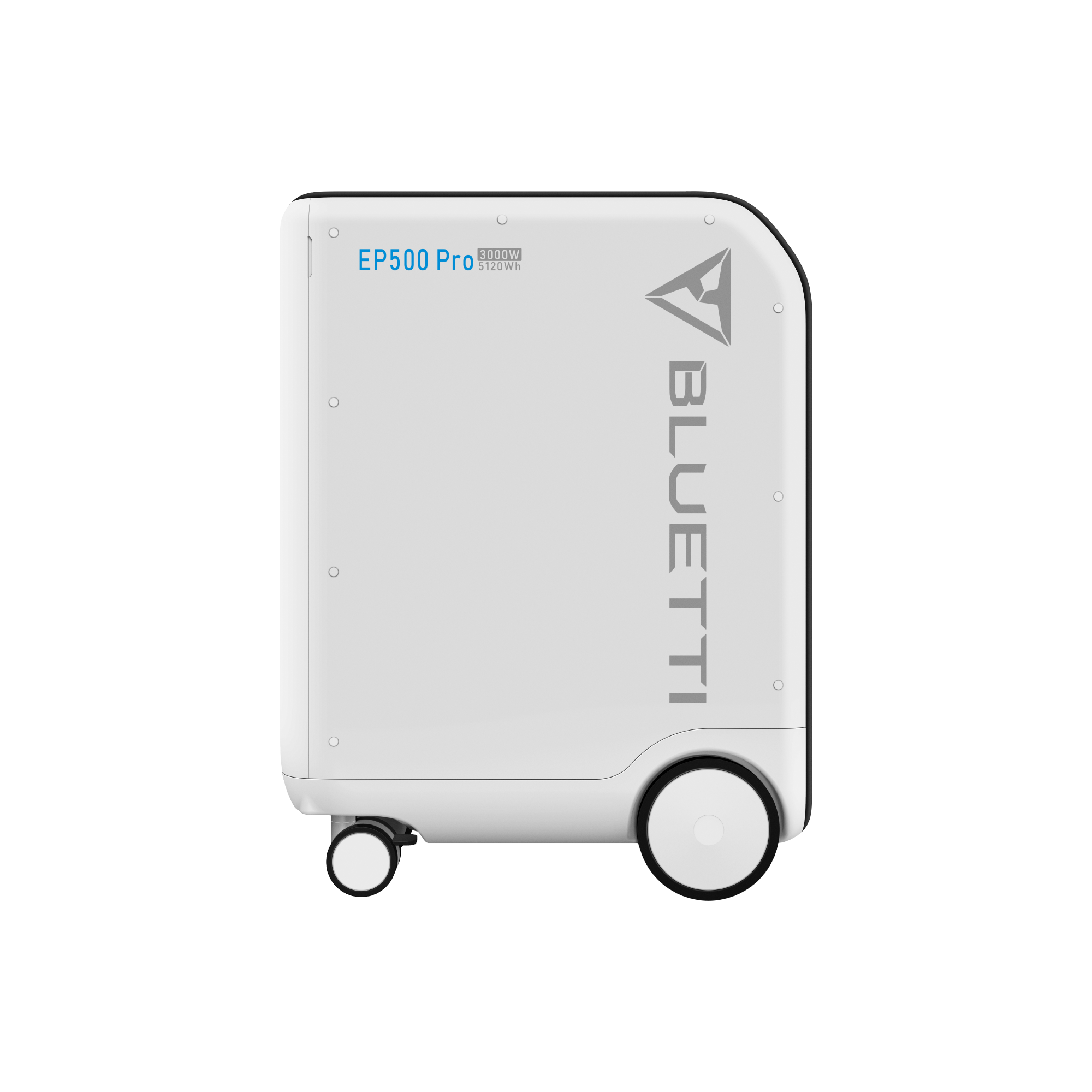
BLUETTI EP500Pro
$3,499.00
$3,499.00 · direct from BLUETTI
Last checked 16 days ago. Prices move — check before you buy.
Prices may vary by retailer and are subject to change.