Head-to-head test
Anker SOLIX F3000 vs BLUETTI Apex 300 + B300K
Same price per watt-hour either way, so the only questions that matter are how much battery you need and whether it has to move, and for most people that points to the lighter, cheaper, expandable F3000.
Full profiles: Anker SOLIX F3000 → · BLUETTI Apex 300 + B300K →
Looking for a different matchup? Anker SOLIX F3000 vs BLUETTI Apex 300

Written by Gunner GustafsonUpdated
Whole-Home Backup Tester, Station Arena Test Desk
Spec deltas
The Anker SOLIX F3000 and the BLUETTI Apex 300 + B300K cost almost the same per watt-hour, 49 cents against 51. That one fact quietly settles what kind of comparison this is: not good versus compromised, but small versus large at the same going rate. The extra $1,099 the BLUETTI asks buys you more watt-hours, not a better price on them.
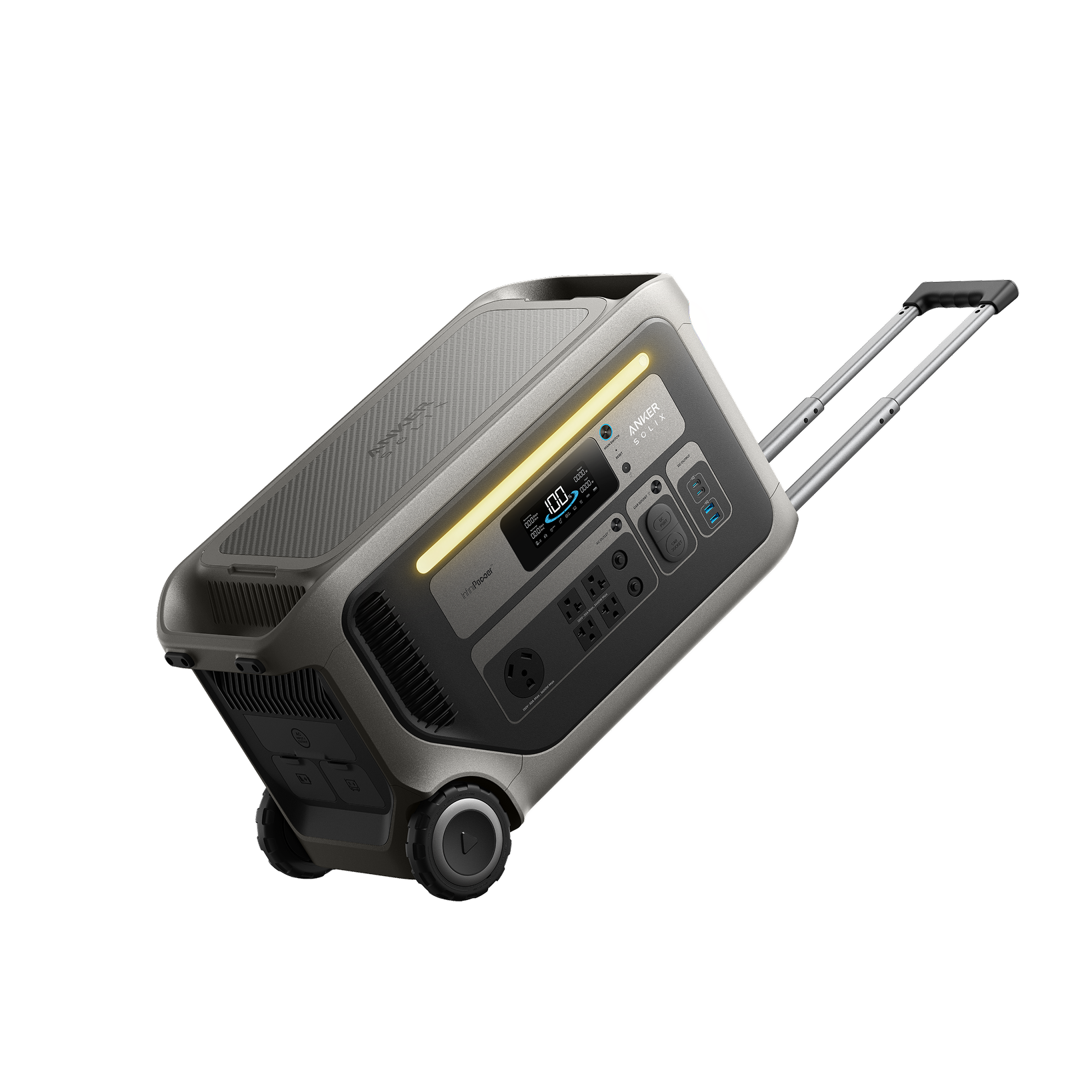
Here is the shape of it. The F3000 is 3,072Wh and 91.5 lbs, a unit one person can wheel out to the driveway. The Apex is 5,529.6Wh and 148.8 lbs, a two-person install that goes in a corner and stays. Output, solar input, and warranty are near enough identical (3,600W against 3,840W, 2,400W of solar on both, 5 years on both), so the real fork is capacity you carry versus capacity you visit.
For most buyers, take the F3000. It is $1,099 cheaper up front ($1,500 against $2,599), a hair cheaper per lifetime kilowatt-hour, movable, better stocked with ports, and, because it expands, not actually capped at 3,072Wh if your needs grow. The Apex is the right call in one specific and legitimate case: you already know you need five-plus kilowatt-hours bolted in one place, for whole-home backup, van life, or running big appliances off the battery. If that isn't you, buy the one you can lift and keep the $1,099.
What the Numbers Reveal
Each conclusion stated first — the numbers behind it on one line, the full analysis below.
Capacity
Run both to end of life and the rates barely diverge either: 12 cents per delivered kilowatt-hour on the Anker, 14 on the BLUETTI, the Anker a touch cheaper on its 4,000-cycle rating and lower price. So no framing of the money picks a winner. You aren't choosing the smarter buy, you're choosing how many watt-hours you want to pay for.
Anker F3000: $1,500 for 3,072Wh, which is $0.49 per watt-hourBLUETTI Apex 300 + B300K: $2,599 for 5,529.6Wh, which is $0.51 per watt-hourLifetime cost per kWh: F3000 $0.12, Apex $0.14 (F3000 rated 4,000 cycles, Apex 3,500)
Why it mattersAnyone waiting for the spreadsheet to decide should stop waiting. Since the rate is the same, the only question left is how much capacity you actually need.
Typical price
Because the F3000 expands, that one miss isn't a permanent verdict. You can buy 3,072Wh today for $1,099 less and bolt on a battery only if your draw ever climbs past it, instead of pre-paying $2,599 for 5.5 kilowatt-hours to cover a day you might never run.
The F3000's 3,072Wh clears five of the six scenarios we test; it only misses Van Life Daily's 4,685Wh, coming up 2,074Wh shortThe F3000 supports Anker expansion batteries, so capacity can be added laterThe F3000 costs $1,099 less than the Apex ($1,500 against $2,599)
Why it mattersIf you're buying the Apex just in case, don't. Buy the F3000 now and the just-in-case battery later, and only pre-buy the big capacity if you already know you'll use it.
For anyone who charges phones, laptops, and DC gear straight off the battery, the F3000 is both cheaper and better equipped out of the box. The Apex is a home-backup AC reservoir that needs a paid accessory to become a personal-electronics charger, and even then one tester got just 8W from the expansion's USB-CB6.
Reviewers found the base Apex 300 ships with no USB or DC ports, just AC outlets and high-voltage connectorsB1BLUETTI's D1 hub, which adds USB and DC, runs about $300B2The expansion battery's USB-C delivered 8W for a phone in one testB6The Anker F3000 includes a 100W USB-C in the box (spec)
Why it mattersDesk, RV, and van buyers who live on USB and DC should price the Apex with the hub included, about $1,600 more than the F3000 rather than $1,099, before deciding the capacity is worth it.
The specific dimensions that decide these two units — everything else is a tie.
Lifetime Value
Selected because: Within two cents per watt-hour at the sticker ($0.49 against $0.51), and 12 against 14 cents per kilowatt-hour over their lives. The money barely separates them, and what little there is leans Anker.
cost / lifetime kWh
Run the two out to end of life and the Anker costs 12 cents per kilowatt-hour delivered against the BLUETTI's 14. Close, but the Anker is the cheaper one to keep, mostly because it is rated for 4,000 charge cycles to the Apex's 3,500 on a lower purchase price. The BLUETTI delivers more total energy over its life, roughly 19,000 kilowatt-hours to the Anker's 12,000, but you pay for that lifetime up front, and at a slightly worse rate.
Neither number is a reason to panic-buy either unit. Two cents a kilowatt-hour is noise against how you'll actually use the thing. It is just the tiebreaker to keep in your pocket for when everything else comes out even, and here everything else nearly does.
Portability & Form Factor
Selected because: 91.5 lbs with wheels versus 148.8 lbs you install once. That 57 lb gap decides which unit can leave the house at all.
weight
The F3000 weighs 91.5 lbs and comes with wheels and a telescoping handleA1A8, which is the difference between a unit you relocate and one you resent. It is still a real lift. One reviewer could carry it alone after a two-hour drive to a picnic, while another found it 'barely passed' a straight manual-lift testA1A8, so treat it as a two-hands, bent-knees job, not a grab-and-go. But one person moves it from garage to driveway.
The Apex is 148.8 lbs stacked, and that is not a lift so much as a two-person maneuver you do once, on install day, then leave alone. This is why the smaller unit takes the campsite and the tailgate outright. Not on capacity, which it has in plenty for a weekend, but because the big one was never going to make the trip. If the battery needs to move, the F3000 isn't the better option. It is the only one.
Your Life, Your Pick
Selected because: The Apex wins three tested scenarios, the F3000 two, and one ties, but the split falls along weight, not capacity.
Line the six scenarios up and they sort themselves by weight, not by watt-hours. The Anker wins Weekend Camping and the Tailgate, not because 3,072Wh is impressive for either (it is overkill for both) but because the 148.8 lb Apex isn't coming to a campsite.
The BLUETTI wins the 8-Hour Blackout, the Remote Workday, and Van Life Daily, and here is the honest part: two of those three, the Anker also passes comfortably. It just has less left in the tank. Through the blackout both units make the night; the Apex simply banks more for a second one. The only scenario the F3000 flat-out fails is the 4,685Wh Van Life day, and even that one the Apex clears by 15Wh, a finish line rather than a cushion. So the scoreboard reads two to three, but the real story is that the F3000 does almost everything and the Apex does the one biggest thing, plus a lot of headroom.
Growth Path
Selected because: Both take expansion batteries, so the F3000's 3,072Wh is a floor it can raise, not a hard cap. The Apex's capacity lead isn't permanent.
The Apex's headline is 5,529.6Wh, but both units take expansion batteries, and that quietly changes the math. The F3000's 3,072Wh isn't a ceiling. It is a starting point you can raise later by adding an Anker battery, and only if and when your needs actually climb past it.
That is the smarter way to spend here. Buy the capacity you can prove you need today for $1,500, and let the other $1,099 stay in your pocket until a real shortfall shows up. Pre-buying the Apex's full 5.5 kilowatt-hours makes sense only if you already know you'll use it. Otherwise you are paying up front for headroom the F3000 will sell you on demand.
Strengths & trade-offs
Anker SOLIX F3000
Strengths
- +Costs $1,099 less
- +Lighter by 57.3 lb
Trade-offs
- –Very heavy unit that may be difficult for one person to lift.
- –Shorter-lived battery — rated for 4,000 charge cycles vs the Apex 300 + B300K's 6,000, so it wears out sooner.
BLUETTI Apex 300 + B300K
Strengths
- +Larger battery capacity
- +Higher AC output
- +Rated for 6,000 charge cycles — much longer battery lifespan
Trade-offs
- –Substantially more expensive (+$1,099) than the SOLIX F3000.
- –Significantly heavier (+57.3 lbs), making it harder to move.
- –Very heavy unit that may be difficult for one person to lift.
Will It Power Your Gear?
Scenario math and per-appliance runtimes, modeled from the spec record.
Scenario verdicts
We ran the math on six real-world scenarios. Here's which unit survives your actual life.
SCN-01 · 2 nights · needs 2,100Wh
Weekend Camping
Two nights off-grid with essential comfort
SOLIX F3000
The Apex 300 + B300K at 148.8 lbs is not a take-along — it rolls off a truck bed if it travels at all, so this scenario belongs to the SOLIX F3000 by default — and it earns it, covering the 2,100Wh with 511Wh to spare. Capacity was never the Apex 300 + B300K's problem here; getting to a campsite was.
Battery budget usedlower = more headroom
LOAD Phone Charger 15W×6h · LED Lights 40W×8h · Box Fan 75W×14h · CPAP Machine 40W×16h
SCN-02 · 8 hours · needs 1,645Wh
8-Hour Blackout
Keep the essentials running through a night without power
Apex 300 + B300K
Both survive the night. The Apex 300 + B300K finishes at 35% used with 3,055Wh left — 1.9 more nights like it. The SOLIX F3000 finishes at 63% with 966Wh, 59% of a second night. If your outages tend to run past one evening, that difference is the whole argument between them.
Battery budget usedlower = more headroom
LOAD Fridge 150W×8h · Router + Modem 20W×8h · LED Lights (4 bulbs) 40W×6h · Phone Charger 15W×3h
SCN-03 · 8 hours · needs 320Wh
CPAP Overnight
Sleep therapy without interruption — the #1 medical use case
Either unit
A CPAP is about 40W for eight hours, so both of these cover the night several times over — capacity isn't the question here. What would separate them is fan noise, but SOLIX F3000 doesn't publish a figure, so there's nothing to hold it to. Buy on price, weight, and whether you can live with a fan you haven't heard.
Battery budget usedlower = more headroom
LOAD CPAP Machine 40W×8h
SCN-04 · 8 hours · needs 910Wh
Remote Workday
Full work day off-grid without power anxiety
Apex 300 + B300K
The Apex 300 + B300K clears the workday at 19% used, banking 3,790Wh — late work, extra calls, or a second laptop charge without arithmetic. The SOLIX F3000 at 35% also finishes, with 1,701Wh of slack for the unplanned.
Battery budget usedlower = more headroom
LOAD Laptop 60W×8h · External Monitor 30W×8h · Router + Modem 20W×8h · Phone Charger 15W×2h
SCN-05 · 4 hours · needs 670Wh
Tailgate Party
Game day power for the crew
SOLIX F3000
The Apex 300 + B300K at 148.8 lbs is not a take-along — it rolls off a truck bed if it travels at all, so this scenario belongs to the SOLIX F3000 by default — and it earns it, covering the 670Wh with 1,941Wh to spare. Capacity was never the Apex 300 + B300K's problem here; getting to a tailgate was.
Battery budget usedlower = more headroom
LOAD Blender 400W×0.5h · LED TV (55") 80W×4h · Bluetooth Speaker 15W×4h · Phone Charger (×3) 45W×2h
SCN-06 · 24 hours · needs 4,685Wh
Van Life Daily
A full day of mobile living — the ultimate endurance test
Apex 300 + B300K
The Apex clears this by 15Wh, which is a rounding error, not a comfort margin. It reaches the finish line on a 4,685Wh day; the F3000, 2,074Wh short, doesn't reach it at all. But finishing by 15Wh isn't a setup you would actually live on. A van pulling this much every day wants a second B300K on the Apex, or a companion battery on the F3000, so plan for the expansion either way. Let this scenario tell you which base unit to start from, not how many you'll end up owning.
Battery budget usedlower = more headroom
LOAD Mini-Fridge 150W×24h · Laptop 60W×4h · Phone Charger 15W×3h · LED Lights 40W×5h · Fan 75W×8h
The Load Test
RUNTIME = (Wh × 0.85) ÷ LOAD
None of the scenarios above exactly yours? Build it. Toggle what you'd plug in; both units are tested against the combined draw.
Essentials
Comfort & Convenience
High-Draw Appliances
Test duration
8h
Continuous draw
205W
Projected runtime
For this load: Apex 300 + B300K runs 22.9h vs 12.7h.
$2,599 list · direct from BLUETTI
Planning for more than this? Describe your whole setup and get it sized →
Modeled from the spec record — same math as the tables below. Methodology
Runtime by appliance
Real-world runtime estimates for common appliances, modeled at 85% inverter efficiency.¹
Essentials
The basics you need runningscale 0–313.3hComfort & Convenience
Makes off-grid life actually enjoyablescale 0–62.7hHigh-Draw Appliances
These reveal the real limitsscale 0–4.7h¹ Runtime = (capacity × 0.85) ÷ appliance watts. Within each group, all bars share one time scale (the group's longest runtime), so lengths are comparable across appliances; identical runtimes collapse into a single blue/orange bar. Actual runtime varies with battery age, temperature, and simultaneous loads — see methodology.
Conclusion
August 30, 2026
Verdict: the Anker SOLIX F3000
At 49 and 51 cents per watt-hour these are the same battery sold in two sizes, so price cannot crown a winner and capacity and portability have to. The F3000 covers five of the six loads we test, moves when you need it to, costs $1,099 less, and runs a slightly cheaper lifetime kilowatt-hour (12 cents against 14). The one load it misses is a 4,685Wh van-life day, and even there the Apex finishes with just 15Wh to spare. Because the F3000 expands, that miss isn't permanent: add a battery if you ever hit it. Buy the Apex only if you already know your daily draw lives above five kilowatt-hours and the unit never has to leave the room.
Editor-assigned confidence, based on cited owner research and spec analysis.
List prices as of August 30, 2026. The links below open Anker's and BLUETTI's current prices.
Sold on Amazon · today’s price is on the listing
or check the Apex 300 + B300K price$2,599.00 list
Written by Gunner Gustafson, Whole-Home Backup Tester · Station Arena Test Desk · Updated August 30, 2026
Black Friday · 38 days out
Price to beat:Apex 300 + B300K $2,599
We have never seen it discounted, so any real cut would be a first.
Measured Data
Benchmark scores and the full spec record, side by side.
Benchmark scores
Not rated for both units (minimum threshold unmet): UPS, RV Living.
Full specifications
ᵈ Derived: price ÷ rated capacity. See the data behind our comparisons →
Comparison ToolAdd more power stations, side by sideOpen Tool →How these numbers are produced
Numeric verification
Every figure on this page traces to our spec database or arithmetic on it — no estimated numbers.
Owner claims
Statements about owner experience are cited to published reviews — see Sources & Research Notes below.
Runtime model
Runtime = (rated capacity × 0.85 inverter efficiency) ÷ device wattage. Solar recharge estimates assume panels deliver 70% of rated output. Cold weather, battery age, and stacked loads reduce real-world results.
Power Score
Computed from 14 published spec dimensions, weighted per use-case bench. Higher is better; a unit must meet a bench's minimum threshold to be rated.
See the full weight table and data sourcing on our methodology page →Class ranking (the star rating)
Each unit's star score is a category ranking, not customer reviews — no buyer opinions feed it. We score every station on size-independent quality (value, output, portability, endurance, ports, warranty, and more), then percentile-rank it against the other units in its capacity class, so a class-leading compact unit and a class-leading whole-home unit can both earn 5★. Here, SOLIX F3000 rates 4.8/5 (88th percentile of 26 Large-class units), and Apex 300 + B300K rates 4.2/5 (53rd percentile of 20 Home Backup-class units).
How the class ranking is computed →Test Notes & Caveats
Hidden gotchas and advantages we spotted that you won't find on the product page.
Weight Reality Check
Neither unit is grab-and-go. The SOLIX F3000 (91.5 lbs) is manageable solo but heavier than a large checked suitcase. The Apex 300 + B300K (148.8 lbs) is spread across its boxes — no single lift, but nothing you reposition on a whim. That's a 57 lb difference, and it is paid once — getting the heavier one into position, not every time you move it.
Apex 300 + B300K: 45dB Published
45dB is about as loud as a running refrigerator. It is BLUETTI's own rating rather than a reading on a shared bench — makers differ on whether they quote a best case or a figure under load, so treat it as a starting point rather than what you would hear at a bedside. For most people, fan noise around 45dB and up is where sleep starts to suffer.
Apex 300 + B300K: Power Lifting to 7,680W
The Apex 300 + B300K has BLUETTI's Power Lifting mode, which runs a resistive appliance rated up to 7,680W from its 3,840W inverter. It does that by delivering less power than the appliance asks for, not more than the inverter has: the heater still works, it just heats more slowly. Two things follow. BLUETTI scopes the mode to purely resistive loads — a heater, a kettle, an incandescent lamp — so it does nothing for a fridge compressor, a pump or a power tool, and this record publishes no surge figure at all, so read the mode as a resistive-load feature rather than as starting ability. And it is not a reason to size down, because running a load that big from 5,530Wh is a short session either way. Genuinely useful if a heater or a kettle is why you're buying; beside the point otherwise. The SOLIX F3000 publishes no equivalent.
UPS Switchover: ≤10ms vs ≤20ms
Both list a UPS mode, at different rated speeds. The Apex 300 + B300K is rated ≤10ms — quick enough on paper that desktop PCs and routers should ride through, treating that as the rating it is. The SOLIX F3000 is rated ≤20ms — fine on paper for routers and most electronics; the fussiest PC power supplies sit right at this line. If a computer with unsaved work is the thing being protected, the stated class is worth the attention; nothing here is a lab result.
Warranty: No Difference
Both units carry the same 5-year warranty, so coverage isn't a tiebreaker here. The Apex 300 + B300K's figure is a maximum rather than a guarantee — it depends on buying direct from BLUETTI or registering the unit, since reseller purchases carry a shorter term. Worth saying because the per-dollar framing can suggest otherwise: the SOLIX F3000 works out at 3.3 years of cover per $1,000 spent against the Apex 300 + B300K's 1.9, but that spread is the price gap, not the terms.
Battery Lifespan in Real Years
The Apex 300 + B300K is rated for 6,000 cycles vs 4,000. In real life: at daily use, that's 16.4 vs 11 years. At weekend use (twice a week), it's 58 vs 38 years. One caution reading years across different sizes: a cycle is 5,530Wh on the Apex 300 + B300K and 3,072Wh on the SOLIX F3000, so count lifetime energy — roughly 33,178 kWh against 12,288 kWh over the rated life. After hitting the cycle limit, the battery doesn't die — it drops to ~80% of original capacity, which is still very usable.
SOLIX F3000: Noise Level Not Disclosed
The Apex 300 + B300K publishes its noise level (45dB); the SOLIX F3000 doesn't publish one. That isn't evidence the SOLIX F3000 is louder — it means there's no figure to hold it to, and no way to compare the two on this without hearing them. If you're buying for a bedroom, a CPAP, or an apartment, treat the Apex 300 + B300K's 45dB as the only published number on the table — a spec-sheet figure, not a measurement — and look for hands-on reports of the SOLIX F3000 before deciding.
Full record above — the Test Desk pick is the SOLIX F3000.
Check SOLIX F3000 price →or check the Apex 300 + B300K priceOwnership Analysis
What happens after you buy — true cost of ownership, brand trust, and growth potential.
Lifetime value
Service lifeyears at one full cycle per day
Lifetime energy delivered
Cost per delivered kWh
│ warranty ends · Reaching the cycle rating means ~80% capacity remains — degraded, not dead.
Analyst note
The SOLIX F3000 is cheaper to buy, but the Apex 300 + B300K is cheaper to own. At $0.08/kWh over its lifetime vs $0.12/kWh, the Apex 300 + B300K's higher cycle life and capacity make each dollar go further over the years.
Brand trust
Anker
Ecosystem
7-8 SOLIX portable power stations across C-series (compact) and F-series (flagship), plus the X1 home energy system
Support
US-based support. Historically known for incredible no-hassle replacements, but recent reports describe AI-driven support agents giving generic responses and complex return logistics for heavy units (hazmat shipping). The Anker brand reputation is still strong, but SOLIX-specific support quality is trending down.
Community
Moderate — active Reddit (r/Anker, r/AnkerSOLIXCommunity) and growing. Benefits from Anker's massive consumer electronics brand awareness.
App experience
Rated 4.5/5 iOS (~1,100 ratings) · 4.3/5 Android
Unique strength
Parent brand trust from Anker's consumer electronics dominance. InfiniPower technology for long cycle life. Strong $/Wh value in the mid-size and larger units — the S2000, F2600 and C1000 are among the better buys per watt-hour in the catalog.
Worth knowing
Anker's SOLIX support has drifted from its old no-questions replacement reputation toward scripted, AI-flavored responses, and returning a 91.5 lb unit means hazmat freight rather than a prepaid box. The draw is the hardware: InfiniPower cells and a 4,000-cycle rating that outlasts most of what you will plug into it.
BLUETTI
Ecosystem
One of the broadest lineups — 15-20+ models from budget (AC2A) to flagship portable (Apex 300, 2764.8Wh). Includes specialized products: vehicle solar hubs, sodium-ion cold-weather units, and balcony storage systems.
Support
The most inconsistent support in the space. Heavily email-based with China timezone delays. Some users get smooth, efficient service; others report weeks of troubleshooting runarounds, being offered discounts on new units instead of repairs, and confusing third-party purchase claim processes. Buying direct from Bluetti's website tends to produce better support outcomes.
Community
Active and growing — Reddit r/bluetti has a dedicated community. Second-largest after EcoFlow in engagement.
App experience
Rated 4.5/5 iOS and Android — tied for best app experience in the category. V3.0 UI redesign was well-received.
Unique strength
Among the best capacity-to-price ratios available — several Elite and Apex units are the lowest $/Wh in the catalog. Widest product diversity including industry-firsts like sodium-ion cold-weather units and dual solar+alternator vehicle hubs. LFP across the rest of the range, though rated cycle life spans 2,500 (EB3A) to 6,000, and it varies WITHIN the Elite range rather than tracking it — the Elite 300 and Elite 200 V2 are rated 6,000 while the Elite 30 V2, Elite 10 Mini, Elite 320 and Elite 400 are rated 3,000+ and the Elite 100 V2 4,000+, so check the specific model. Dual-voltage (120V/240V) in flagships.
Worth knowing
BLUETTI runs the most inconsistent support in the category, heavily email-based, across time zones, and hit-or-miss, but buyers who purchase direct from BLUETTI tend to land the smoother outcomes. On a $2,599 system that is worth doing deliberately, so skip the third-party marketplace listing.
Analyst note
Neither brand's support is a reason to buy, and both machines are heavy enough that any warranty claim is a freight event rather than a mailer, so factor in how you would actually get one serviced. Their apps are roughly a wash, both 4.5 on iOS. If you go BLUETTI, buy it direct; if you go Anker, you are at least holding the cheaper unit to replace if it ever comes to that.
Growth path
SOLIX F3000
EXPANDABLESupports Anker expansion batteries, so you can add capacity later without replacing the base unit — useful if your needs may climb past 3,072Wh.
Accepts up to 2,400W of solar. Enough for a serious multi-panel array.
Limited ports. You'll likely need a power strip or splitter.
Expansion batteries are Anker-specific. You're investing in the Anker ecosystem.
Apex 300 + B300K
EXPANDABLESupports BLUETTI expansion batteries, so you can add capacity later without replacing the base unit — useful if your needs may climb past 5,530Wh.
Accepts up to 2,400W of solar. Enough for a serious multi-panel array.
Limited ports. You'll likely need a power strip or splitter.
Expansion batteries are BLUETTI-specific. You're investing in the BLUETTI ecosystem.
Realistic full solar rechargeat 70% of rated panel output — see methodology
Analyst note
Both expand, so neither locks you out of growth — decide on capacity, price, and the rest, not the expansion checkbox.
What Owners Report
Patterns from published owner reports and long-term reviews — every claim cited to its source below.
Anker SOLIX F3000
The F3000 reads as the more mature unit in the field reports. Reviewers measured idle draw at 20.5W, under Anker's own 25W spec, so it can sit on standby for days without bleeding outA4, and one called it practically silent even under heavy load, a real turn from earlier Anker units that whined under strainA5. Build quality earns consistent marks: solid handle, smooth wheels, and a tester who lifted it alone after a two-hour drive, though that same crew notes it 'barely passed' a straight manual-lift test at 92 lbsA1A8.
The honest catches are real but narrow. The four AC outlets sit close enough that fat adapters block their neighborsA6, Anker switched to a bulky proprietary twist-lock charging plug that barely fits under the unitA7, and the F3000 will shut itself off if you run, say, an air fryer and a microwave at once, so stagger the two biggest loads and it is fineA2. On the other side of the ledger, one reviewer ran a Vitamix that trips 20A breakers elsewhere without a hiccupA9.
“Nothing feels cheap or loose — the handle doesn't wiggle and the wheels roll smoothly; the reviewer could lift it alone without straining after taking it to a family picnic two hours away.”
Sources
androidauthority.com · thesolarlab.com · cleantechnica.com
BLUETTI Apex 300 + B300K
Field data on the exact Apex 300 + B300K bundle is thin. It is new enough that what exists is professional reviewers with test units, not owners six months inB0. What they report is a genuine heavy-appliance machine: one washer cycle pulled it from 100% to 65% in about an hour, a heat-pump dryer took it down to 20% over another 90 minutes, and a tester said outright it could stand in for a generator without the noise or fumesB9B10B4. Recharge drew praise too, under an hour to full in one testB12.
The recurring gripe isn't capacity, it is ports. The base Apex ships with essentially no USB or DC outputs, just AC and high-voltage connectorsB1, the D1 hub that adds them runs about $300B2, and even the expansion battery's USB-C managed a measly 8W for a phone in testingB6. And everyone agrees on the weight: around 150 lbs stacked, not something you casually carryB5B14.
“The Apex 300 doesn't have USB ports, DC ports, or much of anything beyond its six AC plugs and high-voltage connectors.”
Sources
thesolarlab.com · techspective.net · digitalreviews.net · thesolarpit.com · cleantechnica.com · trustedreviews.com · bluettipower.com
Sources & Research Notes
Every owner claim in this report is traceable to a published source. The bracketed references above resolve here.
Recurring owner themes
- Low idle draw and quiet operation are repeatedly cited as the biggest improvements over earlier Anker SOLIX models (F3800/F2600), which reviewers said struggled on both fronts. [SOLIX F3000 · 2 entries]
- Wheels and a deployable handle make the ~90 lb unit manageable to move, but reviewers still describe manually lifting it as a real effort. [SOLIX F3000 · 2 entries]
- Reviewers hit real-world output limits the spec sheet doesn't convey — simultaneous heavy appliance loads and ungrounded high-draw EV charging both triggered shutoffs/failures. [SOLIX F3000 · 2 entries]
- The outlet layout and the switch to a proprietary twist-lock AC charging plug are the most consistent physical-design complaints. [SOLIX F3000 · 2 entries]
- Reviewers consistently flag that the base Apex 300 has no USB/DC ports and requires a separate paid Hub D1 accessory, which some feel is overpriced for what it offers. [Apex 300 + B300K · 3 entries]
- Multiple sources note the extreme weight/bulk of the stacked Apex 300 + B300K system, making 'portable' a stretch despite handles/trolley options. [Apex 300 + B300K · 2 entries]
- Reviewers praise fast recharge and the system's ability to genuinely replace a generator for home backup and heavy loads like washers/dryers. [Apex 300 + B300K · 4 entries]
- A1
“Nothing feels cheap or loose — the handle doesn't wiggle and the wheels roll smoothly; the reviewer could lift it alone without straining after taking it to a family picnic two hours away.”
androidauthority.com — Anker SOLIX F3000 review · 2025-08 · [positive]
- A2
“The battery will often turn itself off if you try to run an air fryer and a microwave at the same time, so simultaneous heavy loads need to be staggered rather than run together.”
androidauthority.com — Anker SOLIX F3000 review · 2025-08 · [mixed]
- A4
“Measured idle draw was 20.5W with only the inverter active — beating Anker's own 25W spec — so it can sit in standby for days without chewing through the battery.”
thesolarlab.com — Anker F3000 Review: Does It Finally Get It Right? · 2025 (exact date unknown) · [positive]
- A5
“Practically silent even under heavy loads — a marked improvement over earlier Anker models that struggled with fan noise.”
thesolarlab.com — Anker F3000 Review: Does It Finally Get It Right? · 2025 (exact date unknown) · [positive]
- A6
“The four standard AC outlets are a bit too close together — plugging in larger adapters or chargers can block the others.”
thesolarlab.com — Anker F3000 Review: Does It Finally Get It Right? · 2025 (exact date unknown) · [negative]
- A7
“Anker switched to a proprietary twist-lock AC charging plug; positioned upright, the bulky plug barely fits underneath the unit.”
thesolarlab.com — Anker F3000 Review: Does It Finally Get It Right? · 2025 (exact date unknown) · [negative]
- A8
“At 92 lbs the built-in wheels and extendable handle make it more portable, but it 'barely passed' the reviewer's own manual-lift test.”
thesolarlab.com — Anker F3000 Review: Does It Finally Get It Right? · 2025 (exact date unknown) · [mixed]
- A9
“Ran a high-power Vitamix blender that pops 20A breakers elsewhere without issue during testing.”
cleantechnica.com — Anker SOLIX F3000 Portable Power Station: CleanTechnica Tested · 2025-08 · [positive]
- B1
“The Apex 300 doesn't have USB ports, DC ports, or much of anything beyond its six AC plugs and high-voltage connectors.”
thesolarlab.com — Bluetti Apex 300 Review: Cheap, Practical Home Backup? · unknown (2025/2026) · [mixed]
- B2
“That Bluetti D1 Power Hub that gives you your DC and USB ports costs about $300, which is a steep price for what you're getting.”
thesolarlab.com — Bluetti Apex 300 Review: Cheap, Practical Home Backup? · unknown (2025/2026) · [negative]
- B4
“It's one of the few systems I've tested that feels like it could genuinely replace a generator, without the noise, fumes, or maintenance.”
techspective.net — Bluetti Apex 300 with B300K Review · 2025-09-21 · [positive]
- B5
“Stacked, you're near 150 pounds of lithium iron phosphate and inverter muscle—movable with the built-in handles or a trolley... but not something you'll casually lug to a picnic.”
techspective.net — Bluetti Apex 300 with B300K Review · 2025-09-21 · [mixed]
- B6
“I just wonder why Bluetti did not include a USB-C port with some decent output, like 100 or 140W as I only got a measly 8W charge out of it for my phone.”
digitalreviews.net — Bluetti B300K Expansion Battery Review · 2025-12 · [negative]
- B9
“Results: 1 wash took about 1 hour and drained the Apex from 100% down to 65%.”
digitalreviews.net — Bluetti Apex 300 Power Station Tests (Australia) Part II · 2025-09 · [positive]
- B10
“Just for fun we then turned on our heat pump dryer to see that over 1½ hours it would further drain it down to 20%.”
digitalreviews.net — Bluetti Apex 300 Power Station Tests (Australia) Part II · 2025-09 · [mixed]
- B12
“During my testing, the recharge speed was astonishing. In under an hour, I had a system ready to go again.”
thesolarpit.com — Bluetti Apex 300 Review · 2025-10-28 · [positive]
- B14
“As will you: it weighs in at 38kg, and is probably much too big and heavy for most people to carry alone.”
trustedreviews.com — Bluetti Apex 300 Review · 2025-10-10 · [negative]
Research compiled August 30, 2026.
Who Should Buy Which
Buy the SOLIX F3000 if you…
- →You want one battery for nearly everything, a camping weekend, a home blackout, keeping your desk alive through an outage, and you would still like to move it. 3,072Wh covers all of it, and the wheels mean it comes with you.
- →The $1,099 gap is real money to you. The F3000 does the job for $1,500 and costs a little less per lifetime kilowatt-hour.
- →You might need more capacity down the road but can't prove it yet. Buy this and add an Anker expansion battery if and when the shortfall actually shows up.
- →You charge laptops, phones, and DC gear directly and want proper ports in the box. The F3000 includes a 100W USB-C; the Apex needs a roughly $300 hub to match itB2.
Buy the Apex 300 + B300K if you…
- →Your daily draw genuinely lives near 4,685Wh, full van-life electrical, or holding a fridge, well pump, and lights through a multi-day outage. This is the one that finishes those days, if only by 15Wh before you expand it.
- →The battery installs in one place and stays, a garage, a utility closet, a fixed van build. At 148.8 lbs, staying put was the plan anyway.
- →You want to run big 120V appliances off the battery, a washer, a dryer, a heat pump, and treat it as a real generator stand-in.
If neither fits
If your actual loads are a phone, a laptop, a CPAP, and a few recharges, a weekend's power rather than a house's, both of these are far more battery and far more money than you need. A smaller, lighter power station does that job for less cash and less lifting. Step up to this tier only once you've done the watt-hour math and genuinely need something close to the 4,685Wh-a-day draw that leaves the F3000 short. Below that, you're paying to haul capacity you'll never drain.
The Bottom Line
Same rate per watt-hour, two different sizes: that is the whole comparison. The Anker SOLIX F3000 is the one to buy for almost everyone. It is $1,099 less, a hair cheaper to own over its life, movable when you need it to be, better stocked with portsB1, and expandable if 3,072Wh ever stops being enough. It handles five of the six loads we throw at it and only misses the one that is really a van's daily electrical panel.
Buy the BLUETTI Apex 300 + B300K if you already know you are in that exception: five-plus kilowatt-hours a day, living in one fixed spot, standing in for a generator. It is not the better deal, since at 51 cents a watt-hour against 49 nothing here is, but it is the bigger battery, and sometimes bigger is exactly the spec you need. For everyone else, the F3000 does the job, moves when you do, and leaves $1,099 in your pocket for the expansion battery you probably won't buy.
Frequently Asked Questions
Answers drawn from the spec record and cited owner research.
Is the BLUETTI Apex 300 worth $1,099 more than the Anker F3000?
Only if you need the capacity. The two cost almost the same per watt-hour, so the extra $1,099 buys you 2,458 more watt-hours (5,529.6 against 3,072), not a better unit, just a bigger one. If your daily draw stays under what the F3000 covers, you are paying for headroom you won't use. If you genuinely need five kilowatt-hours in a fixed location, the Apex is the one that delivers it.
Which is quieter for a bedroom or CPAP, the F3000 or the Apex 300?
Neither publishes a number you can fully trust for a bedroom. The Apex lists 45dB, but that is a best-case floor; it runs louder under load, and 45dB is already about where light sleepers start to stir. The F3000 publishes no figure at all, though a reviewer who ran it under heavy load called it practically silent. For a CPAP, capacity is irrelevant, since both cover a 40W night many times over, so if quiet matters, treat the Apex's 45dB as a ceiling to beat and try to hear the F3000 before you commit.
Can the Anker F3000 run a whole house during an outage?
For a normal evening's essentials, yes. It carried our 8-hour blackout load with 966Wh to spare, about 59% of a second night still in reserve. For true multi-day whole-home backup, a well pump and full-size fridge running for days, its 3,072Wh runs thin, and that is the Apex's territory: 5,529.6Wh finishes the same night with roughly 1.9 more like it in the tank. Both expand, so the F3000 can close that gap with an added battery if you would rather start smaller.
Does the Apex 300 have USB ports?
Barely, and it surprises people. Reviewers found the base Apex ships with no USB or DC ports at all, just AC outlets and high-voltage connectors, so to get proper USB and DC you add BLUETTI's D1 hub for about $300, which pushes the real system cost past $3,000. Even the expansion battery's USB-C put out only 8W for a phone in one test. The F3000, by contrast, includes a 100W USB-C in the box, so if you charge laptops and DC gear directly, that is a meaningful gap.
How long will each one last before the battery wears out?
Both are rated for thousands of cycles, 4,000 for the F3000 and 3,500 for the Apex, which at everyday use is well over a decade either way (Anker's own math works out to about 11 years of daily cycling, BLUETTI's to about 9.6). Over its full life the F3000 delivers roughly 12,000 kilowatt-hours and the Apex roughly 19,000, the Apex's edge coming from its larger pack. Neither is going to wear out before the rest of your electronics do.
Where to buy
Anker SOLIX F3000Pick
Sold on Amazon · today’s price is on the listing

BLUETTI Apex 300 + B300K
$2,599.00
$2,599.00 · direct from BLUETTI
Last checked 16 days ago. Prices move — check before you buy.
Prices may vary by retailer and are subject to change.