Head-to-head test
BLUETTI Apex 300 vs BLUETTI EP500Pro
BLUETTI Apex 300 vs BLUETTI EP500Pro: Take the Apex 300. The EP500Pro's extra 2,355Wh is the most expensive energy on this page, and the only load big enough to need it runs both units flat.
Full profiles: BLUETTI Apex 300 → · BLUETTI EP500Pro →

Written by Gunner GustafsonUpdated
Whole-Home Backup Tester, Station Arena Test Desk
Spec deltas
Two BLUETTI boxes, one rated 6,000 cycles and one 3,500, both capped at 2,400W of solar, and $1,800 apart. The whole page comes down to one question: will you ever reach the second battery you'd be paying for?
The scenario strip says the EP500Pro takes five of six loads, which is true and nearly meaningless, because the Apex clears all five too. A camping weekend needing 2,100Wh uses 89% of the Apex's usable 2,350Wh and 48% of the EP500Pro's 4,352Wh. Same trip, same outcome, different margin. A scenario winner here is a headroom score, not a pass mark.
The EP500Pro does score higher on our PowerScore, 5,376 to 5,062, and nearly all of that gap is the capacity. That's the honest case for it, and it's a real one. It's also the expensive way to buy watt-hours, on a chassis that weighs 187 lbs and can never hold more than it does today.
What the Numbers Reveal
Each conclusion stated first — the numbers behind it on one line, the full analysis below.
rated cycles
A 6,000-cycle rating against 3,500 means that premium can't be recovered as longevity either, and the lifetime arithmetic is blunter than the sticker: 10 cents per kWh across the Apex's life against 20 cents across the EP500Pro's. So the $1,800 isn't buying cheaper energy or a longer-lived unit. It's buying headroom at a markup, redeemable only on nights that actually go past 2,350Wh.
Apex 300: $1,699 for 2,765WhEP500Pro: $3,499 for 5,120WhApex 300 rated 6,000 cycles, EP500Pro 3,500
Why it mattersIf your worst night has never crossed the Apex's usable 2,350Wh, that $1,800 buys a reserve you will watch and never spend.
That inverts the usual expandability argument. The engine is right that a first expansion battery on the Apex mostly buys back ground the EP500Pro already covers, so below 5,120Wh the sealed unit is the simpler purchase. But the EP500Pro's ceiling is welded shut at exactly the point the hardest use case here sits above. One of these boxes can eventually answer that day. The other never will, at any price.
Five of six modeled loads go to the EP500Pro on headroom, and the Apex clears every one of themVan Life Daily needs 4,685Wh; the EP500Pro's usable energy is 4,352WhThe EP500Pro is fixed at 5,120Wh with no expansion port; the Apex takes BLUETTI expansion batteries
Why it mattersIf your real draw is climbing toward van-life numbers, start with the expandable unit rather than the bigger sealed one.
continuous output
Per pound the Apex carries 33 watt-hours (2,765 over 84) to the EP500Pro's 27 (5,120 over 187), and it holds a bigger simultaneous load while doing it. Even the Apex is a serious lift; one reviewer couldn't get it onto a tableA8. But that's a lift. The EP500Pro is furniture that happens to have outlets, and where the wheels stop is where it lives.
Apex 300: 83.78 lbs, 3,840W continuous outputEP500Pro: 187 lbs, 3,000W continuous outputReviewers describe the EP500Pro as needing two people and its wheels to shift at allB7B11
Why it mattersAnyone whose unit will change rooms, floors, or vehicles has already made this decision.
At 6,000 cycles against 3,500 you're living with whichever set of problems for a decade or more, and only one set gets fixed while you sleep. A firmware branch that locks a unit in Backup modeA1 is a bad month. A unit you can't get up a staircase is a bad ten years.
Apex 300 field reports cluster on post-update faults: a unit locked in Backup mode, Error 004 during charging, Bluetooth dropping from a Home Assistant integration, a stuck update promptA1A2A3A4An 18-month follow-up on the EP500Pro found it working as it did from the beginning, with minimal self-discharge in storageB1B2The Apex 300 is rated 6,000 cycles, the EP500Pro 3,500
Why it mattersIf a rough update week would genuinely strand you, that's a reason to wait a firmware cycle on the Apex, not a reason to buy 103 extra pounds.
The specific dimensions that decide these two units — everything else is a tie.
Your Life, Your Pick
Selected because: The EP500Pro takes five of the six modeled loads, but the Apex clears those same five; the percentages here are margin, not pass or fail.
Take the eight-hour blackout at 1,645Wh. The Apex finishes at 70% used, the EP500Pro at 38%, and both households wake up to lights and a cold fridge. The EP500Pro's margin is real and it's worth something on the night an outage runs long. It just isn't the line between working and stranded.
The exception is the 4,685Wh van-life day, where the strip finally discriminates and lands on neither. That's the signal worth taking from this section: across the normal range the capacity gap between these two is the difference between comfortable and very comfortable, and at the one place a real boundary exists, both units are on the wrong side of it.
Lifetime Value
Selected because: 10 cents against 20 cents per lifetime kWh, and the $1,800 difference in what you pay today points the same way.
cost / lifetime kWh
Ten cents per lifetime kilowatt-hour separates these units, 10 against 20, and each figure assumes you run every rated cycle — 6,000 on the Apex, 3,500 on the EP500Pro. That's not a gap you need a spreadsheet to feel, and it runs the same direction as the $1,800 leaving your account on the day of purchase.
Which is why the marginal math matters more than the blended math. Stepping up to the bigger box isn't buying cheaper energy, it's buying more energy at a worse rate, on a unit that reaches end of life at a little over half the cheap one's cycle count.
Portability & Form Factor
Selected because: 84 lbs against 187 lbs, and the lighter unit is also the one with the stronger 3,840W continuous output.
weight
187 lbs isn't a weight, it's an installation. Reviewers describe it as far too heavy for one person, with even two fit people struggling to get it upstairsB7, and a second review puts the same point in plainer termsB11. Choose where it lives before it arrives, because that is where it lives.
The Apex isn't a shoulder carry either. One reviewer found it so heavy he couldn't lift it onto a tableA8, while another calls it heavy but manageable thanks to the handles and modular battery designA6. The difference between the two units is category, not degree. One you move with a friend and a plan. The other you move with a hand truck and a ramp, once.
Growth Path
Selected because: One of these takes expansion batteries and the other is sealed at 5,120Wh, which only starts to matter above a certain nightly draw.
The Apex's expansion port is worth less than it sounds, and that's worth saying before anyone treats it as a free win. Its base 2,765Wh sits well under the EP500Pro's 5,120Wh, so the first battery you bolt on largely buys back capacity the EP500Pro included in the box. If your ceiling is anywhere under 5,120Wh, the sealed unit is the tidier purchase.
What changes the calculus is where that ceiling actually sits. The EP500Pro's 4,352Wh of usable energy is the end of the road for that chassis, and the heaviest day modeled on this page is past it. Expandability isn't a feature until you need it. Then it's the only feature.
What the Specs Don't Tell You
Selected because: Five flags fire on this pair, and two of them are really one fact: a noise figure that BLUETTI publishes for the Apex and not for the EP500Pro.
rated cycles
Two of the five cards below are the same fact wearing different hats. BLUETTI publishes 45dB under load for the Apex and publishes nothing at all for the EP500Pro, so the Apex collects a noise card and the EP500Pro collects a disclosure card. Read them together, or you'll come away believing the unit with the number is the loud one.
The UPS card is the one people over-weight, and it still decides nothing here: 10ms line-interactive against 20ms standby. A fridge, a router, a modem or a furnace fan rides through either gap without a flicker. If you're protecting a desktop or a NAS that truly can't take 20ms, it needs a proper UPS in front of it whichever of these sits behind.
Strengths & trade-offs
BLUETTI Apex 300
Strengths
- +Costs $1,800 less
- +Lighter by 103.2 lb
- +Higher AC output
- +Rated for 6,000 charge cycles — much longer battery lifespan
Trade-offs
- –Very heavy unit that may be difficult for one person to lift.
BLUETTI EP500Pro
Strengths
- +Larger battery capacity
Trade-offs
- –Substantially more expensive (+$1,800) than the Apex 300.
- –Significantly heavier (+103.2 lbs), making it harder to move.
- –Weaker inverter (-840W) limits appliance compatibility.
- –Very heavy unit that may be difficult for one person to lift.
- –Shorter-lived battery — rated for 3,500 charge cycles vs the Apex 300's 6,000, so it wears out sooner.
Will It Power Your Gear?
Scenario math and per-appliance runtimes, modeled from the spec record.
Scenario verdicts
We ran the math on six real-world scenarios. Here's which unit survives your actual life.
SCN-01 · 2 nights · needs 2,100Wh
Weekend Camping
Two nights off-grid with essential comfort
Apex 300
Both boxes do the 2,100Wh weekend without drama. The EP500Pro just does it at 48% of its usable energy where the Apex finishes at 89%, which is the difference between driving home with a reserve and driving home empty. If your weekends have a habit of becoming long weekends, that margin is what the extra money is for.
Battery budget usedlower = more headroom
LOAD Phone Charger 15W×6h · LED Lights 40W×8h · Box Fan 75W×14h · CPAP Machine 40W×16h
SCN-02 · 8 hours · needs 1,645Wh
8-Hour Blackout
Keep the essentials running through a night without power
EP500Pro
Both survive the night. The EP500Pro finishes at 38% used with 2,707Wh left — 1.6 more nights like it. The Apex 300 finishes at 70% with 705Wh, 43% of a second night. If your outages tend to run past one evening, that difference is the whole argument between them.
Battery budget usedlower = more headroom
LOAD Fridge 150W×8h · Router + Modem 20W×8h · LED Lights (4 bulbs) 40W×6h · Phone Charger 15W×3h
SCN-03 · 8 hours · needs 320Wh
CPAP Overnight
Sleep therapy without interruption — the #1 medical use case
Either unit
320Wh is a rounding error for either unit: 14% of the Apex's usable energy, 7% of the EP500Pro's. A dead heat, so break it on where the thing actually sits. One of these you can carry into the bedroom at 84 lbs. The other is 187 lbs and stays wherever the wheels stopped.
Battery budget usedlower = more headroom
LOAD CPAP Machine 40W×8h
SCN-04 · 8 hours · needs 910Wh
Remote Workday
Full work day off-grid without power anxiety
EP500Pro
The EP500Pro clears the workday at 21% used, banking 3,442Wh — late work, extra calls, or a second laptop charge without arithmetic. The Apex 300 at 39% also finishes, with 1,440Wh of slack for the unplanned.
Battery budget usedlower = more headroom
LOAD Laptop 60W×8h · External Monitor 30W×8h · Router + Modem 20W×8h · Phone Charger 15W×2h
SCN-05 · 4 hours · needs 670Wh
Tailgate Party
Game day power for the crew
Apex 300
The EP500Pro at 187 lbs is not a take-along — it rolls off a truck bed if it travels at all, so this scenario belongs to the Apex 300 by default — and it earns it, covering the 670Wh with 1,680Wh to spare. Capacity was never the EP500Pro's problem here; getting to a tailgate was.
Battery budget usedlower = more headroom
LOAD Blender 400W×0.5h · LED TV (55") 80W×4h · Bluetooth Speaker 15W×4h · Phone Charger (×3) 45W×2h
SCN-06 · 24 hours · needs 4,685Wh
Van Life Daily
A full day of mobile living — the ultimate endurance test
Neither unit
Neither unit gets you through a 4,685Wh van day, and the near miss is the interesting part. The EP500Pro lands about 330Wh short of its 4,352Wh of usable energy, and the Apex runs out around the halfway mark. Only one of them has anywhere to go from here: the Apex takes expansion batteries, the EP500Pro is sealed at 5,120Wh.
Battery budget usedlower = more headroom
LOAD Mini-Fridge 150W×24h · Laptop 60W×4h · Phone Charger 15W×3h · LED Lights 40W×5h · Fan 75W×8h
The Load Test
RUNTIME = (Wh × 0.85) ÷ LOAD
None of the scenarios above exactly yours? Build it. Toggle what you'd plug in; both units are tested against the combined draw.
Essentials
Comfort & Convenience
High-Draw Appliances
Test duration
8h
Continuous draw
205W
Projected runtime
For this load: EP500Pro runs 21.2h vs 11.5h.
$3,499 list · direct from BLUETTI
Planning for more than this? Describe your whole setup and get it sized →
Modeled from the spec record — same math as the tables below. Methodology
Runtime by appliance
Real-world runtime estimates for common appliances, modeled at 85% inverter efficiency.¹
Essentials
The basics you need runningscale 0–290.1hComfort & Convenience
Makes off-grid life actually enjoyablescale 0–58hHigh-Draw Appliances
These reveal the real limitsscale 0–4.4h¹ Runtime = (capacity × 0.85) ÷ appliance watts. Within each group, all bars share one time scale (the group's longest runtime), so lengths are comparable across appliances; identical runtimes collapse into a single blue/orange bar. Actual runtime varies with battery age, temperature, and simultaneous loads — see methodology.
Conclusion
August 9, 2026
Verdict: the Apex 300
Take the Apex 300. It's $1,699 against $3,499, and the $1,800 you'd add buys 2,355Wh (5,120 minus 2,765), which prices the extra capacity at about 76 cents per watt-hour. That's worse than either unit charges for the energy it already holds: $1,699 divided by 2,765Wh is 61 cents, $3,499 divided by 5,120Wh is 68 cents. The Apex is rated for 6,000 cycles against the EP500Pro's 3,500, so the premium can't come back as service life either, and the lifetime figures land ten cents apart at 10 and 20 cents per kWh. There is one clean window where the EP500Pro is right: a nightly draw above the Apex's 2,350Wh of usable energy and below its own 4,352Wh, in a spot the 187-lb unit never has to leave. Outside that window the Apex is cheaper to buy, 103 lbs lighter, 840W stronger on continuous output, and still able to grow.
Today the Apex 300 is $1,499, $200 under its typical $1,699. The verdict weighs typical prices, not today's. Prices checked 16 days ago.
Editor-assigned confidence, based on cited owner research and spec analysis.
List prices as of August 9, 2026. The links below open BLUETTI's current price.
$1,499.00 · direct from BLUETTI
down from $1,699 · 12% below usual
Last checked 16 days ago. Prices move — check before you buy.
or check the EP500Pro price$3,499.00 list
Written by Gunner Gustafson, Whole-Home Backup Tester · Station Arena Test Desk · Updated August 9, 2026
Black Friday · 38 days out
Prices to beat:Apex 300 $1,499EP500Pro $3,499
The lowest we have recorded for each. We have never seen the EP500Pro discounted, so any real cut on it would be a first.
Measured Data
Benchmark scores and the full spec record, side by side.
Benchmark scores
Not rated for both units (minimum threshold unmet): UPS, RV Living, Solar Generator.
Full specifications
ᵈ Derived: price ÷ rated capacity. See the data behind our comparisons →
Comparison ToolAdd more power stations, side by sideOpen Tool →How these numbers are produced
Numeric verification
Every figure on this page traces to our spec database or arithmetic on it — no estimated numbers.
Owner claims
Statements about owner experience are cited to published reviews — see Sources & Research Notes below.
Runtime model
Runtime = (rated capacity × 0.85 inverter efficiency) ÷ device wattage. Solar recharge estimates assume panels deliver 70% of rated output. Cold weather, battery age, and stacked loads reduce real-world results.
Power Score
Computed from 14 published spec dimensions, weighted per use-case bench. Higher is better; a unit must meet a bench's minimum threshold to be rated.
See the full weight table and data sourcing on our methodology page →Class ranking (the star rating)
Each unit's star score is a category ranking, not customer reviews — no buyer opinions feed it. We score every station on size-independent quality (value, output, portability, endurance, ports, warranty, and more), then percentile-rank it against the other units in its capacity class, so a class-leading compact unit and a class-leading whole-home unit can both earn 5★. Here, Apex 300 rates 4.9/5 (92nd percentile of 26 Large-class units), and EP500Pro rates 3.5/5 (11th percentile of 20 Home Backup-class units).
How the class ranking is computed →Test Notes & Caveats
Hidden gotchas and advantages we spotted that you won't find on the product page.
Neither of These Is a Carry
84 lbs against 187 lbs, and the honest reading is that both are over the line. The Apex is a bent-knees, two-hands lift you'll want help with on stairs. The EP500Pro is furniture with outlets: it rolls, and rolling is the only way it moves. Decide where each one lives before it ships.
45dB Is the Published Number, Not a Penalty
The Apex collects this card because BLUETTI states a figure for it under load, and 45dB is the only dB number anywhere on this page. A manufacturer willing to print one is doing you a favor. Don't read this card as evidence the Apex is the louder of the two units.
The Apex's Expansion Port Isn't a Free Win
This card flags the EP500Pro's fixed 5,120Wh, and it deserves context that cuts against the cheaper unit. The Apex starts at 2,765Wh, well below that, so the first expansion battery you add largely buys back capacity the EP500Pro shipped with. Expandability only starts paying above 5,120Wh. Above it, though, it's the entire argument, because the EP500Pro can't follow.
Apex 300: Power Lifting to 7,680W
The Apex 300 has BLUETTI's Power Lifting mode, which runs a resistive appliance rated up to 7,680W from its 3,840W inverter. It does that by delivering less power than the appliance asks for, not more than the inverter has: the heater still works, it just heats more slowly. Two things follow. BLUETTI scopes the mode to purely resistive loads — a heater, a kettle, an incandescent lamp — so it does nothing for a fridge compressor, a pump or a power tool, and this record publishes no surge figure at all, so read the mode as a resistive-load feature rather than as starting ability. And it is not a reason to size down, because running a load that big from 2,765Wh is a short session either way. Genuinely useful if a heater or a kettle is why you're buying; beside the point otherwise. Our record for the EP500Pro carries no Power Lifting figure, only a 6,000W surge peak, which is a different rating, so check BLUETTI's own spec sheet before reading this as something the EP500Pro lacks.
10ms vs 20ms Decides Nothing Here
Line-interactive against standby is a real distinction and an academic one for most of what people plug in. A fridge, a router, a modem or a furnace fan rides through either gap without a flicker. If you're protecting a desktop or a NAS that genuinely can't take 20ms, it wants a proper UPS in front of it regardless of which station sits behind.
Warranty: No Difference
Both units carry the same 5-year warranty, so coverage isn't a tiebreaker here. Both figures are maximums rather than guarantees — they depend on buying direct from BLUETTI or registering the unit, since reseller purchases carry a shorter term. Worth saying because the per-dollar framing can suggest otherwise: the Apex 300 works out at 2.9 years of cover per $1,000 spent against the EP500Pro's 1.4, but that spread is the price gap, not the terms.
Battery Lifespan in Real Years
The Apex 300 is rated for 6,000 cycles vs 3,500. In real life: at daily use, that's 16.4 vs 9.6 years. At weekend use (twice a week), it's 58 vs 34 years. One caution reading years across different sizes: a cycle is 2,765Wh on the Apex 300 and 5,120Wh on the EP500Pro, so count lifetime energy — roughly 16,589 kWh against 17,920 kWh over the rated life. After hitting the cycle limit, the battery doesn't die — it drops to ~80% of original capacity, which is still very usable.
A Missing Number Isn't a Loud Fan
BLUETTI doesn't publish a dB rating for the EP500Pro. That's a documentation gap, not a measurement, and it should be read as unknown rather than bad. The practical consequence is narrow: if fan noise is a deciding factor for you, the Apex is the one whose fan behavior you can check on a spec sheet before you buy.
Full record above — the Test Desk pick is the Apex 300.
Check Apex 300 price →or check the EP500Pro priceOwnership Analysis
What happens after you buy — true cost of ownership, brand trust, and growth potential.
Lifetime value
Service lifeyears at one full cycle per day
Lifetime energy delivered
Cost per delivered kWh
│ warranty ends · Reaching the cycle rating means ~80% capacity remains — degraded, not dead.
Analyst note
The Apex 300 wins on both sticker price and long-term value. At $0.10/kWh over its lifetime, it's meaningfully cheaper to own. Clear value winner. One caution on the lifespan row: the Apex 300 takes longer to reach its cycle rating, but a cycle moves a different amount of energy on each unit — the EP500Pro still delivers more over its shorter horizon (17,920 vs 16,589 kWh). Years measure wear, not usefulness.
Delivers each lifetime kWh for $0.10 less — check the Apex 300 price →
Growth path
Apex 300
EXPANDABLESupports BLUETTI expansion batteries, so you can add capacity later without replacing the base unit — useful if your needs may climb past 2,765Wh.
Accepts up to 2,400W of solar. Enough for a serious multi-panel array.
Limited ports. You'll likely need a power strip or splitter.
Expansion batteries are BLUETTI-specific. You're investing in the BLUETTI ecosystem.
EP500Pro
FIXED CAPACITYFixed at 5,120Wh — a sealed, complete system rather than a starting point. There's no expansion port, so that figure is the ceiling: check it against your longest unplugged stretch before you buy.
Accepts up to 2,400W of solar. Enough for a serious multi-panel array.
Adequate ports for most setups, but heavy users may want a power strip.
Realistic full solar rechargeat 70% of rated panel output — see methodology
Analyst note
Don't read the Apex 300's expandability as a straight win here: it starts at 2,765Wh, below the EP500Pro's 5,120Wh, so a first expansion battery largely buys back capacity the EP500Pro already includes. It only pulls ahead if you'd grow past 5,120Wh — short of that, the EP500Pro's larger fixed capacity is the simpler value.
What Owners Report
Patterns from published owner reports and long-term reviews — every claim cited to its source below.
BLUETTI Apex 300
The Apex 300's field record is short, and what exists is dominated by one theme: firmware. Owners report a unit stuck in Backup mode after an updateA1, Error 004 stopping a charge at 97%A2, Bluetooth dropping out of a Home Assistant integration after a new buildA3, and an app that keeps offering an update it then insists isn't neededA4. Four separate reports, all software, all recent.
On hardware the reviewers are kinder. One notes that where other units sound like small jet engines, the Apex's fans stay relatively tameA5. Another calls it heavy but manageable thanks to the handles and modular batteriesA6, while a third simply couldn't lift it onto a tableA8. The app is described as sluggish next to EcoFlow's and Anker's but perfectly usable for switching modes and monitoring from a distanceA10. Bear in mind what this ledger is: press units, tested early, with almost no long-term ownership behind them yetA5A6A10.
“I was using Bluetti-bt until the latest Bluetti firmware update. I then started having disconnects.”
BLUETTI EP500Pro
The EP500Pro has the one thing the Apex can't have yet, which is time. A reviewer returning to one after 18 months found it working as it did from the beginningB1; pulled from roughly a year of storage it still held about 49% chargeB2, then refilled from half to full in about an hour and thirty-five minutes on a standard 120V outletB3. Output is described as rock-solid even at high loadB9, and the fan as very quietB6.
The complaints are consistent and structural. It's too heavy for one person and a struggle for two on stairsB7B11. The display won't show estimated runtime and washes out in direct sunB5, and the app won't schedule outputs or tell you when charging will finishB8. Support is hard to reachB4, and one secondhand buyer whose unit threw error code 006 was refused help outright because he wasn't the original purchaserB10. Worth knowing if you're shopping the used market for one of these.
“After 1.5 years, the system still works superbly — there's still plenty of battery capacity, and it all seems to be operating how it did from the beginning.”
Sources
cleantechnica.com · freshlycharged.com · trustedreviews.com · diysolarforum.com · technicaltrendy.com
Sources & Research Notes
Every owner claim in this report is traceable to a published source. The bracketed references above resolve here.
Recurring owner themes
- Multiple owners report firmware updates causing app glitches, mode-lock issues, error codes, or Bluetooth/Home Assistant disconnects shortly after updating. [Apex 300 · 4 entries]
- Reviewers consistently flag the lack of built-in USB/DC ports as a design tradeoff requiring costly add-on accessories (Hub D1, Hub A1). [Apex 300 · 4 entries]
- The unit's extreme weight (~85 lbs) is repeatedly described as making it barely 'portable' and hard to carry alone. [Apex 300 · 2 entries]
- Reviewers repeatedly flag the EP500 Pro's 180+ lb weight as making it essentially immovable without its wheels, needing two people to shift it upstairs. [EP500Pro · 2 entries]
- Long-term owners report the EP500 Pro holds its charge and function well after a year-plus in storage, with minimal capacity loss. [EP500Pro · 2 entries]
- The app and display are called out as limited on real-time detail (no runtime estimate, no output scheduling) despite solid core power performance. [EP500Pro · 2 entries]
- A1
“I updated my Apex 300 to the latest firmware yesterday. Now it's stuck in 'Backup' mode... Now when I go into the app to try to change it back, it flashes to...”
BLUETTI Community forum — 'Apex 300 stuck in Backup mode after last firmware update' · 2025-11 · [negative]
- A2
“When the system reached 97% charge, I decided to install the firmware updates. After the update completed, the charging stopped and I received Error 004.”
BLUETTI Community forum — 'Error E004 Apex 300' · 2025-11 · [negative]
- A3
“I was using Bluetti-bt until the latest Bluetti firmware update. I then started having disconnects.”
GitHub bluetti-official/bluetti-home-assistant issue #95 — 'APEX 300 and Hub A! now working' · 2026-05 · [mixed]
- A4
“Problem is every time I connect to the power station it shows that I still have an update, and I need to tap to upgrade which then tells me I am up to date.”
BLUETTI Community forum — 'Check For Update App issue' · 2025-09 · [negative]
- A5
“Some units sound like small jet engines under load, but the Apex 300's fans are relatively tame.”
Techspective — 'Bluetti Apex 300 with B300K Review' · 2025-09 · [positive]
- A6
“It's heavy, no question, but the handles and modular battery design make it manageable.”
Techspective — 'Bluetti Apex 300 with B300K Review' · 2025-09 · [mixed]
- A8
“In fact, it's so heavy I can hardly carry it more than a few feet at a time and have been unable to lift it onto a table.”
T3 — 'Bluetti Apex 300 review: transform your off-grid life' · 2025-11 · [negative]
- A10
“The Bluetti app is still a little sluggish compared to the EcoFlow or Anker apps, but it lets you toggle power modes, monitor stats, and tweak settings from a distance.”
TheSolarLab — 'Bluetti Apex 300 Review: Cheap, Practical Home Backup?' · unknown · [mixed]
- A12
“Say you want to connect multiple Apex 300 power stations together, you'll need to buy the Bluetti Hub A1 Parallel Box, which retails for around $699!”
TheSolarLab — 'Bluetti Apex 300 Review: Cheap, Practical Home Backup?' · unknown · [negative]
- B1
“After 1.5 years, the system still works superbly — there's still plenty of battery capacity, and it all seems to be operating how it did from the beginning.”
cleantechnica.com — BLUETTI EP500 Pro — 1½ Years Later · 2025-03 · [positive]
- B2
“Pulled from storage after about a year, the unit still retained roughly 49% charge — self-discharge over that time was minimal.”
cleantechnica.com — BLUETTI EP500 Pro — 1½ Years Later · 2025-03 · [positive]
- B3
“After a long storage period, it charged from 50% to 100% in about 1 hour 35 minutes on a standard 120V outlet.”
cleantechnica.com — BLUETTI EP500 Pro — 1½ Years Later · 2025-03 · [positive]
- B4
“Customer service is difficult to get in contact with.”
freshlycharged.com — Bluetti EP500Pro Review: This Thing is Big and Smart! · unknown · [negative]
- B5
“The display does not show the estimated run time, and it gets washed out in direct sunlight.”
freshlycharged.com — Bluetti EP500Pro Review: This Thing is Big and Smart! · unknown · [negative]
- B6
“The fan on the EP500 Pro is very quiet.”
freshlycharged.com — Bluetti EP500Pro Review: This Thing is Big and Smart! · unknown · [positive]
- B7
“At 83kg it's far too heavy for a single user to lift — even two fit people would struggle to move it upstairs.”
trustedreviews.com — Bluetti EP500Pro Review: A staggering amount of power · unknown · [negative]
- B8
“The app doesn't do the sums to let you know when you can expect it to stop charging, and you can't schedule the AC or DC outputs.”
trustedreviews.com — Bluetti EP500Pro Review: A staggering amount of power · unknown · [negative]
- B9
“Power output is rock-solid and very stable, even at high load.”
trustedreviews.com — Bluetti EP500Pro Review: A staggering amount of power · unknown · [positive]
- B10
“A used EP500 Pro threw error code 006 (SPS voltage low) and wouldn't charge or power any ports; Bluetti refused support since the owner wasn't the original buyer.”
diysolarforum.com — "help with my bluetti ep500pro" thread · unknown · [negative]
- B11
“It weighs 182 pounds, which makes it less portable than some other power stations on the market.”
technicaltrendy.com — BLUETTI EP500Pro Solar Power Station Review · unknown · [negative]
Research compiled August 9, 2026.
Who Should Buy Which
Buy the Apex 300 if you…
- →Your worst night looks like the 1,645Wh blackout on this page rather than the 4,685Wh van day. The Apex covers it at 70% of usable and leaves you $1,800 better off.
- →The unit will move. RV bay to campsite, garage to living room when the power cuts, jobsite to truck. 84 lbs is at the edge of what one determined person manages; 187 lbs isn't in that conversation.
- →You run several heavy things at once. 3,840W of continuous output against 3,000W is the widest hard-spec gap on this page, and it belongs to the cheaper unit.
- →You want the option to grow later without buying a whole second system, and you know your target is above 5,120Wh.
Buy the EP500Pro if you…
- →Your real daily draw lands between 2,350Wh and 4,352Wh: more than the Apex covers comfortably, still inside the EP500Pro's ceiling. That's the one window where the extra $1,800 buys something you'll genuinely use.
- →It goes in one place and stays there. A basement, a utility closet, a shop corner near an outlet. Weight stops mattering the moment the unit stops moving.
- →You want a service record before you spend. There's an 18-month follow-up reporting this unit still working as newB1B2, where the Apex's ledger is a few months of press units and firmware threadsA1A2A3A4.
- →You'd rather have 5,120Wh in one box than manage a base unit plus expansion batteries.
If neither fits
The 4,685Wh van-life day is the profile that should send you off this page entirely. The EP500Pro finishes about 330Wh short of it and the Apex gets roughly halfway, so a single portable box is simply the wrong shape for that load. Price out a fixed 48V LiFePO4 house bank with its own inverter, or two Apex units plus the roughly $699 parallel box BLUETTI sells for tying them togetherA12, and go in with the real number rather than buying one of these and hoping.
The Bottom Line
Take the Apex 300. It costs $1,699 to the EP500Pro's $3,499, it's 103 lbs lighter, its continuous output is 840W stronger, and it's rated for 6,000 cycles against the EP500Pro's 3,500 at half the lifetime cost per kilowatt-hour. What the extra money buys is capacity, at the worst per-watt-hour rate on this page, redeemable only on nights that run past 2,350Wh of usable energy.
There's one clean reason to overrule that, and it deserves saying out loud: if your nightly draw genuinely lives between the Apex's 2,350Wh and the EP500Pro's 4,352Wh, and the unit is never leaving the basement, the bigger box is the right answer and you should buy it without a second thought. Everyone else is choosing between a unit that covers their real loads and a unit that covers them with more room to spare, for $1,800 and a hundred extra pounds. Buy the Apex, keep the difference, and keep the option to grow.
Frequently Asked Questions
Answers drawn from the spec record and cited owner research.
Is the EP500Pro worth double the price of the Apex 300?
Only if you regularly drain past the Apex's 2,350Wh of usable energy. The $1,800 step up buys 2,355Wh, a worse rate per watt-hour than either unit charges across its own pack, and it buys no extra service life at all — the EP500Pro is rated 3,500 cycles against the Apex's 6,000. Below that draw you're paying a premium for a reserve you'll never touch.
Which one can run more at once?
The Apex 300, by 840W. It's rated 3,840W of continuous output against the EP500Pro's 3,000W, so it holds the bigger simultaneous load. That's the reverse of what the prices and the weights would lead you to guess.
Can I expand the Apex 300 to match the EP500Pro's capacity?
It accepts BLUETTI expansion batteries, so its capacity isn't fixed the way the EP500Pro's 5,120Wh is. Be clear-eyed about the value, though: the Apex starts at 2,765Wh, so the first expansion battery mostly buys back capacity the EP500Pro ships with. Expansion earns its keep when your target sits above 5,120Wh, not below it.
Is the EP500Pro too heavy to move?
For one person, yes. It's 187 lbs on wheels, and reviewers describe two fit people struggling to get it upstairs. Treat it as an appliance you install rather than a power station you carry, and pick its spot before delivery. The Apex at 84 lbs is still a bent-knees, two-hands lift, but it is a lift.
Which is better for home backup during an outage?
For an eight-hour cut both are comfortable: that 1,645Wh load takes 70% of the Apex's usable energy and 38% of the EP500Pro's. The EP500Pro switches over in 20ms against the Apex's 10ms, and neither gap is enough for a fridge, router or modem to register. Choose on how long your outages actually run, not on switchover speed.
Where to buy
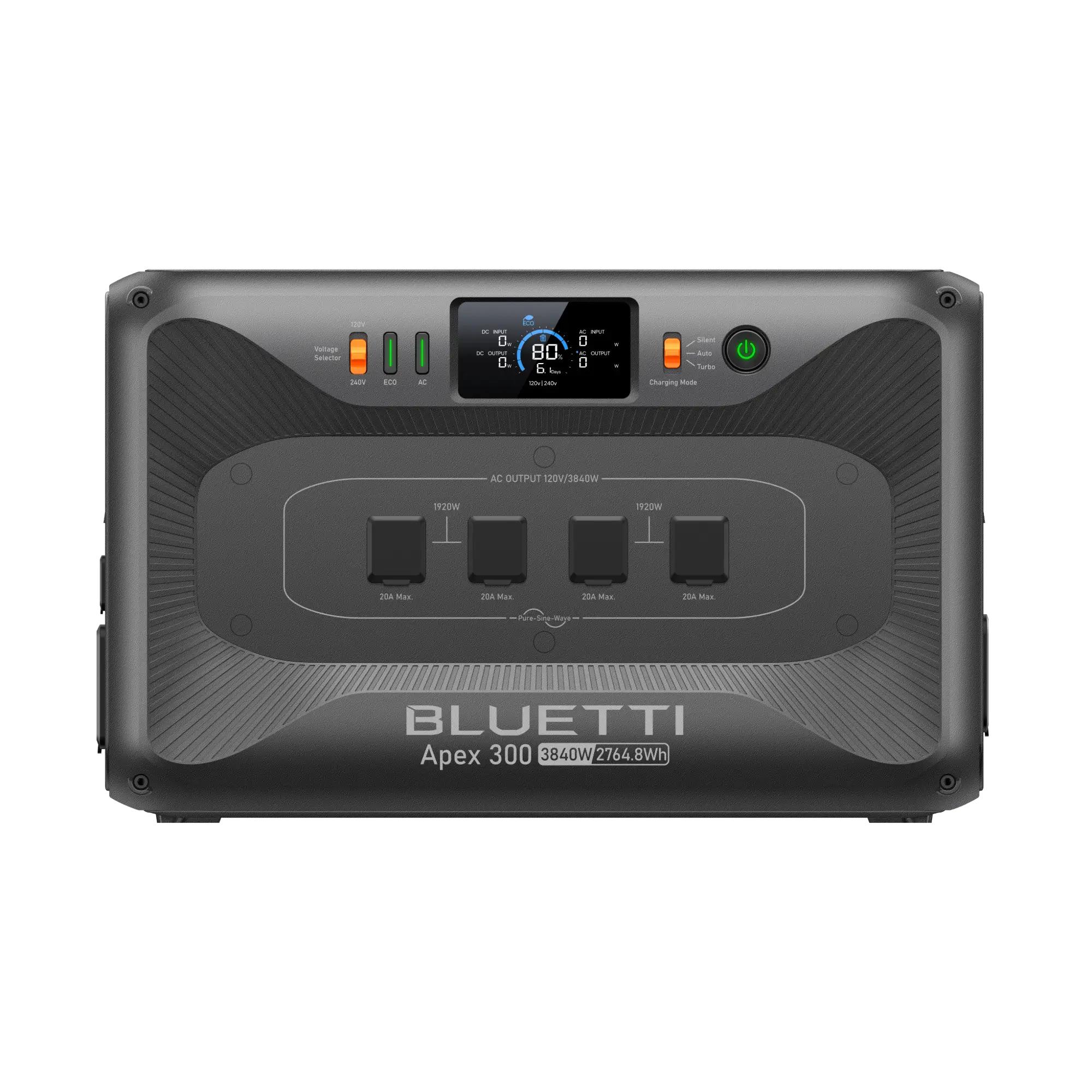
BLUETTI Apex 300Pick
$1,499.00
$1,499.00 · direct from BLUETTI
down from $1,699 · 12% below usual
Last checked 16 days ago. Prices move — check before you buy.
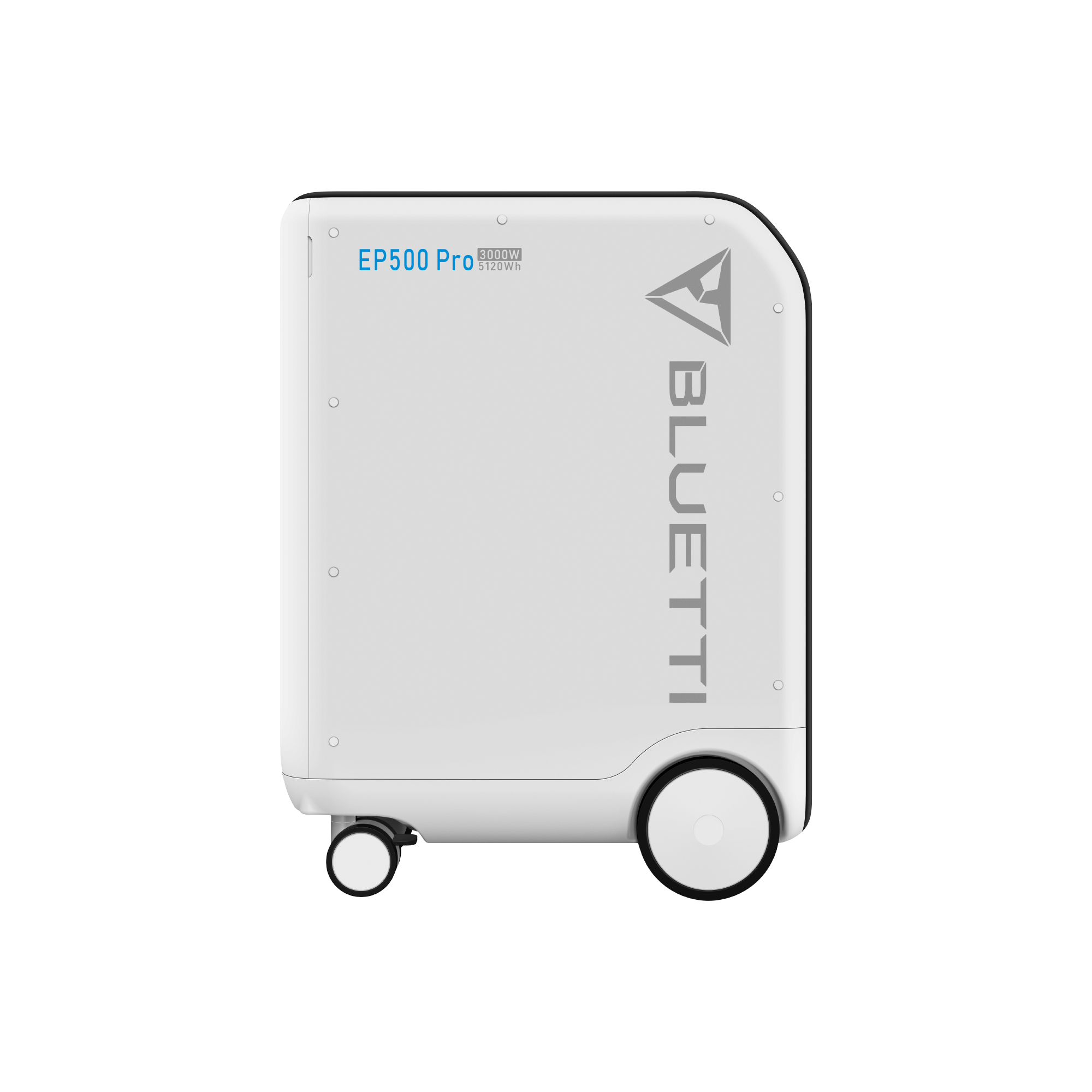
BLUETTI EP500Pro
$3,499.00
$3,499.00 · direct from BLUETTI
Last checked 16 days ago. Prices move — check before you buy.
Prices may vary by retailer and are subject to change.