Head-to-head test
BLUETTI AC200MAX vs Goal Zero Yeti 3000X
The Yeti 3000X's entire case is 984 more watt-hours, and it charges $1,801 for them on a battery rated to 500 cycles.
Full profiles: BLUETTI AC200MAX → · Goal Zero Yeti 3000X →

Written by Gunner GustafsonUpdated
Whole-Home Backup Tester, Station Arena Test Desk

$1,199.00 · direct from BLUETTI
Last checked 1 day ago. Prices move — check before you buy.
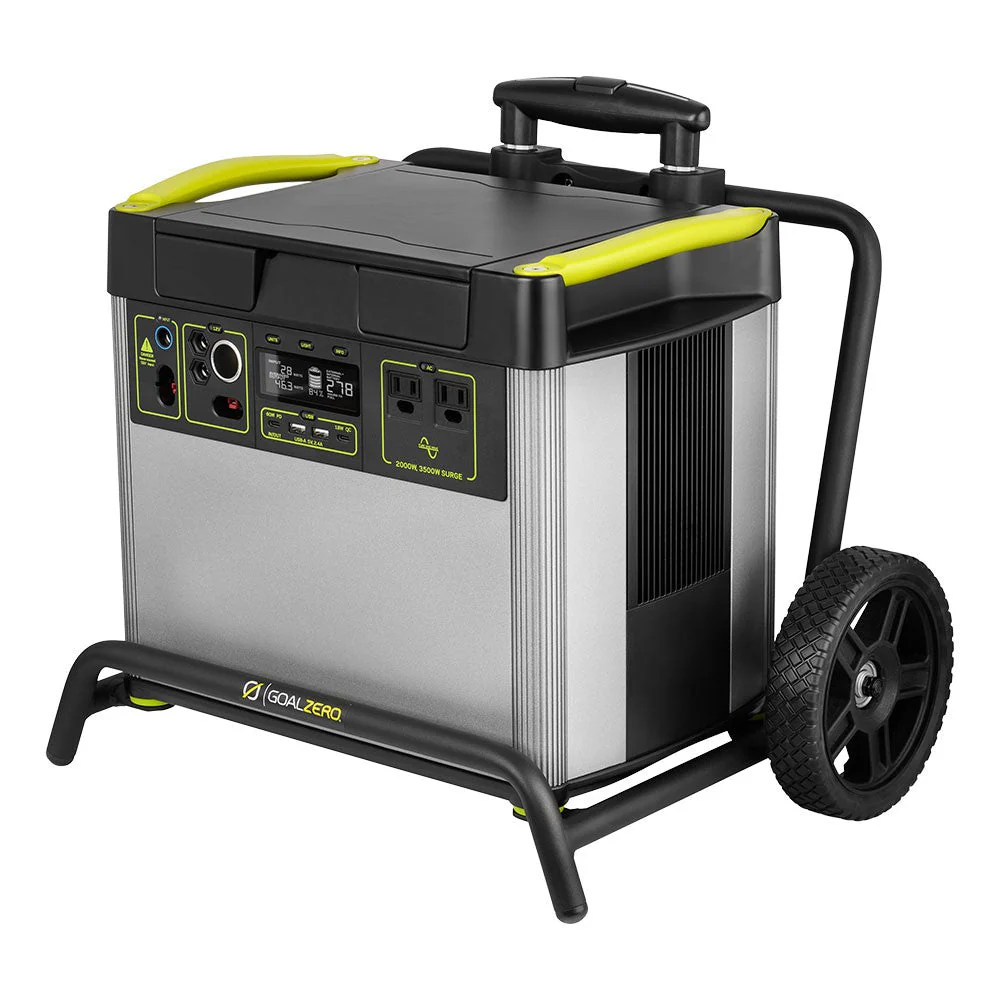
$2,999.95 · direct from Goal Zero
Last checked 1 day ago. Prices move — check before you buy.
Spec deltas
Take the AC200MAX. It's $1,199 against $3,000, and the cheaper box is also the one with the stronger inverter, the higher solar ceiling, the longer warranty and seven times the rated cycles (3,500 against 500). That combination is lopsided enough to be suspicious, so here's the catch up front: the Yeti holds more, and there's one trip on this page it covers and the BLUETTI doesn't.
Seventeen cents per lifetime kilowatt-hour against a dollar ninety-eight. The arithmetic behind that is just cycles times capacity: 3,500 x 2,048Wh gives the BLUETTI 7,168 kWh to hand you across its life, while 500 x 3,032Wh gives the Yeti 1,516 kWh. Put another way, the AC200MAX matches the Yeti's entire lifetime output on its 740th cycle (1,516 kWh divided by 2,048Wh) and still has 2,760 cycles in the tank.
The honest catch, since the BLUETTI is the pick: 2,048Wh derates to 1,741Wh usable at the 85% these scenarios assume, and a 2,100Wh camping weekend leaves it 359Wh short. That's a fail, not a squeaker. It's also the one gap here you can close with money, because expansion batteries exist and a second AC200MAX costs $1,199, while a 500-cycle rating is welded in at the factory.
What the Numbers Reveal
Each conclusion stated first — the numbers behind it on one line, the full analysis below.
Capacity
You also don't have to buy that capacity from Goal Zero at all. Two AC200MAXes are $2,398, which is $602 less than one Yeti, and they give you 4,096Wh, a second 2,200W inverter and a spare unit for the garage. The extra watt-hours are the Yeti's one product, and they are the single easiest thing in this category to buy somewhere else.
Yeti 3000X: 3,032Wh at $3,000BLUETTI AC200MAX: 2,048Wh at $1,199Capacity gap 984Wh; price gap $1,801
Why it mattersIf headroom is the reason the Yeti is on your list, buy headroom the cheap way and keep the change.
rated cycles
Spread across the coverage you actually paid for, that's $1,500 per warranty year against $300. The Yeti isn't a more expensive battery; it's a shorter subscription to one, and Goal Zero has written the warranty to the calendar rather than to the chemistry.
Yeti 3000X: 500 rated cycles, 2-year warrantyAC200MAX: 3,500 rated cycles, 4-year warrantyDaily cycling reaches the rating in 1.4 years for the Yeti and 9.6 for the AC200MAX
Why it mattersAnyone who plans to discharge this thing weekly rather than store it should stop reading specs at cycle life, because that's where the decision already happened.
continuous output
Surge is the spec you meet on the one appliance you bought this for. A fridge or an AC compressor draws far more than its rated wattage in the instant it starts, and headroom is what swallows that spike. Neither unit failed a peak-power check in the six scenarios modelled here, so this is about the load that isn't on that list: the chest freezer, the shop vac, the window unit in August. The USB-C ports tell the same story in miniature, since a laptop that wants 100W will charge slower on the Yeti's 60W port.
AC200MAX: 2,200W continuous, 4,800W surge, 100W USB-CYeti 3000X: 2,000W continuous, 3,500W surge, 60W USB-CBoth units cleared the peak-power check in all six modelled scenarios
Why it mattersIf your load list has a compressor in it, compare inverters first and watt-hours second.
solar input
A bigger bank also needs a bigger array to refill it, and the ceilings run the wrong way. Capacity over peak solar input, before any real-world losses, puts the BLUETTI's 2,048Wh at a shade over two hours of full sun on 900W and the Yeti's 3,032Wh at just over five on 600W. The unit with less to refill refills faster, and it's the one whose expansion adds lithium rather than subtracting it.
Both spec sheets read expandable: YesThe Yeti's expansion is the lead-acid Tank, which gives up only about half its capacity and halves the onboard lithium the moment it's connectedB4Solar input ceiling: 900W on the AC200MAX, 600W on the Yeti 3000X
Why it mattersIf the word expandable is what's keeping the Yeti in the running, strike it out; that column is where it trails by the most.
The specific dimensions that decide these two units — everything else is a tie.
Lifetime Value
Selected because: 3,500 rated cycles against 500 moves the real cost of these two units far more than the $1,801 on the price tags does.
cost / lifetime kWh
Every number in this section assumes you cycle the thing. If this is a closet battery that comes out twice a winter, neither unit will ever approach its rated cycle count, and the longevity argument quietly evaporates.
That's the strongest case anyone can build for the Yeti 3000X, and it still doesn't carry. Strip cycle life out of the comparison entirely and what's left is the price tag against the capacity lead: the same trade, minus the BLUETTI's best card, and the Yeti loses it anyway because those extra watt-hours were never priced at anything like the market rate. Longevity is the reason the AC200MAX wins by a mile instead of by a length.
Your Life, Your Pick
Selected because: This is where the Yeti's extra capacity earns its money: it's the only one of the two that finishes a 2,100Wh camping weekend.
The Yeti takes four of the six scenarios, ties the CPAP night, and joins the BLUETTI in failing van life. Exactly one of those four wins is a capability difference. Weekend Camping asks for 2,100Wh and the AC200MAX has 1,741Wh usable, so it doesn't finish the trip. The other three are margin, not muscle: both units walk through a blackout, a workday and a tailgate, and the Yeti simply ends the day holding more.
Read the percentages for what they actually measure, which is need divided by 85% of nameplate capacity. A bigger battery wins that metric automatically at every load it can cover, which is why the Yeti takes a tailgate that neither unit strains at. The blackout is the one where margin has teeth: the AC200MAX finishes with 96Wh spare against the Yeti's 932Wh. And neither unit carries a published switchover time, so treat both as something you plug in by hand when the lights go, not as a UPS.
Growth Path
Selected because: Both spec sheets say expandable, and only one of them expands into lithium.
solar input
BLUETTI's expansion adds lithium. Goal Zero's adds lead-acid and takes lithium awayB4. That asymmetry is the whole section, and it's invisible on a spec table that marks both units expandable.
The solar ceilings compound it. The unit with the bigger bank to fill has the smaller array to fill it with, 600W against 900W, so every battery bolted onto the Yeti is slower to recover than the one before it. Expandability only counts if the thing you expand into is worth having and you can actually put energy back into it.
What the Specs Don't Tell You
Selected because: Warranty, surge headroom and cycle life all break the same direction, and the two noise cards need reading against each other rather than one at a time.
rated cycles
Three of the six cards break the same way and they're the three that cost money: 4,800W of surge against 3,500W, four years of warranty against two, 3,500 cycles against 500. Nothing in the remaining cards pushes back.
The two noise cards are the interesting ones and they need reading together. One unit is flagged for publishing a 50dB figure, the other is flagged for publishing nothing at all. Only one of those is a measurement, and the flag lands on the company that took the measurement. Weight is the card that decides nothing: 61.9 lbs and 69.78 lbs are the same species of object.
Strengths & trade-offs
BLUETTI AC200MAX
Strengths
- +Costs $1,800.9 less
- +Lighter by 7.9 lb
- +Higher AC output
- +Longer warranty
- +Faster solar charging
- +Rated for 3,500 charge cycles — much longer battery lifespan
Trade-offs
- –No major technical downsides compared to rival.
Goal Zero Yeti 3000X
Strengths
- +Larger battery capacity
Trade-offs
- –Substantially more expensive (+$1,800.9) than the AC200MAX.
- –Shorter-lived battery — rated for 500 charge cycles vs the AC200MAX's 3,500, so it wears out sooner.
Will It Power Your Gear?
Scenario math and per-appliance runtimes, modeled from the spec record.
Scenario verdicts
We ran the math on six real-world scenarios. Here's which unit survives your actual life.
SCN-01 · 2 nights · needs 2,100Wh
Weekend Camping
Two nights off-grid with essential comfort
Yeti 3000X
A 2,100Wh weekend is more than the AC200MAX has in it: 1,741Wh usable against 2,100Wh needed, 359Wh short. That's a fail, not a squeaker, and it's the clearest thing the Yeti 3000X's extra capacity buys, since it finishes the same trip with 477Wh still in hand. Shorten the load list, add an expansion battery, or accept that this specific weekend belongs to the Yeti.
Battery budget usedlower = more headroom
LOAD Phone Charger 15W×6h · LED Lights 40W×8h · Box Fan 75W×14h · CPAP Machine 40W×16h
SCN-02 · 8 hours · needs 1,645Wh
8-Hour Blackout
Keep the essentials running through a night without power
Yeti 3000X
Both units make it through eight hours and the margins are not comparable. The AC200MAX ends with 96Wh left out of 1,741Wh usable, which is a phone and a lamp, not a second night. The Yeti 3000X ends with 932Wh, which is real insurance when the storm outlasts the forecast. Neither publishes a switchover time, so keep a flashlight within reach for the handover either way.
Battery budget usedlower = more headroom
LOAD Fridge 150W×8h · Router + Modem 20W×8h · LED Lights (4 bulbs) 40W×6h · Phone Charger 15W×3h
SCN-03 · 8 hours · needs 320Wh
CPAP Overnight
Sleep therapy without interruption — the #1 medical use case
Either unit
320Wh is a rounding error to both of these, at 18% of the AC200MAX and 12% of the Yeti 3000X, so capacity settles nothing. What would settle it is the fan eighteen inches from your head at 3 a.m., and there the honest answer is that you can't compare them: BLUETTI publishes 50dB under load, Goal Zero publishes nothing, and a missing number isn't a quiet one. At this load neither unit is working hard. Buy the cheaper one and keep the receipt.
Battery budget usedlower = more headroom
LOAD CPAP Machine 40W×8h
SCN-04 · 8 hours · needs 910Wh
Remote Workday
Full work day off-grid without power anxiety
Yeti 3000X
A 910Wh workday leaves 831Wh in the AC200MAX and 1,667Wh in the Yeti 3000X. Both finish with tomorrow already covered; the Yeti just has more of tomorrow. Score this one a headroom win rather than a capability one.
Battery budget usedlower = more headroom
LOAD Laptop 60W×8h · External Monitor 30W×8h · Router + Modem 20W×8h · Phone Charger 15W×2h
SCN-05 · 4 hours · needs 670Wh
Tailgate Party
Game day power for the crew
Yeti 3000X
670Wh is a light day for both, and the Yeti 3000X ends it with more in reserve. What you feel in a parking lot is the whole unit rather than the difference between them: 69.78 lbs of Yeti or 61.9 lbs of BLUETTI, and both are a two-hands, straight-back carry from the tailgate to the grass.
Battery budget usedlower = more headroom
LOAD Blender 400W×0.5h · LED TV (55") 80W×4h · Bluetooth Speaker 15W×4h · Phone Charger (×3) 45W×2h
SCN-06 · 24 hours · needs 4,685Wh
Van Life Daily
A full day of mobile living — the ultimate endurance test
Neither unit
Neither unit covers this scenario's 4,685Wh: the AC200MAX comes up 2,944Wh short (about 37% covered), the Yeti 3000X 2,108Wh (55%). Treat this as partial cover — enough for the essentials in it, not the whole list.
Battery budget usedlower = more headroom
LOAD Mini-Fridge 150W×24h · Laptop 60W×4h · Phone Charger 15W×3h · LED Lights 40W×5h · Fan 75W×8h
The Load Test
RUNTIME = (Wh × 0.85) ÷ LOAD
None of the scenarios above exactly yours? Build it. Toggle what you'd plug in; both units are tested against the combined draw.
Essentials
Comfort & Convenience
High-Draw Appliances
Test duration
8h
Continuous draw
205W
Projected runtime
For this load: Yeti 3000X runs 12.6h vs 8.5h.
$2,999.95 list · direct from Goal Zero
Modeled from the spec record — same math as the tables below. Methodology
Runtime by appliance
Real-world runtime estimates for common appliances, modeled at 85% inverter efficiency.¹
Essentials
The basics you need runningscale 0–171.8hComfort & Convenience
Makes off-grid life actually enjoyablescale 0–34.4hHigh-Draw Appliances
These reveal the real limitsscale 0–2.6h¹ Runtime = (capacity × 0.85) ÷ appliance watts. Within each group, all bars share one time scale (the group's longest runtime), so lengths are comparable across appliances; identical runtimes collapse into a single blue/orange bar. Actual runtime varies with battery age, temperature, and simultaneous loads — see methodology.
Conclusion
August 9, 2026
Verdict: the AC200MAX
Buy the AC200MAX. The Yeti 3000X wins exactly one thing, 984Wh of capacity, and asks $1,801 for it on cells rated to 500 cycles against the BLUETTI's 3,500 and covered for two years against four. Capacity is also the only advantage on this page that money fixes later: the AC200MAX takes expansion batteries, and at $1,199 apiece two of them run $2,398, still $602 under the Yeti's price. Nothing fixes 500 cycles. The case for the Yeti is narrow and real, and it is this: you need 3,032Wh out of a single box on a single trip, you're buying once, and you'll never add to it. Outside that, the cheaper unit is also the stronger one, with 2,200W continuous against 2,000W, 4,800W of surge against 3,500W, 900W of solar input against 600W, a 100W USB-C port against 60W, and 7.9 lbs less to lift.
Editor-assigned confidence, based on cited owner research and spec analysis.
List prices as of August 9, 2026. The links below open BLUETTI's and Goal Zero's current prices.
$1,199.00 · direct from BLUETTI
Last checked 1 day ago. Prices move — check before you buy.
or check the Yeti 3000X price$2,999.95 list
Written by Gunner Gustafson, Whole-Home Backup Tester · Station Arena Test Desk · Updated August 9, 2026
Measured Data
Benchmark scores and the full spec record, side by side.
Benchmark scores
Full specifications
ᵈ Derived: price ÷ rated capacity. See the data behind our comparisons →
Comparison ToolAdd more power stations, side by sideOpen Tool →How these numbers are produced
Numeric verification
Every figure on this page traces to our spec database or arithmetic on it — no estimated numbers.
Owner claims
Statements about owner experience are cited to published reviews — see Sources & Research Notes below.
Runtime model
Runtime = (rated capacity × 0.85 inverter efficiency) ÷ device wattage. Solar recharge estimates assume panels deliver 70% of rated output. Cold weather, battery age, and stacked loads reduce real-world results.
Power Score
Computed from 14 published spec dimensions, weighted per use-case bench. Higher is better; a unit must meet a bench's minimum threshold to be rated.
See the full weight table and data sourcing on our methodology page →Class ranking (the star rating)
Each unit's star score is a category ranking, not customer reviews — no buyer opinions feed it. We score every station on size-independent quality (value, output, portability, endurance, ports, warranty, and more), then percentile-rank it against the other units in its capacity class, so a class-leading compact unit and a class-leading whole-home unit can both earn 5★. Here, AC200MAX rates 3.4/5 (4th percentile of 26 Large-class units), and Yeti 3000X rates 3.3/5 (1st percentile of 26 Large-class units).
How the class ranking is computed →Test Notes & Caveats
Hidden gotchas and advantages we spotted that you won't find on the product page.
Both Are Two-Hand Lifts
61.9 lbs and 69.78 lbs are the same species of object: a bent-knees, don't-try-it-on-the-stairs lift. The 7.9 lbs between them won't change where either unit lives in your house or how often you move it. If weight is your deciding factor, both of these are the wrong size of unit.
50dB, Because BLUETTI Published It
The AC200MAX carries a noise figure for the unglamorous reason that BLUETTI states one: 50dB under load, not at idle. Read it as disclosure. It's the only decibel number on this page, and having one is not the same as being the louder unit.
4,800W of Headroom on a 2,200W Inverter
Surge is what absorbs the spike when a compressor starts, and the AC200MAX holds more than twice its continuous rating in reserve. The Yeti 3000X offers 3,500W behind a 2,000W inverter. Neither unit failed a peak-power check in the six scenarios modelled here, so this is insurance for the appliance that isn't on that list.
Four Years Against Two
BLUETTI covers the AC200MAX for four years, Goal Zero covers the Yeti 3000X for two. Spread over the purchase price that's $300 per covered year against $1,500. These terms aren't close, and the longer one is bolted to the cheaper unit with the longer-lived cells.
33.7 Years Against 4.8
On weekend duty, 3,500 cycles and 500 cycles convert to 33.7 years for the AC200MAX and 4.8 for the Yeti 3000X. One of those is a number you will never personally reach. The other is a replacement date, and no accessory, discount or firmware update moves it.
Goal Zero's Missing Decibel
No published noise figure for the Yeti 3000X means there's nothing to compare and nothing to hold anyone to later. An unstated number isn't a low one. If this unit is going to live in a bedroom or a home office, buy it somewhere with a return window and use that window.
Full record above — the Test Desk pick is the AC200MAX.
Check AC200MAX price →or check the Yeti 3000X priceOwnership Analysis
What happens after you buy — true cost of ownership, brand trust, and growth potential.
Lifetime value
Service lifeyears at one full cycle per day
Lifetime energy delivered
Cost per delivered kWh
│ warranty ends · Reaching the cycle rating means ~80% capacity remains — degraded, not dead.
Analyst note
The AC200MAX wins on both sticker price and long-term value. At $0.17/kWh over its lifetime, it's meaningfully cheaper to own. Clear value winner.
Delivers each lifetime kWh for $1.81 less — check the AC200MAX price →
Brand trust
BLUETTI
Ecosystem
One of the broadest lineups — 15-20+ models from budget (AC2A) to flagship portable (Apex 300, 2764.8Wh). Includes specialized products: vehicle solar hubs, sodium-ion cold-weather units, and balcony storage systems.
Support
Support is BLUETTI's weak point and the honest reason to pause before buying. It's email-first, runs on a China timezone, and outcomes swing wildly from one customer to the next. Buying direct from BLUETTI rather than through a third party measurably improves your odds when something goes wrong.
Community
Active and growing — Reddit r/bluetti has a dedicated community. Second-largest after EcoFlow in engagement.
App experience
Rated 4.5/5 iOS and Android — tied for best app experience in the category. V3.0 UI redesign was well-received.
Unique strength
Some of the best capacity per dollar in the category, LFP chemistry standardised across the lineup, and the widest spread of formats of any brand here, down to sodium-ion cold-weather units and balcony storage.
Worth knowing
Older and discontinued models can become unrepairable, since there's no spare-parts commitment covering all of them. Worth a thought on any unit you plan to keep for a decade.
Goal Zero
Ecosystem
Focused — a compact current line (6th-gen Yeti and Yeti Pro series), the previous-gen X series now out of stock across every model on Goal Zero's own store (checked 2026-09-13: 200X, 500X, 1000X, 1500X, 3000X, 6000X, some listed only as open-box), so buying one new means finding retailer stock, Sherpa power banks for the under-100Wh tier, plus Alta coolers, Nomad/Ranger solar panels, and vehicle integration kits
Support
Goal Zero is US-based, in Salt Lake City, and for years that was the answer to why it costs more. The answer has weakened: long waits, unanswered email, tickets sitting for weeks, and the official community forums now closed. Premium support was the argument for premium pricing, and it's the part of the brand that has aged worst.
Community
Small but loyal — strong following in overlanding and preparedness communities. Official community forums were recently shuttered, frustrating long-time users.
App experience
Rated 4.4/5 iOS (~1,200 ratings) but recent reviews skew negative — recurring connectivity issues, crashes, and stability problems.
Unique strength
Real heritage, since Goal Zero more or less created this product category, plus IPX4 weather resistance and a Yeti-Ready ecosystem of coolers, lights and vehicle kits built around the same batteries.
Worth knowing
Goal Zero is the most expensive brand in the category per watt-hour, and the Yeti 3000X is one of the clearest illustrations of that in the catalogue.
Analyst note
The usual reason to pay Goal Zero's premium is the company standing behind it: American, established, reachable on the phone. That case is thinner than it used to be, and BLUETTI's own weakness happens to be the identical one. So this isn't a choice between good support and bad support. It's a choice between two brands carrying support question marks, one of which is charging $1,801 more for the privilege.
Growth path
AC200MAX
EXPANDABLESupports BLUETTI expansion batteries, so you can add capacity later without replacing the base unit — useful if your needs may climb past 2,048Wh.
Accepts up to 900W of solar. Suitable for a 1-2 panel setup.
Generous port selection supports complex multi-device setups.
Expansion batteries are BLUETTI-specific. You're investing in the BLUETTI ecosystem.
Yeti 3000X
EXPANDABLESupports Goal Zero expansion batteries, so you can add capacity later without replacing the base unit — useful if your needs may climb past 3,032Wh.
Accepts up to 600W of solar. Suitable for a 1-2 panel setup.
Adequate ports for most setups, but heavy users may want a power strip.
Expansion batteries are Goal Zero-specific. You're investing in the Goal Zero ecosystem.
Realistic full solar rechargeat 70% of rated panel output — see methodology
Analyst note
Both expand, but the AC200MAX's higher solar ceiling (900W vs 600W) gives it the stronger off-grid growth path — more panels can feed a bigger bank as it grows.
What Owners Report
Patterns from published owner reports and long-term reviews — every claim cited to its source below.
BLUETTI AC200MAX
The recurring note on the AC200MAX is generational rather than defective. It's the unit the AC200L was built to improve on, and the specifics are fans measured well into the 50s dBA under load at a meterA1, AC charging that takes roughly two hours where the newer unit does it in well under oneA2, and an app that reads like an afterthoughtA3. Take that as the shape of the compromise. None of it is a reliability complaint.
The evidence is also thin and second-hand: this is review-desk and forum material rather than years of ownershipA1A2A3. The one longevity claim in it lines up with the spec sheet, at around 3,500 cycles, roughly nine years of useful life, on a four-year warrantyA4.
“The AC200MAX was a popular mid-range unit with solid capacity and an expandable battery, but its frustrations included slow charging, aging LFP chemistry, and an app that felt like an afterthought — the AC200L addresses nearly every one of these.”
Sources
diysolarforum.com · offgridbenchmark.com · firstquadcopter.com · bluettipower.eu · techradar.com
Goal Zero Yeti 3000X
Every source lands on the same number: 500 cycles to 80% capacity on Li-ion NMC, where LFP units run past 3,000B1. It's named as the unit's biggest drawback and nothing else in the record competes with it. The second theme is the lift, at roughly 70 lbs, with a roll cart treated as essential rather than as an accessoryB2.
The expansion path is the third. The Tank uses lead-acid batteries that give up only about half their capacity in use, and connecting one halves the lithium already in the YetiB4. The headline specs check out against ours, at 3,032Wh, 2,000W continuous and 3,500W surgeB3, so the argument here was never about what the Yeti is. It's about what it costs to own one.
“A roughly 70-pound unit that comes with a roll cart, essential to move it around.”
Sources
poweredportablesolar.com · bestgeneratorsolar.com · shopsolarkits.com · rei.com · goalzero.com · protoolreviews.com
Sources & Research Notes
Every owner claim in this report is traceable to a published source. The bracketed references above resolve here.
Recurring owner themes
- The AC200MAX is the older generation — louder, slower to charge, weaker app — that the AC200L was built to improve on. [AC200MAX · 3 entries]
- Large NMC capacity but a crippling 500-cycle rating, heavy weight (roll cart needed), and a limited lead-acid expansion path are the recurring points. [Yeti 3000X · 3 entries]
- A1
“The AC200MAX's fans are noticeably louder than the newer AC200L — measured well into the 50s dBA under load at 1 meter, versus the AC200L staying barely audible under moderate load.”
diysolarforum.com / offgridbenchmark.com — AC200MAX vs AC200L noise · 2026 · [negative]
- A2
“Slow AC charging is a common frustration — the AC200MAX takes roughly two hours to reach most of a charge, versus well under an hour for the AC200L.”
offgridbenchmark.com / firstquadcopter.com — AC200L vs AC200MAX · 2026 · [negative]
- A3
“The AC200MAX was a popular mid-range unit with solid capacity and an expandable battery, but its frustrations included slow charging, aging LFP chemistry, and an app that felt like an afterthought — the AC200L addresses nearly every one of these.”
offgridbenchmark.com — AC200L review / comparison · 2026 · [mixed]
- A4
“Still a solid, well-liked expandable power station with LFP chemistry rated around 3,500 cycles (roughly nine years of useful life) and a 4-year warranty, versus the AC200L's 5-year.”
bluettipower.eu / techradar.com — AC200MAX · 2026 · [mixed]
- B1
“Its biggest drawback is the Li-ion NMC battery rated for only 500 cycles to 80% capacity, where LiFePO4 power stations last 3,000+ cycles.”
poweredportablesolar.com / bestgeneratorsolar.com — Yeti 3000X review · 2026 · [negative]
- B2
“A roughly 70-pound unit that comes with a roll cart, essential to move it around.”
shopsolarkits.com / rei.com — Yeti 3000X review · 2026 · [mixed]
- B3
“3,032Wh capacity with a 2,000W continuous inverter and 3,500W surge.”
goalzero.com / protoolreviews.com — Yeti 3000X specifications · 2026 · [positive]
- B4
“Expandable via the Goal Zero Tank system, but the Tank uses lead-acid batteries that allow only ~50% usable capacity and halve the onboard lithium capacity when connected — a limited expansion path.”
poweredportablesolar.com — Yeti 3000X / Tank review · 2026 · [negative]
Research compiled August 9, 2026.
Who Should Buy Which
Buy the AC200MAX if you…
- →You actually cycle it. Weekly campsite runs, a job site, a battery you discharge on purpose instead of storing. Cycle life is the one spec separating these two by an order of magnitude and the one you can't upgrade later.
- →Your load list has a compressor in it. The AC200MAX carries more than twice its continuous rating in surge reserve, which is the difference between a fridge starting and a fridge tripping the inverter.
- →You charge from panels. The BLUETTI accepts half again as much array as the Yeti, so a sunny afternoon does more for you.
- →You'd rather spend the $1,801 on panels, a second unit, or a very good weekend.
Buy the Yeti 3000X if you…
- →You need 3,032Wh out of one box, on one trip, with no second unit and no expansion battery, and you need it this weekend. That's a real case, and it's the only one: the Yeti is the only unit here that finishes a 2,100Wh camping weekend.
- →You want a US company with a Salt Lake City address and an IPX4-rated case around the electronics, and you've read the note on what Goal Zero's support has become before you pay for it.
If neither fits
Van life. A 4,685Wh day is beyond both of these, with the AC200MAX covering about 37% of it and the Yeti about 55%, and stacking portable units until they add up is the most expensive way ever devised to build a house bank. If you're living in the vehicle, buy a fixed battery bank with a proper inverter/charger and an alternator charging path. These two are what you carry in, not what you wire in.
The Bottom Line
Buy the AC200MAX. The Yeti 3000X wins on capacity and loses on everything capacity doesn't cover, including cycles, warranty, inverter, surge, solar input, USB-C, weight and price. The one thing it wins is the one thing you can add later for less than the premium it charges for it.
The capacity gap is real and it costs the BLUETTI a camping weekend. Say that out loud, then weigh it against a 500-cycle rating, which isn't a shortcoming you route around but a replacement date with a countdown already running. Pocket the difference and buy the one that's still working when the other is a recycling problem.
Frequently Asked Questions
Answers drawn from the spec record and cited owner research.
Is the Goal Zero Yeti 3000X worth $1,801 more than the BLUETTI AC200MAX?
No, unless you need all 3,032Wh out of a single box on a single trip. The premium buys capacity and nothing else: the AC200MAX has more continuous output, more surge, a higher solar ceiling, double the warranty and seven times the rated cycles, at $1,199 against $3,000. Buy the Yeti only if a second unit or an expansion battery is genuinely off the table.
Will the BLUETTI AC200MAX run a full camping weekend?
Not the 2,100Wh weekend modelled here. Derated for inverter losses, its 2,048Wh comes to 1,741Wh usable, so it finishes 359Wh short, which is a real miss rather than a rounding error. The Yeti 3000X covers the same weekend with 477Wh to spare. If your weekend is lighter than that, or you add an expansion battery, the AC200MAX is fine.
How long does the Yeti 3000X battery actually last?
It's rated to 500 cycles to 80% capacity on Li-ion NMC, which works out to about 1.4 years of daily cycling or 4.8 years of weekend use. The AC200MAX's LFP cells are rated to 3,500 cycles over the same duty, and BLUETTI covers it for four years against Goal Zero's two. That gap is the single biggest thing separating these units.
Is the Yeti 3000X Tank expansion worth buying?
It's the weakest expansion path in this comparison. The Tank uses lead-acid batteries that give up only about half their rated capacity, and connecting one halves the lithium capacity already in the Yeti, so you add a battery and end up with less usable energy than the arithmetic promises. The AC200MAX's expansion adds lithium instead, and its 900W solar ceiling can actually refill a larger bank.
Which is quieter, the AC200MAX or the Yeti 3000X?
Nobody can honestly tell you. BLUETTI publishes 50dB under load for the AC200MAX and Goal Zero publishes no figure at all for the Yeti 3000X, and an unstated number is not a low one. Reviewers do describe the AC200MAX's fans as loud for its class, measured well into the 50s dBA at a meter. If it's going in a bedroom, buy it somewhere with a return window and listen for yourself.
Where to buy
BLUETTI AC200MAXPick
$1,199.00
$1,199.00 · direct from BLUETTI
Last checked 1 day ago. Prices move — check before you buy.
Goal Zero Yeti 3000X
$2,999.95
$2,999.95 · direct from Goal Zero
Last checked 1 day ago. Prices move — check before you buy.
Prices may vary by retailer and are subject to change.