Head-to-head test
Anker SOLIX F3800 PLUS vs Jackery HomePower 3600 Pro Max
The Anker's 6,000W inverter and 3,200W solar ceiling are the entire reason it costs more, and nothing in a blackout, a workday or a campsite ever asks for either, which makes the lighter, longer-lived Jackery the buy.
Full profiles: Anker SOLIX F3800 PLUS → · Jackery HomePower 3600 Pro Max →

Written by Gunner GustafsonUpdated
Whole-Home Backup Tester, Station Arena Test Desk
Spec deltas
Buy the Jackery HomePower 3600 Pro Max. It holds 3,584Wh against the Anker's 3,840Wh, weighs 58 lb less, is rated for twice as many cycles, and lists at $1,799 against $2,600. Across the six scenarios on this page, not one of them asks for anything the extra $801 buys.
The Anker earns its price in exactly two places, and they are both real. It runs 6,000W continuous where the Jackery runs 4,000W, and it accepts 3,200W of solar where the Jackery accepts 1,200W. If you are backing a 240V circuit with a well pump or a mini-split on it, that gap is the whole decision. If your worst night is a fridge, a router, some laptops and a CPAP, you are buying a bigger inverter and then never leaving second gear.
Here is the honest complication: the Anker is the higher-scoring of the two on our composite, and it has the stronger growth path. What tips this is the pack underneath. Anker rates 3,000 cycles on 3,840Wh, Jackery rates 6,000 on 3,584Wh, which works out to 8 cents per kilowatt-hour the pack will ever store against 23. Nearly three times the cost per stored kilowatt-hour is not something a bigger inverter argues with.
What the Numbers Reveal
Each conclusion stated first — the numbers behind it on one line, the full analysis below.
continuous output
That headroom only wakes up at 240V house loads, a well pump, a central AC compressor, an electric range. Everything below that line runs identically on both units, which means a large share of the $801 gap buys capability measured in watts you will never draw. The Jackery's 4,000W is not the compromise in this pairing. The Anker's 6,000W is the overbuy.
SOLIX F3800 PLUS: 6,000W continuous, 9,000W surge ceilingHomePower 3600 Pro Max: 4,000W continuous, 8,000W surge ceilingAcross all six scenarios on this page the largest startup draw is 400W (Tailgate Party) and the largest single-day energy need is 4,685Wh (Van Life Daily)
Why it mattersIf the biggest thing you plan to switch on is a fridge or a microwave, stop treating the inverter spec as a reason to spend more and buy the cheaper unit.
solar input
To reach 3,200W you have to own roughly 3,200W of panels, which is a roof-scale or ground-array purchase, not two folding panels off a tailgate. That money lands on top of the $801 gap, and real panels never deliver nameplate anyway. Until the array exists the Anker's intake ceiling is a number printed on the case, while the Jackery's 1,200W already exceeds what most people actually deploy. One counterweight, and it is a fair one: the Anker's input takes ordinary MC4 panelsA11, and the Jackery's solar input uses a proprietary connector rather than the common XT60B3.
SOLIX F3800 PLUS accepts 3,200W of solar input; HomePower 3600 Pro Max accepts 1,200W3,840Wh at a 3,200W input ceiling is about 1.2 hours of charging at rated full input; 3,584Wh at 1,200W is about 3 hoursBoth units support their maker's expansion batteries, so neither is capped at its base capacity
Why it mattersIf you already own more than 1,200W of panels, or the plan is a permanent array, the Anker is the correct purchase and the rest of this page is noise.
Rated switchover speed gets marketed at whole-house backup, and whole-house is precisely where the 4,000W ceiling bites. Read the 10ms class for what it actually protects: a desk. The PC with unsaved work and the router ride through it, and the reader who wants the house on that circuit still has sub-panel wiring to pay for. Neither figure here is a measurement, they are manufacturer ratings.
HomePower 3600 Pro Max is rated at a switchover class of 10ms or better; SOLIX F3800 PLUS is rated at 20ms or betterHomePower 3600 Pro Max runs 4,000W continuousCommenters and a press hands-on repeatedly questioned whether the marketed transfer switch delivers true whole-home coverage given that 4,000W ceilingB1B4B6, and getting the full benefit requires a dedicated sub-panel or Jackery's own smart panelB2
Why it mattersBuy the Jackery to protect a circuit or a desk, not because an automatic transfer switch implies a house, and price in a sub-panel if a house is the goal.
rated cycles
Deep cycling is exactly what spends cycles, and the Anker has half as many to spend at nearly three times the cost each. At daily use the Jackery reaches the Anker's rated end of life and then keeps going for another 8.2 years. Both ratings are minimums rather than expiry dates, and the gap between two minimums this far apart still points one way.
SOLIX F3800 PLUS: $2,600 for 3,000 rated cycles on 3,840Wh, which is 11,520 kWh over the pack's life, or 23 cents per kilowatt-hour storedHomePower 3600 Pro Max: $1,799 for 6,000 rated cycles on 3,584Wh, which is 21,504 kWh, or 8 centsA hands-on reviewer logged about 7.3 hours running a fridge and a freezer together on the Anker, and roughly 17 hours on lighter household loadsA4A5
Why it mattersAnyone who will actually cycle the unit weekly, rather than park it for hurricane season, should take the Jackery on the arithmetic alone.
The specific dimensions that decide these two units — everything else is a tie.
Lifetime Value
Selected because: Same 5-year warranty and nearly the same battery, yet one pack costs 23 cents per kilowatt-hour it will ever store and the other 8.
cost / lifetime kWh
Eight cents a kilowatt-hour against twenty-three. Read that once and the rest of this section is a footnote: 3,000 cycles on 3,840Wh is 11,520 kWh of stored energy across the Anker's rated life, while 6,000 cycles on 3,584Wh is 21,504 kWh across the Jackery's, and the Jackery starts about $801 lower. The cheaper unit is also the one you amortise over twice as much energy.
The warranty is identical at five years, so coverage settles nothing, and that five years is the more interesting number anyway. Both packs are rated to outlive their warranty by a wide margin at anything short of daily use, which means the cycle rating is not a warranty question, it is a resale-and-replacement question. At daily use the Anker is at its rated end of life while the Jackery is halfway through its own.
Your Life, Your Pick
Selected because: The largest startup draw across these six scenarios is 400W, which is where the Anker's extra 2,000W of inverter goes to sit.
Five of these six rows are settled before capacity is mentioned. Both units cover the blackout, the CPAP night and the workday with more than a kilowatt-hour spare, both start every load on the list, and the camping and tailgate rows go to the Jackery because the Anker at 132.3 lbs does not travel unless something with a tailgate travels with it. Capacity was never the Anker's problem in those two. Getting there was.
The van-life row is the one worth staring at, because it is the row where neither unit wins. 4,685Wh against 3,264Wh and 3,046Wh of usable capacity after the flat 85% derate these scenarios apply leaves the Anker 1,421Wh short and the Jackery 1,639Wh. Both get you roughly two-thirds of the way, and a 218Wh difference in how short you fall is not a reason to pick one. If that is your day, the answer is a midday recharge or a bigger system, not either of these boxes.
Growth Path
Selected because: Both take expansion batteries, so the growth question is intake: 3,200W of solar against 1,200W.
solar input
Both units bolt on their maker's expansion batteries, so expansion itself cannot break the tie. How far the Jackery goes is genuinely unsettled: our research turned up three different published ceilings across sources with no reliable way to tell which is currentB0, so treat it as expandable and treat any specific maximum you read elsewhere with suspicion until Jackery says it plainly.
What does separate them on growth is intake, and it separates them hard. A bigger bank needs a bigger tap, and the Anker's is 3,200W against 1,200W, through standard MC4 connectors rather than a proprietary plugA11B3. That is the Anker's best argument on this page, and it is an argument aimed at one specific reader: the one who is buying panels, not the one who is buying a battery.
What the Specs Don't Tell You
Selected because: Six flags fire here, and the two that decide most are 58 lb of weight difference and one missing noise figure, not capacity.
rated cycles
Six cards fire on this pairing and not one of them is about running out of power. The two that should move your hand are weight and disclosure. 58 lb is the gap between a unit two people install once and a unit one person can wrestle into a truck bed, and the Anker publishes no noise figure at all, which is a disclosure gap rather than evidence it is loud.
The surge card is the one most likely to be misread, so here it is straight: the Jackery keeps the wider ratio above its own rating at 2x against 1.5x, while the Anker holds the higher absolute ceiling at 9,000W against 8,000W. A compressor draws a number of watts at switch-on, not a multiple of somebody's rating, so the Anker is the better starter of genuinely large motors. Nothing on this page needs more than 400W to start.
PowerScore Breakdown
Selected because: The composite ranks the Anker above the unit we pick, and the reason it does is worth seeing before you spend.
overall power score
The instrument ranks the Anker as the higher-scoring of the two, and we are telling you to buy the other one. That is not a disagreement so much as a difference in what is being measured: the composite rewards watts, capacity and surge, all of which the Anker genuinely has more of, while the money rewards kilowatt-hours delivered per dollar over a pack's life, which the Jackery wins by nearly three to one. Scores rank machines. Buyers own them for years.
Strengths & trade-offs
Anker SOLIX F3800 PLUS
Strengths
- +Larger battery capacity
- +Higher AC output
- +Faster solar charging
Trade-offs
- –Substantially more expensive (+$801) than the HomePower 3600 Pro Max.
- –Significantly heavier (+58.5 lbs), making it harder to move.
- –Very heavy unit that may be difficult for one person to lift.
- –Shorter-lived battery — rated for 3,000 charge cycles vs the HomePower 3600 Pro Max's 6,000, so it wears out sooner.
Jackery HomePower 3600 Pro Max
Strengths
- +Costs $801 less
- +Lighter by 58.5 lb
- +Rated for 6,000 charge cycles — much longer battery lifespan
Trade-offs
- –Weaker inverter (-2,000W) limits appliance compatibility.
Will It Power Your Gear?
Scenario math and per-appliance runtimes, modeled from the spec record.
Scenario verdicts
We ran the math on six real-world scenarios. Here's which unit survives your actual life.
SCN-01 · 2 nights · needs 2,100Wh
Weekend Camping
Two nights off-grid with essential comfort
HomePower 3600 Pro Max
2,100Wh over a weekend fits inside both packs with room left, so this row is decided in the driveway rather than at the campsite. The Jackery covers the weekend with 946Wh of usable capacity spare and weighs 73.9 lbs. The Anker weighs 132.3 lbs, which is a unit you load with help and a ramp, if you load it at all.
Battery budget usedlower = more headroom
LOAD Phone Charger 15W×6h · LED Lights 40W×8h · Box Fan 75W×14h · CPAP Machine 40W×16h
SCN-02 · 8 hours · needs 1,645Wh
8-Hour Blackout
Keep the essentials running through a night without power
Either unit
Both units walk through this one: 1,645Wh out of thousands, with 1,401Wh still in the Jackery afterwards and more in the Anker. Since capacity decides nothing, break it on the rated transfer class, where the Jackery's 10ms rating sits a class above the Anker's 20ms, and on price. The Anker only takes this row back if your blackout list includes something that needs more than 4,000W continuous.
Battery budget usedlower = more headroom
LOAD Fridge 150W×8h · Router + Modem 20W×8h · LED Lights (4 bulbs) 40W×6h · Phone Charger 15W×3h
SCN-03 · 8 hours · needs 320Wh
CPAP Overnight
Sleep therapy without interruption — the #1 medical use case
Either unit
A CPAP asks about 40W for eight hours, so 320Wh, which is 11% of the Jackery and 10% of the Anker. Capacity is irrelevant here and both units cover the night four times over. What matters is the machine an arm’s length from your head at 2am, and only the Jackery publishes a noise figure at all, which is a reason to prefer it without being proof it is quieter.
Battery budget usedlower = more headroom
LOAD CPAP Machine 40W×8h
SCN-04 · 8 hours · needs 910Wh
Remote Workday
Full work day off-grid without power anxiety
Either unit
Both power your workstation all day without strain, and their USB-C output is a wash — pick on weight, ports, or price.
Battery budget usedlower = more headroom
LOAD Laptop 60W×8h · External Monitor 30W×8h · Router + Modem 20W×8h · Phone Charger 15W×2h
SCN-05 · 4 hours · needs 670Wh
Tailgate Party
Game day power for the crew
HomePower 3600 Pro Max
670Wh and a 400W startup draw, which both units swallow without noticing, so the Anker's 9,000W surge ceiling gets no exercise whatsoever. This row goes to the Jackery because the Jackery is the one that can plausibly arrive: 73.9 lbs into a truck bed against 132.3 lbs that rolls off a tailgate if it travels at all. It still finishes the afternoon with 2,376Wh of usable capacity spare.
Battery budget usedlower = more headroom
LOAD Blender 400W×0.5h · LED TV (55") 80W×4h · Bluetooth Speaker 15W×4h · Phone Charger (×3) 45W×2h
SCN-06 · 24 hours · needs 4,685Wh
Van Life Daily
A full day of mobile living — the ultimate endurance test
Neither unit
Neither unit covers this one, and the honest framing is how short each falls rather than which loses by less. Against 4,685Wh, the Anker comes up 1,421Wh short at about 69% covered and the Jackery 1,639Wh at 65%. A 218Wh difference in shortfall is not a buying signal. Plan a midday solar or alternator top-up, or shop a size class up, because both of these are a two-thirds day.
Battery budget usedlower = more headroom
LOAD Mini-Fridge 150W×24h · Laptop 60W×4h · Phone Charger 15W×3h · LED Lights 40W×5h · Fan 75W×8h
The Load Test
RUNTIME = (Wh × 0.85) ÷ LOAD
None of the scenarios above exactly yours? Build it. Toggle what you'd plug in; both units are tested against the combined draw.
Essentials
Comfort & Convenience
High-Draw Appliances
Test duration
8h
Continuous draw
205W
Projected runtime
For this load: SOLIX F3800 PLUS runs 15.9h vs 14.9h.
Sold on Amazon
Planning for more than this? Describe your whole setup and get it sized →
Modeled from the spec record — same math as the tables below. Methodology
Runtime by appliance
Real-world runtime estimates for common appliances, modeled at 85% inverter efficiency.¹
Essentials
The basics you need runningscale 0–217.6hComfort & Convenience
Makes off-grid life actually enjoyablescale 0–43.5hHigh-Draw Appliances
These reveal the real limitsscale 0–3.3h¹ Runtime = (capacity × 0.85) ÷ appliance watts. Within each group, all bars share one time scale (the group's longest runtime), so lengths are comparable across appliances; identical runtimes collapse into a single blue/orange bar. Actual runtime varies with battery age, temperature, and simultaneous loads — see methodology.
Conclusion
September 13, 2026
Verdict: the Jackery HomePower 3600 Pro Max
Buy the HomePower 3600 Pro Max. It stores within 256Wh of the Anker, 3,584Wh against 3,840Wh, and it wins on every axis a normal buyer touches: 73.9 lbs instead of 132.3, 6,000 rated cycles instead of 3,000, a rated transfer class of 10ms rather than 20ms, and about $801 less at $1,799 against $2,600. What the Anker sells you is headroom in two places, 6,000W continuous against 4,000W and 3,200W of solar intake against 1,200W. Both are real and both are narrow. Across the six scenarios on this page the largest startup draw is 400W and the largest daily energy need is 4,685Wh, which no amount of extra inverter fixes. Confidence sits at 7 rather than 9 because that headroom is genuinely decisive for a slice of buyers: cross 4,000W continuous and the Jackery is not slower, it is unable.
Editor-assigned confidence, based on cited owner research and spec analysis.
List prices as of September 13, 2026. The links below open Anker's and Jackery's current prices.
$1,799.00 · direct from Jackery
Last checked 16 days ago. Prices move — check before you buy.
Written by Gunner Gustafson, Whole-Home Backup Tester · Station Arena Test Desk · Updated September 13, 2026
Black Friday · 38 days out
Price to beat:HomePower 3600 Pro Max $1,799
We have never seen it discounted, so any real cut would be a first.
Measured Data
Benchmark scores and the full spec record, side by side.
Benchmark scores
Not rated for both units (minimum threshold unmet): UPS, Tailgating.
Full specifications
ᵈ Derived: price ÷ rated capacity. See the data behind our comparisons →
Comparison ToolAdd more power stations, side by sideOpen Tool →How these numbers are produced
Numeric verification
Every figure on this page traces to our spec database or arithmetic on it — no estimated numbers.
Owner claims
Statements about owner experience are cited to published reviews — see Sources & Research Notes below.
Runtime model
Runtime = (rated capacity × 0.85 inverter efficiency) ÷ device wattage. Solar recharge estimates assume panels deliver 70% of rated output. Cold weather, battery age, and stacked loads reduce real-world results.
Power Score
Computed from 14 published spec dimensions, weighted per use-case bench. Higher is better; a unit must meet a bench's minimum threshold to be rated.
See the full weight table and data sourcing on our methodology page →Class ranking (the star rating)
Each unit's star score is a category ranking, not customer reviews — no buyer opinions feed it. We score every station on size-independent quality (value, output, portability, endurance, ports, warranty, and more), then percentile-rank it against the other units in its capacity class, so a class-leading compact unit and a class-leading whole-home unit can both earn 5★. Here, SOLIX F3800 PLUS rates 4.4/5 (63rd percentile of 20 Home Backup-class units), and HomePower 3600 Pro Max rates 4.3/5 (58th percentile of 20 Home Backup-class units).
How the class ranking is computed →Test Notes & Caveats
Hidden gotchas and advantages we spotted that you won't find on the product page.
Weight: One Install Versus Every Trip
58 lb separates these, and where that cost lands is the point. The Anker's 132.3 lbs is a two-person, bent-knees, do-not-attempt-the-basement-stairs lift, paid once when you put it where it lives. The Jackery's 73.9 lbs is heavier than a full checked suitcase and still a two-person job into a pickup bed, but it is a weight you can plan around more than once. Neither is grab-and-go. Only one of them is go.
Surge: The Ratio and the Ceiling Point Different Ways
Two true statements that look like a contradiction. The Jackery holds the wider surge ratio above its own rating, 2x against 1.5x, so at steady state it runs further below its own limit. The Anker holds the higher absolute ceiling, 9,000W against 8,000W, so it can swallow a bigger spike. A compressor draws a number of watts at switch-on, not a multiple of somebody else's rating, which makes the Anker the better starter of genuinely large motors. Worth knowing what that buys you here: the biggest startup draw in any scenario on this page is 400W.
UPS: 10ms Rated Against 20ms Rated
Both list a UPS mode and the Jackery's rated class is the faster one, 10ms or better against 20ms or better. Fussy desktop power supplies sit right around the 20ms line, so if the thing being protected is a PC with unsaved work, the rated class is worth the attention. Two caveats, both honest. These are manufacturer ratings and not lab results, and a faster transfer does not raise the Jackery's 4,000W ceiling, so the unit that switches over quicker is also the one that can carry less once it has.
Warranty: No Difference
Both units carry the same 5-year warranty, so coverage isn't a tiebreaker here. The HomePower 3600 Pro Max's figure is a maximum rather than a guarantee — it depends on registering the unit with Jackery, which is what extends the base term to the full period. Worth saying because the per-dollar framing can suggest otherwise: the HomePower 3600 Pro Max works out at 2.8 years of cover per $1,000 spent against the SOLIX F3800 PLUS's 1.9, but that spread is the price gap, not the terms.
Cycle Life: The Jackery Outlasts the Anker's Whole Rated Life
6,000 rated cycles against 3,000, which at daily use is 16.4 years against 8.2. Put another way: the Jackery reaches the Anker's rated end of life and then does the whole thing again. Two fair softeners. Both figures are minimums rather than expiry dates, and hitting a cycle limit does not kill a pack, it drops it to roughly 80% of original capacity, which is still a usable battery. At weekend use, twice a week, both ratings outlast any plan you currently have.
Anker Publishes No Noise Figure At All
Jackery publishes 30dB and Anker publishes nothing, and the correct reading of that is a disclosure gap rather than a noise gap. Treat the 30dB carefully too: numbers like it are typically a best-case floor from a quiet mode, not what a unit sounds like at high load, so it is not a figure you can subtract anything from. If you are buying for a bedroom, an apartment or a CPAP, the Jackery is the only unit here with a number you can hold it to, and that is worth something on its own.
Full record above — the Test Desk pick is the HomePower 3600 Pro Max.
Check HomePower 3600 Pro Max price →or check the SOLIX F3800 PLUS priceOwnership Analysis
What happens after you buy — true cost of ownership, brand trust, and growth potential.
Lifetime value
Service lifeyears at one full cycle per day
Lifetime energy delivered
Cost per delivered kWh
│ warranty ends · Reaching the cycle rating means ~80% capacity remains — degraded, not dead.
Analyst note
The HomePower 3600 Pro Max wins on both sticker price and long-term value. At $0.08/kWh over its lifetime, it's meaningfully cheaper to own. Clear value winner.
Delivers each lifetime kWh for $0.15 less — check the HomePower 3600 Pro Max price →
Brand trust
Anker
Ecosystem
7-8 SOLIX portable power stations across C-series (compact) and F-series (flagship), plus the X1 home energy system
Support
Anker's SOLIX support is the part of this brand that has slipped. The parent-brand reputation was built on no-hassle replacements, and the more recent picture includes AI-driven agents returning generic responses and return logistics that get complicated quickly when the item is heavy enough to ship as hazmat. That last detail is not abstract on a 132.3 lb unit.
Community
Moderate — active Reddit (r/Anker, r/AnkerSOLIXCommunity) and growing. Benefits from Anker's massive consumer electronics brand awareness.
App experience
Rated 4.5/5 iOS (~1,100 ratings) · 4.3/5 Android
Unique strength
Anker's leverage is the parent brand and the ecosystem behind it, seven or eight SOLIX stations across compact and flagship lines plus the X1 home energy system, with genuinely strong dollars-per-watt-hour in the mid-size models.
Worth knowing
Firmware updates have removed features without warning, and the expansion ecosystem is smaller than EcoFlow's. The app is the clear win for Anker in this pairing: 4.5 on iOS across roughly 1,100 ratings and 4.3 on Android.
Jackery
Ecosystem
12-15+ models across Explorer (portable) and HomePower (home backup) series, plus SolarSaga panel ecosystem and innovative form factors
Support
Jackery's support is the weakest part of the case for this unit: scripted responses, strict receipt requirements on warranty claims, and refurbished replacements for units that were clearly defective. The practical countermeasure is where you buy it. Purchased through Costco or Amazon, the retailer's return policy stands behind you instead of the manufacturer's queue.
Community
The smallest owner community of the major brands, around 2,000 members on its subreddit, so when something odd happens you are less likely to find somebody who already solved it. YouTube coverage is solid, which is a different thing from peer support.
App experience
Rated 2.3-3.3/5 iOS and Android — the weakest app experience of the major brands. Multiple confusing apps (Jackery app vs Jackery Home) and mandatory login even offline.
Unique strength
The widest retail distribution of any brand here, Costco, Home Depot, Best Buy and Amazon, which is another way of saying you can carry it back. Call it the Toyota position: proven, available, unexciting in the way that keeps working.
Worth knowing
The app is the weakest in the category at 2.3 to 3.3 across iOS and Android, there are two of them, Jackery and Jackery Home, and it wants you logged in even when you are standing next to the unit. Also check chemistry on any older Jackery you compare against this one, since a couple of legacy models still ship NMC with a shorter rated life.
Analyst note
Anker wins the app and, historically, the support desk. Jackery wins the shelf. On a purchase this heavy the shelf is worth more than it sounds: a unit you can walk back into a Costco is a fundamentally different risk from one you have to crate, declare and ship. Both brands have support records that argue for the same tactic, so buy either one somewhere with a return policy you would actually be willing to use.
Growth path
SOLIX F3800 PLUS
EXPANDABLESupports Anker expansion batteries, so you can add capacity later without replacing the base unit — useful if your needs may climb past 3,840Wh.
Accepts up to 3,200W of solar. Enough for a serious multi-panel array.
Generous port selection supports complex multi-device setups.
Expansion batteries are Anker-specific. You're investing in the Anker ecosystem.
HomePower 3600 Pro Max
EXPANDABLESupports Jackery expansion batteries, so you can add capacity later without replacing the base unit — useful if your needs may climb past 3,584Wh.
Accepts up to 1,200W of solar. Enough for a serious multi-panel array.
Limited ports. You'll likely need a power strip or splitter.
Expansion batteries are Jackery-specific. You're investing in the Jackery ecosystem.
Realistic full solar rechargeat 70% of rated panel output — see methodology
Analyst note
Both expand, but the SOLIX F3800 PLUS's higher solar ceiling (3,200W vs 1,200W) gives it the stronger off-grid growth path — more panels can feed a bigger bank as it grows.
What Owners Report
Patterns from published owner reports and long-term reviews — every claim cited to its source below.
Anker SOLIX F3800 PLUS
Field data on the F3800 Plus specifically is thin, and we would rather say so than dress it up: a dedicated search returned no Reddit threads and exactly one substantive owner-forum thread, so most of what exists comes from review-site writers who lived with the unit for weeks or months rather than from long-term ownersA0. Read the rest of this paragraph with that in mind.
The useful field numbers are about load, not capacity. One hands-on logged about 7.3 hours with a fridge and a freezer running together, and roughly 17 hours on lighter household loads such as a fridge, some laptop charging and an e-bikeA4A5. The same reviewer tried the headline party trick and got about 5 miles of range into a Rivian from a full drain, calling EV charging gimmickyA6, which is a fair description. Fan behaviour reads well: barely audible under normal household loads, noticeably louder only above about 4,000W or at maximum charge speedA10, and one reviewer who rates it below the quietest unit they have tested still calls it surprisingly quiet when pushedA12.
Support is where the record splits hardest. One owner describes emailing Anker more than five times about an alarming noise from a battery pack and being ghostedA1, while another Solix owner in the same thread describes fast responses and even an advance replacementA2. Our researcher could not confirm that second account is about this model rather than a sibling unit, so take it as character evidence about the brand and not about this SKUA0A2. Two other things worth dating: early coverage flagged standby drain, and a later firmware update was said to cut idle use by about half, which we could not cross-verify against a second independent sourceA9A0. And the rear wheels handle grass but stop dead on small bumpsA8, which is the practical version of 132.3 lbs.
“I've called them and submitted tickets via their portal, always very responsive. They've even done advanced replacement for me.”
Sources
campingsolar.us · cleanenergybusinesscouncil.com
Jackery HomePower 3600 Pro Max
This is a 2026 SKU, so there is no long-term ownership record to draw on, and we will not pretend otherwise: what exists is YouTube reviewer-comment reaction within about a month of launch, one press hands-on and one review-site hands-on, with sibling models deliberately excluded to avoid conflating themB0.
The consistent theme across that early signal is the transfer switch rather than the battery. Commenters and a press reviewer independently landed on the same question, whether a 4,000W inverter can plausibly deliver whole-home UPS, with one noting the inverter will not stay up if more than 4,000W of pass-through is terminatedB1B4B6. One commenter spells out the install reality: most homes use a generator input with a manual interlock, so making the automatic transfer switch behave as advertised takes a dedicated sub-panel or Jackery's smart panelB2. A press reviewer called the 10ms claim impressive but possibly meaningless in practice, having never noticed a rival unit switch over during testingB6.
Two smaller notes with real consequences. The solar input uses a proprietary connector rather than the common XT60, which is a recurring irritation for anyone with panels already in handB3. And at about 74 lbs this is not a one-hand carry, and lifting it into a pickup bed is a two-person jobB8. That is the honest version of the lighter unit in this pair: lighter, not light.
“Regarding your dislike of inverter fail to stay on if > 4000W passthrough is terminated, it's understandable. It's internal inverter can only handle 4000W 240V.”
Sources
powerstationlab.com
Sources & Research Notes
Every owner claim in this report is traceable to a published source. The bracketed references above resolve here.
Recurring owner themes
- Owner support experiences with Anker/Solix diverge sharply — some report being ghosted after repeated contact attempts over a hardware fault, while others describe fast, responsive advanced-replacement service. [SOLIX F3800 PLUS · 2 entries]
- Real-world runtime drops off steeply with load: light loads (lights, router, occasional laptop/e-bike charging) stretch toward the ~17-hour mark, but running a fridge and freezer together drains the base unit in around 7 hours. [SOLIX F3800 PLUS · 2 entries]
- Fan noise is reported as low/background during normal household loads and only becomes noticeably audible under heavy loads (4,000W+) or max-speed charging. [SOLIX F3800 PLUS · 2 entries]
- The unit's near-137 lb weight is a recurring friction point: reviewers note the wheels/handles work for moderate use but struggle over rough terrain, and aggregated user feedback flags portability and packaging as concerns despite praise for raw performance. [SOLIX F3800 PLUS · 2 entries]
- Commenters and a press reviewer repeatedly question whether the marketed automatic transfer switch delivers true whole-home UPS coverage, given the 4,000W continuous ceiling and a gap between switchover-speed marketing claims and what testers actually notice in practice. [HomePower 3600 Pro Max · 3 entries]
- Getting the full ATS benefit requires extra infrastructure (a dedicated sub-panel or Jackery's smart panel), and the solar input uses a proprietary connector rather than the industry-common XT60. [HomePower 3600 Pro Max · 2 entries]
- Reactions to price and capacity are mixed: cheaper than the closest whole-home competitor but with roughly half the base capacity, and viewers flag the price point as a barrier despite liking the concept. [HomePower 3600 Pro Max · 2 entries]
- A1
“I think it may be a fire hazard with this crazy noise it's making. I have emailed Anker support over 5 times... Anker support is ghosting me after I spent over 20k on their solix line and solar panels within a month.”
DIY Solar Forum — "Big issue with Anker Solix F3800 plus battery pack (Large Anker Solix setup)" · 2025-08 · [negative]
- A2
“I've called them and submitted tickets via their portal, always very responsive. They've even done advanced replacement for me.”
DIY Solar Forum — "Big issue with Anker Solix F3800 plus battery pack (Large Anker Solix setup)" (reply from another Solix owner) · 2025-08 · [positive]
- A4
“You would be able to keep a fridge or freezer running, charge a few laptops or phones, maybe charge up an e-Bike and the F3800 Plus base unit would last about 17 hours before needing a recharge.”
Digital Trends — "Anker Solix F3800 Plus review: this power station wins for versatility and value" · 2025-05 · [positive]
- A5
“With both the freezer and my fridge plugged in at the same time, I was about to get 7.34 hours before the unit was completely drained.”
Digital Trends — "Anker Solix F3800 Plus review: this power station wins for versatility and value" · 2025-05 · [mixed]
- A6
“With my Rivian R1S, I was able to get about 5 miles of charge out of the F3800 Plus – fully drained... Charging an EV with the Solix F3800 Plus is gimmicky in my opinion.”
Digital Trends — "Anker Solix F3800 Plus review: this power station wins for versatility and value" · 2025-05 · [mixed]
- A8
“The big wheels in the back are enough to go over grassy terrain, but avoid anything too challenging. Small bumps can be enough to slam everything to a halt.”
AppleInsider — "Anker Solix F3800 Plus portable power station review: investment in reliable home power" · 2025-08 · [mixed]
- A9
“Early reviews focused heavily on the standby drain of the Anker SOLIX F3800 Plus. Anker later released a firmware update that said it can cut idle use by about 50%.”
VoltNest — "Anker SOLIX F3800 Plus Review: My Honest Test Results" · 2026-04 · [mixed]
- A10
“Under normal loads (lights, fridge, TV), the fans are barely audible. It only gets loud when you're pulling over 4,000W or charging at max speed.”
CampingSolar.us — "Anker SOLIX F3800 Plus Review: The Ultimate 240V Home & RV Power" · 2026-02 · [positive]
- A11
“Anker really addressed this issue with the F3800 Plus. You now get a true 3,200W solar input, which is compatible with normal MC4 solar panels.”
TheSolarLab — "Anker SOLIX F3800 Plus Review: Big Power, Big Price?" · unknown · [positive]
- A12
“It doesn't match the whisper-quiet performance of the EcoFlow Delta Pro Ultra, which remains one of the quietest power stations we've ever tested, but the F3800 Plus is still surprisingly quiet, even when you're really pushing it.”
TheSolarLab — "Anker SOLIX F3800 Plus Review: Big Power, Big Price?" · unknown · [positive]
- B1
“Regarding your dislike of inverter fail to stay on if > 4000W passthrough is terminated, it's understandable. It's internal inverter can only handle 4000W 240V.”
YouTube — The Solar Lab, "Jackery HomePower 3600 Pro Max - Don't Fall For This!" (viewer comment) · 2026-06 · [mixed]
- B2
“Most homeowners use a generator input with a MANUAL interlock switch...you still have to manually flip the interlock to get power back into the house. To make the ATS work as intended, you need a dedicated sub-panel or Jackery's smart panel.”
YouTube — The Solar Lab, "Jackery HomePower 3600 Pro Max - Don't Fall For This!" (viewer comment) · 2026-06 · [negative]
- B3
“Why doesn't Jackery use the common XT60 connector when hooking up solar? Seems proprietary.”
YouTube — The Solar Lab, "Jackery HomePower 3600 Pro Max - Don't Fall For This!" (viewer comment) · 2026-06 · [negative]
- B4
“I watched all the hype videos last week and they barely touched on the functionality of the bypass power from the wall. You answered my question exactly...how is it UPS for an entire house with a 4K inverter.”
YouTube — Outdoor Prepper video comment thread, cross-referencing The Solar Lab's "Don't Fall For This!" review · 2026-06 · [mixed]
- B6
“Jackery says it can automatically flip on backup power in just 10 milliseconds...impressive, but perhaps practically meaningless, considering I never noticed when the Solix E10 switched to backup power in my testing.”
Gizmodo — "Jackery's New HomePower Backup Batteries Could Be a Cheap Way to Get (Partially) Off the Grid" · 2026 · [mixed]
- B8
“At about 74 lbs, this is not a device you carry with one hand...you will need two people to lift it into the back of a pickup truck.”
powerstationlab.com — "Jackery HomePower 3600 Pro Max Review (2026): Delta Killer?" · 2026 · [mixed]
Research compiled September 13, 2026.
Who Should Buy Which
Buy the SOLIX F3800 PLUS if you…
- →You are backing a 240V circuit with something motorised on it, a well pump, a mini-split, a shop compressor. The Jackery's 4,000W ceiling is not slow here, it is a wall, and the Anker's 6,000W continuous with a 9,000W surge ceiling is the only one of the two that clears it.
- →You already own, or are about to buy, more than 1,200W of panels. 3,200W of intake through standard MC4 connectorsA11 is the one advantage on this page you cannot buy your way into later on the other unit.
- →The unit is going into a utility room or a garage and will never move again. 132.3 lbs is a two-person lift into position and then it is furniture, which is a fine outcome if that was always the plan.
Buy the HomePower 3600 Pro Max if you…
- →Your worst night is a fridge, a router, a couple of laptops and a CPAP. That 1,645Wh blackout leaves 1,401Wh of usable capacity untouched, and you kept about $801.
- →You are going to use it, not store it. Twice the rated cycles at two-thirds the price is where the money on this page actually is, and the cheaper unit is also the longer-lived one.
- →It has to go somewhere: a truck bed, a campsite, a tailgate. 73.9 lbs is still two people into a pickupB8, but it is a lift you can plan around. 132.3 lbs is a logistics decision.
- →You want the faster rated transfer class for a desk or an entertainment centre, and you understand that 10ms is a rating rather than a measurement.
If neither fits
If your day genuinely looks like the van-life row, roughly 4,685Wh between charges, close this tab. The Anker falls 1,421Wh short and the Jackery 1,639Wh, so both leave you rationing by evening, and covering the gap with expansion batteries on either platform costs more than the difference between the two units. Price a 5kWh-plus system with a permanent solar array instead, or commit to a midday recharge and accept that you are buying a daytime top-up rather than a night of autonomy.
The Bottom Line
Take the HomePower 3600 Pro Max. You give up 256Wh, 2,000W of inverter and 2,000W of solar intake. You get twice the rated cycles, 58 lb less to move, the faster rated transfer class and about $801 back, and across six scenarios the Anker's headroom is never once asked for. Eight cents a kilowatt-hour against twenty-three is the whole page.
The reversal is narrow and specific, which is what makes it worth stating plainly. If your load list crosses 4,000W continuous, or you own more panels than 1,200W of intake can swallow, the Anker is not the expensive unit, it is the only one of the two that works. Everybody else should buy the lighter box and keep the eight hundred dollars.
Frequently Asked Questions
Answers drawn from the spec record and cited owner research.
Is the Jackery HomePower 3600 Pro Max enough to back up a whole house?
Not a house, no. It runs 4,000W continuous, which backs circuits rather than a panel, and the automatic transfer switch is the feature that implies otherwise. Getting the full benefit takes a dedicated sub-panel or Jackery's own smart panel, and commenters plus a press hands-on all landed on the same doubt about whole-home coverage at that inverter size. Back the circuits that matter, the fridge, the router, a room or two, and the unit is well matched to the job. The Anker's 6,000W is the one in this pair with house-scale headroom.
Why does the Anker SOLIX F3800 PLUS cost about $801 more for roughly the same battery?
You are paying for the inverter and the solar input, not the pack. The Anker runs 6,000W continuous against 4,000W, holds a 9,000W surge ceiling against 8,000W, and accepts 3,200W of solar against 1,200W, on 256Wh more capacity. The cycle rating runs the other way, 3,000 against 6,000, so the more expensive unit is also the shorter-lived one on paper.
Which one is quieter, the F3800 Plus or the HomePower 3600 Pro Max?
Nobody can tell you from the spec sheets. Jackery publishes 30dB and Anker publishes nothing, and a published figure like that is almost always a best-case floor from a quiet mode rather than what the unit sounds like under load, so it is not a measured gap. What field reports there are describe the Anker's fans as barely audible on normal household loads and noticeable only above about 4,000W or at maximum charge speed. If a bedroom or a CPAP is the use case, treat the 30dB as the only number on the table and the absence of an Anker figure as a disclosure gap rather than proof of noise.
Do I need Jackery's smart panel to get the 10ms switchover?
Not for a single circuit or a plugged-in device, but yes for the whole-home behaviour the transfer switch suggests. Most homes have a generator inlet with a manual interlock, which means flipping a switch by hand, so making the automatic transfer switch work as intended takes a dedicated sub-panel or Jackery's own panel. Also worth keeping in proportion: 10ms is a manufacturer rating, not a measurement, and one reviewer called the claim impressive but close to meaningless in practice because he never noticed a rival unit transfer at all.
Which of these is better for camping or a tailgate?
The Jackery, on weight before anything else. 73.9 lbs is a two-person lift into a truck bed while 132.3 lbs is a unit that goes into position once and stays there. A 2,100Wh camping weekend still leaves the Jackery 946Wh of usable capacity spare and it starts every load on that list, so nothing about the smaller pack is tight. The Anker loses these two scenarios on logistics, not on power.
Where to buy
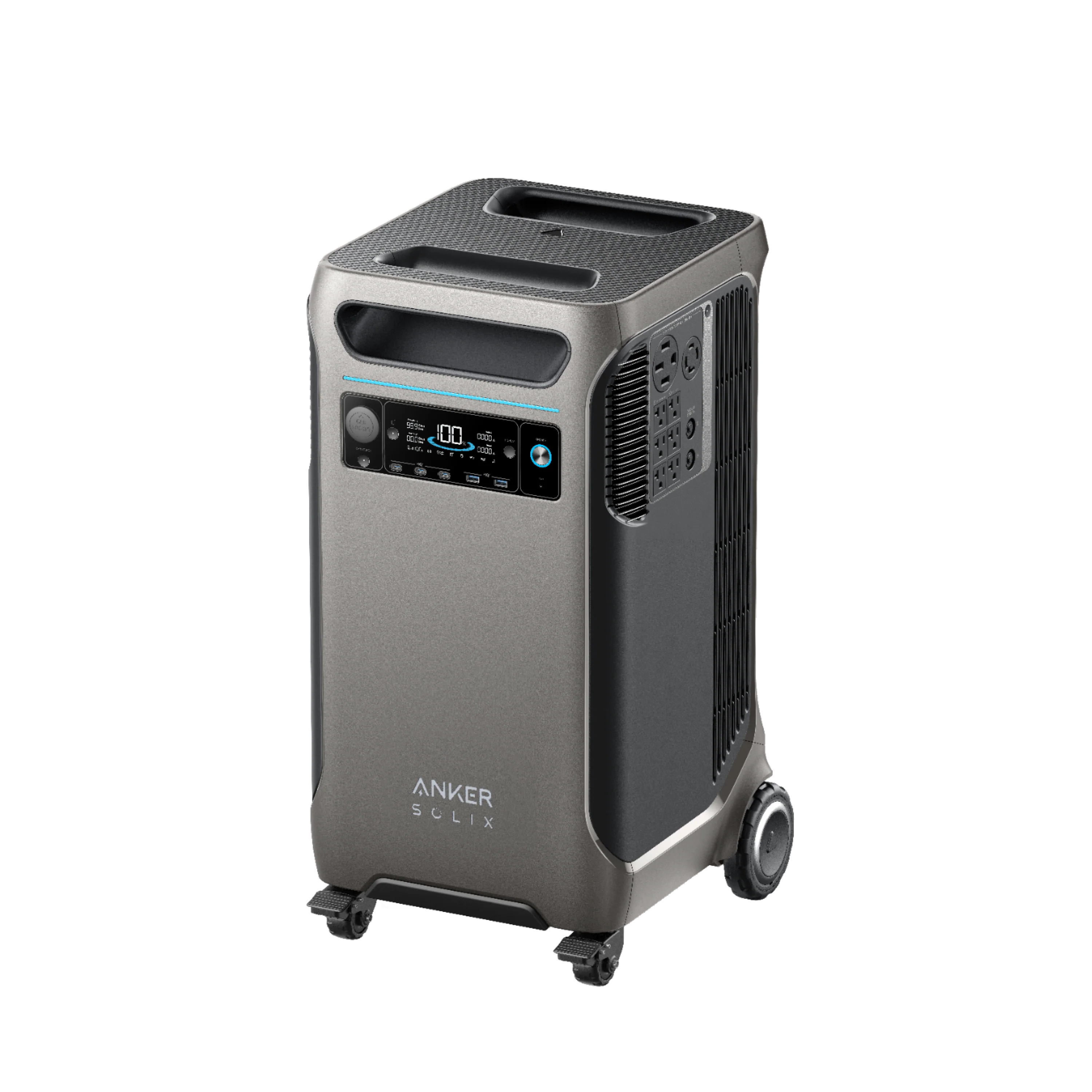
Anker SOLIX F3800 PLUS
Sold on Amazon · today’s price is on the listing

Jackery HomePower 3600 Pro MaxPick
$1,799.00
$1,799.00 · direct from Jackery
Last checked 16 days ago. Prices move — check before you buy.
Prices may vary by retailer and are subject to change.