Head-to-head test
Anker SOLIX F3800 PLUS vs Jackery Explorer 1500 v2
One of these goes into a trunk with one hand and the other gets placed once and never moves again, so unless you can name a load bigger than the Explorer's 1,306Wh usable, the $1,651 gap buys headroom you'll never reach.
Full profiles: Anker SOLIX F3800 PLUS → · Jackery Explorer 1500 v2 →

Written by Gunner GustafsonUpdated
Whole-Home Backup Tester, Station Arena Test Desk
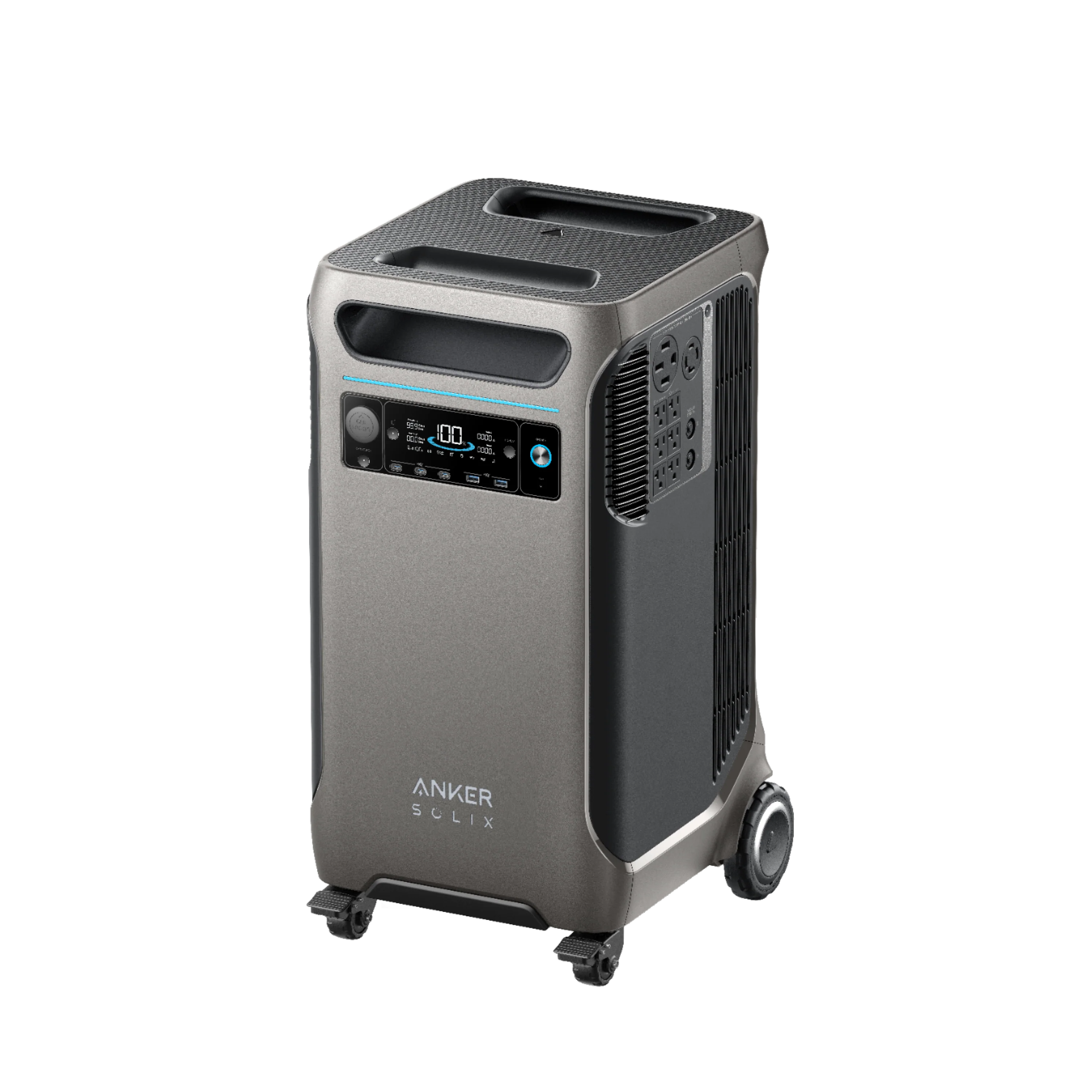
$2,599.99 · direct from Anker
Last checked 1 day ago. Prices move — check before you buy.

$949.00 · direct from Jackery
Last checked 1 day ago. Prices move — check before you buy.
Spec deltas
$949 buys 1,536Wh and 32 lbs. $2,600 buys 3,840Wh, 6,000W, and 132.3 lbs that two people set down once and leave alone. These aren't two sizes of the same product. They're two different purchases that happen to share a comparison page.
The Explorer wins the money question outright, and not narrowly. Its cells are rated for 4,000 cycles against the SOLIX's 3,000, so the cheaper unit is also the longer-lived one: 6,144 lifetime kilowatt-hours at 11 cents each, against 11,520 at 22. You pay 3.6 times the price ($2,600 against $949) for 1.9 times the total energy. Whatever the premium is buying here, it isn't endurance.
What it is buying is a class of job the Explorer can't attempt. 6,000W continuous against 2,000W, a 9,000W surge ceiling against 4,000W, and 3,200W of solar input against 400W. So the question isn't which is better, it's whether you have a load that needs the bigger class. The line is unforgiving: 1,306Wh usable and 2,000W. Under it, take the Explorer. Over it, take the SOLIX and start deciding which room it gets.
What the Numbers Reveal
Each conclusion stated first — the numbers behind it on one line, the full analysis below.
solar input
Capacity is a one-night number. Input is what gets you to day three. The moment a load outruns either battery, and Van Life Daily does it to both, the only spec still doing work is how fast the sun puts the energy back. The SOLIX closes its 1,421Wh deficit inside a lunch break; the Explorer spends most of a good solar day climbing back to full and still can't reach the load.
SOLIX F3800 PLUS: 3,840Wh capacity, 3,200W maximum solar inputExplorer 1500 v2: 1,536Wh capacity, 400W maximum solar inputVan Life Daily needs 4,685Wh: the SOLIX falls 1,421Wh short, the Explorer 3,379Wh short
Why it mattersIf you're buying for a multi-day outage or an off-grid stretch, read the solar input line before the capacity line. If you're buying for one night away from a wall socket, ignore it entirely.
rated cycles
The premium buys size and speed, not staying power. The unit you'd assume is the heirloom is the one that reaches roughly 80% of original capacity first, almost three years earlier on a daily cycle (8.2 against 11). Nothing about spending $2,600 makes this the buy-it-for-life option.
SOLIX F3800 PLUS: $2,600, 3,840Wh, 3,000 cycles, which is 11,520 lifetime kWh at 22 cents eachExplorer 1500 v2: $949, 1,536Wh, 4,000 cycles, which is 6,144 lifetime kWh at 11 cents eachAt a full cycle every day the SOLIX reaches its rating in 8.2 years, the Explorer in 11
Why it mattersIf your reason for looking at the SOLIX is that it'll last longer, that reason is wrong and you can stop paying for it.
So the Explorer's shortfall is either trivial or fatal, and which one depends on what's in your kitchen. At the modeled 206W it covers about six and a half of the eight hours (1,306 divided by 206) and you lose the tail. At the measured 523WA5 it manages about two and a half hours, which isn't a blackout plan. It's a phone charger with ambitions.
The 8-Hour Blackout models 1,645Wh; the Explorer has 1,306Wh usable and falls 339Wh shortA reviewer ran a fridge and a freezer together and drained the SOLIX's 3,840Wh in 7.34 hoursA5On that same modeled blackout the SOLIX finishes with 1,619Wh of its 3,264 usable untouched
Why it mattersCount your cold appliances before you decide. One fridge and the Explorer gets you through the night; a fridge plus a chest freezer and you need the class above it.
weight
A 32-lb box that fails goes back in the carton it arrived in, through a retailer that treats returns as routine. A 132.3-lb one ships as hazmat freight, and you own that problem for as long as it takes support to decide whether to answer, which on this evidence ranges from an advance replacement to five unanswered emailsA1A2.
SOLIX F3800 PLUS: 132.3 lbs, a two-person lift, with rear wheels that handle grass but get stopped dead by small bumpsA8One owner emailed Anker support more than five times about a battery-pack noise fault and got nothing backA1; another Solix owner in the same thread describes fast, responsive service including an advance replacementA2Explorer 1500 v2: 32 lbs, from the brand with the widest retail footprint in the category (Costco, Home Depot, Best Buy, Amazon)
Why it mattersIf you buy the SOLIX, buy it where the return is somebody else's logistics problem, and run it hard while you're still inside that window.
The specific dimensions that decide these two units — everything else is a tie.
Portability & Form Factor
Selected because: A two-person 132.3-lb lift and a one-hand 32-lb carry are not two sizes of the same thing, and this is where the decision actually gets made.
weight
Wheels change the verb but not the problem. The SOLIX rolls across grass well enough and small bumps stop it deadA8, so portable here means you can reposition it in a garage, not that you can bring it. At 132.3 lbs it's a two-person lift over anything with a lip: a tailgate, a trunk edge, a threshold, three basement stairs.
The Explorer weighs 32 lbs, and one review calls it the world's lightest 1.5kWh LFP station on that basisB1. That single spec changes how often the thing gets used, which is the argument the table can't make: a power station that stays in the closet because moving it is a chore has an effective capacity of zero.
Your Life, Your Pick
Selected because: The Explorer covers three of the six modeled loads and misses two of them by 794Wh and 339Wh. The sixth beats both units.
The two misses are different sizes of problem. Weekend Camping wants 2,100Wh and the Explorer holds 1,306Wh usable, so it covers about 62% of the trip (1,306 divided by 2,100) and then it's luggage. The 8-Hour Blackout miss is 339Wh, which at the scenario's roughly 206W average is the last hour and a half of the night. You might genuinely not care about that.
Read the SOLIX's wins with the scoring's blind spot in view. It has no category for an installed appliance, so Weekend Camping and Tailgate Party hand the campsite and game day to a 132.3-lb wheeled unit as though it drove itself there. On the metric those wins are real, 1,164Wh and 2,594Wh left in reserve. In a parking lot they're theoretical. The SOLIX's uncontested win is the blackout, where it finishes with 1,619Wh of its 3,264 usable still in hand and never has to leave the room to do it.
Lifetime Value
Selected because: The cheaper unit is also the longer-lived one: 4,000 cycles against 3,000, and 11 cents per lifetime kilowatt-hour against 22.
cost / lifetime kWh
The Explorer is cheaper to buy and cheaper per unit of energy it will ever deliver, which is not the usual shape of this trade. 46 cents per watt-hour up front against 65 ($949 divided by 1,536Wh, $2,600 divided by 3,840Wh), then 11 cents against 22 for every lifetime kilowatt-hour. Normally the premium unit claws that back on durability. Here it can't: 3,000 cycles against 4,000.
On weekend use the SOLIX works out to 24 cents a day and the Explorer to 5, and neither number should decide anything, because nobody feels 19 cents. What should decide something is that both units end their rated life at roughly 80% of original capacity and only one of them charged $1,651 extra for the trip.
Growth Path
Selected because: The SOLIX can add expansion batteries past 3,840Wh while the Explorer is sealed at 1,536Wh, and that ceiling is the one honest reason to spend the extra $1,651.
solar input
The Explorer's ceiling is the price of its virtues. 1,536Wh sealed, no expansion pack, no second battery, and what you buy is what you have permanently. That's a genuine limitation rather than a technicality, because the SOLIX's expanded ceiling actually clears it instead of expanding into something worse. It's the strongest argument on this page for the more expensive unit.
The catch is that expansion is a plan, not a feature. Adding batteries to a 132.3-lb base unit means the assembly stops being something you move and starts being something you site: near a panel, on a floor that takes the load, in a corner you're willing to give up. If you can picture that corner, the headroom is worth $1,651. If you're picturing a closet you open twice a year, the ceiling you're worried about is never going to bother you.
Brand Trust
Selected because: Support quality is a coin flip on both sides, so what matters is which failure is cheaper to execute, and a 132.3-lb return ships as freight.
Anker's field evidence on this exact unit splits hard on the one thing you'd want it to agree about. One owner describes emailing support more than five times over a battery-pack fault loud enough to frighten him and hearing nothing backA1; another Solix owner in the same thread describes consistently responsive service and an advance replacementA2, though that second account may be describing the non-Plus F3800, which is a fair measure of how thin the record is here. Call it a coin flip, on a unit that ships back as hazmat freight.
Jackery's counterweight isn't better support, it's better distribution: Costco, Home Depot, Best Buy, Amazon. When the manufacturer's warranty process is the weak link, buying through a retailer that takes returns without an argument is worth more than a phone number. The app gap is real and mostly irrelevant. Anker's rates 4.5 on iOS across about 1,100 ratings and Jackery's sits between 2.3 and 3.3, which matters only if you plan to watch the thing from another room every day.
Strengths & trade-offs
Anker SOLIX F3800 PLUS
Strengths
- +Larger battery capacity
- +Higher AC output
- +Faster solar charging
Trade-offs
- –Substantially more expensive (+$1,651) than the Explorer 1500 v2.
- –Significantly heavier (+100.3 lbs), making it harder to move.
- –Very heavy unit that may be difficult for one person to lift.
- –Shorter-lived battery — rated for 3,000 charge cycles vs the Explorer 1500 v2's 4,000, so it wears out sooner.
Jackery Explorer 1500 v2
Strengths
- +Costs $1,651 less
- +Lighter by 100.3 lb
- +Rated for 4,000 charge cycles — much longer battery lifespan
Trade-offs
- –Weaker inverter (-4,000W) limits appliance compatibility.
- –Sealed capacity — the SOLIX F3800 PLUS can add batteries to grow past 1,536Wh; this one can't.
Will It Power Your Gear?
Scenario math and per-appliance runtimes, modeled from the spec record.
Scenario verdicts
We ran the math on six real-world scenarios. Here's which unit survives your actual life.
SCN-01 · 2 nights · needs 2,100Wh
Weekend Camping
Two nights off-grid with essential comfort
Neither unit
2,100Wh over a weekend is more than the Explorer can hold. It has 1,306Wh usable, runs 794Wh short, and covers about 62% of the trip before it becomes a heavy box you carry home empty. The SOLIX finishes with 1,164Wh spare. Take that win at face value, though, and you've missed something: this scoring assumes both units come camping, and one of them is a 132.3-lb wheeled appliance you set down once. Two Explorers would cost $1,398, weigh 64 lbs across two liftable halves, and hold 2,612Wh usable, which covers the same weekend. The SOLIX wins this on arithmetic and loses it in the driveway.
Battery budget usedlower = more headroom
LOAD Phone Charger 15W×6h · LED Lights 40W×8h · Box Fan 75W×14h · CPAP Machine 40W×16h
SCN-02 · 8 hours · needs 1,645Wh
8-Hour Blackout
Keep the essentials running through a night without power
SOLIX F3800 PLUS
The Explorer is 339Wh short of the 1,645Wh this night needs, which at the scenario's roughly 206W average is the last hour and a half. That lands somewhere between annoying and irrelevant depending on what's in the fridge. The SOLIX covers the whole night on half its usable energy and finishes with 1,619Wh in hand. This is the one scenario the bigger unit wins on its own terms, because it doesn't have to go anywhere to do it, and a blackout is precisely the event a semi-permanent appliance exists for.
Battery budget usedlower = more headroom
LOAD Fridge 150W×8h · Router + Modem 20W×8h · LED Lights (4 bulbs) 40W×6h · Phone Charger 15W×3h
SCN-03 · 8 hours · needs 320Wh
CPAP Overnight
Sleep therapy without interruption — the #1 medical use case
Either unit
A CPAP night is 320Wh: 10% of the SOLIX's usable energy, 25% of the Explorer's. Both finish with plenty left, 2,944Wh and 986Wh, so capacity settles nothing. Don't break the tie on the noise figure either. The Explorer publishes 30dB and the SOLIX publishes nothing at all, which isn't a comparison, it's one number and a blank space. That leaves $1,651 and the difference between a 32-lb box and a 132.3-lb one, and for this job alone that isn't a close call.
Battery budget usedlower = more headroom
LOAD CPAP Machine 40W×8h
SCN-04 · 8 hours · needs 910Wh
Remote Workday
Full work day off-grid without power anxiety
SOLIX F3800 PLUS
Both units finish the day. The Explorer uses 70% of its usable energy and ends with 396Wh in reserve; the SOLIX uses 28% and ends with 2,354Wh. The reserve gap is real, and it's also the least useful money on this page, because the workday you're buying for is the same workday either way. String three of those days together with no wall socket and the reserve starts earning its keep. For one day, it's headroom you're renting.
Battery budget usedlower = more headroom
LOAD Laptop 60W×8h · External Monitor 30W×8h · Router + Modem 20W×8h · Phone Charger 15W×2h
SCN-05 · 4 hours · needs 670Wh
Tailgate Party
Game day power for the crew
Explorer 1500 v2
670Wh is a light evening and both units cover it, the SOLIX with 2,594Wh in reserve and the Explorer with 636Wh. The SOLIX takes the reserve column and that's the whole of what it takes here, because the scoring has no category for an appliance and cheerfully awards game day to 132.3 lbs of wheeled unit that needs two people to clear a tailgate. The Explorer does the same job at 32 lbs with one pair of hands. Reserve you can't get to the parking lot isn't reserve.
Battery budget usedlower = more headroom
LOAD Blender 400W×0.5h · LED TV (55") 80W×4h · Bluetooth Speaker 15W×4h · Phone Charger (×3) 45W×2h
SCN-06 · 24 hours · needs 4,685Wh
Van Life Daily
A full day of mobile living — the ultimate endurance test
Neither unit
Neither unit covers a real van-life day. The load runs 4,685Wh; the SOLIX gets through about 69% of it and is 1,421Wh short, the Explorer about 28% and 3,379Wh short. Treat both as partial cover, enough for the essentials on the list rather than the list. The honest answer for full-timers is a wired house bank charged off the alternator and the roof, or the SOLIX with expansion batteries budgeted in from the start instead of discovered in month two.
Battery budget usedlower = more headroom
LOAD Mini-Fridge 150W×24h · Laptop 60W×4h · Phone Charger 15W×3h · LED Lights 40W×5h · Fan 75W×8h
The Load Test
RUNTIME = (Wh × 0.85) ÷ LOAD
None of the scenarios above exactly yours? Build it. Toggle what you'd plug in; both units are tested against the combined draw.
Essentials
Comfort & Convenience
High-Draw Appliances
Test duration
8h
Continuous draw
205W
Projected runtime
For this load: SOLIX F3800 PLUS runs 15.9h vs 6.4h.
$2,599.99 list · direct from Anker
Modeled from the spec record — same math as the tables below. Methodology
Runtime by appliance
Real-world runtime estimates for common appliances, modeled at 85% inverter efficiency.¹
Essentials
The basics you need runningscale 0–217.6hComfort & Convenience
Makes off-grid life actually enjoyablescale 0–43.5hHigh-Draw Appliances
These reveal the real limitsscale 0–3.3h¹ Runtime = (capacity × 0.85) ÷ appliance watts. Within each group, all bars share one time scale (the group's longest runtime), so lengths are comparable across appliances; identical runtimes collapse into a single blue/orange bar. Actual runtime varies with battery age, temperature, and simultaneous loads — see methodology.
Conclusion
August 9, 2026
Verdict: the Jackery Explorer 1500 v2
Take the Explorer 1500 v2 unless you can name the load that breaks it. It covers three of the six modeled scenarios outright, it costs 11 cents per lifetime kilowatt-hour against the SOLIX's 22, and its cells are rated for 4,000 cycles against 3,000, so the cheap box is also the longer-lived one. The SOLIX F3800 PLUS is the better machine and it isn't close: 6,000W continuous, a 9,000W surge ceiling, 3,200W of solar input, and expansion batteries waiting when 3,840Wh stops being enough. But it weighs 132.3 lbs, it's a two-person lift, and most of the scenarios where it beats the Explorer on the metric quietly assume it came along for the ride. Buy it when the box lives in one place and something in your house needs more than 2,000W continuous or more than 1,306Wh of stored energy. Otherwise you're spending $1,651 on capacity the arithmetic says you won't touch.
Editor-assigned confidence, based on cited owner research and spec analysis.
List prices as of August 9, 2026. The links below open Anker's and Jackery's current prices.
$949.00 · direct from Jackery
Last checked 1 day ago. Prices move — check before you buy.
or check the SOLIX F3800 PLUS price$2,599.99 list
Written by Gunner Gustafson, Whole-Home Backup Tester · Station Arena Test Desk · Updated August 9, 2026
Measured Data
Benchmark scores and the full spec record, side by side.
Benchmark scores
Not rated for both units (minimum threshold unmet): UPS, CPAP, Tailgating, Apartment Balcony, Camping.
Full specifications
ᵈ Derived: price ÷ rated capacity. See the data behind our comparisons →
Comparison ToolAdd more power stations, side by sideOpen Tool →How these numbers are produced
Numeric verification
Every figure on this page traces to our spec database or arithmetic on it — no estimated numbers.
Owner claims
Statements about owner experience are cited to published reviews — see Sources & Research Notes below.
Runtime model
Runtime = (rated capacity × 0.85 inverter efficiency) ÷ device wattage. Solar recharge estimates assume panels deliver 70% of rated output. Cold weather, battery age, and stacked loads reduce real-world results.
Power Score
Computed from 14 published spec dimensions, weighted per use-case bench. Higher is better; a unit must meet a bench's minimum threshold to be rated.
See the full weight table and data sourcing on our methodology page →Class ranking (the star rating)
Each unit's star score is a category ranking, not customer reviews — no buyer opinions feed it. We score every station on size-independent quality (value, output, portability, endurance, ports, warranty, and more), then percentile-rank it against the other units in its capacity class, so a class-leading compact unit and a class-leading whole-home unit can both earn 5★. Here, SOLIX F3800 PLUS rates 4.5/5 (73rd percentile of 16 Home Backup-class units), and Explorer 1500 v2 rates 3.8/5 (27th percentile of 27 Everyday-class units).
How the class ranking is computed →Test Notes & Caveats
Hidden gotchas and advantages we spotted that you won't find on the product page.
132.3 lbs: Decide Where It Lives Before It Arrives
This is a two-person lift over anything with an edge, and that's the easy part. The harder part is that a unit this heavy ships back as hazmat freight when something goes wrong, so the return trip is a logistics project rather than a box on a porch. Choose the spot, choose the retailer, and test it hard while sending it back is still somebody else's problem.
Our Pick Is the Sealed One
1,536Wh is the Explorer's ceiling and there's no future in which it isn't. That's a real limitation rather than a technicality, because the SOLIX's expanded ceiling genuinely clears it instead of expanding into something worse. If you can see your needs climbing toward partial-home backup, this is the line that should make you hesitate over the cheaper unit.
The Ratio Flatters the Explorer, the Ceiling Settles It
The Explorer keeps more headroom above its own rating, 2x against 1.5x, which sounds like the better inverter and answers the wrong question. A motor pulls a fixed number of watts at switch-on, so what decides whether it starts is the absolute ceiling: 9,000W on the SOLIX against 4,000W on the Explorer. Read the ratio as how relaxed each unit is at steady state, and the ceiling as what it can actually swallow.
Warranty: No Difference
Both units carry the same 5-year warranty, so coverage isn't a tiebreaker here. The Explorer 1500 v2's figure is a maximum rather than a guarantee — it depends on registering the unit with Jackery, which is what extends the base term to the full period. Worth saying because the per-dollar framing can suggest otherwise: the Explorer 1500 v2 works out at 5.3 years of cover per $1,000 spent against the SOLIX F3800 PLUS's 1.9, but that spread is the price gap, not the terms.
The Cheap One Is the Long-Lived One
4,000 cycles against 3,000, or about 11 years of daily cycling against 8.2, and the longer rating belongs to the $949 unit. Neither battery dies at the limit; both settle near 80% of original capacity and carry on. So the SOLIX premium buys capacity and output, and buys back nothing in years.
SOLIX F3800 PLUS: Noise Level Not Disclosed
The Explorer 1500 v2 publishes its noise level (30dB); the SOLIX F3800 PLUS doesn't publish one. That isn't evidence the SOLIX F3800 PLUS is louder — it means there's no figure to hold it to, and no way to compare the two on this without hearing them. If you're buying for a bedroom, a CPAP, or an apartment, treat the Explorer 1500 v2's 30dB as the only published number on the table — a spec-sheet figure, not a measurement — and look for hands-on reports of the SOLIX F3800 PLUS before deciding.
Full record above — the Test Desk pick is the Explorer 1500 v2.
Check Explorer 1500 v2 price →or check the SOLIX F3800 PLUS priceOwnership Analysis
What happens after you buy — true cost of ownership, brand trust, and growth potential.
Lifetime value
Service lifeyears at one full cycle per day
Lifetime energy delivered
Cost per delivered kWh
│ warranty ends · Reaching the cycle rating means ~80% capacity remains — degraded, not dead.
Analyst note
The Explorer 1500 v2 wins on both sticker price and long-term value. At $0.15/kWh over its lifetime, it's meaningfully cheaper to own. Clear value winner. One caution on the lifespan row: the Explorer 1500 v2 takes longer to reach its cycle rating, but a cycle moves a different amount of energy on each unit — the SOLIX F3800 PLUS still delivers more over its shorter horizon (11,520 vs 6,144 kWh). Years measure wear, not usefulness.
Brand trust
Anker
Ecosystem
7-8 SOLIX portable power stations across C-series (compact) and F-series (flagship), plus the X1 home energy system
Support
US-based, and on this specific unit the experience is a coin flip. Anker's consumer-electronics reputation was built on no-hassle replacements, but SOLIX service is trending the other way, with scripted agents and, because these units are heavy, returns that run as hazmat freight.
Community
Moderate — active Reddit (r/Anker, r/AnkerSOLIXCommunity) and growing. Benefits from Anker's massive consumer electronics brand awareness.
App experience
Rated 4.5/5 iOS (~1,100 ratings) · 4.3/5 Android
Unique strength
Parent-brand trust plus genuinely strong dollars per watt-hour in the mid and large sizes. The expansion ecosystem is smaller than EcoFlow's, but it exists, which is more than the Explorer can say.
Worth knowing
Firmware updates have removed features without warning. On a unit you're wiring into a house, that deserves more attention than it usually gets.
Jackery
Ecosystem
12-15+ models across Explorer (portable) and HomePower (home backup) series, plus SolarSaga panel ecosystem and innovative form factors
Support
Also US-based, also widely criticized: scripted responses, strict receipt requirements for warranty claims, refurbished replacements for units that failed new. The practical workaround is distribution. Buy it from Costco or Amazon and let the retailer's return policy do the work.
Community
The smallest community of the major brands, with the Jackery subreddit running around 2,000 members. Troubleshooting help is thinner than the brand's size would suggest.
App experience
Rated 2.3-3.3/5 iOS and Android — the weakest app experience of the major brands. Multiple confusing apps (Jackery app vs Jackery Home) and mandatory login even offline.
Unique strength
The widest retail presence in the category and the highest brand recognition in it. Dependable and available everywhere, which is worth real money on the day something has to go back.
Worth knowing
The app is the weakest of the major brands at 2.3 to 3.3 stars, there are two confusingly similar apps, and it wants a login even offline.
Analyst note
Neither support organization is a reason to choose a side; both draw the same complaints about scripted responses. What differs is the cost of a failure. A 32-lb Jackery bought at Costco goes back over a counter. A 132.3-lb SOLIX goes back as freight, after a conversation. Weight isn't only a portability spec here, it's a warranty spec.
Growth path
SOLIX F3800 PLUS
EXPANDABLESupports Anker expansion batteries, so you can add capacity later without replacing the base unit — useful if your needs may climb past 3,840Wh.
Accepts up to 3,200W of solar. Enough for a serious multi-panel array.
Generous port selection supports complex multi-device setups.
Expansion batteries are Anker-specific. You're investing in the Anker ecosystem.
Explorer 1500 v2
FIXED CAPACITYFixed at 1,536Wh, with no expansion — so size it for your needs up front rather than planning to add capacity later.
Accepts up to 400W of solar. Suitable for a 1-2 panel setup.
Adequate ports for most setups, but heavy users may want a power strip.
Realistic full solar rechargeat 70% of rated panel output — see methodology
Analyst note
The Explorer 1500 v2 is sealed at 1,536Wh, which is fine if that covers you. The SOLIX F3800 PLUS starts at 3,840Wh and can grow beyond it with Anker expansion batteries — real headroom the Explorer 1500 v2 doesn't have if your needs climb toward partial-home backup.
What Owners Report
Patterns from published owner reports and long-term reviews — every claim cited to its source below.
Anker SOLIX F3800 PLUS
Field evidence on the F3800 Plus comes mostly from reviewers who lived with it for weeks rather than long-term ownersA4A7, so there's no six-month failure record yet. What was measured is useful: light household loads, meaning lights, a router, a laptop, an e-bike top-up, stretch toward 17 hoursA4, while a fridge and freezer running together drained it in 7.34 hoursA5. UPS switchover held around 20ms even wired through a home power panel, with the lights barely flickeringA3, and the 3,200W solar input takes ordinary MC4 panels rather than a proprietary connectorA11. Charging an EV works and is pointless: about 5 miles of range for a full drainA6.
Fan noise reads as a non-issue at household loads and a real one at the top end, barely audible under lights, fridge and TV, and loud only above roughly 4,000W or at maximum charge speedA10A12. The wheels are a partial answer to the mass: fine over grass, stopped by small bumpsA8. Standby drain was the loudest early complaint, and a later firmware update was said to cut idle use by about halfA9, a claim nobody independently reproduced, so treat it as unsettled rather than fixed.
“I've called them and submitted tickets via their portal, always very responsive. They've even done advanced replacement for me.”
Sources
campingsolar.us · cleanenergybusinesscouncil.com
Jackery Explorer 1500 v2
The Explorer's ledger is thin and uniformly positive, and all of it comes from review sites rather than owners a year inB1B3B4, so read it as first-impression quality and not durability evidence. The consistent findings: about 32 lbs and billed as the lightest 1.5kWh LFP station goingB1; seven simultaneous outputs including three AC sockets, two USB-C and a 12V car port, so a phone never costs you an AC outletB2; and a full recharge in roughly 64 minutesB3. One reviewer scores it 8.7 out of 10 and calls it the most cost-efficient route to real LFP capacity for anyone who doesn't need a rugged or waterproof boxB4.
What's absent matters as much as what's there: nothing on failures, nothing on warranty claims, nothing on cold-weather behaviorB1B4. A unit this new with a spotless record hasn't been proven. It's been unboxed.
“The world's lightest 1.5kWh LFP power station at about 32 lbs — class-leading weight is one of its defining features.”
Sources
backuppowerhub.com · jackery.com · portablepowernerd.com
Sources & Research Notes
Every owner claim in this report is traceable to a published source. The bracketed references above resolve here.
Recurring owner themes
- Owner support experiences with Anker/Solix diverge sharply — some report being ghosted after repeated contact attempts over a hardware fault, while others describe fast, responsive advanced-replacement service. [SOLIX F3800 PLUS · 2 entries]
- Real-world runtime drops off steeply with load: light loads (lights, router, occasional laptop/e-bike charging) stretch toward the ~17-hour mark, but running a fridge and freezer together drains the base unit in around 7 hours. [SOLIX F3800 PLUS · 2 entries]
- Fan noise is reported as low/background during normal household loads and only becomes noticeably audible under heavy loads (4,000W+) or max-speed charging. [SOLIX F3800 PLUS · 2 entries]
- The unit's near-137 lb weight is a recurring friction point: reviewers note the wheels/handles work for moderate use but struggle over rough terrain, and aggregated user feedback flags portability and packaging as concerns despite praise for raw performance. [SOLIX F3800 PLUS · 2 entries]
- Class-leading light weight, a versatile 7-port layout, fast ~64-minute charging, and the lowest cost-per-watt in its class are the consistent praise. [Explorer 1500 v2 · 3 entries]
- A1
“I think it may be a fire hazard with this crazy noise it's making. I have emailed Anker support over 5 times... Anker support is ghosting me after I spent over 20k on their solix line and solar panels within a month.”
DIY Solar Forum — "Big issue with Anker Solix F3800 plus battery pack (Large Anker Solix setup)" · 2025-08 · [negative]
- A2
“I've called them and submitted tickets via their portal, always very responsive. They've even done advanced replacement for me.”
DIY Solar Forum — "Big issue with Anker Solix F3800 plus battery pack (Large Anker Solix setup)" (reply from another Solix owner) · 2025-08 · [positive]
- A3
“In UPS mode, the F3800 Plus can switch in about 20ms. There's more cabling and components when connected to the whole home setup, but the lights still barely flicker.”
Android Authority — "Anker SOLIX F3800 Plus with Home Power Panel review: Total power backup" · 2025-05 · [positive]
- A4
“You would be able to keep a fridge or freezer running, charge a few laptops or phones, maybe charge up an e-Bike and the F3800 Plus base unit would last about 17 hours before needing a recharge.”
Digital Trends — "Anker Solix F3800 Plus review: this power station wins for versatility and value" · 2025-05 · [positive]
- A5
“With both the freezer and my fridge plugged in at the same time, I was about to get 7.34 hours before the unit was completely drained.”
Digital Trends — "Anker Solix F3800 Plus review: this power station wins for versatility and value" · 2025-05 · [mixed]
- A6
“With my Rivian R1S, I was able to get about 5 miles of charge out of the F3800 Plus – fully drained... Charging an EV with the Solix F3800 Plus is gimmicky in my opinion.”
Digital Trends — "Anker Solix F3800 Plus review: this power station wins for versatility and value" · 2025-05 · [mixed]
- A7
“After a few months with its successor, I can easily say it is a repeat success.”
AppleInsider — "Anker Solix F3800 Plus portable power station review: investment in reliable home power" · 2025-08 · [positive]
- A8
“The big wheels in the back are enough to go over grassy terrain, but avoid anything too challenging. Small bumps can be enough to slam everything to a halt.”
AppleInsider — "Anker Solix F3800 Plus portable power station review: investment in reliable home power" · 2025-08 · [mixed]
- A9
“Early reviews focused heavily on the standby drain of the Anker SOLIX F3800 Plus. Anker later released a firmware update that said it can cut idle use by about 50%.”
VoltNest — "Anker SOLIX F3800 Plus Review: My Honest Test Results" · 2026-04 · [mixed]
- A10
“Under normal loads (lights, fridge, TV), the fans are barely audible. It only gets loud when you're pulling over 4,000W or charging at max speed.”
CampingSolar.us — "Anker SOLIX F3800 Plus Review: The Ultimate 240V Home & RV Power" · 2026-02 · [positive]
- A11
“Anker really addressed this issue with the F3800 Plus. You now get a true 3,200W solar input, which is compatible with normal MC4 solar panels.”
TheSolarLab — "Anker SOLIX F3800 Plus Review: Big Power, Big Price?" · unknown · [positive]
- A12
“It doesn't match the whisper-quiet performance of the EcoFlow Delta Pro Ultra, which remains one of the quietest power stations we've ever tested, but the F3800 Plus is still surprisingly quiet, even when you're really pushing it.”
TheSolarLab — "Anker SOLIX F3800 Plus Review: Big Power, Big Price?" · unknown · [positive]
- B1
“The world's lightest 1.5kWh LFP power station at about 32 lbs — class-leading weight is one of its defining features.”
backuppowerhub.com / jackery.com — Explorer 1500 v2 review · 2026 · [positive]
- B2
“Seven simultaneous outputs is genuinely useful: three AC outlets cover larger appliances, dual USB-C ports support fast charging for phones and laptops, and the DC car output handles 12V accessories without burning an AC outlet.”
portablepowernerd.com / backuppowerhub.com — Explorer 1500 v2 review · 2026 · [positive]
- B3
“At $699 it's the lightest, fastest-charging, and lowest cost-per-watt 1.5kWh LFP station on the market, undercutting comparable LFP units, with a roughly 64-minute full charge.”
backuppowerhub.com — Explorer 1500 v2 review · 2026 · [positive]
- B4
“Earns 8.7/10; for buyers who don't need rugged or waterproof features, it's the most cost-efficient path to serious LFP capacity in 2026.”
backuppowerhub.com / portablepowernerd.com — Explorer 1500 v2 review · 2026 · [positive]
Research compiled August 9, 2026.
Who Should Buy Which
Buy the SOLIX F3800 PLUS if you…
- →It's going into a utility room or onto a transfer panel and it never moves again. At 132.3 lbs that isn't a compromise, it's the intended installation.
- →You have a fridge and a second cold appliance to carry through a long outage. That load drained even this unit in 7.34 hoursA5; the Explorer isn't in the conversation.
- →Something in your house needs more than 2,000W continuous, or a startup spike bigger than the Explorer's 4,000W ceiling can swallow. 6,000W and 9,000W is a different tier of appliance, not just a bigger number.
- →You want the outage to refill itself every morning. 3,200W of solar input against 400W is eight times the panel array the Explorer can accept, and in a multi-day event that's the spec that ends the event.
- →You expect your needs to climb past 3,840Wh and you have somewhere to put the expansion batteries.
Buy the Explorer 1500 v2 if you…
- →You lift it into the trunk yourself without thinking about it. 32 lbs covers car camping, a job site, a friend's spare room, the tailgate.
- →Your worst realistic night stays under 1,306Wh usable. A CPAP overnight uses a quarter of that (320Wh) and a full remote workday still leaves 396Wh in reserve.
- →You're optimizing dollars per stored watt-hour across years. 4,000 cycles and 11 cents per lifetime kilowatt-hour is the better deal on this page and it isn't close.
- →You want backup you'll actually deploy. The unit you can carry one-handed is the unit that leaves the closet.
If neither fits
Full-time van life and real off-grid living. The daily load we model runs 4,685Wh, and the SOLIX is 1,421Wh short of it while the Explorer is 3,379Wh short. Neither of these is a system, they're appliances. Budget instead for a wired 12V house bank charged off the alternator and the roof, or accept from day one that the SOLIX only works here with expansion batteries costed in up front. Same answer for anyone imagining whole-home backup on a $2,600 budget: without a transfer panel, that's a very expensive extension cord.
The Bottom Line
Take the Explorer 1500 v2. It's $949 against $2,600, 32 lbs against 132.3, rated for 4,000 cycles against 3,000, and it delivers energy at 11 cents per lifetime kilowatt-hour against 22. The cheaper unit is also the longer-lived one, which is not how this usually goes, and it means the SOLIX premium is buying size and speed rather than staying power.
The exception is precise, so use it precisely. If your load genuinely exceeds 1,306Wh usable or 2,000W continuous, whether that's a fridge and a freezer through a long outage or a house you intend to back up properly, the Explorer isn't a smaller answer, it's no answer, and the SOLIX with its 6,000W and its 3,200W of solar is the right machine. Just buy it knowing what it is: 132.3 lbs of appliance that gets placed once. Everyone else is looking at $1,651 of headroom they'll never reach.
Frequently Asked Questions
Answers drawn from the spec record and cited owner research.
Is the Anker SOLIX F3800 Plus worth $1,651 more than the Jackery Explorer 1500 v2?
Only if you can name the load that breaks the Jackery. The gap buys two and a half times the capacity (3,840Wh against 1,536Wh) and three times the continuous output (6,000W against 2,000W), and it buys nothing at all if your real draw stays under the Explorer's 1,306Wh usable and 2,000W. It also buys a shorter cycle rating, 3,000 against 4,000, so it is not the more durable purchase.
Can the Jackery Explorer 1500 v2 run a fridge through an 8-hour blackout?
A fridge on its own, most likely. A fridge plus a freezer, no. Our 8-hour blackout models 1,645Wh, about 206W on average, and the Explorer's 1,306Wh usable covers roughly six and a half of the eight hours. At the 523W a reviewer measured running a fridge and freezer together on the bigger unit, that same 1,306Wh lasts about two and a half hours.
How heavy is the Anker SOLIX F3800 Plus, and can one person move it?
132.3 lbs, and no. It's a two-person lift over anything with an edge: a tailgate, a trunk lip, a doorstep. It does roll, and the rear wheels handle grass, though small bumps can stop it. Pick the spot before it arrives, because you'll only pick it once.
Which lasts longer, the SOLIX F3800 Plus or the Explorer 1500 v2?
The Explorer, on paper. It's rated for 4,000 charge cycles against the SOLIX's 3,000, which at a full cycle a day works out to about 11 years against 8.2. Both carry the same 5-year warranty, and neither battery dies at the cycle limit. They settle at roughly 80% of original capacity and keep working.
Which one has more starting power for a fridge or a pump?
The SOLIX, though the two ways of measuring it disagree in a way worth understanding. The Explorer keeps the better ratio, 4,000W of surge over a 2,000W continuous rating, which is 2x against the SOLIX's 1.5x. But the SOLIX holds the far higher absolute ceiling, 9,000W against 4,000W, and a motor draws a fixed number of watts at switch-on rather than a multiple of somebody's rating. One caveat on our own table: the scenario grid's can-power check tests the continuous rating, not the startup spike, and both units clear every modeled load on that test. Clearing it is not the same as starting the same motor.
Where to buy
Anker SOLIX F3800 PLUS
$2,599.99
$2,599.99 · direct from Anker
Last checked 1 day ago. Prices move — check before you buy.
Jackery Explorer 1500 v2Pick
$949.00
$949.00 · direct from Jackery
Last checked 1 day ago. Prices move — check before you buy.
Prices may vary by retailer and are subject to change.