Head-to-head test
Anker SOLIX F3800 PLUS vs BLUETTI AC70P
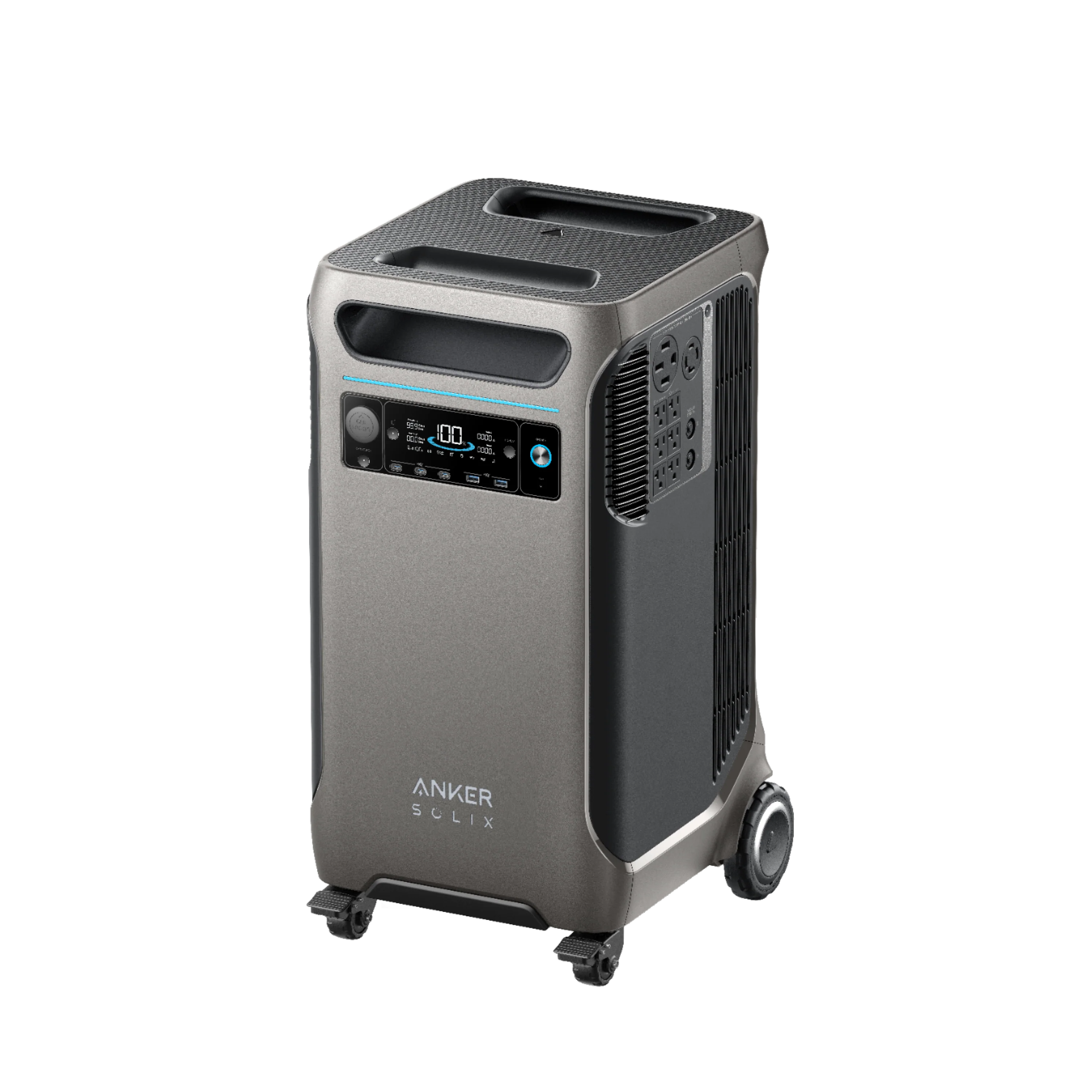
These two barely belong on the same page: a 132-lb, 3,840Wh home-backup flagship against a 22-lb, 864Wh grab-and-go, so the only question that settles it is whether your power has to travel or has to outlast the outage.
Full profiles: Anker SOLIX F3800 PLUS → · BLUETTI AC70P →

Written by Gunner GustafsonUpdated
Whole-Home Backup Tester, Station Arena Test Desk
$2,599.99 · direct from Anker
Last checked 7 hours ago. Prices move — check before you buy.

$499.00 · direct from BLUETTI
Last checked 7 hours ago. Prices move — check before you buy.
Spec deltas
One of these weighs 132 pounds and never leaves the garage; the other weighs 22 and rides in the passenger seat. Those two facts settle more of this comparison than any spec beneath them. The Anker SOLIX F3800 Plus ($2,600, 3,840Wh) and the BLUETTI AC70P ($499, 864Wh) aren't two answers to one question; they're answers to two different ones.
The F3800 Plus is a home-backup appliance. It's 3,840Wh of capacity behind 6,000W of output, on wheels it genuinely needs because it's a two-person lift. The AC70P is a weekender: 864Wh, carried in one hand, priced closer to an accessory for the Anker than a rival to it. Cross-shopping the two usually means you haven't yet decided how much power you need to move, so decide that first, because it decides everything after.
There's no overall winner here, because there's no overall buyer. If your loads fit under about 730Wh of usable energy and you have to carry the unit, the AC70P does the job for a fifth of the price. If you need to ride out a real outage with the fridge running, the AC70P can't finish and the F3800 can. That gap in capability, not a gap in quality, is what the extra money buys. The rest of this page is about finding which of those two people is you.
What the Numbers Reveal
Each conclusion stated first — the numbers behind it on one line, the full analysis below.
weight
Weight isn't a footnote to capacity here; it's the gate in front of it. A unit this heavy can hold all the watt-hours it likes, but if the use case is a campsite or a tailgate, none of them arrive. The AC70P's 22.5 lbs is the spec doing the work in every mobile scenario, and no amount of the F3800's reserve overrides it.
F3800 Plus: 132.3 lbs, stationaryAC70P: 22.5 lbs, portableTailgate scenario (670Wh): AC70P wins because the F3800 can't travel, despite the F3800's 3,264Wh usable against the AC70P's 734Wh
Why it mattersIf your power has to move, stop comparing capacity: the F3800 is disqualified by its own weight, and the AC70P wins by showing up.
That reframes the price gap. The AC70P tops out at roughly 730Wh usable, and everything past that point (a fridge overnight, a workday with a monitor and a laptop, a real outage) is a hard fail for it and a coast for the F3800, which finishes the blackout with more than twice the AC70P's entire usable capacity still in the tank.
8-Hour Blackout needs 1,645Wh; AC70P is 911Wh short, about 45% coveredRemote Workday needs 910Wh; AC70P is 176Wh short, about 81% coveredF3800 covers the blackout with 1,619Wh to spare against the AC70P's 734Wh usable
Why it mattersIf the reason you're buying is backup that lasts past a few hours, the AC70P's low price is beside the point: it can't finish, and only the F3800 qualifies.
cost / lifetime kWh
So the roughly $2,101 you'd add for the F3800 buys capacity, not quality. That only pays back if you actually cycle the extra headroom, about 2,500 usable watt-hours (3,264Wh against 734Wh). Bought as insurance and left mostly full, the F3800's per-kWh math never shows up, and you've paid flagship money to keep a reserve you don't draw.
AC70P: $0.19 per lifetime kWh; F3800: $0.23 per lifetime kWhBoth rated 3,000 cycles and 5-year warrantyPrice: $499 against $2,600, a gap of about $2,101
Why it mattersBuy the F3800 for capacity you'll use, not capacity you might want: if your real loads fit the AC70P, the big unit is worse value, not better.
The specific dimensions that decide these two units — everything else is a tie.
Portability & Form Factor
Selected because: The whole decision starts here: 132.3 lbs that stays put versus 22.5 lbs you carry to the campsite.
weight
The F3800 Plus ships with wheels for the same reason a chest freezer does: at 132.3 lbs it's a two-person, bent-knee lift, and once it's placed it stays placed. Reviewers who rolled it around found the wheels fine on a driveway but easily stopped by grass and small bumpsA8, so "portable" here means "repositionable in a garage," not "coming to the lake." The AC70P is the opposite proposition: 22.5 lbs, one hand, in and out of a car without a plan.
This is the fork the rest of the specs hang off. Settle whether the unit lives in one place or travels, and half the comparison resolves before you've read a single watt-hour figure.
Your Life, Your Pick
Selected because: Which real loads each unit finishes (an 8-hour blackout, a workday, a tailgate) is where the 864Wh ceiling and the 3,840Wh reserve stop being abstract.
The AC70P's usable ceiling, about 734Wh after the flat 15% derate applied to its 864Wh, draws a clean line through these scenarios. Below it the little unit is genuinely enough: a 320Wh CPAP night uses under half of it, and a 670Wh tailgate leaves 64Wh in reserve. At 910Wh, an ordinary remote workday, it quits 176Wh early. At 1,645Wh, an 8-hour blackout with the fridge, it covers less than half. The F3800 clears all of them and only meets its own wall at van-life scale (4,685Wh), where it too comes up short and the honest answer is a bigger system, not either of these.
Lifetime Value
Selected because: Whether the F3800's roughly $2,101 premium buys real value or just capacity you'll never cycle: over their rated lives the two cost within a few cents per kWh.
cost / lifetime kWh
Cost per lifetime kilowatt-hour is where you'd expect the cheap unit to win big, and it barely wins at all: 19 cents against 23. Both are rated for 3,000 cycles on the same LiFePO4-class chemistry and both carry five years of warranty, so neither is buying you a longer-lived battery. They're selling you differently-sized ones at nearly the same rate. The per-dollar warranty framing looks lopsided (the F3800 works out to about $520 for each year it's under warranty, the AC70P to $100), but that spread is the purchase price talking, not the coverage, which is an identical five years on both.
What the Specs Don't Tell You
Selected because: The catches that survive the spec sheet: a two-person lift, an undisclosed fan level, and a sealed 864Wh ceiling.
The catches sort neatly by unit, and neither is a dealbreaker so much as a boundary. The F3800's is mass: a 132.3-lb two-person lift that, once placed, is staying (the weight card below spells out why the wheels only get you so far). The AC70P's is its ceiling, sealed at 864Wh with no expansion battery. Per our standing view that's not a mark against a right-sized portable; it only bites if your needs climb past what it holds, and that's exactly the point where the F3800's ability to add batteries starts to earn its keep. The two remaining cards, the F3800's undisclosed fan level and how to read each unit's surge rating, are worth a look before a bedroom install or a big motor load.
Strengths & trade-offs
Anker SOLIX F3800 PLUS
Strengths
- +Larger battery capacity
- +Higher AC output
- +Faster solar charging
Trade-offs
- –Substantially more expensive (+$2,101) than the AC70P.
- –Significantly heavier (+109.8 lbs), making it harder to move.
- –Very heavy unit that may be difficult for one person to lift.
BLUETTI AC70P
Strengths
- +Costs $2,101 less
- +Lighter by 109.8 lb
Trade-offs
- –Weaker inverter (-5,000W) limits appliance compatibility.
- –Sealed capacity — the SOLIX F3800 PLUS can add batteries to grow past 864Wh; this one can't.
Will It Power Your Gear?
Scenario math and per-appliance runtimes, modeled from the spec record.
Scenario verdicts
We ran the math on six real-world scenarios. Here's which unit survives your actual life.
SCN-01 · 2 nights · needs 2,100Wh
Weekend Camping
Two nights off-grid with essential comfort
Neither unit
Neither gives you a powered weekend: the SOLIX F3800 PLUS has the energy but doesn't travel, and the AC70P covers about 35% of the 2,100Wh. One can't go; the other can't finish.
Battery budget usedlower = more headroom
LOAD Phone Charger 15W×6h · LED Lights 40W×8h · Box Fan 75W×14h · CPAP Machine 40W×16h
SCN-02 · 8 hours · needs 1,645Wh
8-Hour Blackout
Keep the essentials running through a night without power
SOLIX F3800 PLUS
The AC70P doesn't finish — 734Wh usable against the 1,645Wh this needs leaves it 911Wh short, about 45% of the scenario covered. The SOLIX F3800 PLUS covers it with 1,619Wh to spare.
Battery budget usedlower = more headroom
LOAD Fridge 150W×8h · Router + Modem 20W×8h · LED Lights (4 bulbs) 40W×6h · Phone Charger 15W×3h
SCN-03 · 8 hours · needs 320Wh
CPAP Overnight
Sleep therapy without interruption — the #1 medical use case
Either unit
A CPAP is about 40W for eight hours, so both cover the night with room to spare and capacity decides nothing. Fan noise would — but SOLIX F3800 PLUS doesn't publish a figure, so there's nothing to hold it to. Buy on price, weight, and whether you can live with a fan you haven't heard.
Battery budget usedlower = more headroom
LOAD CPAP Machine 40W×8h
SCN-04 · 8 hours · needs 910Wh
Remote Workday
Full work day off-grid without power anxiety
SOLIX F3800 PLUS
A work-from-home day runs about 910Wh, and it's the scenario that catches the AC70P out: 734Wh usable leaves it 176Wh short, dark before you've logged off. The F3800 runs the same day and still has 2,354Wh left for the evening. This isn't a capacity flex so much as the difference between a unit sized for a desk and one sized for a house.
Battery budget usedlower = more headroom
LOAD Laptop 60W×8h · External Monitor 30W×8h · Router + Modem 20W×8h · Phone Charger 15W×2h
SCN-05 · 4 hours · needs 670Wh
Tailgate Party
Game day power for the crew
AC70P
The SOLIX F3800 PLUS at 132.3 lbs is not a take-along — it rolls off a truck bed if it travels at all, so this scenario belongs to the AC70P by default — and it earns it, covering the 670Wh with 64Wh to spare. Capacity was never the SOLIX F3800 PLUS's problem here; getting to a tailgate was.
Battery budget usedlower = more headroom
LOAD Blender 400W×0.5h · LED TV (55") 80W×4h · Bluetooth Speaker 15W×4h · Phone Charger (×3) 45W×2h
SCN-06 · 24 hours · needs 4,685Wh
Van Life Daily
A full day of mobile living — the ultimate endurance test
Neither unit
Neither unit covers this scenario's 4,685Wh: the SOLIX F3800 PLUS comes up 1,421Wh short (about 69% covered), the AC70P 3,951Wh (16%). This is well outside what either unit is for; the right answer here is a larger station, not a choice between these two.
Battery budget usedlower = more headroom
LOAD Mini-Fridge 150W×24h · Laptop 60W×4h · Phone Charger 15W×3h · LED Lights 40W×5h · Fan 75W×8h
The Load Test
RUNTIME = (Wh × 0.85) ÷ LOAD
None of the scenarios above exactly yours? Build it. Toggle what you'd plug in; both units are tested against the combined draw.
Essentials
Comfort & Convenience
High-Draw Appliances
Test duration
8h
Continuous draw
205W
Projected runtime
For this load: SOLIX F3800 PLUS runs 15.9h vs 3.6h.
$2,599.99 list · direct from Anker
Modeled from the spec record — same math as the tables below. Methodology
Runtime by appliance
Real-world runtime estimates for common appliances, modeled at 85% inverter efficiency.¹
Essentials
The basics you need runningscale 0–217.6hComfort & Convenience
Makes off-grid life actually enjoyablescale 0–43.5hHigh-Draw Appliances
These reveal the real limitsscale 0–3.3h¹ Runtime = (capacity × 0.85) ÷ appliance watts. Within each group, all bars share one time scale (the group's longest runtime), so lengths are comparable across appliances; identical runtimes collapse into a single blue/orange bar. Actual runtime varies with battery age, temperature, and simultaneous loads — see methodology.
Conclusion
August 30, 2026
Verdict: the SOLIX F3800 PLUS, on Power Score margin
These aren't two answers to one question; they're built for different jobs, and the honest verdict is a clean split rather than a winner. If your loads fit under about 730Wh of usable energy and you need to carry the unit, the AC70P does the work for $499 and is even a hair cheaper per lifetime kWh. If you need to outlast a real outage with a fridge and essentials past a few hours, only the F3800 Plus finishes, and that capability, not a better battery, is what the extra roughly $2,101 buys. Match the unit to your actual load and the decision makes itself; buy on the headline capacity number alone and you'll either overpay for reserve you never touch or come up short when it counts.
Editor-assigned confidence, based on cited owner research and spec analysis.
Written by Gunner Gustafson, Whole-Home Backup Tester · Station Arena Test Desk · Updated August 30, 2026
Measured Data
Benchmark scores and the full spec record, side by side.
Benchmark scores
Not rated for both units (minimum threshold unmet): UPS, RV Living, Home Backup, CPAP, Tailgating, Food Truck, Apartment Balcony, Camping.
Full specifications
ᵈ Derived: price ÷ rated capacity. See the data behind our comparisons →
Comparison ToolAdd more power stations, side by sideOpen Tool →How these numbers are produced
Numeric verification
Every figure on this page traces to our spec database or arithmetic on it — no estimated numbers.
Owner claims
Statements about owner experience are cited to published reviews — see Sources & Research Notes below.
Runtime model
Runtime = (rated capacity × 0.85 inverter efficiency) ÷ device wattage. Solar recharge estimates assume panels deliver 70% of rated output. Cold weather, battery age, and stacked loads reduce real-world results.
Power Score
Computed from 14 published spec dimensions, weighted per use-case bench. Higher is better; a unit must meet a bench's minimum threshold to be rated.
See the full weight table and data sourcing on our methodology page →Class ranking (the star rating)
Each unit's star score is a category ranking, not customer reviews — no buyer opinions feed it. We score every station on size-independent quality (value, output, portability, endurance, ports, warranty, and more), then percentile-rank it against the other units in its capacity class, so a class-leading compact unit and a class-leading whole-home unit can both earn 5★. Here, SOLIX F3800 PLUS rates 4.5/5 (73rd percentile of 16 Home Backup-class units), and AC70P rates 4.5/5 (68th percentile of 20 Compact-class units).
How the class ranking is computed →Test Notes & Caveats
Hidden gotchas and advantages we spotted that you won't find on the product page.
SOLIX F3800 PLUS: 132.3 lbs Is a Commitment
At 132.3 lbs, this is a two-person lift. Plan your placement carefully. Once it's set up, you won't want to move it. It's a semi-permanent appliance. Pick your spot.
AC70P: 45dB Published
45dB is about as loud as a running refrigerator. It is BLUETTI's own rating rather than a reading on a shared bench — makers differ on whether they quote a best case or a figure under load, so treat it as a starting point rather than what you would hear at a bedside. For most people, fan noise around 45dB and up is where sleep starts to suffer.
AC70P: Fixed Capacity
The AC70P is sealed at 864Wh — fine if that covers you, but it's the ceiling. By contrast the SOLIX F3800 PLUS can add expansion batteries, though the first thing it has over the AC70P is its own 3,840Wh base — expansion is the step after that, for the buyer who would outgrow 3,840Wh as well.
Surge: the ratio flatters the AC70P, the ceiling favors the F3800
Two surge numbers, and they point at different things. The AC70P keeps more headroom above its own rating (2x against the F3800's 1.5x), which is a comfortable margin at steady state. But a motor at startup pulls a fixed number of watts, not a multiple of your inverter's rating, and there the only figure that counts is the absolute ceiling: 9,000W on the F3800 against 2,000W on the AC70P. For a well pump, a table saw, or an RV air conditioner, the F3800 starts loads the AC70P simply trips on.
Warranty: No Difference
Both units carry the same 5-year warranty, so coverage isn't a tiebreaker here. The AC70P's figure is a maximum rather than a guarantee — it depends on buying direct from BLUETTI or registering the unit, since reseller purchases carry a shorter term. Worth saying because the per-dollar framing can suggest otherwise: the AC70P works out at 10 years of cover per $1,000 spent against the SOLIX F3800 PLUS's 1.9, but that spread is the price gap, not the terms.
SOLIX F3800 PLUS: Noise Level Not Disclosed
The AC70P publishes its noise level (45dB); the SOLIX F3800 PLUS doesn't publish one. That isn't evidence the SOLIX F3800 PLUS is louder — it means there's no figure to hold it to, and no way to compare the two on this without hearing them. If you're buying for a bedroom, a CPAP, or an apartment, treat the AC70P's 45dB as the only published number on the table — a spec-sheet figure, not a measurement — and look for hands-on reports of the SOLIX F3800 PLUS before deciding.
Ownership Analysis
What happens after you buy — true cost of ownership, brand trust, and growth potential.
Lifetime value
Service lifeyears at one full cycle per day
Lifetime energy delivered
Cost per delivered kWh
│ warranty ends · Reaching the cycle rating means ~80% capacity remains — degraded, not dead.
Analyst note
Both units have similar long-term ownership costs ($0.23/kWh vs $0.19/kWh). The price difference is what you see on the sticker — neither is a hidden bargain or rip-off. One thing to know reading the table: both carry the same 3,000-cycle rating, so the lifetime rows are sticker price and capacity in disguise — the wear horizon is identical and decides nothing here.
Brand trust
Anker
Ecosystem
7-8 SOLIX portable power stations across C-series (compact) and F-series (flagship), plus the X1 home energy system
Support
US-based support. Historically known for incredible no-hassle replacements, but recent reports describe AI-driven support agents giving generic responses and complex return logistics for heavy units (hazmat shipping). The Anker brand reputation is still strong, but SOLIX-specific support quality is trending down.
Community
Moderate — active Reddit (r/Anker, r/AnkerSOLIXCommunity) and growing. Benefits from Anker's massive consumer electronics brand awareness.
App experience
Rated 4.5/5 iOS (~1,100 ratings) · 4.3/5 Android
Unique strength
Parent brand trust from Anker's consumer electronics dominance. InfiniPower technology for long cycle life. Strong $/Wh value in the mid-size and larger units — the S2000, F2600 and C1000 are among the better buys per watt-hour in the catalog.
Worth knowing
Returning a 132-pound unit is a project in itself; heavy stations ship as hazmat, so if support does go sideways, the logistics of sending it back are part of the cost. Anker's support reputation is strong historically but reads as trending down on the SOLIX line specifically.
BLUETTI
Ecosystem
One of the broadest lineups — 15-20+ models from budget (AC2A) to flagship portable (Apex 300, 2764.8Wh). Includes specialized products: vehicle solar hubs, sodium-ion cold-weather units, and balcony storage systems.
Support
The most inconsistent support in the space. Heavily email-based with China timezone delays. Some users get smooth, efficient service; others report weeks of troubleshooting runarounds, being offered discounts on new units instead of repairs, and confusing third-party purchase claim processes. Buying direct from Bluetti's website tends to produce better support outcomes.
Community
Active and growing — Reddit r/bluetti has a dedicated community. Second-largest after EcoFlow in engagement.
App experience
Rated 4.5/5 iOS and Android — tied for best app experience in the category. V3.0 UI redesign was well-received.
Unique strength
Among the best capacity-to-price ratios available — several Elite and Apex units are the lowest $/Wh in the catalog. Widest product diversity including industry-firsts like sodium-ion cold-weather units and dual solar+alternator vehicle hubs. LFP across the rest of the range, though rated cycle life spans 2,500 (EB3A) to 6,000, and it varies WITHIN the Elite range rather than tracking it — the Elite 300 and Elite 200 V2 are rated 6,000 while the Elite 30 V2, Elite 10 Mini, Elite 320 and Elite 400 are rated 3,000+ and the Elite 100 V2 4,000+, so check the specific model. Dual-voltage (120V/240V) in flagships.
Worth knowing
BLUETTI support is the most inconsistent in the category and runs email-first with timezone lag. Buyers who purchase direct from BLUETTI tend to report smoother outcomes than those who go through third parties.
Analyst note
Neither brand's support is a reason to pick the other; both carry real consistency risk, and on both the safest path is buying direct so a warranty claim has a clean owner of record. The asymmetry is stakes, not odds: a support miss on a $499 portable is an annoyance, while the same miss on a $2,600 unit you can't easily ship back is the one that actually hurts.
Growth path
SOLIX F3800 PLUS
EXPANDABLESupports Anker expansion batteries, so you can add capacity later without replacing the base unit — useful if your needs may climb past 3,840Wh.
Accepts up to 3,200W of solar. Enough for a serious multi-panel array.
Generous port selection supports complex multi-device setups.
Expansion batteries are Anker-specific. You're investing in the Anker ecosystem.
AC70P
FIXED CAPACITYFixed at 864Wh, with no expansion — so size it for your needs up front rather than planning to add capacity later.
Accepts up to 500W of solar. Suitable for a 1-2 panel setup.
Adequate ports for most setups, but heavy users may want a power strip.
Realistic full solar rechargeat 70% of rated panel output — see methodology
Analyst note
The AC70P is sealed at 864Wh, which is fine if that covers you. The SOLIX F3800 PLUS starts at 3,840Wh and can grow beyond it with Anker expansion batteries — real headroom the AC70P doesn't have if your needs climb toward partial-home backup.
What Owners Report
Patterns from published owner reports and long-term reviews — every claim cited to its source below.
Anker SOLIX F3800 PLUS
Genuine long-term owner reports on the F3800 Plus specifically are thin; a dedicated search turned up almost no grassroots threads, so most of what exists comes from reviewers who ran the unit for weeks rather than owners who've lived with it for a yearA0. What they found is encouraging on runtime: light household loads (lights, a router, the odd laptop and e-bike) stretched toward 17 hours, while a fridge and freezer running together drained the base unit in about 7.3 hoursA4A5. Fans stayed in the background at normal loads and only spoke up above roughly 4,000W or at max charging speedA10A12.
The two soft spots are weight and support. The wheels handle a driveway but stall on grass and small bumps, and aggregated feedback flags portability and packaging even while praising the raw performanceA8A14. Support experiences split hard: one owner described being ghosted after repeated emails over a battery-pack noise and possible fire-hazard worryA1, while another reported fast, no-drama advanced replacement, though that second account may describe a sibling unit rather than the Plus, so read it for character, not proofA2. A firmware update reportedly cut the unit's idle standby drain by about half, though we couldn't confirm it against a second sourceA9A0.
“I've called them and submitted tickets via their portal, always very responsive. They've even done advanced replacement for me.”
Sources
campingsolar.us · cleanenergybusinesscouncil.com
BLUETTI AC70P
Field data on the AC70P is thin and leans on the manufacturer's own material, so treat the spec claims as BLUETTI's rather than tested findingsB0B4. The advantages the buyer guides call out are modest and real: 864Wh of capacity, about 96Wh more than the standard AC70, on LiFePO4 built for thousands of cycles, plus fast wall charging that reaches 80% in roughly 0.8 hoursB1B2. The 1,000W output, 2,000W surge and 500W solar input come straight from BLUETTI's site: plausible, but brand-stated, not independently confirmedB4.
One correction worth carrying into the decision: the AC70P is the sealed one. It does not accept an expansion battery, while the cheaper AC70 is the model that grows, to about 1,574Wh with BLUETTI's B80 packB3B0. If a listing anywhere tells you the AC70P expands and the AC70 doesn't, that's backwards. Size the AC70P for what you need on day one.
“Holds 864Wh — about 96Wh more than the AC70 — on safe, stable LiFePO4 chemistry built for thousands of charge cycles.”
Sources
bluettipower.com · bestgeneratorsolar.com · madetoexplore.ca · truegear.com.au
Sources & Research Notes
Every owner claim in this report is traceable to a published source. The bracketed references above resolve here.
Recurring owner themes
- Owner support experiences with Anker/Solix diverge sharply — some report being ghosted after repeated contact attempts over a hardware fault, while others describe fast, responsive advanced-replacement service. [SOLIX F3800 PLUS · 2 entries]
- Real-world runtime drops off steeply with load: light loads (lights, router, occasional laptop/e-bike charging) stretch toward the ~17-hour mark, but running a fridge and freezer together drains the base unit in around 7 hours. [SOLIX F3800 PLUS · 2 entries]
- Fan noise is reported as low/background during normal household loads and only becomes noticeably audible under heavy loads (4,000W+) or max-speed charging. [SOLIX F3800 PLUS · 2 entries]
- The unit's near-137 lb weight is a recurring friction point: reviewers note the wheels/handles work for moderate use but struggle over rough terrain, and aggregated user feedback flags portability and packaging as concerns despite praise for raw performance. [SOLIX F3800 PLUS · 2 entries]
- AC70P's real advantages are more base capacity and faster wall charging; crucially it is sealed while the cheaper AC70 is the expandable model. [AC70P · 3 entries]
- A1
“I think it may be a fire hazard with this crazy noise it's making. I have emailed Anker support over 5 times... Anker support is ghosting me after I spent over 20k on their solix line and solar panels within a month.”
DIY Solar Forum — "Big issue with Anker Solix F3800 plus battery pack (Large Anker Solix setup)" · 2025-08 · [negative]
- A2
“I've called them and submitted tickets via their portal, always very responsive. They've even done advanced replacement for me.”
DIY Solar Forum — "Big issue with Anker Solix F3800 plus battery pack (Large Anker Solix setup)" (reply from another Solix owner) · 2025-08 · [positive]
- A4
“You would be able to keep a fridge or freezer running, charge a few laptops or phones, maybe charge up an e-Bike and the F3800 Plus base unit would last about 17 hours before needing a recharge.”
Digital Trends — "Anker Solix F3800 Plus review: this power station wins for versatility and value" · 2025-05 · [positive]
- A5
“With both the freezer and my fridge plugged in at the same time, I was about to get 7.34 hours before the unit was completely drained.”
Digital Trends — "Anker Solix F3800 Plus review: this power station wins for versatility and value" · 2025-05 · [mixed]
- A8
“The big wheels in the back are enough to go over grassy terrain, but avoid anything too challenging. Small bumps can be enough to slam everything to a halt.”
AppleInsider — "Anker Solix F3800 Plus portable power station review: investment in reliable home power" · 2025-08 · [mixed]
- A9
“Early reviews focused heavily on the standby drain of the Anker SOLIX F3800 Plus. Anker later released a firmware update that said it can cut idle use by about 50%.”
VoltNest — "Anker SOLIX F3800 Plus Review: My Honest Test Results" · 2026-04 · [mixed]
- A10
“Under normal loads (lights, fridge, TV), the fans are barely audible. It only gets loud when you're pulling over 4,000W or charging at max speed.”
CampingSolar.us — "Anker SOLIX F3800 Plus Review: The Ultimate 240V Home & RV Power" · 2026-02 · [positive]
- A12
“It doesn't match the whisper-quiet performance of the EcoFlow Delta Pro Ultra, which remains one of the quietest power stations we've ever tested, but the F3800 Plus is still surprisingly quiet, even when you're really pushing it.”
TheSolarLab — "Anker SOLIX F3800 Plus Review: Big Power, Big Price?" · unknown · [positive]
- A14
“Overall, feedback indicates a mixed experience. Customers appreciate its robust performance but express concerns about portability and packaging.”
CleanEnergyBusinessCouncil.com — "Anker SOLIX F3800 Plus Review: Power Unleashed" (site's summary of user feedback) · 2025-08 · [mixed]
- B1
“Holds 864Wh — about 96Wh more than the AC70 — on safe, stable LiFePO4 chemistry built for thousands of charge cycles.”
bluettipower.com / bestgeneratorsolar.com — AC70P buyer's guide · 2026 · [positive]
- B2
“Recharges faster from the wall — supports a higher AC input and reaches 0 to 80% in roughly 0.8 hours, acting as an efficient fast charger when you're in a hurry.”
bluettipower.com / madetoexplore.ca — AC70P review · 2026 · [positive]
- B3
“The AC70P does NOT support battery expansion — it is sealed at 864Wh. By contrast, the cheaper AC70 CAN expand to roughly 1,574Wh by adding BLUETTI's B80 expansion battery.”
truegear.com.au / bluettipower.com — AC70 vs AC70P comparison · 2026 · [mixed]
- B4
“1,000W continuous / 2,000W surge, car charging (12V/24V), and solar up to 500W — the same as the AC70.”
bluettipower.com — AC70P specifications · 2026 · [positive]
Research compiled August 30, 2026.
Who Should Buy Which
Buy the SOLIX F3800 PLUS if you…
- →You're backing up a house or an RV and need to ride out real outages, a fridge and freezer for the better part of a day rather than a single appliance for a couple of hours. The F3800 covers an 8-hour essentials blackout with 1,619Wh to spare.
- →You have a genuinely large or 240V-style draw, or you need to start big motor loads a small inverter would trip on. The 9,000W surge ceiling is doing that work.
- →The unit will live in one place, a garage, a utility closet, an RV bay, and you'd rather add battery capacity later than buy a second station. Its weight stops being a drawback the moment it stops moving.
Buy the AC70P if you…
- →Your loads are small and your life is mobile: CPAP nights, phones and laptops, a router through a short outage, a tailgate, a day on a jobsite. Most of that fits under the AC70P's roughly 730Wh of usable energy with room to spare.
- →You actually have to lift and carry it. At 22.5 lbs it goes up stairs, into a trunk, and out to a campsite without a second person or a cart.
- →You want to spend $499 rather than $2,600, and you're honest that your real needs fit. The AC70P is the better value right up until the moment your loads outgrow it.
If neither fits
If your daily need is van-life scale, think 4,685Wh a day for a full off-grid rig, neither finishes, and the F3800 comes up 1,421Wh short of even that. Look at a larger stationary system or a 5,000Wh-plus unit instead. And if you want one box that is both truly portable and able to outlast a long outage, understand that it isn't on this page: you're choosing which compromise you can live with, not finding a unit without one.
The Bottom Line
There's no single winner because there's no single buyer. The AC70P is 22 pounds and $499, and for CPAP nights, tailgates, and short outages it does everything asked of it at a fifth of the F3800's price. The F3800 Plus is 132 pounds and $2,600, and it's the only one of the two that finishes a real blackout, with more than twice the AC70P's whole usable capacity still in reserve. Weight and watt-hours point in opposite directions, and which one you weight decides this.
So answer the one question the spec sheet can't: does your power have to travel, or does it have to last? Carry-it-and-small points to the BLUETTI; count-on-it-and-big points to the Anker. Buy for the job you actually have, not the one the bigger number tempts you toward.
Frequently Asked Questions
Answers drawn from the spec record and cited owner research.
Can the BLUETTI AC70P run a refrigerator during a power outage?
It can start and run a typical fridge; the 2,000W surge covers the compressor's startup spike. What it can't do is carry a full outage. With about 734Wh usable it covers roughly 45% of a typical 8-hour essentials blackout (around 1,645Wh with other loads on), so you're looking at partial coverage, not an overnight. For all-night or fridge-plus-freezer backup, that's the F3800 Plus's job.
Is the Anker SOLIX F3800 Plus actually portable?
Only in the way a wheeled cooler is. It weighs 132 pounds, needs two people to lift, and reviewers found its wheels fine on pavement but easily stopped by grass and small bumps. Treat it as an appliance you position once, in a garage or an RV bay, not something you carry to a campsite.
Why does the F3800 Plus cost five times as much as the AC70P?
Almost entirely capacity and output: 3,840Wh versus 864Wh, 6,000W versus 1,000W, plus 3,200W of solar input and room to add batteries. It isn't a better-built cell. Over their rated lives the two cost within a few cents per kilowatt-hour, so the roughly $2,101 gap buys more energy, not longer life.
Which is quieter for a bedroom or CPAP setup?
On paper it's a non-answer, and that itself is the finding. The AC70P lists 45dB, which you should read as a best-case floor rather than a figure it hits under load; the F3800 Plus lists no noise level at all. At CPAP-level draw (~40W) both have far more capacity than a night needs, so fan behavior is the only real variable, and reviewers report the F3800's fans stay quiet until you push well past normal household loads. For a silent bedroom, favor the unit you can at least verify, or find a hands-on noise report first.
Can I add more battery to the AC70P later?
No. The AC70P is sealed at 864Wh with no port for an expansion battery. If expandability is what you're after in that size, BLUETTI's cheaper AC70 is the one that accepts a B80 pack to reach about 1,574Wh. The F3800 Plus is the expandable unit in this matchup: it starts at 3,840Wh and adds Anker batteries from there, so size the AC70P for today and the F3800 for where you're headed.
Where to buy
Anker SOLIX F3800 PLUS
$2,599.99
$2,599.99 · direct from Anker
Last checked 7 hours ago. Prices move — check before you buy.
BLUETTI AC70P
$499.00
$499.00 · direct from BLUETTI
Last checked 7 hours ago. Prices move — check before you buy.
Prices may vary by retailer and are subject to change.