Head-to-head test
Anker SOLIX F3800 PLUS vs BLUETTI AC180P
The AC180P only truly runs out of power in two of the six scenarios on this page — everywhere else it finishes the job too, just with less room to spare, and that distinction is what actually decides whether the F3800 Plus's $1,951 premium is worth paying.
Full profiles: Anker SOLIX F3800 PLUS → · BLUETTI AC180P →

Written by Gunner GustafsonUpdated
Whole-Home Backup Tester, Station Arena Test Desk
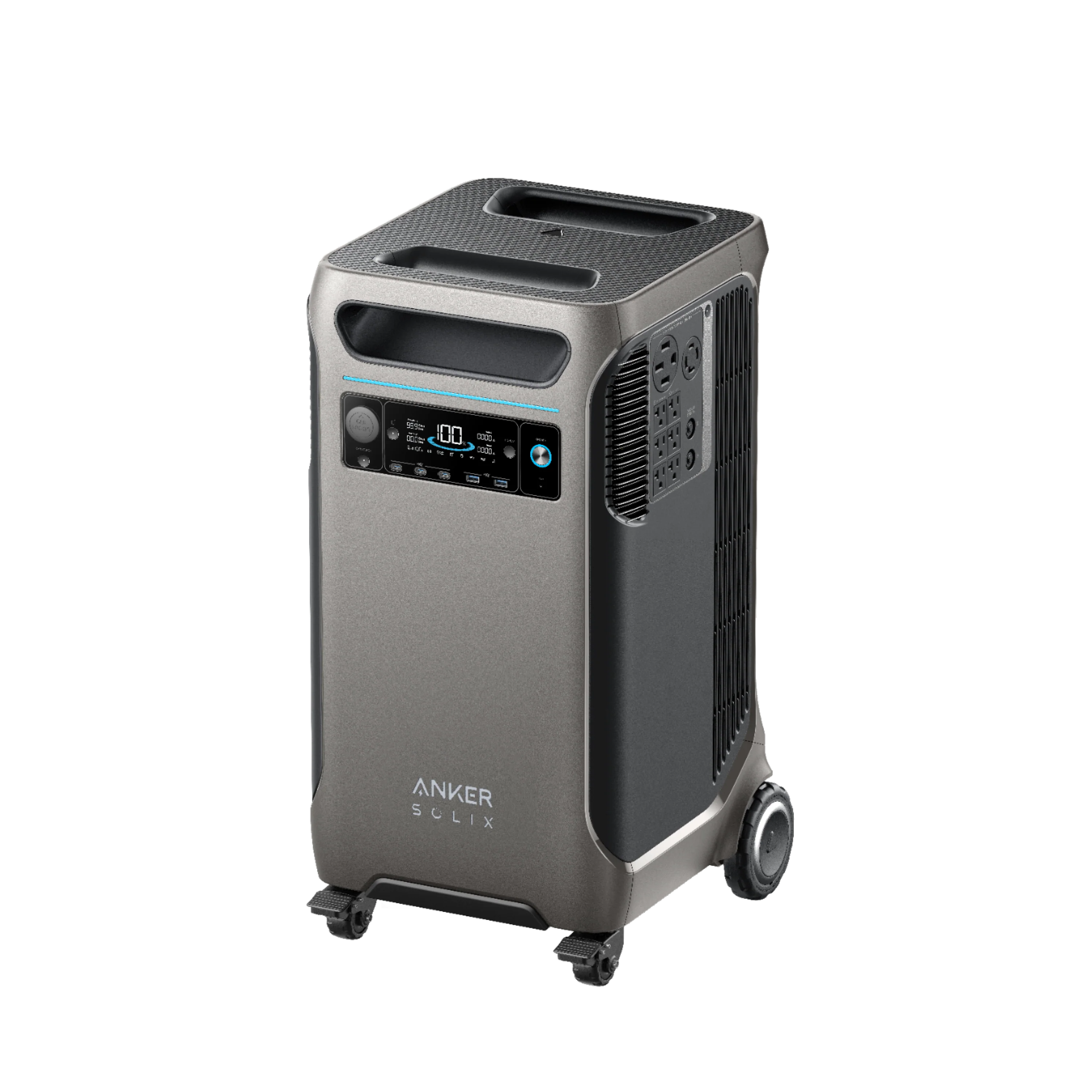
$2,599.99 · direct from Anker
Last checked 1 day ago. Prices move — check before you buy.

$649.00 · direct from BLUETTI
Last checked 1 day ago. Prices move — check before you buy.
Spec deltas
The Anker SOLIX F3800 Plus wins five of the six scenarios on this page, but only two of those wins are load-bearing. An 8-Hour Blackout and a full weekend of camping are the two situations where the BLUETTI AC180P actually runs out of power — 134% and 172% of its usable capacity, respectively — rather than just running low on cushion.
That capability costs $1,951 more: $2,600 against $649, more than four times the price. The AC180P is still the cheaper unit to own even after that gap, with a lower cost per lifetime kWh and cheaper warranty-year math. The F3800 Plus is the better power station. The AC180P is very often the better buy.
Weight tells the same story in miniature: 132.3 lbs against 35.3, which turns 'which one do I buy' into 'do I want to move this thing by myself.' The F3800 Plus can also grow past its 3,840Wh starting point with Anker's own expansion batteries if your needs climb; the AC180P is sealed at 1,440Wh for good, no matter what a listing implies about charging it from a bigger external batteryB3. What follows is which of those two boxes actually solves your problem.
What the Numbers Reveal
Each conclusion stated first — the numbers behind it on one line, the full analysis below.
The F3800 Plus's win column looks like a clean sweep, five of six scenarios, but the real capability gap is narrower than that scoreboard suggests. Multi-day camping and an extended blackout are where the extra capacity is load-bearing. For a lighter routine like CPAP, a workday, or a tailgate, the AC180P finishes every time, it just breathes harder doing it.
AC180P needs 172% of its usable capacity for Weekend Camping and 134% for an 8-Hour Blackout — both over 100%, meaning it runs out before the job is doneFor CPAP Overnight, Remote Workday, and Tailgate Party the AC180P uses 26%, 74%, and 55% of its capacity — all under 100%, meaning it finishes with room to spare
Why it mattersIf your heaviest realistic draw tops out around a remote workday's 910Wh or a tailgate's 670Wh, don't pay $1,951 more for headroom you won't spend. If it includes a multi-day outage or a fridge-and-freezer camping trip, the extra capacity is the difference between finishing and not.
Capability and value point in opposite directions here: the F3800 Plus wins on raw headroom and the power-score math (6,265 vs 3,401), but the AC180P wins the dollar math outright. Buying the F3800 Plus is a bet that you'll actually spend the extra 2,400Wh. Pay for capacity you don't use and the higher-scoring unit becomes the worse deal.
F3800 Plus costs $2,600 (about $1,951 more than the AC180P) and runs $0.22 per lifetime kWh, versus the AC180P's $0.12Over the shared 5-year warranty, that works out to roughly $500 a year of coverage on the F3800 Plus against $120 a year on the AC180P
Why it mattersIf your heaviest realistic scenario tops out around Remote Workday's 910Wh or Tailgate Party's 670Wh, the AC180P's value case beats the F3800 Plus's capability case outright. Pick the box that matches your actual draw, not the higher score.
Capacity
That's not automatically a mark against the AC180P: some listings imply it can be expanded because it accepts charging from external battery packs, but that's Power Bank Mode topping up the existing 1,440Wh, not new capacityB3. At this size and price, a sealed ceiling isn't a missing feature. It only becomes a real drawback if your power needs are likely to climb past 1,440Wh, in which case the F3800 Plus is the only one of the two that can follow you there.
F3800 Plus specs mark it expandable, with Anker's own expansion batteries able to extend it past its 3,840Wh starting pointAC180P specs mark it not expandable, fixed at 1,440Wh with no expansion port
Why it mattersBuy the AC180P because it's complete as-is for a fixed, known load. Buy the F3800 Plus if you expect your needs to grow, since it's the only path on this page that can grow with them.
weight
Reviewers who've run the F3800 Plus describe the fans as barely audible under normal household loads, getting loud only once you're pulling serious power or charging at full speedA10A12, so the missing spec isn't hiding a bad result. It's an honest gap in what Anker discloses, not a red flag.
F3800 Plus weighs 132.3 lbs, nearly three and three-quarters times the AC180P's 35.3 lbs, and ships with wheels rather than handles aloneAnker doesn't publish a decibel rating for the F3800 Plus at all, while BLUETTI lists the AC180P at 45dB under load
Why it mattersIf a shared wall or a light sleeper is the deciding factor, the AC180P's published 45dB is a known quantity, while the F3800 Plus's real-world-quiet reputationA10A12 is a reasonable bet you can't verify against a spec sheet.
The specific dimensions that decide these two units — everything else is a tie.
Your Life, Your Pick
Selected because: Six real-world scenarios show the actual capability gap is narrower than the 5-1 scoreboard suggests, worth separating genuine fails from margin.
The F3800 Plus wins the verdict in five of six scenarios, but it only wins by force in two of them. An 8-Hour Blackout needs 1,645Wh — 50% of the F3800 Plus's usable capacity, but 134% of the AC180P's, which means the AC180P runs out before the power comes back. A full weekend of camping (2,100Wh) does the same thing: 64% for the F3800 Plus, 172% for the AC180P, which doesn't finish the trip.
CPAP Overnight, Remote Workday, and Tailgate Party tell a different story: the AC180P uses 26%, 74%, and 55% of its capacity respectively and finishes all three. It's not losing those scenarios so much as working harder at them. Van Life Daily is the one place size doesn't rescue either unit — 4,685Wh a day outruns the F3800 Plus (144%) and the AC180P (383%) alike, which argues for solar top-ups or real expansion batteries, not a bigger single box.
Lifetime Value
Selected because: The $1,951 price gap makes cost-of-ownership the first question serious buyers ask, and the AC180P wins this axis outright.
cost / lifetime kWh
Sticker price says $2,600 against $649, but the more honest number is cost per lifetime kWh: $0.22 for the F3800 Plus against $0.12 for the AC180P, which folds in cycle life (3,000 vs 3,500) as well as capacity. On that basis the AC180P is the value leader here, not a close second — close to half the running cost, and $120 a year of warranty coverage against $500. Run either one every weekend and the gap shows up daily too: about $0.24 in wear per day on the F3800 Plus against $0.05 on the AC180P.
None of that makes the F3800 Plus a bad buy. It makes it a buy for a bigger job. If your power draw actually spends the extra 2,400Wh, the premium buys real capability. If it doesn't, you're financing headroom you'll never touch, and the AC180P's lower cost per kWh stops being a consolation prize and becomes the correct answer.
Growth Path
Selected because: Only one unit has a real expansion path; the spec sheet's 'expandable' flag is easy to misread for the AC180P.
solar input
The F3800 Plus can add Anker expansion batteries and grow past its 3,840Wh starting point — real headroom if a home addition or a second major appliance is somewhere in your future. The AC180P's 1,440Wh is permanent: no expansion port, and while it can be charged by an external battery in Power Bank Mode, that tops it up rather than raising its ceilingB3.
That's not a knock on the AC180P. At 1,440Wh it was never built to be whole-home backup, so a sealed ceiling isn't a missing feature here, it's a complete product at its price point. The real question is whether you're buying for today's load or a load that's still growing; only one of these two boxes can follow you there.
What the Specs Don't Tell You
Selected because: Weight, an unpublished noise spec, and a warranty-year cost swing are the three things the spec sheet undersells.
rated cycles
132.3 lbs is the F3800 Plus's real tax — a two-person job or a wheeled-cart commitment, against the AC180P's 35.3 lbs, which one person carries without thinking about it. Anker also doesn't publish a dB figure for the F3800 Plus, so there's no spec-sheet answer for anyone whose main constraint is bedroom or apartment noise. The AC180P at least tells you upfront: 45dB under load.
Both carry a 5-year warranty, which sounds like a tie until you divide by price: that's $500 a year of coverage on the F3800 Plus and $120 on the AC180P. Same duration, a very different value per year insured.
Brand Trust
Selected because: Cross-brand pair, Anker vs BLUETTI, with real support and ecosystem differences worth a beat.
Anker carries the bigger consumer-electronics halo, and SOLIX support was historically excellent, though recent reports describe more AI-driven responses and clunkier logistics for returning a 132-lb unit. BLUETTI's pitch is blunter: the strongest capacity-per-dollar in the category, with support quality that's the most inconsistent in the space.
Neither brand risk should be the deciding factor here. The F3800 Plus and AC180P are different enough in size and price that most buyers will have already picked a category, home backup versus grab-and-go, before brand loyalty ever enters the decision.
Strengths & trade-offs
Anker SOLIX F3800 PLUS
Strengths
- +Larger battery capacity
- +Higher AC output
- +Faster solar charging
Trade-offs
- –Substantially more expensive (+$1,951) than the AC180P.
- –Significantly heavier (+97 lbs), making it harder to move.
- –Very heavy unit that may be difficult for one person to lift.
BLUETTI AC180P
Strengths
- +Costs $1,951 less
- +Lighter by 97 lb
Trade-offs
- –Weaker inverter (-4,200W) limits appliance compatibility.
- –Sealed capacity — the SOLIX F3800 PLUS can add batteries to grow past 1,440Wh; this one can't.
Will It Power Your Gear?
Scenario math and per-appliance runtimes, modeled from the spec record.
Scenario verdicts
We ran the math on six real-world scenarios. Here's which unit survives your actual life.
SCN-01 · 2 nights · needs 2,100Wh
Weekend Camping
Two nights off-grid with essential comfort
Neither unit
A weekend of camping needs 2,100Wh. The AC180P can't cover it solo — at 172% of its usable capacity, it runs dry before the trip's over. The F3800 Plus uses 64% and comes home with plenty left.
Battery budget usedlower = more headroom
LOAD Phone Charger 15W×6h · LED Lights 40W×8h · Box Fan 75W×14h · CPAP Machine 40W×16h
SCN-02 · 8 hours · needs 1,645Wh
8-Hour Blackout
Keep the essentials running through a night without power
SOLIX F3800 PLUS
An 8-hour blackout needs 1,645Wh. The AC180P hits 134% of its usable capacity and runs out before the power comes back. The F3800 Plus uses about half its tank (50%) and rides out the whole outage.
Battery budget usedlower = more headroom
LOAD Fridge 150W×8h · Router + Modem 20W×8h · LED Lights (4 bulbs) 40W×6h · Phone Charger 15W×3h
SCN-03 · 8 hours · needs 320Wh
CPAP Overnight
Sleep therapy without interruption — the #1 medical use case
Either unit
CPAP Overnight needs just 320Wh — 10% of the F3800 Plus's usable capacity and 26% of the AC180P's. Both machines get through the night without issue; this one's about margin, not survival.
Battery budget usedlower = more headroom
LOAD CPAP Machine 40W×8h
SCN-04 · 8 hours · needs 910Wh
Remote Workday
Full work day off-grid without power anxiety
SOLIX F3800 PLUS
910Wh covers a remote workday on either unit: 74% of the AC180P's capacity, 28% of the F3800 Plus's. Both finish the day — the F3800 Plus just finishes with far more in reserve.
Battery budget usedlower = more headroom
LOAD Laptop 60W×8h · External Monitor 30W×8h · Router + Modem 20W×8h · Phone Charger 15W×2h
SCN-05 · 4 hours · needs 670Wh
Tailgate Party
Game day power for the crew
AC180P
670Wh is comfortable territory for both: 55% of the AC180P's capacity, 21% of the F3800 Plus's. Bring either one — the F3800 Plus just barely notices.
Battery budget usedlower = more headroom
LOAD Blender 400W×0.5h · LED TV (55") 80W×4h · Bluetooth Speaker 15W×4h · Phone Charger (×3) 45W×2h
SCN-06 · 24 hours · needs 4,685Wh
Van Life Daily
A full day of mobile living — the ultimate endurance test
Neither unit
4,685Wh a day outruns both of these on battery alone — 144% of the F3800 Plus's usable capacity and 383% of the AC180P's. This is a daily-solar-recharge scenario or a case for a bigger stack, not a single fixed unit of either size.
Battery budget usedlower = more headroom
LOAD Mini-Fridge 150W×24h · Laptop 60W×4h · Phone Charger 15W×3h · LED Lights 40W×5h · Fan 75W×8h
The Load Test
RUNTIME = (Wh × 0.85) ÷ LOAD
None of the scenarios above exactly yours? Build it. Toggle what you'd plug in; both units are tested against the combined draw.
Essentials
Comfort & Convenience
High-Draw Appliances
Test duration
8h
Continuous draw
205W
Projected runtime
For this load: SOLIX F3800 PLUS runs 15.9h vs 6h.
$2,599.99 list · direct from Anker
Modeled from the spec record — same math as the tables below. Methodology
Runtime by appliance
Real-world runtime estimates for common appliances, modeled at 85% inverter efficiency.¹
Essentials
The basics you need runningscale 0–217.6hComfort & Convenience
Makes off-grid life actually enjoyablescale 0–43.5hHigh-Draw Appliances
These reveal the real limitsscale 0–3.3h¹ Runtime = (capacity × 0.85) ÷ appliance watts. Within each group, all bars share one time scale (the group's longest runtime), so lengths are comparable across appliances; identical runtimes collapse into a single blue/orange bar. Actual runtime varies with battery age, temperature, and simultaneous loads — see methodology.
Conclusion
July 28, 2026
Verdict: the SOLIX F3800 PLUS, on Power Score margin
The F3800 Plus wins on raw capability: nearly double the power score (6,265 vs 3,401), 2,400Wh more capacity, and a real expansion path, while the AC180P's capacity is fixed despite what some listings imply — its 'expansion' option is Power Bank Mode charging from an external battery, which recharges it rather than growing itB3. It's also the only one of the two that actually finishes an 8-Hour Blackout or a full weekend of camping without running dry. But the AC180P is the better dollar-for-dollar buy — $0.12 per lifetime kWh against $0.22, and $120 a year of warranty coverage against $500 — and for CPAP Overnight, a remote workday, or a tailgate, it finishes the job just as completely as the F3800 Plus, for a fraction of the price. Buy the F3800 Plus for headroom you'll actually spend; buy the AC180P if your loads are smaller than a full weekend of camping or a multi-day outage.
Editor-assigned confidence, based on cited owner research and spec analysis.
List prices as of July 28, 2026. The links below open Anker's and BLUETTI's current prices.
$2,599.99 · direct from Anker
Last checked 1 day ago. Prices move — check before you buy.
or check the AC180P price$649.00 list
Written by Gunner Gustafson, Whole-Home Backup Tester · Station Arena Test Desk · Updated July 28, 2026
Measured Data
Benchmark scores and the full spec record, side by side.
Benchmark scores
Not rated for both units (minimum threshold unmet): UPS, CPAP, Tailgating, Apartment Balcony, Camping.
Full specifications
ᵈ Derived: price ÷ rated capacity. See the data behind our comparisons →
Comparison ToolAdd more power stations, side by sideOpen Tool →How these numbers are produced
Numeric verification
Every figure on this page traces to our spec database or arithmetic on it — no estimated numbers.
Owner claims
Statements about owner experience are cited to published reviews — see Sources & Research Notes below.
Runtime model
Runtime = (rated capacity × 0.85 inverter efficiency) ÷ device wattage. Solar recharge estimates assume panels deliver 70% of rated output. Cold weather, battery age, and stacked loads reduce real-world results.
Power Score
Computed from 14 published spec dimensions, weighted per use-case bench. Higher is better; a unit must meet a bench's minimum threshold to be rated.
See the full weight table and data sourcing on our methodology page →Class ranking (the star rating)
Each unit's star score is a category ranking, not customer reviews — no buyer opinions feed it. We score every station on size-independent quality (value, output, portability, endurance, ports, warranty, and more), then percentile-rank it against the other units in its capacity class, so a class-leading compact unit and a class-leading whole-home unit can both earn 5★. Here, SOLIX F3800 PLUS rates 4.5/5 (73rd percentile of 16 Home Backup-class units), and AC180P rates 4.1/5 (50th percentile of 27 Everyday-class units).
How the class ranking is computed →Test Notes & Caveats
Hidden gotchas and advantages we spotted that you won't find on the product page.
SOLIX F3800 PLUS: 132.3 Lbs Changes How You Buy It
132.3 lbs is a two-hands, bent-knees lift, not a one-person grab-and-go, nearly four times the AC180P's 35.3 lbs. Anker ships it with wheels for a reason. Fine if it lives in a closet and comes out twice a year; feel the weight first if you're moving it in and out of a vehicle regularly.
AC180P: 45dB Is a Known Quantity
45dB under load lands around the noise floor of a quiet office — noticeable in a silent room, easy to ignore with anything else going on. It's a published number you can plan around before you buy.
AC180P: Sized Up Front, Not Later
1,440Wh is a fixed number here — no expansion port, no bigger version to grow into. That's not a shortcoming at this size and price; it just means you're sizing the AC180P for what you need today, not what you might need in three years. If your loads are likely to grow past 1,440Wh, that's a question for the F3800 Plus, not this unit.
Same 5 Years, Very Different Math
Both units carry a 5-year warranty, but that coverage means something different in dollar terms: $500 a year of protection on the F3800 Plus against $120 a year on the AC180P. Identical duration, a wide gap in what you're insuring per year.
SOLIX F3800 PLUS: No Published dB Rating
Anker doesn't list a decibel figure for the F3800 Plus anywhere in its specs, so there's no spec-sheet number to weigh against the AC180P's 45dB. For anyone whose main constraint is a shared wall or a nearby bedroom, that's a real gap in the listing, not just a missing nice-to-have.
Full record above — the Test Desk pick is the SOLIX F3800 PLUS.
Check SOLIX F3800 PLUS price →or check the AC180P priceOwnership Analysis
What happens after you buy — true cost of ownership, brand trust, and growth potential.
Lifetime value
Service lifeyears at one full cycle per day
Lifetime energy delivered
Cost per delivered kWh
│ warranty ends · Reaching the cycle rating means ~80% capacity remains — degraded, not dead.
Analyst note
The AC180P wins on both sticker price and long-term value. At $0.13/kWh over its lifetime, it's meaningfully cheaper to own. Clear value winner. One caution on the lifespan row: the AC180P takes longer to reach its cycle rating, but a cycle moves a different amount of energy on each unit — the SOLIX F3800 PLUS still delivers more over its shorter horizon (11,520 vs 5,040 kWh). Years measure wear, not usefulness.
Brand trust
Anker
Ecosystem
7-8 SOLIX portable power stations across C-series (compact) and F-series (flagship), plus the X1 home energy system
Support
US-based support. Historically known for incredible no-hassle replacements, but recent reports describe AI-driven support agents giving generic responses and complex return logistics for heavy units (hazmat shipping). The Anker brand reputation is still strong, but SOLIX-specific support quality is trending down.
Community
Moderate — active Reddit (r/Anker, r/AnkerSOLIXCommunity) and growing. Benefits from Anker's massive consumer electronics brand awareness.
App experience
Rated 4.5/5 iOS (~1,100 ratings) · 4.3/5 Android
Unique strength
Anker's SOLIX line rides on the parent brand's reputation in consumer electronics, and its InfiniPower cell tech is built for a long service life. The wider Gen 2 lineup is some of the best value per Wh in the category.
Worth knowing
Support was historically excellent, no-hassle replacements included, but recent reports describe more AI-driven responses and clunkier return logistics for a unit this heavy. The brand's reputation is still strong; the trend line on SOLIX-specific support isn't.
BLUETTI
Ecosystem
One of the broadest lineups — 15-20+ models from budget (AC2A) to flagship portable (Apex 300, 2764.8Wh). Includes specialized products: vehicle solar hubs, sodium-ion cold-weather units, and balcony storage systems.
Support
The most inconsistent support in the space. Heavily email-based with China timezone delays. Some users get smooth, efficient service; others report weeks of troubleshooting runarounds, being offered discounts on new units instead of repairs, and confusing third-party purchase claim processes. Buying direct from Bluetti's website tends to produce better support outcomes.
Community
Active and growing — Reddit r/bluetti has a dedicated community. Second-largest after EcoFlow in engagement.
App experience
Rated 4.5/5 iOS and Android — tied for best app experience in the category. V3.0 UI redesign was well-received.
Unique strength
BLUETTI's pitch is capacity per dollar, the strongest in the category, backed by full LiFePO4 standardization across a lineup running from budget to flagship.
Worth knowing
Support is BLUETTI's real risk: outcomes range from smooth to weeks of email back-and-forth with timezone delays, and buying direct from BLUETTI's own site reportedly gets better results than going through a third party.
Analyst note
Anker sells the safer name; BLUETTI sells the better price. Neither should be the deciding factor here — the F3800 Plus and AC180P sit far enough apart in size and price that most buyers pick a category, home backup versus grab-and-go, before brand ever enters the decision.
Growth path
SOLIX F3800 PLUS
EXPANDABLESupports Anker expansion batteries, so you can add capacity later without replacing the base unit — useful if your needs may climb past 3,840Wh.
Accepts up to 3,200W of solar. Enough for a serious multi-panel array.
Generous port selection supports complex multi-device setups.
Expansion batteries are Anker-specific. You're investing in the Anker ecosystem.
AC180P
FIXED CAPACITYFixed at 1,440Wh, with no expansion — so size it for your needs up front rather than planning to add capacity later.
Accepts up to 500W of solar. Suitable for a 1-2 panel setup.
Adequate ports for most setups, but heavy users may want a power strip.
Realistic full solar rechargeat 70% of rated panel output — see methodology
Analyst note
The AC180P is sealed at 1,440Wh, which is fine if that covers you. The SOLIX F3800 PLUS starts at 3,840Wh and can grow beyond it with Anker expansion batteries — real headroom the AC180P doesn't have if your needs climb toward partial-home backup.
What Owners Report
Patterns from published owner reports and long-term reviews — every claim cited to its source below.
Anker SOLIX F3800 PLUS
Grassroots owner chatter on the F3800 Plus specifically is thin — most of what's available comes from reviewers who ran the unit for weeks rather than casual forum posts. Support experiences diverge sharply where they do exist: one owner describes being ghosted after repeated contact attempts over a battery-pack faultA1, while another Solix owner in the same thread reports fast, responsive service and an advanced replacementA2. Treat that as results-vary rather than a settled pattern.
Real-world runtime falls off fast with load. Light use, like lights, a router, and occasional device charging, stretches toward most of a day, but running a fridge and a freezer together drains the base unit in a few hoursA4A5. Reviewers describe the fans as barely audible under normal household loads, turning noticeably loud only once you're pulling serious power or charging at max speedA10A12. The 132.3-lb weight draws its own recurring complaint: fine on wheels over flat ground, but reviewers note it struggles once the terrain gets rough, and aggregated feedback flags portability alongside praise for raw performanceA8A14.
“I've called them and submitted tickets via their portal, always very responsive. They've even done advanced replacement for me.”
Sources
campingsolar.us · cleanenergybusinesscouncil.com
BLUETTI AC180P
Review coverage on the AC180P is strong, and the recurring theme is fast charging plus a genuinely useful high-power surge mode for demanding gearB1B2. The one real clarification worth knowing: despite what some listings imply, it does not accept true expansion batteries — no external battery pack raises its capacity. It can be charged by one in Power Bank Mode, but that's a recharge, not an upgradeB3.
Weight lands around 35.3 lbs in most listings, which reviewers call fine for car camping or a base camp and more of a strain for backpacking or carrying any real distanceB4.
“Delivers 1,440Wh of LiFePO4 capacity and 1,800W continuous output, with a Turbo Charge feature reaching 0-80% in roughly 45 minutes and a Power Lifting Mode that delivers 2,700W to run high-powered devices.”
Sources
backuppowerhub.com · bluettipower.com · batteryskills.com · the-gadgeteer.com · bestgeneratorsolar.com
Sources & Research Notes
Every owner claim in this report is traceable to a published source. The bracketed references above resolve here.
Recurring owner themes
- Owner support experiences with Anker/Solix diverge sharply — some report being ghosted after repeated contact attempts over a hardware fault, while others describe fast, responsive advanced-replacement service. [SOLIX F3800 PLUS · 2 entries]
- Real-world runtime drops off steeply with load: light loads (lights, router, occasional laptop/e-bike charging) stretch toward the ~17-hour mark, but running a fridge and freezer together drains the base unit in around 7 hours. [SOLIX F3800 PLUS · 2 entries]
- Fan noise is reported as low/background during normal household loads and only becomes noticeably audible under heavy loads (4,000W+) or max-speed charging. [SOLIX F3800 PLUS · 2 entries]
- The unit's near-137 lb weight is a recurring friction point: reviewers note the wheels/handles work for moderate use but struggle over rough terrain, and aggregated user feedback flags portability and packaging as concerns despite praise for raw performance. [SOLIX F3800 PLUS · 2 entries]
- Fast Turbo charging, strong owner ratings, and a useful Power Lifting Mode are the praise; the key clarification is that it does NOT accept true battery expansion despite some listings. [AC180P · 3 entries]
- A1
“I think it may be a fire hazard with this crazy noise it's making. I have emailed Anker support over 5 times... Anker support is ghosting me after I spent over 20k on their solix line and solar panels within a month.”
DIY Solar Forum — "Big issue with Anker Solix F3800 plus battery pack (Large Anker Solix setup)" · 2025-08 · [negative]
- A2
“I've called them and submitted tickets via their portal, always very responsive. They've even done advanced replacement for me.”
DIY Solar Forum — "Big issue with Anker Solix F3800 plus battery pack (Large Anker Solix setup)" (reply from another Solix owner) · 2025-08 · [positive]
- A4
“You would be able to keep a fridge or freezer running, charge a few laptops or phones, maybe charge up an e-Bike and the F3800 Plus base unit would last about 17 hours before needing a recharge.”
Digital Trends — "Anker Solix F3800 Plus review: this power station wins for versatility and value" · 2025-05 · [positive]
- A5
“With both the freezer and my fridge plugged in at the same time, I was about to get 7.34 hours before the unit was completely drained.”
Digital Trends — "Anker Solix F3800 Plus review: this power station wins for versatility and value" · 2025-05 · [mixed]
- A8
“The big wheels in the back are enough to go over grassy terrain, but avoid anything too challenging. Small bumps can be enough to slam everything to a halt.”
AppleInsider — "Anker Solix F3800 Plus portable power station review: investment in reliable home power" · 2025-08 · [mixed]
- A10
“Under normal loads (lights, fridge, TV), the fans are barely audible. It only gets loud when you're pulling over 4,000W or charging at max speed.”
CampingSolar.us — "Anker SOLIX F3800 Plus Review: The Ultimate 240V Home & RV Power" · 2026-02 · [positive]
- A12
“It doesn't match the whisper-quiet performance of the EcoFlow Delta Pro Ultra, which remains one of the quietest power stations we've ever tested, but the F3800 Plus is still surprisingly quiet, even when you're really pushing it.”
TheSolarLab — "Anker SOLIX F3800 Plus Review: Big Power, Big Price?" · unknown · [positive]
- A14
“Overall, feedback indicates a mixed experience. Customers appreciate its robust performance but express concerns about portability and packaging.”
CleanEnergyBusinessCouncil.com — "Anker SOLIX F3800 Plus Review: Power Unleashed" (site's summary of user feedback) · 2025-08 · [mixed]
- B1
“Delivers 1,440Wh of LiFePO4 capacity and 1,800W continuous output, with a Turbo Charge feature reaching 0-80% in roughly 45 minutes and a Power Lifting Mode that delivers 2,700W to run high-powered devices.”
backuppowerhub.com / bluettipower.com — AC180P review · 2025-2026 · [positive]
- B2
“Holds a strong 4.6-star rating from 708 verified Amazon purchasers; reviewers confirm the 0-80% in 45 minutes claim held true in testing.”
batteryskills.com / the-gadgeteer.com — AC180P review · 2025-2026 · [positive]
- B3
“Does not include a battery expansion port and does not support capacity expansion with B80, B230, or B300 batteries — contrary to some listings — though it can be charged by such batteries through Power Bank Mode.”
bestgeneratorsolar.com / backuppowerhub.com — AC180P buyer's guide · 2025-2026 · [mixed]
- B4
“Weight is cited around 35 lbs in most listings (one source lists ~28.7 lbs) — manageable for base camp or car camping, more of a constraint for backpacking or carrying any distance.”
backuppowerhub.com / batteryskills.com — AC180P review · 2025-2026 · [mixed]
Research compiled July 28, 2026.
Who Should Buy Which
Buy the SOLIX F3800 PLUS if you…
- →Your real scenario is an extended blackout or a full weekend of camping, where the AC180P doesn't just fall short, it runs dry. The F3800 Plus finishes both with capacity to spare (50% and 64% used, against the AC180P's 134% and 172%).
- →Your power needs might grow: a home addition, a second major appliance, an EV you're willing to trickle-charge. You want a station with a real expansion path instead of a hard ceiling.
- →You want the higher-scoring, more capable unit outright and the extra $1,951 isn't the deciding factor. The F3800 Plus's power score (6,265) roughly doubles the AC180P's (3,401).
Buy the AC180P if you…
- →Your actual loads are CPAP, a remote workday, or a tailgate setup, all comfortably inside the AC180P's range (26%, 74%, and 55% of capacity), and you'd rather keep the extra $1,951 than pay for headroom you won't use.
- →You care about cost per kWh over the unit's life, not just the sticker price. The AC180P wins that math outright.
- →You need something one person moves without a second thought: 35.3 lbs against the F3800 Plus's 132.3.
If neither fits
Skip both if you're running a full-time van-life setup — a genuine 4,685Wh a day outruns the F3800 Plus (needing 144% of its usable capacity) and the AC180P (383%) alike. That's a job for a stack of real expansion batteries on a bigger base unit, a proper solar-plus-alternator system, or a dedicated house-battery setup, not a single fixed-capacity station, which is what you're choosing between on this page either way.
The Bottom Line
The SOLIX F3800 Plus is the better power station: nearly double the power score, 2,400Wh more capacity, and a real path to grow beyond it, while the AC180P is sealed at 1,440Wh for good. But 'better station' isn't the same claim as 'better buy' — the AC180P remains the cheaper unit to own over its life, and it only truly loses two of the six real-world scenarios here, both involving loads well past what most buyers actually run.
Buy the F3800 Plus if your power draw genuinely lives in blackout-and-camping territory, or if you can already see your needs growing past 1,440Wh. Buy the AC180P if it doesn't. You'll bank close to two thousand dollars and still finish every load you actually have.
Frequently Asked Questions
Answers drawn from the spec record and cited owner research.
Is the BLUETTI AC180P actually expandable?
No. Despite what some listings suggest, the AC180P doesn't accept true capacity-expansion batteries — no external battery pack raises its 1,440Wh ceiling. It can be charged by one in Power Bank Mode, but that recharges the unit rather than growing it. If you need a station that can grow past its starting capacity, that's the F3800 Plus, not the AC180P.
Why does the Anker SOLIX F3800 Plus win almost every scenario if it's so much more expensive?
Because 'winning' a scenario here mostly means finishing with more spare capacity, not finishing at all. The AC180P actually fails only two of the six scenarios tested: an 8-Hour Blackout and a full weekend of camping, where it would need 134% and 172% of its usable capacity. In the other three it covers, it's just using more of a smaller tank (26%, 74%, and 55%, against the F3800 Plus's 10%, 28%, and 21%).
What's the noise level on the Anker SOLIX F3800 Plus?
Anker doesn't publish one. There's no decibel rating listed for the F3800 Plus, which stands out next to the AC180P's disclosed 45dB under load. Reviewers who've tested it describe the fans as barely audible at normal household loads and noticeably louder only under heavy draw or max-speed charging, but that's a field observation, not a spec you can rely on before you buy.
Which one is actually cheaper to own, not just to buy?
The AC180P, and it's not close: $0.12 per lifetime kWh against the F3800 Plus's $0.22, and $120 a year of warranty coverage against $500. The F3800 Plus only closes that gap if you're actually spending the extra 2,400Wh of capacity it carries — unused capacity doesn't lower your cost per kWh.
Can one person move the SOLIX F3800 Plus by themselves?
Technically, with the wheels, but 132.3 lbs is still a two-hands, watch-your-back job, not a quick grab, well over three and a half times the AC180P's 35.3 lbs. Reviewers say it handles flat ground and grass fine but struggles once the terrain gets rough or bumpy.
Where to buy
Anker SOLIX F3800 PLUSPick
$2,599.99
$2,599.99 · direct from Anker
Last checked 1 day ago. Prices move — check before you buy.
BLUETTI AC180P
$649.00
$649.00 · direct from BLUETTI
Last checked 1 day ago. Prices move — check before you buy.
Prices may vary by retailer and are subject to change.