Head-to-head test
Anker SOLIX F3000 vs Jackery Explorer 3000 v2
Same 3,072Wh, same 3,600W inverter, and the Anker costs $1,100 less while taking more than twice the solar — the Explorer 3000 v2's entire answer is that it weighs 28 pounds less, which is either the whole ballgame or nothing, depending on your stairs.
Full profiles: Anker SOLIX F3000 → · Jackery Explorer 3000 v2 →

Written by Gunner GustafsonUpdated
Whole-Home Backup Tester, Station Arena Test Desk
Spec deltas
The F3000 and the Explorer 3000 v2 store the same 3,072Wh and deliver the same 3,600W — on the two specs most buyers start with, they're twins. Then the price tags land: $1,400 for the Anker, $2,499 for the Jackery.
That $1,100 gap doesn't buy the Explorer more battery or more output, because there isn't any more to buy. It buys about 28 pounds off — 59.52 against 88 — a genuinely liftable box against a wheels-and-handle one. For a buyer hauling this upstairs or room to roomB1, that's a real feature. For everyone else it's a lot of money for lightness.
And the Anker spends the difference in the other direction: 2,400W of solar input to the Explorer's 1,000W, plus an expansion port the sealed Explorer doesn't haveB4. Same energy today, more ways to refill it and more room to grow, for far less money. Unless you're the one carrying it, this isn't close.
What the Numbers Reveal
Each conclusion stated first — the numbers behind it on one line, the full analysis below.
solar input
When two boxes hold the same 3,072Wh and push the same 3,600W, the battery is a tie and the decision moves entirely to what surrounds it — and there the F3000 is cheaper by four figures and pulls 2,400W off panels to the Explorer's 1,000W, so it costs far less today and refills far faster off-grid, from the same starting energy.
both store 3,072Wh and output 3,600Wthe F3000 costs $1,400 to the Explorer's $2,499the F3000 takes 2,400W of solar to the Explorer's 1,000W
Why it mattersAnyone comparing these two on capacity is comparing a dead heat; the price and the solar input settle it for the Anker unless one specific thing is worth $1,100 to you.
Twenty-eight pounds is the whole Jackery argument, and it isn't nothing: 59.52 pounds is a one-person lift up a staircase, while the F3000's 88 is the load a tester said 'barely passed' his own carryA8 even with wheels and a handle to help — so if this battery travels and meets stairs, the Explorer earns its premium the instant you lift it.
Explorer weighs 59.52 lb to the F3000's 88 lbone reviewer carried the Explorer room to room by handB1the F3000 rolls on wheels but a tester said it 'barely passed' his manual-lift testA8
Why it mattersFor the buyer who moves the unit often, alone, and over steps, the Explorer's lightness is worth real money; for the buyer who rolls it into a corner and leaves it, that money is better kept.
Here's the split, stated fairly: the Explorer's sealed 3,072Wh works out to about $0.20 a lifetime kilowatt-hour over its 4,000 cycles, a real longevity number the F3000 leaves blank, yet the Explorer also costs $500 a warranty year to the Anker's $280 and can never add a watt-hour — so it's the more knowable box and the more expensive, less expandable one at the same time.
the F3000 accepts Anker expansion batteries; the Explorer is sealed at 3,072WhB4the Explorer is rated 4,000 cycles; the F3000 publishes no cycle lifethe Explorer costs $500 per warranty year to the F3000's $280
Why it mattersIf a published cycle life and a sealed, finished system is what reassures you, that's the Explorer's fair point; if a far lower yearly cost and the option to grow matter more, the Anker takes it.
The specific dimensions that decide these two units — everything else is a tie.
Portability & Form Factor
Selected because: The Explorer's entire reason to exist: 28 lb lighter and hand-carryable. Lead with it.
weight
This is the Explorer's reason to exist. At 59.52 pounds it's about 28 lighter than the F3000's 88, and that crosses a real line: one is a two-hands-but-doable carry, the other is a wheels-and-handle unit you roll because lifting it is a project. A reviewer summed up the Jackery's appeal as being able to move it room to room without wrecking his backB1.
But notice what the lightness costs here. You're paying about $1,100 for those 28 pounds, on a battery that otherwise matches the Anker watt-for-watt. If the unit lives in one spot, or only ever rolls across a garage floor, you're buying a portability you'll rarely feel — and handing back solar input, expandability, and a four-figure pile of cash to get it.
Lifetime Value
Selected because: cheaperToOwn=p2 only because the Anker posts no cycle count; the warranty-year number favors Anker. Surface honestly.
The spec engine flags the Explorer as the cheaper unit to own, and the honest reason is unflattering to both. The Explorer publishes a 4,000-cycle life that works out to about $0.20 a lifetime kilowatt-hour; the F3000 publishes no cycle count, so it has no lifetime figure to compute — the Anker doesn't win this line, it simply doesn't post a score.
Read the number that is on the page, though, and it favors the Anker anyway: $280 per warranty year against the Explorer's $500. Over the five-year warranty they share, the Explorer costs far more per year of coverage for the same 3,072Wh. A published cycle life is worth something. It isn't worth $1,100 and double the yearly cost.
Growth Path
Selected because: Anker expands; Explorer is sealed at 3,072Wh. Real Anker advantage, expansion gotcha fires.
solar input
The F3000 has an expansion port and the Explorer doesn't — that's the whole section. Anker will sell you add-on batteries to push past 3,072Wh when your needs climb; the Explorer is sealed at 3,072Wh for good, and its own reviewer noted the lack of expansion, if only to add that it didn't bother him personallyB4.
Whether that matters is a question about your future, not your present. If 3,072Wh covers you now and forever — a CPAP, a fridge, a work-from-home outage — the sealed box is honestly fine, and simpler for it. If there's any chance you'll want partial-home backup later, the Anker is the one that lets you grow into it instead of rebuying.
Brand Trust
Selected because: Jackery retail/return backstop vs weak direct support; Anker app/value — cross-brand.
Jackery's pitch is ubiquity: it's the power-station brand your relatives recognize, stocked at Costco, Home Depot, and Best Buy, with a return counter that doubles as a warranty backstop. That matters more than usual here, because Jackery's direct support draws steady criticism and its app is the weakest of the majors. Buying from a retailer with a real return window is the workaround owners actually recommendB5.
Anker counters with software and price position — a well-rated app and some of the best dollar-per-watt-hour in the category — though its SOLIX support has drifted from the no-hassle standard the brand was built on. Neither company is a clear safe harbor. On this pair, though, the Anker's edge is decided by the box and the sticker long before brand tips it.
Strengths & trade-offs
Anker SOLIX F3000
Strengths
- +Faster solar charging
Trade-offs
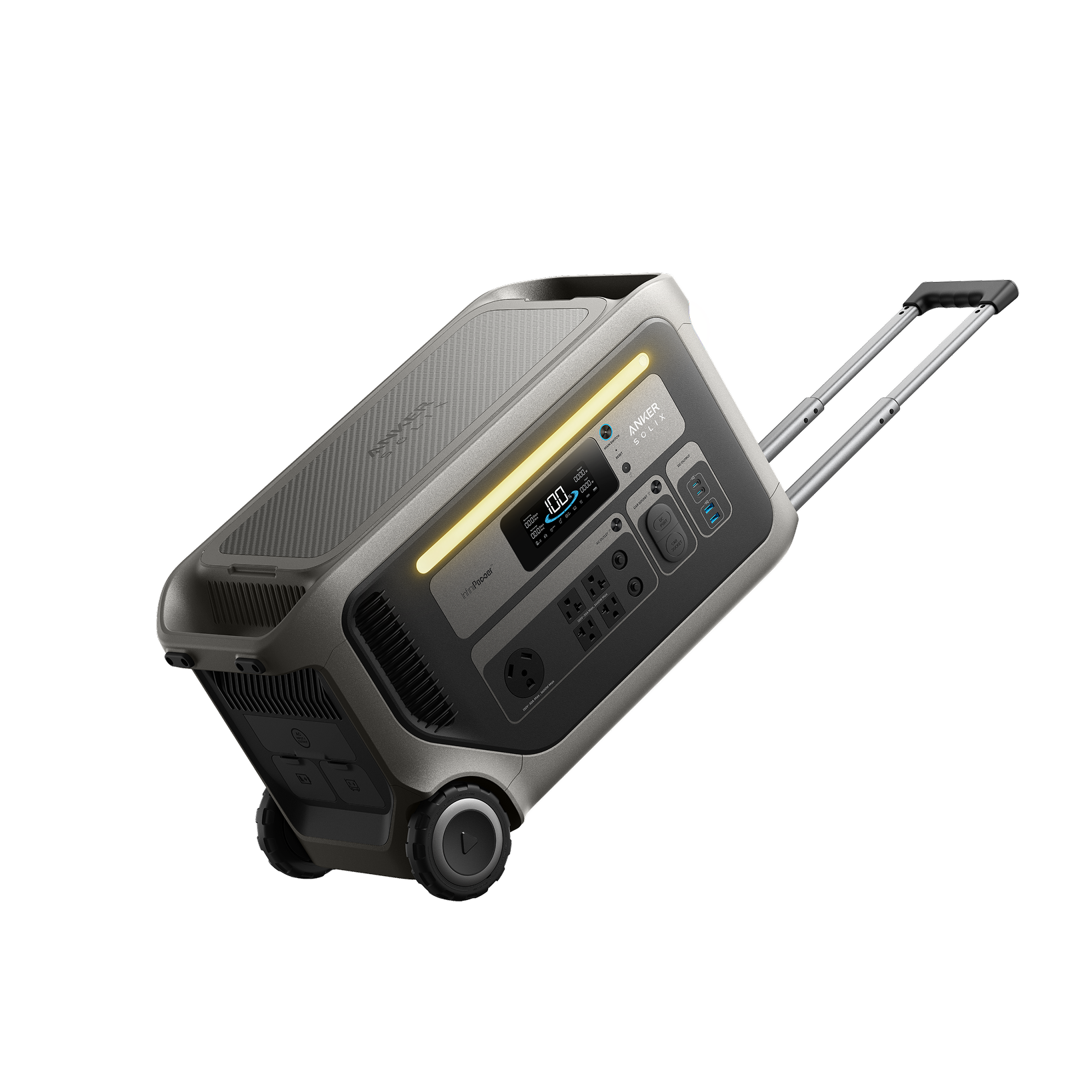
- –Significantly heavier (+32 lbs), making it harder to move.
- –Very heavy unit that may be difficult for one person to lift.
Jackery Explorer 3000 v2
Strengths
- +Lighter by 32 lb
Trade-offs
- –Sealed capacity — the SOLIX F3000 can add batteries to grow past 3,072Wh; this one can't.
Will It Power Your Gear?
Scenario math and per-appliance runtimes, modeled from the spec record.
Scenario verdicts
We ran the math on six real-world scenarios. Here's which unit survives your actual life.
SCN-01 · 2 nights · needs 2,100Wh
Weekend Camping
Two nights off-grid with essential comfort
Either unit
A two-night camp draws about 2,100Wh, and since these two hold the identical 3,072Wh, they land in exactly the same place — same 80% of usable capacity, same reserve, same margin. This scenario can't separate them. Break the tie on what differs: the Anker's lower price, or the Jackery's lighter haul to the site.
Battery budget usedlower = more headroom
LOAD Phone Charger 15W×6h · LED Lights 40W×8h · Box Fan 75W×14h · CPAP Machine 40W×16h
SCN-02 · 8 hours · needs 1,645Wh
8-Hour Blackout
Keep the essentials running through a night without power
Either unit
An eight-hour essentials outage needs around 1,645Wh, and both cover it to the same 63% of usable capacity — a genuine dead heat, because they carry the same battery. If your decision comes down to a blackout, decide it on recharge instead: the Anker takes 2,400W of solar to the Explorer's 1,000W, so it comes back faster the next day.
Battery budget usedlower = more headroom
LOAD Fridge 150W×8h · Router + Modem 20W×8h · LED Lights (4 bulbs) 40W×6h · Phone Charger 15W×3h
SCN-03 · 8 hours · needs 320Wh
CPAP Overnight
Sleep therapy without interruption — the #1 medical use case
Either unit
A CPAP is about 40W for eight hours, so both of these cover the night several times over — capacity isn't the question here. What would separate them is fan noise, but neither maker publishes a fan-noise figure, so there's nothing to hold either of them to. Only the SOLIX F3000 is still sold, so for a new buy it takes this by default; the Explorer 3000 v2 is worth weighing on weight and fan noise only if you already own one.
Battery budget usedlower = more headroom
LOAD CPAP Machine 40W×8h
SCN-04 · 8 hours · needs 910Wh
Remote Workday
Full work day off-grid without power anxiety
Either unit
Both power your workstation all day without strain, and their USB-C output is a wash — pick on weight, ports, or price.
Battery budget usedlower = more headroom
LOAD Laptop 60W×8h · External Monitor 30W×8h · Router + Modem 20W×8h · Phone Charger 15W×2h
SCN-05 · 4 hours · needs 670Wh
Tailgate Party
Game day power for the crew
Either unit
Both handle game day easily. Since capacity isn't the deciding factor, weight is: at 59.5 lbs the Explorer 3000 v2 is the easier carry, but it is no longer sold, so the SOLIX F3000 is the one to plan around. Fan noise under load is worth a listen too — it's audible in the lulls between songs.
Battery budget usedlower = more headroom
LOAD Blender 400W×0.5h · LED TV (55") 80W×4h · Bluetooth Speaker 15W×4h · Phone Charger (×3) 45W×2h
SCN-06 · 24 hours · needs 4,685Wh
Van Life Daily
A full day of mobile living — the ultimate endurance test
Neither unit
Neither unit covers this scenario's 4,685Wh: the SOLIX F3000 comes up 2,074Wh short (about 56% covered), the Explorer 3000 v2 2,074Wh (56%). Either gets you most of the way, so this is a scenario you plan around rather than one you should rule them out for.
Battery budget usedlower = more headroom
LOAD Mini-Fridge 150W×24h · Laptop 60W×4h · Phone Charger 15W×3h · LED Lights 40W×5h · Fan 75W×8h
The Load Test
RUNTIME = (Wh × 0.85) ÷ LOAD
None of the scenarios above exactly yours? Build it. Toggle what you'd plug in; both units are tested against the combined draw.
Essentials
Comfort & Convenience
High-Draw Appliances
Test duration
8h
Continuous draw
205W
Projected runtime
Dead heat — both run this 205W load for roughly 12.7h. Pick on price, weight, or ports.
Planning for more than this? Describe your whole setup and get it sized →
Modeled from the spec record — same math as the tables below. Methodology
Runtime by appliance
Real-world runtime estimates for common appliances, modeled at 85% inverter efficiency.¹
Essentials
The basics you need runningscale 0–174.1hComfort & Convenience
Makes off-grid life actually enjoyablescale 0–34.8hHigh-Draw Appliances
These reveal the real limitsscale 0–2.6h¹ Runtime = (capacity × 0.85) ÷ appliance watts. Within each group, all bars share one time scale (the group's longest runtime), so lengths are comparable across appliances; identical runtimes collapse into a single blue/orange bar. Actual runtime varies with battery age, temperature, and simultaneous loads — see methodology.
Conclusion
July 18, 2026
Verdict: the SOLIX F3000
Buy the SOLIX F3000 unless portability is the point. It stores the identical 3,072Wh and pushes the identical 3,600W as the Explorer 3000 v2, yet costs about $1,100 less, accepts 2,400W of solar to the Explorer's 1,000W, and can bolt on expansion batteries where the Explorer is sealed for life. The Explorer's honest edges are that it weighs 59.52 pounds to the Anker's 88 — light enough that one reviewer carried it room to roomB1 — that it publishes a 4,000-cycle life the Anker leaves blank, and that it switches over five milliseconds faster. Those are worth something to a buyer who moves the unit constantly and solo. For everyone charging off panels, planning to grow, or simply counting the difference, the Anker wins going away.
Editor-assigned confidence, based on cited owner research and spec analysis.
List prices as of July 18, 2026. The links below open Anker's current price.
Sold on Amazon · today’s price is on the listing
Written by Gunner Gustafson, Whole-Home Backup Tester · Station Arena Test Desk · Updated July 18, 2026
Measured Data
Benchmark scores and the full spec record, side by side.
Benchmark scores
Not rated for both units (minimum threshold unmet): Tailgating, Apartment Balcony.
Full specifications
ᵈ Derived: price ÷ rated capacity. See the data behind our comparisons →
Comparison ToolAdd more power stations, side by sideOpen Tool →How these numbers are produced
Numeric verification
Every figure on this page traces to our spec database or arithmetic on it — no estimated numbers.
Owner claims
Statements about owner experience are cited to published reviews — see Sources & Research Notes below.
Runtime model
Runtime = (rated capacity × 0.85 inverter efficiency) ÷ device wattage. Solar recharge estimates assume panels deliver 70% of rated output. Cold weather, battery age, and stacked loads reduce real-world results.
Power Score
Computed from 14 published spec dimensions, weighted per use-case bench. Higher is better; a unit must meet a bench's minimum threshold to be rated.
See the full weight table and data sourcing on our methodology page →Class ranking (the star rating)
Each unit's star score is a category ranking, not customer reviews — no buyer opinions feed it. We score every station on size-independent quality (value, output, portability, endurance, ports, warranty, and more), then percentile-rank it against the other units in its capacity class, so a class-leading compact unit and a class-leading whole-home unit can both earn 5★. Here, SOLIX F3000 rates 4.8/5 (88th percentile of 26 Large-class units), and Explorer 3000 v2 rates 3.8/5 (28th percentile of 26 Large-class units).
How the class ranking is computed →Test Notes & Caveats
Hidden gotchas and advantages we spotted that you won't find on the product page.
88 pounds is the Anker's one real cost here
This is the F3000's genuine weakness against the Explorer: 88 pounds to 59.52, and while the wheels and handle help you roll it, lifting it is a two-people-or-regret job. If your use involves stairs, truck beds, or frequent solo carries, this is the line where the pricier Jackery earns its money. If the unit lives in one place, it's a non-issue.
The Explorer is sealed for good
The Explorer 3000 v2 is fixed at 3,072Wh with no expansion port — what you buy is the ceiling. That's fine if 3,072Wh covers your needs for good, and genuinely simpler. But the Anker can add batteries to grow past its starting capacity, so if partial-home backup is anywhere in your future, the sealed Jackery is the one that would make you start over.
Same five years, very different yearly cost
Both carry a 5-year warranty, but spread each price across it and the gap is stark: the Anker costs $280 a warranty year to the Explorer's $500. You're covered for the same span either way — you're just paying far more per year of it for the Jackery, on a battery that stores exactly the same energy.
Full record above — the Test Desk pick is the SOLIX F3000.
Check SOLIX F3000 price →Ownership Analysis
What happens after you buy — true cost of ownership, brand trust, and growth potential.
Lifetime value
Service lifeyears at one full cycle per day
Lifetime energy delivered
Cost per delivered kWh
│ warranty ends · Reaching the cycle rating means ~80% capacity remains — degraded, not dead.
Analyst note
The Explorer 3000 v2 is no longer sold, so there is no price to work its cost per kWh from, and this comparison doesn't quote one. On what you can actually buy today, the SOLIX F3000 works out at $0.12/kWh over its rated life. If you already own the Explorer 3000 v2, the hardware comparison still holds: each delivers about 12,288 kWh over its rated life. One thing to know reading the table: both carry the same 4,000-cycle rating, so the lifetime rows are sticker price and capacity in disguise — the wear horizon is identical and decides nothing here.
Brand trust
Anker
Ecosystem
7-8 SOLIX portable power stations across C-series (compact) and F-series (flagship), plus the X1 home energy system
Support
US-based support. Historically known for incredible no-hassle replacements, but recent reports describe AI-driven support agents giving generic responses and complex return logistics for heavy units (hazmat shipping). The Anker brand reputation is still strong, but SOLIX-specific support quality is trending down.
Community
Moderate — active Reddit (r/Anker, r/AnkerSOLIXCommunity) and growing. Benefits from Anker's massive consumer electronics brand awareness.
App experience
Rated 4.5/5 iOS (~1,100 ratings) · 4.3/5 Android
Unique strength
Parent brand trust from Anker's consumer electronics dominance. InfiniPower technology for long cycle life. Strong $/Wh value in the mid-size and larger units — the S2000, F2600 and C1000 are among the better buys per watt-hour in the catalog.
Worth knowing
Support quality appears to be declining from its historically excellent level. Firmware updates have removed features without warning. Expansion ecosystem is smaller than EcoFlow's.
Jackery
Ecosystem
12-15+ models across Explorer (portable) and HomePower (home backup) series, plus SolarSaga panel ecosystem and innovative form factors
Support
US-based support but widely criticized. Reddit reports describe slow/dismissive responses, scripted AI agents, strict receipt requirements for warranty claims, and refurbished replacements for clearly defective units. Strongly recommended: buy from Costco or Amazon for return protection.
Community
Smallest community of the major brands — Reddit r/Jackery has ~2,000 members. YouTube presence is solid due to brand recognition.
App experience
Rated 2.3-3.3/5 iOS and Android — the weakest app experience of the major brands. Multiple confusing apps (Jackery app vs Jackery Home) and mandatory login even offline.
Unique strength
Highest brand recognition and widest retail distribution (Costco, Home Depot, Best Buy, Amazon). The "Toyota" of power stations — dependable, proven, wide availability. Innovative form factors like the Solar Gazebo and Solar Mars Bot.
Worth knowing
A couple of older models still ship NMC chemistry with a shorter rated lifespan, so check the cycle rating on the specific unit — though most of the current line has moved to LFP. Generally perceived as overpriced for the specs offered compared to newer competitors. App experience is significantly behind rivals.
Analyst note
Anker and Jackery are close competitors. Both have established support channels and growing ecosystems. Compare their specific warranty terms and community size for your peace of mind.
Growth path
SOLIX F3000
EXPANDABLESupports Anker expansion batteries, so you can add capacity later without replacing the base unit — useful if your needs may climb past 3,072Wh.
Accepts up to 2,400W of solar. Enough for a serious multi-panel array.
Limited ports. You'll likely need a power strip or splitter.
Expansion batteries are Anker-specific. You're investing in the Anker ecosystem.
Explorer 3000 v2
FIXED CAPACITYFixed at 3,072Wh — a sealed, complete system rather than a starting point. There's no expansion port, so that figure is the ceiling: check it against your longest unplugged stretch before you buy.
Accepts up to 1,000W of solar. Enough for a serious multi-panel array.
Adequate ports for most setups, but heavy users may want a power strip.
Realistic full solar rechargeat 70% of rated panel output — see methodology
Analyst note
Growth only counts if you can still buy in, and the Explorer 3000 v2 is no longer sold (Jackery points owners to the HomePower 3000). That leaves the SOLIX F3000: it starts at 3,072Wh and takes Anker expansion batteries, so the ceiling moves if your needs do. The Explorer 3000 v2's fixed 3,072Wh still matters if you already own one, but it isn't a reason to pick it over the SOLIX F3000.
What Owners Report
Patterns from published owner reports and long-term reviews — every claim cited to its source below.
Anker SOLIX F3000
The F3000 feels solid in the field — testers report nothing cheap or loose, a handle that doesn't wiggle and wheels that roll, and at least one reviewer lifted it alone without strain after a two-hour drive to a picnicA1. The weight is still the honest catch: even with the wheels and extendable handle, one tester said the unit 'barely passed' his own manual-lift testA8, which is exactly the line the featherweight Explorer is built to exploit.
On raw output it mostly delivers and occasionally reminds you of its ceiling. It ran a high-power Vitamix that trips 20-amp breakers elsewhere without complaintA9, but try to run an air fryer and a microwave together and it shuts itself off — heavy loads want staggering, not stackingA2. One tester also couldn't charge a Cybertruck from it because the outlet isn't groundedA10, the kind of edge case the spec sheet never warns you about.
“Nothing feels cheap or loose — the handle doesn't wiggle and the wheels roll smoothly; the reviewer could lift it alone without straining after taking it to a family picnic two hours away.”
Sources
androidauthority.com · thesolarlab.com · cleantechnica.com
Jackery Explorer 3000 v2
The Explorer's reviews sing one note loudest: at last, a battery this powerful that a person can actually liftB1. One reviewer said he hadn't found an appliance in his home it couldn't run, short of a high-end ovenB2, and an owner reported running a fridge for over ten hours with most of the battery still leftB7. The runtime and appliance coverage genuinely impress for the size.
The knocks are consistent and specific. Two independent reviewers flag Jackery's proprietary solar connector, which locks out third-party panels without an adapter Jackery doesn't includeB3B10. It's sealed, with no expansion batteriesB4, its app trails EcoFlow'sB5, and more than one reviewer simply called it expensive for what it isB6. High-draw appliances like portable heaters drain it fastB8, and without a rugged rating it's not the one to leave out in the weatherB9.
“This particular model is most definitely a lot lighter — and smaller — than anything else I've seen with this level of performance...I can actually carry it from room to room without a visit to the chiropractor.”
Sources & Research Notes
Every owner claim in this report is traceable to a published source. The bracketed references above resolve here.
Recurring owner themes
- Low idle draw and quiet operation are repeatedly cited as the biggest improvements over earlier Anker SOLIX models (F3800/F2600), which reviewers said struggled on both fronts. [SOLIX F3000 · 2 entries]
- Wheels and a deployable handle make the ~90 lb unit manageable to move, but reviewers still describe manually lifting it as a real effort. [SOLIX F3000 · 2 entries]
- Reviewers hit real-world output limits the spec sheet doesn't convey — simultaneous heavy appliance loads and ungrounded high-draw EV charging both triggered shutoffs/failures. [SOLIX F3000 · 2 entries]
- The outlet layout and the switch to a proprietary twist-lock AC charging plug are the most consistent physical-design complaints. [SOLIX F3000 · 2 entries]
- Two independent reviewers (T3, TechRadar) both flag Jackery's proprietary DC8020 solar input as a real limitation — no third-party panel compatibility without a separate adapter. [Explorer 3000 v2 · 2 entries]
- Real-world portability and appliance coverage repeatedly beat expectations for a 3kWh-class unit, but the trade-offs are a high price and no expansion-battery option. [Explorer 3000 v2 · 4 entries]
- Owners confirm strong sustained runtime on moderate loads (10+ hours on a fridge) but warn that high-draw items like portable heaters deplete the battery quickly. [Explorer 3000 v2 · 2 entries]
- A1
“Nothing feels cheap or loose — the handle doesn't wiggle and the wheels roll smoothly; the reviewer could lift it alone without straining after taking it to a family picnic two hours away.”
androidauthority.com — Anker SOLIX F3000 review · 2025-08 · [positive]
- A2
“The battery will often turn itself off if you try to run an air fryer and a microwave at the same time, so simultaneous heavy loads need to be staggered rather than run together.”
androidauthority.com — Anker SOLIX F3000 review · 2025-08 · [mixed]
- A8
“At 92 lbs the built-in wheels and extendable handle make it more portable, but it 'barely passed' the reviewer's own manual-lift test.”
thesolarlab.com — Anker F3000 Review: Does It Finally Get It Right? · 2025 (exact date unknown) · [mixed]
- A9
“Ran a high-power Vitamix blender that pops 20A breakers elsewhere without issue during testing.”
cleantechnica.com — Anker SOLIX F3000 Portable Power Station: CleanTechnica Tested · 2025-08 · [positive]
- A10
“Charging a Cybertruck from the F3000 was not successful because the outlet isn't grounded — a real-world limitation the spec sheet doesn't flag.”
cleantechnica.com — Anker SOLIX F3000 Portable Power Station: CleanTechnica Tested · 2025-08 · [negative]
- B1
“This particular model is most definitely a lot lighter — and smaller — than anything else I've seen with this level of performance...I can actually carry it from room to room without a visit to the chiropractor.”
T3 — "Jackery Explorer 3000 V2 review: at last, a high-output portable power station that I can actually lift" · 2026 · [positive]
- B2
“I have yet to find an appliance in my home that it's incapable of running (except for their Miele oven).”
T3 — "Jackery Explorer 3000 V2 review: at last, a high-output portable power station that I can actually lift" · 2026 · [positive]
- B3
“I'm also disappointed that it isn't compatible with any other type of third-party solar panel, and Jackery doesn't include any kind of adaptor.”
T3 — "Jackery Explorer 3000 V2 review: at last, a high-output portable power station that I can actually lift" · 2026 · [negative]
- B4
“The Explorer 3000 V2 isn't expandable by adding extra battery packs — though the reviewer notes this doesn't affect their own personal usage.”
T3 — "Jackery Explorer 3000 V2 review: at last, a high-output portable power station that I can actually lift" · 2026 · [mixed]
- B5
“App not as slick as EcoFlow's.”
T3 — "Jackery Explorer 3000 V2 review: at last, a high-output portable power station that I can actually lift" · 2026 · [negative]
- B6
“Not cheap — the base unit costs £2,299/$2,499.”
T3 — "Jackery Explorer 3000 V2 review: at last, a high-output portable power station that I can actually lift" · 2026 · [negative]
- B7
“Ran a refrigerator for 10 plus hours with around 74% of the battery still remaining.”
Best Buy customer reviews — Jackery Explorer 3000 V2 Portable Power Station product page (review aggregate) · unknown · [positive]
- B8
“Certain household items pull significant power and will drain the system fast, such as portable heaters.”
Best Buy customer reviews — Jackery Explorer 3000 V2 Portable Power Station product page (review aggregate) · unknown · [mixed]
- B9
“Given the amount of power here, more than three mains outlets would be ideal, and without a rugged rating, it's difficult to recommend for those consistently using it outdoors.”
TechRadar — "Jackery Explorer 3000 v2 portable power station review" · unknown · [negative]
- B10
“Jackery opted to use a DC8020 connector and socket, which requires adapters for other solar panel connectors.”
TechRadar — "Jackery Explorer 3000 v2 portable power station review" · unknown · [negative]
Research compiled July 18, 2026.
Who Should Buy Which
Buy the SOLIX F3000 if you…
- →The value buyer who wants maximum battery per dollar. The same 3,072Wh and 3,600W as the Explorer for about $1,100 less is the simplest math on this page — spend the difference on panels, or don't spend it at all.
- →The solar or off-grid user, and anyone who might grow. A 2,400W solar input refills more than twice as fast as the Explorer's 1,000W, and the expansion port means a bigger bank later is an add-on, not a re-buy.
Buy the Explorer 3000 v2 if you…
- →The buyer who carries it, alone, over stairs. At 59.52 pounds it's about 28 lighter than the Anker and the one reviewers say you can move room to roomB1 — if the unit travels with you, that's worth paying for.
- →The buyer who wants a sealed, knowable box and will never charge from third-party solar. The Explorer publishes a 4,000-cycle life and asks nothing of you but a wall outlet and its own panels; if that closed, finished simplicity appeals and the price doesn't scare you, it's a fine unit.
If neither fits
If you need to cover a full van-life day near 4,685Wh, neither of these 3,072Wh boxes gets there on its own — and since the Explorer can't expand at all, this pairing is the wrong aisle entirely. Price a larger station or a two-battery setup instead.
The Bottom Line
Buy the SOLIX F3000 unless you'll be the one carrying it. It matches the Explorer 3000 v2 watt-for-watt — the same 3,072Wh and 3,600W — for about $1,100 less, takes more than twice the solar at 2,400W, and can grow past its starting capacity where the Explorer is sealed for lifeB4.
The Explorer's case is real but narrow: 28 pounds lighter, a published 4,000-cycle life, and light enough that a reviewer moved it room to roomB1. If this battery travels with you constantly and solo, pay for the lightness. If it mostly sits, charges from the sun, or might need to grow, the Anker gives you the same energy and more of everything else for eleven hundred dollars less.
Frequently Asked Questions
Answers drawn from the spec record and cited owner research.
Why is the Jackery Explorer 3000 v2 so much more expensive than the Anker F3000?
You're mostly paying for weight — the Explorer's 59.52 pounds against the Anker's 88, about a $1,100 premium for roughly 28 pounds saved. The two hold the same 3,072Wh and output the same 3,600W, so the price gap isn't buying more battery or power. It buys portability, and gives up solar input and expandability to do it.
Do the F3000 and Explorer 3000 v2 hold the same amount of power?
Yes — both are 3,072Wh with a 3,600W inverter and 7,200W surge, so for runtime they're effectively identical. Every load scenario one handles, the other handles the same way. The differences are all around the battery: price, weight, solar input, and expandability.
Can the Jackery Explorer 3000 v2 be expanded with extra batteries?
No. The Explorer 3000 v2 is sealed at 3,072Wh with no expansion port, something its own reviewers note. The Anker F3000 does take add-on batteries, so if there's any chance you'll want more capacity later, the Anker is the one that can grow — the Explorer would mean buying a second, separate unit.
Which is better for charging from solar?
The Anker, clearly. It accepts 2,400W of solar to the Explorer's 1,000W — more than double — so it refills far faster from panels. The Explorer also uses a proprietary solar connector that won't take third-party panels without an adapter it doesn't include, which narrows your options further.
Where to buy
Anker SOLIX F3000Pick
Sold on Amazon · today’s price is on the listing

Jackery Explorer 3000 v2
Now sold as the HomePower 3000
Prices may vary by retailer and are subject to change.