Head-to-head test
Anker SOLIX C1000 Gen 2 vs Anker SOLIX C800X
At fourteen ounces apart, neither of these is the portable one, so the whole decision is what the extra eighty dollars buys: an inverter that starts a 1,500W heater, or a 100W panel in the box.
Full profiles: Anker SOLIX C1000 Gen 2 → · Anker SOLIX C800X →

Written by Ian SchneiderUpdated
Solar & Off-Grid Tester, Station Arena Test Desk
Spec deltas
Eighty dollars separates these two Ankers, and it does not buy capacity. The C1000 Gen 2 runs 2,000W continuous against the C800X's 1,200W, with 3,000W of peak against 1,600W. That gap decides which appliances are on your list before a single watt-hour gets spent.
The two prices aren't measuring the same thing. Anker sells the C800X as a kit with a 100W panel, so its tag covers a station plus a way to charge it, while the C1000 Gen 2's tag is the bare unit. Buyers already struggle to tell which C800 bundle they are looking at, and one had to dig through Anker's own site to work out which panel came with which priceB1B2B4. Any cost-per-watt-hour figure that lines these two up is comparing a box against a box and a panel.
Take the C1000 Gen 2, and know what you're giving up. It is the louder of the two when it is working hard: reviewers put it near 55dB past 1,000W, against the 35dB it publishes for low loadsA2. The C800X is a competent small station that finishes a CPAP night with 333Wh still in the pack. But it is sealed at 768Wh, its maker publishes no noise figure at all, and every measured number in circulation for it traces back to a single affiliate review claiming a test nobody can verifyB0B16.
What the Numbers Reveal
Each conclusion stated first — the numbers behind it on one line, the full analysis below.
weight
With weight off the table, the C800X's case rests entirely on $80 and the panel in its box. That reframes the question. You are not choosing between a big unit and a portable one, you are deciding whether a 100W starter panel is worth more to you than 256Wh, 800W of inverter and 1,000 extra cycles.
SOLIX C1000 Gen 2: 24.9 lbs, 1,024WhSOLIX C800X: 24 lbs, 768WhPrices: $530 for the C1000 Gen 2 bare, $450 for the C800X as a kit including a 100W panel
Why it mattersIf you already own a solar panel, the cheaper unit's argument is eighty dollars and nothing else.
continuous output
A 1,500W heater is above the C800X's continuous rating entirely, not merely above what its peak covers for a moment. These are not two sizes of the same station. They are two different appliance lists, and the C1000 Gen 2 still has 500W spare while running the load the smaller unit cannot take at all.
SOLIX C800X: 1,200W continuous, 1,600W peakSOLIX C1000 Gen 2: 2,000W continuous, 3,000W peakReviewers run a standard 1,500W space heater on the C1000 Gen 2 with headroom to spareA3
Why it mattersIf a 1,500W appliance appears anywhere in your plan, the C800X is out at any price.
solar input
Feed the C1000 Gen 2 its full 600W and 1,024Wh comes back in a bit under two hours of strong sun (1,024 divided by 600). The C800X's ceiling is half that, so the moment solar stops being an accessory and becomes the plan, you outgrow the bundled panel first and then hit a 300W wall. Recharge speed is a survival spec in a multi-day outage, because the outage does not schedule itself around your panel.
The C800X's price is a kit that includes a 100W solar panelSOLIX C800X solar input ceiling: 300W, into a 768Wh packSOLIX C1000 Gen 2 solar input ceiling: 600W, into a 1,024Wh pack
Why it mattersBuy the C800X kit if you want a panel for the picnic table. If solar is how you intend to keep the thing full, buy the ceiling that goes to 600W.
One of these two gives you a number to interpret and the other gives you a blank. The C1000 Gen 2's 35dB is a floor rather than a measurement, and at a 40W draw that floor is the regime you are actually in, not the fast-charge regime where it gets loud. The C800X might be silent, but there is nothing published to hold Anker to, and on the one axis a bedroom buyer cares about that asymmetry is the whole argument.
A CPAP is about 40W, so eight hours is 320Wh; both units cover it, leaving 550Wh and 333Wh spareThe C1000 Gen 2 publishes 35dB, a best-case floor, and reviewers put it near 55dB past 1,000WA2Anker publishes no noise figure for the C800X, and the only dB claim in circulation comes from one affiliate review's unverified testB0B16
Why it mattersFor a bedroom or a CPAP, the published figure is worth the $80 by itself. If the unit lives in a garage, ignore this chain entirely.
The specific dimensions that decide these two units — everything else is a tie.
Runtime: Will It Power Your Gear?
Selected because: The inverter ceiling settles more here than the battery does: 2,000W continuous against 1,200W, on packs only 256Wh apart.
continuous output
Nameplate capacity is not what you get to spend. Against the flat 15% conversion allowance applied to every unit on this site, the C1000 Gen 2 has about 870Wh to work with and the C800X about 653Wh, and nobody drains a pack to zero anyway. A 217Wh difference sounds modest until you notice it is roughly a third of everything the smaller unit has.
Refill speed is the other half of runtime, and it is where the gap widens. The C1000 Gen 2 takes 600W of solar to the C800X's 300W, and on wall power reviewers time a full recharge at roughly 49 minutesA1. We are not printing a recharge time for the C800X. The figure that circulates for it does not survive arithmetic against a 768Wh pack, and an empty box beats a number nobody can stand behindB0. In a multi-day outage, how fast a unit comes back matters as much as how long it lasts.
Your Life, Your Pick
Selected because: Four of the six nights we model come out 'neither', so what matters is how close each one gets. The C1000 Gen 2 misses the 910Wh workday by 40Wh; the C800X misses it by 257Wh.
Four of these six rows say 'neither', which is the honest answer for a pair of 1kWh-class stations and also the least useful thing the grid can tell you. Read the margins instead. On the 910Wh workday the C1000 Gen 2 lands 40Wh short, under 5%, which is one appliance trimmed or one hour earlier to bed. The C800X lands 257Wh short, which is a different conversation about what you do not run at all.
The tailgate row is harsher on the C800X than reality is. Its nameplate 768Wh clears that 670Wh day outright; what puts it 17Wh under is the flat 15% derate, not the hardware, and 17Wh is a rounding error you would never notice in a day's use. The C1000 Gen 2 covers the same day with 200Wh left, and both units start the 400W peak without complaint. Where neither belongs is the van-life row: 4,685Wh is more than four times what even the bigger one holds, and the answer there is a larger station, not a choice between these two.
Lifetime Value
Selected because: Rated life is the clean half of this comparison, 4,096 kWh against 2,304 kWh. The per-dollar half needs an asterisk, because only one of these two prices is a bare unit.
cost / lifetime kWh
4,000 cycles on a 1,024Wh pack is 4,096 kWh of rated life; 3,000 cycles on 768Wh is 2,304 kWh. That is about 78% more energy through the C1000 Gen 2 before either pack reaches its rated floor, and that floor is not death. Both drop to roughly 80% of original capacity and keep working. At daily cycling the two records read 11 years against 8.2.
The per-dollar figures in this section are the ones to handle carefully, because they assume both prices buy a bare station and one of them does not. The C800X's price includes a 100W panel, so the cost-per-watt-hour and cost-per-lifetime-kilowatt-hour numbers are charging that unit for hardware which is not part of its battery. Do not settle this on those figures. Settle it on contents: one carton has a panel in it, the other has a bigger inverter, a bigger pack and a thousand more cycles.
What the Specs Don't Tell You
Selected because: Two of these cards can change a purchase: Anker publishes no noise figure for the C800X, and the C800X is sealed at 768Wh.
rated cycles
The card worth your attention is the blank one. Anker publishes 35dB for the C1000 Gen 2 and nothing at all for the C800X, and an absent figure is not evidence of a loud unit. It is the absence of anything to hold the maker to. For a bedroom, a shared apartment wall, or a CPAP, that asymmetry is the decision, because there is no way to compare these two on noise without hearing them both.
Two cards that look decisive are not. The warranty is five years on both, so coverage settles nothing. The UPS ratings do differ, 10ms against 20ms, but both are manufacturer ceilings rather than stopwatch readings, so treat them as the class each unit belongs to and care only if the thing you are protecting is a desktop with unsaved work.
Strengths & trade-offs
Anker SOLIX C1000 Gen 2
Strengths
- +Larger battery capacity
- +Higher AC output
- +Faster solar charging
- +Rated for 4,000 charge cycles — much longer battery lifespan
Trade-offs
- –No major technical downsides compared to rival.
Anker SOLIX C800X
Strengths
- +Costs $80 less
- +Lighter by 0.9 lb
Trade-offs
- –Weaker inverter (-800W) limits appliance compatibility.
- –Sealed capacity — the SOLIX C1000 Gen 2 can add batteries to grow past 768Wh; this one can't.
- –Shorter-lived battery — rated for 3,000 charge cycles vs the SOLIX C1000 Gen 2's 4,000, so it wears out sooner.
Will It Power Your Gear?
Scenario math and per-appliance runtimes, modeled from the spec record.
Scenario verdicts
We ran the math on six real-world scenarios. Here's which unit survives your actual life.
SCN-01 · 2 nights · needs 2,100Wh
Weekend Camping
Two nights off-grid with essential comfort
Neither unit
Neither unit covers this scenario's 2,100Wh: the SOLIX C1000 Gen 2 comes up 1,230Wh short (about 41% covered), the SOLIX C800X 1,447Wh (31%). Treat this as partial cover — enough for the essentials in it, not the whole list.
Battery budget usedlower = more headroom
LOAD Phone Charger 15W×6h · LED Lights 40W×8h · Box Fan 75W×14h · CPAP Machine 40W×16h
SCN-02 · 8 hours · needs 1,645Wh
8-Hour Blackout
Keep the essentials running through a night without power
Neither unit
Eight hours of the whole list is beyond both of them. The C1000 Gen 2 covers about 53% of the 1,645Wh this row needs, the C800X about 40%, so this is not a choice between units, it is a triage exercise with two different starting points. Covering half the list instead of two-fifths means one more appliance stays on, not a different outcome. If riding out a full outage without making cuts is the goal, this is the wrong size class.
Battery budget usedlower = more headroom
LOAD Fridge 150W×8h · Router + Modem 20W×8h · LED Lights (4 bulbs) 40W×6h · Phone Charger 15W×3h
SCN-03 · 8 hours · needs 320Wh
CPAP Overnight
Sleep therapy without interruption — the #1 medical use case
Either unit
A CPAP is about 40W, so eight hours is 320Wh, and both units finish the night with most of the pack untouched: 550Wh spare on the C1000 Gen 2, 333Wh on the C800X. Capacity is settled, which moves the whole decision from the battery to the fan an arm's length from your head. The C1000 Gen 2 publishes 35dB as a best-case floor, and at a 40W draw that floor is the regime you are in. Anker publishes nothing for the C800X. Both win the night; only one tells you what it sounds like.
Battery budget usedlower = more headroom
LOAD CPAP Machine 40W×8h
SCN-04 · 8 hours · needs 910Wh
Remote Workday
Full work day off-grid without power anxiety
Neither unit
Neither unit finishes a 910Wh workday, but the misses are not the same kind. The C1000 Gen 2 comes up 40Wh short, under 5%, which disappears if you trim one device or accept a slightly shorter evening. The C800X is 257Wh short, which is a real gap and a decision about what stays unplugged. Same verdict on paper, two very different afternoons.
Battery budget usedlower = more headroom
LOAD Laptop 60W×8h · External Monitor 30W×8h · Router + Modem 20W×8h · Phone Charger 15W×2h
SCN-05 · 4 hours · needs 670Wh
Tailgate Party
Game day power for the crew
SOLIX C1000 Gen 2
The C800X's nameplate 768Wh clears this 670Wh day. What puts it 17Wh under is the flat 15% conversion allowance, not the hardware, and 17Wh is a rounding error rather than a failure. The C1000 Gen 2 simply does not make you find out, covering the day outright with 200Wh in reserve. Both units start the 400W peak without trouble; only one still has energy left when the game ends.
Battery budget usedlower = more headroom
LOAD Blender 400W×0.5h · LED TV (55") 80W×4h · Bluetooth Speaker 15W×4h · Phone Charger (×3) 45W×2h
SCN-06 · 24 hours · needs 4,685Wh
Van Life Daily
A full day of mobile living — the ultimate endurance test
Neither unit
Neither unit covers this scenario's 4,685Wh: the SOLIX C1000 Gen 2 comes up 3,815Wh short (about 19% covered), the SOLIX C800X 4,032Wh (14%). This is well outside what either unit is for; the right answer here is a larger station, not a choice between these two.
Battery budget usedlower = more headroom
LOAD Mini-Fridge 150W×24h · Laptop 60W×4h · Phone Charger 15W×3h · LED Lights 40W×5h · Fan 75W×8h
The Load Test
RUNTIME = (Wh × 0.85) ÷ LOAD
None of the scenarios above exactly yours? Build it. Toggle what you'd plug in; both units are tested against the combined draw.
Essentials
Comfort & Convenience
High-Draw Appliances
Test duration
8h
Continuous draw
205W
Projected runtime
For this load: SOLIX C1000 Gen 2 runs 4.2h vs 3.2h.
$529.99 list · direct from Anker
Planning for more than this? Describe your whole setup and get it sized →
Modeled from the spec record — same math as the tables below. Methodology
Runtime by appliance
Real-world runtime estimates for common appliances, modeled at 85% inverter efficiency.¹
Essentials
The basics you need runningscale 0–58hComfort & Convenience
Makes off-grid life actually enjoyablescale 0–11.6hHigh-Draw Appliances
These reveal the real limitsscale 0–0.9h¹ Runtime = (capacity × 0.85) ÷ appliance watts. Within each group, all bars share one time scale (the group's longest runtime), so lengths are comparable across appliances; identical runtimes collapse into a single blue/orange bar. Actual runtime varies with battery age, temperature, and simultaneous loads — see methodology.
Conclusion
September 13, 2026
Verdict: the SOLIX C1000 Gen 2, on Power Score margin
Buy the SOLIX C1000 Gen 2. For $80 more you get 800W more continuous output, 1,400W more peak, 256Wh more battery, twice the solar input ceiling, 1,000 more cycles, a faster rated UPS transfer and the only published noise figure on the table, and you pay for all of it with nine-tenths of a pound of carry weight. The C800X's counter-argument is real but narrow: its price is a kit that includes a 100W solar panel, so a buyer who owns no solar gear and whose load list genuinely stays under 1,200W and 768Wh gets a complete setup for less money. That is the one version of this decision the C800X wins, and it is why this sits at an 8 rather than a 10. Anyone who might plug in a 1,500W appliance, wants solar faster than a trickle, or is putting the unit in a bedroom should spend the extra.
Editor-assigned confidence, based on cited owner research and spec analysis.
List prices as of September 13, 2026. The links below open Anker's current price.
$549.99 · direct from Anker
Last checked 16 days ago. Prices move — check before you buy.
or check the SOLIX C800X price$449.99 list
Written by Ian Schneider, Solar & Off-Grid Tester · Station Arena Test Desk · Updated September 13, 2026
Black Friday · 38 days out
Prices to beat:SOLIX C1000 Gen 2 $530SOLIX C800X $450
We have never seen either discounted, so any real cut would be a first.
Measured Data
Benchmark scores and the full spec record, side by side.
Benchmark scores
Not rated for both units (minimum threshold unmet): RV Living, Home Backup, Food Truck.
Full specifications
ᵈ Derived: price ÷ rated capacity. See the data behind our comparisons →
Comparison ToolAdd more power stations, side by sideOpen Tool →How these numbers are produced
Numeric verification
Every figure on this page traces to our spec database or arithmetic on it — no estimated numbers.
Owner claims
Statements about owner experience are cited to published reviews — see Sources & Research Notes below.
Runtime model
Runtime = (rated capacity × 0.85 inverter efficiency) ÷ device wattage. Solar recharge estimates assume panels deliver 70% of rated output. Cold weather, battery age, and stacked loads reduce real-world results.
Power Score
Computed from 14 published spec dimensions, weighted per use-case bench. Higher is better; a unit must meet a bench's minimum threshold to be rated.
See the full weight table and data sourcing on our methodology page →Class ranking (the star rating)
Each unit's star score is a category ranking, not customer reviews — no buyer opinions feed it. We score every station on size-independent quality (value, output, portability, endurance, ports, warranty, and more), then percentile-rank it against the other units in its capacity class, so a class-leading compact unit and a class-leading whole-home unit can both earn 5★. Here, SOLIX C1000 Gen 2 rates 4.9/5 (96th percentile of 27 Everyday-class units), and SOLIX C800X rates 4.3/5 (58th percentile of 20 Compact-class units).
How the class ranking is computed →Test Notes & Caveats
Hidden gotchas and advantages we spotted that you won't find on the product page.
Expansion, and What It Actually Buys
The C800X is sealed at 768Wh and the C1000 Gen 2 is not, but be clear about what that port is for. At this size, adding a battery buys longer runtimes on the same appliance list. More hours, not more house. It does not raise the inverter ceiling and it does not turn either unit into home backup, so treat expansion as insurance against underestimating your evening rather than a path into a different category. And if 768Wh genuinely covers your list, sealed is not a flaw. It is a ceiling, stated up front.
UPS Switchover: ≤10ms vs ≤20ms
Both list a UPS mode, at different rated speeds. The SOLIX C1000 Gen 2 is rated ≤10ms — quick enough on paper that desktop PCs and routers should ride through, treating that as the rating it is. The SOLIX C800X is rated ≤20ms — fine on paper for routers and most electronics; the fussiest PC power supplies sit right at this line. If a computer with unsaved work is the thing being protected, the stated class is worth the attention; nothing here is a lab result.
Warranty: No Difference
Both units carry the same 5-year warranty, so coverage isn't a tiebreaker here.
Battery Lifespan in Real Years
The SOLIX C1000 Gen 2 is rated for 4,000 cycles vs 3,000. In real life: at daily use, that's 11 vs 8.2 years. At weekend use (twice a week), it's 38 vs 29 years. One caution reading years across different sizes: a cycle is 1,024Wh on the SOLIX C1000 Gen 2 and 768Wh on the SOLIX C800X, so count lifetime energy — roughly 4,096 kWh against 2,304 kWh over the rated life. After hitting the cycle limit, the battery doesn't die — it drops to ~80% of original capacity, which is still very usable.
One Published Number, One Blank
Two cautions here, in order. First, a maker's dB figure is almost always a best-case floor, so the C1000 Gen 2's 35dB describes it idling rather than working, and it gets louder as you load it. Second, Anker publishes no figure at all for the C800X, and a blank is not a verdict. That unit may well be quiet, but there is nothing on the spec sheet to hold anyone to, and no way to settle it without putting both units in the same room. If this is going in a bedroom, that is the difference that matters.
Full record above — the Test Desk pick is the SOLIX C1000 Gen 2.
Check SOLIX C1000 Gen 2 price →or check the SOLIX C800X priceOwnership Analysis
What happens after you buy — true cost of ownership, brand trust, and growth potential.
Lifetime value
Service lifeyears at one full cycle per day
Lifetime energy delivered
Cost per delivered kWh
│ warranty ends · Reaching the cycle rating means ~80% capacity remains — degraded, not dead.
Analyst note
The SOLIX C800X is cheaper to buy, but the SOLIX C1000 Gen 2 is cheaper to own. At $0.13/kWh over its lifetime vs $0.20/kWh, the SOLIX C1000 Gen 2's higher cycle life and capacity make each dollar go further over the years.
Growth path
SOLIX C1000 Gen 2
EXPANDABLESupports Anker expansion batteries, so you can add capacity later without replacing the base unit — useful if your needs may climb past 1,024Wh.
Accepts up to 600W of solar. Suitable for a 1-2 panel setup.
Adequate ports for most setups, but heavy users may want a power strip.
Expansion batteries are Anker-specific. You're investing in the Anker ecosystem.
SOLIX C800X
FIXED CAPACITYFixed at 768Wh, with no expansion — so size it for your needs up front rather than planning to add capacity later.
Accepts up to 300W of solar. Limited to a single portable panel.
Adequate ports for most setups, but heavy users may want a power strip.
Realistic full solar rechargeat 70% of rated panel output — see methodology
Analyst note
The SOLIX C800X is sealed at 768Wh, which is fine if that covers you. The SOLIX C1000 Gen 2 starts at 1,024Wh and can grow beyond it with Anker expansion batteries — though at this size expansion means longer runtimes on the same loads, not a path to home backup. More hours, not more house.
What Owners Report
Patterns from published owner reports and long-term reviews — every claim cited to its source below.
Anker SOLIX C1000 Gen 2
What exists for the C1000 Gen 2 is review coverage rather than long-term ownership, and it is consistentA0. The recurring praise is the refill, a full recharge in roughly 49 minutes and comfortably quicker than the original C1000 managedA1. The recurring complaint is the fan. Reviewers call noise the single most common gripe: near-silent under about 200W, then audibly ramping during fast charging or heavy output, around 55dB once you are past 1,000WA2.
The upgrade reviewers actually care about is output, which crosses the threshold where a standard 1,500W space heater runs with headroom to spareA3, and the broad read is that this is the mid-size unit to beat this yearA4. Nothing on record describes a year-in reliability picture, so take praise and complaint alike as first impressions from people who tested it rather than people who have lived with itA0.
“Fast HyperFlash charging — a full recharge in roughly 49 minutes, noticeably quicker than the original C1000's ~58-80 minutes.”
Sources
thepowerpick.com · macrumors.com · outdoorgearlab.com · technerdo.com · mensjournal.com · powerstationadvisor.com
Anker SOLIX C800X
Field data on the C800X is thin and concentrated in one place, the comment threads under a single YouTube channel's two videos of itB0. The most-watched of those reviews contains no measurements at all, and its top comment says exactly thatB15. What owners talk about most is not performance, it is identityB1B2. The C800, C800X and C800 Plus are hard to tell apart, owners say the X and Plus carry a telescoping light pole in the top compartment while the base model does not, and they say Anker's own materials never spell the lineup outB1B2B11. One skipped the lights deliberately to keep the top cubby for his own gearB11; another paid more for a 200W panel bundle after hunting the site to work out which price included which panelB4.
Owners who kept it are satisfied in an unremarkable way: a router and desktop PCs riding through outages with no interruption, a heater on low, a toaster, about a year in with no complaintB6B14. Our researcher could not confirm which model in the C800 family those two comments describe, so read them for character rather than as specB0. The same caveat covers the faults on record, both from 2024 stock: a false low-temperature reading that shut the inverter off in a 66°F living room, and a reported reverse-polarity AC outlet on early unitsB7B9. After-sales handling cuts both ways. One owner could not get an order mistake corrected and said he would avoid the brand over it; another sent in a dead USB-C port and had the unit repaired and back inside three daysB8B10.
Every measured number in circulation for this unit comes from the same sourceB16B17B18, and it is worth knowing that before you lean on any of them. One affiliate site claiming a 45-day in-house test is the origin of the sub-30dB fan at a 290W load, the 24 to 30 hours on a refrigerator, and the 8% capacity loss at 28°FB16B17B18. That test is unverified, and the fridge figure implies roughly a 26W average draw, which is optimisticB0. Treat all three as claims rather than results. Separately, one owner reported seeing the C800X marked Final Sale on Anker's Canadian storefrontB5. That is one country's store page rather than an announcement, and nothing is confirmed, but if long-term service and accessories matter to you it is worth a question to Anker before you buy.
“I am confused the Anker C800x isn't supposed to have the lights in the top compartment? Those are supposed to be in the Anker solix C800 plus.”
Sources
battenhomesecurity.com
Sources & Research Notes
Every owner claim in this report is traceable to a published source. The bracketed references above resolve here.
Recurring owner themes
- Fast charging and higher output over the original are the standout gains; fan noise under load or fast charging is the top complaint. [SOLIX C1000 Gen 2 · 3 entries]
- Buyers cannot tell the C800X apart from the C800 and C800 Plus; the top-compartment light pole is the only difference anyone can name, and owners say Anker's own materials never spell the lineup out. [SOLIX C800X · 4 entries]
- Anker's after-sales handling is polarised: one owner describes an order/RMA that Anker would not correct, another a no-quibble USB-C warranty repair returned within three days. [SOLIX C800X · 2 entries]
- Owners work around the absence of an expansion battery by feeding an external LiFePO4 pack into the 11-60V XT-60 solar input; experienced users counter that it costs MPPT conversion losses and occupies the only charge input. [SOLIX C800X · 2 entries]
- The hardware faults on record are all from 2024 units - a false low-temperature reading that shut the inverter off despite current firmware, and a reported reverse-polarity AC outlet on early stock - so they may not describe current production. [SOLIX C800X · 2 entries]
- Owners who kept the unit report it doing exactly the job they bought it for - UPS for a router and PCs, a heater on low, a toaster - with no reliability complaint after roughly a year. [SOLIX C800X · 2 entries]
- Every measured figure in circulation for this unit traces back to one affiliate site's unverified test; the highest-traffic C800X video review contains no measurements at all and viewers called it out. [SOLIX C800X · 4 entries]
- A1
“Fast HyperFlash charging — a full recharge in roughly 49 minutes, noticeably quicker than the original C1000's ~58-80 minutes.”
thepowerpick.com / macrumors.com — Anker SOLIX C1000 Gen 2 review · 2026 · [positive]
- A2
“Fan noise is the single most common complaint — nearly silent at low load (about 35 dB under 200W), but the fans ramp up audibly during fast charging or heavy output, reaching around 55 dB at 1,000W-plus.”
outdoorgearlab.com / technerdo.com — C1000 Gen 2 review · 2026 · [negative]
- A3
“The higher continuous output crosses a useful threshold over the original — enough to run a standard 1,500W space heater with headroom to spare.”
thepowerpick.com / mensjournal.com — C1000 Gen 2 review · 2026 · [positive]
- A4
“Reviewers describe it as a refined, powerful, fast-charging update to a popular 1kWh platform, widely rated the mid-size unit to beat in 2026.”
thepowerpick.com / powerstationadvisor.com — C1000 Gen 2 review · 2026 · [positive]
- B1
“I am confused the Anker C800x isn't supposed to have the lights in the top compartment? Those are supposed to be in the Anker solix C800 plus.”
youtube The Solar Lab — comment on "Anker C800X - Finally, a REAL Power Station for $499?" · 2025-11 · [mixed]
- B2
“I have same question re: the 800, 800X and 800 Plus. So far, only thing I know fir sure is that the X & + versions have flashlights & telescoping rod in top compartment, while the 800 does not... Anker doesn't spell it out anywhere I can find.”
youtube The Solar Lab — comment reply on "Anker C800X - Finally, a REAL Power Station for $499?" · 2024-10 · [negative]
- B4
“I just bought the c800x with the 200 watt panels..was very hard to locate on the Anker website..cost was $629…could of bought the unit with the 100 watt panels..for $429...very strange way to locate the c800 units.”
youtube The Solar Lab — comment on "What Power Station Do You Actually Need? - Anker SOLIX Edition" · 2026-07 · [mixed]
- B5
“The C800X is showing as "Final Sale" on the Canadian site, so it sounds like it may be phased out soon.”
youtube The Solar Lab — comment on "What Power Station Do You Actually Need? - Anker SOLIX Edition" · 2026-07 · [mixed]
- B6
“Yes I've actually purchased both this and the CX1000, and I have no interruption of service on the PCs or router when unplugged or power outage.”
youtube The Solar Lab — reply to a question about using it as a home-office UPS, on "Anker C800X - Finally, a REAL Power Station for $499?" · 2026-08 · [positive]
- B7
“I have the latest firmware on the C800, the temp drops suddenly from room temp (19C 66 F) to 4C 39 F and sometimes below freezing 0 C 32 F shutting off the AC inverter....this is when its inside my living room the entire time.”
youtube The Solar Lab — comment on "Anker C800X - Finally, a REAL Power Station for $499?" · 2024-12 · [negative]
- B8
“A pretty good product, but pray you never need customer support. They made several mistakes with my order... It was their complete lack of willingness to try and correct them. Unless you can roll the dice for $500, I would avoid it.”
youtube The Solar Lab — comment on "Anker C800X - Finally, a REAL Power Station for $499?" · 2024-09 · [negative]
- B9
“The first units they sent out were defective, ( reverse polarity ) on the 110 ac outlet! Ruined my window ac !”
youtube The Solar Lab — comment reply on "Anker C800X - Finally, a REAL Power Station for $499?" · 2024-09 · [negative]
- B10
“I had to do a warranty claim on mine due to the usb c stopped working. So far it's been easy, sent then a video about the issue. sent it in via FedEx label provided by Anker. After 3 days, they just emailed me it's been repaired.”
youtube The Solar Lab — comment reply on "Anker C800X - Finally, a REAL Power Station for $499?" · 2024-11 · [mixed]
- B11
“I already have flashlights and lanterns that take 18650 and 21700 lithium batteries, so I opted for the C800 without the lights for $429. I would rather have the extra storage space on top for my own lights, chargers and cables.”
youtube The Solar Lab — comment on "Anker C800X - Finally, a REAL Power Station for $499?" · 2024-07 · [mixed]
- B14
“mine has 4 outlets to use for small things...I can run a portable heater (on low) or fan. Also, small appliances (toaster). It also has USB ports for charging things... I've had it about a year and I love it.”
youtube The Solar Lab — comment reply on "Anker C800X - Finally, a REAL Power Station for $499?" · 2025-11 · [positive]
- B15
“You are called 'The Solar Lab' but this video didn't have any tests or performance info? Maybe you should be called the 'Unsponsored Unboxers'.”
youtube The Solar Lab — top comment on "Anker C800X - Finally, a REAL Power Station for $499?" (129k views, the highest-traffic C800X review) · 2024-03 · [negative]
- B16
“Fan noise stayed below 30dB, allowing comfortable indoor use. Multi-device testing at a 290W combined load showed stable long-duration performance.”
battenhomesecurity.com — "Anker SOLIX C800X Review: Serious Emergency Power Station", byline Fabian Raemy; affiliate site claiming a 45-day in-house test (test claim unverified) · 2025-12 · [positive]
- B17
“95°F testing caused no throttling, while 28°F cold testing reduced capacity by only 8%.”
battenhomesecurity.com — "Anker SOLIX C800X Review: Serious Emergency Power Station", byline Fabian Raemy; affiliate site claiming a 45-day in-house test (test claim unverified) · 2025-12 · [positive]
- B18
“Simulated 48-hour winter outage... refrigerator runtime of 24-30 hours. SurgePad supported brief surges, including a 1400W air conditioner startup.”
battenhomesecurity.com — "Anker SOLIX C800X Review: Serious Emergency Power Station", byline Fabian Raemy; affiliate site claiming a 45-day in-house test (test claim unverified) · 2025-12 · [positive]
Research compiled September 13, 2026.
Who Should Buy Which
Buy the SOLIX C1000 Gen 2 if you…
- →The cold-snap household. If a 1,500W space heater is the reason you are buying, this is the only one of the two that runs it, with 500W of continuous headroom left over.
- →Anyone putting the unit in a bedroom or beside a CPAP. It is the only one here with a published noise figure, and at a 40W draw you sit in the quiet end of its range rather than the fast-charge end.
- →The solar buyer with a plan rather than an accessory. 600W of input refills 1,024Wh in a bit under two hours of strong sun, and that ceiling is twice what the C800X allows.
- →The buy-once buyer. 4,096 kWh of rated life, 11 years of daily cycling, and a port to add capacity if you underestimate your evening.
Buy the SOLIX C800X if you…
- →You own no solar gear and want one box that arrives complete. The C800X's price includes a 100W panel, and for a campsite or a picnic table that is a real head start.
- →Your list honestly tops out under 1,200W and under 768Wh: a CPAP, a laptop, phones, lights, a fan. It finishes a CPAP night with 333Wh untouched, and it gives up nothing on weight.
- →You want a cheap UPS for a router and a desktop, and can live with a transfer rated at 20ms rather than 10ms.
If neither fits
If your night looks like the blackout or van-life rows, close this tab. Eight hours of a full outage list needs 1,645Wh and leaves even the C1000 Gen 2 775Wh short, and a van-life day needs 4,685Wh, more than four times what it holds. Buy a 2kWh-plus station, or plan on a second unit and a bigger inverter, rather than pricing these two against a job neither of them does.
The Bottom Line
Take the C1000 Gen 2. Going the other way saves you fourteen ounces and the price of a panel, and costs you 800W of inverter, half your solar ceiling and a thousand cycles. The one thing the cheaper price genuinely includes is that 100W panel, and it is the slowest component in either box. If you already own one, the case for the C800X is gone.
The exception is narrow and honest: no solar gear, nothing over 1,200W on the list, 768Wh of appetite. That buyer gets a complete kit for less and should take it without agonising. Everyone else is choosing between a starter panel and a station that can start what they will actually plug in. Buy the station.
Frequently Asked Questions
Answers drawn from the spec record and cited owner research.
Is the Anker SOLIX C1000 Gen 2 worth $80 more than the C800X?
For most buyers, yes. The $80 buys 800W more continuous output, 1,400W more peak, 256Wh more battery, twice the solar input ceiling and 1,000 more cycles, and it costs you nine-tenths of a pound of carry weight. The exception is real: the C800X's price includes a 100W panel, so if you own no solar gear and your loads stay under 1,200W, the cheaper kit is the better buy.
Can the Anker SOLIX C800X run a 1,500W space heater?
No. Its inverter is rated 1,200W continuous with a 1,600W peak, so a 1,500W heater sits above its continuous rating, and a peak rating does not carry a load like that for an evening. The C1000 Gen 2 runs the same heater with 500W to spare, and reviewers confirm it in practice. If a heater is the plan, that single spec ends the comparison.
Does the Anker SOLIX C800X come with a solar panel?
Yes. Anker sells it as a kit with a 100W panel, which is why its price is not directly comparable to the bare C1000 Gen 2. Treat the panel as a top-up rather than a recharge: 100W into a 768Wh pack is about seven and a half hours of strong sun for a full refill. Buyers also report that Anker's own site makes it hard to tell which bundle and which panel go with which price.
Which Anker is quieter, the C1000 Gen 2 or the C800X?
Nobody can answer that honestly yet. The C1000 Gen 2 publishes 35dB, which is a best-case floor for low loads rather than a measurement, and reviewers put it near 55dB past 1,000W. Anker publishes no noise figure for the C800X at all, so there is nothing to compare it against. The only dB claim in circulation for it comes from a single affiliate review's unverified test.
Is the Anker SOLIX C800X being discontinued?
Nothing is confirmed. One owner reported seeing it marked Final Sale on Anker's Canadian storefront, which is one country's store page and not an announcement, and the unit itself has been reviewed under the C800X name since March 2024. If long-term service and accessories matter to you, ask Anker directly before buying, and factor in that the C800X is sealed at 768Wh with no expansion path either way.
Where to buy
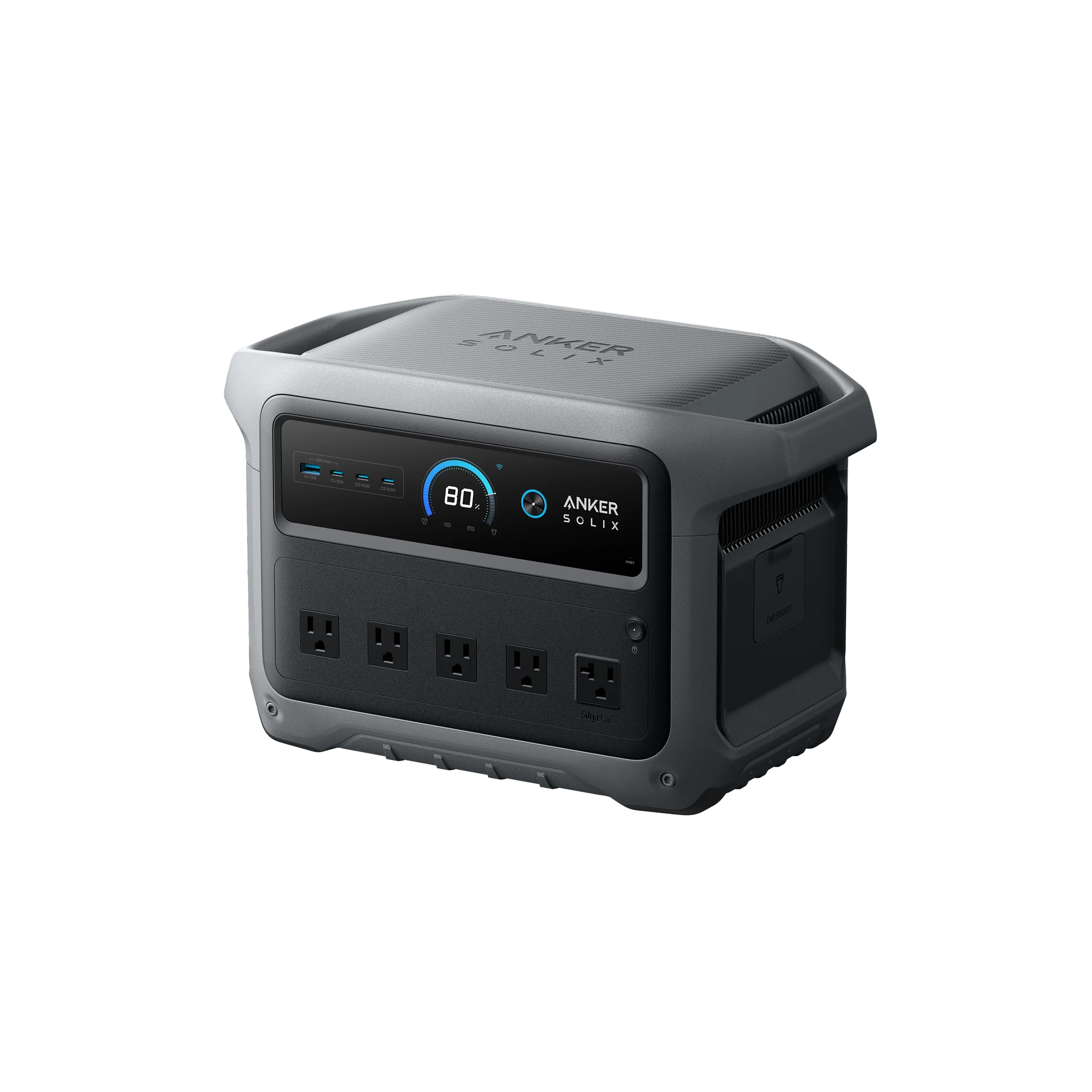
Anker SOLIX C1000 Gen 2Pick
$549.99
$549.99 · direct from Anker
Last checked 16 days ago. Prices move — check before you buy.

Anker SOLIX C800X
$449.99
$449.99 · direct from Anker
Last checked 16 days ago. Prices move — check before you buy.
Prices may vary by retailer and are subject to change.