Head-to-head test
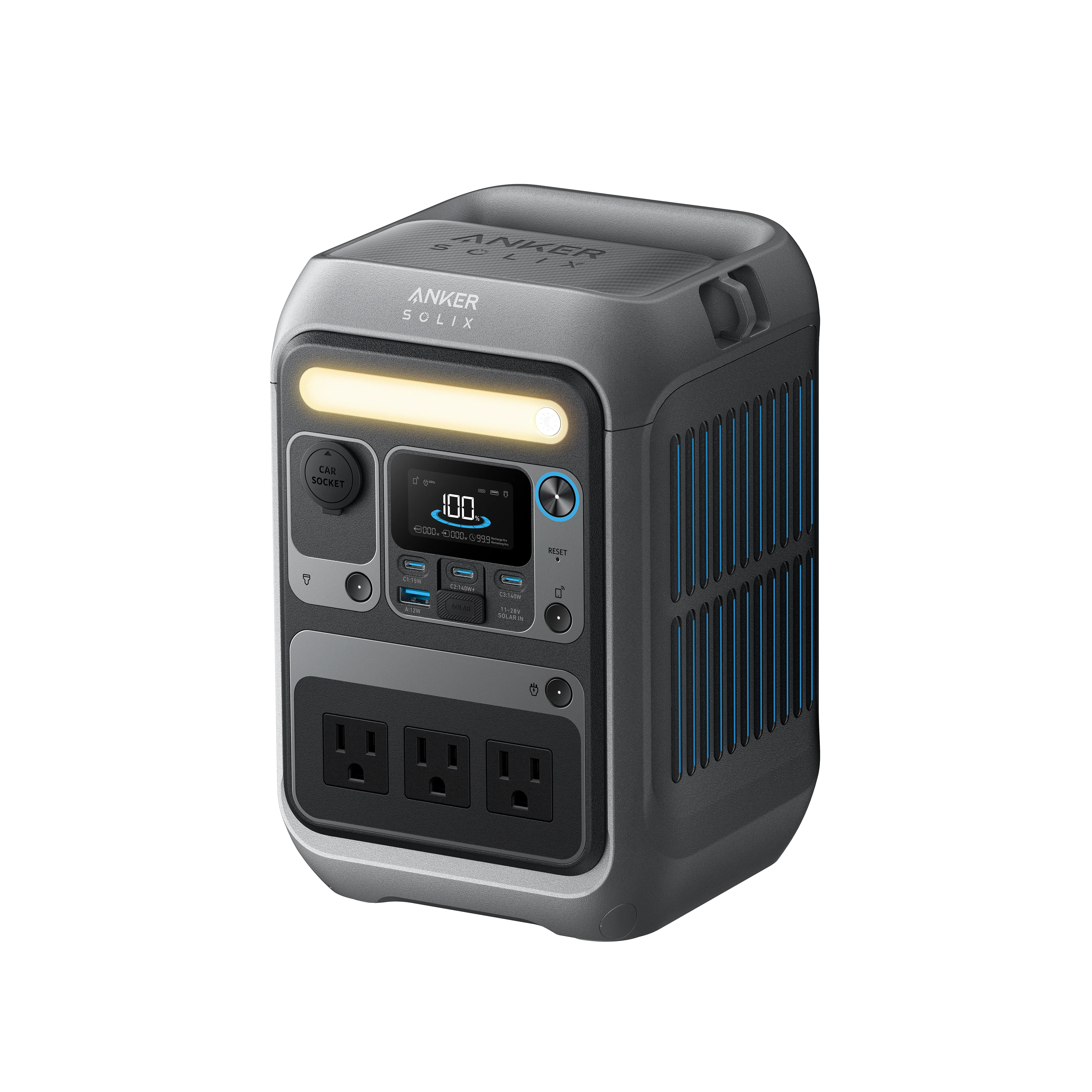
Anker SOLIX C300 vs Jackery Explorer 300
Two 300W boxes holding the same energy, and the split is time: the Jackery's cells are rated out around two years of daily use, the Anker's are still working at eight.
Full profiles: Anker SOLIX C300 → · Jackery Explorer 300 →

Written by Wenny ZhengUpdated
Portable Power Tester, Station Arena Test Desk
$329.99 · direct from Anker
Last checked 1 day ago. Prices move — check before you buy.

$289.00 · direct from Jackery
Last checked 1 day ago. Prices move — check before you buy.
Spec deltas
Twenty-one dollars separates these two, and the Anker SOLIX C300 is the expensive one. Buy it anyway. The Explorer 300's pack is rated for 800 charge cycles against the C300's 3,000, so once you spread each price across the energy the battery will actually deliver before it's done, the cheap box becomes the costly one. The Anker's energy works out to $0.35 per lifetime kilowatt-hour. The Jackery's costs $1.19. Read that once and you won't need it again.
Everything else about them is close to a copy. Both put out 300W of AC, both take 100W of solar, and the capacity gap is 288Wh against 293Wh, five watt-hours you will never once notice. Where they separate is what Anker built around the battery: 140W of USB-C to the Jackery's 60W, a 10ms UPS switchover the Explorer doesn't have, five years of warranty against two, and a fan you can sleep next to.
One warning before either. These are small. Every one of the six load models on this page comes back neither, including the CPAP night, which asks for 320Wh from packs holding 288Wh and 293Wh. If you arrived here planning to ride out a blackout or keep a fridge cold, both of these are the wrong size, and no amount of picking between them fixes that.
What the Numbers Reveal
Each conclusion stated first — the numbers behind it on one line, the full analysis below.
rated cycles
To pull the Anker's lifetime energy out of Explorer 300s you'd buy close to four of them (864 divided by 234 is 3.7), at $259 each time. The $71 you saved at checkout is the smallest number in this comparison, and it's the only one pointing the other way.
Anker SOLIX C300: 288Wh, rated 3,000 cyclesJackery Explorer 300: 293Wh, rated 800 cyclesC300 costs $330, Explorer 300 costs $259
Why it mattersIf this gets used most weeks rather than a few times a year, the Jackery is the more expensive purchase, whatever the tag says.
The Anker's warranty runs out with more than three years of rated cycle life still in the pack, which is the shape a warranty is supposed to have. Per covered year that's $60 against $140, and the cheaper one is the one that keeps going after coverage ends.
Explorer 300: 800 cycles, which is 2.2 years at daily use, with a 2-year warrantyC300: 3,000 cycles, which is 8.2 years at daily use, with a 5-year warrantyPrice spread across covered years: $60 a year for the Anker, $140 a year for the Jackery
Why it mattersIf the warranty is part of why you're buying, the Jackery's is the one that expires exactly when you'd need it.
weight
So the two pounds you save carrying the Jackery get repaid in hours of sitting next to it. That's a fine trade for a unit that lives in a pack and rarely comes out, and a bad one for a unit that lives on a table with a laptop plugged into it.
C300 tops out at 140W over USB-C; Explorer 300 tops out at 60WExplorer 300 weighs 7.1 lb; C300 weighs 9.1 lbBoth hold roughly the same energy: 288Wh and 293Wh
Why it mattersCount ounces and take the Explorer. Charge real gear off it and the two pounds are the cheapest thing you'll pay.
Capacity
What a 10ms switchover is worth on a 288Wh box is a desk, not a bedroom. It keeps a router, a modem and a laptop from rebooting when the lights blink, and reviewers are right that it's rare at this size and priceA3. Judge it as medical backup and both units fail the same test by the same margin.
C300 switches over in 10ms; the Explorer 300 has no UPS modeC300 fan rated 25 dBA; Explorer 300 rated 36 dBAThe CPAP Overnight model asks 320Wh; the C300 holds 288Wh and the Explorer 293Wh
Why it mattersCPAP shoppers should close this page and shop a size up. Home-office buyers should note that only one of these keeps the desk alive.
The specific dimensions that decide these two units — everything else is a tie.
Lifetime Value
Selected because: One of these delivers 864 kWh over its rated life and the other 234 kWh, which is what the $71 price gap is really buying.
cost / lifetime kWh
Cycle ratings are the one spec you can't feel on day one, which is exactly why they're worth reading before you pay. Charge either unit every day and the Explorer reaches its rated end a bit past the two-year mark while the C300 is still working deep into year eight. That's the same money buying two very different amounts of time.
The fair counter is duty cycle. Used on weekends only, the Explorer's clock stretches to 7.7 years, which is the better part of a decade of camping trips and an honest answer for a lot of buyers. The Anker's weekend figure runs past 28 years, at which point the number stops meaning anything and just tells you the cells will outlast your interest in owning it. The gap only turns punishing when the unit gets used like an appliance instead of like gear.
Your Life, Your Pick
Selected because: All six load models come back neither, so the first question isn't which unit wins but whether either one is the size you need.
Six load models, six neither results, and the closest one still doesn't land: the CPAP night wants 320Wh from packs under 300Wh, before the inverter takes its cut. Read that as the boundary of the category rather than a knock on either unit. Both are built to keep phones, laptops, cameras, lights and a fan going, and both do that job well.
The tailgate model is the one worth a second look, because it's the only load here where neither unit can meet the peak draw, never mind the total. Everywhere else you at least get a useful partial day. On a tailgate load you plug something in and it simply refuses to start, which is a different and more annoying kind of failure than running out at hour six.
What the Specs Don't Tell You
Selected because: Five spec cards fire on this pair and all five lean the same way, which matters more than any single one of them.
rated cycles
Five cards fire on this pair and every one leans the same way: surge headroom, switchover, USB-C speed, warranty length, fan noise. The C300 takes all five, and only the last is a surprise. It's rated 25 dBA against the Explorer's 36, which is the distance between a unit you forget is running and one you keep hearing.
The card that flatters the Anker more than it deserves is app control. The Explorer 300 doesn't have an app, and that's logged as a real difference, but look at what's missing. Jackery's app runs 2.3 to 3.3 out of 5 across iOS and Android, split across two confusing apps, and it demands a login even when you're standing next to the hardware. Anker's sits at 4.5 on iOS. Losing the Jackery app is close to a rounding error, and if app control is the reason you're leaning Anker, lean on one of the other four instead.
Portability & Form Factor
Selected because: Two pounds is the Explorer 300's only win, 7.1 lb against 9.1 lb, and for some buyers it's the one that counts.
weight
Two pounds sounds like nothing until it's the difference between a battery you throw in a daypack and one you plan around. 7.1 lb against 9.1 lb is roughly a fifth of the Anker's weight gone, and if the job is a hike where the unit charges phones and a headlamp, the Explorer is the correct answer and you should take it without guilt.
The catch is what you're comparing against. Reviewers who've handled the C300 call it impressively light and compact for what it holds, and Anker claims it's 30% smaller than competing stationsA2. So this isn't heavy against light. It's light against slightly lighter, and the slightly lighter one pays for those two pounds with the cycle life, the ports, the warranty and the switchover.
Strengths & trade-offs
Anker SOLIX C300
Strengths
- +Longer warranty
- +Rated for 3,000 charge cycles — much longer battery lifespan
Trade-offs
- –No major technical downsides compared to rival.
Jackery Explorer 300
Strengths
- +Costs $71 less
- +Lighter by 2 lb
- +Larger battery capacity
Trade-offs
- –Lacks smartphone app control for remote monitoring.
- –Shorter-lived battery — rated for 800 charge cycles vs the SOLIX C300's 3,000, so it wears out sooner.
Will It Power Your Gear?
Scenario math and per-appliance runtimes, modeled from the spec record.
Scenario verdicts
We ran the math on seven real-world scenarios. Here's which unit survives your actual life.
SCN-01 · 2 nights · needs 2,100Wh
Weekend Camping
Two nights off-grid with essential comfort
Neither unit
Neither, and the model is why. A 2,100Wh weekend assumes a fridge and real appliances, which is not the job of a 300W box. Scale the load down to phones, lights, a fan and a speaker and you're inside what a 288Wh or 293Wh pack does comfortably. Scale it up to a compressor cooler running Friday to Sunday and neither one finishes Saturday.
Battery budget usedlower = more headroom
LOAD Phone Charger 15W×6h · LED Lights 40W×8h · Box Fan 75W×14h · CPAP Machine 40W×16h
SCN-02 · 8 hours · needs 1,645Wh
8-Hour Blackout
Keep the essentials running through a night without power
Neither unit
Neither, by a wide margin. The model wants 1,645Wh, more than five times what either pack holds, so the useful question isn't which unit lasts longer but what you'd actually plug in. Both will keep a router, a laptop and phones alive through the evening. Neither goes near a fridge for eight hours.
Battery budget usedlower = more headroom
LOAD Fridge 150W×8h · Router + Modem 20W×8h · LED Lights (4 bulbs) 40W×6h · Phone Charger 15W×3h
SCN-03 · 8 hours · needs 320Wh
CPAP Overnight
Sleep therapy without interruption — the #1 medical use case
Neither unit
The closest either gets, and it still falls short: the night is modeled at 320Wh against packs of 288Wh and 293Wh. This is the most frustrating neither on the page, because the C300's quiet fan and 10ms switchover are precisely the specs a bedside unit wants and the capacity isn't there to use them. Buy a size up rather than gambling on a margin this thin.
Battery budget usedlower = more headroom
LOAD CPAP Machine 40W×8h
SCN-04 · 8 hours · needs 910Wh
Remote Workday
Full work day off-grid without power anxiety
Neither unit
Neither unit covers this scenario's 910Wh: the SOLIX C300 comes up 665Wh short (about 27% covered), the Explorer 300 661Wh (27%). Treat this as partial cover — enough for the essentials in it, not the whole list.
Battery budget usedlower = more headroom
LOAD Laptop 60W×8h · External Monitor 30W×8h · Router + Modem 20W×8h · Phone Charger 15W×2h
SCN-05 · 4 hours · needs 670Wh
Tailgate Party
Game day power for the crew
Neither unit
Neither, and this is the only load here where neither unit can meet the peak draw, not just the total. A 670Wh afternoon against packs under 300Wh was never going to finish, but the peak is what bites first: the C300's 600W surge and the Explorer's 500W both come up short, so the appliance says no at the moment you plug it in rather than four hours later.
Battery budget usedlower = more headroom
LOAD Blender 400W×0.5h · LED TV (55") 80W×4h · Bluetooth Speaker 15W×4h · Phone Charger (×3) 45W×2h
SCN-06 · 24 hours · needs 4,685Wh
Van Life Daily
A full day of mobile living — the ultimate endurance test
Neither unit
Neither unit covers this scenario's 4,685Wh: the SOLIX C300 comes up 4,440Wh short (about 5% covered), the Explorer 300 4,436Wh (5%). This is well outside what either unit is for; the right answer here is a larger station, not a choice between these two.
Battery budget usedlower = more headroom
LOAD Mini-Fridge 150W×24h · Laptop 60W×4h · Phone Charger 15W×3h · LED Lights 40W×5h · Fan 75W×8h
SCN-07 · an afternoon · needs 100Wh
Afternoon Off-Grid
Phones and a speaker at the park, beach, or campsite — the small-unit job description
Either unit
This is the job small stations are actually for, and both do it: the SOLIX C300 finishes at 41% used, the Explorer 300 at 40%. At this size the decider is what rides in the bag — 7.1 lbs for the Explorer 300 against 9.1 for the SOLIX C300 — and price, not the leftover watt-hours.
Battery budget usedlower = more headroom
LOAD Phone Charger (×2) 30W×2h · Bluetooth Speaker 10W×4h
The Load Test
RUNTIME = (Wh × 0.85) ÷ LOAD
None of the scenarios above exactly yours? Build it. Toggle what you'd plug in; both units are tested against the combined draw.
Essentials
Comfort & Convenience
High-Draw Appliances
Test duration
8h
Continuous draw
205W
Projected runtime
Dead heat — both run this 205W load for roughly 1.2h. Pick on price, weight, or ports.
Modeled from the spec record — same math as the tables below. Methodology
Runtime by appliance
Real-world runtime estimates for common appliances, modeled at 85% inverter efficiency.¹
Essentials
The basics you need runningscale 0–16.6hComfort & Convenience
Makes off-grid life actually enjoyablescale 0–3.3hHigh-Draw Appliances
These reveal the real limits¹ Runtime = (capacity × 0.85) ÷ appliance watts. Within each group, all bars share one time scale (the group's longest runtime), so lengths are comparable across appliances; identical runtimes collapse into a single blue/orange bar. Actual runtime varies with battery age, temperature, and simultaneous loads — see methodology.
Conclusion
August 9, 2026
Verdict: the Anker SOLIX C300
Buy the Anker SOLIX C300. It asks $330 against the Explorer 300's $259, and the $71 buys a pack rated for 3,000 charge cycles instead of 800, five years of warranty instead of two, more than twice the USB-C throughput, a 10ms switchover the Jackery doesn't offer at all, and a quieter fan. Capacity is a wash at 288Wh against 293Wh, so none of those wins are being traded for energy. The Explorer takes exactly one card, and it's a real one: 7.1 lb against 9.1 lb. If this unit lives in a backpack and comes out a few times a year, that two pounds is worth more to you than a cycle rating you'll never approach, and you should save the money. If it lives on a desk or gets used most weeks, the Anker is the cheaper of the two and it isn't close.
Editor-assigned confidence, based on cited owner research and spec analysis.
List prices as of August 9, 2026. The links below open Anker's and Jackery's current prices.
$329.99 · direct from Anker
Last checked 1 day ago. Prices move — check before you buy.
or check the Explorer 300 price$289.00 list
Written by Wenny Zheng, Portable Power Tester · Station Arena Test Desk · Updated August 9, 2026
Measured Data
Benchmark scores and the full spec record, side by side.
Benchmark scores
Not rated for both units (minimum threshold unmet): UPS, CPAP.
Full specifications
ᵈ Derived: price ÷ rated capacity. See the data behind our comparisons →
Comparison ToolAdd more power stations, side by sideOpen Tool →How these numbers are produced
Numeric verification
Every figure on this page traces to our spec database or arithmetic on it — no estimated numbers.
Owner claims
Statements about owner experience are cited to published reviews — see Sources & Research Notes below.
Runtime model
Runtime = (rated capacity × 0.85 inverter efficiency) ÷ device wattage. Solar recharge estimates assume panels deliver 70% of rated output. Cold weather, battery age, and stacked loads reduce real-world results.
Power Score
Computed from 14 published spec dimensions, weighted per use-case bench. Higher is better; a unit must meet a bench's minimum threshold to be rated.
See the full weight table and data sourcing on our methodology page →Class ranking (the star rating)
Each unit's star score is a category ranking, not customer reviews — no buyer opinions feed it. We score every station on size-independent quality (value, output, portability, endurance, ports, warranty, and more), then percentile-rank it against the other units in its capacity class, so a class-leading compact unit and a class-leading whole-home unit can both earn 5★. Here, SOLIX C300 rates 4.2/5 (52nd percentile of 22 Personal-class units), and Explorer 300 rates 3.6/5 (19th percentile of 22 Personal-class units).
How the class ranking is computed →Test Notes & Caveats
Hidden gotchas and advantages we spotted that you won't find on the product page.
The app the Explorer doesn't have
The Explorer 300 has no app control and the C300 does, so check what you're actually missing before you weight this card. Jackery's app runs 2.3 to 3.3 out of 5 across iOS and Android, spread over two separate apps, with a mandatory login even when the unit is an arm's length away. Anker's sits at 4.5 on iOS. This is a card the C300 wins more convincingly on paper than in your hands.
600W of surge, and what it still won't start
The C300 doubles its 300W rating to 600W on surge where the Explorer stretches to 500W, and that headroom is often the difference between a motor starting and a motor clicking. Worth saying before this flatters our pick: on the tailgate load elsewhere on this page, neither unit's peak clears the draw. Surge sorts these two against each other. It doesn't move either into appliance territory.
Ten milliseconds, on a 288Wh box
The C300 catches a cut in 10ms and the Explorer 300 doesn't catch it at all, which is a genuine difference and a smaller one than it sounds. On a pack this size, UPS means your desktop, router and modem don't reboot when the lights blink. It does not mean the desk survives anything you'd call an outage. Buy it for the flicker, not the storm.
Warranty: 5 Years vs 2
The SOLIX C300 is covered for 5 years against the Explorer 300's 2 years. An underrated factor if you're keeping this unit for years.
800 cycles is a calendar, not a number
Charge the Explorer 300 every day and its rated life runs out a little past two years. Charge the C300 the same way and you're into year eight. Weekend-only use softens this a lot, taking the Jackery to 7.7 years, which is a real answer for gear that lives in a closet. Daily use is where the two price tags stop meaning what they say.
Full record above — the Test Desk pick is the SOLIX C300.
Check SOLIX C300 price →or check the Explorer 300 priceOwnership Analysis
What happens after you buy — true cost of ownership, brand trust, and growth potential.
Lifetime value
Service lifeyears at one full cycle per day
Lifetime energy delivered
Cost per delivered kWh
│ warranty ends · Reaching the cycle rating means ~80% capacity remains — degraded, not dead.
Analyst note
The Explorer 300 is cheaper to buy, but the SOLIX C300 is cheaper to own. At $0.38/kWh over its lifetime vs $1.1/kWh, the SOLIX C300's higher cycle life and capacity make each dollar go further over the years.
Delivers each lifetime kWh for $0.72 less — check the SOLIX C300 price →
Brand trust
Anker
Ecosystem
7-8 SOLIX portable power stations across C-series (compact) and F-series (flagship), plus the X1 home energy system
Support
US-based, and Anker's long record of no-hassle replacements is doing some of the work here. Recent SOLIX-specific service trends the other way: AI-first agents returning generic answers, and return logistics that get complicated on heavy units. At 9.1 lb, at least that last problem isn't yours.
Community
Moderate — active Reddit (r/Anker, r/AnkerSOLIXCommunity) and growing. Benefits from Anker's massive consumer electronics brand awareness.
App experience
Rated 4.5/5 iOS (~1,100 ratings) · 4.3/5 Android
Unique strength
Parent brand trust from Anker's consumer electronics dominance. InfiniPower technology for long cycle life. Strong $/Wh value in the mid-size and larger units — the S2000, F2600 and C1000 are among the better buys per watt-hour in the catalog.
Worth knowing
Firmware updates have removed features without warning before, and the expansion ecosystem is narrower than EcoFlow's. Neither lands hard on a sealed 288Wh unit that was never going to expand.
Jackery
Ecosystem
12-15+ models across Explorer (portable) and HomePower (home backup) series, plus SolarSaga panel ecosystem and innovative form factors
Support
The weak point of an otherwise strong brand. Scripted agents, strict receipt requirements on warranty claims, and refurbished units offered in place of clearly defective ones. The practical workaround is the buying channel rather than the phone line.
Community
Smallest community of the major brands — Reddit r/Jackery has ~2,000 members. YouTube presence is solid due to brand recognition.
App experience
Rated 2.3-3.3/5 iOS and Android — the weakest app experience of the major brands. Multiple confusing apps (Jackery app vs Jackery Home) and mandatory login even offline.
Unique strength
The widest retail distribution in the category, and it's worth more than it sounds. Costco, Home Depot, Best Buy and Amazon all carry Jackery, so if something goes wrong the fix is a drive rather than a claim. Buy it from one of them.
Worth knowing
A couple of older models still ship NMC chemistry with a shorter rated lifespan, so check the cycle rating on the specific unit — though most of the current line has moved to LFP. Generally perceived as overpriced for the specs offered compared to newer competitors. App experience is significantly behind rivals.
Analyst note
Five years of coverage against two, and that's before you weigh which claims line you'd rather be standing in. Anker's service is sliding from an excellent starting point while Jackery's starts lower and leans on retail to catch the difference. Neither brand's support is a reason to buy on its own, but if you take the Explorer, take it from a store whose return policy you'd actually be happy to use.
Growth path
SOLIX C300
FIXED CAPACITYFixed at 288Wh, with no expansion — so size it for your needs up front rather than planning to add capacity later.
Accepts up to 100W of solar. Limited to a single portable panel.
Adequate ports for most setups, but heavy users may want a power strip.
Explorer 300
FIXED CAPACITYFixed at 293Wh, with no expansion — so size it for your needs up front rather than planning to add capacity later.
Accepts up to 100W of solar. Limited to a single portable panel.
Limited ports. You'll likely need a power strip or splitter.
Realistic full solar rechargeat 70% of rated panel output — see methodology
Analyst note
Neither expands, and that's no knock on either — each is a complete unit at a fixed size. Buy the capacity that covers your needs now (the Explorer 300 gives you the larger ceiling); you can't add to either later.
What Owners Report
Patterns from published owner reports and long-term reviews — every claim cited to its source below.
Anker SOLIX C300
Field coverage on the C300 leans on reviewers rather than long-term ownersA1A4, and it converges on two things. The first is size for capacity: write-ups call it light and compact for what it holds, aimed at people keeping phones and gadgets alive on hikes and camping tripsA2. The second is the switchover, described as legitimately unique in this size and price classA3.
The rest of the record is specification-level rather than experiential: 288Wh, 300W with a 600W SurgePad boost, dual 140W USB-C portsA1, pitched at buyers who want reliability and smart features in something smallA4. Nobody in this record has owned one long enough to tell you how it ages, which is the one thing a 3,000-cycle rating asks you to take on faith.
“288Wh capacity with 300W output (600W with SurgePad) and dual 140W USB-C ports for fast device charging.”
Sources
ankersolix.com · trustedreviews.com · im.com.au · solarwaypoint.com · backuppowerhub.com · powerstationlab.com
Jackery Explorer 300
What exists on the Explorer 300 is two owner accounts, both positive, both describing the same kind of useB3B4. One ran phones, a speaker, a fan and an air mattress through a camping trip and called it easy to use, light and quietB3. Another topped up several devices daily and ran small loads for about two weeks before the charge finally got lowB4.
That's the whole field record: no failures, no complaints, and nothing that runs long enough to put the 800-cycle rating under any pressureB3B4. Both accounts describe a unit doing exactly what a 293Wh pack should do on a tripB3B4, which is useful confirmation and not evidence about year three.
“288Wh capacity with 300W output on LiFePO4 chemistry rated for 3,000+ cycles — over a decade of daily use, a major upgrade from the older lithium-ion Explorer 300 (500 cycles).”
Sources
powerstationlab.com · batteryskills.com · voltagebasics.com · rv.com · bestbuy.com
Sources & Research Notes
Every owner claim in this report is traceable to a published source. The bracketed references above resolve here.
Recurring owner themes
- Compact, light design; dual 140W USB-C fast charging; and a standout 10ms UPS rare at this size are the highlights. [SOLIX C300 · 3 entries]
- Light weight, LFP 3,000-cycle longevity, quiet operation, and easy portability are the consistent praise for this small unit. [Explorer 300 · 3 entries]
- A1
“288Wh capacity with 300W output (600W with SurgePad) and dual 140W USB-C ports for fast device charging.”
ankersolix.com / trustedreviews.com — SOLIX C300 review · 2026 · [positive]
- A2
“Anker claims the C300 is 30% smaller than competing power stations; reviewers call it impressively light and compact for the capacity, aimed at keeping phones and gadgets charged on hikes and camping trips.”
im.com.au / solarwaypoint.com — SOLIX C300 review · 2026 · [positive]
- A3
“Its 10ms UPS switchover is legitimately unique in this size and price class.”
backuppowerhub.com / powerstationlab.com — SOLIX C300 review · 2026 · [positive]
- A4
“Targets users who value reliability, smart features, and compact design.”
backuppowerhub.com — SOLIX C300 review · 2026 · [positive]
- B3
“One owner powered phones, a speaker, a fan, and an air mattress on a camping trip with no issues, calling it super easy to use, lightweight, and quiet.”
bestbuy.com owner reviews — Explorer 300 Plus · 2026 · [positive]
- B4
“Another owner recharged multiple electronics daily and ran small-wattage devices for about two weeks before reaching a low charge.”
bestbuy.com owner reviews — Explorer 300 Plus · 2026 · [positive]
Research compiled August 9, 2026.
What Owners Actually Report
Drawn from 33 comments on independent review channels — not from retailer reviews, which skew to the first week of ownership. Each line is our summary of one commenter's claim, linked to the original. We record what they said, including where it contradicts the spec sheet.
Anker SOLIX C300
14 claims from 11 comments · 9 from owners · 2 with figures
- Build quality
- 2 · 55% negative
- Other
- 3 · 0% negative
- Size & weight
- 2 · 21% negative
- Solar input
- 3 · 14% negative
- Durability
- 1 · 0% negative
What owners complain about
Returned it: temps hit 52C and above when recharging at 300-330W, with a terrible burning plastic smell.
Build qualitymeasuredowner5 agreedsource →
A 300W inverter cannot start a fridge or drive a drill, where a 600W unit can.
Inverter & surgesource →
Calls the tall tower form factor nonsense in a car camper where a flat, stable unit is needed.
Size & weightsource →
What owners praise
Prefers the Ankers for portable use in the car or beside a chair.
Size & weightowner34 agreedsource →
Better AC outlet spacing, more USB-C ports and a light; bought two after the EcoFlow issue.
Build qualityowner4 agreedsource →
Uses two Anker 300W stations to power video lights on film shoots instead of costly V-mount batteries.
Otherowner1 agreedsource →
Jackery Explorer 300
29 claims from 22 comments · 20 from owners · 6 with figures
- Runtime
- 9 · 36% negative
- Solar input
- 3 · 0% negative
- Price & value
- 5 · 94% negative
- Durability
- 3 · 8% negative
- Other
- 3 · 53% negative
What owners complain about
Plans to return the day-old Jackery 300 after seeing the EB3A review.
Price & valueowner8 agreedsource →
Metered 235Wh delivered against an advertised 288Wh, about 80% usable.
Runtimemeasuredowner1 agreedsource →
Returning the Jackery 300 bought to run a compressor fridge and ordered an EB3A.
Otherowner2 agreedsource →
What owners praise
Fully charges in 3 hours from a 100W panel in full sunshine.
Solar inputmeasuredowner43 agreedsource →
Has been great for about 3 years and performs better than the budget rival tested in the video.
Durabilitymeasuredownerafter 36 months6 agreedsource →
Enough to run a lamp and a few small items where there is no grid wiring.
Runtimeowner43 agreedsource →
Claims are weighted by how specific they are, whether the commenter owns the unit, and how many readers agreed. Comments that mention a product under a rival's review count for more, because the commenter had no reason to be there. This is what buyers report, not our test results — for measurements we ran ourselves, see the methodology.
Who Should Buy Which
Buy the SOLIX C300 if you…
- →The unit lives under your desk. It keeps the router, the modem and the laptop from rebooting when the power blinks, and it's topping something up most days of the year.
- →You're charging real gear on trips. Camera batteries, a drone, a laptop between shoots. 140W over USB-C decides how long you sit next to it, and the Jackery's 60W roughly doubles that wait.
- →You want this to be the last small station you buy. 3,000 cycles is 8.2 years of daily use, and the five-year warranty covers the first stretch of it.
- →You'll sleep in the same room as it. 25 dBA is the reason, and the Explorer's 36 dBA is the reason you'd regret the other one.
Buy the Explorer 300 if you…
- →It goes in a backpack and comes out four or five times a year. At that pace the 800-cycle rating is 7.7 years away and the two pounds are the only spec you'll ever notice.
- →You want the cheapest working 300W station and you're buying it somewhere with a real return desk. Jackery's retail spread is the practical version of a warranty here.
- →Your loads are phones, lights, a speaker and a fan, you're not charging a laptop off it, and you'd rather keep the $71.
If neither fits
Anyone here to keep a fridge cold, get through an eight-hour outage, or run a CPAP until morning. All six load models come back neither, and the shortfalls aren't marginal: the blackout model alone wants 1,645Wh, more than five times what either pack holds, and the tailgate load defeats both inverters at the moment you plug in. If that's your list, the choice between these two is the wrong argument. Shop capacity first, buy something several times this size with real inverter headroom behind it, and treat 300W units as what they are: chargers for the things you carry, not backup for the things you plug into a wall.
The Bottom Line
Take the C300. Twenty-one dollars buys 3,000 rated cycles instead of 800, which is the difference between a unit you keep and a unit you replace, and every smaller spec on the page leans the same direction: the warranty, the ports, the surge headroom, the switchover, the fan. To get the Anker's lifetime energy out of Explorer 300s you'd buy close to four of them.
The honest exception is the person who wants the lightest thing that will charge a phone on a trail a handful of times a year. Buy the Jackery, pocket the difference, and you'll never reach the cycle limit that makes this page. Everyone else is buying a battery they intend to use, and only one of these two is built to still be there when they do.
Frequently Asked Questions
Answers drawn from the spec record and cited owner research.
Is the Anker SOLIX C300 worth $71 more than the Jackery Explorer 300?
Yes, unless weight is your deciding spec. The $71 buys 3,000 rated charge cycles instead of 800, five years of warranty instead of two, more than twice the USB-C output, and a 10ms UPS switchover the Explorer doesn't have. Capacity is effectively identical at 288Wh against 293Wh, so nothing is being traded away to get those.
Can either of these run a CPAP all night?
No. An overnight CPAP load is modeled at 320Wh and these hold 288Wh and 293Wh, before the inverter takes its share. The C300's quiet fan and instant switchover make it look like a bedside unit, but the battery isn't there. Shop the next size class up if this is the job.
Which one should I take backpacking?
The Explorer 300, at 7.1 lb against 9.1 lb. Two pounds is real when you're carrying it, and on a trip where the unit charges phones, a headlamp and a camera, none of the Anker's advantages get exercised. If you're carrying a laptop too, reconsider: the Explorer's 60W USB-C port takes nearly five hours to move 293Wh, against about two hours for the C300's 140W.
Is this the same as the Jackery Explorer 300 Plus?
No. The unit priced on this page is the original Explorer 300: 293Wh, 7.1 lb, rated to 800 cycles. The Plus is a separate, newer model with a different battery chemistry, and search results mix the two constantly. If the spec sheet in front of you says LiFePO4, you're reading about the Plus, not this.
How long will each battery actually last?
Depends entirely on how often you cycle it. Daily use puts the Explorer at 2.2 years and the C300 at 8.2. Weekend-only use stretches the Explorer to 7.7 years and the C300 to 28.8, at which point the rating is academic. The daily number is the one that separates them, and it's the one to read if this unit is going to live on a desk.
Where to buy
Anker SOLIX C300Pick
$329.99
$329.99 · direct from Anker
Last checked 1 day ago. Prices move — check before you buy.
Jackery Explorer 300
$289.00
$289.00 · direct from Jackery
Last checked 1 day ago. Prices move — check before you buy.
Prices may vary by retailer and are subject to change.