Head-to-head test
Anker SOLIX C2000 Gen 2 vs Jackery Explorer 1000 v2
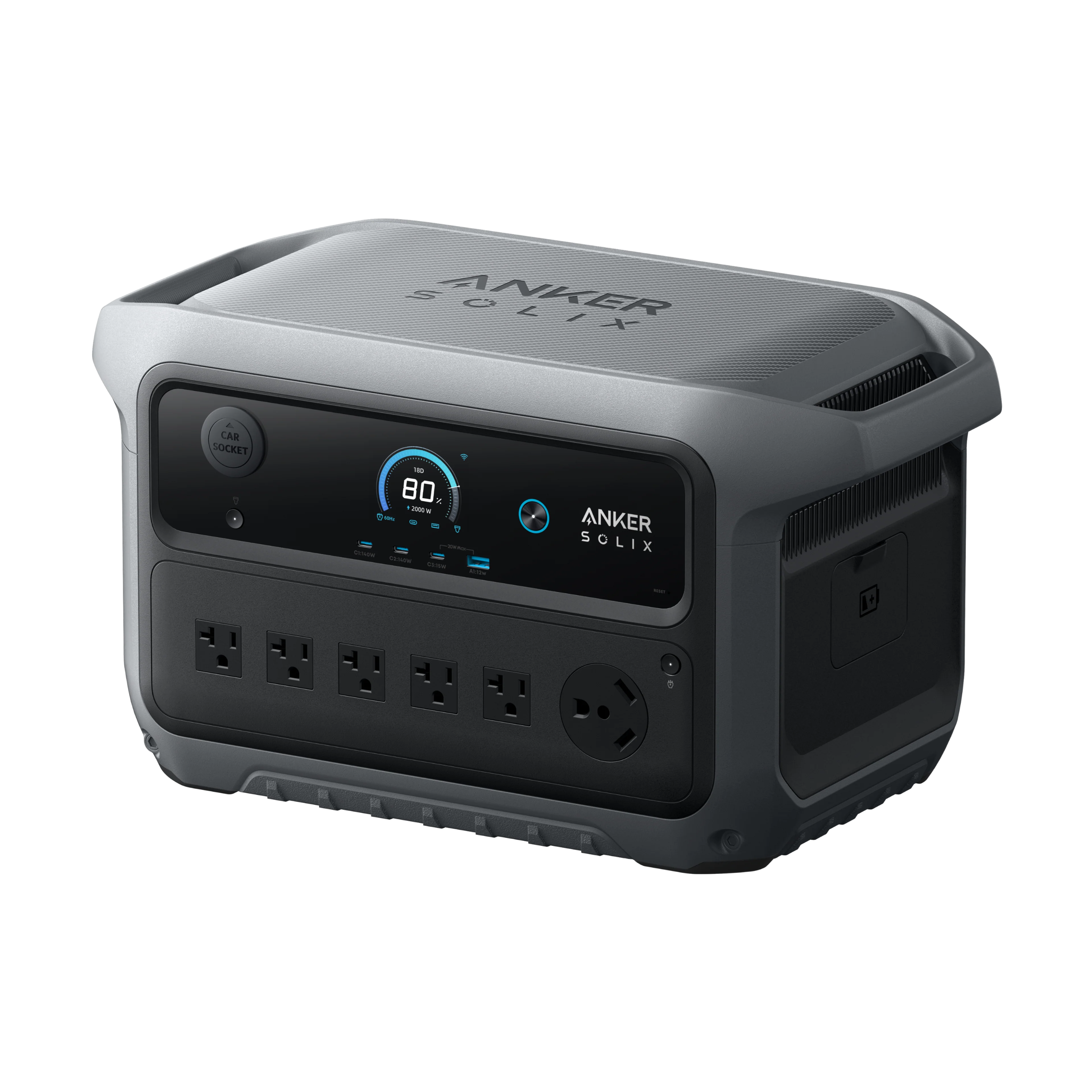
The C2000 Gen 2 and the Explorer 1000 v2 cost almost identically per lifetime kilowatt-hour, so the gap between them isn't a rip-off. It's a bet on whether you need 978 more watt-hours than the cheaper box holds.
Full profiles: Anker SOLIX C2000 Gen 2 → · Jackery Explorer 1000 v2 →

Written by Ian SchneiderUpdated
Solar & Off-Grid Tester, Station Arena Test Desk
$999.99 · direct from Anker
Last checked 1 day ago. Prices move — check before you buy.

$559.00 · direct from Jackery
Last checked 1 day ago. Prices move — check before you buy.
Spec deltas
The Anker SOLIX C2000 Gen 2 and the Jackery Explorer 1000 v2 cost almost exactly the same per lifetime kilowatt-hour, $0.12 either way, so the roughly $500 gap between them isn't about getting the better deal. It's about how much capacity you actually need. At $1,000, the C2000 Gen 2 holds 2,048Wh and puts out 2,400W continuous. At $499, the Explorer 1000 v2 holds 1,070Wh and puts out 1,500W. Nearly double the capacity, at nearly double the price.
Run six real-world scenarios and the C2000 Gen 2 wins four outright: 8-Hour Blackout, Remote Workday, CPAP Overnight, and Tailgate Party. The Explorer 1000 v2 doesn't fail the last two; it comfortably covers a CPAP and a tailgate. It just finishes both with less room to spare than the C2000 Gen 2 does. Neither unit covers a full Weekend Camping trip or a Van Life Daily load; those need more battery than either box holds.
So: big load, C2000 Gen 2. Small load, Explorer 1000 v2. Buy the C2000 Gen 2 when the need is real, an outage, a full workday, anything past what a CPAP or a tailgate asks for. Buy the Explorer 1000 v2 when it isn't; it does the smaller jobs at half the price and meaningfully less to lift. And if your target looks like Van Life Daily, keep shopping: at 4,685Wh needed, that load is past what either box holds.
What the Numbers Reveal
Each conclusion stated first — the numbers behind it on one line, the full analysis below.
Capacity
That makes the spec engine's 'cheaper to own' tag on the C2000 Gen 2 a rounding coin flip, not a real advantage. The actual decision is whether 8,192 lifetime kWh of capacity is worth having over 4,280, priced identically either way.
C2000 Gen 2 costs $1,000 for 8,192 lifetime kWh (2,048Wh x 4,000 cycles)Explorer 1000 v2 costs $499 for 4,280 lifetime kWh (1,070Wh x 4,000 cycles)Both compute to $0.12 per lifetime kilowatt-hour
Why it mattersStop shopping this pair on cost per kilowatt-hour. It's tied. Shop it on how many watt-hours your worst realistic day needs.
weight
The Explorer 1000 v2 stays 17.9 lbs lighter because it has nowhere to grow. These aren't just priced differently, they're built on opposite bets about whether you'd rather carry more capacity now or add it later at a weight cost.
C2000 Gen 2 weighs 41.7 lbs and can add Anker expansion batteries beyond its 2,048Wh baseExplorer 1000 v2 weighs 23.8 lbs and is fixed at 1,070Wh with no expansion path17.9 lbs separates the two before any expansion battery is added
Why it mattersAnyone hauling this to a truck or a tailgate regularly, rather than parking it for outages, should weigh 17.9 lbs as seriously as the capacity gap. Expansion capacity you never carry along isn't really available to you.
solar input
Where they actually diverge is wall power. The Explorer 1000 v2's quick AC rechargeB3 gets a depleted unit back in action fast, which matters more than solar speed during an outage where grid power is flickering, not absent for days.
C2000 Gen 2 accepts up to 800W of solar for 2,048Wh of capacityExplorer 1000 v2 accepts up to 400W of solar for 1,070Wh of capacityReviewers single out the Explorer 1000 v2's fast AC recharge through its app's emergency-charge modeB3
Why it mattersIf your outage plan leans on bridging short grid flickers rather than sustained off-grid solar, the Explorer 1000 v2's fast AC rechargeB3 closes some of the gap the watt-hour numbers alone suggest.
For a CPAP a couple feet from the unit all night, the deciding spec is fan behavior at low load, not headroom neither unit is stressing. The C2000 Gen 2 is the one reviewers single out for staying quiet even under full powerA1, a harder test than the light draw a CPAP asks for.
CPAP Overnight needs 320Wh, using 18% of the C2000 Gen 2's capacity and 35% of the Explorer 1000 v2'sBoth units carry the same 30 dBA noise rating on specReviewers describe the C2000 Gen 2's fans staying a subdued, easily-backgrounded whirr even at full powerA1
Why it mattersA buyer whose only real load is a CPAP has no capacity reason to pay nearly double for the C2000 Gen 2. The honest tiebreaker there is whether the quieter reputationA1 is worth the price gap on its own.
The specific dimensions that decide these two units — everything else is a tie.
Your Life, Your Pick
Selected because: p1 wins 4 of 6 scenarios outright and p2 wins none outright, the clearest decision-relevant signal in the pair.
Run the six real scenarios and a pattern falls out fast. The C2000 Gen 2 wins four outright, the Explorer 1000 v2 wins none outright, and the two nobody wins, Weekend Camping and Van Life Daily, need more battery than either box holds. The gap shows up hardest on the 8-Hour Blackout: the C2000 Gen 2 covers it using 94% of its capacity, cutting it close but real, while the Explorer 1000 v2 needs 181% of what it has and runs out partway through the night. On the Remote Workday, the Explorer 1000 v2 runs out again before the day ends, while the C2000 Gen 2 finishes with about half its charge, 52% used, still in reserve.
The two scenarios where the Explorer 1000 v2 holds its own, CPAP Overnight and Tailgate Party, are also the two lightest loads on the list (320Wh and 670Wh), the ones where extra capacity was never going to matter. That record lines up with the raw PowerScore too: 4,157 for the C2000 Gen 2 against 3,084 for the Explorer 1000 v2. Buy the Explorer 1000 v2 for loads that stay small, and the C2000 Gen 2 for anything that might not.
Lifetime Value
Selected because: cheaperToOwn flags p1 but the two cost-per-lifetime-kWh figures are literally tied at 0.12, needs honest unpacking so we don't oversell it.
Run both units to the end of their rated cycle life and they land at the same $0.12 per lifetime kilowatt-hour. The spec engine tags the C2000 Gen 2 'cheaper to own,' but that is a rounding artifact, not a real edge; at two decimal places these are tied. What the extra money buys isn't a better rate, it's more total energy: 8,192 lifetime kilowatt-hours from the C2000 Gen 2 against 4,280 from the Explorer 1000 v2, almost double the energy at almost double the price.
Even the sticker price per watt-hour is nearly identical at checkout: $0.49 for the C2000 Gen 2, $0.47 for the Explorer 1000 v2. The tie isn't just a lifetime-math artifact; it holds at the register too. Both run identical 4,000-cycle LFP chemistry and identical 5-year warranties, so cycle count and warranty term don't explain the price gap either. It comes down to capacity: 2,048Wh against 1,070Wh, priced at almost exactly the same rate per watt-hour delivered over a lifetime.
Growth Path
Selected because: expansion gotcha fires; p1's expansion ceiling genuinely beats p2's fixed 1,070Wh, a real differentiator not a phantom one.
solar input
The Explorer 1000 v2 is sealed at 1,070Wh. What's in the box on day one is what you'll have on day one thousand. That's not a flaw if 1,070Wh already covers you, and it does, comfortably, for CPAP Overnight and Tailgate Party. But it's a ceiling with no door.
The C2000 Gen 2 starts almost double that at 2,048Wh and adds Anker expansion batteries on top if you outgrow it, real headroom the Explorer 1000 v2 doesn't have. That matters most for the one scenario where the C2000 Gen 2 itself comes up short: Weekend Camping needs 2,100Wh, just past its base capacity, and expansion is exactly the tool built for closing a gap that size. The Explorer 1000 v2 has no equivalent move. Its 1,070Wh is the whole conversation.
What the Specs Don't Tell You
Selected because: surgeRatio/ups/warranty gotchas all fire with nuance worth surfacing, including one (surgeRatio) that cuts slightly toward p2.
Beyond the expansion question above, three more small-print details separate these two, and only one clearly favors the C2000 Gen 2. Its 10ms transfer switch is twice as fast as the Explorer 1000 v2's 20ms, line-interactive-class switching against standby-class, which matters if you're protecting something that hates even a brief power gap.
The surge numbers cut the other way, a little. The C2000 Gen 2 has more surge capacity in absolute terms, 4,000W against 3,000W, but relative to its own continuous rating, the Explorer 1000 v2's inverter is proportionally the more overbuilt of the two: its 3,000W surge is exactly 2x its 1,500W continuous rating, while the C2000 Gen 2's 4,000W surge is 1.67x its 2,400W rating. In practice the C2000 Gen 2 still has more raw wattage for starting something large. The Explorer 1000 v2's inverter just isn't the weaker engineering of the two, only the smaller one.
Warranty looks like a third point of difference: $200 per covered year on the C2000 Gen 2 against $100 on the Explorer 1000 v2. But both are 5-year warranties, so that split just tracks the purchase price. Neither brand is backing its unit less than the other.
Brand Trust
Selected because: sameBrand=false with rich brand data; the support-quality gap is a real secondary decision factor at this price point.
Anker's SOLIX line rides on a parent brand people already trust from chargers and earbuds, and the 7-8-model SOLIX lineup plus expansion batteries gives the C2000 Gen 2 a real ecosystem to grow into. Support is the one place that trust is fraying: current SOLIX support leans on AI-agent chat first, and returning a 41.7-lb unit means hazmat shipping logistics, not a prepaid envelope.
Jackery's advantage is distribution, not support. It's the one of these two you can walk into a Costco or Best Buy and buy today, and Costco's return desk is a sturdier warranty backstop than Jackery's own support line, the more criticized of the two on process. Neither brand is the reason to buy either unit here. Buy for the box, and treat the retailer as part of the warranty.
Strengths & trade-offs
Anker SOLIX C2000 Gen 2
Strengths
- +Larger battery capacity
- +Higher AC output
- +Faster solar charging
Trade-offs
- –Substantially more expensive (+$501) than the Explorer 1000 v2.
- –Significantly heavier (+17.9 lbs), making it harder to move.
Jackery Explorer 1000 v2
Strengths
- +Costs $501 less
- +Lighter by 17.9 lb
Trade-offs
- –Weaker inverter (-900W) limits appliance compatibility.
- –Sealed capacity — the SOLIX C2000 Gen 2 can add batteries to grow past 1,070Wh; this one can't.
Will It Power Your Gear?
Scenario math and per-appliance runtimes, modeled from the spec record.
Scenario verdicts
We ran the math on six real-world scenarios. Here's which unit survives your actual life.
SCN-01 · 2 nights · needs 2,100Wh
Weekend Camping
Two nights off-grid with essential comfort
Neither unit
This trip needs 2,100Wh, and neither unit gets there: the C2000 Gen 2 would need 121% of its 2,048Wh capacity, the Explorer 1000 v2 231% of its 1,070Wh. Plan on a recharge partway through, or size up.
Battery budget usedlower = more headroom
LOAD Phone Charger 15W×6h · LED Lights 40W×8h · Box Fan 75W×14h · CPAP Machine 40W×16h
SCN-02 · 8 hours · needs 1,645Wh
8-Hour Blackout
Keep the essentials running through a night without power
SOLIX C2000 Gen 2
This outage needs 1,645Wh. The C2000 Gen 2 covers it using 94% of its capacity, tight but real. The Explorer 1000 v2 would need 181% of what it holds and runs out before the outage ends.
Battery budget usedlower = more headroom
LOAD Fridge 150W×8h · Router + Modem 20W×8h · LED Lights (4 bulbs) 40W×6h · Phone Charger 15W×3h
SCN-03 · 8 hours · needs 320Wh
CPAP Overnight
Sleep therapy without interruption — the #1 medical use case
Either unit
A CPAP pulls just 320Wh overnight. Both units handle it with room to spare, using 18% of the C2000 Gen 2's capacity and 35% of the Explorer 1000 v2's.
Battery budget usedlower = more headroom
LOAD CPAP Machine 40W×8h
SCN-04 · 8 hours · needs 910Wh
Remote Workday
Full work day off-grid without power anxiety
SOLIX C2000 Gen 2
A full remote workday needs 910Wh. The C2000 Gen 2 covers it using about half its capacity (52%). The Explorer 1000 v2 runs out before the day is done.
Battery budget usedlower = more headroom
LOAD Laptop 60W×8h · External Monitor 30W×8h · Router + Modem 20W×8h · Phone Charger 15W×2h
SCN-05 · 4 hours · needs 670Wh
Tailgate Party
Game day power for the crew
SOLIX C2000 Gen 2
This load needs 670Wh. Both units cover it comfortably, using 38% of the C2000 Gen 2's capacity and 74% of the Explorer 1000 v2's.
Battery budget usedlower = more headroom
LOAD Blender 400W×0.5h · LED TV (55") 80W×4h · Bluetooth Speaker 15W×4h · Phone Charger (×3) 45W×2h
SCN-06 · 24 hours · needs 4,685Wh
Van Life Daily
A full day of mobile living — the ultimate endurance test
Neither unit
Daily van-life draw runs 4,685Wh, well past both units: the C2000 Gen 2 would need 269% of its capacity, the Explorer 1000 v2 515%. This is a multi-battery or solar-plus-storage job, not a single portable station.
Battery budget usedlower = more headroom
LOAD Mini-Fridge 150W×24h · Laptop 60W×4h · Phone Charger 15W×3h · LED Lights 40W×5h · Fan 75W×8h
The Load Test
RUNTIME = (Wh × 0.85) ÷ LOAD
None of the scenarios above exactly yours? Build it. Toggle what you'd plug in; both units are tested against the combined draw.
Essentials
Comfort & Convenience
High-Draw Appliances
Test duration
8h
Continuous draw
205W
Projected runtime
For this load: SOLIX C2000 Gen 2 runs 8.5h vs 4.4h.
$999.99 list · direct from Anker
Modeled from the spec record — same math as the tables below. Methodology
Runtime by appliance
Real-world runtime estimates for common appliances, modeled at 85% inverter efficiency.¹
Essentials
The basics you need runningscale 0–116.1hComfort & Convenience
Makes off-grid life actually enjoyablescale 0–23.2hHigh-Draw Appliances
These reveal the real limitsscale 0–1.7h¹ Runtime = (capacity × 0.85) ÷ appliance watts. Within each group, all bars share one time scale (the group's longest runtime), so lengths are comparable across appliances; identical runtimes collapse into a single blue/orange bar. Actual runtime varies with battery age, temperature, and simultaneous loads — see methodology.
Conclusion
July 28, 2026
Verdict: the SOLIX C2000 Gen 2, on Power Score margin
Take the C2000 Gen 2 if the extra money buys scenarios you'd actually hit: it clears an 8-Hour Blackout and a full Remote Workday that leave the Explorer 1000 v2 running out, and it can grow further through Anker expansion batteries if your needs climb past 2,048Wh. The two are tied on cost per lifetime kilowatt-hour, so you are not overpaying for the capacity, you are just deciding whether you need 978 more watt-hours than the Explorer 1000 v2 holds. If your loads stay light, a CPAP, a tailgate, a few hours of remote work, the Explorer 1000 v2 does the job at half the price and noticeably less to carry.
Editor-assigned confidence, based on cited owner research and spec analysis.
List prices as of July 28, 2026. The links below open Anker's and Jackery's current prices.
$999.99 · direct from Anker
Last checked 1 day ago. Prices move — check before you buy.
or check the Explorer 1000 v2 price$559.00 list
Written by Ian Schneider, Solar & Off-Grid Tester · Station Arena Test Desk · Updated July 28, 2026
Measured Data
Benchmark scores and the full spec record, side by side.
Benchmark scores
Not rated for both units (minimum threshold unmet): RV Living, Food Truck.
Full specifications
ᵈ Derived: price ÷ rated capacity. See the data behind our comparisons →
Comparison ToolAdd more power stations, side by sideOpen Tool →How these numbers are produced
Numeric verification
Every figure on this page traces to our spec database or arithmetic on it — no estimated numbers.
Owner claims
Statements about owner experience are cited to published reviews — see Sources & Research Notes below.
Runtime model
Runtime = (rated capacity × 0.85 inverter efficiency) ÷ device wattage. Solar recharge estimates assume panels deliver 70% of rated output. Cold weather, battery age, and stacked loads reduce real-world results.
Power Score
Computed from 14 published spec dimensions, weighted per use-case bench. Higher is better; a unit must meet a bench's minimum threshold to be rated.
See the full weight table and data sourcing on our methodology page →Class ranking (the star rating)
Each unit's star score is a category ranking, not customer reviews — no buyer opinions feed it. We score every station on size-independent quality (value, output, portability, endurance, ports, warranty, and more), then percentile-rank it against the other units in its capacity class, so a class-leading compact unit and a class-leading whole-home unit can both earn 5★. Here, SOLIX C2000 Gen 2 rates 4.1/5 (48th percentile of 26 Large-class units), and Explorer 1000 v2 rates 4.0/5 (38th percentile of 27 Everyday-class units).
How the class ranking is computed →Test Notes & Caveats
Hidden gotchas and advantages we spotted that you won't find on the product page.
Sealed vs. Expandable
The Explorer 1000 v2 is fixed at 1,070Wh for the life of the unit, no add-on path. The C2000 Gen 2 starts at 2,048Wh and can grow further with Anker expansion batteries. That is only a real edge if you would actually use the headroom. Plenty of buyers never will.
Surge Ratio: What It Actually Tells You
The C2000 Gen 2 has more surge capacity in absolute terms, 4,000W against 3,000W. But the Explorer 1000 v2's surge is a bigger multiple of its own continuous rating: 2x its 1,500W, versus 1.67x for the C2000 Gen 2's 2,400W. Absolute wattage still favors the C2000 Gen 2 for starting something large. The ratio just shows the Explorer 1000 v2's inverter is not the weaker engineering of the two, only the smaller one.
Transfer Switch: 10ms vs. 20ms
The C2000 Gen 2 switches over in 10ms, line-interactive territory. The Explorer 1000 v2 takes about 20ms, more standby-class, twice as long, though still fast for a portable power station. Most connected gear will not notice either gap. The most power-sensitive equipment will prefer the C2000 Gen 2's number.
Same Warranty, Different Sticker Price
Both carry a 5-year warranty, no edge either way on coverage length. The cost of that coverage differs, $200 per warranted year on the C2000 Gen 2 versus $100 on the Explorer 1000 v2, but that split simply tracks the purchase price. It is not a sign either brand backs its unit less.
Full record above — the Test Desk pick is the SOLIX C2000 Gen 2.
Check SOLIX C2000 Gen 2 price →or check the Explorer 1000 v2 priceOwnership Analysis
What happens after you buy — true cost of ownership, brand trust, and growth potential.
Lifetime value
Service lifeyears at one full cycle per day
Lifetime energy delivered
Cost per delivered kWh
│ warranty ends · Reaching the cycle rating means ~80% capacity remains — degraded, not dead.
Analyst note
Both units cost the same to own over their rated lives — $0.12/kWh each. Lifetime cost can't separate them, so decide on the sticker price and everything else. One thing to know reading the table: both carry the same 4,000-cycle rating, so the lifetime rows are sticker price and capacity in disguise — the wear horizon is identical and decides nothing here.
Brand trust
Anker
Ecosystem
7-8 SOLIX portable power stations across C-series (compact) and F-series (flagship), plus the X1 home energy system
Support
Anker's reputation for no-hassle replacements is real history, but current SOLIX-specific support leans more on AI-agent chat, and a return on a 41.7-lb unit means hazmat shipping logistics, not a prepaid envelope.
Community
Moderate — active Reddit (r/Anker, r/AnkerSOLIXCommunity) and growing. Benefits from Anker's massive consumer electronics brand awareness.
App experience
Rated 4.5/5 iOS (~1,100 ratings) · 4.3/5 Android
Unique strength
Anker's consumer-electronics scale backs the SOLIX line, and the Gen 2 refresh is a genuine value standout on cost per watt-hour. The expansion-battery path means 2,048Wh here is a starting point, not a hard ceiling.
Worth knowing
Firmware updates have quietly dropped features on SOLIX units before. The expansion ecosystem is real but smaller than some rivals'.
Jackery
Ecosystem
12-15+ models across Explorer (portable) and HomePower (home backup) series, plus SolarSaga panel ecosystem and innovative form factors
Support
Jackery's support process is the more consistently criticized of the major brands here: expect slower responses and stricter receipt requirements on a warranty claim. Buying through Costco or Amazon makes the retailer's return policy the real backstop.
Community
Smallest community of the major brands — Reddit r/Jackery has ~2,000 members. YouTube presence is solid due to brand recognition.
App experience
Rated 2.3-3.3/5 iOS and Android — the weakest app experience of the major brands. Multiple confusing apps (Jackery app vs Jackery Home) and mandatory login even offline.
Unique strength
The widest retail footprint of the major brands: Costco, Home Depot, Best Buy, and Amazon all stock it, which matters when you want it today or need an easy return.
Worth knowing
The companion app is the weakest of the major brands' and still asks for a login even offline, an odd requirement for a box meant to work when the grid doesn't.
Analyst note
Anker is the newer, more actively-developing ecosystem; Jackery is the safer name to buy off a store shelf and return at the counter if it arrives broken. Neither company is the reason to choose either unit. Buy for the box, and treat the retailer you buy it from as part of the warranty.
Growth path
SOLIX C2000 Gen 2
EXPANDABLESupports Anker expansion batteries, so you can add capacity later without replacing the base unit — useful if your needs may climb past 2,048Wh.
Accepts up to 800W of solar. Suitable for a 1-2 panel setup.
Generous port selection supports complex multi-device setups.
Expansion batteries are Anker-specific. You're investing in the Anker ecosystem.
Explorer 1000 v2
FIXED CAPACITYFixed at 1,070Wh, with no expansion — so size it for your needs up front rather than planning to add capacity later.
Accepts up to 400W of solar. Suitable for a 1-2 panel setup.
Adequate ports for most setups, but heavy users may want a power strip.
Realistic full solar rechargeat 70% of rated panel output — see methodology
Analyst note
The Explorer 1000 v2 is sealed at 1,070Wh, which is fine if that covers you. The SOLIX C2000 Gen 2 starts at 2,048Wh and can grow beyond it with Anker expansion batteries — real headroom the Explorer 1000 v2 doesn't have if your needs climb toward partial-home backup.
What Owners Report
Patterns from published owner reports and long-term reviews — every claim cited to its source below.
Anker SOLIX C2000 Gen 2
Reviewers are unusually unanimous on this one: even at full power, the C2000 Gen 2 is the quietest high-power Anker station tested, staying a subdued, easily-backgrounded whirr rather than a whineA1. Setup gets similar praise, no firmware fuss, no odd voltage drops, just plug in and go, with fast charging and a build that feels premiumA2. The SOLIX app draws specific praise for making it easy to monitor charging and use over Bluetooth or Wi-FiA3.
Independent reviewers call it one of the most attractive 2kWh-class stations on the market, with few real criticisms surfacing across coverageA4. It's also notably lighter than its predecessor, which reviewers flagged as a meaningful improvement in day-to-day carryingA5, though this pass didn't turn up long-term, six-month-plus owner reports, so the read here is strong hands-on sentiment more than years-in reliability data.
“Even at full power it's far quieter than any other powerful Anker station tested — the fans never rise above a subdued, easily-backgrounded whirr, working largely silently and only occasionally reaching a pleasantly quiet ~35 dB at 1 m under high load.”
Sources
notebookcheck.net · thesolarlab.com · trustedreviews.com · androidguys.com
Jackery Explorer 1000 v2
At 23.8 lbs, reviewers repeatedly call it easy to lift and carry for a 1kWh-class unitB1. The move to LiFePO4 chemistry rated for 4,000 cycles is flagged as a dramatic lifespan improvement over the lithium-ion model it replacedB2, and AC charging draws specific praise for speed via the app's emergency-charge mode, a notable upgrade over the original's long waitB3.
Overall, reviewers position it as one of the strongest mid-size stations of 2026, a genuine balance of portability, fast charging, and long-term battery reliability, with the 1,500W continuous output as its clearest limitB4. Coverage here is solid and consistent across multiple review sites, though like the C2000 Gen 2, it leans on hands-on test coverage rather than extended owner-forum history.
“At just 23.8 lbs it's easy to lift and carry — light for a 1kWh-class unit.”
Sources
backuppowerhub.com · outdoortechlab.com · rvoutfitting.com · thesolarlab.com · amusthavething.com
Sources & Research Notes
Every owner claim in this report is traceable to a published source. The bracketed references above resolve here.
Recurring owner themes
- Reviewers consistently praise quiet operation, fast charging, premium build, and no-fuss plug-and-play simplicity. [SOLIX C2000 Gen 2 · 3 entries]
- Light weight, fast ~1-hour charging, quiet operation, and a 4,000-cycle LFP battery make it a well-balanced value favorite; the main limit is 1,500W output. [Explorer 1000 v2 · 3 entries]
- A1
“Even at full power it's far quieter than any other powerful Anker station tested — the fans never rise above a subdued, easily-backgrounded whirr, working largely silently and only occasionally reaching a pleasantly quiet ~35 dB at 1 m under high load.”
notebookcheck.net / thesolarlab.com — Anker SOLIX C2000 Gen 2 review · 2026 · [positive]
- A2
“Really simple to use — no need to download firmware or deal with weird voltage drops; you just turn it on, plug in, and go. Rapid charging and premium build.”
trustedreviews.com / thesolarlab.com — Anker SOLIX C2000 Gen 2 review · 2026 · [positive]
- A3
“The Anker Solix app is a good way to monitor the station during charging and use over Bluetooth or Wi-Fi; reviewers appreciated the monitoring functionality.”
androidguys.com — Anker SOLIX C2000 Gen 2 review · 2026 · [positive]
- A4
“Delivers a convincing performance with few points of criticism — undoubtedly one of the most attractive 2 kWh power stations on the market.”
notebookcheck.net — Anker SOLIX C2000 Gen 2 review · 2026 · [positive]
- A5
“Substantially lighter than its predecessor — the Gen 2 shed a large amount of weight versus the original C2000, making it notably easier to carry for its capacity.”
notebookcheck.net — '11.6 kg lighter than its predecessor' review · 2026 · [positive]
- B1
“At just 23.8 lbs it's easy to lift and carry — light for a 1kWh-class unit.”
backuppowerhub.com / outdoortechlab.com — Explorer 1000 v2 review · 2026 · [positive]
- B2
“Moves to LiFePO4 chemistry rated for 4,000 charge cycles before capacity drops, dramatically increasing lifespan over the original lithium-ion model.”
backuppowerhub.com / rvoutfitting.com — Explorer 1000 v2 review · 2026 · [positive]
- B3
“Fast AC charging — consistently reached 100% in about 60-65 minutes from empty via the app's emergency charge mode, a big improvement over the original's long wait.”
thesolarlab.com / outdoortechlab.com — Explorer 1000 v2 review · 2026 · [positive]
- B4
“One of the strongest mid-size portable power stations of 2026, striking an excellent balance of portability, fast charging, quiet operation, and long-term battery reliability; pushes 1,500W continuous with a 3,000W surge.”
backuppowerhub.com / amusthavething.com — Explorer 1000 v2 review · 2026 · [positive]
Research compiled July 28, 2026.
What Owners Actually Report
Drawn from 26 comments on independent review channels — not from retailer reviews, which skew to the first week of ownership. Each line is our summary of one commenter's claim, linked to the original. We record what they said, including where it contradicts the spec sheet.
Anker SOLIX C2000 Gen 2
15 claims from 8 comments · 11 from owners · 4 with figures
- Expandability
- 2 · 0% negative
- Size & weight
- 1 · 0% negative
- Price & value
- 3 · 0% negative
- Idle drain
- 2 · 0% negative
- App & firmware
- 1 · 0% negative
What owners complain about
Says the 800W max claim is limited by a 60V, 17A window, so real peak input is well under the rating.
Solar input2 agreedsource →
What owners praise
Jackery Explorer 1000 v2
26 claims from 18 comments · 22 from owners · 9 with figures
- Price & value
- 6 · 3% negative
- Other
- 3 · 37% negative
- Solar input
- 3 · 49% negative
- Charging
- 2 · 100% negative
- Warranty & support
- 3 · 63% negative
What owners complain about
Replacement charged at 900W out of the box but now maxes at 345W, like the failed one.
Chargingmeasuredowner5 agreedsource →
Suspects voltage: the fridge runs fine on a 14.4V supply but the Jackery puts out 12V.
Othermeasuredowner2 agreedsource →
Only dig is that max solar input tops out at 400 watts.
Solar inputmeasuredowner2 agreedsource →
What owners praise
Bought his Jackery 1000 v2 for $325 last Black Friday.
Price & valuemeasuredowner10 agreedsource →
Pairing his Explorer 1000 v2 with two 200W Harbor Freight panels has been a huge success.
Solar inputowner132 agreedsource →
Loves it more than anything he bought from Goal Zero; runs his fridge/freezer daily.
Otherowner26 agreedsource →
Claims are weighted by how specific they are, whether the commenter owns the unit, and how many readers agreed. Comments that mention a product under a rival's review count for more, because the commenter had no reason to be there. This is what buyers report, not our test results — for measurements we ran ourselves, see the methodology.
Who Should Buy Which
Buy the SOLIX C2000 Gen 2 if you…
- →Anyone who might face a multi-hour outage, the kind long enough to matter and not just a flicker, should get the C2000 Gen 2. It clears the 8-Hour Blackout scenario with real margin (94% used against the Explorer 1000 v2's 181% shortfall), and it has an expansion path if a future outage runs longer than this one.
- →Same call for anyone working remote out of a van, cabin, or job site. The C2000 Gen 2 covers a full Remote Workday using about half its capacity, and its 140W USB-C output has 40W more headroom than the Explorer 1000 v2's 100W for laptops that can use it.
Buy the Explorer 1000 v2 if you…
- →Buy the Explorer 1000 v2 if the load is genuinely light: a CPAP, a phone and laptop for a few hours, a tailgate speaker and a cooler. It clears CPAP Overnight using just 35% of its capacity and Tailgate Party using 74%, comfortable margins for a unit that costs half as much.
- →It's also the pick for anyone carrying this solo, in and out of a vehicle, on a regular basis. At 23.8 lbs it's a one-hand lift the 41.7-lb C2000 Gen 2 isn't, and there's no expansion capacity going unused since it was never on offer.
If neither fits
Skip both if the real number is Weekend Camping (2,100Wh) or Van Life Daily (4,685Wh). Every unit here falls short of those loads, some badly; the Explorer 1000 v2 would need more than five times its capacity for a van-life day. That's a job for a larger stationary power station, a built-in RV or van electrical system, or a multi-battery solar setup, not a portable unit sized like either of these.
The Bottom Line
The C2000 Gen 2 and the Explorer 1000 v2 cost the same per lifetime kilowatt-hour, so this was never a value argument. It's a capacity argument, and the C2000 Gen 2 wins it by covering four of six real scenarios outright to the Explorer 1000 v2's zero, with an expansion path if your needs ever climb past 2,048Wh.
Buy the Explorer 1000 v2 anyway if your heaviest night is a CPAP and your heaviest day is a tailgate; it does both comfortably at half the price and noticeably less to lift. But if there's a real outage in your future, get the box built for one.
Frequently Asked Questions
Answers drawn from the spec record and cited owner research.
Is the Anker SOLIX C2000 Gen 2 worth nearly double the price of the Jackery Explorer 1000 v2?
If you need the extra capacity, yes. The two cost the same $0.12 per lifetime kilowatt-hour, so you're not paying a premium for the privilege, just paying for more energy (2,048Wh against 1,070Wh) and more continuous output (2,400W against 1,500W). If your loads top out around what the Explorer 1000 v2 already covers, CPAP Overnight, a tailgate, a few hours of remote work, the extra capacity goes unused and the Explorer 1000 v2 is the better buy at half the price.
Can either of these power a full weekend of camping?
Not on its own. A Weekend Camping load in this comparison runs 2,100Wh, and the C2000 Gen 2 would need 121% of its 2,048Wh capacity to cover it while the Explorer 1000 v2 would need 231%. Both fall short. Plan on a recharge, solar or a generator hookup, partway through the weekend, or size up to a larger station.
Which one handles a power outage better?
The C2000 Gen 2. An 8-Hour Blackout in this comparison needs 1,645Wh; the C2000 Gen 2 covers it using 94% of its capacity, while the Explorer 1000 v2 needs 181% of what it has and runs out before the outage ends. The C2000 Gen 2's faster 10ms transfer switch is also the more UPS-like number of the two, versus the Explorer 1000 v2's 20ms.
Is the Anker SOLIX C2000 Gen 2 expandable, and does it matter?
Yes. It starts at 2,048Wh and can add Anker expansion batteries if you outgrow that, while the Explorer 1000 v2 is sealed at 1,070Wh for good. It matters most if your needs might grow past 2,048Wh later. If 1,070Wh already covers everything you'll ever ask of it, the Explorer 1000 v2's fixed capacity isn't a real drawback.
Which brand has better support if something goes wrong?
Neither is a clean win. Anker's SOLIX support still trades on a strong parent-brand reputation, but its current support process leans more on AI-agent chat, and returning a unit this heavy means hazmat shipping logistics. Jackery's support process is the more consistently criticized of the two major brands here, which is why buying it from Costco or another retailer with its own return policy matters more than it would elsewhere.
Related comparisons
Where to buy
Anker SOLIX C2000 Gen 2Pick
$999.99
$999.99 · direct from Anker
Last checked 1 day ago. Prices move — check before you buy.
Jackery Explorer 1000 v2
$559.00
$559.00 · direct from Jackery
Last checked 1 day ago. Prices move — check before you buy.
Prices may vary by retailer and are subject to change.