Head-to-head test
Anker SOLIX C1000 Gen 2 vs BLUETTI AC180P
The AC180P holds 416Wh more, but it's now $119 pricier, 10.4 lbs heavier, and 10dB louder — the C1000 Gen 2 has taken the price lead too, leaving the AC180P as the pick only for buyers who truly need the bigger tank.
Full profiles: Anker SOLIX C1000 Gen 2 → · BLUETTI AC180P →

Written by Ian SchneiderUpdated
Solar & Off-Grid Tester, Station Arena Test Desk
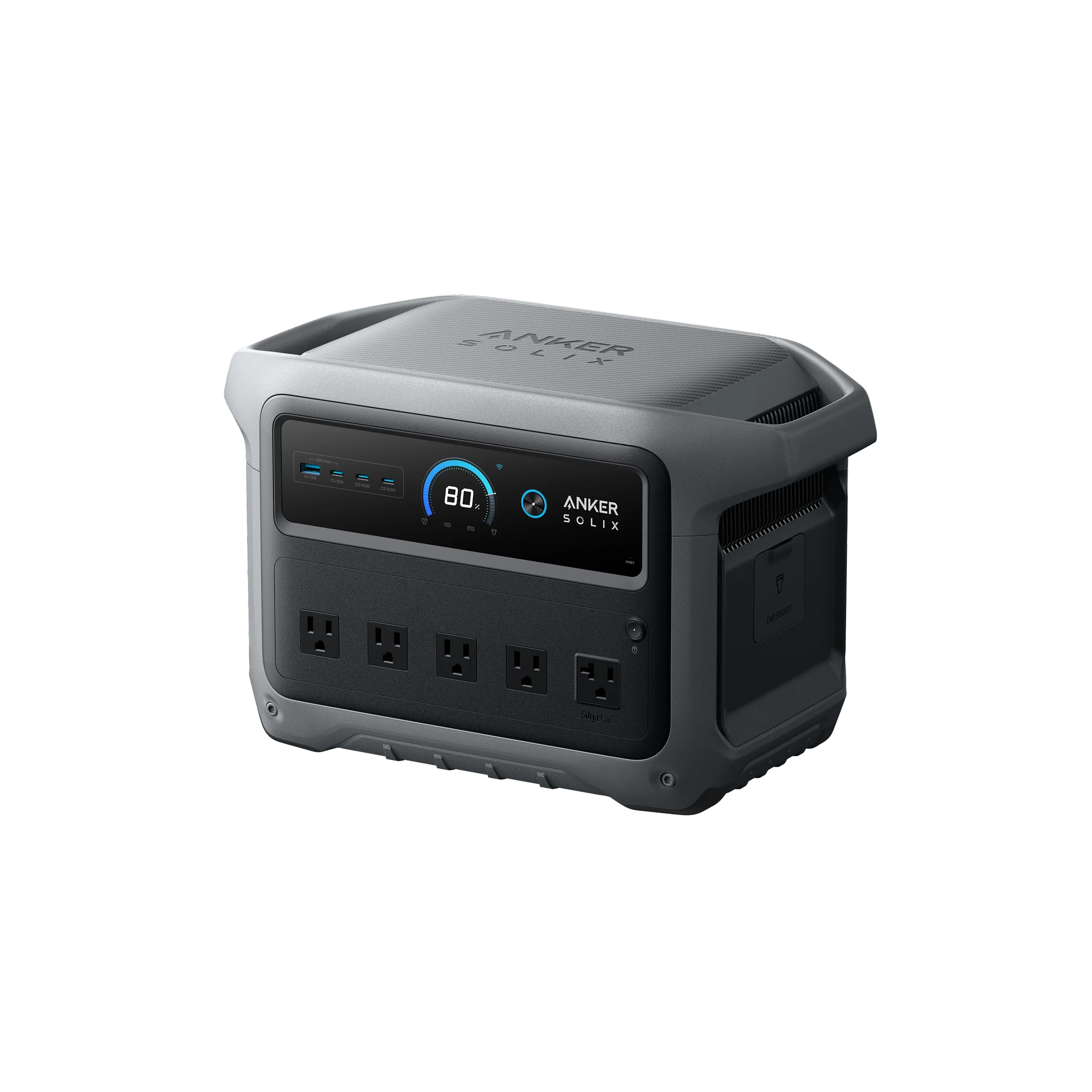
$529.99 · direct from Anker
Last checked 1 day ago. Prices move — check before you buy.

$649.00 · direct from BLUETTI
Last checked 1 day ago. Prices move — check before you buy.
Spec deltas
The Anker SOLIX C1000 Gen 2 now costs $119 less than the BLUETTI AC180P — $530 against $649 — even though the AC180P still holds 416Wh more, 1,440Wh against 1,024Wh. The AC180P used to be the $50-cheaper unit; that advantage has reversed, and with it the easy case for the bigger tank.
The AC180P's extra battery also comes with extra mass: the C1000 Gen 2 weighs 24.9 lbs to the AC180P's 35.3, a 10.4-lb gap that's the difference between one-hand carry and a real lift. It's also quieter by spec (35dB against 45dB) and switches over on outage in 10ms instead of 20ms, the kind of number that matters if something sensitive is plugged in when the power drops.
So the AC180P now wins on one thing: tank size. The C1000 Gen 2 wins on price and on nearly everything you'd notice while actually living with the unit. Which one matters more comes down to whether you truly need the extra 416Wh — because you're no longer paying less to get it.
What the Numbers Reveal
Each conclusion stated first — the numbers behind it on one line, the full analysis below.
weight
The bigger tank used to come with a lower sticker; now it costs $119 more and 10.4 lbs more, so its only remaining justification is the 416Wh itself.
The C1000 Gen 2 now costs $119 less than the AC180P ($530 vs $649), while the AC180P holds 416Wh more capacityThe C1000 Gen 2 weighs 24.9 lbs against the AC180P's 35.3 lbs — a 10.4-lb difference
Why it mattersBuyers who don't specifically need that extra capacity have no reason left to take the AC180P — the C1000 Gen 2 is lighter and cheaper; buyers who genuinely need the bigger tank now pay a real premium for it.
The AC180P looks like the capacity pick on the spreadsheet, but the C1000 Gen 2 collects the wins that matter once the unit is actually protecting something or the household's power needs change.
The C1000 Gen 2 switches over in 10ms (line-interactive) against the AC180P's 20ms (standby)The C1000 Gen 2 is genuinely expandable, while the AC180P's expansion listing doesn't hold up — it only accepts external batteries as a charging source through Power Bank Mode, never as added capacityB3
Why it mattersAnyone running gear that hates even a brief power gap, or anyone who expects to need more capacity later, gets more from the C1000 Gen 2 than the raw Wh-per-dollar math suggests.
rated cycles
The C1000 Gen 2's 4,000-cycle spec is a genuinely better number in isolation, but it's cycling a smaller battery; the AC180P's 3,500 cycles on a bigger tank still adds up to more total energy delivered over its life.
Remote Workday needs 910Wh: the C1000 Gen 2 uses 105% of its 1,024Wh tank — it can't finish the day on one charge — the AC180P uses 74%Despite its lower 3,500-cycle rating against the C1000 Gen 2's 4,000, the AC180P still delivers more total lifetime energy: 5,040 lifetime kWh against 4,096
Why it mattersDon't shop on cycle count alone — check what each cycle is actually worth in Wh, because the AC180P's smaller number still outproduces the bigger one here.
continuous output
The C1000 Gen 2's extra 300W of surge headroom only becomes relevant when two compressor-driven devices happen to start at once, a narrower scenario than most single-appliance use.
The C1000 Gen 2 runs a 2,000W continuous output with a 3,000W surge; the AC180P runs 1,800W continuous with a 2,700W surgeCompressor loads like fridges commonly spike 2-3x their rated draw at startup
Why it mattersBuyers running one big load at a time won't notice the surge gap; buyers stacking a fridge and a space heater or similar on the same outlet get real extra margin from the C1000 Gen 2.
The specific dimensions that decide these two units — everything else is a tie.
Portability & Form Factor
Selected because: The 10.4-lb weight gap and 10dB noise gap are the most-felt differences in daily use, and they both favor the C1000 Gen 2.
weight
At 24.9 lbs, the C1000 Gen 2 is a one-hand carry for most people; at 35.3 lbs, the AC180P is a two-hands, watch-your-back lift, especially up basement stairs or over a tailgate. That 10.4-lb gap is the single most physical difference between these two units.
Noise follows the same direction: 35dB for the C1000 Gen 2 against 45dB for the AC180P by spec, a real gap that shows up the moment either unit is fast-charging or running a heavy load in a room you're sitting in.
What the Specs Don't Tell You
Selected because: The UPS switchover speed and the AC180P's fake-expansion claim are concrete, spec-true tiebreakers.
rated cycles
The C1000 Gen 2's line-interactive switchover clocks in at 10ms, half the AC180P's 20ms standby switchover. Most gear never notices the difference, but anything genuinely sensitive to a power gap benefits from the faster number.
The AC180P's expansion story doesn't hold up: despite occasional listings, it does not accept true expansion batteries — external batteries only recharge it through Power Bank Mode, never adding capacityB3. The C1000 Gen 2's expansion path is real; the AC180P's is a charging feature wearing an expansion label.
Your Life, Your Pick
Selected because: Remote Workday is where the C1000 Gen 2's smaller tank actually runs out before the day does.
Weekend Camping, the 8-Hour Blackout, and Van Life Daily beat both units outright — the capacity gap between a 1,024Wh and a 1,440Wh tank doesn't matter when neither one is close to sized for the job. CPAP Overnight is a light lift for both, 37% and 26% of capacity respectively, so that alone won't decide the purchase.
Remote Workday is the real divider: the C1000 Gen 2 needs 105% of its tank to cover a modeled workday, meaning it runs out before the AC180P, which finishes at 74%. Tailgate Party tells the same story at a smaller scale — 77% against 55%.
Lifetime Value
Selected because: Despite fewer rated cycles, the AC180P's bigger tank delivers more total lifetime energy — worth spelling out since the cycle numbers alone mislead.
The C1000 Gen 2's 4,000-cycle rating beats the AC180P's 3,500 on paper, but cycle count times capacity is what actually matters, and the AC180P's bigger 1,440Wh tank still wins that math: 5,040 lifetime kWh delivered against 4,096. Where the AC180P used to turn that into a decisive cost-per-kWh lead, the price move has flattened it to a wash — $0.129 against $0.134, close enough that it no longer decides anything.
And the AC180P now costs more upfront, not less ($649 vs $530), so its slim lifetime-energy edge no longer comes with a price discount to back it up. If pure ownership cost is the deciding factor, the two are effectively tied — and the C1000 Gen 2's weight, noise, and switchover advantages tip the everyday call its way.
Strengths & trade-offs
Anker SOLIX C1000 Gen 2
Strengths
- +Costs $119 less
- +Lighter by 10.4 lb
- +Higher AC output
- +Faster solar charging
Trade-offs
- –No major technical downsides compared to rival.
BLUETTI AC180P
Strengths
- +Larger battery capacity
Trade-offs
- –Significantly heavier (+10.4 lbs), making it harder to move.
Will It Power Your Gear?
Scenario math and per-appliance runtimes, modeled from the spec record.
Scenario verdicts
We ran the math on six real-world scenarios. Here's which unit survives your actual life.
SCN-01 · 2 nights · needs 2,100Wh
Weekend Camping
Two nights off-grid with essential comfort
Neither unit
Neither unit covers this scenario's 2,100Wh: the SOLIX C1000 Gen 2 comes up 1,230Wh short (about 41% covered), the AC180P 876Wh (58%). Treat this as partial cover — enough for the essentials in it, not the whole list.
Battery budget usedlower = more headroom
LOAD Phone Charger 15W×6h · LED Lights 40W×8h · Box Fan 75W×14h · CPAP Machine 40W×16h
SCN-02 · 8 hours · needs 1,645Wh
8-Hour Blackout
Keep the essentials running through a night without power
Neither unit
Neither unit covers this scenario's 1,645Wh: the SOLIX C1000 Gen 2 comes up 775Wh short (about 53% covered), the AC180P 421Wh (75%). Either gets you most of the way, so this is a scenario you plan around rather than one you should rule them out for.
Battery budget usedlower = more headroom
LOAD Fridge 150W×8h · Router + Modem 20W×8h · LED Lights (4 bulbs) 40W×6h · Phone Charger 15W×3h
SCN-03 · 8 hours · needs 320Wh
CPAP Overnight
Sleep therapy without interruption — the #1 medical use case
SOLIX C1000 Gen 2
Neither unit is stressed by a CPAP overnight — 37% of tank for the C1000 Gen 2, 26% for the AC180P. This job alone doesn't justify paying more for either one.
Battery budget usedlower = more headroom
LOAD CPAP Machine 40W×8h
SCN-04 · 8 hours · needs 910Wh
Remote Workday
Full work day off-grid without power anxiety
AC180P
The C1000 Gen 2 needs its entire tank and then some — 105% of 1,024Wh for a modeled workday, meaning it won't finish on one charge. The AC180P covers the same day at 74%, with real capacity left.
Battery budget usedlower = more headroom
LOAD Laptop 60W×8h · External Monitor 30W×8h · Router + Modem 20W×8h · Phone Charger 15W×2h
SCN-05 · 4 hours · needs 670Wh
Tailgate Party
Game day power for the crew
AC180P
Both handle a tailgate afternoon, but the AC180P finishes with noticeably more in reserve — 55% used against the C1000 Gen 2's 77%. If the afternoon runs long, that gap is the buffer.
Battery budget usedlower = more headroom
LOAD Blender 400W×0.5h · LED TV (55") 80W×4h · Bluetooth Speaker 15W×4h · Phone Charger (×3) 45W×2h
SCN-06 · 24 hours · needs 4,685Wh
Van Life Daily
A full day of mobile living — the ultimate endurance test
Neither unit
Neither unit covers this scenario's 4,685Wh: the SOLIX C1000 Gen 2 comes up 3,815Wh short (about 19% covered), the AC180P 3,461Wh (26%). This is well outside what either unit is for; the right answer here is a larger station, not a choice between these two.
Battery budget usedlower = more headroom
LOAD Mini-Fridge 150W×24h · Laptop 60W×4h · Phone Charger 15W×3h · LED Lights 40W×5h · Fan 75W×8h
The Load Test
RUNTIME = (Wh × 0.85) ÷ LOAD
None of the scenarios above exactly yours? Build it. Toggle what you'd plug in; both units are tested against the combined draw.
Essentials
Comfort & Convenience
High-Draw Appliances
Test duration
8h
Continuous draw
205W
Projected runtime
For this load: AC180P runs 6h vs 4.2h.
$649 list · direct from BLUETTI
Modeled from the spec record — same math as the tables below. Methodology
Runtime by appliance
Real-world runtime estimates for common appliances, modeled at 85% inverter efficiency.¹
Essentials
The basics you need runningscale 0–81.6hComfort & Convenience
Makes off-grid life actually enjoyablescale 0–16.3hHigh-Draw Appliances
These reveal the real limitsscale 0–1.2h¹ Runtime = (capacity × 0.85) ÷ appliance watts. Within each group, all bars share one time scale (the group's longest runtime), so lengths are comparable across appliances; identical runtimes collapse into a single blue/orange bar. Actual runtime varies with battery age, temperature, and simultaneous loads — see methodology.
Conclusion
July 14, 2026
Verdict: the SOLIX C1000 Gen 2
For most buyers the C1000 Gen 2 is now the better default: $530 against $649, and it's the lighter (by 10.4 lbs), quieter (35dB vs 45dB by spec), and faster-switching (10ms vs 20ms) unit, with a genuinely expandable design where the AC180P's expansion claim doesn't survive owner testingB3. The price move is what tipped it — the AC180P used to be $50 cheaper with a decisive lifetime-cost lead, but at $649 it's now $119 dearer and its cost-to-own edge has collapsed to a wash ($0.129 vs $0.134 per lifetime kWh, down from $0.12 vs $0.16). What the AC180P keeps is real: 416Wh more capacity (1,440Wh vs 1,024Wh), which still wins the capacity-bound scenarios like a full Remote Workday. But this is close — a capacity-first buyer could still hold the AC180P — so it's a soft call: default to the C1000 Gen 2 unless you specifically need the most single-box capacity and won't expand.
Editor-assigned confidence, based on cited owner research and spec analysis.
List prices as of July 14, 2026. The links below open Anker's and BLUETTI's current prices.
$529.99 · direct from Anker
Last checked 1 day ago. Prices move — check before you buy.
or check the AC180P price$649.00 list
Written by Ian Schneider, Solar & Off-Grid Tester · Station Arena Test Desk · Updated July 14, 2026
Measured Data
Benchmark scores and the full spec record, side by side.
Benchmark scores
Full specifications
ᵈ Derived: price ÷ rated capacity. See the data behind our comparisons →
Comparison ToolAdd more power stations, side by sideOpen Tool →How these numbers are produced
Numeric verification
Every figure on this page traces to our spec database or arithmetic on it — no estimated numbers.
Owner claims
Statements about owner experience are cited to published reviews — see Sources & Research Notes below.
Runtime model
Runtime = (rated capacity × 0.85 inverter efficiency) ÷ device wattage. Solar recharge estimates assume panels deliver 70% of rated output. Cold weather, battery age, and stacked loads reduce real-world results.
Power Score
Computed from 14 published spec dimensions, weighted per use-case bench. Higher is better; a unit must meet a bench's minimum threshold to be rated.
See the full weight table and data sourcing on our methodology page →Class ranking (the star rating)
Each unit's star score is a category ranking, not customer reviews — no buyer opinions feed it. We score every station on size-independent quality (value, output, portability, endurance, ports, warranty, and more), then percentile-rank it against the other units in its capacity class, so a class-leading compact unit and a class-leading whole-home unit can both earn 5★. Here, SOLIX C1000 Gen 2 rates 4.9/5 (96th percentile of 27 Everyday-class units), and AC180P rates 4.1/5 (50th percentile of 27 Everyday-class units).
How the class ranking is computed →Test Notes & Caveats
Hidden gotchas and advantages we spotted that you won't find on the product page.
AC180P: 45dB Published
45dB is about as loud as a running refrigerator. The SOLIX C1000 Gen 2 is rated 35dB — lower, but published by a different maker measuring its own way, so the two figures are not a like-for-like gap. For most people, fan noise around 45dB and up is where sleep starts to suffer.
One of These Grows. One Just Says It Does.
The C1000 Gen 2 has a real expansion path. The AC180P's occasional expandable listing doesn't survive testing — external batteries only ever recharge it, they don't add to its 1,440Wh ceiling. If growth is part of the plan, that difference is structural, not cosmetic.
10ms vs 20ms — Line-Interactive Beats Standby
The C1000 Gen 2's line-interactive design switches over in 10ms; the AC180P's standby design takes 20ms. Both are fast enough for most household gear, but the C1000 Gen 2's number is the one to reach for if you're protecting anything genuinely interruption-sensitive.
Warranty: No Difference
Both units carry the same 5-year warranty, so coverage isn't a tiebreaker here. The AC180P's figure is a maximum rather than a guarantee — it depends on buying direct from BLUETTI or registering the unit, since reseller purchases carry a shorter term.
Full record above — the Test Desk pick is the SOLIX C1000 Gen 2.
Check SOLIX C1000 Gen 2 price →or check the AC180P priceOwnership Analysis
What happens after you buy — true cost of ownership, brand trust, and growth potential.
Lifetime value
Service lifeyears at one full cycle per day
Lifetime energy delivered
Cost per delivered kWh
│ warranty ends · Reaching the cycle rating means ~80% capacity remains — degraded, not dead.
Analyst note
Both units cost the same to own over their rated lives — $0.13/kWh each. Lifetime cost can't separate them, so decide on the sticker price and everything else. One caution on the lifespan row: the SOLIX C1000 Gen 2 takes longer to reach its cycle rating, but a cycle moves a different amount of energy on each unit — the AC180P still delivers more over its shorter horizon (5,040 vs 4,096 kWh). Years measure wear, not usefulness.
Brand trust
Anker
Ecosystem
7-8 SOLIX portable power stations across C-series (compact) and F-series (flagship), plus the X1 home energy system
Support
US-based support. Historically known for incredible no-hassle replacements, but recent reports describe AI-driven support agents giving generic responses and complex return logistics for heavy units (hazmat shipping). The Anker brand reputation is still strong, but SOLIX-specific support quality is trending down.
Community
Moderate — active Reddit (r/Anker, r/AnkerSOLIXCommunity) and growing. Benefits from Anker's massive consumer electronics brand awareness.
App experience
Rated 4.5/5 iOS (~1,100 ratings) · 4.3/5 Android
Unique strength
Parent brand trust from Anker's consumer electronics dominance. InfiniPower technology for long cycle life. Strong $/Wh value in the mid-size and larger units — the S2000, F2600 and C1000 are among the better buys per watt-hour in the catalog.
Worth knowing
Support quality appears to be declining from its historically excellent level. Firmware updates have removed features without warning. Expansion ecosystem is smaller than EcoFlow's.
BLUETTI
Ecosystem
One of the broadest lineups — 15-20+ models from budget (AC2A) to flagship portable (Apex 300, 2764.8Wh). Includes specialized products: vehicle solar hubs, sodium-ion cold-weather units, and balcony storage systems.
Support
The most inconsistent support in the space. Heavily email-based with China timezone delays. Some users get smooth, efficient service; others report weeks of troubleshooting runarounds, being offered discounts on new units instead of repairs, and confusing third-party purchase claim processes. Buying direct from Bluetti's website tends to produce better support outcomes.
Community
Active and growing — Reddit r/bluetti has a dedicated community. Second-largest after EcoFlow in engagement.
App experience
Rated 4.5/5 iOS and Android — tied for best app experience in the category. V3.0 UI redesign was well-received.
Unique strength
Among the best capacity-to-price ratios available — several Elite and Apex units are the lowest $/Wh in the catalog. Widest product diversity including industry-firsts like sodium-ion cold-weather units and dual solar+alternator vehicle hubs. LFP across the rest of the range, though rated cycle life spans 2,500 (EB3A) to 6,000, and it varies WITHIN the Elite range rather than tracking it — the Elite 300 and Elite 200 V2 are rated 6,000 while the Elite 30 V2, Elite 10 Mini, Elite 320 and Elite 400 are rated 3,000+ and the Elite 100 V2 4,000+, so check the specific model. Dual-voltage (120V/240V) in flagships.
Worth knowing
Customer support inconsistency is the #1 risk factor. Older/discontinued units may become unrepairable — no spare parts policy for some models. Some reports of erratic communication from support agents.
Analyst note
Anker and BLUETTI are close competitors. Both have established support channels and growing ecosystems. Compare their specific warranty terms and community size for your peace of mind.
Growth path
SOLIX C1000 Gen 2
EXPANDABLESupports Anker expansion batteries, so you can add capacity later without replacing the base unit — useful if your needs may climb past 1,024Wh.
Accepts up to 600W of solar. Suitable for a 1-2 panel setup.
Generous port selection supports complex multi-device setups.
Expansion batteries are Anker-specific. You're investing in the Anker ecosystem.
AC180P
FIXED CAPACITYFixed at 1,440Wh, with no expansion — so size it for your needs up front rather than planning to add capacity later.
Accepts up to 500W of solar. Suitable for a 1-2 panel setup.
Adequate ports for most setups, but heavy users may want a power strip.
Realistic full solar rechargeat 70% of rated panel output — see methodology
Analyst note
Don't read the SOLIX C1000 Gen 2's expandability as a straight win here: it starts at 1,024Wh, below the AC180P's 1,440Wh, so a first expansion battery largely buys back capacity the AC180P already includes. It only pulls ahead if you'd grow past 1,440Wh — short of that, the AC180P's larger fixed capacity is the simpler value.
What Owners Report
Patterns from published owner reports and long-term reviews — every claim cited to its source below.
Anker SOLIX C1000 Gen 2
Reviewers consistently praise the C1000 Gen 2's HyperFlash charging, citing a full recharge in around 49 minutes — noticeably quicker than the original C1000's 58-80 minutesA1. The higher continuous output is also called out as crossing a real threshold: enough headroom to run a standard 1,500W space heater comfortablyA3.
Fan noise is the recurring complaint: the unit runs near silent at light loads, around 35dB under 200W, but reviewers report the fans climbing to roughly 55dB once fast charging or heavy output kicks in past 1,000WA2. Outlets covering the launch broadly call it a refined, powerful update to a popular 1kWh platformA4.
“Fast HyperFlash charging — a full recharge in roughly 49 minutes, noticeably quicker than the original C1000's ~58-80 minutes.”
Sources
thepowerpick.com · macrumors.com · outdoorgearlab.com · technerdo.com · mensjournal.com · powerstationadvisor.com
BLUETTI AC180P
At roughly 35 lbs, reviewers describe the AC180P as manageable for base camp or car camping but a real haul for carrying any distanceB4 — the weight complaint that most directly separates it from a lighter unit like the C1000 Gen 2.
The clarification worth repeating here too: despite some listings calling it expandable, it does not accept true expansion batteries like the B80, B230, or B300 — those only recharge it through Power Bank Mode, they don't add capacityB3. It still holds a 4.6-star rating across 708 verified purchasers, with its Turbo Charge feature (0-80% in about 45 minutes) confirmed to hold up under testingB2.
“Delivers 1,440Wh of LiFePO4 capacity and 1,800W continuous output, with a Turbo Charge feature reaching 0-80% in roughly 45 minutes and a Power Lifting Mode that delivers 2,700W to run high-powered devices.”
Sources
backuppowerhub.com · bluettipower.com · batteryskills.com · the-gadgeteer.com · bestgeneratorsolar.com
Sources & Research Notes
Every owner claim in this report is traceable to a published source. The bracketed references above resolve here.
Recurring owner themes
- Fast charging and higher output over the original are the standout gains; fan noise under load or fast charging is the top complaint. [SOLIX C1000 Gen 2 · 3 entries]
- Fast Turbo charging, strong owner ratings, and a useful Power Lifting Mode are the praise; the key clarification is that it does NOT accept true battery expansion despite some listings. [AC180P · 3 entries]
- A1
“Fast HyperFlash charging — a full recharge in roughly 49 minutes, noticeably quicker than the original C1000's ~58-80 minutes.”
thepowerpick.com / macrumors.com — Anker SOLIX C1000 Gen 2 review · 2026 · [positive]
- A2
“Fan noise is the single most common complaint — nearly silent at low load (about 35 dB under 200W), but the fans ramp up audibly during fast charging or heavy output, reaching around 55 dB at 1,000W-plus.”
outdoorgearlab.com / technerdo.com — C1000 Gen 2 review · 2026 · [negative]
- A3
“The higher continuous output crosses a useful threshold over the original — enough to run a standard 1,500W space heater with headroom to spare.”
thepowerpick.com / mensjournal.com — C1000 Gen 2 review · 2026 · [positive]
- A4
“Reviewers describe it as a refined, powerful, fast-charging update to a popular 1kWh platform, widely rated the mid-size unit to beat in 2026.”
thepowerpick.com / powerstationadvisor.com — C1000 Gen 2 review · 2026 · [positive]
- B2
“Holds a strong 4.6-star rating from 708 verified Amazon purchasers; reviewers confirm the 0-80% in 45 minutes claim held true in testing.”
batteryskills.com / the-gadgeteer.com — AC180P review · 2025-2026 · [positive]
- B3
“Does not include a battery expansion port and does not support capacity expansion with B80, B230, or B300 batteries — contrary to some listings — though it can be charged by such batteries through Power Bank Mode.”
bestgeneratorsolar.com / backuppowerhub.com — AC180P buyer's guide · 2025-2026 · [mixed]
- B4
“Weight is cited around 35 lbs in most listings (one source lists ~28.7 lbs) — manageable for base camp or car camping, more of a constraint for backpacking or carrying any distance.”
backuppowerhub.com / batteryskills.com — AC180P review · 2025-2026 · [mixed]
Research compiled July 14, 2026.
Who Should Buy Which
Buy the SOLIX C1000 Gen 2 if you…
- →You want the better all-round value: at $530 against $649 it's now the cheaper unit, and also the lighter (by 10.4 lbs), quieter, and faster-switching one.
- →You carry the unit regularly — boat, truck bed, repeated moves — or you actually plan to expand capacity later, a real path on the C1000 Gen 2 that the AC180P doesn't offerB3.
Buy the AC180P if you…
- →You specifically need the most single-box capacity — its 1,440Wh tank holds 416Wh more and finishes a full remote workday or loaded tailgate with room the C1000 Gen 2 doesn't have.
- →You're leaving it in one place, so the extra 10.4 lbs and 10dB don't bother you, and you're willing to pay the $119 premium for that capacity.
If neither fits
If your real need is a two-night camping trip (about 2,100Wh) or an 8-hour multi-appliance blackout (about 1,645Wh), both of these come up short — they land between 134% and 241% of what's needed. Step up to a larger-capacity unit in either brand's lineup instead of choosing between these two.
The Bottom Line
The C1000 Gen 2 is now the easier default — $530 against $649, and the lighter (by 10.4 lbs), quieter (10dB), and faster-switching (10ms vs 20ms) unit, with an expansion path that's actually real. The price reversal is what changed the call: it used to cost $50 more than the AC180P, it now costs $119 less, and its old lifetime-cost deficit has flattened to a wash ($0.134 vs $0.129 per kWh).
The AC180P is still the pick if you specifically need the bigger tank — 1,440Wh against 1,024Wh, 416Wh more — and it still wins the capacity-bound scenarios like a full remote workday. But you now pay $119 extra and carry 10.4 lbs more to get that capacity, so it's the choice only for buyers who truly need the extra Wh and won't move or expand the unit.
Frequently Asked Questions
Answers drawn from the spec record and cited owner research.
Which is lighter, the Anker SOLIX C1000 Gen 2 or the BLUETTI AC180P?
The C1000 Gen 2, by a real margin — 24.9 lbs against the AC180P's 35.3 lbs, a 10.4-lb difference. That's roughly the gap between a one-hand carry and a two-hands lift, worth weighing if you move the unit often.
Does the C1000 Gen 2 actually expand, unlike the AC180P?
Yes. The C1000 Gen 2 has a genuine expansion path, while the AC180P's occasional 'expandable' listing doesn't hold up under owner testing — it only accepts external batteries as a charging source through Power Bank Mode, never as added capacity.
Which one is cheaper to own long-term?
It's now essentially a wash. The AC180P's bigger 1,440Wh tank still delivers more total lifetime energy (5,040 kWh vs 4,096), but with the AC180P now the pricier unit, its cost per lifetime kWh ($0.129) sits right alongside the C1000 Gen 2's ($0.134) — close enough that lifetime cost no longer separates them. Upfront, the C1000 Gen 2 is the cheaper buy ($530 vs $649).
Which switches over faster during a power outage?
The C1000 Gen 2, at 10ms line-interactive switchover against the AC180P's 20ms standby switchover. Most household electronics won't notice either gap, but equipment genuinely sensitive to interruption benefits from the faster number.
Which one should I actually buy?
Take the C1000 Gen 2 for most needs — it's now the cheaper unit ($530 vs $649) and the lighter, quieter, faster-switching one, with a real expansion path. Take the AC180P only if you specifically need the bigger tank: its 1,440Wh holds 416Wh more and wins the capacity-bound scenarios, but you'll pay $119 more and carry 10.4 lbs extra for it.
Where to buy
Anker SOLIX C1000 Gen 2Pick
$529.99
$529.99 · direct from Anker
Last checked 1 day ago. Prices move — check before you buy.
BLUETTI AC180P
$649.00
$649.00 · direct from BLUETTI
Last checked 1 day ago. Prices move — check before you buy.
Prices may vary by retailer and are subject to change.