Head-to-head test
Anker 535 PowerHouse vs BLUETTI EB3A
The EB3A's headline advantage is the only UPS mode of the two, and it's the feature its owners report failing under the light loads you'd buy it for; the larger Anker 535 lists no UPS yet outlasts it both per night and per lifetime dollar.
Full profiles: Anker 535 PowerHouse → · BLUETTI EB3A →

Written by Wenny ZhengUpdated
Portable Power Tester, Station Arena Test Desk
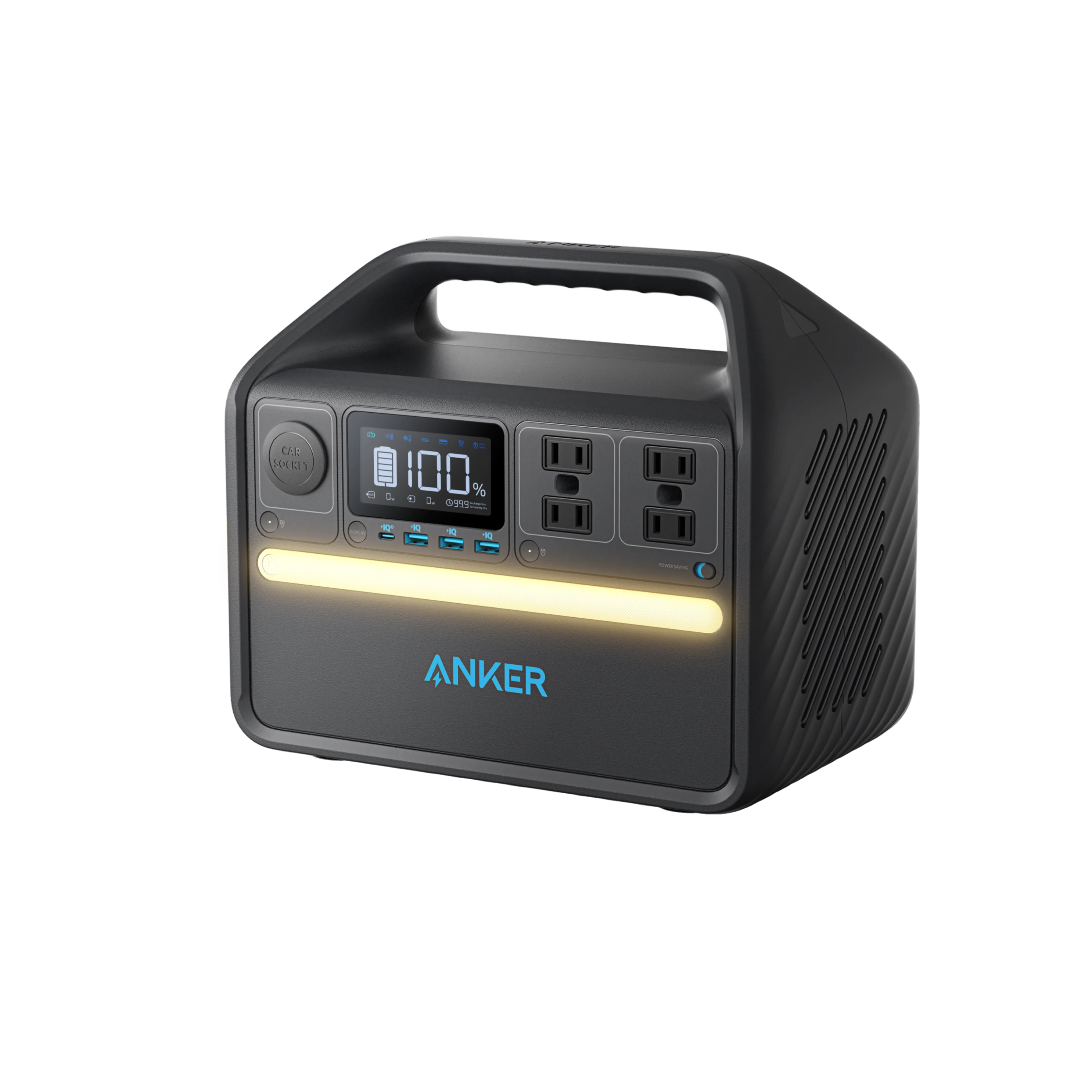
$299.99 · direct from Anker
Last checked 1 day ago. Prices move — check before you buy.

$219.00 · direct from BLUETTI
Last checked 1 day ago. Prices move — check before you buy.
Spec deltas
The Anker 535 PowerHouse costs $81 more than the BLUETTI EB3A and is the cheaper box to live with, at $0.20 per lifetime kilowatt-hour against $0.33. It stores nearly twice the usable energy, lasts more charge cycles, and it's the only one of the two that finishes a full CPAP night. The EB3A answers with 6.6 fewer pounds, a lower sticker, faster solar, and the one trick the Anker lacks entirely: a UPS mode. That last one is the whole argument for the EB3A, which is why it matters that its owners report the mode failing under the very loads you'd trust it withB5B7B8.
First, temper expectations for both. Five of the seven load scenarios we run come back 'neither,' because a weekend campsite, an eight-hour blackout, or a van's daily draw all want far more watt-hours than a 268Wh or 512Wh box carries. These are small stations. The real contest is over the small jobs they're built for: an afternoon off-grid, a laptop workday's essentials, and the overnight CPAP where usable capacity, not sticker price, decides who reaches morning.
So the pick is the Anker 535 for nearly anyone weighing these two. It's more usable capacity, a lower cost per watt-hour today and across its life, and the unit that lasts the night instead of listing a feature for it. Take the EB3A when the entire job is a light, cheap box for afternoon top-ups and the $81 is the deciding number. For a CPAP, a storm kit, or a five-year hold, the extra pounds buy peace you'll actually use.
What the Numbers Reveal
Each conclusion stated first — the numbers behind it on one line, the full analysis below.
rated cycles
Cost per watt-hour tells the same story on day one, $0.59 against $0.82, so the Anker is cheaper per unit of energy both at the register and across every cycle it will ever run. The EB3A's lower price tag is the only money number it wins.
Anker 535: $300 for 512Wh, rated at least 3,000 cyclesEB3A: $219 for 268Wh, rated at least 2,500 cyclessticker cost per watt-hour: $0.59 (Anker) vs $0.82 (EB3A)
Why it mattersIf you're picking on the shelf price alone, you're paying more per usable watt-hour to save $81 today.
Set the shutdown reports aside and the EB3A still can't finish the night on capacity, 92Wh short, so its UPS mode would be guarding a battery that runs out anyway; the Anker reaches morning with 115Wh in reserve but offers no UPS, meaning for a CPAP you run it as primary power rather than pass-through backup.
EB3A is the only unit here that lists a UPS mode (rated no worse than 30ms); the Anker lists noneowners report false 'overload' shutdowns under 40-60W light loads in UPS mode, unresolved after firmwareB5B6B7B8B9EB3A 228Wh usable falls 92Wh short of a 320Wh CPAP night; Anker 435Wh usable covers it with 115Wh to spare
Why it mattersThe medical-backup buyer drawn in by the EB3A's UPS spec should read its field record first, then ask whether they need true pass-through UPS at all.
weight
That's also the ceiling of the EB3A's case. Grow the load to an overnight CPAP or a partial outage and usable capacity and lifetime cost take the wheel, and the Anker pulls ahead and stays there.
EB3A 10.1 lbs vs Anker 16.7 lbsthe only scenario both units fully cover is a 100Wh afternoon load, decided on weight and priceEB3A $219 vs Anker $300, plus 100W USB-C and 200W solar on the EB3A
Why it mattersBuy the EB3A if 'light and cheap for small top-ups' is the entire job; the moment it isn't, it's the Anker.
The Anker's blank spec isn't proof it runs quieter, but a best-case 50dB the fan reportedly overrunsB1B12 is worse information than no number at all for a bedroom decision; the published figure flatters the noisier unit.
EB3A publishes 50dB as an 'as low as' best-case floorthe Anker publishes no noise figure at allowners report the EB3A's fan ramping, buzzing, and cycling at idle and while chargingB1B3B4B12
Why it mattersAnyone placing this within earshot of a bed should get hands-on with the Anker rather than trust the EB3A's lone 50dB spec.
The specific dimensions that decide these two units — everything else is a tie.
Lifetime Value
Selected because: The $81-cheaper EB3A is the pricier unit to own: $0.33 per lifetime kilowatt-hour against the Anker's $0.20.
cost / lifetime kWh
Sticker price is the single money metric the EB3A wins, and it's the one that ages worst. Line up what each dollar buys and the order flips: the Anker's larger 512Wh pack and its at-least-3,000-cycle rating turn a higher price into a lower cost per stored watt-hour, now and across the unit's whole life. The box that costs more at the register is the budget option on every axis that outlives the checkout.
Your Life, Your Pick
Selected because: Five of the seven load scenarios are too big for either battery; the ones that resolve, especially the CPAP night, decide the match.
Read the scenario grid as a size lesson. The five cards that come back 'neither' (camping, blackout, workday, tailgate, van life) aren't close calls; each wants far more watt-hours than either battery holds, and the right answer for them is a bigger station, not a choice between these two. The two that resolve are the small ones, and that's where these units actually earn their keep.
One spec worth ignoring: the EB3A's 1,200W surge. It genuinely beats the Anker's unpublished headroom on paper, but in every scenario both units start the peak they're handed and then drain the battery flat long before the inverter is the bottleneck. Capacity is the wall here, not wattage, which is why the quiet 320Wh CPAP night, not the 400W tailgate, is the scenario that separates them.
What the Specs Don't Tell You
Selected because: The EB3A's marquee feature here is a UPS mode with a shaky field record, and the warranty runs five years to two.
rated cycles
The Anker's three marks in this section are all things it doesn't do: no phone app, a slow 120W solar ceiling, and no published noise figure. Those are conveniences, and you can plan around every one of them. The EB3A's headline entry here is the opposite kind of problem, a UPS mode it advertises and its owners report failing at under light loadsB5B7B8. An advantage on the spec sheet that becomes a liability in the field is the worst kind to buy on.
Warranty is the Anker's clean win: five years against the EB3A's two, though BLUETTI stretches to five if you buy direct and register. That's coverage you might actually lean on, because the EB3A's own owners describe support as the weak link, with tickets that went unanswered and firmware 'fixes' that changed nothingB9B10.
Portability & Form Factor
Selected because: At 10.1 lbs against 16.7, the EB3A is the one you actually carry, and for the smallest jobs that is the whole decision.
weight
This is where the EB3A earns its price. At 10.1 pounds it's a one-hand lift into a bag; the Anker's 16.7 is a two-hand carry you set down more deliberately. For the afternoon-off-grid job both cover, that 6.6-pound difference and the lower price are the whole decision, and the EB3A takes it cleanly. It also tops up a laptop faster over 100W USB-C and refills quicker from the sun. None of that changes what happens overnight, but plenty of people never ask a power station to work a night. They ask it to be light, and to be there on Saturday.
Brand Trust
Selected because: Over a multi-year hold, BLUETTI's inconsistent support is a bigger risk than Anker's, which matters when a warranty claim lands.
Support is the spec that only shows up after something breaks, and it's where these two diverge most. BLUETTI runs the most inconsistent service in the category, email-based and timezone-lagged, while Anker's US-based support was long the easiest in the space, even if SOLIX-specific service has lately slid toward generic AI-agent replies. On the EB3A the inconsistency isn't theoretical: its owners hit unanswered tickets and dead-end firmware adviceB9B10. On a five-year hold with a warranty claim in hand, the Anker's is the inbox likelier to answer.
Strengths & trade-offs
Anker 535 PowerHouse
Strengths
- +Larger battery capacity
- +Longer warranty
Trade-offs
- –Substantially more expensive (+$81) than the EB3A.
- –Lacks smartphone app control for remote monitoring.
BLUETTI EB3A
Strengths
- +Costs $81 less
- +Lighter by 6.6 lb
- +Higher AC output
- +Faster solar charging
Trade-offs
- –No major technical downsides compared to rival.
Will It Power Your Gear?
Scenario math and per-appliance runtimes, modeled from the spec record.
Scenario verdicts
We ran the math on seven real-world scenarios. Here's which unit survives your actual life.
SCN-01 · 2 nights · needs 2,100Wh
Weekend Camping
Two nights off-grid with essential comfort
Neither unit
Neither unit covers this scenario's 2,100Wh: the 535 PowerHouse comes up 1,665Wh short (about 21% covered), the EB3A 1,872Wh (11%). This is well outside what either unit is for; the right answer here is a larger station, not a choice between these two.
Battery budget usedlower = more headroom
LOAD Phone Charger 15W×6h · LED Lights 40W×8h · Box Fan 75W×14h · CPAP Machine 40W×16h
SCN-02 · 8 hours · needs 1,645Wh
8-Hour Blackout
Keep the essentials running through a night without power
Neither unit
Neither unit covers this scenario's 1,645Wh: the 535 PowerHouse comes up 1,210Wh short (about 26% covered), the EB3A 1,417Wh (14%). This is well outside what either unit is for; the right answer here is a larger station, not a choice between these two.
Battery budget usedlower = more headroom
LOAD Fridge 150W×8h · Router + Modem 20W×8h · LED Lights (4 bulbs) 40W×6h · Phone Charger 15W×3h
SCN-03 · 8 hours · needs 320Wh
CPAP Overnight
Sleep therapy without interruption — the #1 medical use case
535 PowerHouse
A UPS mode can't rescue a battery that's too small. The EB3A's 228Wh usable against a 320Wh CPAP night leaves it 92Wh short, about 71% of the way to morning; the Anker 535 clears the same night with 115Wh still in reserve. Run either as the machine's primary power rather than a wall pass-through, and only the Anker actually gets you to sunrise.
Battery budget usedlower = more headroom
LOAD CPAP Machine 40W×8h
SCN-04 · 8 hours · needs 910Wh
Remote Workday
Full work day off-grid without power anxiety
Neither unit
Neither unit covers this scenario's 910Wh: the 535 PowerHouse comes up 475Wh short (about 48% covered), the EB3A 682Wh (25%). Treat this as partial cover — enough for the essentials in it, not the whole list.
Battery budget usedlower = more headroom
LOAD Laptop 60W×8h · External Monitor 30W×8h · Router + Modem 20W×8h · Phone Charger 15W×2h
SCN-05 · 4 hours · needs 670Wh
Tailgate Party
Game day power for the crew
Neither unit
Neither unit covers this scenario's 670Wh: the 535 PowerHouse comes up 235Wh short (about 65% covered), the EB3A 442Wh (34%). Treat this as partial cover — enough for the essentials in it, not the whole list.
Battery budget usedlower = more headroom
LOAD Blender 400W×0.5h · LED TV (55") 80W×4h · Bluetooth Speaker 15W×4h · Phone Charger (×3) 45W×2h
SCN-06 · 24 hours · needs 4,685Wh
Van Life Daily
A full day of mobile living — the ultimate endurance test
Neither unit
Neither unit covers this scenario's 4,685Wh: the 535 PowerHouse comes up 4,250Wh short (about 9% covered), the EB3A 4,457Wh (5%). This is well outside what either unit is for; the right answer here is a larger station, not a choice between these two.
Battery budget usedlower = more headroom
LOAD Mini-Fridge 150W×24h · Laptop 60W×4h · Phone Charger 15W×3h · LED Lights 40W×5h · Fan 75W×8h
SCN-07 · an afternoon · needs 100Wh
Afternoon Off-Grid
Phones and a speaker at the park, beach, or campsite — the small-unit job description
Either unit
This is the job small stations are actually for, and both do it: the 535 PowerHouse finishes at 23% used, the EB3A at 44%. At this size the decider is what rides in the bag — 10.1 lbs for the EB3A against 16.7 for the 535 PowerHouse — and price, not the leftover watt-hours.
Battery budget usedlower = more headroom
LOAD Phone Charger (×2) 30W×2h · Bluetooth Speaker 10W×4h
The Load Test
RUNTIME = (Wh × 0.85) ÷ LOAD
None of the scenarios above exactly yours? Build it. Toggle what you'd plug in; both units are tested against the combined draw.
Essentials
Comfort & Convenience
High-Draw Appliances
Test duration
8h
Continuous draw
205W
Projected runtime
For this load: 535 PowerHouse runs 2.1h vs 1.1h.
$299.99 list · direct from Anker
Modeled from the spec record — same math as the tables below. Methodology
Runtime by appliance
Real-world runtime estimates for common appliances, modeled at 85% inverter efficiency.¹
Essentials
The basics you need runningscale 0–29hComfort & Convenience
Makes off-grid life actually enjoyablescale 0–5.8hHigh-Draw Appliances
These reveal the real limits¹ Runtime = (capacity × 0.85) ÷ appliance watts. Within each group, all bars share one time scale (the group's longest runtime), so lengths are comparable across appliances; identical runtimes collapse into a single blue/orange bar. Actual runtime varies with battery age, temperature, and simultaneous loads — see methodology.
Conclusion
August 30, 2026
Verdict: the Anker 535 PowerHouse
Take the Anker 535 PowerHouse. It holds nearly twice the usable energy (435Wh against the EB3A's 228Wh), costs less per watt-hour both today and across its rated life, and it's the only one that finishes a 320Wh CPAP night: 115Wh to spare, against the EB3A's 92Wh shortfall. The EB3A's real edges are genuine: 6.6 pounds lighter, $81 cheaper, faster 200W solar, 100W USB-C. But its one exclusive feature, the UPS mode, is exactly what owners report failing under light loadsB5B7B8, and its fan draws recurring noise complaintsB1B2B3B12. Buy the EB3A only if you want the lightest, cheapest box for afternoon top-ups; for a CPAP, a storm kit, or a five-year hold, the Anker is more battery for less money over time.
Editor-assigned confidence, based on cited owner research and spec analysis.
List prices as of August 30, 2026. The links below open Anker's and BLUETTI's current prices.
$299.99 · direct from Anker
Last checked 1 day ago. Prices move — check before you buy.
or check the EB3A price$219.00 list
Written by Wenny Zheng, Portable Power Tester · Station Arena Test Desk · Updated August 30, 2026
Measured Data
Benchmark scores and the full spec record, side by side.
Benchmark scores
Not rated for both units (minimum threshold unmet): CPAP, Solar Generator.
Full specifications
ᵈ Derived: price ÷ rated capacity. See the data behind our comparisons →
Comparison ToolAdd more power stations, side by sideOpen Tool →How these numbers are produced
Numeric verification
Every figure on this page traces to our spec database or arithmetic on it — no estimated numbers.
Owner claims
Statements about owner experience are cited to published reviews — see Sources & Research Notes below.
Runtime model
Runtime = (rated capacity × 0.85 inverter efficiency) ÷ device wattage. Solar recharge estimates assume panels deliver 70% of rated output. Cold weather, battery age, and stacked loads reduce real-world results.
Power Score
Computed from 14 published spec dimensions, weighted per use-case bench. Higher is better; a unit must meet a bench's minimum threshold to be rated.
See the full weight table and data sourcing on our methodology page →Class ranking (the star rating)
Each unit's star score is a category ranking, not customer reviews — no buyer opinions feed it. We score every station on size-independent quality (value, output, portability, endurance, ports, warranty, and more), then percentile-rank it against the other units in its capacity class, so a class-leading compact unit and a class-leading whole-home unit can both earn 5★. Here, 535 PowerHouse rates 3.7/5 (21st percentile of 20 Compact-class units), and EB3A rates 3.8/5 (29th percentile of 22 Personal-class units).
How the class ranking is computed →Test Notes & Caveats
Hidden gotchas and advantages we spotted that you won't find on the product page.
EB3A: 50dB Published
50dB is about as loud as moderate rainfall. It is BLUETTI's own rating rather than a reading on a shared bench — makers differ on whether they quote a best case or a figure under load, so treat it as a starting point rather than what you would hear at a bedside. For most people, fan noise around 45dB and up is where sleep starts to suffer.
Slow solar is the Anker's real tax
The Anker's one genuine charging weakness is here: at a 120W ceiling, refilling 512Wh takes better than four hours of strong sun, and that's a clear-sky floor. Treat panels as a top-up and plan on a wall outlet as the real recharge. The EB3A's 200W input refills noticeably faster, and if solar is your main power source rather than a backstop, that gap outweighs any capacity number.
535 PowerHouse: No App Control
Without app control, you have to physically walk to the 535 PowerHouse to check battery level, adjust settings, or monitor power draw. The EB3A lets you do all that from your phone, including getting low-battery alerts.
Only the EB3A Lists a UPS Mode
The EB3A can sit between the wall and your gear and hand it to battery when the grid drops — rated ≤30ms — a transfer this long is one many desktops will NOT ride through, so plan on reboots for sensitive gear. Worth it for a router or a modem — not a CPAP: at 228Wh usable it can bridge the flicker but cannot run the night. The 535 PowerHouse's spec sheet lists no UPS mode, so anything plugged into it rides an outage only as far as your reaction time.
Warranty: 5 Years vs 2
The 535 PowerHouse is covered for 5 years against the EB3A's 2 years. An underrated factor if you're keeping this unit for years.
535 PowerHouse: Noise Level Not Disclosed
The EB3A publishes its noise level (50dB); the 535 PowerHouse doesn't publish one. That isn't evidence the 535 PowerHouse is louder — it means there's no figure to hold it to, and no way to compare the two on this without hearing them. If you're buying for a bedroom, a CPAP, or an apartment, treat the EB3A's 50dB as the only published number on the table — a spec-sheet figure, not a measurement — and look for hands-on reports of the 535 PowerHouse before deciding.
Full record above — the Test Desk pick is the 535 PowerHouse.
Check 535 PowerHouse price →or check the EB3A priceOwnership Analysis
What happens after you buy — true cost of ownership, brand trust, and growth potential.
Lifetime value
Service lifeyears at one full cycle per day
Lifetime energy delivered
Cost per delivered kWh
│ warranty ends · Reaching the cycle rating means ~80% capacity remains — degraded, not dead.
Analyst note
The EB3A is cheaper to buy, but the 535 PowerHouse is cheaper to own. At $0.2/kWh over its lifetime vs $0.33/kWh, the 535 PowerHouse's higher cycle life and capacity make each dollar go further over the years.
Delivers each lifetime kWh for $0.13 less — check the 535 PowerHouse price →
Brand trust
Anker
Ecosystem
7-8 SOLIX portable power stations across C-series (compact) and F-series (flagship), plus the X1 home energy system
Support
US-based, and historically the easiest no-hassle replacements in the category. The caveat is recent: SOLIX-specific service has been drifting toward generic AI-agent replies and awkward return logistics on heavier units, even as the broader Anker name stays strong.
Community
Moderate — active Reddit (r/Anker, r/AnkerSOLIXCommunity) and growing. Benefits from Anker's massive consumer electronics brand awareness.
App experience
Rated 4.5/5 iOS (~1,100 ratings) · 4.3/5 Android
Unique strength
Parent brand trust from Anker's consumer electronics dominance. InfiniPower technology for long cycle life. Strong $/Wh value in the mid-size and larger units — the S2000, F2600 and C1000 are among the better buys per watt-hour in the catalog.
Worth knowing
Firmware updates have quietly pulled features before, so skim the release notes if you depend on a specific behavior.
BLUETTI
Ecosystem
One of the broadest lineups — 15-20+ models from budget (AC2A) to flagship portable (Apex 300, 2764.8Wh). Includes specialized products: vehicle solar hubs, sodium-ion cold-weather units, and balcony storage systems.
Support
The most inconsistent service in the space: email-based, timezone-lagged, and swinging from smooth to weeks of runaround. Buying direct from BLUETTI rather than a reseller tends to go better, and it's also what stretches the warranty past the two-year reseller term.
Community
Active and growing — Reddit r/bluetti has a dedicated community. Second-largest after EcoFlow in engagement.
App experience
Rated 4.5/5 iOS and Android — tied for best app experience in the category. V3.0 UI redesign was well-received.
Unique strength
Among the best capacity-to-price ratios available — several Elite and Apex units are the lowest $/Wh in the catalog. Widest product diversity including industry-firsts like sodium-ion cold-weather units and dual solar+alternator vehicle hubs. LFP across the rest of the range, though rated cycle life spans 2,500 (EB3A) to 6,000, and it varies WITHIN the Elite range rather than tracking it — the Elite 300 and Elite 200 V2 are rated 6,000 while the Elite 30 V2, Elite 10 Mini, Elite 320 and Elite 400 are rated 3,000+ and the Elite 100 V2 4,000+, so check the specific model. Dual-voltage (120V/240V) in flagships.
Worth knowing
BLUETTI's catalog is huge and its best units are among the cheapest per watt-hour anywhere, but the EB3A sits at the budget end, where the 2,500-cycle rating and the support lottery are the trade-offs.
Analyst note
Both are value brands with genuinely good apps, so the real split is support risk over a long ownership. Anker starts higher and is trending down; BLUETTI is a coin flip you improve by buying direct. On a five-year hold, the inbox behind the warranty is part of what you're buying.
Growth path
535 PowerHouse
FIXED CAPACITYFixed at 512Wh, with no expansion — so size it for your needs up front rather than planning to add capacity later.
Accepts up to 120W of solar. Limited to a single portable panel.
Adequate ports for most setups, but heavy users may want a power strip.
EB3A
FIXED CAPACITYFixed at 268Wh, with no expansion — so size it for your needs up front rather than planning to add capacity later.
Accepts up to 200W of solar. Limited to a single portable panel.
Limited ports. You'll likely need a power strip or splitter.
Realistic full solar rechargeat 70% of rated panel output — see methodology
Analyst note
Neither expands, and that's no knock on either — each is a complete unit at a fixed size. Buy the capacity that covers your needs now (the 535 PowerHouse gives you the larger ceiling); you can't add to either later.
What Owners Report
Patterns from published owner reports and long-term reviews — every claim cited to its source below.
Anker 535 PowerHouse
Field data on the Anker 535 is thin and leans on review-bench testing rather than years of ownershipA0. What's there is consistent and positive: testers measured about 89% round-trip efficiency and watched it hold its full 500W output while staying coolA3, and the pack is rated for at least 3,000 cycles behind a five-year warrantyA1. The knock is charging, AC hits 80% in roughly two and a half hours, but solar tops out near 120W and realistically 60 to 75W, so panels are a top-up, not a planA4. Nobody in the record is complaining about fan noise, but with no published figure and no long-haul owner reports, treat that as unproven rather than settledA0.
“512Wh capacity with 500W output on LiFePO4 cells rated for 3,000+ cycles and a 10-year lifespan, backed by a 5-year warranty.”
Sources
ankersolix.com · trustedreviews.com · macrumors.com · batteryessence.com
BLUETTI EB3A
The EB3A's field record is deep and pointed. The loudest theme is the UPS mode: owners across multiple forums, from 2022 to 2024, report the unit throwing false 'overload' errors and shutting down under light 40-60W loads, a CPAP quitting two to three hours into the nightB7, one tester tallying a 100% failure rate among the units he knew running that wayB8, firmware updates that didn't fix itB6, and support that eventually shruggedB9. One reviewer measured the switchover at a full one to two seconds and called it not a true UPS at allB15. The second theme is the fan: recurring reports of ramping, buzzing, and cycling at idle and while charging, loud enough that some owners weighed returning itB1B3B4B12.
It isn't all grievance. Extended testers who lived with it for 60-plus days, across camping trips, an 18-hour outage, and van-life stretches, came away happy with its build and portability and said they'd buy it againB13B16, and one ran a CPAP off it for about six hours on a chargeB17. The honest read: as a light, unplugged battery for top-ups and short runs the EB3A satisfies its owners; as a plugged-in guardian for sensitive gear, its own field record is the reason to hesitate. Note that the durable, multi-year ownership data is still thin, since most of the praise comes from 60-day reviews rather than five-year ownersB0.
“Bluetti advertises the EB3A as "tiny but mighty," and I have to agree. They crammed a lot of ports and functionality into a very portable package... it seems to be a very well-polished product.”
Sources
toolguyd.com · diysolarforum.com · backuppowerhub.com · wanderwoman.ca
Sources & Research Notes
Every owner claim in this report is traceable to a published source. The bracketed references above resolve here.
Recurring owner themes
- Durable LFP (3,000+ cycles, 5-yr warranty), efficient, and compact for weekend camping; slow solar input is the caveat. [535 PowerHouse · 2 entries]
- Multiple owners across forums (2022-2024) report the EB3A randomly shutting off or throwing false 'overload' errors under light loads (40-60W) when used in UPS mode for CPAPs, computers, or routers — a persistent, unresolved issue even after firmware updates. [EB3A · 6 entries]
- Recurring complaints about fan noise and odd fan behavior (ramping, buzzing, wobble) span from 2022 through 2024, spanning silent mode, idle, and charging states, suggesting an ongoing hardware/firmware characteristic rather than a one-time defect. [EB3A · 5 entries]
- Owners report poor or unresponsive Bluetti customer support when troubleshooting UPS failures, including unhelpful firmware fixes and unanswered app support tickets. [EB3A · 2 entries]
- Despite reliability complaints in UPS use, several long-term/extended testers (60+ days, CPAP overnight use) report satisfaction with portability, build quality, and real-world runtime for camping/outage scenarios. [EB3A · 3 entries]
- A1
“512Wh capacity with 500W output on LiFePO4 cells rated for 3,000+ cycles and a 10-year lifespan, backed by a 5-year warranty.”
ankersolix.com / trustedreviews.com — 535 PowerHouse review · 2026 · [positive]
- A3
“Demonstrated 89% round-trip efficiency and stayed stable and cool while delivering its full 500W AC output.”
batteryessence.com — 535 PowerHouse review · 2026 · [positive]
- A4
“AC charging to 80% takes about 2.5 hours; solar input caps at 120W (realistically 60-75W), so panel charging is slow.”
batteryessence.com — 535 PowerHouse review · 2026 · [mixed]
- B1
“I got tired of hearing the fan on the EB3a coming and going off and on, even in the silent mode. The wobbly noise is because of being unbalanced.”
BLUETTI Community forum — 'EB3A fans noise - how is fix it!' · 2022-08 · [negative]
- B2
“Whenever the fan kicks on my EB3A makes a really strange 25 second sequence of electrical noises coming from near the intake fan on the left side of the unit.”
BLUETTI Community forum — 'EB3A Weird fan ramp up noise' · 2022-06 · [negative]
- B3
“Even in slow charging mode and even when fully charged already, the eb3a fan noise is too high to be in a bedroom (if AC input plugged in) The fan runs every 20 min or so”
BLUETTI Community forum — 'EB3A idle noise suggestion' · 2023-09 · [negative]
- B4
“I've noticed periodic buzzing every 10-15 minutes or so, which sometimes (but not always) is followed by the fan coming on... I like the features of the EB3A but may return it to Amazon due to the noise.”
BLUETTI Community forum — 'EB3A buzzing prior to fan' · 2024-08 · [negative]
- B5
“There is a known issue when running it in UPS mode with a light load (40~60 watts). The unit does not keep itself cool and overheats. (The display shows overload.)”
toolguyd.com — 'Bluetti EB3A Portable Power Station Review' comments · 2023-04 (purchased Aug 2023) · [negative]
- B6
“Firmware was updated and did not help. There are various setting some people said helped, but none did for me. The issue has been around for as long as the product”
toolguyd.com — 'Bluetti EB3A Portable Power Station Review' comments · 2023-08 · [negative]
- B7
“About 2-3 hours into my night's sleep it shut down, showing an "overload" indication despite the fact that my CPAP only draws at most 40 watts.”
diysolarforum.com — 'EB3A "Overload" When Used as Uninterruptible Power Supply' · 2022-09 · [negative]
- B8
“He said that both had failed recently in exactly the same way under light loads... Of the units I personally know of that're being used in this way that's a 100% failure rate”
diysolarforum.com — 'EB3A "Overload" When Used as Uninterruptible Power Supply' · 2022-09 · [negative]
- B9
“I contacted bluetti support and they told me to upgrade the firmware. I did so, and that actually increased the frequency of the "blinks". Support eventually just shrugged and had no further help”
diysolarforum.com — 'Is Bluetti EB3A any good as a UPS?' · 2022-12 · [negative]
- B10
“I tried submitting a ticket via the Bluetti app but never got any response. They don't really have support.”
diysolarforum.com — 'Is Bluetti EB3A any good as a UPS?' · 2022-12 · [negative]
- B12
“I was surprised by the noise level of the internal fan during charging, which rivals that of internal fan-cooled cordless power tool battery chargers.”
toolguyd.com — 'Bluetti EB3A Portable Power Station Review' · 2023-04 · [negative]
- B13
“Bluetti advertises the EB3A as "tiny but mighty," and I have to agree. They crammed a lot of ports and functionality into a very portable package... it seems to be a very well-polished product.”
toolguyd.com — 'Bluetti EB3A Portable Power Station Review' · 2023-04 · [positive]
- B15
“No, the EB3A does not have true UPS functionality. There's a brief 1-2 second interruption when switching from grid power to battery during an outage.”
backuppowerhub.com — 'Bluetti EB3A Review: Ultra-Compact Emergency Power Station' · 2026-05 · [mixed]
- B16
“After 60 days of testing—two camping trips, an 18-hour power outage, and five days of van life—would I buy the Bluetti EB3A again? Yes, without hesitation.”
backuppowerhub.com — 'Bluetti EB3A Review: Ultra-Compact Emergency Power Station' · 2026-05 · [positive]
- B17
“On a full charge, the BLUETTI EB3A powered my CPAP machine for approximately six hours... Charging the BLUETTI EB3A from a household outlet took just over four hours.”
wanderwoman.ca — 'CPAP Battery Backup for Camping and Power Outages' · 2026-06 · [positive]
Research compiled August 30, 2026.
Who Should Buy Which
Buy the 535 PowerHouse if you…
- →The CPAP or overnight-medical user who powers the machine straight off the battery: 435Wh usable covers a 320Wh night with 115Wh in reserve, no pass-through mode required.
- →The buyer keeping a power station for years, since at least 3,000 cycles and five-year coverage make it the cheapest energy on this page at $0.20 per lifetime kilowatt-hour.
- →The storm-season planner who wants the most usable watt-hours per dollar in a box one person can still carry (16.7 lbs).
Buy the EB3A if you…
- →The grab-and-go minimalist: at 10.1 lbs and $219, it's the one you actually bring to the beach for an afternoon of phone-and-speaker top-ups, where both units have power to spare.
- →The laptop-first user who values 100W USB-C charging and quicker 200W solar in the lightest package, and won't lean on it for overnight or backup duty.
If neither fits
Anyone planning to ride out a real outage or run a fridge for hours: both are too small, an eight-hour blackout wants about 1,645Wh and the larger Anker covers roughly a quarter of it, so shop a much bigger station. And if you specifically need bulletproof pass-through UPS for medical gear, skip both, since the Anker has no UPS mode and the EB3A's is the feature owners report failing under exactly those light loadsB5B7B8.
The Bottom Line
The Anker 535 PowerHouse is more usable capacity, more cycles, a lower cost per watt-hour, and the only one of the two that finishes a CPAP night. Its losses are 6.6 extra pounds and $81 more at checkout, and for nearly every buyer that's a fair trade for a battery that lasts longer and handles the harder jobs. The EB3A's counter was supposed to be its UPS mode, the one thing the Anker doesn't do, and that's the feature its owners report can't be trusted under a light loadB5B7B8.
Take the EB3A when the whole assignment is light-and-cheap for afternoon top-ups, where it genuinely wins. For a CPAP, a storm kit, or a unit you'll still own in five years, take the Anker. The EB3A is the better one to carry; the Anker is the better one to count on.
Frequently Asked Questions
Answers drawn from the spec record and cited owner research.
Is the Anker 535 PowerHouse or BLUETTI EB3A better for CPAP use?
The Anker 535, if you're running the machine straight off the battery. Its 435Wh usable covers a typical 320Wh night with 115Wh to spare, while the EB3A's 228Wh comes up 92Wh short and its owners report the UPS mode shutting off under CPAP-level loads. The EB3A can run a CPAP for about six hours unplugged, but if you need seamless pass-through backup for medical gear, neither of these is the safe choice; buy a unit with a proven UPS.
Why is the pricier Anker 535 actually cheaper to own than the EB3A?
Because it stores more energy for more cycles. The Anker's $300 buys 512Wh rated for at least 3,000 charge cycles, which works out to $0.20 per lifetime kilowatt-hour; the EB3A's $219 buys 268Wh for at least 2,500 cycles, or $0.33. You pay $81 more once and less for every watt-hour after that.
Does the BLUETTI EB3A work as a UPS?
On paper yes, it lists a UPS mode rated no worse than 30ms, but the field record is shaky. One reviewer clocked the real switchover at one to two seconds and called it not a true UPS, and multiple owners report false 'overload' shutdowns under 40-60W loads that firmware updates didn't fix. It's fine for a router you can afford to have reboot; it's a gamble for anything critical.
Which is quieter, the Anker 535 or the EB3A?
Probably the Anker, but neither publishes a number you can lean on. The EB3A lists 50dB as a best-case floor, and its owners report the fan ramping and buzzing at idle and during charging, so it typically runs louder than that figure. The Anker publishes no noise spec at all, which isn't proof it's quiet, so get hands-on before putting either next to your bed.
Can the Anker 535 or BLUETTI EB3A power a house or a fridge during an outage?
Not for long. A representative eight-hour blackout load runs about 1,645Wh, and the larger Anker covers only about a quarter of it before it's empty. Both can start a fridge, but they run out of stored energy long before the night is over. For outage or fridge duty, you want a much larger station, not either of these.
Where to buy
Anker 535 PowerHousePick
$299.99
$299.99 · direct from Anker
Last checked 1 day ago. Prices move — check before you buy.
BLUETTI EB3A
$219.00
$219.00 · direct from BLUETTI
Last checked 1 day ago. Prices move — check before you buy.
Prices may vary by retailer and are subject to change.