News · Home backup · Explainer
BLUETTI Built a Battery Just for Your Fridge. A Normal One Does the Same Job.
It does, mostly. A 2 kWh BLUETTI FridgePower and a general-purpose station of the same size keep a typical bottom-freezer fridge cold for the same 15 to 23 hours; the fridge-shaped one costs $199 more and buys a slab that stands behind the fridge, a solar port on the unit and room to grow. Jackery’s FridgeGuard, the compressor’s start, the setting that decides a vacation, the number no maker prints, and when a closed door is all you need.
 By Gunner Gustafson, Whole-Home Backup TesterAdd as a preferred source on Google

The four on this page · live prices
Two fridge-shaped, two plain boxes. Same hours in each pair.
Makers’ US stores, read by our price monitor every 12 hours. Hours are for a bottom-freezer or French-door fridge.
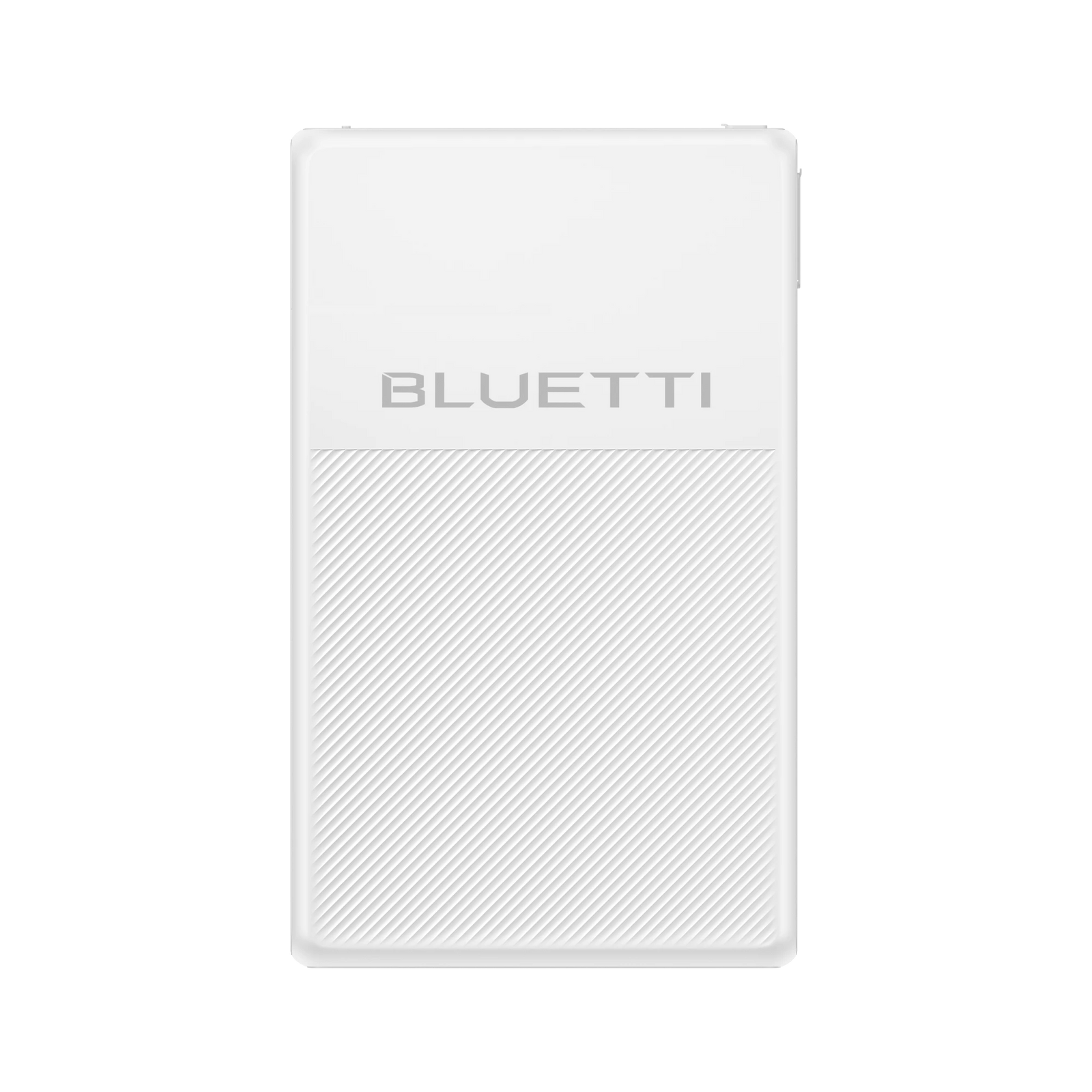 Fridge-shaped
15–23 h of cold · 2,016 Wh
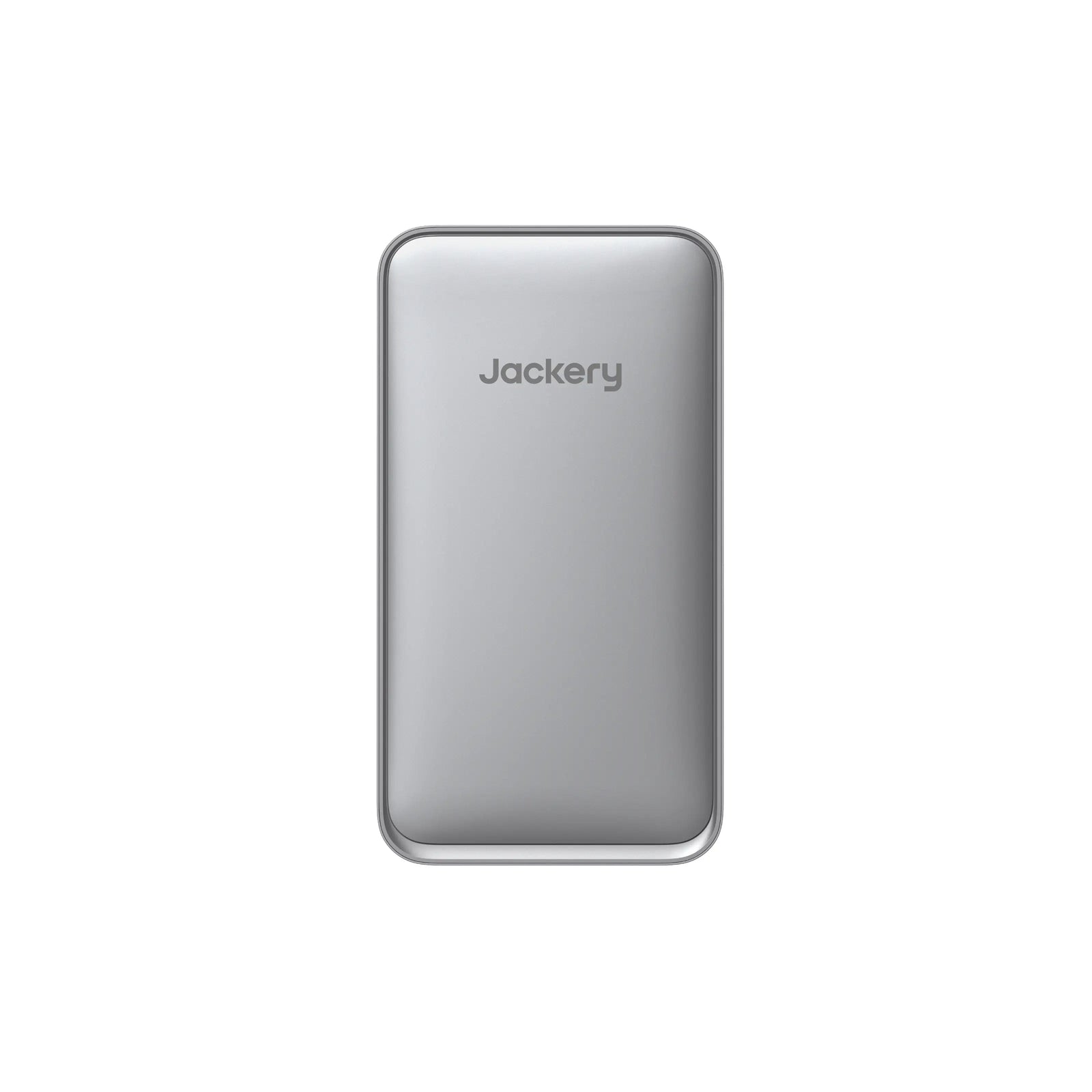 Fridge-shaped
8–12 h of cold · 1,024 Wh
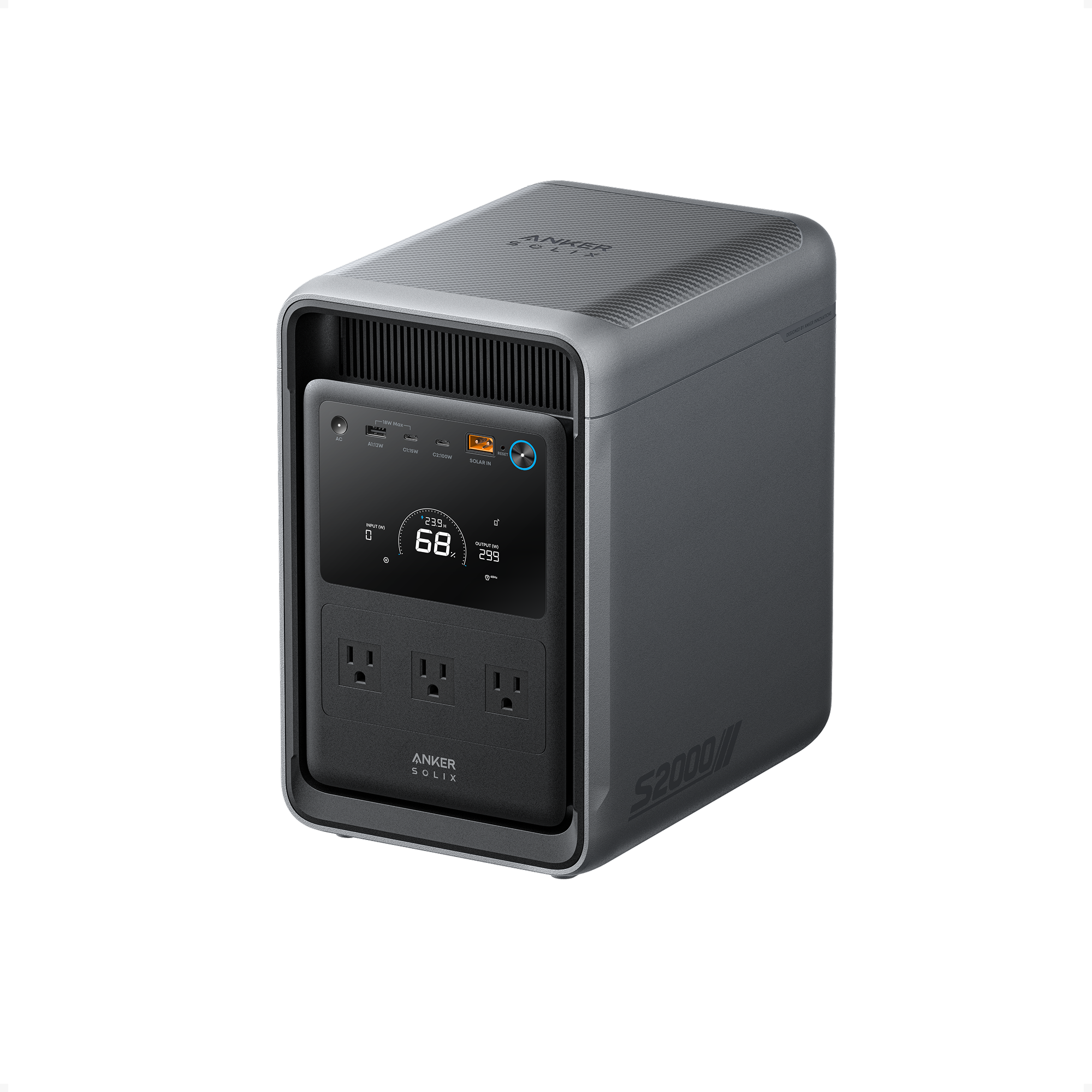 General-purpose
15–23 h of cold · 2,010 Wh
 General-purpose
8–12 h of cold · 1,024 Wh
The short version · as of October 22, 2026
- A closed fridge keeps food safe for about 4 hours on its own, a full freezer 48.[3] A battery’s job is what comes after that, and a lot of outages never get there.
- A 2 kWh BLUETTI FridgePower keeps a typical bottom-freezer or French-door fridge cold for 15 to 23 hours. So does the 2 kWh Anker SOLIX S2000, for $199 less today. The fridge-shaped unit buys a shape, a solar port and room to grow, not hours.
- The Jackery FridgeGuard is half the tank: 8 to 12 hours on the same fridge, with a 1,600 W surge that clears an ordinary compressor and gets tight on a big one.
- The spread in every one of those bands is the number no maker prints: what the station burns holding its inverter ready while the compressor rests. On this fridge it is worth 5 hours on the FridgePower and 2.5 on the FridgeGuard. We are measuring it.
- Two settings decide whether the food survives a week away, and both ship off or unstated: whether the output comes back when the grid does, and whether the unit switches itself off because a resting fridge looks like nothing plugged in.
Which one, in one line each
The best power station for a refrigerator depends on what else the station is for. Hours are for a bottom-freezer or French-door fridge; prices are today’s.
The fridge is the only job and you want the battery to vanish
BLUETTI FridgePower. 15–23 hours, 3.1 in thick, stands in the gap, solar port on the unit, grows to 8,064 Wh.
One box for the fridge and everything else in the house
Anker SOLIX S2000. The same 15–23 hours for $199 less, 5 outlets and USB, and it goes camping.
A smaller fridge, a renter, or nowhere to put a box
Jackery FridgeGuard. 8–12 hours on a bottom-freezer or French-door fridge, 23 lb, lies flat on top of the fridge. While it is sold out, the Jackery HomePower 1000 Plus v2 is the same tank in a box.
The clock
Does your fridge even need a battery?
Start with what the fridge does for free.
Shut the door and a refrigerator holds a safe temperature for about 4 hours. A full freezer holds it for about 48, a half-full one 24, and food that stayed under 40 °F is food you keep.[3] That is the USDA’s clock, and it is the only clock that matters here.
So a battery is not “backup for the fridge”. It is a way to push the start of that 4-hour window later. A 2 kWh unit pushes it 15 hours to 23 hours; add the window itself and the food is safe for 19 to 27 hours from the moment the wall goes dead.
If your outages are an evening, you do not need any of this. Keep the door shut. One viewer put the arithmetic plainly:
“I do not need a $1000 battery backup to protect $150-$200 dollars worth of food, should the power outage last longer than 4 hours for the refrigerator or 24-48 hours for a freezer.”
He is right about his house. He is wrong about a house with a chest freezer full of a hunting season, insulin in the door, a baby’s milk, or a grid that goes down for three days every winter. This page is for the second house, and for anyone deciding whether they live in it.
Our medical outage planner handles the insulin case on its own terms. Here, the question is the fridge.
The start
Will the compressor restart on battery?
Hours are the second question. The first is whether it starts at all.
A fridge compressor runs at about 90 to 150 W. To start, it draws several times that for a fraction of a second, against the pressure left in the system from the last cycle. One owner put a meter on the cord of his and wrote down what it said:[8]
“Powered a 20cu-ft fridge 16 hours straight; 700-800W surge, ~150W running, 52W average.”
Big side-by-side and French-door compressors start harder. We carry a band of 700 to 1,500 W until we clamp our own.
Assumption · replaced by run R2 The start band is one owner’s clamp reading plus headroom for larger compressors. Run R2 of our test clamps five starts on our own fridge.
The Jackery FridgeGuard is the one to watch. Its 1,600 W surge is twice its 800 W rating and clears an ordinary top-freezer. It has no spare over a 1,500 W start, and no room at all for a second compressor. The FridgePower, the SOLIX S2000 and the DELTA 3 Plus clear the band with a third or more to spare; two fridges starting at once, 3,000 W, clears on the FridgePower and does not clear on the FridgeGuard.
Then there is the heater. Every frost-free fridge has a resistive element behind the freezer’s coils that runs 1 or 2 times a day for 15 to 25 minutes at 400 to 600 W, with the compressor off. Its energy is already inside the label figure, because the government test includes it.[2] What it changes is what the station sees at that moment: a fridge drawing 600 W and an app predicting half an hour of runtime, which is exactly what one DELTA 2 owner saw and could not explain.[8] It passes. That is 100 to 500 Wh a day, a few hundred watt-hours, not a new load.
“Refrigerators just don’t have a compressor, they also have defrost cycles 2 to 3 times a day, and that has to be added in.”
And the moment the wall goes dead. All four units here switch from wall to battery in 10 ms or less by their makers’ figures, which a compressor never notices. A station with a relay that takes a second or two is a different story, because the compressor stops against full head pressure and tries to restart into it:
“If the fridge happened to be mid cycle, ie. with compressor running while the power dropped, it would for some reason cause it to go into an overload loop.”
That is the case for a true UPS switchover on a fridge, and it is also the case against pulling plugs to test one: a compressor hates being cycled off and straight back on. Our test plan pulls the wall plug with the compressor running, at rest, and mid-defrost, and logs what the fridge does each time.
The tank
How long does each one keep it cold?
We start from what the fridge actually uses, by shape.
ENERGY STAR publishes a tested annual figure for every certified model, 4,889 of them as of October 22, 2026.[1] We cut that list into five shapes and took the median of each. A typical bottom-freezer or French-door fridge of 20.3 cu ft uses 569 kWh a year, which is 1.6 kWh a day, an average of 65 W around the clock. The smallest shape, a compact or dorm fridge, averages 26 W; a large French door with ice and water in the door averages 84.
The test behind those figures runs with the doors shut in a 90 °F room, the heat standing in for door openings, defrost cycles included.[2] A kitchen at room temperature with ordinary door traffic lands near the label. A garage in July, worn seals, an ice maker filling, or a fridge packed warm after a shopping trip land above it. We carry a “hard day” at 25% over the label as the bottom of every band.
Assumption · replaced by run R1 The hard-day factor is a planning margin, not a measurement. Run R1 logs our fridge for a day against its own label and replaces it with the measured ratio.
Then the battery. We count 85% of each unit’s rated watt-hours as reaching the fridge through the inverter, the same share our EV story uses, and we add what the inverter burns standing ready, which gets its own section below. Hours are what is left divided by the fridge’s average draw plus that idle figure.
Hours of safe food from the moment the wall goes dead · a bottom-freezer or French-door fridge
Solid: hours on a hard day with the inverter idling at 30 W. Faded: at the label with it idling at 10 W. Grey: the USDA’s closed-door window after the battery quits.
| Your fridge | LabelkWh/yr · W avg | BLUETTI FridgePower2,016 Wh | Jackery FridgeGuard1,024 Wh | Anker SOLIX S20002,010 Wh | EcoFlow DELTA 3 Plus1,024 Wh |
|---|---|---|---|---|---|
| Compact or dorm fridgeunder 5 cu ft · median of 1,391 models | 228 · 26 W | 27–48 h | 14–24 h | 27–47 h | 14–24 h |
| Top-freezer16–20 cu ft · median of 395 models | 366 · 42 W | 21–33 h | 11–17 h | 21–33 h | 11–17 h |
| Bottom-freezer or French door18–24 cu ft · median of 722 models | 569 · 65 W | 15–23 h | 8–12 h | 15–23 h | 8–12 h |
| Side-by-side22–28 cu ft · median of 75 models | 647 · 74 W | 14–20 h | 7–10 h | 14–20 h | 7–10 h |
| French door with ice and water in the door25 cu ft and up · median of 209 models | 733 · 84 W | 13–18 h | 6.5–9.5 h | 13–18 h | 6.5–9.5 h |
Hours on battery, hard day at 30 W idle to label day at 10 W idle. Add 4 hours of closed-door grace for the time your food is actually safe.
Read the top row and the bottom one together. A dorm fridge on the FridgePower runs 27 to 48 hours; the big French door on the FridgeGuard runs 6.5 to 9.5. The fridge decides the answer at least as much as the battery, and nobody selling a fridge battery asks which fridge.
Against our own fridge: not yet. The test below logs one kitchen fridge on our own EcoFlow DELTA 3 Plus until it quits, and the model’s error against that number will print here, whatever it is.
The number no maker prints
What the station burns doing nothing
A fridge rests most of the day. The inverter does not.
Between compressor cycles a refrigerator draws a few watts: a light, a control board, a fan. The station holding an AC outlet live for it burns its own power the whole time, converting nothing. On a load this small that is not a rounding error, and owners who measure it report that low-wattage loads get far less runtime than the capacity suggests.[8]
Here is everything that has been said about it. BLUETTI advertises a 4 W standby for the FridgePower.[11] Anker’s product lead told CNET the industry’s typical idle draw is 15 to 20 W.[9] And when CNET ran a FridgePower flat on a real fridge, it lost 328 Wh of a measured 1,621 to the inverter over 23.4 hours, which is 14 W of standby and conversion loss together.[9] Neither Jackery nor Anker states a figure for the units here.
So the honest band is 10 to 30 W, with BLUETTI’s claim under its floor and CNET’s measurement inside it, and the chart shows what that unknown is worth on a bottom-freezer or French-door fridge:
Assumption · replaced by run R3 The idle band is an assumption. Run R3 of our test reads each unit’s battery over two hours with the AC output on and nothing plugged in, then with it off.
That spread is why the two pages on the web with actual numbers disagree by a day: a lab’s run-down of a 2 kWh unit came to 23.4 hours and a formula page’s headline says 14, from a rule of 7 to 14 hours per kilowatt-hour that contradicts the page’s own daily figures.[9][10] It is also the one place a purpose-built fridge unit could earn its price: a smaller inverter sized for one appliance should idle lower than a 1,500 W general-purpose one, and BLUETTI’s 4 W is that claim. The manual itself gives an ECO mode and a power-lifting mode and no idle figure.[4]
Reproduce or refute
What the makers claim, and what one lab measured
Every claim here can be run backwards.
A maker says hours; we ask what fridge would have to be plugged in for the hours to hold. The answer is a watt figure, and ENERGY STAR says which shapes of fridge draw that little at the label.
| The claim | The fridge it names | Fridge it needsW avg, idle 10–30 W | Which fridges draw that at the label |
|---|---|---|---|
| BLUETTI FridgePower: “Runs longer (24+ hrs)”[11] | 18–22 cu ft, standard cycling, watts unstated | 41–61 W | Up to a top-freezer fridge (42 W), at the label, on a good day |
| BLUETTI FridgePower: “up to 4 days of backup”[12] | with three expansion batteries, 8,064 Wh in all | 41–61 W | Up to a top-freezer fridge (42 W), at the label, on a good day |
| Jackery FridgeGuard: “up to 15 hours of backup power”[15] | not stated (launch press material; the product page states no hours) | 28–48 W | Up to a top-freezer fridge (42 W), at the label, on a good day |
| Anker SOLIX S2000: “up to 35 hours of stated refrigerator backup under suitable conditions”[16] | not stated | 19–39 W | Up to a compact or dorm fridge (26 W), at the label, on a good day |
Read that way, BLUETTI’s “Runs longer (24+ hrs)” is true of a top-freezer at the label and not of the bottom-freezer or French-door fridge most kitchens hold, where our band tops out at 23 hours. Jackery’s 15 hours needs a fridge under 48 W, which is a top-freezer on its best day; on the median fridge the FridgeGuard runs 8 to 12. Anker’s 35 hours needs a fridge under 39 W, which is a dorm fridge. None of the three names the fridge, and Jackery’s product page states no hours at all; its calculator divides usable watt-hours by whatever wattage you type, so a shopper who enters a 150 W nameplate is told 5.1 hours.[14]
One lab has actually done it. CNET ran 19 stations on a full-size Whirlpool until each quit. The FridgePower lasted 23.4 hours and delivered 1,621 Wh, of which 328 went to the inverter.[9] Those three figures say the fridge averaged 55 W, a closed-door lab fridge. Put that fridge through our model and it gives 17 to 26 hours, with CNET’s 23.4 inside the band; at CNET’s own measured overhead the model says 25, 6% high. That is the first check on the arithmetic, and our own trace is the second.
“Based on the energy usage of my fridge, this battery would keep my fridge online just a bit longer than Bluetti actually advertises. I should be able to squeeze about 23 hours out of it w/ normal usage patterns.”
An Amazon reviewer with a plug meter on a 27 cu ft French door came to the same place from the other direction: 23 hours projected from his own fridge’s draw, a little over what BLUETTI advertises, on the biggest shape in our table.[13] He then said the thing this page is about:
“Went with this over their S2000 and am glad that I chose form factor over the better inverter performance. Not having a box sitting on the countertop is worth it.”
The money
Fridge-shaped, or just a battery?
Line the twins up and the hours match. The prices don’t.
The BLUETTI FridgePower holds 2,016 Wh. The Anker SOLIX S2000 holds 2,010. On a bottom-freezer or French-door fridge they run 15 to 23 hours and 15 to 23, the same band, and today the SOLIX S2000 is $199 cheaper. The same pairing holds one size down: the FridgeGuard and the EcoFlow DELTA 3 Plus both hold 1,024 Wh.
So what does the fridge shape buy?
BLUETTI FridgePower
Built for one appliance
$899
- Tank
- 2,016 Wh, grows to 8,064
- Starts
- Clears it 3,600 W surge over 1,800 W
- Switches
- Seamless 10 ms
- Plugs
- 2 AC outlets, no USB
- Shape
- 3.1 in thick, 43 lb: stands behind or beside the fridge
- Solar
- 1,000 W, XT60 on the unit
- Comes back
- System Switch Recovery, off by default
- Cold per dollar
- $1,400 per day of cold, hard day
Jackery FridgeGuard
Built for one appliance
$729
- Tank
- 1,024 Wh, grows to 2,048
- Starts
- Tight 1,600 W surge over 800 W
- Switches
- Seamless 10 ms
- Plugs
- 1 AC outlet, no USB
- Shape
- 2.6 in thick, 23 lb: lies flat on top of the fridge, or on a bracket
- Solar
- 500 W, needs the separate DC Input Module
- Comes back
- not stated
- Cold per dollar
- $2,235 per day of cold, hard day
Anker SOLIX S2000
A general-purpose station
$700
- Tank
- 2,010 Wh, no expansion
- Starts
- Clears it 3,000 W surge over 1,500 W
- Switches
- Seamless 10 ms
- Plugs
- 5 AC outlets, USB
- Shape
- 36 lb box on the floor or counter
- Solar
- 400 W, XT60i
- Comes back
- not stated
- Cold per dollar
- $1,094 per day of cold, hard day
EcoFlow DELTA 3 Plus
A general-purpose station
$719
- Tank
- 1,024 Wh, grows to 5,000
- Starts
- Clears it 3,600 W surge over 1,800 W
- Switches
- Seamless 10 ms
- Plugs
- 6 AC outlets, USB
- Shape
- 27 lb box on the floor or counter
- Solar
- 1,000 W, XT60
- Comes back
- not stated
- Cold per dollar
- $2,204 per day of cold, hard day
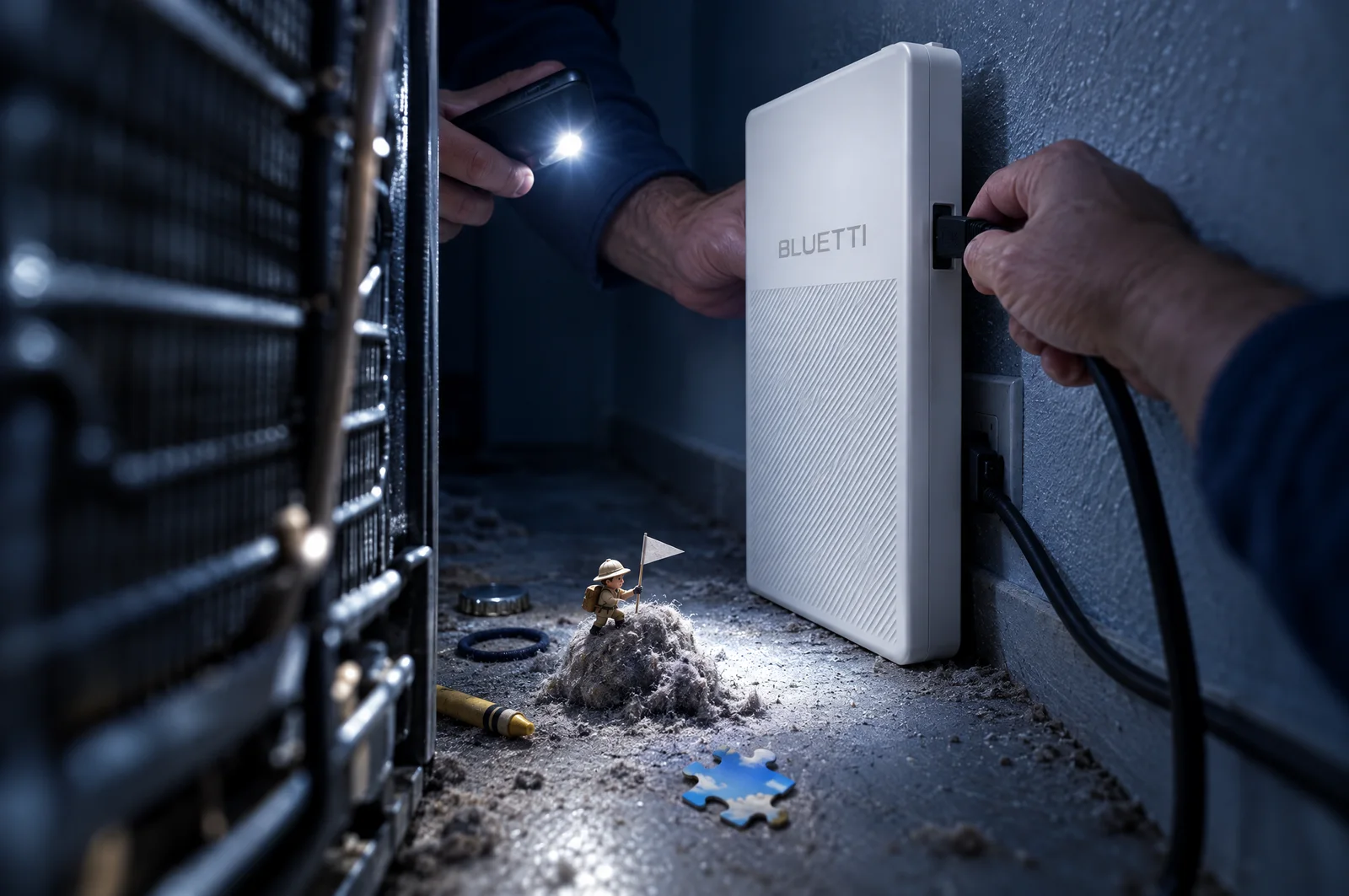
What the FridgePower buys. A slab 3.1 in thick that stands behind the fridge where the plug already is, so the fridge never moves and the kitchen never sees a box. A solar port on the unit, 1,000 W of it, which the SOLIX S2000 cannot match. An expansion port that takes it to 8,064 Wh, which the SOLIX S2000 does not have. And a bypass that passes the wall straight through at up to 1,800 W, so the fridge is on the grid until it isn’t.[4]
“My fridge lives in an alcove in my kitchen, and wrestling it out to get at its plug is a problem, especially if the lights are out.”
What it costs you. No USB of any kind, 2 outlets instead of 5, 43 lb instead of 36, and a unit that is useless on a camping trip. If the fridge is the only job, none of that matters. If the fridge is the first of five jobs, the general-purpose station does all five.
Mind where you buy
On the day we read it, the FridgePower was $1,499 on Amazon, sold by BLUETTI, against $899 on BLUETTI’s own store.[13] The FridgeGuard is not sold on Amazon at all; a search there hands you the FridgePower first. And on Jackery’s own site the FridgeGuard was sold out, with the page steering shoppers to the Jackery HomePower 1000 Plus v2: the same 1,024 Wh and 10 ms switchover in an ordinary box, with a bigger inverter, at $749.[14] This week, the FridgeGuard’s real competitor is Jackery’s own general-purpose unit.
The FridgeGuard is a different bet. It is 2.6 in thick and 23 lb, built to sit on top of the fridge, with 1 outlet and an 800 W inverter that only has to run one appliance. Half the tank of the FridgePower at most of the price, and solar only through a module sold separately.[5] It makes sense for a renter with one fridge and nowhere to put a box; it makes less sense than the DELTA 3 Plus for anyone who wants the same 1,024 Wh to do anything else.
The vacation
What happens when the battery dies, and when the wall comes back
This is the question the brochures skip, and the one an owner asked first.
“If I go on vacation and use the system in UPS mode for my refrigerator and freezer and the battery goes dead, does either system turn back on when the power is restored?”
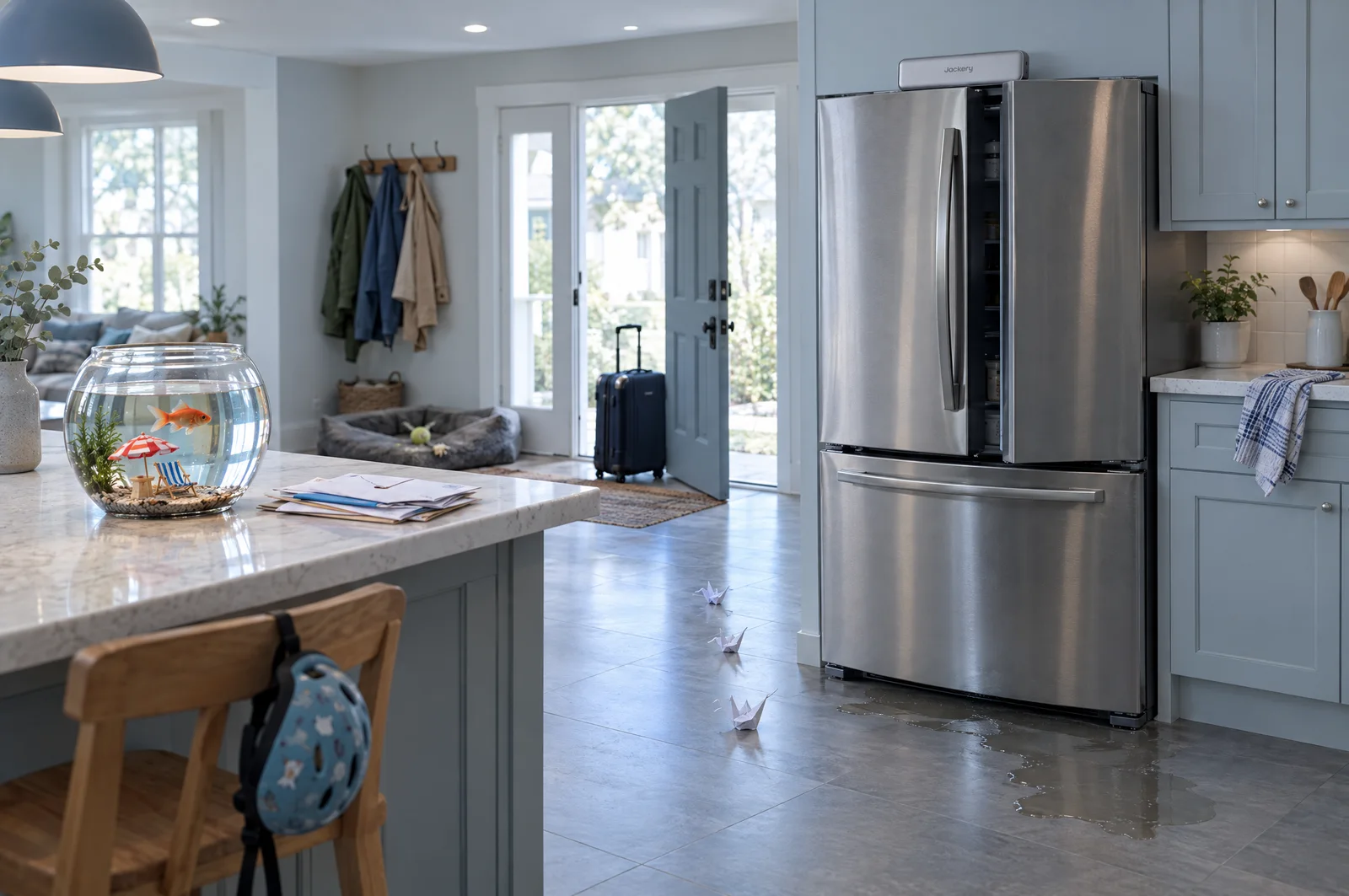
Picture it. You are away for a week. The grid drops on Tuesday night, the fridge runs on battery until Wednesday afternoon, the battery empties and shuts its output off. The grid comes back Wednesday night. Does the fridge come back with it?
On the FridgePower, only if you turned a setting on. BLUETTI calls it System Switch Recovery: the unit remembers that the AC output was on before a low-battery shutdown and restores it on restart. It is off by default, and lives in the app.[4] Leave it off and the fridge sits dark in a powered house until you get home.
The second trap is the opposite one. A resting fridge draws a few watts, which looks to a station like nothing plugged in. Most stations have a low-load timeout for exactly that, and it is a good idea on a camping trip and a terrible one on a fridge. The FridgePower’s is called AC-ECO, off by default, and the manual says in so many words to leave it off for refrigerators.[4] The FridgeGuard shipped with a low-load standby that switched the output off after about two hours, and reviewers made it the headline until Jackery changed it in a firmware update that summer.[6]
“Any standby unit that shuts down after two hours is a def no. They better update that quickly.”
Neither general-purpose station here states what it does on grid return, and both carry an AC timeout whose default we have not confirmed. Our test runs each unit through both cases and records the setting name and its default, which is the kind of fact that belongs on a spec sheet and is not on any of them.
Day two
Refilling it when the outage outlasts the tank
Every band on this page is one charge.
A bottom-freezer or French-door fridge wants 1.6 kWh a day. At their rated input, which panels rarely give for long, the FridgePower’s 1,000 W of solar makes that back in 1.5 hours of sun, the DELTA 3 Plus’s 1,000 W in 1.5, the SOLIX S2000’s 400 W in 4, and the FridgeGuard’s 500 W, through its add-on module, in 3. Real panels, real weather and the inverter’s own appetite stretch all of those; our system builder runs the sun for your zip code.
A gas generator refills any of them faster, and the FridgePower is built to take one on its AC input, the manual asks only that it be a clean sine-wave unit that meets the charger’s input.[4] And an EV with vehicle-to-load refills a station from its charge port, which is the pairing our EV story lands on.
What we will measure
One fridge, one second at a time
Three numbers on this page are assumptions, and we have said which.
The hard-day factor, the idle band and the start band. Our test replaces all three with one kitchen fridge logged at one-second resolution: a day on the wall against its own label, five clamped compressor starts, two hours of each station doing nothing, nine wall-plug pulls with the compressor running, resting and mid-defrost, a run-down to cutoff on our own EcoFlow DELTA 3 Plus, and then the two vacation questions: does the output come back when the wall does, and does it ever switch itself off on a resting fridge.
The trace publishes as a CSV with the page, and the model’s error against the measured hours prints in the hours section above, whatever it turns out to be. The same runs apply to a FridgePower or FridgeGuard when one is on the bench, and the makers’ own “days” claims are the figures to reproduce or refute.
If you own a plug-in power meter and a fridge, you can run the first day yourself: log it for a day, read your fridge’s label, and send us both. Three owners’ traces beside ours would be worth more than any review.
Questions people ask
Before you buy one
- Do I plug the fridge into the battery and the battery into the wall, or do I have to be home to switch it?
- The first. Every unit on this page is a pass-through: the fridge plugs into the station, the station into the wall, and the station hands over in 10 ms when the wall dies. Nobody has to be home. What has to be right are the two settings in the vacation section.
- Can one unit run two fridges, or a fridge and a chest freezer?
- Running, yes, on any of them: two compressors together draw well under 800 W. Starting is the gate. Two starts at once is up to 3,000 W, which the FridgePower, SOLIX S2000 and DELTA 3 Plus clear and the FridgeGuard does not. The FridgeGuard also has 1 outlet.
- Does the fridge shape change the hours?
- No. Hours come from the tank and the fridge, and a 2,016 Wh slab and a 2,010 Wh box land in the same band. The shape changes where it lives, what else it can do, and, possibly, the idle figure, which we are measuring.
- Can I charge it from the solar panels I already have?
- The FridgePower has an XT60 port on the unit for up to 1,000 W, which most folding and rigid panels reach with a common adapter. The FridgeGuard has no solar input on the unit; it needs Jackery’s DC Input Module and then takes 500 W. Check your panels’ open-circuit voltage against each unit’s window before you connect anything; our panel chart lists it.
- Will it fit in the cabinet over the fridge, and does it need air?
- The FridgeGuard is built for that spot at 2.6 in thick and 23 lb, and it has heat vents that need to breathe. The FridgePower is a floor-standing slab at 43 lb, rated for use up to 104 °F, so a closed cabinet over a running fridge is the wrong place for it; it stands behind or beside the fridge.[4]
- Can it cut my electric bill by running the fridge off-peak?
- Both dedicated units schedule charging and discharging by time of use in their apps.[4] On a bottom-freezer or French-door fridge that is 1.6 kWh a day shifted, which at most tariffs is a few cents; cycling a battery that costs $899 to save it is a hobby, not a plan. A whole-home battery with the house on it is the version that pays.
- How long do they last?
- BLUETTI rates the FridgePower at 4,000 to 80% and warrants it 5 years; Jackery rates the FridgeGuard at 6,000 to 70% with the same 5-year warranty.[5] Sitting on a wall outlet at full charge most of its life, a unit will see a few dozen real cycles a year, so calendar age, not cycles, is what wears it.
- I cannot move my fridge. Which one?
- Neither needs it moved. The fridge stays where it is and its plug goes into the unit instead of the wall; the unit’s own cord reaches the outlet. The FridgeGuard at 23 lb is the one a person can lift onto the fridge alone; the FridgePower at 43 lb slides in behind or beside it.
Sources
Where every figure comes from
- [1]ENERGY STAR (U.S. EPA). ENERGY STAR Certified Residential Refrigerators: tested annual energy use (kWh/yr) by model. pulled October 22, 2026
- [2]U.S. Department of Energy. 10 CFR 430, Subpart B, Appendix A: uniform test method for refrigerators (doors closed, 90 °F ambient standing in for door openings, defrost cycles included). read October 22, 2026
- [3]USDA Food Safety and Inspection Service. Keeping food safe during an emergency: a refrigerator keeps food safe about 4 hours unopened; a full freezer about 48 hours, half-full 24. read October 22, 2026
- [4]BLUETTI. FridgePower user manual: §6.4 ECO mode (disable for refrigerators), §5.1 System Switch Recovery, §7 UPS ≤ 10 ms, §12 specifications. read October 22, 2026
- [5]Power Station Arena. Appliance-UPS spec evidence ledger: FridgePower and FridgeGuard, every field to the maker’s manual and product page. September 12, 2026
- [6]The Solar Lab (YouTube). Jackery FIXED The FridgeGuard’s Major Flaw: the low-load shutdown, and the firmware change. July 21, 2026
- [7]Viewers of The Solar Lab and HOBOTECH (YouTube). Owner comments under the FridgePower and FridgeGuard reviews: defrost heaters, idle draw, mid-cycle switchover. read October 22, 2026
- [8]Power Station Arena. Owner voice: 266 fridge-related claims from YouTube comments, graded by specificity (measured, experience, hearsay). read October 22, 2026
- [9]CNET. We tested 19 portable power stations: these 4 will keep your fridge running the longest (each run on a full-size Whirlpool until empty; FridgePower 23.4 h, 328 Wh of overhead). July 23, 2026
- [10]PowerOutage.us. How long will a power station run my refrigerator? (a formula page: "7 to 14 hours per 1,000 Wh"). read October 22, 2026
- [11]BLUETTI. FridgePower smart UPS fridge backup: "Runs longer (24+ hrs)", "self-consumption to only 4 W", 10 ms switchover. read October 22, 2026
- [12]BLUETTI. FridgePower product page: $899 (from $949), "up to 4 days of backup" at 8,064 Wh. read October 22, 2026
- [13]Amazon. BLUETTI FridgePower listing: $1,499, sold by Bluetti; a reviewer’s plug-meter projection of 23 hours on a 27 cu ft French door. read October 22, 2026
- [14]Jackery. FridgeGuard product page: $729, sold out; Bypass, Delay Start and UPS modes; runtime calculator (150 W → 5.1 h); redirect to the HomePower 1000 Plus v2. read October 22, 2026
- [15]Notebookcheck. Jackery launches new FridgeGuard power station: "up to 15 hours of backup power". June 17, 2026
- [16]Anker SOLIX. How long can a portable power station run a refrigerator? ("several hours to roughly two days"; S2000 "up to 35 hours"). September 15, 2026
- [17]Power Station Arena. Catalogue rows, each spec to the maker’s manual or product page. October 22, 2026
Fridge-shaped
BLUETTI FridgePower
$899