Head-to-head test
EcoFlow RIVER 2 vs Jackery Explorer 300D
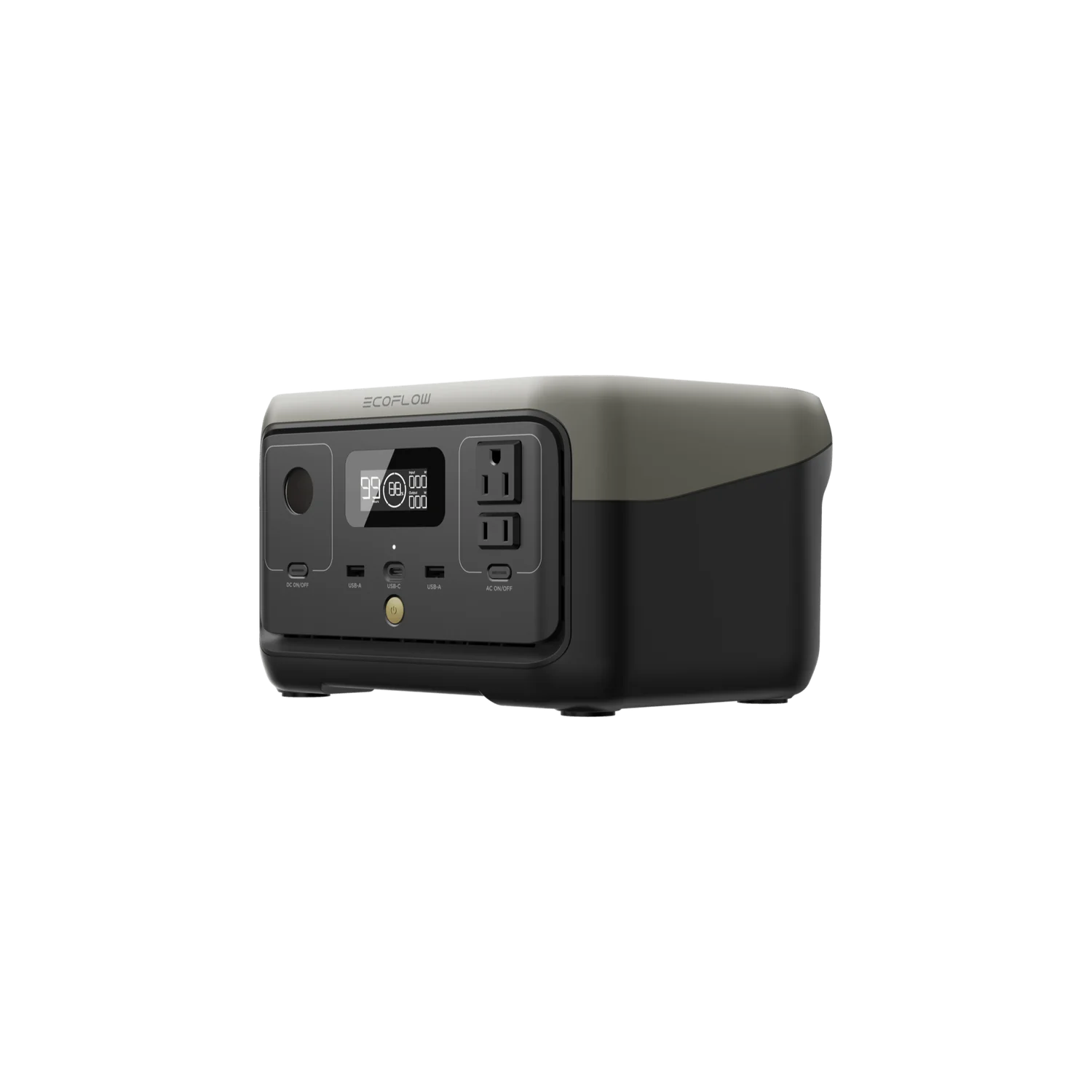
At about the same price — the RIVER 2 now runs $209 to the Explorer 300D's $179 — the RIVER 2 plugs in twice and is covered for five years instead of three. That's a narrower case than it used to be, but for buyers who want two AC outlets and the longer warranty it still edges a close call.
Full profiles: EcoFlow RIVER 2 → · Jackery Explorer 300D →

Written by Wenny ZhengUpdated
Portable Power Tester, Station Arena Test Desk
$209.00 · direct from EcoFlow
Last checked 20 days ago. Prices move — check before you buy.

$209.00 · direct from Jackery
Last checked 1 day ago. Prices move — check before you buy.
Spec deltas
The RIVER 2 has two AC outlets to the Explorer 300D's one — but the price advantage that used to anchor this comparison is gone. At $209 against $179, the RIVER 2 now costs about $30 more, so the outlet count and the warranty do more of the work than the sticker does.
The Explorer 300D answers on refinement and now on price too. It's quieter under load (45dB against the RIVER 2's under-50), switches to battery faster (under 20ms against under 30), and its fastest USB-C port pushes 100W to the RIVER 2's 60 — and it holds slightly more charge for slightly less money. Those are real advantages for a laptop-charging traveler; what the RIVER 2 gives back is the second outlet and two more years of warranty.
Both hold roughly the same charge — 256Wh against 288Wh, a difference you won't notice in daily use — and both are rated for 3,000 cycles. The decision comes down to what you value more: two outlets and a longer warranty, or a quieter fan, faster ports, a bit more capacity, and a slightly lower price. It's close enough that either can be the right pick; for buyers who want the second outlet and the coverage, the RIVER 2 still edges it.
What the Numbers Reveal
Each conclusion stated first — the numbers behind it on one line, the full analysis below.
Typical price
Run the warranty math and the RIVER 2 pulls ahead where the sticker doesn't: $38 per covered year against $60 on the Explorer, so the slightly pricier unit is the longer-insured one and the cheaper one to carry coverage on.
RIVER 2 has 2 AC outlets and costs $209Explorer 300D has 1 AC outlet and costs $179RIVER 2 is backed for 5 years against the Explorer's 3
Why it mattersAnyone who wants to run two AC-powered things at once — a lamp and a laptop brick, say — gets that from the RIVER 2 for roughly the same money as the Explorer's single outlet, plus the longer warranty.
Neither number is dramatic alone, but stacked together they describe the same story: the RIVER 2 is the oldest design in EcoFlow's current lineup, and it shows in the two specs where refinement usually shows up first.
RIVER 2 rated under 50dB, Explorer 300D rated 45dB under loadRIVER 2 switches to battery in under 30ms, Explorer in under 20ms
Why it mattersIf this is sitting on a nightstand for a CPAP or guarding a router through power blips, the Explorer's fan and switchover edge are worth more than the extra outlet.
That's a generational split in what each box assumes you're charging: the Explorer is built around modern USB-C laptops and drones, the RIVER 2 around an older mix of USB-A phones and accessories.
Explorer 300D's fastest USB-C port outputs 100W across 2 USB-C portsRIVER 2's single USB-C port tops out at 60WRIVER 2 has 2 USB-A ports against the Explorer's 1
Why it mattersIf your gear is all USB-C, the Explorer's ports do more work per charge; if you're still charging USB-A devices, the RIVER 2's extra port matters more than its wattage deficit.
The specific dimensions that decide these two units — everything else is a tie.
Lifetime Value
Selected because: Price and warranty-per-year is the sharpest lever between two similarly sized units.
cost / lifetime kWh
$209 against $179 is nearly a wash on sticker, so the warranty math matters more than the price tag here. Spread each price across its warranty and the RIVER 2 costs $38 per covered year against the Explorer's $60 — the slightly pricier unit is the one insured for longer, which pulls the per-year cost back in its favor.
Cost per lifetime kWh runs the other way, though: $0.25 for the RIVER 2 against $0.21 for the Explorer, which holds more capacity for less money. Neither number changes the runtime you get on a given afternoon, but on pure energy-per-dollar the Explorer is now the cheaper box to have bought.
What the Specs Don't Tell You
Selected because: Noise and UPS speed both point to the Explorer even though outlets and warranty point to the RIVER 2 — worth surfacing plainly.
rated cycles
Two cards fire here, and they split. The RIVER 2 is the louder one at under 50dB against the Explorer's 45, and it's the slower one to switch to battery, under 30ms against under 20. Both gaps trace to the same fact: the RIVER 2 is the oldest design in EcoFlow's current lineup, and the fan tuning and switchover speed EcoFlow built into later models simply isn't here yet.
Neither gap is disqualifying for most buyers. A few decibels is audible side by side, not across a room, and a switchover gap this size only matters for gear that can't tolerate any interruption at all — a desktop, not a lamp. Weigh it against the extra outlet and the two extra warranty years the RIVER 2 gives back, and the case still leans its way.
Portability & Form Factor
Selected because: Weight, outlet count, and port mix cover the physical differences a buyer actually feels.
weight
Both are light enough to carry in one hand — 7.8 lbs for the RIVER 2 against 8.27 for the Explorer, less than half a pound apart. The bigger physical difference is in the ports: the RIVER 2 carries two AC outlets and two USB-A ports, the Explorer one AC outlet and two USB-C ports.
That's less a weight question than a what's-in-your-bag question. Two AC outlets means the RIVER 2 can run a lamp and charge a laptop brick at the same time; the Explorer's single outlet means picking one.
Brand Trust
Selected because: Cross-brand pair; EcoFlow's ecosystem and support track record differ meaningfully from Jackery's.
EcoFlow runs the larger ecosystem here — a dozen-plus models across DELTA and RIVER lines, the largest owner community in the category, and support that's polarized but generally reachable by phone. Jackery's community is a fraction of that size, and its app is the weakest-reviewed of the major brands.
Jackery's real card is retail reach — Costco, Home Depot, Best Buy, Amazon — which matters more than usual on a sub-$200 purchase, since a bad unit is easiest to return where you bought it. That's a genuine reason to buy the Explorer from one of those stores if you go that direction, and at these near-identical prices it's a real thumb on the scale.
Strengths & trade-offs
EcoFlow RIVER 2
Strengths
- +Longer warranty
- +Faster solar charging
Trade-offs
- –Shorter-lived battery — rated for 3,000 charge cycles vs the Explorer 300D's 4,000, so it wears out sooner.
Jackery Explorer 300D
Strengths
- +Costs $30 less
- +Lighter by 2.3 lb
- +Larger battery capacity
- +Rated for 4,000 charge cycles — much longer battery lifespan
Trade-offs
- –No major technical downsides compared to rival.
Will It Power Your Gear?
Scenario math and per-appliance runtimes, modeled from the spec record.
Scenario verdicts
We ran the math on seven real-world scenarios. Here's which unit survives your actual life.
SCN-01 · 2 nights · needs 2,100Wh
Weekend Camping
Two nights off-grid with essential comfort
Neither unit
The Explorer 300D has no AC outlets, so the led lights and box fan in this scenario never plug in — it's a DC station for USB and 12V gear, and no wattage figure changes that, so capacity never gets a say. This is the wrong kind of unit for the job rather than a close call. The RIVER 2 doesn't have the energy either — 218Wh usable against 2,100Wh, 1,882Wh short — so neither route works.
Battery budget usedlower = more headroom
LOAD Phone Charger 15W×6h · LED Lights 40W×8h · Box Fan 75W×14h · CPAP Machine 40W×16h
SCN-02 · 8 hours · needs 1,645Wh
8-Hour Blackout
Keep the essentials running through a night without power
Neither unit
The Explorer 300D has no AC outlets, so the fridge, router + modem and the rest in this scenario never plug in — it's a DC station for USB and 12V gear, and no wattage figure changes that, so capacity never gets a say. This is the wrong kind of unit for the job rather than a close call. The RIVER 2 doesn't have the energy either — 218Wh usable against 1,645Wh, 1,427Wh short — so neither route works.
Battery budget usedlower = more headroom
LOAD Fridge 150W×8h · Router + Modem 20W×8h · LED Lights (4 bulbs) 40W×6h · Phone Charger 15W×3h
SCN-03 · 8 hours · needs 320Wh
CPAP Overnight
Sleep therapy without interruption — the #1 medical use case
Neither unit
Neither unit covers this scenario's 320Wh: the RIVER 2 comes up 102Wh short (about 68% covered), the Explorer 300D 75Wh (76%). Either gets you most of the way, so this is a scenario you plan around rather than one you should rule them out for.
Battery budget usedlower = more headroom
LOAD CPAP Machine 40W×8h
SCN-04 · 8 hours · needs 910Wh
Remote Workday
Full work day off-grid without power anxiety
Neither unit
The Explorer 300D has no AC outlets, so the external monitor and router + modem in this scenario never plug in — it's a DC station for USB and 12V gear, and no wattage figure changes that, so capacity never gets a say. This is the wrong kind of unit for the job rather than a close call. The RIVER 2 doesn't have the energy either — 218Wh usable against 910Wh, 692Wh short — so neither route works.
Battery budget usedlower = more headroom
LOAD Laptop 60W×8h · External Monitor 30W×8h · Router + Modem 20W×8h · Phone Charger 15W×2h
SCN-05 · 4 hours · needs 670Wh
Tailgate Party
Game day power for the crew
Neither unit
The RIVER 2 can start the 400W peak but not hold it — 600W of surge gets it going, then the 300W continuous rating takes over, and the Explorer 300D has no AC outlets, so the blender and led tv in this scenario never plug in — it's a DC station for USB and 12V gear, and no wattage figure changes that, so capacity never gets a say. This is the wrong kind of unit for the job rather than a close call.
Battery budget usedlower = more headroom
LOAD Blender 400W×0.5h · LED TV (55") 80W×4h · Bluetooth Speaker 15W×4h · Phone Charger (×3) 45W×2h
SCN-06 · 24 hours · needs 4,685Wh
Van Life Daily
A full day of mobile living — the ultimate endurance test
Neither unit
The Explorer 300D has no AC outlets, so the mini-fridge, led lights and the rest in this scenario never plug in — it's a DC station for USB and 12V gear, and no wattage figure changes that, so capacity never gets a say. This is the wrong kind of unit for the job rather than a close call. The RIVER 2 doesn't have the energy either — 218Wh usable against 4,685Wh, 4,467Wh short — so neither route works.
Battery budget usedlower = more headroom
LOAD Mini-Fridge 150W×24h · Laptop 60W×4h · Phone Charger 15W×3h · LED Lights 40W×5h · Fan 75W×8h
SCN-07 · an afternoon · needs 100Wh
Afternoon Off-Grid
Phones and a speaker at the park, beach, or campsite — the small-unit job description
Either unit
This is the job small stations are actually for, and both do it: the RIVER 2 finishes at 46% used, the Explorer 300D at 41%. At this size the decider is what rides in the bag — 5.5 lbs for the Explorer 300D against 7.8 for the RIVER 2 — and price, not the leftover watt-hours.
Battery budget usedlower = more headroom
LOAD Phone Charger (×2) 30W×2h · Bluetooth Speaker 10W×4h
The Load Test
RUNTIME = (Wh × 0.85) ÷ LOAD
None of the scenarios above exactly yours? Build it. Toggle what you'd plug in; both units are tested against the combined draw.
Essentials
Comfort & Convenience
High-Draw Appliances
Test duration
8h
Continuous draw
205W
Projected runtime
Only the RIVER 2 can run this load — the Explorer 300D has no AC outlets for the wall-plug gear in it.
$209 list · direct from EcoFlow
Modeled from the spec record — same math as the tables below. Methodology
Runtime by appliance
Real-world runtime estimates for common appliances, modeled at 85% inverter efficiency.¹
Essentials
The basics you need runningscale 0–16.3hComfort & Convenience
Makes off-grid life actually enjoyablescale 0–2.9hHigh-Draw Appliances
These reveal the real limits¹ Runtime = (capacity × 0.85) ÷ appliance watts. Within each group, all bars share one time scale (the group's longest runtime), so lengths are comparable across appliances; identical runtimes collapse into a single blue/orange bar. Actual runtime varies with battery age, temperature, and simultaneous loads — see methodology.
Conclusion
July 14, 2026
Verdict: the EcoFlow RIVER 2
At current prices the RIVER 2 and Explorer 300D are effectively a wash on sticker — $209 against $179, a $30 gap the Jackery's way — so this comes down to priorities. The RIVER 2 carries two AC outlets to the Explorer's one and backs the unit for five years instead of three, which keeps its cost per covered year lower ($38 against $60) despite the near-identical price. The Explorer answers with slightly more capacity (288Wh against 256Wh), a quieter fan under load (45dB against under 50), a faster switchover (under 20ms against under 30), a 100W USB-C port against 60 — and, now, a marginally lower price and a lower cost per lifetime kWh. It's a close call: take the RIVER 2 if you want the second outlet and the longer warranty, and the Explorer if your charging is USB-C-first or you want the most capacity per dollar.
Editor-assigned confidence, based on cited owner research and spec analysis.
List prices as of July 14, 2026. The links below open EcoFlow's and Jackery's current prices.
$209.00 · direct from EcoFlow
Last checked 20 days ago. Prices move — check before you buy.
or check the Explorer 300D price$209.00 list
Written by Wenny Zheng, Portable Power Tester · Station Arena Test Desk · Updated July 14, 2026
Measured Data
Benchmark scores and the full spec record, side by side.
Benchmark scores
Not rated for both units (minimum threshold unmet): CPAP, Tailgating.
Full specifications
ᵈ Derived: price ÷ rated capacity. See the data behind our comparisons →
Comparison ToolAdd more power stations, side by sideOpen Tool →How these numbers are produced
Numeric verification
Every figure on this page traces to our spec database or arithmetic on it — no estimated numbers.
Owner claims
Statements about owner experience are cited to published reviews — see Sources & Research Notes below.
Runtime model
Runtime = (rated capacity × 0.85 inverter efficiency) ÷ device wattage. Solar recharge estimates assume panels deliver 70% of rated output. Cold weather, battery age, and stacked loads reduce real-world results.
Power Score
Computed from 14 published spec dimensions, weighted per use-case bench. Higher is better; a unit must meet a bench's minimum threshold to be rated.
See the full weight table and data sourcing on our methodology page →Class ranking (the star rating)
Each unit's star score is a category ranking, not customer reviews — no buyer opinions feed it. We score every station on size-independent quality (value, output, portability, endurance, ports, warranty, and more), then percentile-rank it against the other units in its capacity class, so a class-leading compact unit and a class-leading whole-home unit can both earn 5★. Here, RIVER 2 rates 3.9/5 (33rd percentile of 22 Personal-class units), and Explorer 300D rates 4.8/5 (90th percentile of 22 Personal-class units).
How the class ranking is computed →Test Notes & Caveats
Hidden gotchas and advantages we spotted that you won't find on the product page.
Explorer 300D: 45dB Published
45dB is about as loud as a running refrigerator. It is Jackery's own rating rather than a reading on a shared bench — makers differ on whether they quote a best case or a figure under load, so treat it as a starting point rather than what you would hear at a bedside. For most people, fan noise around 45dB and up is where sleep starts to suffer.
Explorer 300D: No AC Outlets At All
The Explorer 300D's 300W is a DC port total — USB and 12V — not an inverter rating. Anything with a wall plug (a fridge, a TV, a coffee maker, most fans and lamps) never plugs in, at any wattage. That's the design, not a defect: it buys weight, silence, and efficiency for phone, laptop, camera, and 12V-CPAP loads. The RIVER 2 carries a real inverter behind 2 AC outlets, so it plays in both worlds. Decide which side of that line your gear lives on before weighing anything else on this page.
Only the RIVER 2 Lists a UPS Mode
The RIVER 2 can sit between the wall and your gear and hand it to battery when the grid drops — rated ≤30ms — a transfer this long is one many desktops will NOT ride through, so plan on reboots for sensitive gear. Worth it for a router or a modem — not a CPAP: at 218Wh usable it can bridge the flicker but cannot run the night. The Explorer 300D's spec sheet lists no UPS mode, so anything plugged into it rides an outage only as far as your reaction time.
Warranty: 5 Years vs 3
The RIVER 2 is covered for 5 years against the Explorer 300D's 3 years. An underrated factor if you're keeping this unit for years.
Battery Lifespan in Real Years
The Explorer 300D is rated for 4,000 cycles vs 3,000. In real life: at daily use, that's 11 vs 8.2 years. At weekend use (twice a week), it's 38 vs 29 years. After hitting the cycle limit, the battery doesn't die — it drops to ~80% of original capacity, which is still very usable.
RIVER 2: Noise Level Not Disclosed
The Explorer 300D publishes its noise level (45dB); the RIVER 2 doesn't publish one. That isn't evidence the RIVER 2 is louder — it means there's no figure to hold it to, and no way to compare the two on this without hearing them. If you're buying for a bedroom, a CPAP, or an apartment, treat the Explorer 300D's 45dB as the only published number on the table — a spec-sheet figure, not a measurement — and look for hands-on reports of the RIVER 2 before deciding.
Full record above — the Test Desk pick is the RIVER 2.
Check RIVER 2 price →or check the Explorer 300D priceOwnership Analysis
What happens after you buy — true cost of ownership, brand trust, and growth potential.
Lifetime value
Service lifeyears at one full cycle per day
Lifetime energy delivered
Cost per delivered kWh
│ warranty ends · Reaching the cycle rating means ~80% capacity remains — degraded, not dead.
Analyst note
The Explorer 300D wins on both sticker price and long-term value. At $0.16/kWh over its lifetime, it's meaningfully cheaper to own. Clear value winner.
Brand trust
EcoFlow
Ecosystem
Largest in portable power — 12-15 models across DELTA Pro, DELTA 3, and RIVER 3 series, plus solar panels and smart home panels
Support
US-based phone/email/chat support (1-800-368-8604). Experiences are polarized — many report hassle-free prepaid-label replacements, but others report long waits and refurbished units sent for new claims. Pro tip: buying from Costco or Amazon gives you a stronger return safety net.
Community
Largest community in the space — Reddit r/Ecoflow_community (~31K members), multiple Facebook groups, and an official community forum
App experience
Rated 4.6/5 iOS (~8,400 ratings) · 4.2/5 Android (~17,000 ratings)
Unique strength
Fastest-charging technology (X-Stream), deepest product ecosystem, and most active innovation cadence. At the very top of the range, the DELTA Pro Ultra platform stacks batteries and inverters into whole-home backup — a flagship path, not a line-wide feature.
Worth knowing
Tested subscription paywalls for advanced app features in early 2025 before community backlash paused the plan. No parts or service offered out of warranty.
Jackery
Ecosystem
12-15+ models across Explorer (portable) and HomePower (home backup) series, plus SolarSaga panel ecosystem and innovative form factors
Support
US-based support but widely criticized. Reddit reports describe slow/dismissive responses, scripted AI agents, strict receipt requirements for warranty claims, and refurbished replacements for clearly defective units. Strongly recommended: buy from Costco or Amazon for return protection.
Community
Smallest community of the major brands — Reddit r/Jackery has ~2,000 members. YouTube presence is solid due to brand recognition.
App experience
Rated 2.3-3.3/5 iOS and Android — the weakest app experience of the major brands. Multiple confusing apps (Jackery app vs Jackery Home) and mandatory login even offline.
Unique strength
Highest brand recognition and widest retail distribution (Costco, Home Depot, Best Buy, Amazon). The "Toyota" of power stations — dependable, proven, wide availability. Innovative form factors like the Solar Gazebo and Solar Mars Bot.
Worth knowing
A couple of older models still ship NMC chemistry with a shorter rated lifespan, so check the cycle rating on the specific unit — though most of the current line has moved to LFP. Generally perceived as overpriced for the specs offered compared to newer competitors. App experience is significantly behind rivals.
Analyst note
EcoFlow and Jackery are close competitors. Both have established support channels and growing ecosystems. Compare their specific warranty terms and community size for your peace of mind.
Growth path
RIVER 2
FIXED CAPACITYFixed at 256Wh, with no expansion — so size it for your needs up front rather than planning to add capacity later.
Accepts up to 110W of solar. Limited to a single portable panel.
Limited ports. You'll likely need a power strip or splitter.
Explorer 300D
FIXED CAPACITYFixed at 288Wh, with no expansion — so size it for your needs up front rather than planning to add capacity later.
Accepts up to 100W of solar. Limited to a single portable panel.
Limited ports. You'll likely need a power strip or splitter.
Realistic full solar rechargeat 70% of rated panel output — see methodology
Analyst note
Neither expands, and that's no knock on either — each is a complete unit at a fixed size. Buy the capacity that covers your needs now (the Explorer 300D gives you the larger ceiling); you can't add to either later.
What Owners Report
Patterns from published owner reports and long-term reviews — every claim cited to its source below.
EcoFlow RIVER 2
The RIVER 2 shares its core platform with the newer RIVER 3 — the same 300W inverter and roughly hour-long fast charging — and remains a popular, proven pick on that basisA2. What separates it from its own successor is refinement: reviewers note it runs noticeably louder under load than the RIVER 3A1, and for strictly indoor budget use it's still reasonable, but it lacks the newer model's faster switchover and quieter operationA3.
In other words, you're buying the platform at its most basic — not broken, just unrefined.
“Shares the same core platform as the RIVER 3 — 300W output, LiFePO4 chemistry, and roughly 60-minute fast charging — and remains a popular, proven budget small-format unit.”
Sources
backuppowerhub.com · ecoflow.com · versus.com
Jackery Explorer 300D
Reviewers rate the Explorer 300D around 4.3 out of 5, calling it a strong fit for digital nomads and outdoor users who prioritize modern device charging over raw capacityB4. The port lineup backs that up — three total ports built around a 100W-class USB-C output for laptops and drones, not just phonesB3.
Coverage frames the 288Wh LiFePO4 pack as good for roughly a decade of regular useB1, and the upright, speaker-shaped body at about 5.5 lbs draws consistent praise for how little space it takes in a bagB2. Independent long-term ownership data is still thin next to more established units in this lineup.
“288Wh of LiFePO4 capacity rated for over 4,000 cycles — around a decade of regular use — built entirely around DC output with no inverter or AC outlet.”
Sources
jackery.com · solarwaypoint.com · eu.jackery.co · toolhuntr.com
Sources & Research Notes
Every owner claim in this report is traceable to a published source. The bracketed references above resolve here.
Recurring owner themes
- The RIVER 2 is the older, cheaper unit on the same core platform — reasonable for budget indoor use but louder and less refined than the RIVER 3. [RIVER 2 · 2 entries]
- Light DC-only design (no AC), LFP 4,000-cycle longevity, and modern USB-C fast charging for device users are the highlights. [Explorer 300D · 3 entries]
- A1
“The RIVER 2's spec data doesn't include a specific dB rating, and owner reports suggest it's noticeably louder under load than the newer RIVER 3.”
backuppowerhub.com — EcoFlow RIVER 2 vs RIVER 3 · 2026 · [negative]
- A2
“Shares the same core platform as the RIVER 3 — 300W output, LiFePO4 chemistry, and roughly 60-minute fast charging — and remains a popular, proven budget small-format unit.”
ecoflow.com / versus.com — RIVER 2 vs RIVER 3 · 2026 · [positive]
- A3
“For strictly indoor use where every dollar counts, the RIVER 2 is still a reasonable choice — but it lacks the RIVER 3's refinements like waterproofing, faster UPS, and quieter operation.”
backuppowerhub.com — RIVER 2 vs RIVER 3 recommendation · 2026 · [mixed]
- B1
“288Wh of LiFePO4 capacity rated for over 4,000 cycles — around a decade of regular use — built entirely around DC output with no inverter or AC outlet.”
jackery.com / solarwaypoint.com — Explorer 300D review · 2026 · [positive]
- B2
“A unique vertical, speaker-like form factor at about 5.5 lbs, significantly smaller and lighter than traditional models.”
jackery.com (EU) — Explorer 300D · 2026 · [positive]
- B3
“Up to 300W total DC output via 3x USB-C, 1x USB-A, and a car socket, with 140W PD fast charging for laptops, drones, and gear.”
eu.jackery.com — Explorer 300D · 2026 · [positive]
- B4
“Rated about 4.3/5 — ideal for digital nomads and outdoor enthusiasts who prioritize portability and modern device charging.”
toolhuntr.com — Explorer 300D review · 2026 · [positive]
Research compiled July 14, 2026.
Who Should Buy Which
Buy the RIVER 2 if you…
- →Anyone who wants to run two AC-powered things at once — a lamp and a laptop brick, say — the RIVER 2's second outlet does that for about the same price as the Explorer's single one.
- →Buyers who want the longest warranty in this pairing and the lower cost per covered year: five years at $209, or about $38 a year.
Buy the Explorer 300D if you…
- →Buyers whose gear is entirely USB-C — laptops, drones, cameras — get more from the Explorer's 100W second port than they lose from its single AC outlet.
- →Anyone who wants the quieter, faster-switching box with a bit more capacity — and now the lower price too — and is fine giving up the second outlet to get it.
If neither fits
If you need to run something that draws real continuous power for hours — a mini fridge, a space heater, a CPAP through a full humidified night — both of these are too small at 256Wh and 288Wh. Look at a 500Wh-plus unit with a bigger inverter instead of asking either of these to do a job it wasn't built for.
The Bottom Line
This one's close now that the prices have converged — $209 against $179. The RIVER 2's case is the second AC outlet and the longer warranty: five years against three, which works out to about $38 a covered year against the Explorer's $60, so it stays the cheaper unit to carry coverage on even at a slightly higher sticker.
Take the RIVER 2 if you want the second outlet and the longer coverage. Lean Explorer if your charging list is USB-C-first, or if you want the most capacity per dollar — it now holds more charge for slightly less money, with a quieter fan, and the outlet is the only real thing you give up.
Frequently Asked Questions
Answers drawn from the spec record and cited owner research.
Does the EcoFlow RIVER 2 have more outlets than the Jackery Explorer 300D?
Yes. The RIVER 2 has two AC outlets against the Explorer 300D's one, plus two USB-A ports against the Explorer's one. The Explorer answers with two USB-C ports at up to 100W each against the RIVER 2's single 60W port.
Which is quieter, the RIVER 2 or the Explorer 300D?
The Explorer 300D. It's rated at 45dB under load against the RIVER 2's under-50dB rating — a modest but audible gap if either sits close to you overnight. Owners comparing the RIVER 2 to EcoFlow's own newer RIVER 3 note it runs louder under load than the newer model, which puts the RIVER 2 as the loudest unit in this pairing.
Which is cheaper to own over time?
It's now split. Upfront the Explorer 300D is about $30 cheaper ($179 against $209) and works out to a lower $0.21 per lifetime kWh against the RIVER 2's $0.25, because it holds more capacity. But the RIVER 2's five-year warranty against three makes it cheaper per covered year — about $38 against $60 — so which is 'cheaper to own' depends on whether you weight energy-per-dollar or years of coverage.
Is the RIVER 2 or the Explorer 300D better for charging a laptop?
The Explorer 300D, if the laptop charges over USB-C. Its fastest port pushes 100W against the RIVER 2's 60W, and it has two USB-C ports to the RIVER 2's one. If the laptop uses a standard wall brick instead, the RIVER 2's second AC outlet matters more.
Brand matchup
EcoFlow vs Jackery: measured across every matchup →Where to buy
EcoFlow RIVER 2Pick
$209.00
$209.00 · direct from EcoFlow
Last checked 20 days ago. Prices move — check before you buy.
Jackery Explorer 300D
$209.00
$209.00 · direct from Jackery
Last checked 1 day ago. Prices move — check before you buy.
Prices may vary by retailer and are subject to change.