Head-to-head test
EcoFlow RIVER 2 Max vs EcoFlow RIVER 3 MAX PLUS
EcoFlow RIVER 2 Max vs EcoFlow RIVER 3 MAX PLUS: The RIVER 3 MAX PLUS wins on capacity, noise, UPS speed, and the one thing that actually compounds over time: it can grow, and the RIVER 2 Max cannot.
Full profiles: EcoFlow RIVER 2 Max → · EcoFlow RIVER 3 MAX PLUS →
Looking for a different matchup? EcoFlow RIVER 2 Max vs RIVER 3 PLUS · EcoFlow RIVER 2 Max vs RIVER 3 MAX

Written by Wenny ZhengUpdated
Portable Power Tester, Station Arena Test Desk
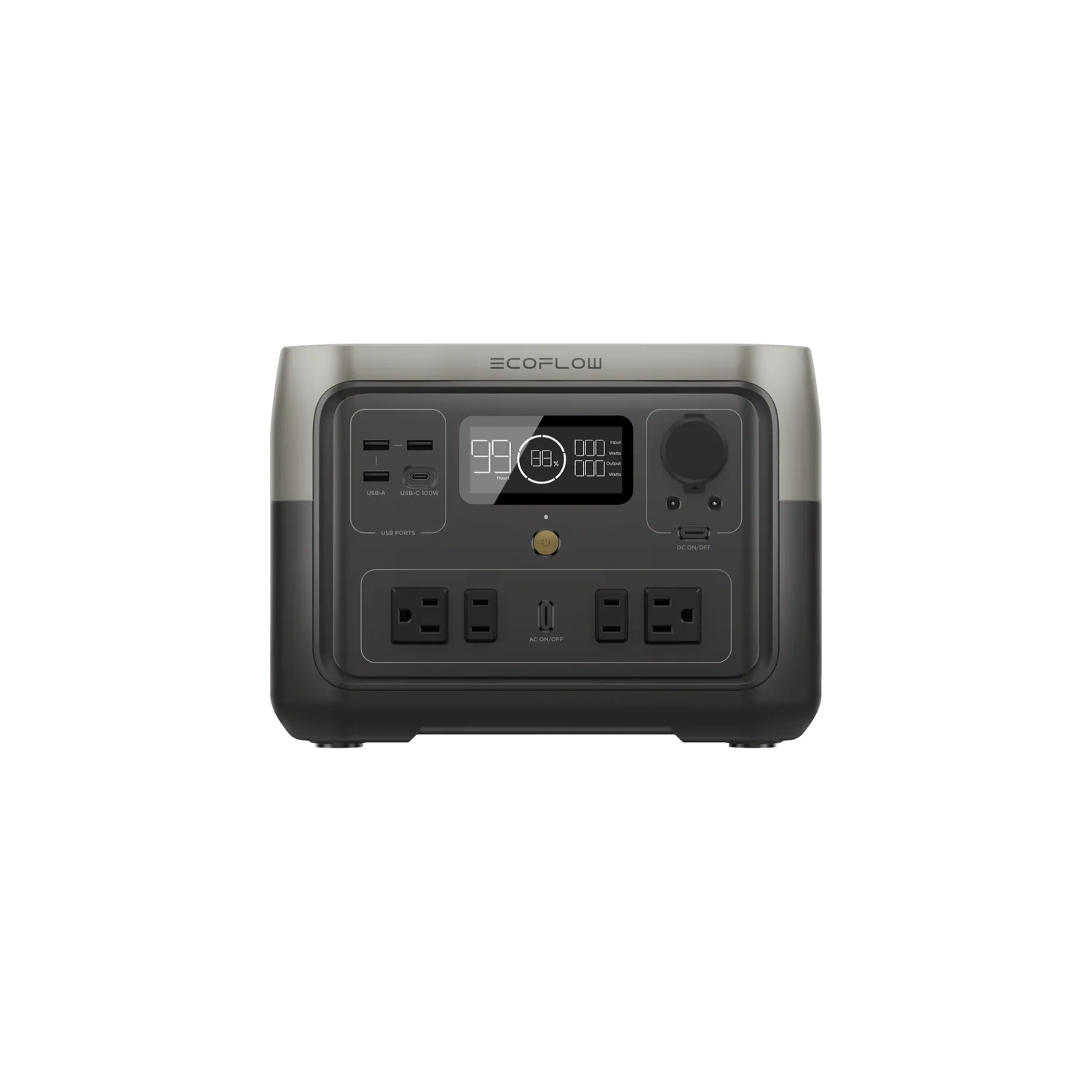
$289.00 · direct from EcoFlow
Last checked 1 day ago. Prices move — check before you buy.

No longer sold
EcoFlow no longer sells the RIVER 3 Max Plus. At this size the closest unit EcoFlow still sells is the RIVER 2 Pro — 768Wh with a stronger 800W inverter, typically for less money. If you'd rather step up in capacity, the DELTA 3 Classic (1,024Wh, 1,800W) is the move.
RIVER 2 Pro · $389.00Spec deltas
$289 buys 512Wh in a 13.4-lb box with no way to add more; $359 buys 858Wh in a 20.8-lb box that's already proof EcoFlow's own expansion system works — the RIVER 3 MAX PLUS is a RIVER 3 Plus base paired with the larger EB600 battery, the same mechanism that would let it grow further later.
On paper, the RIVER 2 Max looks like the value pick: less money, less weight, same 3,000-cycle rating, same 5-year warranty. In practice, it's also more than twice as loud under load — 62dB against the RIVER 3 MAX PLUS's 30dB — and it has no expansion port at all.
This isn't a blowout the way some RIVER-family comparisons are. The RIVER 2 Max is a real budget-and-weight pick for a buyer whose needs are fixed. It's just not the pick for anyone whose needs might grow, or who's going to be sleeping near it.
What the Numbers Reveal
Each conclusion stated first — the numbers behind it on one line, the full analysis below.
weight
At $359 against $289, the RIVER 3 MAX PLUS costs $70 more but delivers 346 more Wh at a lower rate per Wh — $0.55 against the RIVER 2 Max's $0.58. The extra capacity is priced better than the base unit's own rate.
RIVER 2 Max weighs 13.4 lbs and holds 512WhRIVER 3 MAX PLUS weighs 20.8 lbs and holds 858Wh — the base unit plus EcoFlow's EB600 expansion battery
Why it mattersAnyone who can comfortably carry 20.8 lbs is also getting the better per-dollar deal by stepping up.
62dB is roughly the noise level of a nearby conversation, running two feet from a pillow. Pair that with a fan that's already closer to its ceiling for the same job, and the RIVER 2 Max is the worse CPAP companion on both axes.
RIVER 2 Max hits 62dB under loadRIVER 3 MAX PLUS hits 30dB under loadCPAP Overnight needs 320Wh: the RIVER 2 Max uses 74% of its capacity to cover it, the RIVER 3 MAX PLUS uses 44%
Why it mattersCPAP buyers should default to the RIVER 3 MAX PLUS regardless of the $70 difference.
EcoFlow's own expansion battery lineupB8B9 means the RIVER 3 MAX PLUS's path to more capacity is a documented, existing product, not a hoped-for future one. The RIVER 2 Max has no equivalent path at any price.
RIVER 2 Max has no expansion port — a closed system for the life of ownershipRIVER 3 MAX PLUS is itself built from EcoFlow's expansion battery system: the RIVER 3 Plus base plus an EB300 makes a RIVER 3 Max, the larger EB600 makes the RIVER 3 MAX PLUSB8B9
Why it mattersBuyers who expect their power needs to grow over the next couple of years should skip the RIVER 2 Max even at $70 less, because there's no upgrade waiting for it.
On lifetime energy cost, the units are a rounding error apart. On money committed per year of coverage, the RIVER 2 Max is genuinely $34 a year cheaper. The RIVER 3 MAX PLUS's advantage is coming from capacity, noise, and expansion — not from being the objectively cheaper thing to own.
cost per lifetime kWh is nearly tied: $0.19 for the RIVER 2 Max against $0.18 for the RIVER 3 MAX PLUScost per warranty-year is $60 for the RIVER 2 Max against $94 for the RIVER 3 MAX PLUS
Why it mattersBuyers optimizing strictly for ownership cost with modest, fixed needs have a legitimate case for the RIVER 2 Max; the case for the bigger unit rests on headroom and growth, not on a lower price tag.
The specific dimensions that decide these two units — everything else is a tie.
What the Specs Don't Tell You
Selected because: Noise and no-expansion are both flagged warnings on the RIVER 2 Max — the central tradeoffs of this pair.
62dB under load is the RIVER 2 Max's real cost of being smaller and cheaper — a fan working harder in a lighter chassis. The RIVER 3 MAX PLUS's 30dB is close to silent by comparison, a 32dB gap that's the difference between a quiet room and a normal conversation happening inside it.
The bigger flag is structural, not acoustic: the RIVER 2 Max has no expansion port. What ships in the box on day one is what you own for the life of the unit. That's a fine tradeoff for a fixed, modest need — it's a real limitation for anyone whose setup tends to grow.
Growth Path
Selected because: The RIVER 3 MAX PLUS's existence as an expansion-battery product is the strongest argument for paying more.
solar input
The RIVER 3 MAX PLUS isn't just expandable in theory — it's a working example of EcoFlow's expansion system, built by pairing the RIVER 3 Plus base with the larger EB600 batteryB8B9. The same mechanism that produced this unit is available again if capacity needs keep climbing.
The RIVER 2 Max offers none of that. Its 512Wh is the ceiling for as long as you own it, with no bolt-on path back to the family's larger configurations. That's the tradeoff for the lighter, cheaper unit — not a defect, but a permanent one.
Your Life, Your Pick
Selected because: CPAP Overnight and Tailgate Party are the two jobs that actually separate these units.
Weekend Camping, the 8-Hour Blackout, Remote Workday, and Van Life Daily beat both units badly — these are compact daily units, not multi-day backup rigs, and the gap between them barely registers when both are already short of the job.
CPAP Overnight and Tailgate Party are where the RIVER 3 MAX PLUS's extra capacity earns its keep. It covers the overnight job at 44% of tank against the RIVER 2 Max's 74%, and it's the only one of the two that can cover a Tailgate Party's 670Wh draw at all — the RIVER 2 Max comes up short there.
Lifetime Value
Selected because: The two cost metrics point in slightly different directions and both deserve a plain explanation.
cost / lifetime kWh
Cost per lifetime kWh is nearly a wash — $0.19 for the RIVER 2 Max, $0.18 for the RIVER 3 MAX PLUS — so neither unit is meaningfully cheaper to run over its full life on that measure alone.
Cost per warranty-year tells a different story: $60 for the RIVER 2 Max against $94 for the RIVER 3 MAX PLUS. That's a genuine, honest point in the RIVER 2 Max's favor for a buyer who's decided their needs are fixed and isn't paying for headroom they won't use.
Strengths & trade-offs
EcoFlow RIVER 2 Max
Strengths
- +Costs $70 less
- +Lighter by 7.4 lb
- +Faster solar charging
Trade-offs
- –Can receive complaints about fan noise under heavy load.
- –Sealed capacity — the RIVER 3 MAX PLUS can add batteries to grow past 512Wh; this one can't.
EcoFlow RIVER 3 MAX PLUS
Strengths
- +Larger battery capacity
- +Higher AC output
Trade-offs
- –No major technical downsides compared to rival.
Will It Power Your Gear?
Scenario math and per-appliance runtimes, modeled from the spec record.
Scenario verdicts
We ran the math on six real-world scenarios. Here's which unit survives your actual life.
SCN-01 · 2 nights · needs 2,100Wh
Weekend Camping
Two nights off-grid with essential comfort
Neither unit
Neither unit is sized for a two-night trip — both fall well short of the roughly 2,100Wh a real weekend draws down. This comparison is about daily use, not multi-day off-grid camping.
Battery budget usedlower = more headroom
LOAD Phone Charger 15W×6h · LED Lights 40W×8h · Box Fan 75W×14h · CPAP Machine 40W×16h
SCN-02 · 8 hours · needs 1,645Wh
8-Hour Blackout
Keep the essentials running through a night without power
Neither unit
Neither unit covers this scenario's 1,645Wh: the RIVER 2 Max comes up 1,210Wh short (about 26% covered), the RIVER 3 MAX PLUS 916Wh (44%). Treat this as partial cover — enough for the essentials in it, not the whole list.
Battery budget usedlower = more headroom
LOAD Fridge 150W×8h · Router + Modem 20W×8h · LED Lights (4 bulbs) 40W×6h · Phone Charger 15W×3h
SCN-03 · 8 hours · needs 320Wh
CPAP Overnight
Sleep therapy without interruption — the #1 medical use case
RIVER 3 MAX PLUS
Both units can run a CPAP through the night, but the RIVER 3 MAX PLUS does it using less than half its tank against the RIVER 2 Max's three-quarters — and does it more quietly. For bedside use, that gap is worth the price difference.
Battery budget usedlower = more headroom
LOAD CPAP Machine 40W×8h
SCN-04 · 8 hours · needs 910Wh
Remote Workday
Full work day off-grid without power anxiety
Neither unit
Neither unit covers this scenario's 910Wh: the RIVER 2 Max comes up 475Wh short (about 48% covered), the RIVER 3 MAX PLUS 181Wh (80%). Treat this as partial cover — enough for the essentials in it, not the whole list.
Battery budget usedlower = more headroom
LOAD Laptop 60W×8h · External Monitor 30W×8h · Router + Modem 20W×8h · Phone Charger 15W×2h
SCN-05 · 4 hours · needs 670Wh
Tailgate Party
Game day power for the crew
RIVER 3 MAX PLUS
The RIVER 3 MAX PLUS covers a cooler-speaker-lights afternoon with room left; the RIVER 2 Max's smaller tank comes up short. Capacity, not brand loyalty, decides this one.
Battery budget usedlower = more headroom
LOAD Blender 400W×0.5h · LED TV (55") 80W×4h · Bluetooth Speaker 15W×4h · Phone Charger (×3) 45W×2h
SCN-06 · 24 hours · needs 4,685Wh
Van Life Daily
A full day of mobile living — the ultimate endurance test
Neither unit
Neither unit covers this scenario's 4,685Wh: the RIVER 2 Max comes up 4,250Wh short (about 9% covered), the RIVER 3 MAX PLUS 3,956Wh (16%). This is well outside what either unit is for; the right answer here is a larger station, not a choice between these two.
Battery budget usedlower = more headroom
LOAD Mini-Fridge 150W×24h · Laptop 60W×4h · Phone Charger 15W×3h · LED Lights 40W×5h · Fan 75W×8h
The Load Test
RUNTIME = (Wh × 0.85) ÷ LOAD
None of the scenarios above exactly yours? Build it. Toggle what you'd plug in; both units are tested against the combined draw.
Essentials
Comfort & Convenience
High-Draw Appliances
Test duration
8h
Continuous draw
205W
Projected runtime
For this load: RIVER 3 MAX PLUS runs 3.6h vs 2.1h.
Modeled from the spec record — same math as the tables below. Methodology
Runtime by appliance
Real-world runtime estimates for common appliances, modeled at 85% inverter efficiency.¹
Essentials
The basics you need runningscale 0–48.6hComfort & Convenience
Makes off-grid life actually enjoyablescale 0–9.7hHigh-Draw Appliances
These reveal the real limits¹ Runtime = (capacity × 0.85) ÷ appliance watts. Within each group, all bars share one time scale (the group's longest runtime), so lengths are comparable across appliances; identical runtimes collapse into a single blue/orange bar. Actual runtime varies with battery age, temperature, and simultaneous loads — see methodology.
Conclusion
July 14, 2026
Verdict: the RIVER 3 MAX PLUS, on Power Score margin
The RIVER 3 MAX PLUS wins on capacity, noise, UPS speed, and the one thing that actually compounds over time: it can grow, and the RIVER 2 Max cannot. The RIVER 2 Max claws back real ground on sticker price and cost per warranty-year — $60 against $94 — and it's genuinely the lighter, more grab-and-go unit. If your power needs are fixed and modest, that's a legitimate reason to save the $70. If there's any chance they grow, the RIVER 3 MAX PLUS is the only one of the two with a next step.
Editor-assigned confidence, based on cited owner research and spec analysis.
List prices as of July 14, 2026. The links below open EcoFlow's current price.
$359.00 · direct from EcoFlow
Last checked 41 days ago. Prices move — check before you buy.
or check the RIVER 2 Max price$289.00 list
Written by Wenny Zheng, Portable Power Tester · Station Arena Test Desk · Updated July 14, 2026
Measured Data
Benchmark scores and the full spec record, side by side.
Benchmark scores
Not rated for both units (minimum threshold unmet): UPS.
Full specifications
ᵈ Derived: price ÷ rated capacity. See the data behind our comparisons →
Comparison ToolAdd more power stations, side by sideOpen Tool →How these numbers are produced
Numeric verification
Every figure on this page traces to our spec database or arithmetic on it — no estimated numbers.
Owner claims
Statements about owner experience are cited to published reviews — see Sources & Research Notes below.
Runtime model
Runtime = (rated capacity × 0.85 inverter efficiency) ÷ device wattage. Solar recharge estimates assume panels deliver 70% of rated output. Cold weather, battery age, and stacked loads reduce real-world results.
Power Score
Computed from 14 published spec dimensions, weighted per use-case bench. Higher is better; a unit must meet a bench's minimum threshold to be rated.
See the full weight table and data sourcing on our methodology page →Class ranking (the star rating)
Each unit's star score is a category ranking, not customer reviews — no buyer opinions feed it. We score every station on size-independent quality (value, output, portability, endurance, ports, warranty, and more), then percentile-rank it against the other units in its capacity class, so a class-leading compact unit and a class-leading whole-home unit can both earn 5★. Here, RIVER 2 Max rates 3.7/5 (26th percentile of 20 Compact-class units), and RIVER 3 MAX PLUS rates 4.9/5 (95th percentile of 20 Compact-class units).
How the class ranking is computed →Test Notes & Caveats
Hidden gotchas and advantages we spotted that you won't find on the product page.
62dB vs 30dB: The RIVER 2 Max Works Harder For Less
A 32dB gap under load is the difference between a quiet room and one with a conversation running in it. The RIVER 2 Max's smaller cells and lighter build come at the cost of a fan that's audibly working, especially on longer charges or bigger draws.
No Port, No Path
The RIVER 2 Max ships as a closed system — no expansion battery, no upgrade route, ever. The RIVER 3 MAX PLUS is the opposite case in miniature: it's already the product of one expansion battery being added to a smaller base unit.
UPS Switchover: ≤10ms vs ≤30ms
Both list a UPS mode, at different rated speeds. The RIVER 3 MAX PLUS is rated ≤10ms — quick enough on paper that desktop PCs and routers should ride through, treating that as the rating it is. The RIVER 2 Max is rated ≤30ms — a transfer this long is one many desktops will NOT ride through, so plan on reboots for sensitive gear. If a computer with unsaved work is the thing being protected, the stated class is worth the attention; nothing here is a lab result.
Same 5 Years, Different Yearly Cost
Both units carry a 5-year warranty, so the cost-per-warranty-year gap ($60 vs $94) comes entirely from the sticker price, not unequal coverage. If warranty value alone is the metric, the RIVER 2 Max wins it outright.
Full record above — the Test Desk pick is the RIVER 3 MAX PLUS.
Check RIVER 3 MAX PLUS price →or check the RIVER 2 Max priceOwnership Analysis
What happens after you buy — true cost of ownership, brand trust, and growth potential.
Lifetime value
Service lifeyears at one full cycle per day
Lifetime energy delivered
Cost per delivered kWh
│ warranty ends · Reaching the cycle rating means ~80% capacity remains — degraded, not dead.
Analyst note
The RIVER 2 Max is cheaper to buy, but the RIVER 3 MAX PLUS is cheaper to own. At $0.14/kWh over its lifetime vs $0.19/kWh, the RIVER 3 MAX PLUS's higher cycle life and capacity make each dollar go further over the years. One thing to know reading the table: both carry the same 3,000-cycle rating, so the lifetime rows are sticker price and capacity in disguise — the wear horizon is identical and decides nothing here.
Growth path
RIVER 2 Max
FIXED CAPACITYFixed at 512Wh, with no expansion — so size it for your needs up front rather than planning to add capacity later.
Accepts up to 220W of solar. Limited to a single portable panel.
Adequate ports for most setups, but heavy users may want a power strip.
RIVER 3 MAX PLUS
EXPANDABLESupports EcoFlow expansion batteries, so you can add capacity later without replacing the base unit — useful if your needs may climb past 858Wh.
Accepts up to 200W of solar. Limited to a single portable panel.
Adequate ports for most setups, but heavy users may want a power strip.
Expansion batteries are EcoFlow-specific. You're investing in the EcoFlow ecosystem.
Realistic full solar rechargeat 70% of rated panel output — see methodology
Analyst note
The RIVER 2 Max is sealed at 512Wh, which is fine if that covers you. The RIVER 3 MAX PLUS starts at 858Wh and can grow beyond it with EcoFlow expansion batteries — though at this size expansion means longer runtimes on the same loads, not a path to home backup. More hours, not more house.
What Owners Report
Patterns from published owner reports and long-term reviews — every claim cited to its source below.
EcoFlow RIVER 2 Max
Reviewers consistently single out the RIVER 2 Max's light build — about 13 lbs, lighter than Li-Ion competitors in its classA1 — and its roughly 60-minute full charge via X-Stream, unusually fast for a portable power stationA2. The EcoFlow app draws praise too, offering simple remote monitoring and charge-speed control over WiFi and BluetoothA3.
In field testing, the RIVER 2 Max's 3,000-cycle LFP cells powered a telescope, a 65-inch TV, two laptops, and phones through a 4-hour event with capacity to spareA4 — a real-world data point that lines up with the light weight and fast charging owners consistently report.
“512Wh in a light package of about 13 lbs, lighter than some of its closest competitors that use Li-Ion chemistry.”
Sources
storagereview.com · backuppowerhub.com · gagadget.com · ecoflow.com · thecampingnerd.com · thetechnologyman.com · bestbuy.com
EcoFlow RIVER 3 MAX PLUS
The RIVER 3 MAX PLUS's identity as a modular pairing shows up directly in reviewer commentary: it's the RIVER 3 Plus base plus EcoFlow's larger EB600 expansion battery, adding up to the 858Wh totalB2, and that same expansion system is what lets EcoFlow sell the same base unit as a RIVER 3 Max with the smaller EB300 or a RIVER 3 MAX PLUS with the EB600B9. A full mains recharge runs about 2.3 hours despite the larger tankB1.
One honest caveat: the 1200W X-Boost surge mode is built for resistive loads like heaters, not sensitive electronics such as a desktop PCB7 — worth knowing before assuming the bigger surge number covers everything the RIVER 2 Max's smaller one doesn't.
“The RIVER 3 Max Plus (Wireless) can go from empty to full from mains in around 2.3 hours, which is very quick given its capacity.”
Sources
wandering-bird.com · root-nation.com · phonearena.com
Sources & Research Notes
Every owner claim in this report is traceable to a published source. The bracketed references above resolve here.
Recurring owner themes
- Light weight, fast roughly-one-hour charging, and a simple capable app are the standout praise for this 512Wh unit. [RIVER 2 Max · 3 entries]
- Owners/reviewers consistently note the Max Plus is a modular upgrade (base unit + EB600 battery) rather than a distinct unit, and reference its 858Wh combined capacity — this conflicts with the 1196Wh figure given in the task brief, suggesting a possible spec discrepancy or regional/bundle variant not covered by available sources. [RIVER 3 MAX PLUS · 3 entries]
- Reviewers agree the extended 1200W X-Boost output is best suited to resistive/heating loads, not sensitive electronics like PCs. [RIVER 3 MAX PLUS · 2 entries]
- Sub-10ms UPS switchover is repeatedly highlighted as a standout, real-world-tested feature across the River 3 Plus/Max/Max Plus family. [RIVER 3 MAX PLUS · 2 entries]
- A1
“512Wh in a light package of about 13 lbs, lighter than some of its closest competitors that use Li-Ion chemistry.”
storagereview.com / backuppowerhub.com — RIVER 2 Max review · 2026 · [positive]
- A2
“Fully charges in about 60 minutes via X-Stream charging — far faster than most portable power stations — with multiple charging options.”
gagadget.com / ecoflow.com — RIVER 2 Max review · 2026 · [positive]
- A3
“The EcoFlow app offers simple remote control and monitoring over WiFi and Bluetooth — view charge levels, customize settings, and adjust charging speed from a phone.”
thecampingnerd.com / ecoflow.com — RIVER 2 Max review · 2026 · [positive]
- A4
“Upgraded LFP chemistry rated for about 3,000 cycles, roughly a decade of everyday use; in field testing it powered a telescope, a 65-inch LED TV, two laptops, and phones through a 4-hour event with power to spare.”
thetechnologyman.com / bestbuy.com owner reviews — RIVER 2 Max · 2026 · [positive]
- B1
“The RIVER 3 Max Plus (Wireless) can go from empty to full from mains in around 2.3 hours, which is very quick given its capacity.”
wandering-bird.com — REVIEW: Ecoflow River 3 Max Plus- vanlife essential or not? · 2025-11 · [positive]
- B2
“The RIVER 3 Max Plus (Wireless) is created by taking the RIVER 3 Plus (Wireless) and attaching the larger EB600 extra battery, giving a total capacity of 858Wh.”
wandering-bird.com — REVIEW: Ecoflow River 3 Max Plus- vanlife essential or not? · 2025-11 · [positive]
- B7
“the extended output is designed for resistive loads – things like hair dryers, heaters, or compact air conditioners. It's not meant for sensitive electronics like desktop PCs.”
root-nation.com — EcoFlow River 3 Max Review (discusses River 3 Max Plus family) · 2025-05 · [mixed]
- B8
“The latter now features expansion ports, with EcoFlow selling additional batteries that help users upgrade to the EcoFlow River 3 Max or the River 3 Max Plus”
phonearena.com — EcoFlow River 3 Plus Review (background context on Max Plus) · 2025-03 · [positive]
- B9
“With the EB300, you transform the station into the River 3 Max model, while the larger expansion battery gives you the EcoFlow River 3 Max Plus.”
phonearena.com — EcoFlow River 3 Plus Review · 2025-03 · [positive]
Research compiled July 14, 2026.
Who Should Buy Which
Buy the RIVER 2 Max if you…
- →Your power needs are fixed and modest — phones, a laptop, small electronics on a short trip — and you'd rather save $70 and carry 7.4 fewer pounds than pay for headroom you won't use.
- →You're not sleeping near it. The 62dB fan under load is a non-issue in a garage or car trunk and a real one at bedside.
Buy the RIVER 3 MAX PLUS if you…
- →There's a real chance your needs grow — more gear, longer trips, a partial home-backup use case — and you want a unit that's already proof EcoFlow's expansion battery system worksB8B9.
- →You want the quieter, faster-switching unit for CPAP or any load sensitive to noise or a power blip.
This is you — check the RIVER 3 MAX PLUS price
If neither fits
If the real need is an 8-hour blackout (about 1,645Wh) or a two-night camping trip (about 2,100Wh), both of these come up well short — even the bigger RIVER 3 MAX PLUS only covers around 44% of a blackout's draw. Step up to EcoFlow's DELTA series instead.
The Bottom Line
This one isn't a blowout. The RIVER 2 Max is a legitimate lighter, cheaper pick for a buyer whose power needs are small and fixed — the cost-per-lifetime-kWh numbers are nearly tied, and it's genuinely $70 less and 7.4 lbs lighter.
But the RIVER 3 MAX PLUS wins on the things that compound: it's quieter exactly where quiet matters, it covers more of the real-world scenarios outright, and it's already proof that EcoFlow's expansion battery system works — a path the RIVER 2 Max simply doesn't have. If there's any chance your needs grow, buy the one that can.
Frequently Asked Questions
Answers drawn from the spec record and cited owner research.
Is the RIVER 3 MAX PLUS just a RIVER 2 Max with a bigger battery?
Not exactly — they're different generations built on different platforms, and the RIVER 3 MAX PLUS is specifically a RIVER 3 Plus base combined with EcoFlow's EB600 expansion battery. The practical differences that matter are capacity (858Wh against 512Wh), noise (30dB against 62dB under load), and expandability, which the RIVER 2 Max doesn't have at all.
Is the extra $70 for the RIVER 3 MAX PLUS worth it?
It depends on whether your needs might grow. Cost per lifetime kWh is nearly identical between the two ($0.18 vs $0.19), so you're not overpaying for energy — you're paying for 346Wh more capacity, a much quieter fan, and a real expansion path the RIVER 2 Max doesn't offer.
Which one is quieter?
The RIVER 3 MAX PLUS, by a wide margin — 30dB under load against the RIVER 2 Max's 62dB, roughly the gap between a quiet room and a nearby conversation. That matters most for CPAP use or anywhere the unit sits close to where you sleep.
Can the RIVER 2 Max be expanded later?
No. It has no expansion port, so its 512Wh capacity is fixed for the life of the unit. If there's any chance your power needs grow, the RIVER 3 MAX PLUS's expansion-battery platform is the safer starting point.
Which is the better value on paper?
It depends which number you weight. Cost per warranty-year favors the RIVER 2 Max at $60 against the RIVER 3 MAX PLUS's $94, while cost per lifetime kWh is nearly tied. For a fixed, modest need, the RIVER 2 Max is the honestly cheaper buy; for anything that might grow, the RIVER 3 MAX PLUS's headroom and expansion path are worth the difference.
Check RIVER 3 MAX PLUS price →
Where to buy
EcoFlow RIVER 2 Max
$289.00
$289.00 · direct from EcoFlow
Last checked 1 day ago. Prices move — check before you buy.
EcoFlow RIVER 3 MAX PLUSPick
$359.00
$359.00 · direct from EcoFlow
Last checked 41 days ago. Prices move — check before you buy.
Prices may vary by retailer and are subject to change.