Head-to-head test
EcoFlow DELTA Pro Ultra + 2 Batteries vs Goal Zero Yeti PRO 4000 + Tank PRO 4000 (Yeti PRO 8000)
Buy the Yeti PRO 8000 and you'll carry less through the door on install day; buy the DELTA Pro Ultra and you'll pay less for every kilowatt-hour, for as long as you own it.
Full profiles: EcoFlow DELTA Pro Ultra + 2 Batteries → · Goal Zero Yeti PRO 4000 + Tank PRO 4000 (Yeti PRO 8000) →

Written by Gunner GustafsonUpdated
Whole-Home Backup Tester, Station Arena Test Desk
Spec deltas
These are whole-home systems, not campsite batteries: 18,432Wh for the EcoFlow DELTA Pro Ultra + 2 Batteries, 7,988Wh for the Goal Zero Yeti PRO 4000 + Tank PRO 4000 (the Yeti PRO 8000), each sized to carry a house through an outage rather than a weekend. At that scale, 'can it run my stuff' stops being the interesting question — both handle every scenario on this page — and 'what does it cost to actually own' takes over.
Run the six scenarios we test every system against and three come back a flat tie: CPAP Overnight, Remote Workday, and Tailgate Party each ask for 2 to 6 percent of the DELTA's tank and 5 to 13 percent of the Yeti's. Manufacturing a winner out of that would be padding — at this capacity tier, neither system blinks at a CPAP or a laptop-and-lights workday.
The other three scenarios, the weight on install day, the surge ceiling, and what a kilowatt-hour actually costs over the years you'll own this — that's where the real gap lives, and on most of it, the DELTA Pro Ultra + 2 Batteries comes out ahead.
What the Numbers Reveal
Each conclusion stated first — the numbers behind it on one line, the full analysis below.
Capacity
Divide price by what each system will actually deliver and the cheaper box stops looking cheap: the DELTA's 18,432Wh moving through 3,500 cycles outweighs the Yeti's 500 extra cycles on a 7,988Wh tank, which is why the DELTA ends up the lower cost per kilowatt-hour despite the higher price tag.
$7,999 vs $5,999 (Yeti PRO 8000 is $2,000 cheaper upfront)18,432Wh vs 7,988Wh capacity64,512 vs 31,952 lifetime kWh over each unit's full cycle life
Why it mattersAnyone comparing these on sticker price alone is comparing the wrong number — budget by energy delivered over the system's life, not the price tag on install day.
rated cycles
But more cycles on a smaller tank still moves less total energy: 500 extra cycles on a 7,988Wh battery doesn't make up for a tank less than half the DELTA's size, so the Yeti's longer-lived cells still land at 31,952 lifetime kWh against the DELTA's 64,512.
Yeti cycles 4,000 vs DELTA cycles 3,500Yeti yearsDaily 11 vs DELTA yearsDaily 9.6DELTA capacity 18,432Wh vs Yeti capacity 7,988Wh
Why it mattersDon't let 'more cycles' read as 'better value' on its own — size the math on total energy delivered, or you'll talk yourself into the system that costs more per kWh.
continuous output
For a single compressor starting up, the ratio matters and the Yeti's 2x edges the DELTA's 1.5x. For several compressors starting together — central AC, a well pump, a fridge, the realistic whole-home case — absolute watts decide it, and 10,800W beats 7,200W regardless of ratio. Owners running exactly that combination on the DELTA report it held without a flickerA9.
DELTA surge 10,800W vs continuous 7,200W (1.5x)Yeti surge 7,200W vs continuous 3,600W (2x)fridge and AC compressors surge 2-3x rated draw at startup
Why it mattersSize the surge question to your actual panel: one big appliance, look at the ratio; several starting together, look at the DELTA's bigger absolute ceiling.
10ms won't drop most electronics, so the switchover gap is real but narrow in practice. The noise gap is more telling: Goal Zero doesn't disclose a figure for a system this size at all, while EcoFlow's 30dBA is backed by an owner who reports never hearing a fan kick on at allA15.
DELTA switchoverMs 0 vs Yeti switchoverMs 10DELTA noiseDba 30 (published) vs Yeti noiseDba unpublished
Why it mattersIf you're syncing this to medical equipment, a home server, or anything else that hates a gap — or it's living in a room you sleep near — the DELTA is the one with both numbers on the table.
The specific dimensions that decide these two units — everything else is a tie.
Lifetime Value
Selected because: cheaperToOwn=p1 by a real margin (twelve vs nineteen cents per lifetime kWh) — the strongest quantifiable differentiator on the page.
cost / lifetime kWh
That gap between twelve and nineteen cents a kilowatt-hour comes from capacity, not chemistry: 18,432Wh across 3,500 cycles works out to 64,512 lifetime kWh for the DELTA, against 7,988Wh across 4,000 cycles — 31,952 kWh — for the Yeti PRO 8000. Half the lifetime energy from a system that's only $2,000 cheaper doesn't clear the bar, and the warranty math tells the same story: $790 a warranty-year for the DELTA's 10-year coverage against $1,200 a year for the Yeti's 5.
Credit where it's due: the Tank PRO 4000's cells are rated for 500 more cycles than the DELTA's (4,000 vs 3,500), and at a daily-cycle pace that's 11 years to the DELTA's 9.6. Goal Zero's chemistry genuinely outlasts EcoFlow's here, cycle-for-cycle — this isn't the old NMC-vs-LiFePO4 mismatch some older Yeti lines carry. It just doesn't move the value math: those extra cycles are still moving less than half the total energy, which is why the per-kWh price still lands in the DELTA's favor.
Portability & Form Factor
Selected because: 405.4 lbs vs 195.95 lbs is an install-day reality, not a spec-sheet abstraction, for two systems that are otherwise both 'the big one.'
weight
405.4 lbs against 195.95 lbs — more than double, and the extra battery pair is why. Neither number describes something you carry to a campsite; both are install-once systems that go in with a home integration panel, not a trunk.
At 195.95 lbs, the Yeti PRO 8000 build is still a two-person lift by any reasonable standard, just not the near-quarter-ton the DELTA rig adds up to. If a future move, a rearrangement, or a service call is even a possibility, the DELTA's added mass is the one that's more disruptive to route through a doorway.
What the Specs Don't Tell You
Selected because: Surge ratio and UPS switchover are electrical differentiators the scenario table can't show; the noise disclosure gap is a real information asymmetry.
rated cycles
Look at surge two ways and you get two different winners. In absolute watts, the DELTA can spike to 10,800W against the Yeti's 7,200W — a 3,600W bigger ceiling. Scaled to each unit's own continuous rating, it flips: 7,200W over a 3,600W continuous rating is 2x for the Yeti, against 10,800W over 7,200W, or 1.5x, for the DELTA. Which number matters depends on whether your panel is starting one big compressor or several at once.
Switchover is 0ms on the DELTA — true double-conversion UPS grade — against 10ms line-interactive on the Yeti. Ten milliseconds won't drop a laptop, but it isn't zero. Noise is the starker gap: EcoFlow publishes 30dBA for the DELTA; Goal Zero doesn't publish a figure for this configuration at all. Not a bad number. No number.
Your Life, Your Pick
Selected because: Three of six scenarios tie at this capacity tier — worth stating plainly rather than padding; the other three show the real headroom gap.
Three of six scenarios are a dead heat: CPAP Overnight, Remote Workday, and Tailgate Party ask for 2, 6, and 4 percent of the DELTA's tank and 5, 13, and 10 percent of the Yeti's. Manufacturing a winner out of that would be noise — at this capacity tier, ability was never the question for a CPAP or a laptop-and-lights workday.
The real gap shows up in the heavier draws. Weekend Camping (2,100Wh needed) uses 13 percent of the DELTA against 31 percent of the Yeti; an 8-Hour Blackout (1,645Wh) is 10 percent against 24 percent. Van Life Daily is the sharpest: at 4,685Wh a day, the DELTA sits at a comfortable 30 percent, while the Yeti is pulling 69 percent of its tank daily — one cloudy stretch away from a real problem, where the DELTA still has most of its tank in reserve.
PowerScore Breakdown
Selected because: The composite score is the cleanest single summary figure for a reader skimming past the detail sections.
overall power score
14,547 against 7,402 is a little under double — which tracks with everything else on this page: a battery more than double the capacity, a bigger absolute surge ceiling, and a faster switchover, all rolled into one figure. Treat the composite score as a confirming signal, not a new argument; everything driving it is already covered in the sections above.
Strengths & trade-offs
EcoFlow DELTA Pro Ultra + 2 Batteries
Strengths
- +Larger battery capacity
- +Higher AC output
- +Longer warranty
- +Faster solar charging
Trade-offs
- –Substantially more expensive (+$2,000.1) than the Yeti PRO 4000 + Tank PRO 4000 (Yeti PRO 8000).
- –Significantly heavier (+209.5 lbs), making it harder to move.
- –Very heavy unit that may be difficult for one person to lift.
Goal Zero Yeti PRO 4000 + Tank PRO 4000 (Yeti PRO 8000)
Strengths
- +Costs $2,000.1 less
- +Lighter by 209.5 lb
Trade-offs
- –Weaker inverter (-3,600W) limits appliance compatibility.
- –Very heavy unit that may be difficult for one person to lift.
Will It Power Your Gear?
Scenario math and per-appliance runtimes, modeled from the spec record.
Scenario verdicts
We ran the math on six real-world scenarios. Here's which unit survives your actual life.
SCN-01 · 2 nights · needs 2,100Wh
Weekend Camping
Two nights off-grid with essential comfort
Neither unit
Both handle a weekend without strain, but the margin is real: the DELTA uses 13 percent of its tank against the Yeti's 31 percent for the same 2,100Wh — more than double the cushion if the weather runs long.
Battery budget usedlower = more headroom
LOAD Phone Charger 15W×6h · LED Lights 40W×8h · Box Fan 75W×14h · CPAP Machine 40W×16h
SCN-02 · 8 hours · needs 1,645Wh
8-Hour Blackout
Keep the essentials running through a night without power
DELTA Pro Ultra + 2 Batteries
An 8-hour outage draws 1,645Wh from either system — 10 percent of the DELTA's tank, 24 percent of the Yeti's. Both ride it out easily; the DELTA just barely notices.
Battery budget usedlower = more headroom
LOAD Fridge 150W×8h · Router + Modem 20W×8h · LED Lights (4 bulbs) 40W×6h · Phone Charger 15W×3h
SCN-03 · 8 hours · needs 320Wh
CPAP Overnight
Sleep therapy without interruption — the #1 medical use case
Either unit
At 320Wh, this is single-digit territory for both — 2 percent for the DELTA, 5 percent for the Yeti. Neither battery is the variable in a CPAP night.
Battery budget usedlower = more headroom
LOAD CPAP Machine 40W×8h
SCN-04 · 8 hours · needs 910Wh
Remote Workday
Full work day off-grid without power anxiety
Either unit
A laptop-and-lights workday needs 910Wh, or 6 percent of the DELTA and 13 percent of the Yeti. Both finish the day without a second thought — a genuine tie.
Battery budget usedlower = more headroom
LOAD Laptop 60W×8h · External Monitor 30W×8h · Router + Modem 20W×8h · Phone Charger 15W×2h
SCN-05 · 4 hours · needs 670Wh
Tailgate Party
Game day power for the crew
Neither unit
670Wh for a tailgate is 4 percent of the DELTA's tank and 10 percent of the Yeti's — plenty of headroom either way. Decide this one on price and weight, not capability.
Battery budget usedlower = more headroom
LOAD Blender 400W×0.5h · LED TV (55") 80W×4h · Bluetooth Speaker 15W×4h · Phone Charger (×3) 45W×2h
SCN-06 · 24 hours · needs 4,685Wh
Van Life Daily
A full day of mobile living — the ultimate endurance test
DELTA Pro Ultra + 2 Batteries
This is the scenario that actually separates them. 4,685Wh a day is 30 percent of the DELTA's tank and 69 percent of the Yeti's — the Yeti is doing that every single day with well under a third of its capacity left as buffer for a run of bad solar.
Battery budget usedlower = more headroom
LOAD Mini-Fridge 150W×24h · Laptop 60W×4h · Phone Charger 15W×3h · LED Lights 40W×5h · Fan 75W×8h
The Load Test
RUNTIME = (Wh × 0.85) ÷ LOAD
None of the scenarios above exactly yours? Build it. Toggle what you'd plug in; both units are tested against the combined draw.
Essentials
Comfort & Convenience
High-Draw Appliances
Test duration
8h
Continuous draw
205W
Projected runtime
For this load: DELTA Pro Ultra + 2 Batteries runs 76.4h vs 33.1h.
$7,999 list · direct from EcoFlow
Planning for more than this? Describe your whole setup and get it sized →
Modeled from the spec record — same math as the tables below. Methodology
Runtime by appliance
Real-world runtime estimates for common appliances, modeled at 85% inverter efficiency.¹
Essentials
The basics you need runningscale 0–1044.5hComfort & Convenience
Makes off-grid life actually enjoyablescale 0–208.9hHigh-Draw Appliances
These reveal the real limitsscale 0–15.7h¹ Runtime = (capacity × 0.85) ÷ appliance watts. Within each group, all bars share one time scale (the group's longest runtime), so lengths are comparable across appliances; identical runtimes collapse into a single blue/orange bar. Actual runtime varies with battery age, temperature, and simultaneous loads — see methodology.
Conclusion
July 28, 2026
Verdict: the DELTA Pro Ultra + 2 Batteries, on Power Score margin
Take the DELTA Pro Ultra + 2 Batteries if you're installing a permanent whole-home system and actually plan to cycle it for years: twelve cents a kilowatt-hour against the Yeti PRO 8000's nineteen, backed by a 10-year warranty against 5, and a true 0ms switchover against 10ms. The trade is real — at 405.4 lbs it's more than double the Yeti's 195.95 lbs to install, and EcoFlow's own support experience is polarized, with owners describing dismissive answers to specific technical questionsA2A4A5. Goal Zero's cells cycle longer (4,000 vs 3,500) and its sticker is $2,000 less, but a smaller tank moving less total energy doesn't overcome a per-kWh gap that repeats every cycle for a decade — so unless the lighter install job or Goal Zero's brand heritage is the deciding factor for you, the DELTA is the one to own long-term.
Editor-assigned confidence, based on cited owner research and spec analysis.
List prices as of July 28, 2026. The links below open EcoFlow's and Goal Zero's current prices.
$7,999.00 · direct from EcoFlow
Last checked 16 days ago. Prices move — check before you buy.
or check the Yeti PRO 4000 + Tank PRO 4000 (Yeti PRO 8000) price$5,998.95 list
Written by Gunner Gustafson, Whole-Home Backup Tester · Station Arena Test Desk · Updated July 28, 2026
Black Friday · 38 days out
Prices to beat:DELTA Pro Ultra + 2 Batteries $7,899Yeti PRO 4000 + Tank PRO 4000 (Yeti PRO 8000) $5,999
The lowest we have recorded for each. We have never seen the Yeti PRO 4000 + Tank PRO 4000 (Yeti PRO 8000) discounted, so any real cut on it would be a first.
Measured Data
Benchmark scores and the full spec record, side by side.
Benchmark scores
Full specifications
ᵈ Derived: price ÷ rated capacity. See the data behind our comparisons →
Comparison ToolAdd more power stations, side by sideOpen Tool →How these numbers are produced
Numeric verification
Every figure on this page traces to our spec database or arithmetic on it — no estimated numbers.
Owner claims
Statements about owner experience are cited to published reviews — see Sources & Research Notes below.
Runtime model
Runtime = (rated capacity × 0.85 inverter efficiency) ÷ device wattage. Solar recharge estimates assume panels deliver 70% of rated output. Cold weather, battery age, and stacked loads reduce real-world results.
Power Score
Computed from 14 published spec dimensions, weighted per use-case bench. Higher is better; a unit must meet a bench's minimum threshold to be rated.
See the full weight table and data sourcing on our methodology page →Class ranking (the star rating)
Each unit's star score is a category ranking, not customer reviews — no buyer opinions feed it. We score every station on size-independent quality (value, output, portability, endurance, ports, warranty, and more), then percentile-rank it against the other units in its capacity class, so a class-leading compact unit and a class-leading whole-home unit can both earn 5★. Here, DELTA Pro Ultra + 2 Batteries rates 3.8/5 (29th percentile of 29 Whole-Home / Off-Grid-class units), and Yeti PRO 4000 + Tank PRO 4000 (Yeti PRO 8000) rates 3.4/5 (4th percentile of 29 Whole-Home / Off-Grid-class units).
How the class ranking is computed →Test Notes & Caveats
Hidden gotchas and advantages we spotted that you won't find on the product page.
Two-Person Job, Either Way
405.4 lbs for the DELTA Pro Ultra rig against 195.95 lbs for the Yeti PRO 8000 — the DELTA's extra battery pair accounts for the gap. Both are install-once systems, not something you carry to a campsite, but the DELTA carries roughly double the mass through the doorway on installation day.
Surge Power: Absolute vs Proportional
10,800W surge for the DELTA against 7,200W for the Yeti — a bigger absolute ceiling for multiple compressors starting together. Scaled to each unit's own continuous rating, though, the Yeti's inverter surges to 2x its baseline against the DELTA's 1.5x, so proportionally it's the peppier design.
UPS Switchover: 0ms-rated vs ≤15ms
Both list a UPS mode, at different rated speeds. The DELTA Pro Ultra + 2 Batteries is rated 0ms — a no-break design on paper, which is the maker's classification rather than a stopwatch result. The Yeti PRO 4000 + Tank PRO 4000 (Yeti PRO 8000) is rated ≤15ms — fine on paper for routers and most electronics; the fussiest PC power supplies sit right at this line. If a computer with unsaved work is the thing being protected, the stated class is worth the attention; nothing here is a lab result.
Warranty: 10 Years vs 5
The DELTA Pro Ultra + 2 Batteries is covered for 10 years against the Yeti PRO 4000 + Tank PRO 4000 (Yeti PRO 8000)'s 5 years. An underrated factor if you're keeping this unit for years.
One Published Noise Figure, One Blank
EcoFlow publishes 30dBA for the DELTA. Goal Zero doesn't publish a noise rating for this configuration at all — an unpublished spec, not a quiet one confirmed at zero.
Full record above — the Test Desk pick is the DELTA Pro Ultra + 2 Batteries.
Check DELTA Pro Ultra + 2 Batteries price →or check the Yeti PRO 4000 + Tank PRO 4000 (Yeti PRO 8000) priceOwnership Analysis
What happens after you buy — true cost of ownership, brand trust, and growth potential.
Lifetime value
Service lifeyears at one full cycle per day
Lifetime energy delivered
Cost per delivered kWh
│ warranty ends · Reaching the cycle rating means ~80% capacity remains — degraded, not dead.
Analyst note
The Yeti PRO 4000 + Tank PRO 4000 (Yeti PRO 8000) is cheaper to buy, but the DELTA Pro Ultra + 2 Batteries is cheaper to own. At $0.12/kWh over its lifetime vs $0.19/kWh, the DELTA Pro Ultra + 2 Batteries's higher cycle life and capacity make each dollar go further over the years. One caution on the lifespan row: the Yeti PRO 4000 + Tank PRO 4000 (Yeti PRO 8000) takes longer to reach its cycle rating, but a cycle moves a different amount of energy on each unit — the DELTA Pro Ultra + 2 Batteries still delivers more over its shorter horizon (64,512 vs 31,952 kWh). Years measure wear, not usefulness.
Brand trust
EcoFlow
Ecosystem
The deepest bench in the category — a dozen-plus active models spanning DELTA Pro, DELTA 3, and RIVER 3, plus its own solar panels and home integration panels.
Support
US-based phone, email, and chat support. Experiences are polarized: plenty of hassle-free prepaid-label swaps, but a real minority report long waits or a refurbished unit sent back for a new-unit claim. Buying through Costco or Amazon adds a second return safety net worth having.
Community
The largest community in the category by a wide margin — Reddit alone runs about 31,000 members, plus multiple Facebook groups and an official forum.
App experience
Rated 4.6/5 iOS (~8,400 ratings) · 4.2/5 Android (~17,000 ratings)
Unique strength
Fastest charging in the category and the most active release cadence of any brand here.
Worth knowing
A DELTA Max 2000 recall in October 2025 (overheating risk, six incidents) is worth knowing about, as is a since-paused attempt to paywall advanced app features behind a subscription. Out-of-warranty parts and service aren't offered.
Goal Zero
Ecosystem
Smaller and more focused — five or six active power station models across the Yeti and Yeti PRO lines, plus Alta coolers and Nomad solar panels.
Support
US-based (Salt Lake City, owned by NRG Energy) and historically considered the premium-support brand in the category. That reputation has taken real damage: recent reports describe long waits and tickets going unanswered for weeks, which is a harder pill given it's also the most expensive brand here per watt-hour.
Community
Smaller but loyal, with a real following in overlanding and off-grid circles — though the official community forum was recently shut down, which long-time users haven't loved.
App experience
Rated 4.4/5 iOS (~1,200 ratings) but recent reviews skew negative — recurring connectivity issues, crashes, and stability problems.
Unique strength
The category's original brand, with a genuinely rugged, weather-resistant build and a wider vehicle-and-cooler ecosystem than EcoFlow offers.
Worth knowing
This is the most expensive brand in the category on a per-watt-hour basis, and that premium is harder to justify while support response times slip and the app's iOS reviews skew negative on stability.
Analyst note
Neither brand is a clean pick on support alone — EcoFlow's is polarized, Goal Zero's premium reputation is fading — so let the hardware and the economics on this page do more of the deciding than the brand name.
Growth path
DELTA Pro Ultra + 2 Batteries
EXPANDABLESupports EcoFlow expansion batteries, so you can add capacity later without replacing the base unit — useful if your needs may climb past 18,432Wh.
Accepts up to 5,600W of solar. Enough for a serious multi-panel array.
Adequate ports for most setups, but heavy users may want a power strip.
Expansion batteries are EcoFlow-specific. You're investing in the EcoFlow ecosystem.
Yeti PRO 4000 + Tank PRO 4000 (Yeti PRO 8000)
EXPANDABLESupports Goal Zero expansion batteries, so you can add capacity later without replacing the base unit — useful if your needs may climb past 7,988Wh.
Accepts up to 3,000W of solar. Enough for a serious multi-panel array.
Generous port selection supports complex multi-device setups.
Expansion batteries are Goal Zero-specific. You're investing in the Goal Zero ecosystem.
Realistic full solar rechargeat 70% of rated panel output — see methodology
Analyst note
Both expand, but the DELTA Pro Ultra + 2 Batteries's higher solar ceiling (5,600W vs 3,000W) gives it the stronger off-grid growth path — more panels can feed a bigger bank as it grows.
What Owners Report
Patterns from published owner reports and long-term reviews — every claim cited to its source below.
EcoFlow DELTA Pro Ultra + 2 Batteries
Owner coverage on this exact two-battery build is thinner than we'd like, but what exists is telling. One owner who upgraded from a single battery to two says it doubled their runtime and eliminated the anxiety of running shortA13; another reports a two-battery build running most of the house through the home panel with no flickerA14; and a two-unit, four-battery owner describes the performance and scalability as matchlessA10. On the base platform, reviewers independently confirm it running a central AC, refrigerator, and well pump simultaneously without a flickerA9, and one owner reports the unit runs quiet enough that they never heard a fan kick on at allA15.
The complaints cluster in three places. Support: owners describe a bare-bones web manual, with support pointing back to the same inadequate guide when asked twiceA2; when one owner reported the inverter interfering with common radio frequencies even when idleA3, support's suggested fix was a faraday cageA4; a separate request for state-of-charge charting got the same non-answer, twiceA5. Software: one owner logged the display swinging from 90% down to 8% within daysA6, and a separate review measured real parasitic drain — enough to empty a 6kWh battery in about 60 hours with zero loadA7. Hardware: each Ultra Smart extra battery is a dense 115 lbs requiring two people to moveA8, and one owner noticed the battery closest to the inverter running about 10°F warmer than the one below, raising overheating concerns in a hot garageA11A12. None of this is disqualifying at whole-home scale, but all of it is worth budgeting around before you treat this as your only line of defense.
Installation is its own project, not a plug-and-play affair: one reviewer found it genuinely hard to find an installer experienced with this gear, even in a major metro, and the job itself ran about nine hours, including cutting drywall to sink the panel into the wallA16A17. Budget for that labor, not just the hardware price.
“This means that without any grid or solar input, the system would fully drain its own 6kWh battery in about 60 hours. For off-grid use, this parasitic drain must be carefully factored into your energy budget.”
Goal Zero Yeti PRO 4000 + Tank PRO 4000 (Yeti PRO 8000)
Professional reviewers are consistent: this is a high-powered, reliable station built to last, expandable up to four Tank PRO 4000 batteries for as much as 20kWhB1. The Tank PRO 4000's LiFePO4 cells are rated for meaningfully longer life than the brand's previous expansion batteriesB4 — which lines up with the spec sheet's 4,000-cycle rating, ahead of the DELTA's 3,500.
Owner sentiment is more mixed than the pro reviews suggest: reports describe lingering bugs, and at least one owner says their unit didn't power on the first time they actually needed it in an outage — the exact scenario this system is bought for — though professional testers didn't reproduce those issuesB3. The 3,000W solar ceiling is also a conditional number: hitting it requires Goal Zero's own proprietary panels and combiner box, an added cost most competing systems don't imposeB2.
“A strong expandable system — you can add up to four Tank PRO 4000 batteries for up to 20 kWh; professional reviewers call it a high-powered, highly reliable power station built to last.”
Sources
batteryskills.com · techradar.com · goalzero.com · bestgeneratorsolar.com · business.walmart.co · thesolarlab.com
Sources & Research Notes
Every owner claim in this report is traceable to a published source. The bracketed references above resolve here.
Recurring owner themes
- Owners repeatedly report EcoFlow customer support gives dismissive or unhelpful answers to specific technical questions (manual gaps, RFI interference, app charting). [DELTA Pro Ultra + 2 Batteries · 3 entries]
- The unit's idle/parasitic self-consumption is a recurring theme, both as a documented SoC anomaly and as an acknowledged spec-level drain figure from a tester. [DELTA Pro Ultra + 2 Batteries · 2 entries]
- Multiple owners note the extra battery packs are extremely heavy (100+ lbs each), requiring two people, and one owner separately observed uneven heat between stacked batteries raising summer overheating concerns. [DELTA Pro Ultra + 2 Batteries · 3 entries]
- Real owners with 2-battery setups consistently praise seamless/flicker-free UPS switchover and confirm the system genuinely runs whole-home loads (AC, well pump, most of house). [DELTA Pro Ultra + 2 Batteries · 3 entries]
- Adding a second battery is described by owners as meaningfully extending real-world runtime for whole-home backup, matching expectations. [DELTA Pro Ultra + 2 Batteries · 2 entries]
- Praised for large expandability (to 20 kWh) and fast solar recharge; caveats are mixed owner reliability reports and a max solar rate locked behind proprietary Goal Zero hardware. [Yeti PRO 4000 + Tank PRO 4000 (Yeti PRO 8000) · 3 entries]
- A2
“No real manual. All they have is the web user guide which is superficial if I'm being generous. I asked support about it and they pointed me at the web guide I was complaining about. Twice.”
DIY Solar Power Forum — 'Ecoflow Delta Pro Ultra issues' thread · 2024-02 · [negative]
- A3
“Even when the inverter is not running, it interferes with common frequencies like 146.520MHz.”
DIY Solar Power Forum — 'Ecoflow Delta Pro Ultra issues' thread · 2024-02 · [negative]
- A4
“I contacted EcoFlow support and they told me I could put it in a 'faraday cage'.”
DIY Solar Power Forum — 'Ecoflow Delta Pro Ultra issues' thread · 2024-02 · [negative]
- A5
“No State of Charge graph in the app... I contacted support and twice they told me to go to the app screen with the charts, which only has input and output.”
DIY Solar Power Forum — 'Ecoflow Delta Pro Ultra issues' thread · 2024-02 · [negative]
- A6
“After a few days of using it overnight and letting it charge back up to '90%', it'd go from '90%' down to '8%'.”
DIY Solar Power Forum — 'Ecoflow Delta Pro Ultra issues' thread · 2024-02 · [negative]
- A7
“This means that without any grid or solar input, the system would fully drain its own 6kWh battery in about 60 hours. For off-grid use, this parasitic drain must be carefully factored into your energy budget.”
Battery Skills — 'EF ECOFLOW DELTA Pro Ultra + Extra Battery Review' · 2025-10 · [mixed]
- A8
“The main inverter is a manageable 71 lbs, but each Ultra Smart Extra Battery is a dense 115 lbs, requiring two people for safe movement.”
Battery Skills — 'EF ECOFLOW DELTA Pro Ultra + Extra Battery Review' · 2025-10 · [mixed]
- A9
“We powered a central air conditioner, refrigerator, and well pump simultaneously without a flicker.”
Battery Skills — 'EF ECOFLOW DELTA Pro Ultra + Extra Battery Review' · 2025-10 · [positive]
- A10
“I own two Delta Pro Ultra's with two batteries each... We have experienced matchless performance, scalability, flexibility. It cools/heats itself in temperature extremes-simply awesome!”
Walmart customer reviews — 'EF EcoFlow Extra Battery for DELTA Pro Ultra' · unknown · [positive]
- A11
“I noticed the battery closest to the inverter seems to run hotter than the one below. About 10 degrees warmer. I switched the batteries around to ensure that it wasn't the battery and got the same results.”
Walmart customer reviews — 'EF EcoFlow Extra Battery for DELTA Pro Ultra' · unknown · [negative]
- A12
“My garage could get up to 98 degrees during the summer, that means my batteries can overheat.”
Walmart customer reviews — 'EF EcoFlow Extra Battery for DELTA Pro Ultra' · unknown · [negative]
- A13
“I originally bought my Delta Pro Ultra with the single battery, worked great is able to power my entire home for about 4 to 5 hours during peak times... I bought a second battery... My run time has doubled eliminating the anxiety.”
Walmart customer reviews — 'EF EcoFlow Extra Battery for DELTA Pro Ultra' · unknown · [positive]
- A14
“With the home panel, there is no flicker when the power changes. I bought a unit with 2 batteries and it runs my most of my house.”
Walmart customer reviews — 'EF EcoFlow Extra Battery for DELTA Pro Ultra' · unknown · [positive]
- A15
“I was pleased to discover the DPU runs completely silent; if a fan kicked on at some point, I never heard it.”
Yahoo Tech — 'EcoFlow Delta Pro Ultra whole home battery backup review' · 2024-06 · [positive]
- A16
“In my neck of the woods (suburban Detroit), it was a bit challenging finding one who had experience with this kind of gear.”
Yahoo Tech — 'EcoFlow Delta Pro Ultra whole home battery backup review' · 2024-06 · [mixed]
- A17
“Sure enough, the job went smoothly; it took him around nine total hours to complete, which included cutting out portions of drywall in order to sink the panel into the wall.”
Yahoo Tech — 'EcoFlow Delta Pro Ultra whole home battery backup review' · 2024-06 · [mixed]
- B1
“A strong expandable system — you can add up to four Tank PRO 4000 batteries for up to 20 kWh; professional reviewers call it a high-powered, highly reliable power station built to last.”
batteryskills.com / techradar.com — Yeti PRO 4000 review · 2026 · [positive]
- B2
“Accepts up to 3,000W of solar input, but reaching that ceiling needs Goal Zero's own expensive proprietary panels and combiner box. Note the widely quoted "0% to 100% in under 2 hours" figure describes the standalone PRO 4000; with the Tank attached the system holds roughly twice the energy, so a full refill takes correspondingly longer.”
goalzero.com / bestgeneratorsolar.com — Yeti PRO 4000 review · 2026 · [mixed]
- B3
“Owner reviews are mixed on reliability — one owner's Yeti 4000 didn't work the first time they lost power and really needed it, and some report it's still riddled with bugs, though professional reviewers didn't experience those issues.”
business.walmart.com reviews / thesolarlab.com — Yeti PRO 4000 owner reviews · 2026 · [negative]
- B4
“The Tank PRO 4000 expansion batteries use improved LiFePO4 tech rated for a much longer lifespan than the previous generation of expansion batteries.”
goalzero.com — Tank PRO 4000 expansion battery · 2026 · [positive]
Research compiled July 28, 2026.
Who Should Buy Which
Buy the DELTA Pro Ultra + 2 Batteries if you…
- →Anyone installing a permanent whole-home backup system who plans to actually run it for years: at twelve cents per lifetime kWh against the Yeti's nineteen, and a 10-year warranty against 5, the DELTA earns back its higher price the longer you own it.
- →Households with multiple big compressors on one panel — central air, a well pump, a full-size fridge — where the 10,800W surge ceiling and a true 0ms UPS switchover matter more than a proportionally peppier but smaller inverter.
- →Anyone who's already budgeted for a licensed-electrician install: at 405.4 lbs and requiring a home integration panel, this isn't a weekend DIY project either way, but it's the heavier of the two jobsA17.
Buy the Yeti PRO 4000 + Tank PRO 4000 (Yeti PRO 8000) if you…
- →Buyers prioritizing the lighter installation job: at 195.95 lbs against 405.4 lbs, this is meaningfully easier to route through a doorway or a tight utility room.
- →Anyone weighing raw cycle life on its own: the Tank PRO 4000 is rated for 4,000 cycles against the DELTA's 3,500, and Goal Zero's heritage in overlanding and off-grid circles runs deep.
- →Buyers who already own Goal Zero's proprietary solar hardware, since that's what it takes to actually hit the advertised 3,000W solar ceilingB2.
This is you — check the Yeti PRO 4000 + Tank PRO 4000 (Yeti PRO 8000) price
If neither fits
Skip both if you just need to keep a fridge and some lights on for a weekend outage. At 195.95 to 405.4 lbs and $5,999 to $7,999, these are whole-home installations, not a bigger version of a portable power station — a single mid-capacity unit in the 2,000-3,000Wh range covers a weekend or a blackout for a fraction of the price and none of the install labor.
The Bottom Line
Both of these will run a house through a blackout — that was never really the question at 7,988Wh and up. What decides it is what a kilowatt-hour costs you over the years you'll own the thing: twelve cents for the DELTA Pro Ultra + 2 Batteries against nineteen for the Yeti PRO 8000, backed by double the warranty and a true 0ms switchover. The Yeti's cells genuinely cycle longer and the box is $2,000 lighter on your card today, but a smaller tank moving less total energy doesn't close a gap that repeats every single cycle.
Budget for the DELTA's extra weight on install day and for EcoFlow's more polarized support experienceA2A4A5 — but if you're actually going to live on this system for a decade, that's the smaller bill to pay.
Frequently Asked Questions
Answers drawn from the spec record and cited owner research.
Can the Goal Zero Yeti PRO 8000 actually run a whole house, or is that marketing?
At 7,988Wh and a 3,600W continuous rating (7,200W surge), it comfortably covers every real-world scenario on this page, from CPAP Overnight (5 percent of its tank) to Van Life Daily (69 percent of its tank). The DELTA Pro Ultra + 2 Batteries has more headroom at every one of them, but 'can it' isn't the real question for either system at this capacity tier.
Why does the cheaper Goal Zero system cost more per kilowatt-hour?
Because price alone doesn't count what you actually get to use. Over its rated life, the Yeti PRO 8000 delivers about 31,952 kWh; the DELTA rig delivers 64,512 kWh over its own. Divide price by lifetime energy and the Yeti works out to nineteen cents per kWh against the DELTA's twelve — even though the Yeti's sticker is $2,000 lower.
Does the Yeti PRO 8000 actually outlast the DELTA Pro Ultra?
By cycle count, yes — the Tank PRO 4000 is rated for 4,000 cycles against the DELTA's 3,500, or about 11 years versus 9.6 at a daily-cycle pace. It doesn't close the value gap, though, because the DELTA's tank is more than double the size, so even at fewer cycles it moves more total energy over its life.
How much heavier is the DELTA Pro Ultra + 2 Batteries setup, really?
405.4 lbs against the Yeti PRO 8000's 195.95 lbs — more than double. Both are professional-install jobs built around a home integration panel rather than something you carry, but the DELTA is the heavier one to route through a doorway on install day.
Is Goal Zero's support still worth the premium price?
That reputation is under real pressure. Goal Zero's support was historically considered best-in-class, but recent reports describe long waits and unanswered tickets — a harder sell given it's also the priciest brand in the category per watt-hour. EcoFlow's support isn't uniformly better either — plenty of easy replacements, but a documented pattern of dismissive answers to specific technical questions — so let the hardware and the economics on this page do the deciding, not the brand name.
Related comparisons
Where to buy

EcoFlow DELTA Pro Ultra + 2 BatteriesPick
$7,999.00
$7,999.00 · direct from EcoFlow
Last checked 16 days ago. Prices move — check before you buy.
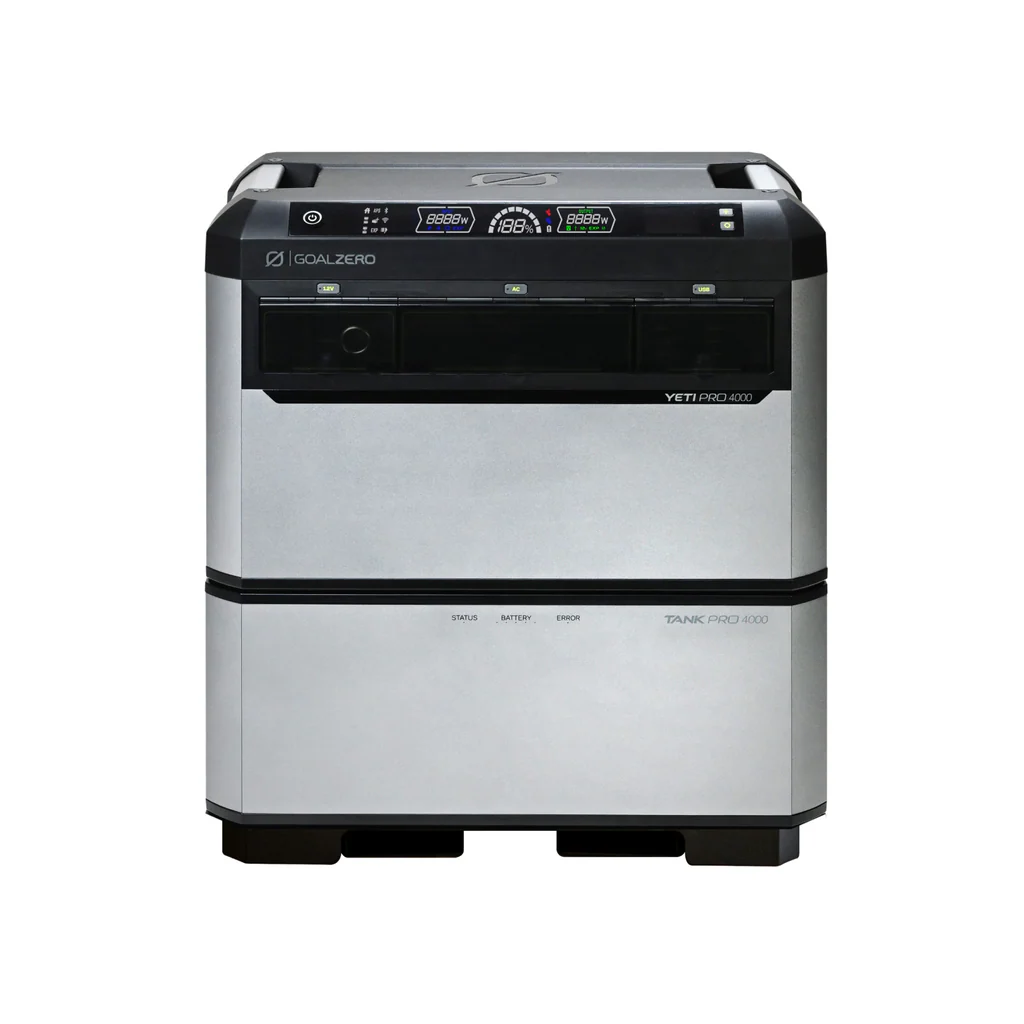
Goal Zero Yeti PRO 4000 + Tank PRO 4000 (Yeti PRO 8000)
$5,998.95
$5,998.95 · direct from Goal Zero
Last checked 16 days ago. Prices move — check before you buy.
Prices may vary by retailer and are subject to change.