Head-to-head test
Goal Zero Yeti 6000X vs Goal Zero Yeti PRO 4000 + Tank PRO 4000 (Yeti PRO 8000)
Goal Zero Yeti 6000X vs Goal Zero Yeti PRO 4000 + Tank PRO 4000 (Yeti PRO 8000): The Yeti PRO 8000 bundle (a Yeti PRO 4000 base paired with a Tank PRO 4000 expansion battery) is the stronger long-term buy inside Goal Zero's own catalog, but the case is closer than it was.
Full profiles: Goal Zero Yeti 6000X → · Goal Zero Yeti PRO 4000 + Tank PRO 4000 (Yeti PRO 8000) →

Written by Gunner GustafsonUpdated
Whole-Home Backup Tester, Station Arena Test Desk
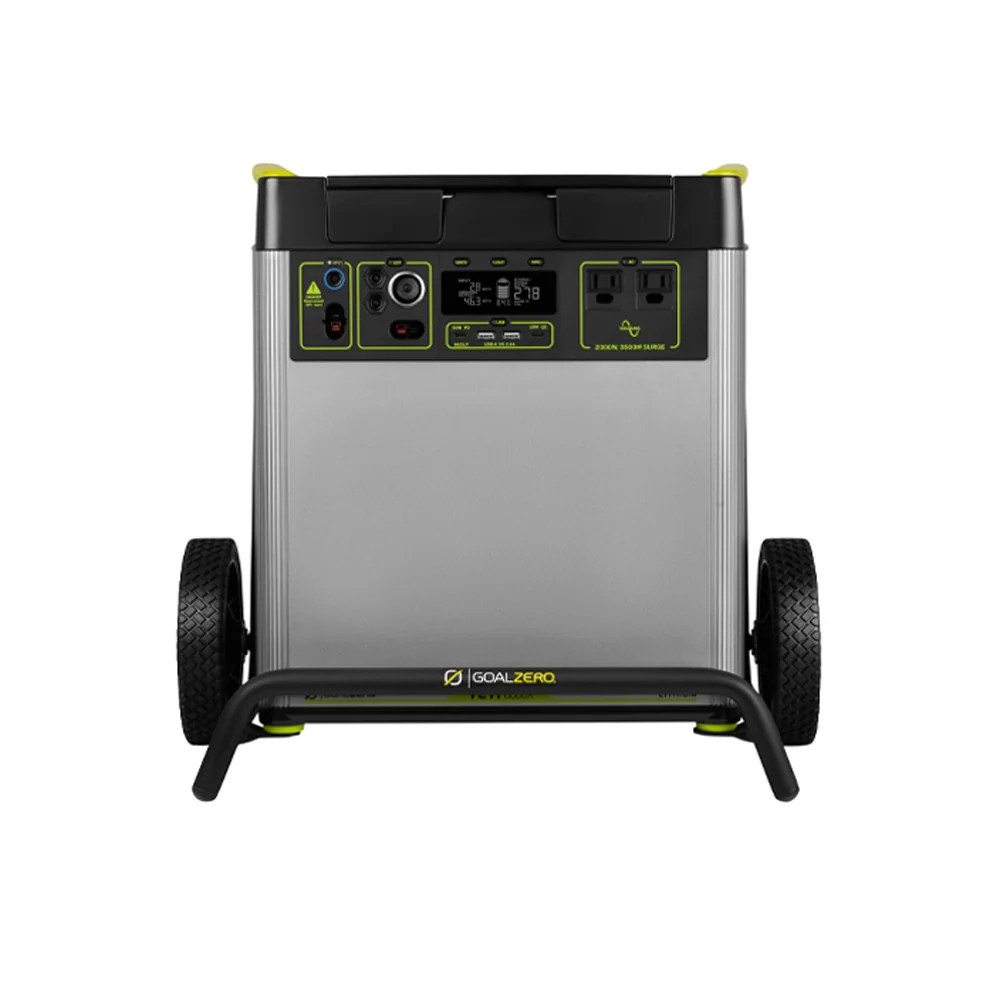
$3,999.95 · direct from Goal Zero
Last checked 1 day ago. Prices move — check before you buy.
Goal Zero
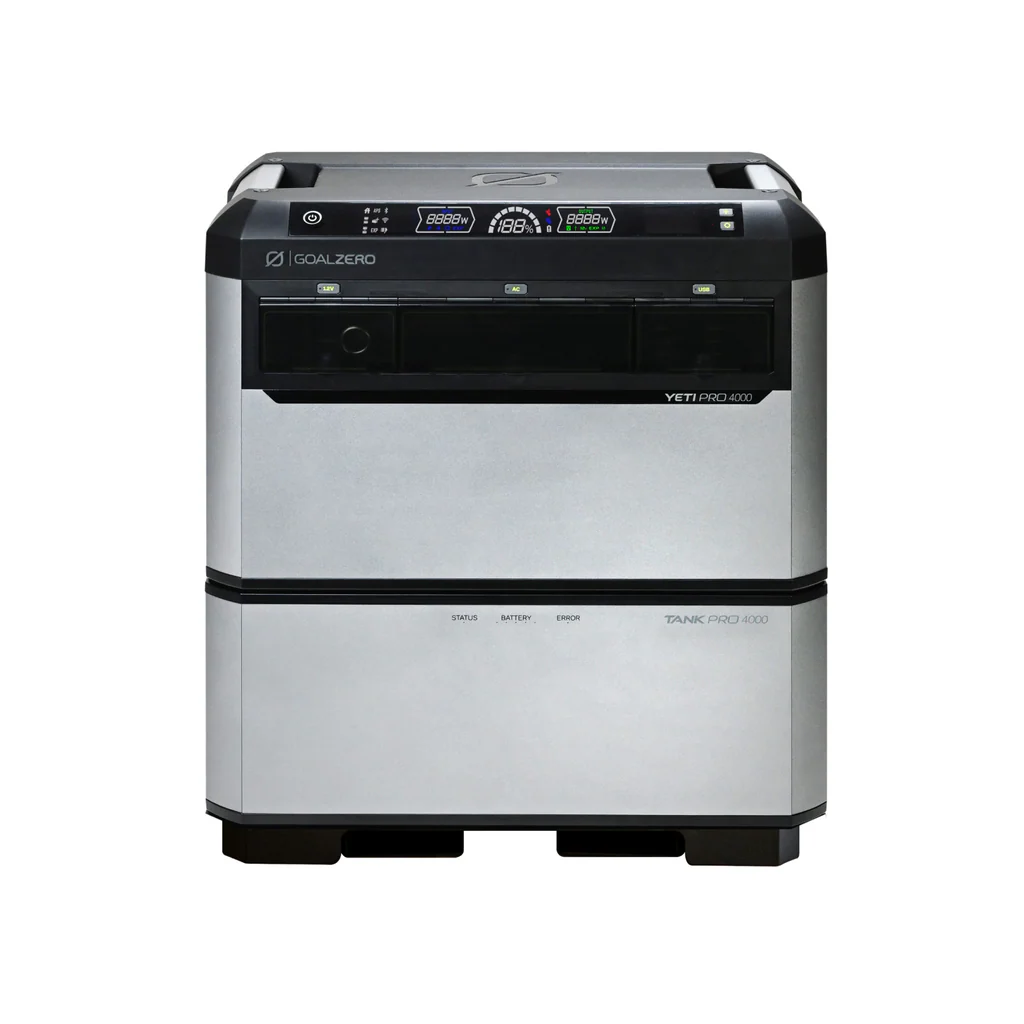
Yeti PRO 4000 + Tank PRO 4000 (Yeti PRO 8000)
6,834Power Score · The AC & Fridge Zone
$5,998.95 · direct from Goal Zero
Last checked 1 day ago. Prices move — check before you buy.
Spec deltas
The Yeti PRO 8000 — Goal Zero's own Yeti PRO 4000 paired with a Tank PRO 4000 expansion battery — costs $5,999, about $1,999 more than the 6000X's $4,000, while holding 1,917Wh more energy and outputting 3,600W to the 6000X's 2,000W. Within Goal Zero's own lineup, you pay more to get bigger and stronger — the usual trade, not a free lunch.
The picture changes once you look past year one. The 6000X's battery uses lithium NMC cells rated for 500 cyclesA1; the PRO 8000's Tank PRO 4000 batteries use newer LiFePO4 chemistry built for a far longer service lifeB4. The engine's lifetime math shows the result: $1.32 per kilowatt-hour over the 6000X's life against $0.19 for the PRO 8000 — buy the 6000X and you're paying roughly seven times as much for every kilowatt-hour you actually use, which is how the PRO 8000's higher sticker price pays itself back over a long enough life.
The 6000X's real cards are a lower upfront price — about $1,999 less — and being a single box at 106 lbs, not a base unit plus a separate battery totaling 195.95 lbs. The twist is that it's the same company charging a heavy premium for its bigger bundle, which then earns that money back on lifetime cost and outlasts the flagship eightfold. If you want the lower sticker, never plan to expand, or want the lightest thing Goal Zero sells at this tier, those are real reasons to pick the 6000X. For heavy, long-term users, the PRO 8000 is still the better Goal Zero to own.
What the Numbers Reveal
Each conclusion stated first — the numbers behind it on one line, the full analysis below.
cost / lifetime kWh
The reason isn't the battery size — it's the cell chemistry. The 6000X runs 500-cycle NMC cellsA1 against the PRO 8000's Tank PRO 4000 batteries on longer-lived LiFePO4B4. A higher sticker price but more capacity and a roughly seven-times-lower cost per kilowatt-hour makes this a genuine tradeoff between two products from the same brand — upfront cost against lifetime cost.
the Yeti PRO 8000 costs $5,999 versus the 6000X's $4,000the Yeti PRO 8000 holds 7,988Wh versus the 6000X's 6,071Whthe 6000X's cost per lifetime kWh is $1.32 versus the PRO 8000's $0.19
Why it mattersAnyone comparing these two on sticker price alone will grab the 6000X and miss that the PRO 8000's battery costs far less to actually use over its life.
solar input
Ninety additional pounds, split across a base unit and a Tank PRO 4000 battery, buys a recharge that's roughly six times faster once you're off-grid and the sun's out. Move the 6000X and you're carrying less; run it dry and you're waiting most of a day to fill it back up.
the 6000X weighs 106 lbs as a single unit versus the PRO 8000's combined 195.95 lbs across two boxesthe 6000X takes 12 hours for a full recharge on its included 600W chargerA3the PRO 8000 takes 3,000W of solar input for a full recharge in under two hours off-gridB2
Why it mattersBuyers who recharge from solar in the field should weigh the PRO 8000's speed against its extra bulk — the 6000X's lightness stops mattering the moment the battery's empty.
rated cycles
Reviewers who tested the PRO 8000 came away impressedB1, but some owners report bugs and at least one unit that failed exactly when it was neededB3 — the kind of report that matters more on a power station than almost any other spec. Even so, the 6000X isn't the safer bet either; its battery is already guaranteed to give back less than its rated capacity well before the PRO 8000 hits its own rated lifeA4.
the PRO 8000 configuration can expand to four Tank PRO 4000 batteries, and professional reviewers call it highly reliableB1some owner reviews describe inconsistent reliability, including a unit that didn't work the first time it was needed during an outageB3the 6000X's NMC battery already ages out of some of its rated capacity by the end of its 500-cycle lifeA4
Why it mattersA buyer choosing on reliability alone should weigh the newer unit's mixed field recordB3 against a battery on the older one that's already shrinking on a fixed schedule.
The specific dimensions that decide these two units — everything else is a tie.
PowerScore Breakdown
Selected because: 7,402 vs 4,982 — the composite score reflects the PRO 8000's lead across nearly every spec.
overall power score
The PRO 8000's 7,402 composite score against the 6000X's 4,982 isn't one advantage carrying the number — it's stacked ones: more output, more surge, more solar input, more cycles, a longer warranty. The 6000X pulls ahead only on its now-roughly-$1,999-lower upfront price and its single-box weight; its 500-cycle NMC batteryA1 is where it falls behind.
A composite score this lopsided inside one brand's own catalog is unusual. Goal Zero isn't being out-scored by a competitor here — it's being out-scored by its own newer, pricier bundle, which beats the flagship on the composite even though it now costs about $1,999 more.
Lifetime Value
Selected because: A roughly seven-times gap in cost per lifetime kWh is the core of the verdict.
cost / lifetime kWh
$0.19 per lifetime kWh for the PRO 8000 against $1.32 for the 6000X is the number that reframes the debate: the PRO 8000 costs about $1,999 more up front but far less per unit of energy delivered. Run either unit daily and the 6000X reaches its rated cycle life in 1.4 years; the PRO 8000 stretches that to 11 years before it's being asked to do more than its rating allows.
On a once-a-week cadence the 6000X's math is a little kinder — 9.6 years instead of 1.4 — but the PRO 8000 still stretches to 76.9. Per kilowatt-hour the 6000X always costs more, because its battery is the more expensive component to wear out; the catch is that a light-use owner may never run enough cycles to earn back the PRO 8000's roughly $1,999 higher upfront price, which is exactly when the cheaper 6000X makes sense.
What the Specs Don't Tell You
Selected because: Weight, UPS speed, and cycle life all diverge sharply between these two.
rated cycles
Both are heavy. The 6000X's 106 lbs already ships with a roll cartA2; the PRO 8000 adds a second box and comes to 195.95 lbs combined. Neither is a unit you carry to a campsite — think garage or vehicle mount, not trailhead.
The PRO 8000 switches to battery power in under 10ms, fast enough to qualify as line-interactive UPS behavior — the kind that matters for a CPAP or a desktop — against the 6000X's 25ms basic-standby switchover. Paired with an eightfold cycle-life advantage, the PRO 8000 is built for the kind of daily reliance the 6000X's battery simply isn't rated for.
Growth Path
Selected because: Both expand, but the solar ceiling separates them for off-grid growth.
solar input
Both expand. The 6000X takes Goal Zero expansion batteries, and the PRO 8000 configuration already includes one Tank PRO 4000 with room for three more, up to 20kWh totalB1. The real difference is the on-ramp: 3,000W of solar input against 600W.
That gap means the PRO 8000 can recharge a bigger bank fast, provided you're using Goal Zero's own panels and combiner to hit that ceilingB2. The 6000X's 600W ceiling caps any expansion plan at a slow refill no matter how many batteries you add. For a buyer planning to grow the system, the PRO 8000 is the better foundation to grow from.
Strengths & trade-offs
Goal Zero Yeti 6000X
Strengths
- +Costs $1,999 less
- +Lighter by 89.9 lb
Trade-offs
- –Weaker inverter (-1,600W) limits appliance compatibility.
- –Very heavy unit that may be difficult for one person to lift.
- –Shorter-lived battery — rated for 500 charge cycles vs the Yeti PRO 4000 + Tank PRO 4000 (Yeti PRO 8000)'s 4,000, so it wears out sooner.
Goal Zero Yeti PRO 4000 + Tank PRO 4000 (Yeti PRO 8000)
Strengths
- +Larger battery capacity
- +Higher AC output
- +Longer warranty
- +Faster solar charging
- +Rated for 4,000 charge cycles — much longer battery lifespan
Trade-offs
- –Substantially more expensive (+$1,999) than the Yeti 6000X.
- –Significantly heavier (+89.9 lbs), making it harder to move.
- –Very heavy unit that may be difficult for one person to lift.
Will It Power Your Gear?
Scenario math and per-appliance runtimes, modeled from the spec record.
Scenario verdicts
We ran the math on six real-world scenarios. Here's which unit survives your actual life.
SCN-01 · 2 nights · needs 2,100Wh
Weekend Camping
Two nights off-grid with essential comfort
Neither unit
Scoring these two at a campsite is a category error: neither travels — the Yeti 6000X is 106 lbs and the Yeti PRO 4000 + Tank PRO 4000 (Yeti PRO 8000) 196 lbs, and at those weights they roll off a truck bed if they go anywhere at all. The 2,100Wh here is trivial for either — it's the going that doesn't happen. If you need power away from the building, you're shopping the wrong class.
Battery budget usedlower = more headroom
LOAD Phone Charger 15W×6h · LED Lights 40W×8h · Box Fan 75W×14h · CPAP Machine 40W×16h
SCN-02 · 8 hours · needs 1,645Wh
8-Hour Blackout
Keep the essentials running through a night without power
Either unit
Both survive the blackout with similar margin, so the tiebreaker is UPS behaviour — only the Yeti PRO 4000 + Tank PRO 4000 (Yeti PRO 8000) lists a UPS mode, which hands a router or PC to battery the moment the grid drops instead of after your reaction time.
Battery budget usedlower = more headroom
LOAD Fridge 150W×8h · Router + Modem 20W×8h · LED Lights (4 bulbs) 40W×6h · Phone Charger 15W×3h
SCN-03 · 8 hours · needs 320Wh
CPAP Overnight
Sleep therapy without interruption — the #1 medical use case
Either unit
A CPAP is about 40W for eight hours, so both cover the night with room to spare and capacity decides nothing. Fan noise would — but neither maker publishes a fan-noise figure, so there's nothing to hold either of them to. Buy on price, weight, and whether you can live with a fan you haven't heard.
Battery budget usedlower = more headroom
LOAD CPAP Machine 40W×8h
SCN-04 · 8 hours · needs 910Wh
Remote Workday
Full work day off-grid without power anxiety
Either unit
Both power your workstation all day without strain. At these utilization levels the real difference is USB-C for direct laptop charging — 100W on the Yeti PRO 4000 + Tank PRO 4000 (Yeti PRO 8000) against 60W — which beats the inverter for convenience and wastes less energy.
Battery budget usedlower = more headroom
LOAD Laptop 60W×8h · External Monitor 30W×8h · Router + Modem 20W×8h · Phone Charger 15W×2h
SCN-05 · 4 hours · needs 670Wh
Tailgate Party
Game day power for the crew
Neither unit
Scoring these two at a tailgate is a category error: neither travels — the Yeti 6000X is 106 lbs and the Yeti PRO 4000 + Tank PRO 4000 (Yeti PRO 8000) 196 lbs, and at those weights they roll off a truck bed if they go anywhere at all. The 670Wh here is trivial for either — it's the going that doesn't happen. If you need power away from the building, you're shopping the wrong class.
Battery budget usedlower = more headroom
LOAD Blender 400W×0.5h · LED TV (55") 80W×4h · Bluetooth Speaker 15W×4h · Phone Charger (×3) 45W×2h
SCN-06 · 24 hours · needs 4,685Wh
Van Life Daily
A full day of mobile living — the ultimate endurance test
Yeti PRO 4000 + Tank PRO 4000 (Yeti PRO 8000)
The Yeti 6000X uses 91% of its battery on a full day, leaving 475Wh — miss a solar day and that is the entire cushion. The Yeti PRO 4000 + Tank PRO 4000 (Yeti PRO 8000) at 69% keeps 2,105Wh in hand, a far more forgiving rhythm for full-time living.
Battery budget usedlower = more headroom
LOAD Mini-Fridge 150W×24h · Laptop 60W×4h · Phone Charger 15W×3h · LED Lights 40W×5h · Fan 75W×8h
The Load Test
RUNTIME = (Wh × 0.85) ÷ LOAD
None of the scenarios above exactly yours? Build it. Toggle what you'd plug in; both units are tested against the combined draw.
Essentials
Comfort & Convenience
High-Draw Appliances
Test duration
8h
Continuous draw
205W
Projected runtime
For this load: Yeti PRO 4000 + Tank PRO 4000 (Yeti PRO 8000) runs 33.1h vs 25.2h.
$5,998.95 list · direct from Goal Zero
Modeled from the spec record — same math as the tables below. Methodology
Runtime by appliance
Real-world runtime estimates for common appliances, modeled at 85% inverter efficiency.¹
Essentials
The basics you need runningscale 0–452.7hComfort & Convenience
Makes off-grid life actually enjoyablescale 0–90.5hHigh-Draw Appliances
These reveal the real limitsscale 0–6.8h¹ Runtime = (capacity × 0.85) ÷ appliance watts. Within each group, all bars share one time scale (the group's longest runtime), so lengths are comparable across appliances; identical runtimes collapse into a single blue/orange bar. Actual runtime varies with battery age, temperature, and simultaneous loads — see methodology.
Conclusion
July 14, 2026
Verdict: the Yeti PRO 4000 + Tank PRO 4000 (Yeti PRO 8000), on Power Score margin
The Yeti PRO 8000 bundle (a Yeti PRO 4000 base paired with a Tank PRO 4000 expansion battery) is the stronger long-term buy inside Goal Zero's own catalog, but the case is closer than it was. At $5,999 it now costs about $1,999 more than the 6000X's $4,000, while holding 1,917Wh more energy, outputting 1,600W more, and surging to 7,200W against 3,500. Its Tank PRO 4000 batteries run LiFePO4 cells rated for roughly eight times the cycle life of the 6000X's NMC batteryA1B4, which is most of why its cost per lifetime kWh works out to $0.19 against $1.32 — so the higher sticker is recovered many times over if you actually use that cycle life. The catches: it costs about $1,999 more up front, it's two boxes weighing 195.95 lbs combined against the 6000X's single 106-lb enclosure, and some owners report reliability issues the professional reviews didn't catchB3. If you want the lower upfront price, a single lighter box, or won't put in the cycles to bank the lifetime savings, the 6000X makes real sense. For heavy, long-term users, the PRO 8000 still wins.
Editor-assigned confidence, based on cited owner research and spec analysis.
List prices as of July 14, 2026. The links below open Goal Zero's current price.
$5,998.95 · direct from Goal Zero
Last checked 1 day ago. Prices move — check before you buy.
or check the Yeti 6000X price$3,999.95 list
Written by Gunner Gustafson, Whole-Home Backup Tester · Station Arena Test Desk · Updated July 14, 2026
Measured Data
Benchmark scores and the full spec record, side by side.
Benchmark scores
Not rated for both units (minimum threshold unmet): Solar Generator.
Full specifications
ᵈ Derived: price ÷ rated capacity. See the data behind our comparisons →
Comparison ToolAdd more power stations, side by sideOpen Tool →How these numbers are produced
Numeric verification
Every figure on this page traces to our spec database or arithmetic on it — no estimated numbers.
Owner claims
Statements about owner experience are cited to published reviews — see Sources & Research Notes below.
Runtime model
Runtime = (rated capacity × 0.85 inverter efficiency) ÷ device wattage. Solar recharge estimates assume panels deliver 70% of rated output. Cold weather, battery age, and stacked loads reduce real-world results.
Power Score
Computed from 14 published spec dimensions, weighted per use-case bench. Higher is better; a unit must meet a bench's minimum threshold to be rated.
See the full weight table and data sourcing on our methodology page →Class ranking (the star rating)
Each unit's star score is a category ranking, not customer reviews — no buyer opinions feed it. We score every station on size-independent quality (value, output, portability, endurance, ports, warranty, and more), then percentile-rank it against the other units in its capacity class, so a class-leading compact unit and a class-leading whole-home unit can both earn 5★. Here, Yeti 6000X rates 3.3/5 (1st percentile of 16 Home Backup-class units), and Yeti PRO 4000 + Tank PRO 4000 (Yeti PRO 8000) rates 3.4/5 (4th percentile of 29 Whole-Home / Off-Grid-class units).
How the class ranking is computed →Test Notes & Caveats
Hidden gotchas and advantages we spotted that you won't find on the product page.
195.95 lbs split across two boxes, 106 in one
The PRO 8000's extra capacity comes packed into a base unit and a separate Tank PRO 4000 battery — combined they weigh almost double the 6000X's single 106-lb enclosure. Budget for two lifts, or a cart, either way; the 6000X ships with a roll cart for the same reason.
Only the Yeti PRO 4000 + Tank PRO 4000 (Yeti PRO 8000) Lists a UPS Mode
The Yeti PRO 4000 + Tank PRO 4000 (Yeti PRO 8000) can sit between the wall and your gear and hand it to battery when the grid drops — rated ≤15ms — fine on paper for routers and most electronics; the fussiest PC power supplies sit right at this line. Worth it for a router, a desktop PC, or a CPAP. The Yeti 6000X's spec sheet lists no UPS mode, so anything plugged into it rides an outage only as far as your reaction time.
Warranty: 5 Years vs 2
The Yeti PRO 4000 + Tank PRO 4000 (Yeti PRO 8000) is covered for 5 years against the Yeti 6000X's 2 years. An underrated factor if you're keeping this unit for years.
500 cycles versus 4,000
The 6000X's NMC cells are rated to 500 cycles before capacity starts to fade; the PRO 8000's Tank PRO 4000 batteries are rated for roughly eight times that. Run either daily and the difference between a battery that's done its job in about a year and a half versus one that's still going after eleven years is most of the cost-per-kWh gap on this page.
Full record above — the Test Desk pick is the Yeti PRO 4000 + Tank PRO 4000 (Yeti PRO 8000).
Check Yeti PRO 4000 + Tank PRO 4000 (Yeti PRO 8000) price →or check the Yeti 6000X priceOwnership Analysis
What happens after you buy — true cost of ownership, brand trust, and growth potential.
Lifetime value
Service lifeyears at one full cycle per day
Lifetime energy delivered
Cost per delivered kWh
│ warranty ends · Reaching the cycle rating means ~80% capacity remains — degraded, not dead.
Analyst note
The Yeti 6000X is cheaper to buy, but the Yeti PRO 4000 + Tank PRO 4000 (Yeti PRO 8000) is cheaper to own. At $0.19/kWh over its lifetime vs $1.32/kWh, the Yeti PRO 4000 + Tank PRO 4000 (Yeti PRO 8000)'s higher cycle life and capacity make each dollar go further over the years.
Delivers each lifetime kWh for $1.13 less — check the Yeti PRO 4000 + Tank PRO 4000 (Yeti PRO 8000) price →
Growth path
Yeti 6000X
EXPANDABLESupports Goal Zero expansion batteries, so you can add capacity later without replacing the base unit — useful if your needs may climb past 6,071Wh.
Accepts up to 600W of solar. Suitable for a 1-2 panel setup.
Adequate ports for most setups, but heavy users may want a power strip.
Expansion batteries are Goal Zero-specific. You're investing in the Goal Zero ecosystem.
Yeti PRO 4000 + Tank PRO 4000 (Yeti PRO 8000)
EXPANDABLESupports Goal Zero expansion batteries, so you can add capacity later without replacing the base unit — useful if your needs may climb past 7,988Wh.
Accepts up to 3,000W of solar. Enough for a serious multi-panel array.
Generous port selection supports complex multi-device setups.
Expansion batteries are Goal Zero-specific. You're investing in the Goal Zero ecosystem.
Realistic full solar rechargeat 70% of rated panel output — see methodology
Analyst note
Both expand, but the Yeti PRO 4000 + Tank PRO 4000 (Yeti PRO 8000)'s higher solar ceiling (3,000W vs 600W) gives it the stronger off-grid growth path — more panels can feed a bigger bank as it grows.
What Owners Report
Patterns from published owner reports and long-term reviews — every claim cited to its source below.
Goal Zero Yeti 6000X
The 6000X ships with a roll cart, and reviewers treat that as a tell: at 106 lbs it's built as a semi-stationary power hub, not something you carry to a siteA2. Its 2,000W pure sine inverter peaks to 3,500W and takes about 12 hours for a full recharge on the included 600W chargerA3.
The bigger issue is underneath the spec sheet. It runs lithium NMC cells rated for just 500 cycles to 80% capacityA1, and reviewers note that once you've put it through those cycles, the battery is giving back meaningfully less than its rated 6,071WhA4. It's a large battery built on an aging chemistry.
“Weighs about 106 lbs — not portable for most people; designed as a semi-stationary power hub, and comes with a roll cart.”
Sources
poweredportablesolar.com · bestgeneratorsolar.com · shopsolarkits.com · bhphotovideo.com · poweraic.com
Goal Zero Yeti PRO 4000 + Tank PRO 4000 (Yeti PRO 8000)
Professional reviewers rate the PRO 8000 configuration as a highly reliable, built-to-last system, and its expansion story is real — up to four Tank PRO 4000 batteries for as much as 20kWhB1. Its 3,000W solar ceiling can take it from empty to full in under two hours off-grid, though reaching that top rate requires Goal Zero's own panels and combiner boxB2.
Owner reviews are more mixed than the professional ones. Some report bugs, and at least one owner says their unit didn't work the first time they actually needed it during an outageB3. The upgraded Tank PRO 4000 batteries do use newer LiFePO4 cells built for a longer life than the previous generation of Goal Zero expansion batteriesB4 — the hardware has genuinely moved forward, even if not every owner's experience has been smooth.
“A strong expandable system — you can add up to four Tank PRO 4000 batteries for up to 20 kWh; professional reviewers call it a high-powered, highly reliable power station built to last.”
Sources
batteryskills.com · techradar.com · goalzero.com · bestgeneratorsolar.com · business.walmart.co · thesolarlab.com
Sources & Research Notes
Every owner claim in this report is traceable to a published source. The bracketed references above resolve here.
Recurring owner themes
- Large NMC capacity but a crippling 500-cycle rating, very heavy (~106 lbs), and slow charging are the recurring points. [Yeti 6000X · 3 entries]
- Praised for large expandability (to 20 kWh) and fast solar recharge; caveats are mixed owner reliability reports and a max solar rate locked behind proprietary Goal Zero hardware. [Yeti PRO 4000 + Tank PRO 4000 (Yeti PRO 8000) · 3 entries]
- A1
“Uses lithium NMC cells with a 6,071Wh capacity but a cycle life of only 500 cycles to 80% — not high compared to competing LFP models.”
poweredportablesolar.com / bestgeneratorsolar.com — Yeti 6000X review · 2026 · [negative]
- A2
“Weighs about 106 lbs — not portable for most people; designed as a semi-stationary power hub, and comes with a roll cart.”
shopsolarkits.com / bhphotovideo.com — Yeti 6000X review · 2026 · [mixed]
- A3
“A 2,000W pure sine inverter peaking to 3,500W, fully rechargeable in 12 hours with the included 600W AC charger.”
bestgeneratorsolar.com / poweraic.com — Yeti 6000X review · 2026 · [mixed]
- A4
“After 500 cycles capacity drops to ~80%, so the 6,071Wh battery effectively becomes ~4,857Wh — a structural NMC disadvantage vs LFP.”
poweredportablesolar.com — Yeti 6000X review · 2026 · [negative]
- B1
“A strong expandable system — you can add up to four Tank PRO 4000 batteries for up to 20 kWh; professional reviewers call it a high-powered, highly reliable power station built to last.”
batteryskills.com / techradar.com — Yeti PRO 4000 review · 2026 · [positive]
- B2
“Accepts up to 3,000W of solar input, but reaching that ceiling needs Goal Zero's own expensive proprietary panels and combiner box. Note the widely quoted "0% to 100% in under 2 hours" figure describes the standalone PRO 4000; with the Tank attached the system holds roughly twice the energy, so a full refill takes correspondingly longer.”
goalzero.com / bestgeneratorsolar.com — Yeti PRO 4000 review · 2026 · [mixed]
- B3
“Owner reviews are mixed on reliability — one owner's Yeti 4000 didn't work the first time they lost power and really needed it, and some report it's still riddled with bugs, though professional reviewers didn't experience those issues.”
business.walmart.com reviews / thesolarlab.com — Yeti PRO 4000 owner reviews · 2026 · [negative]
- B4
“The Tank PRO 4000 expansion batteries use improved LiFePO4 tech rated for a much longer lifespan than the previous generation of expansion batteries.”
goalzero.com — Tank PRO 4000 expansion battery · 2026 · [positive]
Research compiled July 14, 2026.
Who Should Buy Which
Buy the Yeti 6000X if you…
- →You want the lower upfront price — the 6000X now costs about $1,999 less than the PRO 8000 bundle — and won't run enough cycles to earn that premium back over the battery's life.
- →You want a single box, not a base unit plus a separate battery, even at 106 lbsA2.
- →You're not planning to expand and 2,000W of continuous output covers everything you run.
- →You already own 6000X-compatible accessories and don't want to change setups.
Buy the Yeti PRO 4000 + Tank PRO 4000 (Yeti PRO 8000) if you…
- →You want the most capacity and output Goal Zero sells at this tier and will keep it long enough for its far lower cost per lifetime kilowatt-hour to pay back the roughly $1,999 higher upfront price.
- →You're recharging from solar in the field and want the faster refillB2.
- →You're fine assembling a base unit and a Tank battery instead of one sealed box, and can live with a few owner-reported reliability hiccupsB3.
This is you — check the Yeti PRO 4000 + Tank PRO 4000 (Yeti PRO 8000) price
If neither fits
Shoppers who haven't committed to the Goal Zero ecosystem specifically should price-shop outside this lineup before spending $4,000 to $6,000 here — modern LFP power stations with cycle life at or above the PRO 8000's are available from other brands, often for much less.
The Bottom Line
Within Goal Zero's own catalog, the Yeti PRO 8000 bundle is the better long-term buy for heavy users: bigger, faster to recharge, and rated for eight times the cycle life of the 6000X, with a cost-per-lifetime-kWh roughly a seventh of what the 6000X asks — enough to recover its roughly $1,999 higher upfront price over a long service life.
The 6000X's case is stronger now: a single box, 90 fewer pounds to move, and about $1,999 less up front — real if you want the lower sticker, will never expand, or won't run the cycles to bank the bundle's lifetime savings. Buyers who will use that cycle life should still pay up for the newer bundle.
Frequently Asked Questions
Answers drawn from the spec record and cited owner research.
Goal Zero Yeti 6000X vs Yeti PRO 8000 — which should I buy?
For heavy, long-term users, the Yeti PRO 8000 bundle — but it's now a closer call. It costs about $1,999 more than the 6000X, yet holds 1,917Wh more, outputs 1,600W more, is rated for eight times the cycle life, and costs far less per lifetime kilowatt-hour ($0.19 against $1.32). The 6000X's real advantages are its roughly $1,999 lower price and being a single 106-lb box instead of two boxes totaling 195.95 lbs.
Why does the pricier Yeti PRO 8000 cost so much less per kilowatt-hour over its life?
Chemistry. The 6000X runs lithium NMC cells rated for 500 cycles to 80% capacity, while the PRO 8000's Tank PRO 4000 batteries use LiFePO4 cells built for a much longer service life. That difference is most of why the cost-per-lifetime-kWh works out to $1.32 for the 6000X against $0.19 for the PRO 8000, even though the PRO 8000 now costs about $1,999 more up front.
Is the Yeti PRO 8000's extra weight a problem?
Only if you're carrying it somewhere. At 195.95 lbs combined across the base unit and one Tank PRO 4000, it's meant for a garage, basement, or vehicle mount, not a hike. The 6000X is lighter at 106 lbs but comes with its own roll cart for the same reason — neither is a grab-and-go unit.
Does the 6000X ever make more sense than the PRO 8000?
More often than it used to. It makes sense if you want the roughly $1,999 lower upfront price, prefer one sealed box to a base unit plus expansion battery, won't bank enough cycles to recover the PRO 8000's premium, or find 2,000W of continuous output covers everything you run. Otherwise the PRO 8000 still beats it on capacity, output, cycle life, lifetime cost per kilowatt-hour, and solar recharge speed.
Related comparisons
Where to buy
Goal Zero Yeti 6000X
$3,999.95
$3,999.95 · direct from Goal Zero
Last checked 1 day ago. Prices move — check before you buy.
Goal Zero Yeti PRO 4000 + Tank PRO 4000 (Yeti PRO 8000)Pick
$5,998.95
$5,998.95 · direct from Goal Zero
Last checked 1 day ago. Prices move — check before you buy.
Prices may vary by retailer and are subject to change.