Head-to-head test
Goal Zero Yeti 3000X vs Goal Zero Yeti PRO 4000 + Tank PRO 4000 (Yeti PRO 8000)
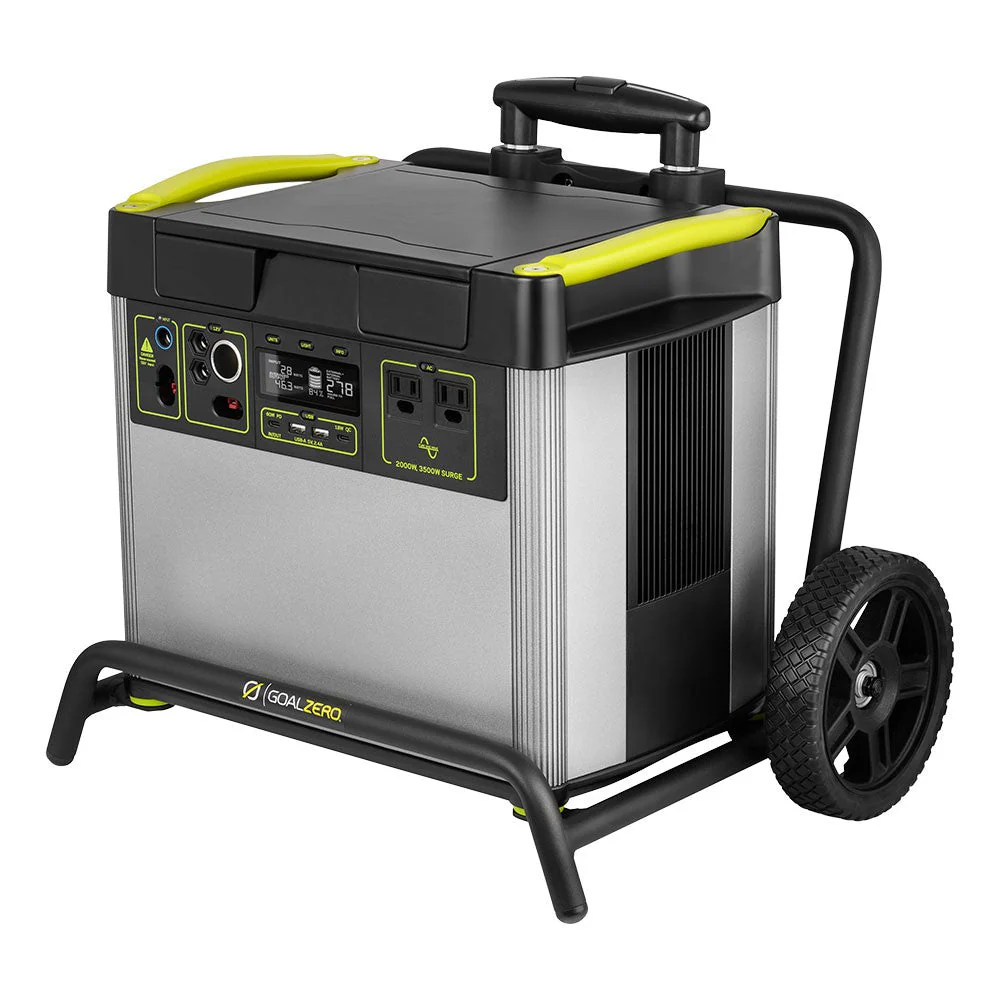
The 3000X is the only one here you can move by yourself, and that is the whole case for it: the PRO 8000 is cheaper per watt-hour on the day you buy it and ten times cheaper per kilowatt-hour it will ever deliver.
Full profiles: Goal Zero Yeti 3000X → · Goal Zero Yeti PRO 4000 + Tank PRO 4000 (Yeti PRO 8000) →

Written by Gunner GustafsonUpdated
Whole-Home Backup Tester, Station Arena Test Desk
$2,999.95 · direct from Goal Zero
Last checked 1 day ago. Prices move — check before you buy.
Goal Zero
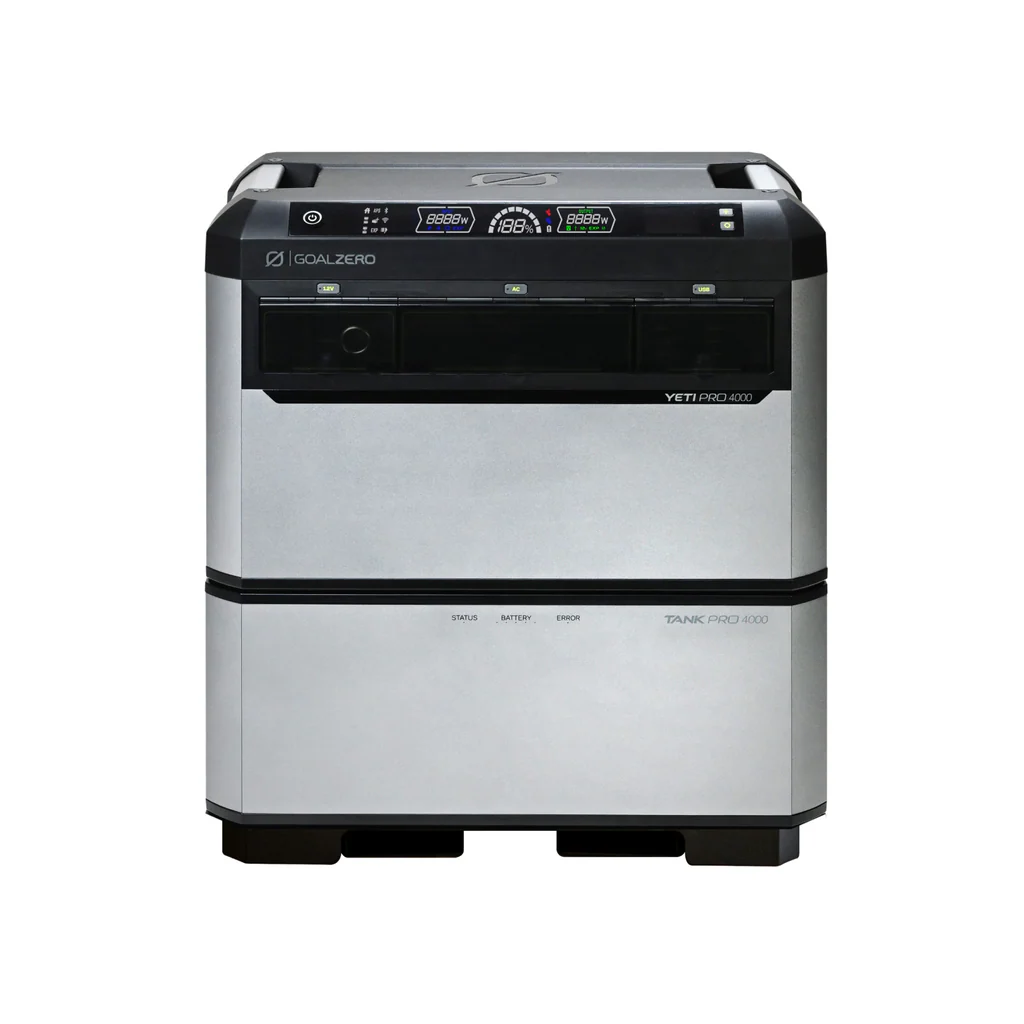
Yeti PRO 4000 + Tank PRO 4000 (Yeti PRO 8000)
6,834Power Score · The AC & Fridge Zone
$5,998.95 · direct from Goal Zero
Last checked 1 day ago. Prices move — check before you buy.
Spec deltas
Doubling your budget on this page buys you a cheaper battery. The Yeti PRO 8000 is $5,999 against the 3000X's $3,000, and it still works out to 75 cents per watt-hour of capacity where the 3000X charges 99. The larger system is not the premium option here. It is the one with better unit economics before you have plugged anything into it.
Cycle life is why the gap then turns into a canyon. The 3000X uses Li-ion NMC rated for 500 cycles to 80% capacity, against the 3,000+ cycles typical of LiFePO4 packsA1, while the PRO 8000 is rated for 4,000. Across their rated lives that is 1,516 kWh from the small unit and 31,952 kWh from the big one: twenty-one times the energy for twice the money, or $1.98 per lifetime kilowatt-hour against nineteen cents. You only need that number once.
What the 3000X keeps is the ability to leave the house. Roughly 70 pounds and a roll cartA2 will go in a truck bed; the PRO 8000 is 196 pounds across two boxes and belongs against a utility-room wall. If your use case has wheels under it, that is a real argument and the rest of this page cannot answer it. If it has a breaker panel behind it, it isn't.
What the Numbers Reveal
Each conclusion stated first — the numbers behind it on one line, the full analysis below.
rated cycles
Fold in the cycle ratings and the day-one gap stops being the story. The 3000X will pass 1,516 kWh over its rated life and the PRO 8000 will pass 31,952, so the same dollar buys $1.98 of lifetime kilowatt-hour from one and nineteen cents from the other. Nothing on the spec table closes a ten-to-one difference in what energy costs you.
Yeti 3000X: $2,999.95 for 3,032Wh, which the spec sheet puts at $0.99 per watt-hourYeti PRO 8000: $5,999 for 7,988Wh, or $0.75 per watt-hour3000X rated 500 cycles; PRO 8000 rated 4,000 cycles
Why it mattersIf you are framing this as 'spend $3,000 or spend $6,000,' you are measuring the sticker instead of the purchase.
The buyer most punished by that 500-cycle rating never gets to find out about it, because the 3000X cannot finish a single full-time off-grid day in the first place. At 4,685Wh of daily draw it runs dry at 182% of what it can usefully hold, so the van and the off-grid cabin are ruled out on capacity before cycle life gets a vote.
3000X rated 500 cycles, which the engine puts at 1.4 years of daily cyclingPRO 8000 rated 4,000 cycles, or 11 years of daily cyclingVan Life Daily draws 4,685Wh, which is 182% of the 3000X's usable capacity
Why it mattersFull-timers can stop comparing: the 3000X is not a candidate, and the question becomes whether the PRO 8000 is worth $5,999 to you.
solar input
That ceiling is expensive to actually reach, since 3,000W means buying Goal Zero's proprietary panels and combinerB2, so budget for the array or accept a fraction of the rate. Even a fraction of 3,000W beats a hard 600W cap, and in a multi-day outage the refill rate is what decides whether you are rationing on day three or not.
3000X: 600W maximum solar input into 3,032WhPRO 8000: 3,000W maximum solar input into 7,988WhReaching the 3,000W ceiling requires Goal Zero's own proprietary panels and combiner boxB2
Why it mattersAnyone buying for outages longer than one night should price the panels alongside the box, because on the 3000X no amount of panel spending moves that 600W wall.
It is fast, not instantaneous, so genuinely intolerant equipment still wants a dedicated double-conversion UPS. But the 3000X is not in that conversation: with no automatic transfer, it is a battery you plug into after the lights go out, which means somebody has to be home and awake to do it. For a home office or a NAS, that is the difference between backup and a fire drill.
PRO 8000 transfers from grid to battery in under 15ms3000X carries no UPS mode and no rated switchover time at all8-Hour Blackout draws 1,645Wh, using 24% of the PRO 8000 and 64% of the 3000X
Why it mattersIf the plan is 'wire it in behind the desk and forget about it,' the 3000X cannot do the job at any price.
The specific dimensions that decide these two units — everything else is a tie.
Lifetime Value
Selected because: $1.98 per lifetime kilowatt-hour against nineteen cents is the number that settles this matchup, and it runs opposite to the sticker prices.
cost / lifetime kWh
Ninety-nine cents a watt-hour against seventy-five is the part that should stop you, because it happens before any argument about longevity. The unit with the smaller price tag is charging more for the thing you are actually buying, which is energy. Everything after this is the gap widening.
Weekend users sometimes assume cycle life is a problem for other people. At weekend cadence the 3000X reaches its rated end in 4.8 years and the PRO 8000 in 38.5, which is to say one of them is a purchase and the other is a subscription with a long billing cycle. The daily-cost line tells the same story in dollars: $1.71 a weekend day against 43 cents.
Your Life, Your Pick
Selected because: Five of the six loads here are within both units; the sixth, a 4,685Wh off-grid day, is the one the 3000X cannot finish.
One scenario in six actually separates these units, and it is the one full-timers care about. A 4,685Wh off-grid day asks 182% of what the 3000X can usefully deliver and 69% of the PRO 8000, so the small unit doesn't come up short, it comes up short every single day, forever. Everywhere else both boxes finish the job and the grid is just measuring headroom.
Which makes the CPAP row worth reading as a warning rather than a result. A 320Wh night uses 12% of the 3000X and 5% of the PRO 8000. Buying either of these to keep a CPAP running is renting a moving truck to carry a suitcase, and the suitcase will not thank you.
Portability & Form Factor
Selected because: Roughly 70 pounds with a roll cart against 196 pounds in two boxes is the one axis where the 3000X wins outright.
weight
Seventy pounds is a bent-knees, two-hands, don't-attempt-the-stairs lift, which is exactly why Goal Zero ships the 3000X with a roll cartA2. It is still the box that fits in a truck bed and comes back out at the campsite. The PRO 8000 is 196 pounds spread across a Yeti PRO 4000 and a Tank PRO 4000, and while two boxes is easier than one impossible one, this is a system you install rather than one you pack.
So here is the honest catch on the unit winning everywhere else: the PRO 8000 does not go camping, and pretending otherwise would cost you a weekend and possibly a back. If the battery has to move more than once a year, that fact outranks the entire lifetime-value chart above it.
Growth Path
Selected because: Both units expand, but one expands into lead-acid and the other into four Tank PRO 4000 batteries fed by a 3,000W solar ceiling.
solar input
The 3000X's upgrade path is the Tank, and the Tank runs lead-acid: roughly half its rated capacity is usable, and connecting it halves the onboard lithium you already paid forA4. Bolt on more battery and you end up with less battery. That is a rare enough outcome in consumer electronics that it deserves saying plainly rather than being buried in a compatibility chart.
The PRO 8000 is already one expansion in, and it takes up to four Tank PRO 4000 batteries for as much as 20 kWhB1, with Goal Zero rating those cells as LiFePO4 built to outlast the previous expansion generationB4. The 3,000W solar ceiling against 600W is what makes that growth honest, because a bigger bank you cannot refill in a day is just heavier furniture.
What the Specs Don't Tell You
Selected because: Three cards fire on this pair: weight, automatic grid transfer, and the 500-versus-4,000-cycle spread.
rated cycles
Two of the three cards below favor the PRO 8000 and the third is a warning about it, which is a fair shape for this matchup. The weight card is the one that should change somebody's mind, and it should change it toward the 3000X.
The transfer card is the one buyers underrate until the first outage. A battery that cannot take over on its own is a battery you have to be present for, and outages do not check your calendar first.
Strengths & trade-offs
Goal Zero Yeti 3000X
Strengths
- +Costs $2,999 less
- +Lighter by 126.2 lb
Trade-offs
- –Weaker inverter (-1,600W) limits appliance compatibility.
- –Shorter-lived battery — rated for 500 charge cycles vs the Yeti PRO 4000 + Tank PRO 4000 (Yeti PRO 8000)'s 4,000, so it wears out sooner.
Goal Zero Yeti PRO 4000 + Tank PRO 4000 (Yeti PRO 8000)
Strengths
- +Larger battery capacity
- +Higher AC output
- +Longer warranty
- +Faster solar charging
- +Rated for 4,000 charge cycles — much longer battery lifespan
Trade-offs
- –Substantially more expensive (+$2,999) than the Yeti 3000X.
- –Significantly heavier (+126.2 lbs), making it harder to move.
- –Very heavy unit that may be difficult for one person to lift.
Will It Power Your Gear?
Scenario math and per-appliance runtimes, modeled from the spec record.
Scenario verdicts
We ran the math on six real-world scenarios. Here's which unit survives your actual life.
SCN-01 · 2 nights · needs 2,100Wh
Weekend Camping
Two nights off-grid with essential comfort
Yeti 3000X
Both units finish the weekend on that 2,100Wh load, so this comes down to what's left in reserve: the PRO 8000 ends the trip at 31% used and the 3000X at 81%. One of them has a fourth day in it and the other is looking for a wall outlet on the drive home. Worth remembering what the winner weighs before you plan the trip around it.
Battery budget usedlower = more headroom
LOAD Phone Charger 15W×6h · LED Lights 40W×8h · Box Fan 75W×14h · CPAP Machine 40W×16h
SCN-02 · 8 hours · needs 1,645Wh
8-Hour Blackout
Keep the essentials running through a night without power
Yeti PRO 4000 + Tank PRO 4000 (Yeti PRO 8000)
A 1,645Wh night is comfortable for both, taking 24% of the PRO 8000 and 64% of the 3000X. The gap that matters isn't capacity, it's that the PRO 8000 takes over on its own in under 15ms while the 3000X has no automatic transfer at all, so someone has to be home to plug things in. Outages rarely start at a convenient hour.
Battery budget usedlower = more headroom
LOAD Fridge 150W×8h · Router + Modem 20W×8h · LED Lights (4 bulbs) 40W×6h · Phone Charger 15W×3h
SCN-03 · 8 hours · needs 320Wh
CPAP Overnight
Sleep therapy without interruption — the #1 medical use case
Either unit
Dead heat, and comically so: 320Wh is 12% of the 3000X and 5% of the PRO 8000, so both wake up nearly full. Break the tie on the automatic transfer instead. The PRO 8000 hands off from grid to battery in under 15ms without anyone getting out of bed; the 3000X has no UPS mode, which means at 2 a.m. the machine is waiting on you.
Battery budget usedlower = more headroom
LOAD CPAP Machine 40W×8h
SCN-04 · 8 hours · needs 910Wh
Remote Workday
Full work day off-grid without power anxiety
Yeti PRO 4000 + Tank PRO 4000 (Yeti PRO 8000)
The Yeti PRO 4000 + Tank PRO 4000 (Yeti PRO 8000) clears the workday at 13% used, banking 5,880Wh — late work, extra calls, or a second laptop charge without arithmetic. The Yeti 3000X at 35% also finishes, with 1,667Wh of slack for the unplanned.
Battery budget usedlower = more headroom
LOAD Laptop 60W×8h · External Monitor 30W×8h · Router + Modem 20W×8h · Phone Charger 15W×2h
SCN-05 · 4 hours · needs 670Wh
Tailgate Party
Game day power for the crew
Yeti 3000X
The Yeti PRO 4000 + Tank PRO 4000 (Yeti PRO 8000) at 196 lbs is not a take-along — it rolls off a truck bed if it travels at all, so this scenario belongs to the Yeti 3000X by default — and it earns it, covering the 670Wh with 1,907Wh to spare. Capacity was never the Yeti PRO 4000 + Tank PRO 4000 (Yeti PRO 8000)'s problem here; getting to a tailgate was.
Battery budget usedlower = more headroom
LOAD Blender 400W×0.5h · LED TV (55") 80W×4h · Bluetooth Speaker 15W×4h · Phone Charger (×3) 45W×2h
SCN-06 · 24 hours · needs 4,685Wh
Van Life Daily
A full day of mobile living — the ultimate endurance test
Yeti PRO 4000 + Tank PRO 4000 (Yeti PRO 8000)
This is the only load on the page one of these cannot do. A 4,685Wh day is 182% of the 3000X's usable capacity, so it runs out before the day ends and does so again tomorrow. The PRO 8000 covers the same day at 69% and refills through a 3,000W solar ceiling instead of a 600W one.
Battery budget usedlower = more headroom
LOAD Mini-Fridge 150W×24h · Laptop 60W×4h · Phone Charger 15W×3h · LED Lights 40W×5h · Fan 75W×8h
The Load Test
RUNTIME = (Wh × 0.85) ÷ LOAD
None of the scenarios above exactly yours? Build it. Toggle what you'd plug in; both units are tested against the combined draw.
Essentials
Comfort & Convenience
High-Draw Appliances
Test duration
8h
Continuous draw
205W
Projected runtime
For this load: Yeti PRO 4000 + Tank PRO 4000 (Yeti PRO 8000) runs 33.1h vs 12.6h.
$5,998.95 list · direct from Goal Zero
Modeled from the spec record — same math as the tables below. Methodology
Runtime by appliance
Real-world runtime estimates for common appliances, modeled at 85% inverter efficiency.¹
Essentials
The basics you need runningscale 0–452.7hComfort & Convenience
Makes off-grid life actually enjoyablescale 0–90.5hHigh-Draw Appliances
These reveal the real limitsscale 0–6.8h¹ Runtime = (capacity × 0.85) ÷ appliance watts. Within each group, all bars share one time scale (the group's longest runtime), so lengths are comparable across appliances; identical runtimes collapse into a single blue/orange bar. Actual runtime varies with battery age, temperature, and simultaneous loads — see methodology.
Conclusion
August 4, 2026
Verdict: the Yeti PRO 4000 + Tank PRO 4000 (Yeti PRO 8000), on Power Score margin
Take the Yeti PRO 8000 if the battery is going to live in one place and work for a living. It costs $2,999 more than the 3000X, and it still comes out cheaper per watt-hour of capacity (75 cents against 99) because you are buying 7,988Wh instead of 3,032Wh. Then the cycle rating settles it: 4,000 cycles against 500, which is 31,952 kWh over its rated life against 1,516. It also carries the 5-year warranty, the 3,600W inverter, the 3,000W solar ceiling and the only automatic grid-to-battery handoff of the two. The 3000X wins exactly one thing, and it is not a small thing: at roughly 70 pounds with a roll cart it is the one you can actually load into a vehicle, where the PRO 8000 is 196 pounds spread across two boxes. Buy the small one if it has to travel and it will only be cycled a few dozen times a year. Buy the big one for everything else.
Editor-assigned confidence, based on cited owner research and spec analysis.
List prices as of August 4, 2026. The links below open Goal Zero's current price.
$5,998.95 · direct from Goal Zero
Last checked 1 day ago. Prices move — check before you buy.
or check the Yeti 3000X price$2,999.95 list
Written by Gunner Gustafson, Whole-Home Backup Tester · Station Arena Test Desk · Updated August 4, 2026
Measured Data
Benchmark scores and the full spec record, side by side.
Benchmark scores
Not rated for both units (minimum threshold unmet): RV Living, Solar Generator, Tailgating, Apartment Balcony.
Full specifications
ᵈ Derived: price ÷ rated capacity. See the data behind our comparisons →
Comparison ToolAdd more power stations, side by sideOpen Tool →How these numbers are produced
Numeric verification
Every figure on this page traces to our spec database or arithmetic on it — no estimated numbers.
Owner claims
Statements about owner experience are cited to published reviews — see Sources & Research Notes below.
Runtime model
Runtime = (rated capacity × 0.85 inverter efficiency) ÷ device wattage. Solar recharge estimates assume panels deliver 70% of rated output. Cold weather, battery age, and stacked loads reduce real-world results.
Power Score
Computed from 14 published spec dimensions, weighted per use-case bench. Higher is better; a unit must meet a bench's minimum threshold to be rated.
See the full weight table and data sourcing on our methodology page →Class ranking (the star rating)
Each unit's star score is a category ranking, not customer reviews — no buyer opinions feed it. We score every station on size-independent quality (value, output, portability, endurance, ports, warranty, and more), then percentile-rank it against the other units in its capacity class, so a class-leading compact unit and a class-leading whole-home unit can both earn 5★. Here, Yeti 3000X rates 3.3/5 (1st percentile of 26 Large-class units), and Yeti PRO 4000 + Tank PRO 4000 (Yeti PRO 8000) rates 3.4/5 (4th percentile of 29 Whole-Home / Off-Grid-class units).
How the class ranking is computed →Test Notes & Caveats
Hidden gotchas and advantages we spotted that you won't find on the product page.
196 Pounds, In Two Pieces
The PRO 8000 is a Yeti PRO 4000 plus a Tank PRO 4000, and together they come to 196 pounds. Splitting the load across two boxes helps, but this is equipment you position once and leave alone. The 3000X is roughly 70 pounds and ships with a roll cart, which is still a bent-knees lift into a truck bed but is a lift one person can complete. If the battery has to travel, this card outranks everything else on the page.
One of These Catches You Automatically
The PRO 8000 transfers from grid to battery in under 15ms, fast enough that a desktop, a router or a NAS keeps running without noticing. It is quick rather than truly uninterrupted, so equipment with zero tolerance for a transfer still wants a dedicated double-conversion UPS. The 3000X has no UPS mode and no rated switchover, so treat it as a battery you plug into after the fact, not one that stands guard.
Warranty: 5 Years vs 2
The Yeti PRO 4000 + Tank PRO 4000 (Yeti PRO 8000) is covered for 5 years against the Yeti 3000X's 2 years. An underrated factor if you're keeping this unit for years.
500 Cycles Against 4,000
Cycle ratings only feel abstract until you convert them to a calendar. Used daily, the 3000X reaches its rated end in about 1.4 years and the PRO 8000 in 11. Used on weekends, it's 4.8 years against 38.5. Occasional-use buyers can genuinely ignore this line; anyone with a daily routine cannot.
Full record above — the Test Desk pick is the Yeti PRO 4000 + Tank PRO 4000 (Yeti PRO 8000).
Check Yeti PRO 4000 + Tank PRO 4000 (Yeti PRO 8000) price →or check the Yeti 3000X priceOwnership Analysis
What happens after you buy — true cost of ownership, brand trust, and growth potential.
Lifetime value
Service lifeyears at one full cycle per day
Lifetime energy delivered
Cost per delivered kWh
│ warranty ends · Reaching the cycle rating means ~80% capacity remains — degraded, not dead.
Analyst note
The Yeti 3000X is cheaper to buy, but the Yeti PRO 4000 + Tank PRO 4000 (Yeti PRO 8000) is cheaper to own. At $0.19/kWh over its lifetime vs $1.98/kWh, the Yeti PRO 4000 + Tank PRO 4000 (Yeti PRO 8000)'s higher cycle life and capacity make each dollar go further over the years.
Delivers each lifetime kWh for $1.79 less — check the Yeti PRO 4000 + Tank PRO 4000 (Yeti PRO 8000) price →
Growth path
Yeti 3000X
EXPANDABLESupports Goal Zero expansion batteries, so you can add capacity later without replacing the base unit — useful if your needs may climb past 3,032Wh.
Accepts up to 600W of solar. Suitable for a 1-2 panel setup.
Adequate ports for most setups, but heavy users may want a power strip.
Expansion batteries are Goal Zero-specific. You're investing in the Goal Zero ecosystem.
Yeti PRO 4000 + Tank PRO 4000 (Yeti PRO 8000)
EXPANDABLESupports Goal Zero expansion batteries, so you can add capacity later without replacing the base unit — useful if your needs may climb past 7,988Wh.
Accepts up to 3,000W of solar. Enough for a serious multi-panel array.
Generous port selection supports complex multi-device setups.
Expansion batteries are Goal Zero-specific. You're investing in the Goal Zero ecosystem.
Realistic full solar rechargeat 70% of rated panel output — see methodology
Analyst note
Both expand, but the Yeti PRO 4000 + Tank PRO 4000 (Yeti PRO 8000)'s higher solar ceiling (3,000W vs 600W) gives it the stronger off-grid growth path — more panels can feed a bigger bank as it grows.
What Owners Report
Patterns from published owner reports and long-term reviews — every claim cited to its source below.
Goal Zero Yeti 3000X
Field commentary on the 3000X reads more like reviewer assessment than long-term owner logs, and it converges on the same three points: the Li-ion NMC pack rated for 500 cycles to 80% where LiFePO4 units run past 3,000A1, the roughly 70-pound body that reviewers describe as needing its roll cart to move at allA2, and the Tank expansion path whose lead-acid batteries allow only about half their capacity to be used while halving the onboard lithium when connectedA4.
Nobody disputes what it delivers when it's full: 3,032Wh through a 2,000W inverter with 3,500W of surge is a serious amount of power for a unit one person can wheelA3. The criticism is about how many times you get to do that.
“A roughly 70-pound unit that comes with a roll cart, essential to move it around.”
Sources
poweredportablesolar.com · bestgeneratorsolar.com · shopsolarkits.com · rei.com · goalzero.com · protoolreviews.com
Goal Zero Yeti PRO 4000 + Tank PRO 4000 (Yeti PRO 8000)
The PRO 8000 has the more interesting split in its record. Professional reviewers rate the platform highly reliable and built to last, and praise the expandability up to four Tank PRO 4000 batteries and 20 kWhB1. Owner reports are rougher: one owner's unit didn't work the first time they lost power and actually needed it, and some describe it as still carrying bugs, though the pro reviewers didn't hit those problems themselvesB3.
The other caveat worth pricing in is the solar ceiling. Reaching the full 3,000W input takes Goal Zero's own proprietary panels and combiner box, which is a real expense on top of a $5,999 systemB2. Note also that the fast-refill figures quoted around this platform describe the standalone PRO 4000; with the Tank attached the system holds roughly twice the energy, so a full refill takes correspondingly longerB2.
“A strong expandable system — you can add up to four Tank PRO 4000 batteries for up to 20 kWh; professional reviewers call it a high-powered, highly reliable power station built to last.”
Sources
batteryskills.com · techradar.com · goalzero.com · bestgeneratorsolar.com · business.walmart.co · thesolarlab.com
Sources & Research Notes
Every owner claim in this report is traceable to a published source. The bracketed references above resolve here.
Recurring owner themes
- Large NMC capacity but a crippling 500-cycle rating, heavy weight (roll cart needed), and a limited lead-acid expansion path are the recurring points. [Yeti 3000X · 3 entries]
- Praised for large expandability (to 20 kWh) and fast solar recharge; caveats are mixed owner reliability reports and a max solar rate locked behind proprietary Goal Zero hardware. [Yeti PRO 4000 + Tank PRO 4000 (Yeti PRO 8000) · 3 entries]
- A1
“Its biggest drawback is the Li-ion NMC battery rated for only 500 cycles to 80% capacity, where LiFePO4 power stations last 3,000+ cycles.”
poweredportablesolar.com / bestgeneratorsolar.com — Yeti 3000X review · 2026 · [negative]
- A2
“A roughly 70-pound unit that comes with a roll cart, essential to move it around.”
shopsolarkits.com / rei.com — Yeti 3000X review · 2026 · [mixed]
- A3
“3,032Wh capacity with a 2,000W continuous inverter and 3,500W surge.”
goalzero.com / protoolreviews.com — Yeti 3000X specifications · 2026 · [positive]
- A4
“Expandable via the Goal Zero Tank system, but the Tank uses lead-acid batteries that allow only ~50% usable capacity and halve the onboard lithium capacity when connected — a limited expansion path.”
poweredportablesolar.com — Yeti 3000X / Tank review · 2026 · [negative]
- B1
“A strong expandable system — you can add up to four Tank PRO 4000 batteries for up to 20 kWh; professional reviewers call it a high-powered, highly reliable power station built to last.”
batteryskills.com / techradar.com — Yeti PRO 4000 review · 2026 · [positive]
- B2
“Accepts up to 3,000W of solar input, but reaching that ceiling needs Goal Zero's own expensive proprietary panels and combiner box. Note the widely quoted "0% to 100% in under 2 hours" figure describes the standalone PRO 4000; with the Tank attached the system holds roughly twice the energy, so a full refill takes correspondingly longer.”
goalzero.com / bestgeneratorsolar.com — Yeti PRO 4000 review · 2026 · [mixed]
- B3
“Owner reviews are mixed on reliability — one owner's Yeti 4000 didn't work the first time they lost power and really needed it, and some report it's still riddled with bugs, though professional reviewers didn't experience those issues.”
business.walmart.com reviews / thesolarlab.com — Yeti PRO 4000 owner reviews · 2026 · [negative]
- B4
“The Tank PRO 4000 expansion batteries use improved LiFePO4 tech rated for a much longer lifespan than the previous generation of expansion batteries.”
goalzero.com — Tank PRO 4000 expansion battery · 2026 · [positive]
Research compiled August 4, 2026.
Who Should Buy Which
Buy the Yeti 3000X if you…
- →The person who runs a battery a couple dozen times a year for outages and camping trips, where a 500-cycle rating is decades away and $3,000 is the whole budget.
- →Anyone who has to load it alone: roughly 70 pounds on a roll cart clears a tailgate, and 196 pounds across two boxes does not.
- →Someone whose peak load lives under 2,000W continuous and 3,500W of surge, and whose longest night looks like the 1,645Wh blackout the 3000X covers at 64% of usable capacity.
Buy the Yeti PRO 4000 + Tank PRO 4000 (Yeti PRO 8000) if you…
- →The full-time van or off-grid buyer with a 4,685Wh day, which the PRO 8000 handles at 69% while the 3000X cannot finish it at all.
- →Anyone cycling a battery daily: 4,000 cycles is 11 years of that routine against 1.4 for the 3000X.
- →The home-office or NAS owner who wants the battery wired in permanently and taking over by itself in under 15ms, with a 5-year warranty behind it.
- →Someone who expects their needs to grow, since four Tank PRO 4000 batteries and up to 20 kWh is a ceiling most houses never reachB1.
This is you — check the Yeti PRO 4000 + Tank PRO 4000 (Yeti PRO 8000) price
If neither fits
If you need roughly 3kWh and you'll cycle it regularly, close both tabs. $3,000 for a 500-cycle NMC pack is poor value when mainstream LiFePO4 units are rated past 3,000 cyclesA1, and $5,999 is a lot of battery to buy for a need that stops at 3kWh. Shop a modern LFP unit in the 3,032Wh class instead. And if this is purely CPAP backup at 320Wh a night, buy the smallest LiFePO4 unit that clears that with headroom and spend the difference on anything else.
The Bottom Line
Buy the Yeti PRO 8000. The sticker says it costs $2,999 more, and the arithmetic says it charges 75 cents per watt-hour where the 3000X charges 99, then delivers 31,952 kWh over its rated life against 1,516. Ten times cheaper per kilowatt-hour delivered is not a gap that better ports or a lighter chassis argue with.
The one honest reason to take the 3000X instead is that you can pick it up. Seventy pounds on a roll cart goes camping; 196 pounds across two boxes stays where you set it down, permanently. Decide whether this battery travels or works, and the rest of the page has already decided the rest.
Frequently Asked Questions
Answers drawn from the spec record and cited owner research.
Does the Goal Zero Yeti 3000X have a UPS mode?
No. The 3000X carries no UPS mode and no rated switchover time, so it cannot sit between the wall and your gear and take over automatically when the grid drops. The Yeti PRO 8000 can, transferring in under 15ms, which is quick enough that computers and networking gear stay up. If you specifically want automatic backup, that difference decides this comparison on its own.
Is the Yeti 3000X worth $3,000?
Not against the PRO 8000, and arguably not against the wider market. Its Li-ion NMC pack is rated for 500 cycles to 80% capacity where LiFePO4 packs run past 3,000, which works out to $1.98 per lifetime kilowatt-hour against nineteen cents for the PRO 8000. It earns its place only when portability is the requirement: roughly 70 pounds with a roll cart is a load one person can move, and no amount of lifetime value fixes 196 pounds.
What's the difference between the Yeti PRO 4000 and the Yeti PRO 8000?
The PRO 8000 is the Yeti PRO 4000 with a Tank PRO 4000 expansion battery attached, taking the system to 7,988Wh. That pairing changes the solar arithmetic in a way people miss: the fast-refill figures published for the platform describe the standalone PRO 4000, and with the Tank attached the system holds roughly twice the energy, so a full refill takes correspondingly longer. The 3,000W input ceiling is unchanged, and reaching it requires Goal Zero's proprietary panels and combiner.
Can either one run my house during a blackout?
Both clear a typical 8-hour outage comfortably. That 1,645Wh load takes 64% of the 3000X's usable capacity and 24% of the PRO 8000's, so a single night is not the hard part. Multi-day outages are, and there the PRO 8000's 3,000W solar ceiling against 600W, plus its automatic transfer, are what separate them.
Is the Tank expansion battery worth adding to a Yeti 3000X?
It's the weakest part of the 3000X's case. The Tank uses lead-acid cells that allow only about half their rated capacity to be used, and connecting one halves the onboard lithium capacity of the Yeti itself. You spend money to add capacity and end up with a system that gives back much of what you added. If expansion is genuinely on your roadmap, that roadmap points at the PRO platform and its Tank PRO 4000 batteries.
Related comparisons
Where to buy
Goal Zero Yeti 3000X
$2,999.95
$2,999.95 · direct from Goal Zero
Last checked 1 day ago. Prices move — check before you buy.
Goal Zero Yeti PRO 4000 + Tank PRO 4000 (Yeti PRO 8000)Pick
$5,998.95
$5,998.95 · direct from Goal Zero
Last checked 1 day ago. Prices move — check before you buy.
Prices may vary by retailer and are subject to change.