Head-to-head test
EcoFlow DELTA Pro Ultra + 2 Batteries vs Anker SOLIX S5000
The EcoFlow is a multi-day whole-house battery and the S5000 is a one-night one, so buy the bigger one only if your outages are measured in days; otherwise you're paying for 13,408Wh you'll never draw.
Full profiles: EcoFlow DELTA Pro Ultra + 2 Batteries → · Anker SOLIX S5000 →

Written by Gunner GustafsonUpdated
Whole-Home Backup Tester, Station Arena Test Desk
Spec deltas
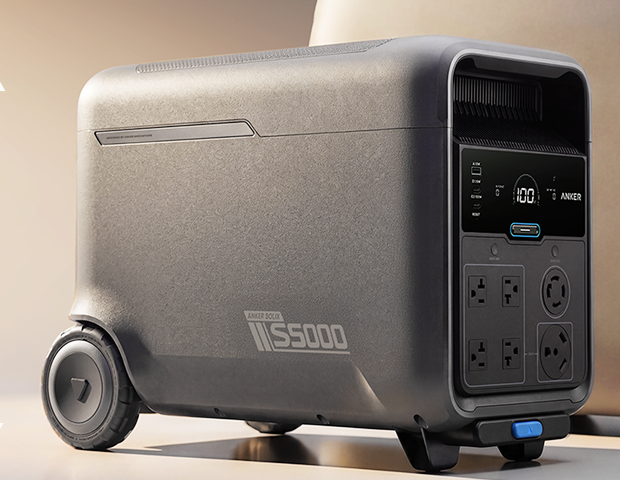
The whole S5000 weighs less than one of the EcoFlow's battery packs. One review puts each DELTA Pro Ultra extra battery at 115 lb and the inverter at 71 lbA8; the S5000 is 97 lb on wheelsB11, and the full EcoFlow bundle comes to 405.4 lb.
That scale carries through the spec sheet. The EcoFlow holds 18,432Wh to the S5000's 5,024Wh, runs 7,200W against 4,500W, and is the cheaper of the two per watt-hour. If you need all of that, nothing else on this page comes close.
Most buyers don't. An 8-hour blackout uses 39% of the S5000 and leaves 1.6 more nights like it in reserve. The EcoFlow's 8.5 extra nights are a plan for a week-long ice storm, and they come with a cycle rating of 3,500 against the S5000's 6,000. We'd buy the S5000 and put the difference toward solar.
What the Numbers Reveal
Each conclusion stated first — the numbers behind it on one line, the full analysis below.
On those figures, the EcoFlow spends more keeping itself awake for a day than the whole 1,645Wh the 8-hour blackout scenario draws. Its 18,432Wh is real, but on a sunless multi-day outage a slice of it goes to the inverter rather than the house. The two figures come from different kinds of source, one review against Anker's own testing, so read the gap as a direction, not a measurement.
One review: with no grid or solar input, the DELTA Pro Ultra would drain its own 6kWh battery in about 60 hoursA7Anker rates the S5000's idle draw at 8.8W on 120V outputB168-Hour Blackout scenario load: 1,645Wh
Why it mattersAnyone buying the EcoFlow for long outages should subtract its standing draw before counting its capacity as nights of backup.
Capacity
The difference is 13,408Wh of battery (18,432 minus 5,024) paid for on day one. If your power has never been out longer than a night, that battery is insurance against a storm you haven't had, and the S5000's expansion port lets you buy that insurance later, pack by pack, if your outages changeB6.
EcoFlow: 18,432Wh; 8-hour blackout at 10% used, 8.5 more nights in reserveS5000: 5,024Wh; 8-hour blackout at 39% used, 1.6 more nights in reserveS5000 expands with up to five BP5000 packs to 30,144WhB6
Why it mattersUnless your area has a history of multi-day outages, buy the S5000 and let the next bad winter decide whether you add a pack.
weight
The S5000 has the same garage problem on paper, since Anker stops it charging above 104°FB18. The difference is that 97 lb on wheels can be rolled to a cooler corner when August arrives. Whoever picks the EcoFlow's spot is picking it for years.
EcoFlow bundle: 405.4 lb; one review says each 115 lb extra battery needs two people to moveA8One owner found the battery nearest the inverter running about 10 degrees warmer, and worries about a 98-degree summer garageA11A12S5000: 97 lb on wheels with a pull rod; charges between 32 and 104°FB11B18
Why it mattersIf your only home for the battery is a hot garage or shed, the S5000's wheels are worth more than they look.
The specific dimensions that decide these two units — everything else is a tie.
Runtime: Will It Power Your Gear?
Selected because: An 8-hour blackout uses 39% of the S5000 and 10% of the EcoFlow, so the question is how many nights you need, not whether either survives one.
continuous output
Both survive the night with plenty left, so the runtime rows are really a count of nights. After the first 8-hour blackout, the S5000 has 1.6 more in reserve and the EcoFlow 8.5. One of those is a bad evening. The other is a week without the grid.
The S5000's one miss is the van-life row, 415Wh short under the engine's flat derate. The EcoFlow wins that row on paper, though nobody is putting 405.4 lb in a van.
Lifetime Value
Selected because: The EcoFlow is cheaper per watt-hour to buy and the S5000 cheaper per kilowatt-hour over its rated life, and which matters depends on how often you cycle it.
cost / lifetime kWh
Buy-price per watt-hour favors the EcoFlow. Cost per kilowatt-hour over the rated life favors the S5000, $0.12 against $0.08, because 3,500 cycles is a lot fewer than 6,000. Both numbers are right; they answer different buyers.
Cycled daily off solar, the S5000's rating stretches to 16.4 years against the EcoFlow's 9.6. Left on standby, neither will see its cycle limit, and the EcoFlow's 64,512 kWh lifetime total stays a figure on paper.
What the Specs Don't Tell You
Selected because: Four test notes fire here, and the warranty and UPS cards both favor the EcoFlow, so they deserve a straight reading.
rated cycles
The UPS card favors the EcoFlow on paper: EcoFlow classifies it as no-break, and Anker rates the S5000 at no worse than 10ms. Owners running the EcoFlow through its home panel describe no flicker at the changeoverA14. Nobody has reported on the S5000's changeover yet, so its figure is a rating, not an experience.
The warranty card is the EcoFlow's strongest: 10 years against 5. On a purchase this size, those extra five years are the best single argument for the premium.
Growth Path
Selected because: The S5000 can reach 30,144Wh in packs, so buying 18,432Wh up front is one route to a big battery, not the only one.
solar input
The engine hands the growth path to the EcoFlow on solar input, 5,600W against 3,000W, and anyone building a large array should take that seriously. But the S5000's own path reaches further than this bundle does: five BP5000 packs put it at 30,144Wh against the 18,432Wh hereB6.
Pack prices aren't on our record, so we can't say which route to a big battery costs less. What we can say is that the S5000 lets you make that decision later.
Strengths & trade-offs
EcoFlow DELTA Pro Ultra + 2 Batteries
Strengths
- +Larger battery capacity
- +Higher AC output
- +Longer warranty
- +Faster solar charging
Trade-offs
- –Substantially more expensive (+$5,499) than the SOLIX S5000.
- –Significantly heavier (+308.4 lbs), making it harder to move.
- –Very heavy unit that may be difficult for one person to lift.
- –Shorter-lived battery — rated for 3,500 charge cycles vs the SOLIX S5000's 6,000, so it wears out sooner.
Anker SOLIX S5000
Strengths
- +Costs $5,499 less
- +Lighter by 308.4 lb
- +Rated for 6,000 charge cycles — much longer battery lifespan
Trade-offs
- –Weaker inverter (-2,700W) limits appliance compatibility.
- –Very heavy unit that may be difficult for one person to lift.
Will It Power Your Gear?
Scenario math and per-appliance runtimes, modeled from the spec record.
Scenario verdicts
We ran the math on six real-world scenarios. Here's which unit survives your actual life.
SCN-01 · 2 nights · needs 2,100Wh
Weekend Camping
Two nights off-grid with essential comfort
SOLIX S5000
The DELTA Pro Ultra + 2 Batteries at 405.4 lbs is not a take-along — it rolls off a truck bed if it travels at all, so this scenario belongs to the SOLIX S5000 by default — and it earns it, covering the 2,100Wh with 2,170Wh to spare. Capacity was never the DELTA Pro Ultra + 2 Batteries's problem here; getting to a campsite was.
Battery budget usedlower = more headroom
LOAD Phone Charger 15W×6h · LED Lights 40W×8h · Box Fan 75W×14h · CPAP Machine 40W×16h
SCN-02 · 8 hours · needs 1,645Wh
8-Hour Blackout
Keep the essentials running through a night without power
DELTA Pro Ultra + 2 Batteries
Both survive the night. The DELTA Pro Ultra + 2 Batteries finishes at 10% used with 14,022Wh left — 8.5 more nights like it. The SOLIX S5000 finishes at 39% with 2,625Wh, 1.6 more nights like it. If your outages tend to run past one evening, that difference is the whole argument between them.
Battery budget usedlower = more headroom
LOAD Fridge 150W×8h · Router + Modem 20W×8h · LED Lights (4 bulbs) 40W×6h · Phone Charger 15W×3h
SCN-03 · 8 hours · needs 320Wh
CPAP Overnight
Sleep therapy without interruption — the #1 medical use case
Either unit
A CPAP is about 40W for eight hours, so both cover the night many times over and the capacity margin is a formality. Both happen to list 30dB — two makers' own figures landing on the same number rather than a measured tie — so there is nothing in the noise column to separate them either. Buy whichever is cheaper or easier to carry.
Battery budget usedlower = more headroom
LOAD CPAP Machine 40W×8h
SCN-04 · 8 hours · needs 910Wh
Remote Workday
Full work day off-grid without power anxiety
DELTA Pro Ultra + 2 Batteries
The DELTA Pro Ultra + 2 Batteries clears the workday at 6% used, banking 14,757Wh — late work, extra calls, or a second laptop charge without arithmetic. The SOLIX S5000 at 21% also finishes, with 3,360Wh of slack for the unplanned.
Battery budget usedlower = more headroom
LOAD Laptop 60W×8h · External Monitor 30W×8h · Router + Modem 20W×8h · Phone Charger 15W×2h
SCN-05 · 4 hours · needs 670Wh
Tailgate Party
Game day power for the crew
SOLIX S5000
The DELTA Pro Ultra + 2 Batteries at 405.4 lbs is not a take-along — it rolls off a truck bed if it travels at all, so this scenario belongs to the SOLIX S5000 by default — and it earns it, covering the 670Wh with 3,600Wh to spare. Capacity was never the DELTA Pro Ultra + 2 Batteries's problem here; getting to a tailgate was.
Battery budget usedlower = more headroom
LOAD Blender 400W×0.5h · LED TV (55") 80W×4h · Bluetooth Speaker 15W×4h · Phone Charger (×3) 45W×2h
SCN-06 · 24 hours · needs 4,685Wh
Van Life Daily
A full day of mobile living — the ultimate endurance test
DELTA Pro Ultra + 2 Batteries
The SOLIX S5000 doesn't finish — 4,270Wh usable against the 4,685Wh this needs leaves it 415Wh short, about 91% of the scenario covered (its nameplate 5,024Wh actually clears this — the flat 15% conversion allowance is what tips it under). The DELTA Pro Ultra + 2 Batteries covers it with 10,982Wh to spare.
Battery budget usedlower = more headroom
LOAD Mini-Fridge 150W×24h · Laptop 60W×4h · Phone Charger 15W×3h · LED Lights 40W×5h · Fan 75W×8h
The Load Test
RUNTIME = (Wh × 0.85) ÷ LOAD
None of the scenarios above exactly yours? Build it. Toggle what you'd plug in; both units are tested against the combined draw.
Essentials
Comfort & Convenience
High-Draw Appliances
Test duration
8h
Continuous draw
205W
Projected runtime
For this load: DELTA Pro Ultra + 2 Batteries runs 76.4h vs 20.8h.
$7,999 list · direct from EcoFlow
Planning for more than this? Describe your whole setup and get it sized →
Modeled from the spec record — same math as the tables below. Methodology
Runtime by appliance
Real-world runtime estimates for common appliances, modeled at 85% inverter efficiency.¹
Essentials
The basics you need runningscale 0–1044.5hComfort & Convenience
Makes off-grid life actually enjoyablescale 0–208.9hHigh-Draw Appliances
These reveal the real limitsscale 0–15.7h¹ Runtime = (capacity × 0.85) ÷ appliance watts. Within each group, all bars share one time scale (the group's longest runtime), so lengths are comparable across appliances; identical runtimes collapse into a single blue/orange bar. Actual runtime varies with battery age, temperature, and simultaneous loads — see methodology.
Conclusion
October 9, 2026
Verdict: the Anker SOLIX S5000
Buy the S5000 unless your outages regularly run past a day with heavy loads. An 8-hour blackout leaves it at 39% used and the EcoFlow at 10%; both get through, and the S5000 does it for $2,500 against $7,999. The EcoFlow is the cheaper of the two per watt-hour and carries 7,200W against 4,500W, so a household that genuinely needs days of whole-home power should take it, and that buyer is why confidence here is only moderate. The S5000 side rests on Anker's documentation aloneB0.
Editor-assigned confidence, based on cited owner research and spec analysis.
List prices as of October 9, 2026. The links below open EcoFlow's and Anker's current prices.
$2,499.99 · direct from Anker
or check the DELTA Pro Ultra + 2 Batteries price$7,999.00 list
Written by Gunner Gustafson, Whole-Home Backup Tester · Station Arena Test Desk · Updated October 9, 2026
Black Friday · 45 days out
Price to beat:DELTA Pro Ultra + 2 Batteries $7,899
The lowest we have recorded. A Black Friday price above it is a sale this unit has already had.
Measured Data
Benchmark scores and the full spec record, side by side.
Benchmark scores
Not rated for both units (minimum threshold unmet): Solar Generator.
Full specifications
ᵈ Derived: price ÷ rated capacity. See the data behind our comparisons →
Comparison ToolAdd more power stations, side by sideOpen Tool →How these numbers are produced
Numeric verification
Every figure on this page traces to our spec database or arithmetic on it — no estimated numbers.
Owner claims
Statements about owner experience are cited to published reviews — see Sources & Research Notes below.
Runtime model
Runtime = (rated capacity × 0.85 inverter efficiency) ÷ device wattage. Solar recharge estimates assume panels deliver 70% of rated output. Cold weather, battery age, and stacked loads reduce real-world results.
Power Score
Computed from 14 published spec dimensions, weighted per use-case bench. Higher is better; a unit must meet a bench's minimum threshold to be rated.
See the full weight table and data sourcing on our methodology page →Class ranking (the star rating)
Each unit's star score is a category ranking, not customer reviews — no buyer opinions feed it. We score every station on size-independent quality (value, output, portability, endurance, ports, warranty, and more), then percentile-rank it against the other units in its capacity class, so a class-leading compact unit and a class-leading whole-home unit can both earn 5★. Here, DELTA Pro Ultra + 2 Batteries rates 3.8/5 (29th percentile of 29 Whole-Home / Off-Grid-class units), and SOLIX S5000 rates 4.6/5 (74th percentile of 20 Home Backup-class units).
How the class ranking is computed →Test Notes & Caveats
Hidden gotchas and advantages we spotted that you won't find on the product page.
Weight Reality Check
Neither unit is grab-and-go. The SOLIX S5000 (97 lbs) is manageable solo but heavier than a large checked suitcase. The DELTA Pro Ultra + 2 Batteries (405.4 lbs) is spread across its boxes — no single lift, but nothing you reposition on a whim. That's a 308 lb difference, and it is paid once — getting the heavier one into position, not every time you move it.
UPS Switchover: 0ms-rated vs ≤10ms
Both list a UPS mode, at different rated speeds. The DELTA Pro Ultra + 2 Batteries is rated 0ms — a no-break design on paper, which is the maker's classification rather than a stopwatch result. The SOLIX S5000 is rated ≤10ms — quick enough on paper that desktop PCs and routers should ride through, treating that as the rating it is. If a computer with unsaved work is the thing being protected, the stated class is worth the attention; nothing here is a lab result.
Warranty: 10 Years vs 5
The DELTA Pro Ultra + 2 Batteries is covered for 10 years against the SOLIX S5000's 5 years. The cheaper SOLIX S5000 does buy more warranty per dollar (2 years per $1,000 against 1.3), but that is a statement about price, not about coverage — if a fault appears in year 6, only one of these is still covered. An underrated factor if you're keeping this unit for years.
Battery Lifespan in Real Years
The SOLIX S5000 is rated for 6,000 cycles vs 3,500. In real life: at daily use, that's 16.4 vs 9.6 years. At weekend use (twice a week), it's 58 vs 34 years. One caution reading years across different sizes: a cycle is 5,024Wh on the SOLIX S5000 and 18,432Wh on the DELTA Pro Ultra + 2 Batteries, so count lifetime energy — roughly 30,144 kWh against 64,512 kWh over the rated life. After hitting the cycle limit, the battery doesn't die — it drops to ~80% of original capacity, which is still very usable.
Full record above — the Test Desk pick is the SOLIX S5000.
Check SOLIX S5000 price →or check the DELTA Pro Ultra + 2 Batteries priceOwnership Analysis
What happens after you buy — true cost of ownership, brand trust, and growth potential.
Lifetime value
Service lifeyears at one full cycle per day
Lifetime energy delivered
Cost per delivered kWh
│ warranty ends · Reaching the cycle rating means ~80% capacity remains — degraded, not dead.
Analyst note
The SOLIX S5000 wins on both sticker price and long-term value. At $0.08/kWh over its lifetime, it's meaningfully cheaper to own. Clear value winner. One caution on the lifespan row: the SOLIX S5000 takes longer to reach its cycle rating, but a cycle moves a different amount of energy on each unit — the DELTA Pro Ultra + 2 Batteries still delivers more over its shorter horizon (64,512 vs 30,144 kWh). Years measure wear, not usefulness.
Brand trust
EcoFlow
Ecosystem
Largest in portable power — 12-15 models across DELTA Pro, DELTA 3, and RIVER 3 series, plus solar panels and smart home panels
Support
US-based phone/email/chat support (1-800-368-8604). Experiences are polarized — many report hassle-free prepaid-label replacements, but others report long waits and refurbished units sent for new claims. Pro tip: buying from Costco or Amazon gives you a stronger return safety net.
Community
Largest community in the space — Reddit r/Ecoflow_community (~31K members), multiple Facebook groups, and an official community forum
App experience
Rated 4.6/5 iOS (~8,400 ratings) · 4.2/5 Android (~17,000 ratings)
Unique strength
Fastest-charging technology (X-Stream), deepest product ecosystem, and most active innovation cadence. At the top of the range sit two whole-home paths: the TITAN line, one 5 kWh unit that grows to 30 kWh, and the DELTA Pro Ultra platform, which stacks batteries and inverters further — flagship paths, not line-wide features.
Worth knowing
Tested subscription paywalls for advanced app features in early 2025 before community backlash paused the plan. No parts or service offered out of warranty.
Anker
Ecosystem
7-8 SOLIX portable power stations across C-series (compact) and F-series (flagship), plus the X1 home energy system
Support
US-based support. Historically known for incredible no-hassle replacements, but recent reports describe AI-driven support agents giving generic responses and complex return logistics for heavy units (hazmat shipping). The Anker brand reputation is still strong, but SOLIX-specific support quality is trending down.
Community
Moderate — active Reddit (r/Anker, r/AnkerSOLIXCommunity) and growing. Benefits from Anker's massive consumer electronics brand awareness.
App experience
Rated 4.5/5 iOS (~1,100 ratings) · 4.3/5 Android
Unique strength
Anker's pitch on this cabinet is cell longevity: it rates the S5000 for 6,000 cycles to 80% and 10,000 to 60%, by its own testing.
Worth knowing
Support quality appears to be declining from its historically excellent level. Firmware updates have removed features without warning. Expansion ecosystem is smaller than EcoFlow's.
Analyst note
EcoFlow's whole-home platform has the longer track record in real houses. The S5000 has a thorough spec sheet and no independent testing yet. On this pair, how long your outages run matters more than either badge.
Growth path
DELTA Pro Ultra + 2 Batteries
EXPANDABLESupports EcoFlow expansion batteries, so you can add capacity later without replacing the base unit — useful if your needs may climb past 18,432Wh.
Accepts up to 5,600W of solar. Enough for a serious multi-panel array.
Adequate ports for most setups, but heavy users may want a power strip.
Expansion batteries are EcoFlow-specific. You're investing in the EcoFlow ecosystem.
SOLIX S5000
EXPANDABLESupports Anker expansion batteries, so you can add capacity later without replacing the base unit — useful if your needs may climb past 5,024Wh.
Accepts up to 3,000W of solar. Enough for a serious multi-panel array.
Adequate ports for most setups, but heavy users may want a power strip.
Expansion batteries are Anker-specific. You're investing in the Anker ecosystem.
Realistic full solar rechargeat 70% of rated panel output — see methodology
Analyst note
Both expand, but the DELTA Pro Ultra + 2 Batteries's higher solar ceiling (5,600W vs 3,000W) gives it the stronger off-grid growth path — more panels can feed a bigger bank as it grows.
What Owners Report
Patterns from published owner reports and long-term reviews — every claim cited to its source below.
EcoFlow DELTA Pro Ultra + 2 Batteries
Field reports on this exact bundle are thin: mostly one forum thread and a handful of short retail reviews, with nothing past six monthsA0. The positives are specific. One reviewer ran central air, a fridge and a well pump at once without a flickerA9, owners with two-battery setups describe flicker-free changeover and running most of a houseA10A14, and one owner who added a second battery says runtime doubledA13.
The complaints are just as specific. One forum owner was lukewarm on the purchase and lists a thin manual, radio interference and support answers that missed the pointA1A2A3A4, and saw the charge reading fall from 90% to 8% after overnight useA6. Another found the pack nearest the inverter running about 10 degrees warmer and worries about a hot garageA11A12.
“This means that without any grid or solar input, the system would fully drain its own 6kWh battery in about 60 hours. For off-grid use, this parasitic drain must be carefully factored into your energy budget.”
Anker SOLIX S5000
The S5000 has no owner or reviewer track record yet; every entry we hold is Anker's paperworkB0. Read as paperwork, it's thorough: the rating label fixes the 4,500W split-phase output and 3,000W of combined solar inputB2B5, the product page gives the 97 lb weight and the 6,000-cycle ratingB11B12, and Anker lists UL 9540 and 9540A certificationB19.
“5,024 Wh LiFePO4 pack rated 16 V, 314 Ah; the cell code IFpP72/175/208[5S] reads as five large prismatic cells in series.”
Sources
ankersolix.com
Sources & Research Notes
Every owner claim in this report is traceable to a published source. The bracketed references above resolve here.
Recurring owner themes
- Owners repeatedly report EcoFlow customer support gives dismissive or unhelpful answers to specific technical questions (manual gaps, RFI interference, app charting). [DELTA Pro Ultra + 2 Batteries · 3 entries]
- The unit's idle/parasitic self-consumption is a recurring theme, both as a documented SoC anomaly and as an acknowledged spec-level drain figure from a tester. [DELTA Pro Ultra + 2 Batteries · 2 entries]
- Multiple owners note the extra battery packs are extremely heavy (100+ lbs each), requiring two people, and one owner separately observed uneven heat between stacked batteries raising summer overheating concerns. [DELTA Pro Ultra + 2 Batteries · 3 entries]
- Real owners with 2-battery setups consistently praise seamless/flicker-free UPS switchover and confirm the system genuinely runs whole-home loads (AC, well pump, most of house). [DELTA Pro Ultra + 2 Batteries · 3 entries]
- Adding a second battery is described by owners as meaningfully extending real-world runtime for whole-home backup, matching expectations. [DELTA Pro Ultra + 2 Batteries · 2 entries]
- No owner or reviewer reports exist yet: every entry is Anker documentation (rating label, product page, launch announcement), plus one of our own readings of the app and label drawing. [SOLIX S5000 · 20 entries]
- A1
“Pulled the trigger on an EcoFlow Delta Pro Ultra (DPU) and I'm kind of meh on it and unlikely to expand or integrate it into the house.”
DIY Solar Power Forum — 'Ecoflow Delta Pro Ultra issues' thread · 2024-02 · [negative]
- A2
“No real manual. All they have is the web user guide which is superficial if I'm being generous. I asked support about it and they pointed me at the web guide I was complaining about. Twice.”
DIY Solar Power Forum — 'Ecoflow Delta Pro Ultra issues' thread · 2024-02 · [negative]
- A3
“Even when the inverter is not running, it interferes with common frequencies like 146.520MHz.”
DIY Solar Power Forum — 'Ecoflow Delta Pro Ultra issues' thread · 2024-02 · [negative]
- A4
“I contacted EcoFlow support and they told me I could put it in a 'faraday cage'.”
DIY Solar Power Forum — 'Ecoflow Delta Pro Ultra issues' thread · 2024-02 · [negative]
- A6
“After a few days of using it overnight and letting it charge back up to '90%', it'd go from '90%' down to '8%'.”
DIY Solar Power Forum — 'Ecoflow Delta Pro Ultra issues' thread · 2024-02 · [negative]
- A7
“This means that without any grid or solar input, the system would fully drain its own 6kWh battery in about 60 hours. For off-grid use, this parasitic drain must be carefully factored into your energy budget.”
Battery Skills — 'EF ECOFLOW DELTA Pro Ultra + Extra Battery Review' · 2025-10 · [mixed]
- A8
“The main inverter is a manageable 71 lbs, but each Ultra Smart Extra Battery is a dense 115 lbs, requiring two people for safe movement.”
Battery Skills — 'EF ECOFLOW DELTA Pro Ultra + Extra Battery Review' · 2025-10 · [mixed]
- A9
“We powered a central air conditioner, refrigerator, and well pump simultaneously without a flicker.”
Battery Skills — 'EF ECOFLOW DELTA Pro Ultra + Extra Battery Review' · 2025-10 · [positive]
- A10
“I own two Delta Pro Ultra's with two batteries each... We have experienced matchless performance, scalability, flexibility. It cools/heats itself in temperature extremes-simply awesome!”
Walmart customer reviews — 'EF EcoFlow Extra Battery for DELTA Pro Ultra' · unknown · [positive]
- A11
“I noticed the battery closest to the inverter seems to run hotter than the one below. About 10 degrees warmer. I switched the batteries around to ensure that it wasn't the battery and got the same results.”
Walmart customer reviews — 'EF EcoFlow Extra Battery for DELTA Pro Ultra' · unknown · [negative]
- A12
“My garage could get up to 98 degrees during the summer, that means my batteries can overheat.”
Walmart customer reviews — 'EF EcoFlow Extra Battery for DELTA Pro Ultra' · unknown · [negative]
- A13
“I originally bought my Delta Pro Ultra with the single battery, worked great is able to power my entire home for about 4 to 5 hours during peak times... I bought a second battery... My run time has doubled eliminating the anxiety.”
Walmart customer reviews — 'EF EcoFlow Extra Battery for DELTA Pro Ultra' · unknown · [positive]
- A14
“With the home panel, there is no flicker when the power changes. I bought a unit with 2 batteries and it runs my most of my house.”
Walmart customer reviews — 'EF EcoFlow Extra Battery for DELTA Pro Ultra' · unknown · [positive]
- B2
“AC output 4,500 W max, either at 120 V (37.5 A across the outlets) or at 120/240 V split-phase (18.75 A).”
Anker rating label, model AS510 (certified 2026-09-15) · 2026-09-15 · [positive]
- B5
“Two solar inputs, 3,000 W together: 11–60 V at 17 A (1,000 W) and 16–165 V at 17 A (2,000 W).”
Anker rating label, model AS510 (certified 2026-09-15) · 2026-09-15 · [positive]
- B6
“Expands with up to five BP5000 expansion batteries (model AS5101A1-85), each 5,024 Wh, for 30,144 Wh in total. They join through a 400 V DC port rated 9,000 W in and 7,500 W out; each battery charges at up to 3,200 W and discharges at up to 3,000 W.”
Anker rating label, model AS510 (certified 2026-09-15) · 2026-09-15 · [positive]
- B11
“Net weight 97 lb; 10.6 × 22.0 × 15.2 in (W × D × H), on wheels with a pull rod and foot pedal.”
Anker SOLIX S5000 product page, ankersolix.com/s5000 (published 2026-10-09) · 2026-10-09 · [positive]
- B12
“Cycle life: 6,000 cycles to 80% capacity, 10,000 cycles to 60%; Anker estimates a 15-year lifespan at 1 to 2 cycles a day, with 5 years of product coverage.”
Anker SOLIX S5000 product page, ankersolix.com/s5000 (published 2026-10-09) · 2026-10-09 · [positive]
- B16
“Idle draw 8.8 W on 120 V output and 13.7 W on 240 V output (Anker internal testing).”
Anker SOLIX S5000 product page, ankersolix.com/s5000 (published 2026-10-09) · 2026-10-09 · [positive]
- B18
“Discharges from -4°F to 104°F and charges from 32°F to 104°F.”
Anker SOLIX S5000 product page, ankersolix.com/s5000 (published 2026-10-09) · 2026-10-09 · [neutral]
- B19
“UL 9540 and UL 9540A certified.”
Anker SOLIX S5000 product page, ankersolix.com/s5000 (published 2026-10-09) · 2026-10-09 · [positive]
Research compiled October 9, 2026.
Who Should Buy Which
Buy the DELTA Pro Ultra + 2 Batteries if you…
- →You've sat through outages that lasted days, you run a well pump or central air, and you want 7,200W and 18,432Wh in place before the next one.
- →You'll install it once with a home panel and leave it, and you want 10 years of coverage on a purchase this size.
- →You're feeding a large solar array and want 5,600W of input to take it all.
Buy the SOLIX S5000 if you…
- →Your outages are an evening or a night, and you want the fridge, furnace blower and internet running through them without buying a week of battery.
- →You'd like room to grow but want to pay for capacity only after you've proven you need it, through BP5000 packs.
- →The battery has to live in a garage you rearrange now and then, and a 97 lb cabinet on wheels suits that better than a stack assembled in place.
If neither fits
If what you really want is a house that switches over by itself with no cords, look at panel-installed home batteries instead. And if you only need a fridge and a router through the odd outage, a mid-size portable station does it for far less than either.
The Bottom Line
The EcoFlow is more battery and the cheaper watt-hour, and if your outages run for days it's the right buy. For a night or two, the S5000 covers the job, sips rather than gulps at idle, and leaves the big-battery decision for later through packs.
Buy the S5000 unless you can name the multi-day storm you'd be buying the EcoFlow for.
Frequently Asked Questions
Answers drawn from the spec record and cited owner research.
Do I need the DELTA Pro Ultra with two extra batteries, or is the Anker S5000 enough?
For outages that last a night, the S5000 is enough: an 8-hour blackout uses 39% of it and leaves 1.6 more nights like it in reserve. The EcoFlow's 18,432Wh adds 8.5 more nights, which only earns its price if your outages run for days. If you've never lost power longer than a night, most of that battery would sit unused.
How much power does the EcoFlow DELTA Pro Ultra use when idle?
One review figures it would drain its own 6kWh battery in about 60 hours with nothing charging it, roughly 100W of standing draw. Anker rates the S5000 at 8.8W idle on 120V and 13.7W on 240V. The figures come from different kinds of source, but the gap is wide enough to matter on a long outage without sun.
Which has the better warranty, the DELTA Pro Ultra or the Anker S5000?
The EcoFlow, at 10 years to the S5000's 5. The S5000 is rated for more cycles, 6,000 against 3,500, but a cycle rating is the maker's estimate of cell life, while a warranty is what the maker will pay for. On a battery you'll keep for a decade, the EcoFlow's is the stronger promise.
How many people does it take to move a DELTA Pro Ultra with extra batteries?
Two, according to one review: the inverter is 71 lb and each extra battery 115 lb. The full bundle is 405.4 lb. The S5000 is a single 97 lb unit with wheels and a pull rod.
Related comparisons
Where to buy

EcoFlow DELTA Pro Ultra + 2 Batteries
$7,999.00
$7,999.00 · direct from EcoFlow
Last checked 28 days ago. Prices move — check before you buy.
Anker SOLIX S5000Pick
$2,499.99
$2,499.99 · direct from Anker
Prices may vary by retailer and are subject to change.