Head-to-head test
EcoFlow DELTA Pro 3 vs Jackery Explorer 5000 Plus Double Kit
This isn't a fight about craftsmanship — it's a fight about scale. The Jackery is two units wired together, priced and sized in almost exactly the same proportion as the EcoFlow, and the only real question is whether you need the extra 5,984Wh or you're paying $3,490 for headroom you'll never touch.
Full profiles: EcoFlow DELTA Pro 3 → · Jackery Explorer 5000 Plus Double Kit →

Written by Gunner GustafsonUpdated
Whole-Home Backup Tester, Station Arena Test Desk
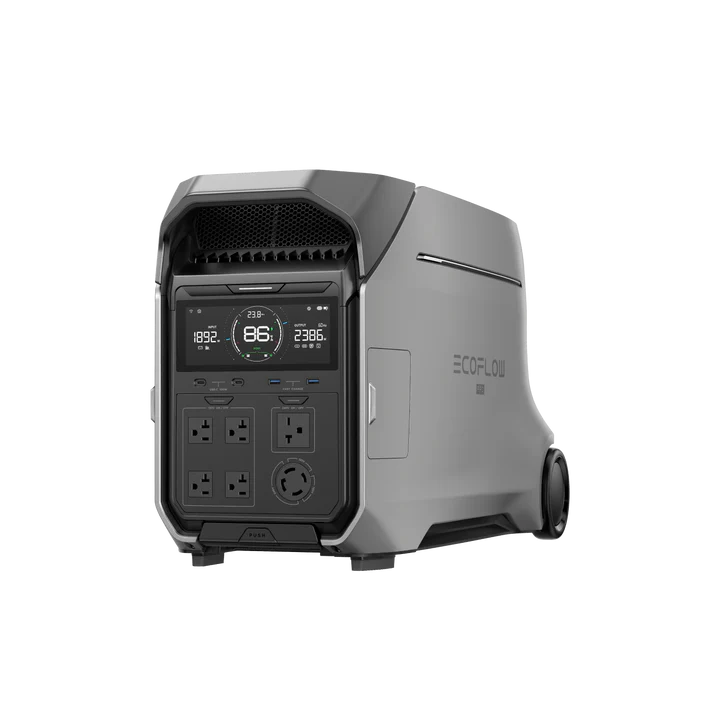
$2,799.00 · direct from EcoFlow
Last checked 1 day ago. Prices move — check before you buy.

$6,289.00 · direct from Jackery
Last checked 1 day ago. Prices move — check before you buy.
Spec deltas
The Jackery Explorer 5000 Plus Double Kit is exactly what it sounds like: two Explorer 5000 Plus units paired into one 10,080Wh, 14,400W system, for $6,289. The EcoFlow DELTA Pro 3 is a single 4,096Wh, 4,000W unit for $2,799. Scale the DELTA Pro 3's price and capacity up by almost exactly the same multiple and you land on the Jackery's numbers — which is also why both work out to the same $0.15 per lifetime kWh. There's no value trick hiding in either box.
Where they actually split is what they can finish. Run six real-world loads through both and the DELTA Pro 3 comfortably covers five of them, spending as little as 9% of its charge on an overnight CPAP and never more than 60% on a weekend campsite. The sixth load — a van's daily 4,685Wh draw — is more than it holds; it runs out at 135% of capacity. The Double Kit shrugs off the same load at 55%.
So the real question isn't which unit is better made. It's whether your heaviest day looks like that sixth scenario. If it does, the Double Kit is the only one of these two that actually finishes it. If it doesn't, the extra $3,490 buys headroom you'll never spend.
What the Numbers Reveal
Each conclusion stated first — the numbers behind it on one line, the full analysis below.
Capacity
That's why there's no value winner here — cost per lifetime kWh lands at an identical $0.15 on both sides. This comparison was never going to turn on value; it turns entirely on how much power you actually need.
DELTA Pro 3: $2,799 for 4,096WhExplorer 5000 Plus Double Kit: $6,289 for 10,080Whboth price out to $0.15 per lifetime kWh
Why it mattersStop shopping for the better deal and start counting your actual daily Wh needs — that's the only number that decides this one.
But on every other scenario modeled, the DELTA Pro 3 also "loses" the comparison while still fully covering the load, using as little as 9% and as much as 60% of its charge. Five of its six losses are the Double Kit simply having more spare capacity, not the DELTA Pro 3 failing.
Van Life Daily needs 4,685WhDELTA Pro 3 uses 135% of capacity on that load and can't finish itthe Double Kit uses just 55% of its capacity on the same load
Why it mattersOnly buyers with a genuine van-life-scale daily draw need the Double Kit's extra headroom; everyone else is paying $3,490 to go from covering the load to covering it with room to spare.
continuous output
That ratio, not the continuous number, is what decides whether a fridge or window AC compressor actually starts. A reviewer testing the Explorer platform's base hardware found it struggled on a large surge air-conditioning load despite looking fine on paperB2 — exactly the scenario a higher ratio protects against.
DELTA Pro 3 surges to 6,000W from a 4,000W continuous rating (1.5x)Double Kit surges to 28,800W from a 14,400W continuous rating (2.0x)compressor-driven fridges and ACs briefly draw 2-3x their rated running watts on startup
Why it mattersAnyone running compressor-based appliances near either unit's ceiling should size against the surge ratio, not the continuous wattage number on the box.
solar input
A DELTA Pro 3 capped at 2,000W takes proportionally longer to recover on a multi-day cloudy stretch than a Double Kit pulling in 8,000W, even though both are equally expandable on paper. Recharge speed, not expandability, is the real off-grid ceiling.
DELTA Pro 3 accepts up to 2,000W of solar inputDouble Kit accepts up to 8,000W of solar input (4x)both support expansion batteries so onboard capacity isn't a hard ceiling for either
Why it mattersAnyone planning serious off-grid solar — van life, a remote cabin — should weight the 4x solar gap over the fact that both units technically expand.
The specific dimensions that decide these two units — everything else is a tie.
PowerScore Breakdown
Selected because: 13,704 vs 5,693 is the cleanest signal this is a scale comparison, not a quality one — frames the whole page before the value numbers muddy it.
overall power score
A power score of 13,704 against 5,693 looks like a rout, and on raw numbers it is — but remember what's actually being scored: one flagship unit against two of them wired together. Judged per dollar, the picture flattens out fast; judged as which system moves more electrons, the Double Kit was never going to lose. Read the gap as a scale multiplier, not a verdict on engineering quality.
Lifetime Value
Selected because: Cost per lifetime kWh ties at $0.15 both sides — the 'cheaper to own' tag is a tie-break artifact worth calling out before a reader over-reads it.
cost / lifetime kWh
Even the sticker price ties: both list at $0.59 per Wh before cycle life enters the picture. Run that through 4,000 cycles apiece and the tie holds — cost per lifetime kWh lands at exactly $0.15 on both sides, because the price gap and the capacity gap scale by almost the same multiple. The 'cheaper to own' label technically lands on the DELTA Pro 3, but only because the tie-break defaults to it when the numbers match to the cent — treat this as a wash, not a win.
Where the DELTA Pro 3 does pull ahead is warranty economics: an identical 5-year term costs $480 a year against the Double Kit's $1,180, purely because the sticker price differs and the coverage length doesn't. That's the $3,490 gap showing up in a new unit, not a new argument.
Your Life, Your Pick
Selected because: 5 of 6 scenario losses for the DELTA Pro 3 are margin, not failure — only Van Life Daily is a real miss, and that distinction changes who should care.
Five of six scenarios technically go to the Double Kit, but only one of them is a real failure for the DELTA Pro 3. Weekend Camping, an 8-hour blackout, a remote workday, and a tailgate all fit comfortably in the smaller unit too — it just spends more of its charge doing it (as much as 60%, against the Double Kit's ceiling of 25% on the same loads). CPAP Overnight is a rounding error for both, at 9% and 4%.
Van Life Daily is the exception that matters: a 4,685Wh daily draw runs past what the DELTA Pro 3 holds in one cycle — 135% of capacity, so it comes up short — while the Double Kit uses about 55% and moves on. If that's your actual daily number, this is the whole comparison. If it isn't, the other five rows are telling you the DELTA Pro 3 already has this covered.
What the Specs Don't Tell You
Selected because: Surge ratio, UPS speed, and warranty-per-dollar cut in three different directions and matter differently depending on what's plugged in.
Two of the four flagged differences favor the DELTA Pro 3, one favors the Double Kit, and one is close to a wash. The Double Kit's inverter carries more surge headroom relative to its own rating (2.0x vs 1.5x), which matters most for compressor startups on a fridge or window AC. The DELTA Pro 3 switches to battery faster in an outage (10ms vs 20ms) and returns more warranty-years per dollar ($480/year vs $1,180/year on an identical 5-year term) — though that second one is really the price gap wearing a new label, not a separate advantage.
Weight is the one nobody wins: both units clear 100 lbs and need two people or a cart, full stop. The Double Kit is the heavier lift by a wide margin (269 lbs vs 112.4 lbs, since it's genuinely two units), but lighter of two heavy things is a low bar to clear.
Brand Trust
Selected because: A purchase this size justifies a look at support and community track record, and the two brands differ meaningfully here.
EcoFlow is the deeper bench here — more models, the largest community by a wide margin, and the fastest charging tech in the category, backed by an active development pace. That comes with real asterisks: a 2025 recall on an unrelated model, and a subscription-paywall experiment the community pushed back on. Jackery's brand carries none of that specific baggage, but it also carries the industry's most-criticized support experience and the smallest dedicated community of the major names — everyone's heard of it is doing a lot of the brand's work.
For a purchase in this price range, that gap in support quality and community size is worth weighing alongside the spec sheet, especially since the Double Kit is the newer, less-proven combination of the two.
Strengths & trade-offs
EcoFlow DELTA Pro 3
Strengths
- +Costs $3,490 less
- +Lighter by 156.6 lb
Trade-offs
- –Weaker inverter (-10,400W) limits appliance compatibility.
- –Very heavy unit that may be difficult for one person to lift.
Jackery Explorer 5000 Plus Double Kit
Strengths
- +Larger battery capacity
- +Higher AC output
- +Faster solar charging
Trade-offs
- –Substantially more expensive (+$3,490) than the DELTA Pro 3.
- –Significantly heavier (+156.6 lbs), making it harder to move.
- –Very heavy unit that may be difficult for one person to lift.
Will It Power Your Gear?
Scenario math and per-appliance runtimes, modeled from the spec record.
Scenario verdicts
We ran the math on six real-world scenarios. Here's which unit survives your actual life.
SCN-01 · 2 nights · needs 2,100Wh
Weekend Camping
Two nights off-grid with essential comfort
Neither unit
Both cover a weekend's 2,100Wh easily — the DELTA Pro 3 uses 60% of its tank, the Double Kit just 25%. This is a margin question, not a capability one: pick based on price unless you're stacking more gear onto the same trip.
Battery budget usedlower = more headroom
LOAD Phone Charger 15W×6h · LED Lights 40W×8h · Box Fan 75W×14h · CPAP Machine 40W×16h
SCN-02 · 8 hours · needs 1,645Wh
8-Hour Blackout
Keep the essentials running through a night without power
Explorer 5000 Plus Double Kit
An 8-hour outage draws 1,645Wh either way. The DELTA Pro 3 spends nearly half its capacity getting through it (47%), the Double Kit under a fifth (19%) — both get you through the night, the Double Kit just has more left over for the next one.
Battery budget usedlower = more headroom
LOAD Fridge 150W×8h · Router + Modem 20W×8h · LED Lights (4 bulbs) 40W×6h · Phone Charger 15W×3h
SCN-03 · 8 hours · needs 320Wh
CPAP Overnight
Sleep therapy without interruption — the #1 medical use case
Either unit
Both units treat a CPAP's 320Wh overnight draw as a rounding error — 9% of the DELTA Pro 3, 4% of the Double Kit. This is the one scenario where scale genuinely doesn't matter; decide on price and UPS switchover speed instead.
Battery budget usedlower = more headroom
LOAD CPAP Machine 40W×8h
SCN-04 · 8 hours · needs 910Wh
Remote Workday
Full work day off-grid without power anxiety
Explorer 5000 Plus Double Kit
A remote workday's 910Wh costs the DELTA Pro 3 about a quarter of its charge (26%) and the Double Kit about a tenth (11%). Either one gets through the day without a recharge; the Double Kit just does it with a second workday's worth left in reserve.
Battery budget usedlower = more headroom
LOAD Laptop 60W×8h · External Monitor 30W×8h · Router + Modem 20W×8h · Phone Charger 15W×2h
SCN-05 · 4 hours · needs 670Wh
Tailgate Party
Game day power for the crew
Neither unit
A tailgate's 670Wh load takes about a fifth of the DELTA Pro 3's charge (19%) and less than a tenth of the Double Kit's (8%). Neither breaks a sweat — the difference is how many more tailgates you get before either needs a plug.
Battery budget usedlower = more headroom
LOAD Blender 400W×0.5h · LED TV (55") 80W×4h · Bluetooth Speaker 15W×4h · Phone Charger (×3) 45W×2h
SCN-06 · 24 hours · needs 4,685Wh
Van Life Daily
A full day of mobile living — the ultimate endurance test
Explorer 5000 Plus Double Kit
This is the scenario that actually separates them. A van's daily 4,685Wh draw is more than the DELTA Pro 3 physically holds — it runs out at 135% of capacity. The Double Kit uses about 55% of its capacity on the same load and comes back for more the next day.
Battery budget usedlower = more headroom
LOAD Mini-Fridge 150W×24h · Laptop 60W×4h · Phone Charger 15W×3h · LED Lights 40W×5h · Fan 75W×8h
The Load Test
RUNTIME = (Wh × 0.85) ÷ LOAD
None of the scenarios above exactly yours? Build it. Toggle what you'd plug in; both units are tested against the combined draw.
Essentials
Comfort & Convenience
High-Draw Appliances
Test duration
8h
Continuous draw
205W
Projected runtime
For this load: Explorer 5000 Plus Double Kit runs 41.8h vs 17h.
$6,289 list · direct from Jackery
Modeled from the spec record — same math as the tables below. Methodology
Runtime by appliance
Real-world runtime estimates for common appliances, modeled at 85% inverter efficiency.¹
Essentials
The basics you need runningscale 0–571.2hComfort & Convenience
Makes off-grid life actually enjoyablescale 0–114.2hHigh-Draw Appliances
These reveal the real limitsscale 0–8.6h¹ Runtime = (capacity × 0.85) ÷ appliance watts. Within each group, all bars share one time scale (the group's longest runtime), so lengths are comparable across appliances; identical runtimes collapse into a single blue/orange bar. Actual runtime varies with battery age, temperature, and simultaneous loads — see methodology.
Conclusion
July 28, 2026
Verdict: the Explorer 5000 Plus Double Kit, on Power Score margin
Buy the Explorer 5000 Plus Double Kit if your daily load genuinely runs in Van Life Daily territory (4,685Wh) — it's the only one of these two that finishes that job, and the power-score gap (13,704 vs 5,693) reflects real scale, not a coin flip. Everyone else should buy the DELTA Pro 3: it covers the other five scenarios modeled here at 60% capacity or less, ties the Double Kit exactly on cost-per-lifetime-kWh at $0.15, and costs $3,490 less. Two caveats temper how hard to lean on the Double Kit pick: its field evidence is all base-unit testing, since nobody's published long-term reports on the paired combo yet, and EcoFlow brings the deeper ecosystem and community to whichever unit you actually buy.
Editor-assigned confidence, based on cited owner research and spec analysis.
List prices as of July 28, 2026. The links below open EcoFlow's and Jackery's current prices.
$6,289.00 · direct from Jackery
Last checked 1 day ago. Prices move — check before you buy.
or check the DELTA Pro 3 price$2,799.00 list
Written by Gunner Gustafson, Whole-Home Backup Tester · Station Arena Test Desk · Updated July 28, 2026
Measured Data
Benchmark scores and the full spec record, side by side.
Benchmark scores
Not rated for both units (minimum threshold unmet): RV Living, Solar Generator.
Full specifications
ᵈ Derived: price ÷ rated capacity. See the data behind our comparisons →
Comparison ToolAdd more power stations, side by sideOpen Tool →How these numbers are produced
Numeric verification
Every figure on this page traces to our spec database or arithmetic on it — no estimated numbers.
Owner claims
Statements about owner experience are cited to published reviews — see Sources & Research Notes below.
Runtime model
Runtime = (rated capacity × 0.85 inverter efficiency) ÷ device wattage. Solar recharge estimates assume panels deliver 70% of rated output. Cold weather, battery age, and stacked loads reduce real-world results.
Power Score
Computed from 14 published spec dimensions, weighted per use-case bench. Higher is better; a unit must meet a bench's minimum threshold to be rated.
See the full weight table and data sourcing on our methodology page →Class ranking (the star rating)
Each unit's star score is a category ranking, not customer reviews — no buyer opinions feed it. We score every station on size-independent quality (value, output, portability, endurance, ports, warranty, and more), then percentile-rank it against the other units in its capacity class, so a class-leading compact unit and a class-leading whole-home unit can both earn 5★. Here, DELTA Pro 3 rates 4.0/5 (40th percentile of 16 Home Backup-class units), and Explorer 5000 Plus Double Kit rates 4.4/5 (64th percentile of 29 Whole-Home / Off-Grid-class units).
How the class ranking is computed →Test Notes & Caveats
Hidden gotchas and advantages we spotted that you won't find on the product page.
Two Boxes, Not One
The Double Kit weighs 269 lbs against the DELTA Pro 3's 112.4 lbs — a 156.6 lb difference, since the Double Kit is genuinely two units sharing a spec sheet. Both clear the 100 lb mark where a unit stops being a solo lift, so neither is grab-and-go, but only one of them is a single box.
Surge Headroom: 1.5x vs 2.0x
The DELTA Pro 3 surges to 6,000W from a 4,000W continuous rating, a 1.5x ratio. The Double Kit surges to 28,800W from 14,400W continuous, a 2.0x ratio. The higher ratio gives more margin when a compressor-driven fridge or AC kicks on, since those loads briefly pull well beyond their rated running watts.
UPS Switchover: 10ms vs 20ms
The DELTA Pro 3 switches to battery in 10ms, a line-interactive tier. The Double Kit takes 20ms, a standby tier. Both are fine for routers, desktops, and CPAP machines — the gap mostly matters for switchover-sensitive gear like NAS arrays.
Same 5 Years, Different Price Tags
Both carry a 5-year warranty, but that coverage costs $480 a year on the DELTA Pro 3 against $1,180 a year on the Double Kit, since the term is identical while the price isn't. Read this as the purchase price gap showing up in a new unit, not a statement about either warranty's quality.
Full record above — the Test Desk pick is the Explorer 5000 Plus Double Kit.
Check Explorer 5000 Plus Double Kit price →or check the DELTA Pro 3 priceOwnership Analysis
What happens after you buy — true cost of ownership, brand trust, and growth potential.
Lifetime value
Service lifeyears at one full cycle per day
Lifetime energy delivered
Cost per delivered kWh
│ warranty ends · Reaching the cycle rating means ~80% capacity remains — degraded, not dead.
Analyst note
The DELTA Pro 3 is cheaper to buy, but the Explorer 5000 Plus Double Kit is cheaper to own. At $0.16/kWh over its lifetime vs $0.17/kWh, the Explorer 5000 Plus Double Kit's higher cycle life and capacity make each dollar go further over the years. One thing to know reading the table: both carry the same 4,000-cycle rating, so the lifetime rows are sticker price and capacity in disguise — the wear horizon is identical and decides nothing here.
Brand trust
EcoFlow
Ecosystem
Twelve to fifteen models deep — DELTA Pro, DELTA 3, and RIVER 3 lines, plus solar panels and smart home panels — the widest catalog of any brand in this comparison.
Support
US-based phone, email, and chat support, with a split reputation: some claims resolve with a fast, prepaid-label swap, others face long waits or a refurbished unit sent back for a new problem. Buying through Costco or Amazon adds a return safety net either way.
Community
The largest community in the category by a wide margin: an active subreddit, several Facebook groups, and an official forum.
App experience
Rated 4.6/5 iOS (~8,400 ratings) · 4.2/5 Android (~17,000 ratings)
Unique strength
The fastest charging tech in the lineup and the deepest expansion ceiling of any brand here, scaling all the way to 180kWh with the DELTA Pro Ultra X.
Worth knowing
A 2025 recall on the unrelated DELTA Max 2000 (overheating risk) and a since-paused plan to paywall advanced app features behind a subscription are both part of the brand's recent record — neither touches the DELTA Pro 3 directly.
Jackery
Ecosystem
A dozen-plus models split between the portable Explorer line and the home-backup HomePower series, backed by the SolarSaga panel ecosystem.
Support
US-based support that draws consistent criticism: slow, scripted responses and strict receipt requirements are common threads, with refurbished units going out even for clear defects. Costco or Amazon purchase protection is the strongly recommended hedge here.
Community
The smallest dedicated community of the major brands, though broad name recognition keeps YouTube coverage solid without a large forum behind it.
App experience
Rated 2.3-3.3/5 iOS and Android — the weakest app experience of the major brands. Multiple confusing apps (Jackery app vs Jackery Home) and mandatory login even offline.
Unique strength
The highest brand recognition and widest retail footprint of any name here — Costco, Home Depot, Best Buy, and Amazon all carry it, which counts for something when you need a return counter instead of a shipping label.
Worth knowing
Jackery has been slower than rivals to move its lineup fully to LFP chemistry, is widely seen as pricier than its specs justify against newer competition, and its app experience lags the rest of the field.
Analyst note
The two platforms price out almost identically per Wh, but the brands behind them aren't equally matched on support or ecosystem depth — EcoFlow's bench is deeper and faster-moving, while Jackery's real edge is that everyone already knows the name.
Growth path
DELTA Pro 3
EXPANDABLESupports EcoFlow expansion batteries, so you can add capacity later without replacing the base unit — useful if your needs may climb past 4,096Wh.
Accepts up to 2,000W of solar. Enough for a serious multi-panel array.
Generous port selection supports complex multi-device setups.
Expansion batteries are EcoFlow-specific. You're investing in the EcoFlow ecosystem.
Explorer 5000 Plus Double Kit
EXPANDABLESupports Jackery expansion batteries, so you can add capacity later without replacing the base unit — useful if your needs may climb past 10,080Wh.
Accepts up to 8,000W of solar. Enough for a serious multi-panel array.
Generous port selection supports complex multi-device setups.
Expansion batteries are Jackery-specific. You're investing in the Jackery ecosystem.
Realistic full solar rechargeat 70% of rated panel output — see methodology
Analyst note
Both expand, but the Explorer 5000 Plus Double Kit's higher solar ceiling (8,000W vs 2,000W) gives it the stronger off-grid growth path — more panels can feed a bigger bank as it grows.
What Owners Report
Patterns from published owner reports and long-term reviews — every claim cited to its source below.
EcoFlow DELTA Pro 3
Independent reviewers mostly echo the spec sheet here rather than adding new field experience — the DELTA Pro 3 gets called a gold-standard whole-home backup unit for its 4,000W dual-voltage output and expansion headroomA1A4, and outside testing singles out its fast-charge tech as unusually quick for a unit this sizeA3. That's professional-reviewer consensus more than years of owner-forum mileage — this ledger is thinner than we'd like, so treat the enthusiasm as credible but early.
The other detail worth flagging is durability framing: reviewers point to its IP65 rating and 4,000+ cycle life as evidence it's built to live outside or in a garage long-term, not just in a closetA2.
“4,096Wh LFP battery with 4,000W continuous AC output (6,000W with X-Boost) and dual-voltage 120V/240V, expandable to 48kWh.”
Sources
ecoflow.com · amazon.com · homedepot.com · thepowerpick.com · outboundpower.com · techradar.com · thesolarlab.com
Jackery Explorer 5000 Plus Double Kit
Every piece of field testimony here is for the standalone Explorer 5000 Plus, not the paired Double Kit — this bundle is too new and niche to have generated its own independent reviews yet, so this is base-hardware evidence, not a verified test of the two-unit combo you'd actually be buying.
That base hardware draws real praise: reviewers repeatedly flag sturdy wheels and a sliding handle that make a heavy case easier to move than expectedB1B7, and call it well-built and quiet for its sizeB9. UPS failover is reported switching over without a noticeable hitchB4B8, and idle power draw measured solid in one professional reviewB3, though a few owners separately note drain when Wi-Fi and Bluetooth are left onB10. One review found the base unit struggled to start a large surge air-conditioning load despite looking fine on paperB2 — exactly the kind of gap a surge-to-continuous ratio is meant to catch — and flagged that true automatic whole-home transfer needs a separate Smart Transfer Switch that isn't included by defaultB14. Overall take from that same review: mixed rather than glowingB13.
“This thing has real wheels, a solid suitcase handle that is actually one of the sturdiest sliding handles we've ever seen on a power station.”
Sources
thesolarlab.com · jackery.com · poweraic.com · hobotech.tv · batteryskills.com
Sources & Research Notes
Every owner claim in this report is traceable to a published source. The bracketed references above resolve here.
Recurring owner themes
- Huge 4,096Wh LFP capacity, 4,000W dual-voltage output, very fast charging, and big expandability are the standout praise; it's heavy at ~113 lbs. [DELTA Pro 3 · 2 entries]
- Reviewers consistently praise build quality, wheels/handle design, and quiet operation for a unit this size. [Explorer 5000 Plus Double Kit · 3 entries]
- UPS/EPS switchover is repeatedly reported as seamless/flawless with no noticeable flicker. [Explorer 5000 Plus Double Kit · 2 entries]
- Some owners note standby/idle drain concerns tied to leaving Wi-Fi/Bluetooth on, though measured idle draw was called 'solid' by one professional reviewer. [Explorer 5000 Plus Double Kit · 2 entries]
- Reviewers flag that true whole-home seamless backup requires the separate Smart Transfer Switch, which isn't automatic/included by default and adds cost/complexity. [Explorer 5000 Plus Double Kit · 1 entries]
- A1
“4,096Wh LFP battery with 4,000W continuous AC output (6,000W with X-Boost) and dual-voltage 120V/240V, expandable to 48kWh.”
ecoflow.com / amazon.com — DELTA Pro 3 · 2026 · [positive]
- A2
“LiFePO4 rated for 4,000+ cycles to 80% (10+ years), with an IP65 battery rating.”
homedepot.com / thepowerpick.com — DELTA Pro 3 review · 2026 · [positive]
- A3
“Multi-charge technology reaches 0-80% in about 50 minutes using up to 7,000W input, with a full charge in roughly 90 minutes; up to 2,600W solar.”
outboundpower.com / techradar.com — DELTA Pro 3 review · 2026 · [positive]
- A4
“Weighs about 113.5 lbs; reviewers call it a gold-standard whole-home backup unit for 2026.”
techradar.com / thesolarlab.com — DELTA Pro 3 review · 2026 · [positive]
- B1
“This thing has real wheels, a solid suitcase handle that is actually one of the sturdiest sliding handles we've ever seen on a power station.”
thesolarlab.com — Jackery Explorer 5000 Plus Review: Worth Buying? · unknown · [positive]
- B2
“it struggled to start a 10,000W surge air conditioner (which drops to a continuous power draw of 3,000W once it's up and running)”
thesolarlab.com — Jackery Explorer 5000 Plus Review: Worth Buying? · unknown · [mixed]
- B3
“The idle power draw was also solid, sitting around 58W per hour when we turned the inverter on and let it run through a full charge without any sort of load”
thesolarlab.com — Jackery Explorer 5000 Plus Review: Worth Buying? · unknown · [positive]
- B4
“The (Uninterrupted Power Supply) UPS mode also worked seamlessly, so you can set it up in a way that will allow outages to go mostly unnoticed.”
thesolarlab.com — Jackery Explorer 5000 Plus Review: Worth Buying? · unknown · [positive]
- B7
“The Explorer, although quite heavy, moves easily given the wheels and handle.”
jackery.com product page — customer review on Explorer 5000 Plus listing · unknown · [positive]
- B8
“Tested UPS mode and power switch was quick! ... Tested regular backup and UPS mode. Both worked flawless.”
jackery.com product page — customer review re: STS installation · unknown · [positive]
- B9
“Very well built… very little noise, great power, solidly built.”
poweraic.com — Jackery Explorer 5000 Plus Solar Generator review of 2025 · 2025-07 · [positive]
- B10
“Some report slow sapping when Wi‑Fi and Bluetooth stay on.”
poweraic.com — Jackery Explorer 5000 Plus Solar Generator review of 2025 · 2025-07 · [negative]
- B13
“I have mixed feelings about the Explorer 5000. Let me explain.”
hobotech.tv — The BIGGEST Jackery EVER! Explorer 5000 Plus Home Backup Solar Generator · 2024-11 · [mixed]
- B14
“No Automatic Transfer Switch Included ... requiring manual intervention to switch power during an outage.”
batteryskills.com — Jackery Explorer 5000 Plus 5000Wh Review · 2025-10 · [negative]
Research compiled July 28, 2026.
Who Should Buy Which
Buy the DELTA Pro 3 if you…
- →Anyone whose worst-case load is a multi-day blackout, a weekend campsite, or a home office running through an outage. The DELTA Pro 3 comfortably covers all six scenarios modeled here except one, using as little as 9% of its charge and never more than 60%.
- →Buyers who'd rather have EcoFlow's faster charging and deeper ecosystem than Jackery's, and who'd rather pocket $3,490 than insure against a van-life-scale daily draw they don't actually have.
Buy the Explorer 5000 Plus Double Kit if you…
- →Anyone running a van, cabin, or workshop pulling something close to our Van Life Daily load (4,685Wh a day) — the one draw here the DELTA Pro 3 can't finish, and the Double Kit covers using about half its charge.
- →Buyers who've already decided they need 10,080Wh of onboard storage and would rather it arrive pre-paired as a Double Kit than shop for two separate units themselves.
If neither fits
If your heaviest job is charging phones, a laptop, and maybe a mini-fridge for an afternoon, both of these are overkill — even the smaller DELTA Pro 3 is a two-person lift built for whole-home backup, not a day bag. A small portable power station at a fraction of either price covers that job instead.
The Bottom Line
The Explorer 5000 Plus Double Kit wins the raw numbers — 10,080Wh and 14,400W against the DELTA Pro 3's 4,096Wh and 4,000W, backed by a power score of 13,704 to 5,693 — but it wins on scale, not on value. Both price out to an identical $0.15 per lifetime kWh, and the DELTA Pro 3 covers five of our six real-world scenarios on its own, comfortably, at 41% of the price.
Buy the Double Kit only if your heaviest day actually looks like Van Life Daily — the one load here the smaller unit can't finish. Otherwise, keep the $3,490 and take the DELTA Pro 3.
Frequently Asked Questions
Answers drawn from the spec record and cited owner research.
Is the Jackery Explorer 5000 Plus Double Kit just two base units combined?
Yes — Jackery pre-pairs two Explorer 5000 Plus units into one 10,080Wh, 14,400W system, roughly doubling a single unit's capacity and output. That also means almost all the owner testimony available is about the standalone unit, not the paired combo, since the Double Kit is too new and niche to have generated its own independent reviews yet.
Can the DELTA Pro 3 run a fridge during a blackout?
Yes — an 8-hour blackout's typical 1,645Wh draw uses under half the DELTA Pro 3's charge. The bigger question for a fridge specifically is surge: its inverter surges to 6,000W from a 4,000W continuous rating (1.5x headroom), which covers most residential compressor startups, though the Double Kit's 2.0x ratio has more margin still if you're running something surge-hungry like a window AC.
Is the Explorer 5000 Plus Double Kit worth nearly 2.5x the price of the DELTA Pro 3?
Only if you need the scale. Both price out to the same $0.15 per lifetime kWh, so there's no hidden value edge either way — the Double Kit's $6,289 buys 10,080Wh and 14,400W of continuous output against the DELTA Pro 3's $2,799 for 4,096Wh and 4,000W. If your loads top out anywhere near what the DELTA Pro 3 already covers, the extra $3,490 buys headroom you won't use.
Which one is quieter or easier to live with day to day?
Both are spec-rated at the same 30dBA operating noise, so there's no built-in edge on paper. Field reviewers do call the Jackery side well-built and quiet for its size, and note the wheels and handle make a heavy case easier to move than its weight suggests. On the EcoFlow side, reviewers focus less on noise and more on how fast it refills, calling its fast-charge tech unusually quick for a unit this size.
What's the one scenario where these two aren't interchangeable?
Van Life Daily is the split. Its 4,685Wh daily draw is more than the DELTA Pro 3 can hold in one cycle — it runs past capacity at 135% — while the Double Kit uses about 55% of its charge on the same load. Every other scenario modeled here, from an 8-hour blackout to a tailgate, both units cover comfortably; this is the one where only the Double Kit actually finishes the job.
Brand matchup
EcoFlow vs Jackery: measured across every matchup →Related comparisons
Where to buy
EcoFlow DELTA Pro 3
$2,799.00
$2,799.00 · direct from EcoFlow
Last checked 1 day ago. Prices move — check before you buy.
Jackery Explorer 5000 Plus Double KitPick
$6,289.00
$6,289.00 · direct from Jackery
Last checked 1 day ago. Prices move — check before you buy.
Prices may vary by retailer and are subject to change.