Head-to-head test
EcoFlow DELTA 3 1500 vs Jackery Explorer 1500 v2
Both hold the same 1,536Wh, so the real question is whether the DELTA 3's $100 saving and expansion port beat a Jackery that's lighter, quieter, longer-lived, and — despite costing more up front — cheaper to own.
Full profiles: EcoFlow DELTA 3 1500 → · Jackery Explorer 1500 v2 →

Written by Ian SchneiderUpdated
Solar & Off-Grid Tester, Station Arena Test Desk
Spec deltas
The EcoFlow DELTA 3 1500 and Jackery Explorer 1500 v2 hold the exact same 1,536Wh, so capacity and runtime are a dead heat — this is decided everywhere else. The Jackery is 4 lbs lighter (32 against 36), rated for 4,000 charge cycles against 3,000, and quieter at a disclosed 30dB. It costs $100 more, at $699 against $599.
That $100 premium is the twist, because the Jackery is still the cheaper unit to own: $0.11 per lifetime kWh against the DELTA 3's $0.13, since 4,000 cycles spread the higher price across a third more charges. Pay more today, pay less over the decade you keep it.
The DELTA 3 holds real ground on three fronts — it's $100 cheaper up front, takes 100W more solar (500W against 400W), and is the only one of the two that expands past 1,536Wh. What shadows it is the same thing on every DELTA 3 1500 page: EcoFlow has discontinued it, and its sparse, secondhand field data isn't clean. That's the trade at the center of this one.
What the Numbers Reveal
Each conclusion stated first — the numbers behind it on one line, the full analysis below.
rated cycles
Those cycles flip the ownership math: $0.11 per lifetime kWh against $0.13, because the higher sticker spreads across a third more full charges. The unit that costs more today is the cheaper one to keep.
Explorer 1500 v2 costs $699 against the DELTA 3's $599Explorer 1500 v2 is rated for 4,000 cycles against the DELTA 3's 3,000
Why it mattersIf you'll own this for years rather than flip it, the Jackery's $100 premium comes back and then some.
weight
Four pounds reads as trivial until it's the same load every time you lift it over a tailgate or down basement stairs. When the capacity is identical, the lighter box is simply the better one to live with, and the Jackery gives up nothing in capacity to be 4 lbs ahead.
Explorer 1500 v2 weighs 32 lbs against the DELTA 3's 36 lbsBoth units hold the same 1,536Wh
Why it mattersAnyone who moves this unit regularly should treat the weight gap as a standing tax the DELTA 3 charges and the Jackery doesn't.
solar input
For an off-grid buyer leaning on panels, 500W against 400W is a real difference in how fast the sun refills the pack, and $100 saved plus an expansion port is a genuine value case. The catch is the one that shadows every DELTA 3 page: it's discontinued, and its thin field data isn't cleanA1A2.
DELTA 3 accepts 500W of solar against the Explorer's 400WDELTA 3 charges over USB-C at 140W against the Explorer's 100WDELTA 3 is $100 cheaper and the only one that expands
Why it mattersSolar-first or budget-first buyers who'll accept the reliability question have a legitimate reason to take the cheaper DELTA 3.
The specific dimensions that decide these two units — everything else is a tie.
Lifetime Value
Selected because: The pricier Jackery is the cheaper unit to own — the counterintuitive core of the verdict.
Here's the counterintuitive part: the Explorer costs $100 more and is still the cheaper unit to own. It runs $0.11 per lifetime kWh against the DELTA 3's $0.13, because 4,000 cycles spread the higher price across a third more charges than the DELTA 3's 3,000 manage.
That only pays off if you keep it. Flip either unit in a couple of years and the DELTA 3's lower sticker wins on the day; hold it for the long haul and the Jackery's cycle life quietly overtakes the gap. Match the pick to how long you actually plan to own it.
Portability & Form Factor
Selected because: Same capacity, so 4 lbs of weight difference becomes one of the few real decision axes.
weight
Same 1,536Wh, and the Jackery carries it in 32 lbs against the DELTA 3's 36 — reviewers single out its weight as class-leading for a 1.5kWh LFP unitB1. Four pounds means nothing in a spec table and everything on the tenth trip up the stairs.
If this unit lives in one spot and rarely moves, the gap is academic and you can skip it. If it rides in and out of a car or van every weekend, it's one of the better reasons on the page to take the Jackery.
What the Specs Don't Tell You
Selected because: Cycle life, warranty, and undisclosed noise are the spec-true tiebreakers between two identical-capacity units.
rated cycles
Warranties match at five years, so the cost-per-warranty-year gap ($140 against $120) just tracks the sticker price, not unequal coverage. The cycle-life gotcha is the one that bites: 4,000 against 3,000 is exactly what powers the Jackery's lower lifetime cost.
The DELTA 3's noise stays undisclosed while the Jackery publishes a quiet 30dB. That matters most for anyone parking this in a bedroom or a quiet cabin — one unit tells you what to expect at 2 a.m., and the other asks you to find out after you've bought it.
Growth Path
Selected because: Expansion is the DELTA 3's one structural advantage over the sealed Jackery.
solar input
Expansion is the DELTA 3's structural card: it takes EcoFlow expansion batteries, and the Explorer is sealed at 1,536Wh. If your needs might climb toward partial-home backup, that's a real reason to prefer the EcoFlow despite everything else pointing at the Jackery.
But sealed isn't a flaw when the capacity already covers you, and most 1,536Wh buyers never add a battery. Weigh expansion only if you can name the day you'd outgrow the pack; if you can't, it's a column that never becomes a purchase.
Strengths & trade-offs
EcoFlow DELTA 3 1500
Strengths
- +Faster solar charging
Trade-offs
- –Shorter-lived battery — rated for 3,000 charge cycles vs the Explorer 1500 v2's 4,000, so it wears out sooner.
Jackery Explorer 1500 v2
Strengths
- +Lighter by 4 lb
- +Higher AC output
- +Rated for 4,000 charge cycles — much longer battery lifespan
Trade-offs
- –Sealed capacity — the DELTA 3 1500 can add batteries to grow past 1,536Wh; this one can't.
Will It Power Your Gear?
Scenario math and per-appliance runtimes, modeled from the spec record.
Scenario verdicts
We ran the math on six real-world scenarios. Here's which unit survives your actual life.
SCN-01 · 2 nights · needs 2,100Wh
Weekend Camping
Two nights off-grid with essential comfort
Neither unit
With identical 1,536Wh packs, these two hit the exact same wall on a two-night camp — both cover only part of it. This isn't a tiebreaker between them; it's a signal you want more capacity than either offers.
Battery budget usedlower = more headroom
LOAD Phone Charger 15W×6h · LED Lights 40W×8h · Box Fan 75W×14h · CPAP Machine 40W×16h
SCN-02 · 8 hours · needs 1,645Wh
8-Hour Blackout
Keep the essentials running through a night without power
Neither unit
Neither unit covers this scenario's 1,645Wh: the DELTA 3 1500 comes up 339Wh short (about 79% covered), the Explorer 1500 v2 339Wh (79%). Either gets you most of the way, so this is a scenario you plan around rather than one you should rule them out for.
Battery budget usedlower = more headroom
LOAD Fridge 150W×8h · Router + Modem 20W×8h · LED Lights (4 bulbs) 40W×6h · Phone Charger 15W×3h
SCN-03 · 8 hours · needs 320Wh
CPAP Overnight
Sleep therapy without interruption — the #1 medical use case
Either unit
Both idle through a CPAP night on about a quarter of the tank. Identical capacity means identical margin here, so decide it on noise: the Jackery's disclosed 30dB against the DELTA 3's unlisted figure.
Battery budget usedlower = more headroom
LOAD CPAP Machine 40W×8h
SCN-04 · 8 hours · needs 910Wh
Remote Workday
Full work day off-grid without power anxiety
Either unit
Both power your workstation all day without strain. At these utilization levels the real difference is USB-C for direct laptop charging — 140W on the DELTA 3 1500 against 100W — which beats the inverter for convenience and wastes less energy.
Battery budget usedlower = more headroom
LOAD Laptop 60W×8h · External Monitor 30W×8h · Router + Modem 20W×8h · Phone Charger 15W×2h
SCN-05 · 4 hours · needs 670Wh
Tailgate Party
Game day power for the crew
Either unit
Both handle game day easily. Since capacity isn't the deciding factor, weight is: at 32 lbs the Explorer 1500 v2 is the one you'll be glad you brought. Fan noise under load is worth a listen too — it's audible in the lulls between songs.
Battery budget usedlower = more headroom
LOAD Blender 400W×0.5h · LED TV (55") 80W×4h · Bluetooth Speaker 15W×4h · Phone Charger (×3) 45W×2h
SCN-06 · 24 hours · needs 4,685Wh
Van Life Daily
A full day of mobile living — the ultimate endurance test
Neither unit
Neither unit covers this scenario's 4,685Wh: the DELTA 3 1500 comes up 3,379Wh short (about 28% covered), the Explorer 1500 v2 3,379Wh (28%). Treat this as partial cover — enough for the essentials in it, not the whole list.
Battery budget usedlower = more headroom
LOAD Mini-Fridge 150W×24h · Laptop 60W×4h · Phone Charger 15W×3h · LED Lights 40W×5h · Fan 75W×8h
The Load Test
RUNTIME = (Wh × 0.85) ÷ LOAD
None of the scenarios above exactly yours? Build it. Toggle what you'd plug in; both units are tested against the combined draw.
Essentials
Comfort & Convenience
High-Draw Appliances
Test duration
8h
Continuous draw
205W
Projected runtime
Dead heat — both run this 205W load for roughly 6.4h. Pick on price, weight, or ports.
Planning for more than this? Describe your whole setup and get it sized →
Modeled from the spec record — same math as the tables below. Methodology
Runtime by appliance
Real-world runtime estimates for common appliances, modeled at 85% inverter efficiency.¹
Essentials
The basics you need runningscale 0–87hComfort & Convenience
Makes off-grid life actually enjoyablescale 0–17.4hHigh-Draw Appliances
These reveal the real limitsscale 0–1.3h¹ Runtime = (capacity × 0.85) ÷ appliance watts. Within each group, all bars share one time scale (the group's longest runtime), so lengths are comparable across appliances; identical runtimes collapse into a single blue/orange bar. Actual runtime varies with battery age, temperature, and simultaneous loads — see methodology.
Conclusion
July 18, 2026
Verdict: the Jackery Explorer 1500 v2
Same 1,536Wh battery, and the Jackery is the better one to keep. It's rated for 4,000 cycles against the DELTA 3's 3,000, which flips the ownership math in its favor ($0.11 per lifetime kWh against $0.13) even though it costs $100 more today. It's also 4 lbs lighter and publishes a quiet 30dB where the DELTA 3 discloses no noise figure at all. The DELTA 3 keeps three real cards — a $100 lower sticker, 500W of solar input against 400W, and an expansion port — but it's discontinued, with a thin and mildly worrying field record. Solar-first and budget-first buyers can still justify it; everyone else buying at this capacity should take the Jackery.
Today the Explorer 1500 v2 is $849, $100 under its typical $949. The verdict weighs typical prices, not today's. Prices checked 16 days ago.
Editor-assigned confidence, based on cited owner research and spec analysis.
List prices as of July 18, 2026. The links below open Jackery's current price.
$849.00 · direct from Jackery
down from $949 · 11% below usual
Last checked 16 days ago. Prices move — check before you buy.
Written by Ian Schneider, Solar & Off-Grid Tester · Station Arena Test Desk · Updated July 18, 2026
Black Friday · 38 days out
Price to beat:Explorer 1500 v2 $699
The lowest we have recorded. A Black Friday price above it is a sale this unit has already had.
Measured Data
Benchmark scores and the full spec record, side by side.
Benchmark scores
Full specifications
ᵈ Derived: price ÷ rated capacity. See the data behind our comparisons →
Comparison ToolAdd more power stations, side by sideOpen Tool →How these numbers are produced
Numeric verification
Every figure on this page traces to our spec database or arithmetic on it — no estimated numbers.
Owner claims
Statements about owner experience are cited to published reviews — see Sources & Research Notes below.
Runtime model
Runtime = (rated capacity × 0.85 inverter efficiency) ÷ device wattage. Solar recharge estimates assume panels deliver 70% of rated output. Cold weather, battery age, and stacked loads reduce real-world results.
Power Score
Computed from 14 published spec dimensions, weighted per use-case bench. Higher is better; a unit must meet a bench's minimum threshold to be rated.
See the full weight table and data sourcing on our methodology page →Class ranking (the star rating)
Each unit's star score is a category ranking, not customer reviews — no buyer opinions feed it. We score every station on size-independent quality (value, output, portability, endurance, ports, warranty, and more), then percentile-rank it against the other units in its capacity class, so a class-leading compact unit and a class-leading whole-home unit can both earn 5★. Here, DELTA 3 1500 rates 5.0/5 (99th percentile of 27 Everyday-class units), and Explorer 1500 v2 rates 3.8/5 (31st percentile of 27 Everyday-class units).
How the class ranking is computed →Test Notes & Caveats
Hidden gotchas and advantages we spotted that you won't find on the product page.
Explorer 1500 v2: Fixed Capacity
The Explorer 1500 v2 is sealed at 1,536Wh, and that is the ceiling. Normally the counterpoint would be that the DELTA 3 1500 can add expansion batteries, but that isn't a live option here: the DELTA 3 1500 is no longer sold, and EcoFlow points owners to the DELTA 3 Max. For a new purchase the expansion question doesn't arise between these two, so the Explorer 1500 v2's fixed 1,536Wh is simply what you get.
UPS Switchover: ≤15ms vs ≤20ms
Both list a UPS mode, at different rated speeds. The DELTA 3 1500 is rated ≤15ms — fine on paper for routers and most electronics; the fussiest PC power supplies sit right at this line. The Explorer 1500 v2 is rated ≤20ms — fine on paper for routers and most electronics; the fussiest PC power supplies sit right at this line. If a computer with unsaved work is the thing being protected, the stated class is worth the attention; nothing here is a lab result.
Same Coverage, Different Sticker
Both carry a five-year warranty, so the cost-per-warranty-year gap ($140 against $120) reflects the price difference alone, not weaker coverage on the cheaper unit.
The $100 Premium Buys 1,000 Cycles
4,000 charge cycles against 3,000 at the same 1,536Wh is what makes the pricier Jackery the cheaper unit to own — $0.11 per lifetime kWh against $0.13. It only pays back if you keep it for the long haul, not if you flip it in two years.
One Noise Number You Get, One You Don't
The Explorer publishes a 30dB rating; the DELTA 3 1500 lists no noise figure. For a bedroom or a quiet cabin, a number you can plan around beats a blank you only fill in after purchase.
Full record above — the Test Desk pick is the Explorer 1500 v2.
Check Explorer 1500 v2 price →Ownership Analysis
What happens after you buy — true cost of ownership, brand trust, and growth potential.
Lifetime value
Service lifeyears at one full cycle per day
Lifetime energy delivered
Cost per delivered kWh
│ warranty ends · Reaching the cycle rating means ~80% capacity remains — degraded, not dead.
Analyst note
The DELTA 3 1500 is no longer sold, so there is no price to work its cost per kWh from, and this comparison doesn't quote one. On what you can actually buy today, the Explorer 1500 v2 works out at $0.15/kWh over its rated life. If you already own the DELTA 3 1500, the hardware comparison still holds: over its rated life the DELTA 3 1500 delivers about 4,608 kWh and the Explorer 1500 v2 about 6,144 kWh.
Brand trust
EcoFlow
Ecosystem
Largest in portable power — 12-15 models across DELTA Pro, DELTA 3, and RIVER 3 series, plus solar panels and smart home panels
Support
US-based phone/email/chat support (1-800-368-8604). Experiences are polarized — many report hassle-free prepaid-label replacements, but others report long waits and refurbished units sent for new claims. Pro tip: buying from Costco or Amazon gives you a stronger return safety net.
Community
Largest community in the space — Reddit r/Ecoflow_community (~31K members), multiple Facebook groups, and an official community forum
App experience
Rated 4.6/5 iOS (~8,400 ratings) · 4.2/5 Android (~17,000 ratings)
Unique strength
Fastest-charging technology (X-Stream), deepest product ecosystem, and most active innovation cadence. At the top of the range sit two whole-home paths: the TITAN line, one 5 kWh unit that grows to 30 kWh, and the DELTA Pro Ultra platform, which stacks batteries and inverters further — flagship paths, not line-wide features.
Worth knowing
Tested subscription paywalls for advanced app features in early 2025 before community backlash paused the plan. No parts or service offered out of warranty.
Jackery
Ecosystem
12-15+ models across Explorer (portable) and HomePower (home backup) series, plus SolarSaga panel ecosystem and innovative form factors
Support
US-based support but widely criticized. Reddit reports describe slow/dismissive responses, scripted AI agents, strict receipt requirements for warranty claims, and refurbished replacements for clearly defective units. Strongly recommended: buy from Costco or Amazon for return protection.
Community
Smallest community of the major brands — Reddit r/Jackery has ~2,000 members. YouTube presence is solid due to brand recognition.
App experience
Rated 2.3-3.3/5 iOS and Android — the weakest app experience of the major brands. Multiple confusing apps (Jackery app vs Jackery Home) and mandatory login even offline.
Unique strength
Highest brand recognition and widest retail distribution (Costco, Home Depot, Best Buy, Amazon). The "Toyota" of power stations — dependable, proven, wide availability. Innovative form factors like the Solar Gazebo and Solar Mars Bot.
Worth knowing
Jackery's app is the weakest of the major brands and its support draws criticism, but buying from Costco or Amazon adds a return safety net that sidesteps most of it.
Analyst note
Jackery's pitch is proven ubiquity — you'll find it at Costco and Best Buy, with the return protection that brings — while EcoFlow brings the deeper ecosystem and faster charging. The wrinkle specific to this matchup: the EcoFlow here is discontinued, so its ecosystem edge doesn't extend to the unit you'd actually be buying.
Growth path
DELTA 3 1500
EXPANDABLESupports EcoFlow expansion batteries, so you can add capacity later without replacing the base unit — useful if your needs may climb past 1,536Wh.
Accepts up to 500W of solar. Suitable for a 1-2 panel setup.
Generous port selection supports complex multi-device setups.
Expansion batteries are EcoFlow-specific. You're investing in the EcoFlow ecosystem.
Explorer 1500 v2
FIXED CAPACITYFixed at 1,536Wh, with no expansion — so size it for your needs up front rather than planning to add capacity later.
Accepts up to 400W of solar. Suitable for a 1-2 panel setup.
Adequate ports for most setups, but heavy users may want a power strip.
Realistic full solar rechargeat 70% of rated panel output — see methodology
Analyst note
Growth only counts if you can still buy in, and the DELTA 3 1500 is no longer sold (EcoFlow points owners to the DELTA 3 Max). That leaves the Explorer 1500 v2: it is sealed at 1,536Wh, so buy the size that covers you now. The DELTA 3 1500's expandability still matters if you already own one, but it isn't a reason to pick it over the Explorer 1500 v2.
What Owners Report
Patterns from published owner reports and long-term reviews — every claim cited to its source below.
EcoFlow DELTA 3 1500
The most-discussed thread on this unit is idle draw: posters went back and forth on where the DELTA 3 line sits at rest, and whether a firmware update that trimmed standby draw on other DELTA 3 units ever reached the 1500 specificallyA4. The data is thin and secondhand, so read it as directional — but against a Jackery owners prize for efficiency and quiet, an unsettled idle-draw question is the wrong place to be guessing.
The rest of the record runs mixed. The UPS cutover was pegged at 15ms in forum discussion, a touch slower than the sub-10ms owners report on the standard DELTA 3A5, and a couple of posters flagged the line as more failure-prone than the older, trouble-free Delta 2A2. EcoFlow has also discontinued the 1500, so you'd be buying into a platform its own maker has already moved past.
“Posters described the Delta 3 1500 as essentially a Delta 2/Delta 3 hybrid — UPS-cutover electronics carried over from the Delta 2, housed in a new case with what one called "larger grade B cells."”
Sources
diysolarforum.com
Jackery Explorer 1500 v2
The Explorer 1500 v2's reputation is the value pick of its class: reviewers call it the lightest 1.5kWh LFP station going at about 32 lbs, and the lowest cost-per-watt in the segmentB1B3. Its seven-output layout draws specific praise — three AC outlets, dual USB-C, and a DC car port so 12V accessories don't burn an AC socketB2.
Charging is quick for the class, a full refill in a bit over an hourB3, and the whole package reads as unglamorous competence rather than any single trick. What reviewers dock it for is what it doesn't do: no expansion, no rugged sealing — a straightforward box that does the basics well and stays the most cost-efficient path to serious LFP capacityB4.
“The world's lightest 1.5kWh LFP power station at about 32 lbs — class-leading weight is one of its defining features.”
Sources
backuppowerhub.com · jackery.com · portablepowernerd.com
Sources & Research Notes
Every owner claim in this report is traceable to a published source. The bracketed references above resolve here.
Recurring owner themes
- Forum posters flagged the Delta 3 1500 as less reliable than EcoFlow's earlier Delta 2, both from direct failure reports and from its unusual hybrid Delta 2/Delta 3 hardware platform. [DELTA 3 1500 · 3 entries]
- Idle power draw and UPS cutover time are both discussed as possible regressions or open questions relative to the standard Delta 3 / Delta 3 Plus, without firm confirmation for the 1500 variant specifically. [DELTA 3 1500 · 2 entries]
- Class-leading light weight, a versatile 7-port layout, fast ~64-minute charging, and the lowest cost-per-watt in its class are the consistent praise. [Explorer 1500 v2 · 3 entries]
- A1
“A poster's neighbor had three separate Delta 3 1500 units fail on him over roughly eight months.”
diysolarforum.com — "Ecoflow Delta 3 1500 (the newer one), refurbed from EF for $360pt, shipped free" · 2026-02 · [negative]
- A2
“Forum consensus leaned toward the Delta 3 line seeing more failure reports than the Delta 2 — one poster said their two Delta 2 units never gave them a single issue by comparison.”
diysolarforum.com — "Ecoflow Delta 3 1500 (the newer one), refurbed from EF for $360pt, shipped free" · 2026-02 · [negative]
- A4
“Idle power draw for the Delta 3 line was debated — some cite roughly 25-30W, others said a firmware update cut it from about 40W to 17W — and posters weren't sure whether the 1500 specifically had received that fix.”
diysolarforum.com — "EcoFlow Delta 3 1500? Any user experiences" and "...refurbed from EF for $360pt" threads · 2026-02 to 2026-03 · [mixed]
- A5
“The Delta 3 1500's UPS cutover was pegged at 15ms in forum discussion, versus a sub-10ms cutover reported for the standard Delta 3 and Delta 3 Plus.”
diysolarforum.com — "EcoFlow Delta 3 1500? Any user experiences" · 2026-03 · [mixed]
- B1
“The world's lightest 1.5kWh LFP power station at about 32 lbs — class-leading weight is one of its defining features.”
backuppowerhub.com / jackery.com — Explorer 1500 v2 review · 2026 · [positive]
- B2
“Seven simultaneous outputs is genuinely useful: three AC outlets cover larger appliances, dual USB-C ports support fast charging for phones and laptops, and the DC car output handles 12V accessories without burning an AC outlet.”
portablepowernerd.com / backuppowerhub.com — Explorer 1500 v2 review · 2026 · [positive]
- B3
“At $699 it's the lightest, fastest-charging, and lowest cost-per-watt 1.5kWh LFP station on the market, undercutting comparable LFP units, with a roughly 64-minute full charge.”
backuppowerhub.com — Explorer 1500 v2 review · 2026 · [positive]
- B4
“Earns 8.7/10; for buyers who don't need rugged or waterproof features, it's the most cost-efficient path to serious LFP capacity in 2026.”
backuppowerhub.com / portablepowernerd.com — Explorer 1500 v2 review · 2026 · [positive]
Research compiled July 18, 2026.
Who Should Buy Which
Buy the DELTA 3 1500 if you…
- →You lean on solar: 500W of input against the Explorer's 400W refills the same 1,536Wh pack meaningfully faster off panels.
- →You want the lowest sticker plus an expansion path — the DELTA 3 is $100 cheaper today and the only one of the two that grows past 1,536Wh, if you'll accept its discontinued statusA1.
Buy the Explorer 1500 v2 if you…
- →You'll keep this for years and carry it often — 4,000 cycles make it cheaper to own despite the $100 premium, and 32 lbs make it the easier lift every tripB1.
- →You want a quiet, proven, no-surprises unit for a cabin or bedroom — a disclosed 30dB and a strong review record beat a cheaper box with an undisclosed noise figureB4.
If neither fits
If your real need is a two-night camp (about 2,100Wh) or an 8-hour whole-home-ish blackout (about 1,645Wh), both fall short at 1,536Wh — same capacity, same shortfall. Move up to a 2kWh-plus unit rather than choosing between two boxes that tie on the number that matters most.
The Bottom Line
Same 1,536Wh battery, and the Jackery is the better one to live with: 4 lbs lighter, quieter at a disclosed 30dB, and — despite the $100 premium — cheaper to own at $0.11 per lifetime kWh on the strength of 4,000 cyclesB1. The DELTA 3 is discontinued with a thin, unsettling field recordA2, which is a lot to take on to save $100.
Take the DELTA 3 only if you're solar-first (500W against 400W) or you need the expansion port. For everyone else buying at this capacity, the Jackery is the quieter, lighter, longer-lived unit, and the $100 comes back over the years you own it.
Frequently Asked Questions
Answers drawn from the spec record and cited owner research.
Is the Jackery Explorer 1500 v2 worth $100 more than the EcoFlow DELTA 3 1500?
If you'll keep it, yes. Same 1,536Wh, but the Jackery is rated for 4,000 cycles against 3,000, which makes it cheaper to own over its life ($0.11 per lifetime kWh against $0.13) and it's 4 lbs lighter to carry. The DELTA 3 wins on sticker price, 500W solar input, and expansion, so a solar-first or budget-first buyer can still justify it.
Which is lighter, and does it matter?
The Jackery, at 32 lbs against 36 — reviewers call it the lightest 1.5kWh LFP station in its class. It matters if you carry the unit in and out of a vehicle or up stairs regularly; for a unit that mostly stays put, four pounds is a rounding error.
Do either of these expand?
Only the DELTA 3 1500. It accepts EcoFlow expansion batteries; the Explorer 1500 v2 is sealed at 1,536Wh with no growth path. If you're confident 1,536Wh covers you, that doesn't matter; if your needs are climbing, the DELTA 3 is the expandable one.
Which charges faster off solar?
The DELTA 3, which takes up to 500W of solar against the Explorer's 400W into the same 1,536Wh pack. On a strong sun day that's a real difference in refill time, and it's one of the clearest reasons an off-grid buyer would pick the EcoFlow over the otherwise-stronger Jackery.
Which is quieter for a bedroom or cabin?
The Jackery publishes a 30dB figure; the DELTA 3 doesn't disclose one, and forum posters never settled its idle behavior. If low, predictable noise near where you sleep is the priority, the disclosed number is the one you can plan around.
Brand matchup
EcoFlow vs Jackery: measured across every matchup →Where to buy
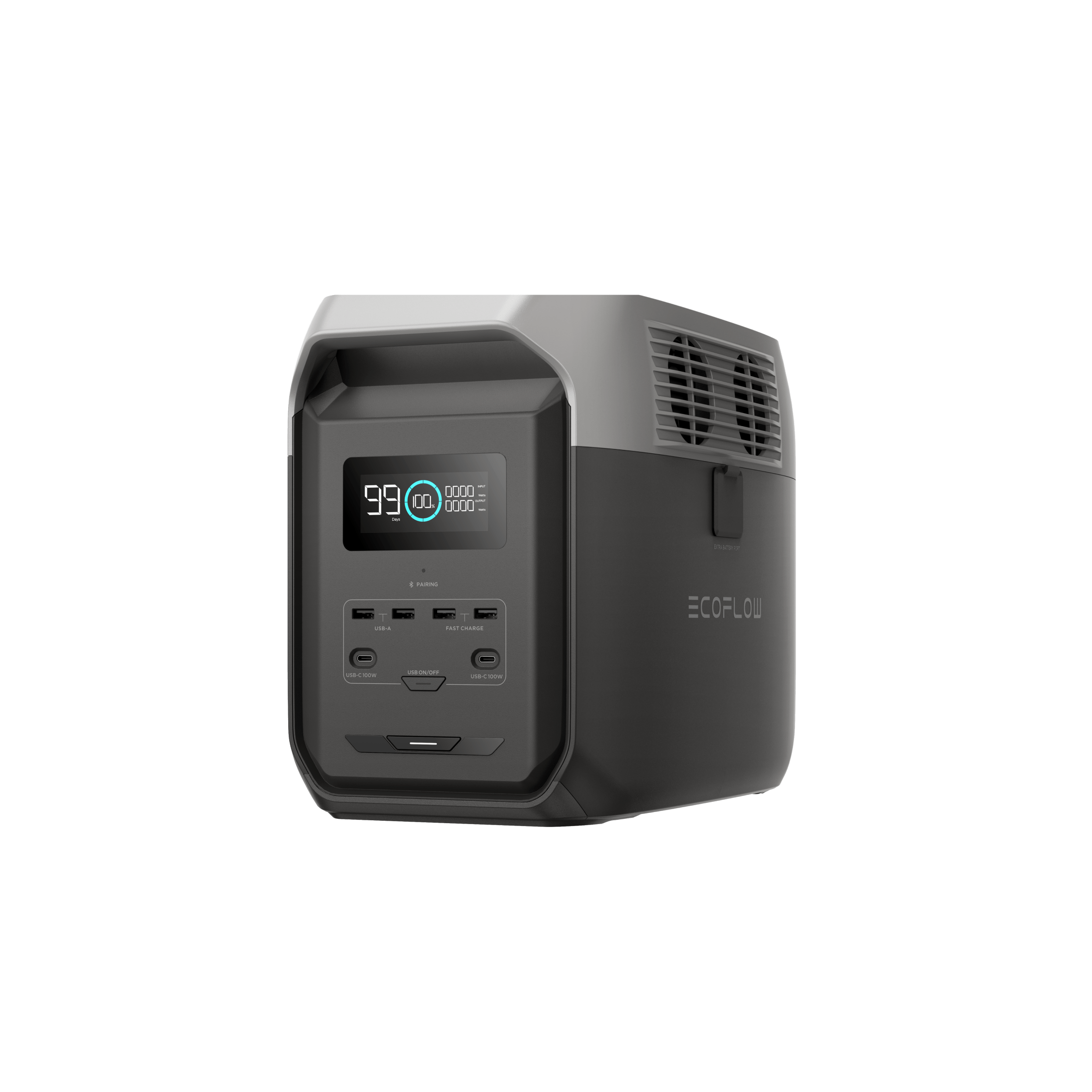
EcoFlow DELTA 3 1500
No longer sold

Jackery Explorer 1500 v2Pick
$849.00
$849.00 · direct from Jackery
down from $949 · 11% below usual
Last checked 16 days ago. Prices move — check before you buy.
Prices may vary by retailer and are subject to change.