Head-to-head test
DJI Power 1000 vs Jackery Explorer 2000 Plus
Neither of these is sold as tested any more, which turns the question from which one to buy into which shape you need: 1,024Wh you lift with one hand, or 2,043Wh you roll and can grow.
Full profiles: DJI Power 1000 → · Jackery Explorer 2000 Plus →

Written by Ian SchneiderUpdated
Solar & Off-Grid Tester, Station Arena Test Desk
Spec deltas
Both of these units are gone from their makers' ranges, and they went in two different ways. DJI superseded the Power 1000 with the Power 1000 V2 and kept the model name, so leftover stock and reseller listings can still be live, and a listing that says 'Power 1000' can ship either revision. Jackery went further: the Explorer 2000 Plus is no longer sold as a standalone unit at all. What is left on its listing is kits, the add-on expansion battery and a refurbished unit.
So compare freely and buy neither. The specs still describe two real objects, and they were never close: 1,024Wh and 28.7 lbs against 2,043Wh and 61.5 lbs, two AC sockets against five, a sealed pack against one that takes expansion batteries. The DJI was the unit you carried to the campsite in one hand. The Jackery was the one you rolled into the garage and left there.
Two readers land here. One of you owns a Power 1000 or an Explorer 2000 Plus and wants to know what you are holding, and the rest of this page is written for you, because the coverage, the noise, the expansion question and the warranty small print are all still live. The other typed a model name into a search box and is about to find out it does not sell any more. For you the answer is short: DJI's line continues in the Power 1000 V2, Jackery's in the HomePower 2000 Plus v2, and the thing worth carrying forward from this comparison is which of the two shapes you were actually shopping for.
What the Numbers Reveal
Each conclusion stated first — the numbers behind it on one line, the full analysis below.
solar input
What separates them is the parts list, not the physics. The Jackery's solar path is in the box with two MPPT inputsB5, while the DJI's runs through a proprietary adapter it does not include, so the smaller unit's tidy refill time only exists once you have bought the extra piece. Our record and our research disagree about the Jackery's ceiling, cited anywhere from about 1,200W up to the 1,400W we carryB0B5, which stretches its refill a little and still not past two hours. Reviewers put the DJI's wall charge at about 70 minutes from emptyA3, which tells you which end of the cable DJI designed it for.
Power 1000: 800W maximum solar input into a 1,024Wh packExplorer 2000 Plus: 1,400W solar input on our spec record, across two MPPT inputsB5, into a 2,043Wh packDJI ships no built-in solar charge controller, so panels need a separate proprietary adapter
Why it mattersAnyone planning to live off panels should count the adapter as part of a Power 1000, and should stop assuming the heavier Jackery is the slower one to fill.
The Explorer 2000 Plus is the one that finishes an eight-hour blackout, but look at what it finishes with. Spread 1,645Wh over eight hours and you are averaging a little over 200W, which makes 91Wh of leftover about half an hour of lights rather than a cushion. One of these is a shift unit and the other is an evening unit. Both are rated to switch over no worse than 20ms, so neither is the better UPS either.
Remote Workday needs 910Wh; the Power 1000's 1,024Wh nameplate becomes 870Wh usable under the flat 15% derate applied to every unit here, leaving it 40Wh short8-Hour Blackout needs 1,645Wh: the Power 1000 covers about half of it, and the Explorer 2000 Plus finishes with 91Wh leftReviewers ran a 45W compressor fridge, phones, laptops and lights off the Power 1000 across a week of campingA4
Why it mattersIf your actual requirement is the lights staying on past bedtime, stop comparing these two and size up a class, which is the successor conversation rather than this one.
That makes expandability, not capacity, the live question for anyone who already owns one. An Explorer 2000 Plus still has somewhere to go, and the ceiling described for it is far above anything a portable needsB2. A Power 1000 is finished at 1,024Wh, and its only upgrade path is a second box, which is the gap DJI closed on the models that replaced it.
Jackery's listing now carries only kits, the add-on battery and a refurbished unitThe Explorer 2000 Plus takes Jackery expansion batteries, with a single unit's stack described as reaching up to 12kWh and two paired units at 6,000W and up to 24kWhB2The Power 1000 is sealed at 1,024Wh, and DJI put battery expansion on newer models in the line rather than on this one
Why it mattersIf you own the Explorer 2000 Plus and thought the discontinuation stranded you, it did not; the growth path is still on sale. If you own the Power 1000 and are about to outgrow it, there is nothing to add, and that is the reason to move.
That leaves the bedside question to description rather than to the spec field, because the published noise numbers are not measuring the same thing and cannot settle it. On description the DJI is the quiet one at CPAP loadsA1A3, and it is the box you can carry to the bedroom with one hand, which is why the smaller unit takes this row outright.
CPAP Overnight needs about 320Wh, roughly 40W for eight hours, against the Power 1000's 870Wh usableReviews describe the Power 1000 as nearly silent under normal loads, with sound only becoming noticeable past 1,500W and a soft whoosh even thenA1, and the fan barely audible during a full-speed chargeA3The two published noise ratings are each maker's own figure, taken by different conventions, so they do not describe the same thing
Why it mattersA CPAP user who already owns a Power 1000 has the right unit for that job and should not trade it for capacity they will never use.
The specific dimensions that decide these two units — everything else is a tie.
Your Life, Your Pick
Selected because: Six loads, and the split is clean: the Power 1000 takes the CPAP night, the Explorer 2000 Plus takes the blackout, the workday and the tailgate, and neither one covers a camping weekend or a van's daily draw.
Read the six rows as a map of where each unit stopped. The Power 1000 covers a CPAP night and a tailgate and not much else on the list, and it misses a remote workday by 40Wh, which is the flat derate doing the tipping rather than any real shortage. The Explorer 2000 Plus covers everything the Power 1000 does plus the eight-hour blackout, then runs out of road in the same two places: a camping weekend's 2,100Wh leaves it 364Wh short, and a van's daily 4,685Wh leaves it short by more than the Power 1000 holds in total.
Both are rated to switch over no worse than 20ms, so a blackout does not favour either on the changeover. It favours the one with 1,736Wh usable. Same reflexes, different tank. And if the workday in question is a laptop day, the DJI's 140W USB-C outruns the Jackery's 100W, which is the one spec on this page where the smaller unit is simply the better one.
Growth Path
Selected because: One of these is sealed at 1,024Wh for life; the other still has its expansion battery on sale after the unit itself stopped being sold.
solar input
The strange thing about how Jackery retired this unit is that it kept selling the part that grows it. Kits, the add-on battery and a refurbished unit are what remain on the listing, which means an Explorer 2000 Plus sitting in a garage today still has its upgrade path intact even though the base unit has no buy button.
The Power 1000 gets no such consolation. It is 1,024Wh, permanently, and DJI put battery expansion on the newer models in the line rather than engineering a way into this one. If you own one and you are about to outgrow it, the answer is not an accessory.
Portability & Form Factor
Selected because: 28.7 lbs against 61.5 lbs is the difference between a unit you carry and a unit you place, and it is the cleanest line between these two.
weight
Two hands, bent knees and a plan for the stairs is what 61.5 lbs buys you. Reviews say it rolls on smooth ground with the included wheels and handle, and that stairs want a second personB3. Both of those are true of everything in this weight class, and neither makes it a unit you sling into a trunk on the way out the door.
28.7 lbs is the other side of that trade. It is a one-hand lift out of a car and a unit you will actually bring, which is the most underrated spec here and the reason the small box wins the CPAP row: it is the one you would carry to the bedroom. About half the energy, but the half you have with you beats the half you left in the garage.
Brand Trust
Selected because: Both units are retired, so what a shopper is really choosing is a line to follow: a brand that entered power stations in 2024 out of the drone business, or the widest retail network in the category attached to its weakest support desk.
You are not choosing a unit in this column any more, you are choosing whose next one to buy, and the two sides answer different worries. DJI arrived in power stations in 2024 with 700+ battery patents and a global repair network already built for drones, which is a great deal of hardware credibility and very little category history. The proprietary streak is what to weigh: the fast-charging SDC ports pay off only if you already own DJI gear, and the missing solar charge controller means an adapter.
Jackery's pitch is that you can buy one at Costco and walk it back into Costco, which counts for more than it sounds when support is the brand's weak column and the app is the weakest of the majors. Two things worth knowing before you shop a name: the Explorer 2000 Plus is not the lighter Explorer 2000 v2B0, and a listing that reads 'Power 1000' may ship the original or the revision, because DJI used the name twice.
What the Specs Don't Tell You
Selected because: Three cards fire here: the Jackery's 61.5 lbs, the DJI's fixed 1,024Wh, and a warranty that reads as a five-year tie until you look at what each maker makes it conditional on.
The warranty card is the one to read twice. Up to five years on both records makes it look like a wash, and then you notice that DJI's five is the figure for buying from DJI's own store while Jackery's is three years that registration stretches to five. On units nobody sells new, the condition is the whole question, and the answer sits with whoever is selling you the box.
The weight and expansion cards are the honest catches, one each. The Jackery asks for a second person on the stairs. The DJI asks you to be certain 1,024Wh is enough, because it always will be.
Strengths & trade-offs
DJI Power 1000
Strengths
- +Lighter by 32.8 lb
Trade-offs
- –Weaker inverter (-800W) limits appliance compatibility.
Jackery Explorer 2000 Plus
Strengths
- +Larger battery capacity
- +Higher AC output
- +Faster solar charging
Trade-offs
- –Significantly heavier (+32.8 lbs), making it harder to move.
Will It Power Your Gear?
Scenario math and per-appliance runtimes, modeled from the spec record.
Scenario verdicts
We ran the math on six real-world scenarios. Here's which unit survives your actual life.
SCN-01 · 2 nights · needs 2,100Wh
Weekend Camping
Two nights off-grid with essential comfort
Neither unit
A weekend asks for 2,100Wh and neither box has it. The Explorer 2000 Plus gets 83% of the way there, which in practice means the list minus one item. The Power 1000 covers about 41%, which means the essentials and an early night. Read this row as the ceiling on both units rather than a contest: a full-list weekend is a bigger station's job, or a panel's.
Battery budget usedlower = more headroom
LOAD Phone Charger 15W×6h · LED Lights 40W×8h · Box Fan 75W×14h · CPAP Machine 40W×16h
SCN-02 · 8 hours · needs 1,645Wh
8-Hour Blackout
Keep the essentials running through a night without power
Explorer 2000 Plus
Only one of these finishes the night, and only just. 1,645Wh across eight hours averages a little over 200W, so the Explorer 2000 Plus's 91Wh of leftover works out at about half an hour of margin rather than a comfortable one, while the Power 1000 stops 775Wh short, a little past halfway. Both switch over no worse than 20ms, so what decides this row is tank size and nothing else.
Battery budget usedlower = more headroom
LOAD Fridge 150W×8h · Router + Modem 20W×8h · LED Lights (4 bulbs) 40W×6h · Phone Charger 15W×3h
SCN-03 · 8 hours · needs 320Wh
CPAP Overnight
Sleep therapy without interruption — the #1 medical use case
Either unit
A CPAP is about 40W for eight hours, so both of these cover the night at least twice over — capacity isn't the question here. The only published difference is fan noise, and it can't settle this: the Power 1000 is rated 23dB and the Explorer 2000 Plus 30dB, but they are two makers' figures, each measured its own way. Neither settles which box is quieter at a bedside. Neither is still sold new, so on both sides this is a used-market question rather than a price comparison.
Battery budget usedlower = more headroom
LOAD CPAP Machine 40W×8h
SCN-04 · 8 hours · needs 910Wh
Remote Workday
Full work day off-grid without power anxiety
Explorer 2000 Plus
The Power 1000 comes up just short — it needs 910Wh and has 870Wh usable, a 40Wh gap (its nameplate 1,024Wh actually clears this — the flat 15% conversion allowance is what tips it under). Trim that much — one small appliance's worth across the day — and it finishes. The Explorer 2000 Plus covers it outright with 826Wh to spare.
Battery budget usedlower = more headroom
LOAD Laptop 60W×8h · External Monitor 30W×8h · Router + Modem 20W×8h · Phone Charger 15W×2h
SCN-05 · 4 hours · needs 670Wh
Tailgate Party
Game day power for the crew
Explorer 2000 Plus
Both handle game day; the Explorer 2000 Plus keeps more in reserve (39% used vs 77%). Tailgating is a light load, though, so the number you'll feel is weight: 28.7 lbs for the Power 1000 against 61.5 lbs for the Explorer 2000 Plus, from the trunk to the setup spot.
Battery budget usedlower = more headroom
LOAD Blender 400W×0.5h · LED TV (55") 80W×4h · Bluetooth Speaker 15W×4h · Phone Charger (×3) 45W×2h
SCN-06 · 24 hours · needs 4,685Wh
Van Life Daily
A full day of mobile living — the ultimate endurance test
Neither unit
Neither unit covers this scenario's 4,685Wh: the Power 1000 comes up 3,815Wh short (about 19% covered), the Explorer 2000 Plus 2,949Wh (37%). This is well outside what either unit is for; the right answer here is a larger station, not a choice between these two.
Battery budget usedlower = more headroom
LOAD Mini-Fridge 150W×24h · Laptop 60W×4h · Phone Charger 15W×3h · LED Lights 40W×5h · Fan 75W×8h
The Load Test
RUNTIME = (Wh × 0.85) ÷ LOAD
None of the scenarios above exactly yours? Build it. Toggle what you'd plug in; both units are tested against the combined draw.
Essentials
Comfort & Convenience
High-Draw Appliances
Test duration
8h
Continuous draw
205W
Projected runtime
For this load: Explorer 2000 Plus runs 8.5h vs 4.2h.
Planning for more than this? Describe your whole setup and get it sized →
Modeled from the spec record — same math as the tables below. Methodology
Runtime by appliance
Real-world runtime estimates for common appliances, modeled at 85% inverter efficiency.¹
Essentials
The basics you need runningscale 0–115.8hComfort & Convenience
Makes off-grid life actually enjoyablescale 0–23.2hHigh-Draw Appliances
These reveal the real limitsscale 0–1.7h¹ Runtime = (capacity × 0.85) ÷ appliance watts. Within each group, all bars share one time scale (the group's longest runtime), so lengths are comparable across appliances; identical runtimes collapse into a single blue/orange bar. Actual runtime varies with battery age, temperature, and simultaneous loads — see methodology.
Conclusion
September 19, 2026
Verdict: the Explorer 2000 Plus, on Power Score margin
A tie, and not because the specs are close. DJI superseded the Power 1000 with the Power 1000 V2, and Jackery stopped selling the Explorer 2000 Plus as a standalone unit, so there is no live candidate on this page to recommend at any confidence. On specs these two were never really rivals: one is a one-hand carry with a sealed pack, the other holds double the energy, grows past it, and stays where you put it. If you already own one, the live question is whether your ceiling is permanent, because Jackery still lists the add-on battery that expands the Explorer while the Power 1000 was sealed at 1,024Wh from the factory. If you came here shopping the names, the current versions of these two shapes are the Power 1000 V2 and the HomePower 2000 Plus v2.
Editor-assigned confidence, based on cited owner research and spec analysis.
Written by Ian Schneider, Solar & Off-Grid Tester · Station Arena Test Desk · Updated September 19, 2026
Measured Data
Benchmark scores and the full spec record, side by side.
Benchmark scores
Not rated for both units (minimum threshold unmet): CPAP, Camping.
Full specifications
ᵈ Derived: price ÷ rated capacity. See the data behind our comparisons →
Comparison ToolAdd more power stations, side by sideOpen Tool →How these numbers are produced
Numeric verification
Every figure on this page traces to our spec database or arithmetic on it — no estimated numbers.
Owner claims
Statements about owner experience are cited to published reviews — see Sources & Research Notes below.
Runtime model
Runtime = (rated capacity × 0.85 inverter efficiency) ÷ device wattage. Solar recharge estimates assume panels deliver 70% of rated output. Cold weather, battery age, and stacked loads reduce real-world results.
Power Score
Computed from 14 published spec dimensions, weighted per use-case bench. Higher is better; a unit must meet a bench's minimum threshold to be rated.
See the full weight table and data sourcing on our methodology page →Class ranking (the star rating)
Each unit's star score is a category ranking, not customer reviews — no buyer opinions feed it. We score every station on size-independent quality (value, output, portability, endurance, ports, warranty, and more), then percentile-rank it against the other units in its capacity class, so a class-leading compact unit and a class-leading whole-home unit can both earn 5★. Here, Power 1000 rates 4.3/5 (58th percentile of 27 Everyday-class units), and Explorer 2000 Plus rates 4.6/5 (74th percentile of 28 Large-class units).
How the class ranking is computed →Test Notes & Caveats
Hidden gotchas and advantages we spotted that you won't find on the product page.
Weight: 61.5 lbs Decides Where It Lives
61.5 lbs is a two-hands, bent-knees lift and a second person on stairs. Wheels and a telescoping handle make flat ground a non-event, which is why a unit like this ends up living in a garage or a van rather than riding along on day trips. The Power 1000's 28.7 lbs is the other half of that trade: about half the energy, in a box you will actually bring.
Warranty: Up to Five Years Each, Conditional Each
Both records carry up to five years, so on paper it is a tie, and neither five is unconditional. DJI's is the term advertised for buying from DJI's own store. Jackery's is three years as sold, stretched to five by registering the unit. Since neither unit is sold new by its maker any more, that condition is what actually decides your cover: a kit, a refurbished unit and leftover retail stock each answer 'who sold it, and can you prove it' differently. Ask the seller, because the spec row cannot tell you.
Ownership Analysis
What happens after you buy — true cost of ownership, brand trust, and growth potential.
Lifetime value
Service lifeyears at one full cycle per day
Lifetime energy delivered
│ warranty ends · Reaching the cycle rating means ~80% capacity remains — degraded, not dead.
Analyst note
Neither is sold new any more, so there is no price left to work a cost per kWh from, and what either costs you now depends on the used market. The hardware comparison still holds: over its rated life the Power 1000 delivers about 4,096 kWh and the Explorer 2000 Plus about 8,171 kWh. One thing to know reading the table: both carry the same 4,000-cycle rating, so the lifetime rows are sticker price and capacity in disguise — the wear horizon is identical and decides nothing here.
Brand trust
DJI
Ecosystem
DJI has been building power stations only since 2024, five models in, and one of those models is a second pass at this one. That matters on a page about a retired unit: a listing that reads 'Power 1000' may ship the original or the revision, and the name will not tell you which.
Support
The service network is DJI's drone network, which is genuinely global and generally well regarded. What is missing is power-station-specific history. The goodwill here is inherited rather than earned in this category.
Community
There is no power station community to speak of yet. Questions land in r/dji among drone owners, which is not where you find someone who has run one of these through a winter.
App experience
Rated 3.5/5 iOS and Android (DJI Home app ratings reflect entire DJI ecosystem including drones/cameras, not power-station-specific). Users report the on-device screen is more reliable than the app.
Unique strength
700+ battery patents out of the drone business, LFP cells rated for at least 4,000 cycles, and a build that runs at the quiet end of the category. The SDC ports fast-charge DJI drone batteries, which is a real advantage if you already own DJI gear and none at all if you do not.
Worth knowing
There is no built-in solar charge controller, so panels need a separate proprietary adapter. And battery expansion exists on DJI's newer models rather than on this one.
Jackery
Ecosystem
A dozen-plus models across the portable Explorer line and the HomePower backup line, plus the SolarSaga panels. This unit's replacement sits on the HomePower side, which tells you how Jackery now thinks about a heavy expandable station: less a thing you carry, more a thing you install.
Support
US-based, and the brand's weakest column: slow and scripted replies, strict receipt requirements on warranty claims, and refurbished replacements for clearly defective units. The practical hedge is buying through a retailer with its own returns desk, which is a large part of why Costco and Amazon matter so much to this brand.
Community
The smallest community of the major brands, at roughly 2,000 in the main subreddit, offset by heavy YouTube coverage. Plenty of first impressions, thin on long-term troubleshooting.
App experience
Rated 2.3-3.3/5 iOS and Android — the weakest app experience of the major brands. Multiple confusing apps (Jackery app vs Jackery Home) and mandatory login even offline.
Unique strength
The widest retail distribution in the category, through Costco, Home Depot, Best Buy and Amazon. That is why a Jackery is easy to buy, easy to return and easy to find secondhand, which is exactly the situation a retired model leaves you in.
Worth knowing
The app is the weakest of the majors, and there are two of them with confusingly similar names and a mandatory login even when you are standing next to the unit. Also worth fixing in your head: 'Explorer 2000 Plus' and 'Explorer 2000 v2' are different products and their specs do not transfer.
Analyst note
Neither of these units is for sale, so the brand column has stopped being background and become the decision itself: you are picking whose next box to buy. DJI brings hardware pedigree, a service network built for drones, and a proprietary streak, from the solar adapter to the SDC ports, that only pays off inside its own ecosystem. Jackery brings the opposite trade: the easiest unit in the category to buy and to return, attached to the weakest support desk and app of the majors. If what you value is being able to walk a bad unit back into a store, that is Jackery. If what you value is the box itself, DJI has the better record at making one.
Growth path
Power 1000
EXPANDABLESupports DJI expansion batteries, so you can add capacity later without replacing the base unit — useful if your needs may climb past 1,024Wh.
Accepts up to 800W of solar. Suitable for a 1-2 panel setup.
Adequate ports for most setups, but heavy users may want a power strip.
Expansion batteries are DJI-specific. You're investing in the DJI ecosystem.
Explorer 2000 Plus
EXPANDABLESupports Jackery expansion batteries, so you can add capacity later without replacing the base unit — useful if your needs may climb past 2,043Wh.
Accepts up to 1,400W of solar. Enough for a serious multi-panel array.
Adequate ports for most setups, but heavy users may want a power strip.
Expansion batteries are Jackery-specific. You're investing in the Jackery ecosystem.
Realistic full solar rechargeat 70% of rated panel output — see methodology
Analyst note
Neither of these is sold new any more, so there is no growth path to buy into on either side. If you already own one: the Power 1000 takes expansion batteries and the Explorer 2000 Plus takes expansion batteries. As a purchase decision, expandability isn't the question here.
What Owners Report
Patterns from published owner reports and long-term reviews — every claim cited to its source below.
DJI Power 1000
Quiet is the thing reviewers keep returning to. One describes it as nearly silent under normal loads, with sound only becoming noticeable past 1,500W and even then a soft whoosh rather than the high-pitched whirr of rivalsA1. Another reports the fan barely audible during a full-speed charge, which runs about 70 minutes from empty with 80% inside the first 50A3. Output holds up as well: one test ran it at 2,400W, above its 2,200W rating, for 20 minutes with no shutdown and no noise complaintA2. The other picture that recurs is a week of camping on a 45W compressor fridge, phones, laptops and lights, plus drone pilots using it to fast-charge batteries while everything else stays poweredA4.
The honest caveat is what that evidence is. Our coverage here is review-based and directional rather than long-term owner reporting, and it was gathered on the base Power 1000 rather than the revision that replaced itA0. Nothing in it tells you how one of these behaves in year four.
“Whisper-quiet operation — one of the quietest power stations in its class, nearly silent under normal loads; sound only becomes noticeable past 1,500W, and even then it's a soft whoosh rather than the high-pitched whirring you'd get from BLUETTI or EcoFlow.”
Sources
thesolarlab.com · trailandkale.com · offgridbenchmark.com · superfashion.us · dronexl.co
Jackery Explorer 2000 Plus
Dependable and unfussy is the consensus, including quiet operation under a full 3,000W load and a port set used on everything from CPAP machines to an electric grillB1. The build draws specific praise: a tank-like shell with IP65 dust and water resistance on key ports, fed by two MPPT solar inputsB5. Expansion is the headline, with a single unit's battery stack described as reaching up to 12kWh and two units paired for 6,000W and up to 24kWhB2. That is far more than a portable needs, which is rather the point. It is a base station that happens to have a handle.
Two caveats come up every time. It weighs 61-62 lbs in reviewers' hands, and while the included wheels and telescoping handle make smooth ground easy, stairs want two peopleB3. And the app, which does carry genuinely useful detail like cycle counts and efficiency graphs, is described as still needing polishB4. One thing to settle before you shop: the solar ceiling is cited inconsistently, from about 1,200W up to the 1,400W our spec record carriesB0B5, so size panels to the lower figure and you cannot be caught out. And the Explorer 2000 Plus is a different, heavier unit from the Explorer 2000 v2, which is the mix-up this model invites mostB0.
“Reviewers describe it as dependable, easy to use, and relatively quiet even under a 3000W load, with universal compatibility for powering everything from CPAP machines to electric grills.”
Sources
outdoorgearlab.com · thesolarpit.com · jackery.com · voltagebasics.com · storagereview.com · thesolarlab.com · tipselite3s.com
Sources & Research Notes
Every owner claim in this report is traceable to a published source. The bracketed references above resolve here.
Recurring owner themes
- Standout quiet operation (quieter than EcoFlow/BLUETTI), robust real-world output above its rating, and appeal to drone pilots and campers are the consistent themes. [Power 1000 · 3 entries]
- Standout expandability (up to 24kWh dual), a rugged IP65 build with wheels, and dependable quiet operation are the praise; the heavy weight and an app that needs polish are the caveats. [Explorer 2000 Plus · 3 entries]
- A1
“Whisper-quiet operation — one of the quietest power stations in its class, nearly silent under normal loads; sound only becomes noticeable past 1,500W, and even then it's a soft whoosh rather than the high-pitched whirring you'd get from BLUETTI or EcoFlow.”
thesolarlab.com / trailandkale.com — DJI Power 1000 review · 2026 · [positive]
- A2
“Tested at 2,400W — slightly above its 2,200W output rating — for 20 minutes and handled it without loud noise or automatic shut-offs.”
offgridbenchmark.com / superfashion.us — DJI Power 1000 review · 2026 · [positive]
- A3
“AC charging takes about 70 minutes from 0% to 100% (about 50 minutes to 80%), and during full-speed charging the fan barely makes a sound.”
thesolarlab.com — DJI Power 1000 review · 2026 · [positive]
- A4
“Over a week-long camping trip it powered a 45W compressor fridge, phones, laptops, and LED lights; it's also a favorite of drone pilots for fast-charging DJI batteries while running other devices.”
offgridbenchmark.com / dronexl.co — DJI Power 1000 review · 2026 · [positive]
- B1
“Reviewers describe it as dependable, easy to use, and relatively quiet even under a 3000W load, with universal compatibility for powering everything from CPAP machines to electric grills.”
outdoorgearlab.com / thesolarpit.com — Jackery Explorer 2000 Plus review · 2026 · [positive]
- B2
“Massive expandability — each unit's battery expands up to 12kWh, and pairing two units gives 6000W output and up to 24kWh total, ideal for RVs, home backup, or serious off-grid setups.”
jackery.com / thesolarpit.com — Explorer 2000 Plus review · 2026 · [positive]
- B3
“Not light at around 61-62 lbs — included wheels and a handle help on smooth surfaces, but it still demands a two-person lift for stairs.”
outdoorgearlab.com / voltagebasics.com — Explorer 2000 Plus review · 2026 · [mixed]
- B4
“The app nails the essentials with pro-level insights like cycle counts and efficiency graphs, but it lacks some of the bells and whistles of rivals and still needs polishing.”
storagereview.com / thesolarlab.com — Explorer 2000 Plus review · 2026 · [mixed]
- B5
“Strong solar with two MPPT inputs (up to ~1,200-1,400W), plus a tank-like build with IP65 dust and water resistance on key ports.”
storagereview.com / tipselite3s.com — Explorer 2000 Plus review · 2026 · [positive]
Research compiled September 19, 2026.
What Owners Actually Report
Drawn from 141 comments on independent review channels — not from retailer reviews, which skew to the first week of ownership. Each line is our summary of one commenter's claim, linked to the original. We record what they said, including where it contradicts the spec sheet.
DJI Power 1000
200 claims from 131 comments · 98 from owners · 31 with figures
- Price & value
- 33 · 11% negative
- Charging
- 22 · 20% negative
- Solar input
- 28 · 52% negative
- App & firmware
- 27 · 79% negative
- Other
- 20 · 53% negative
What owners complain about
Bought and tested it: 140W is out of the USB-C port's league.
Chargingmeasuredowner9 agreedsource →
The 400W MPPT modules run hot and throttle solar watts until he added copper heatsinks.
Build qualitymeasuredowner5 agreedsource →
Says the inverter draws about 50W, which DJI never mentions but which decides real autonomy.
Idle drainmeasuredowner1 agreedsource →
What owners praise
Ordered one on Amazon for under $400 in a November deal.
Price & valuemeasuredowner11 agreedsource →
SDC ports charge Mavic 3 batteries about 50% faster than the 120V fast charger; USB-C rated 140W.
Chargingmeasuredowner5 agreedsource →
Confirms DJI's quietness claim while charging is not exaggerated.
Noiseowner38 agreedsource →
Jackery Explorer 2000 Plus
15 claims from 10 comments · 11 from owners · 2 with figures
- Expandability
- 3 · 48% negative
- Solar input
- 2 · 0% negative
- Warranty & support
- 3 · 100% negative
- Price & value
- 2 · 88% negative
- Charging
- 1 · 100% negative
What owners complain about
The pairing connector box is way overpriced at $200.
Price & valuemeasuredownersource →
Has contacted Jackery too many times across four units and calls their support bad.
Warranty & supportownersource →
The 2000 Plus parallel kit did not do what he needed despite the spec talk.
Expandabilityownersource →
What owners praise
Feeds 4800W into the system across 8 DC ports; any input backfeeds and charges everything.
Solar inputmeasuredowner100 agreedsource →
Each expansion battery has its own controller, giving MPPT redundancy in a grid-down scenario.
Expandabilityowner100 agreedsource →
Switching his decision to Jackery on the reviewer's A grade over the AC300's A- and Delta's B-.
Other17 agreedsource →
Claims are weighted by how specific they are, whether the commenter owns the unit, and how many readers agreed. Comments that mention a product under a rival's review count for more, because the commenter had no reason to be there. This is what buyers report, not our test results — for measurements we ran ourselves, see the methodology.
Who Should Buy Which
Buy the Power 1000 if you…
- →You already own a Power 1000 and mostly run a CPAP, a small fridge, laptops and lights: you have the right box for that work, and the quiet it is known forA1 is the thing you would miss most in a trade. Its 140W USB-C also charges a large laptop faster than the Jackery's 100W can.
- →You want the shape the Power 1000 was, which is a one-hand-portable kilowatt-hour that is quiet and fast from the wall. That shape is current as the Power 1000 V2, and that is where to spend rather than hunting leftovers.
- →You are about to click a listing that says 'Power 1000': find out which revision it ships first. DJI used the name twice, and the original is the one that has been replaced.
Buy the Explorer 2000 Plus if you…
- →You own an Explorer 2000 Plus and assumed the discontinuation stranded you. It did not. The add-on battery is still on the listing, so your ceiling is still the one you choose.
- →You need what this unit was: 2,043Wh that stays where you put it, five AC sockets and a 12V socket instead of two sockets and no 12V, and room to add batteries later. Jackery's current answer to that shape is the HomePower 2000 Plus v2.
- →You are building toward partial-home backup and expect the load to climb. Expansion is the only feature on this page that addresses that, and it sits on the Jackery side.
If neither fits
Anyone whose real load is a van's daily 4,685Wh, or a well pump, should close this tab. Neither unit covers that draw, and our records show neither carries a 240V outlet or a 30A RV socket, so that is a larger hardwired-capable class of station rather than a choice between these two. At the other end, if the whole job is phones and a laptop over a weekend, both of these are far more station than you need, and a sub-kilowatt unit will be lighter and less to think about.
The Bottom Line
Two units, two retirements weeks apart, and no buy button between them. The comparison still resolves cleanly: the Power 1000 was the one you carried and the Explorer 2000 Plus was the one you grew, and the scenario rows split along exactly that line. The CPAP night goes to the small quiet boxA1, the blackout and the workday to the big one, the camping weekend and the van to neither.
So the tie is not a dead heat, it is an empty shelf. If you own one of these, the takeaway is that Jackery kept selling the battery that expands the Explorer while the Power 1000's 1,024Wh was always going to be its last word. And if you came here to buy, take the shape rather than the model number: the Power 1000 V2 if you want to pick it up with one hand, the HomePower 2000 Plus v2 if you want it to stay put and get bigger.
Frequently Asked Questions
Answers drawn from the spec record and cited owner research.
Is the DJI Power 1000 discontinued?
Yes. DJI superseded it with the Power 1000 V2 and kept the model name, so the original has left the range even though stock and reseller listings can still be live. If you find one, confirm which revision it ships before you buy, because DJI's own lineup carries both.
Can you still buy the Jackery Explorer 2000 Plus?
Not as a standalone unit from Jackery. The listing now carries kits, the add-on expansion battery and a refurbished unit, and the model's place in the line has gone to the HomePower 2000 Plus v2. Retailer leftovers and secondhand stock are the only routes to the unit as tested.
Is the Explorer 2000 Plus the same as the Explorer 2000 v2?
No, and it is the most common mix-up on this model. The 2000 Plus is the heavy expandable flagship at 2,043Wh and 61.5 lbs with a 3,000W inverter and expansion battery support; the Explorer 2000 v2 is a lighter, different unit. Specs you read for one do not transfer to the other.
How much can a DJI Power 1000 actually run?
Figure on about 870Wh of real energy from the 1,024Wh pack once you apply the flat 15% derate we use on every unit, with 2,200W continuous output and 4,400W of surge headroom. That covers a CPAP night several times over, a tailgate, and a remote workday if you trim about 40Wh out of the day. An eight-hour household blackout is where it stops, at roughly half the job.
How much solar can the Jackery Explorer 2000 Plus take?
Our spec record carries 1,400W across two MPPT inputs, and that is the figure to work from. Be aware the ceiling is cited inconsistently, from about 1,200W up to that 1,400W, so if you are buying panels right to the limit, size to the lower number. Either way its 2,043Wh refills inside a couple of hours of strong sun.
Brand matchup
DJI vs Jackery: measured across every matchup →Related comparisons
Where to buy

DJI Power 1000
Superseded — buy the V2
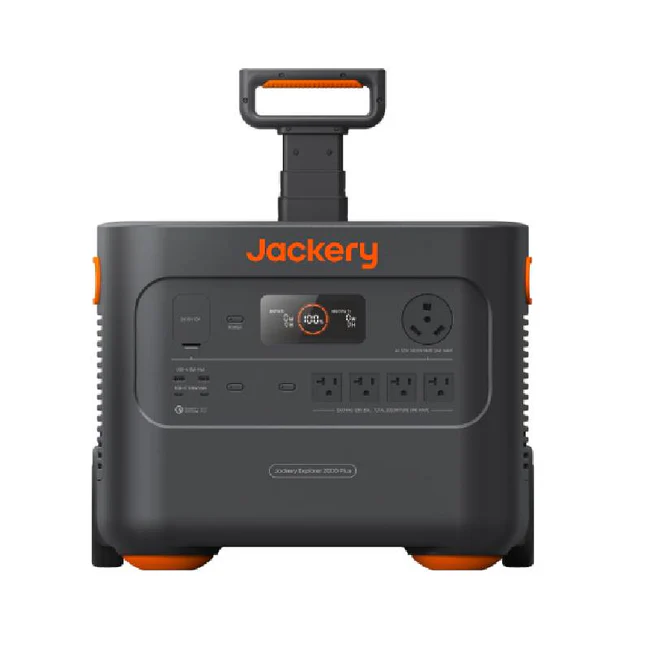
Jackery Explorer 2000 Plus
No longer sold
Prices may vary by retailer and are subject to change.