Head-to-head test
BLUETTI Apex 300 vs Jackery Explorer 5000 Plus Double Kit
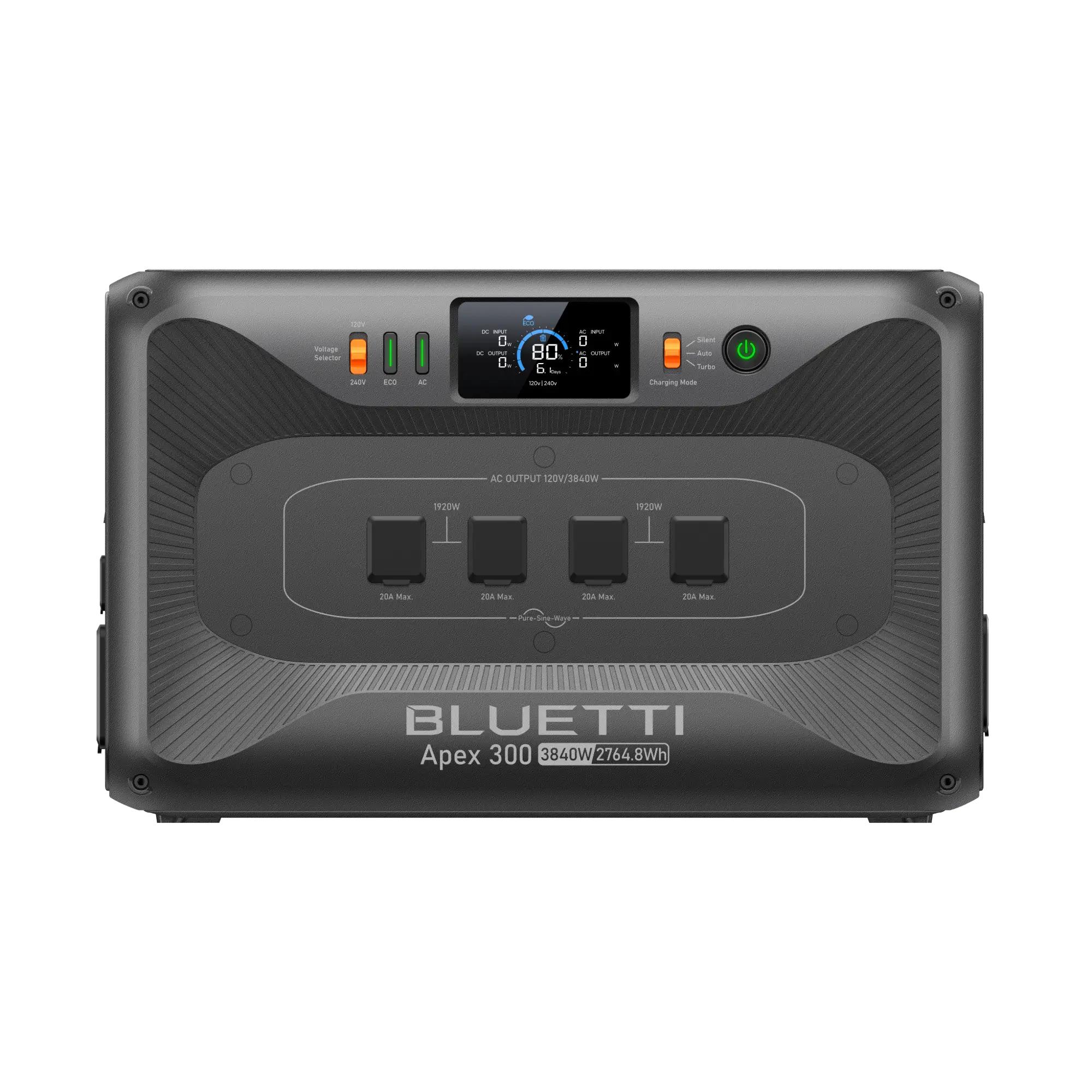
Priced within two cents a watt-hour of each other, these aren't rival designs but two sizes of the same one, and the line between them falls at about 2,350 usable watt-hours a day.
Full profiles: BLUETTI Apex 300 → · Jackery Explorer 5000 Plus Double Kit →

Written by Gunner GustafsonUpdated
Whole-Home Backup Tester, Station Arena Test Desk
$1,499.00 · direct from BLUETTI
down from $1,699 · 12% below usual
Last checked 1 day ago. Prices move — check before you buy.

$6,289.00 · direct from Jackery
Last checked 1 day ago. Prices move — check before you buy.
Spec deltas
Two cents. That's the gap in what these two charge you per watt-hour of storage: $1,699 across 2,765Wh works out to 61 cents, $6,289 across 10,080Wh works out to 59. Nobody's being overcharged here and nobody's getting a bulk discount. You're picking a size.
Which makes this an unusually clean decision, because the Apex 300 and the Explorer 5000 Plus Double Kit aren't really competing on quality. The kit is 3.6 times the battery for 3.5 times the money. The only question worth arguing about is whether you'll ever use the difference, and five of the six loads this site models fit inside the Apex's 2,350Wh usable bank. The sixth doesn't fit at all.
So the verdict is the Apex, with one exit clearly marked. If you're running a van, a cabin, or anything with a 4,685Wh-a-day appetite, the Apex isn't a cheaper version of the right answer, it's the wrong answer, and the rest of this page will point you where to go. Everyone else should keep the $4,590 and spend some of it on panels.
What the Numbers Reveal
Each conclusion stated first — the numbers behind it on one line, the full analysis below.
Capacity
That removes the usual comparison logic entirely. There's no better-value unit to find, only an amount of storage to pick, and the Apex already covers the weekend campsite at 89% of usable, the eight-hour blackout at 70%, the remote workday at 39%, the tailgate at 29% and the CPAP night at 14%. Spend the extra $4,590 and what you've actually bought is the difference between ending an outage 70% used and ending it 19% used.
Apex 300: $1,699 for 2,764.8WhExplorer 5000 Plus Double Kit: $6,289 for 10,080WhFive of six modeled scenarios sit at or under 89% of the Apex's 2,350Wh usable bank
Why it mattersIf you can name your worst realistic day and it lands under 2,350Wh, the Double Kit is $4,590 of headroom you'll never see the bottom of.
Which flips the portability story depending on your floor plan. On flat ground the Jackery is arguably the easier unit to reposition, because a wheeled 135 lb beats a carried 84 lb every timeB1B7. Add one flight of stairs and it inverts hard: the Apex becomes the only unit on this page a single determined person gets to a basement, and even that is a two-hands, bent-knees trip that defeated at least one reviewer outrightA8.
Apex 300: 83.78 lb in a single chassisExplorer 5000 Plus Double Kit: 269 lb, which is the combined weight of the kit's two paired unitsOne reviewer could barely carry the Apex a few feet and couldn't lift it onto a tableA8Reviewers single out the Explorer's wheels and sliding suitcase handle as the sturdiest they've handledB1B7
Why it mattersCount stairs before you count pounds. If the unit's final home is up or down a flight, 269 lb is the number that actually stops you, and if it's on one level, it barely matters.
Typical price
So start-small-and-grow works exactly once. A second Apex is a genuinely good move: it takes you to 5,530Wh for $3,398 total, and it's the cheapest way to respond to a need you didn't see coming. The third unit is where the plan quietly stops making sense, because by then you've spent the Double Kit's money, you're still short of its capacity, and you're siting and cabling three boxes instead of two.
Apex 300: $1,699 for 2,764.8Wh, expandableReviewers price BLUETTI's parallel box, needed to link multiple Apex units, at around $699A12Explorer 5000 Plus Double Kit: $6,289 for 10,080Wh
Why it mattersIf you already know you need something close to 10,000Wh, buy it as a kit. Growing into it one Apex at a time costs the same and lands lower.
Which means the Apex's van-life failure is a buffering problem, not an energy problem. If your 4,685Wh is spread across daylight with a big array feeding it, the Apex can plausibly keep pace by refilling as it goes. If the heavy end of your day lands after dark, induction cooking, heat, air conditioning through the night, there's nothing to refill from and you need the 8,568Wh already sitting in the bank.
Van Life Daily needs 4,685Wh against the Apex's 2,350Wh usable bank, or 199%Apex 300 accepts 2,400W of solar inputThe Double Kit runs the same day at 55% of its 8,568Wh usable bank
Why it mattersVan-lifers with a large rooftop array and daytime-heavy loads can still shortlist the Apex. If your big draws happen after sunset, you're the buyer the Double Kit exists for.
The specific dimensions that decide these two units — everything else is a tie.
Your Life, Your Pick
Selected because: Five of the six loads modeled here fit inside the Apex's 2,350Wh usable bank. The sixth, van life at 4,685Wh, needs 199% of it. That one line decides the page.
Read these percentages as fractions of usable capacity, not nameplate. 85% of 2,764.8Wh is 2,350Wh once the inverter takes its cut, and 85% of 10,080Wh is 8,568Wh. That's why the weekend campsite reads 89% on the Apex: 2,100Wh against 2,350Wh leaves roughly 250Wh in reserve by Sunday afternoon. Comfortable in June, and no margin at all in a cold snap with no sun.
The CPAP row is where oversizing shows its bill. 320Wh a night is 4% of the Jackery kit, and one measured review of a single Explorer 5000 Plus put idle draw at roughly 58W with the inverter switched on and no load attachedB3. Eight hours of that is 464Wh, more than the CPAP itself asks for. There's no matching idle figure for the Apex, so this isn't a scoreboard. It's a warning about buying inverter you don't use, because a big inverter charges you energy just for being awake.
Lifetime Value
Selected because: 10 cents against 15 cents per lifetime kilowatt-hour. The cheaper storage is in the smaller box, so what's left to decide this is capacity.
cost / lifetime kWh
The 15 cents against 10 cents per lifetime kilowatt-hour goes to the Apex, across 16,589 kWh of lifetime throughput for it and 40,320 kWh for the kit. Five cents apart means both are competently priced batteries and the smaller one is the cheaper place to keep a kilowatt-hour. What separates them most isn't the cost of energy, though — it's the $4,590 you hand over on day one.
There's also a quiet assumption inside the kit's number: 15 cents a kilowatt-hour only arrives if you genuinely pull all 10,080Wh, 4,000 times over. Model the eight-hour blackout instead and the kit touches 19% of its bank each time. Lifetime cost per kilowatt-hour measures what a battery charges you to store energy. It says nothing about whether you'll ever ask it to.
Portability & Form Factor
Selected because: 84 lb in one chassis against 269 lb split across two paired units, about 135 lb each. The kit total describes an object nobody ever lifts.
weight
The 269 lb on the Jackery's line is a shipping manifest, not a lift. Split across the kit's two paired units it's roughly 135 lb apiece, and those units are built to be dragged rather than carried, with wheels and a sliding handle reviewers describe as the sturdiest they've seen on a power stationB1B7. The Apex's 84 lb is the smaller number and the more awkward object: one box, both hands, and one reviewer who managed a few feet at a time and never got it onto a tableA8.
So the practical rule is geometry, not mass. Flat ground favors the Jackery, which rolls where the Apex has to be carried. Any staircase reverses that completely, and a 135-lb box on stairs is a two-person job with a strap, if it happens at all. Decide where this thing sleeps before you decide which one to buy.
Growth Path
Selected because: Both expand. But three Apex 300s reach 8,294Wh for $5,097 in units alone, still 1,786Wh short of the Jackery kit's 10,080Wh.
solar input
Both units take expansion batteries, so whether they grow is a tie and the useful question is what growth costs. Stacking whole Apex 300s is the transparent version of that math: two gets you to 5,530Wh for $3,398, three to 8,294Wh for $5,097, and linking them needs BLUETTI's parallel box, which reviewers put near $699A12. Three units plus the box is $5,796 against the kit's $6,289, and you're still 1,786Wh behind.
That's not an argument against buying one Apex. It's an argument against buying three. The first unit is the cheapest way to learn how much power you actually use, and a second is a clean upgrade if the answer surprises you. Past that you're assembling a kit by hand at kit prices, with a third box to find room for.
Strengths & trade-offs
BLUETTI Apex 300
Strengths
- +Costs $4,590 less
- +Lighter by 185.2 lb
- +Rated for 6,000 charge cycles — much longer battery lifespan
Trade-offs
- –Weaker inverter (-10,560W) limits appliance compatibility.
- –Very heavy unit that may be difficult for one person to lift.
Jackery Explorer 5000 Plus Double Kit
Strengths
- +Larger battery capacity
- +Higher AC output
- +Faster solar charging
Trade-offs
- –Substantially more expensive (+$4,590) than the Apex 300.
- –Significantly heavier (+185.2 lbs), making it harder to move.
- –Very heavy unit that may be difficult for one person to lift.
- –Shorter-lived battery — rated for 4,000 charge cycles vs the Apex 300's 6,000, so it wears out sooner.
Will It Power Your Gear?
Scenario math and per-appliance runtimes, modeled from the spec record.
Scenario verdicts
We ran the math on six real-world scenarios. Here's which unit survives your actual life.
SCN-01 · 2 nights · needs 2,100Wh
Weekend Camping
Two nights off-grid with essential comfort
Apex 300
The Double Kit takes this on headroom, but look at the Apex's number before you spend on it: 2,100Wh against 2,350Wh usable leaves roughly 250Wh in the tank by Sunday. That's a fine margin with sun in the forecast and a thin one without. The Jackery finishes the same weekend a quarter used, which is either reassurance or $4,590 of unused battery, depending on how your weekends actually go.
Battery budget usedlower = more headroom
LOAD Phone Charger 15W×6h · LED Lights 40W×8h · Box Fan 75W×14h · CPAP Machine 40W×16h
SCN-02 · 8 hours · needs 1,645Wh
8-Hour Blackout
Keep the essentials running through a night without power
Explorer 5000 Plus Double Kit
Both ride out the full eight hours. The Apex ends the night 70% used, the Jackery 19%, and the gap only starts to matter somewhere around hour nine. That's the honest case for the bigger bank: outages don't tell you how long they plan to stay. It's also the honest case against it, because you're pre-paying for hour nine every time hour nine doesn't come.
Battery budget usedlower = more headroom
LOAD Fridge 150W×8h · Router + Modem 20W×8h · LED Lights (4 bulbs) 40W×6h · Phone Charger 15W×3h
SCN-03 · 8 hours · needs 320Wh
CPAP Overnight
Sleep therapy without interruption — the #1 medical use case
Explorer 5000 Plus Double Kit
Neither of these is a breathing machine's problem. 320Wh is 14% of the Apex's usable bank and 4% of the kit's, and you'd need to lose power for most of a week to trouble either one. The Jackery wins the number and loses the room: it's a moving truck for a suitcase, and the thing two feet from your head all night should be the smallest box that does the job.
Battery budget usedlower = more headroom
LOAD CPAP Machine 40W×8h
SCN-04 · 8 hours · needs 910Wh
Remote Workday
Full work day off-grid without power anxiety
Explorer 5000 Plus Double Kit
The Explorer 5000 Plus Double Kit clears the workday at 11% used, banking 7,658Wh — late work, extra calls, or a second laptop charge without arithmetic. The Apex 300 at 39% also finishes, with 1,440Wh of slack for the unplanned.
Battery budget usedlower = more headroom
LOAD Laptop 60W×8h · External Monitor 30W×8h · Router + Modem 20W×8h · Phone Charger 15W×2h
SCN-05 · 4 hours · needs 670Wh
Tailgate Party
Game day power for the crew
Apex 300
The Explorer 5000 Plus Double Kit at 269 lbs is not a take-along — it rolls off a truck bed if it travels at all, so this scenario belongs to the Apex 300 by default — and it earns it, covering the 670Wh with 1,680Wh to spare. Capacity was never the Explorer 5000 Plus Double Kit's problem here; getting to a tailgate was.
Battery budget usedlower = more headroom
LOAD Blender 400W×0.5h · LED TV (55") 80W×4h · Bluetooth Speaker 15W×4h · Phone Charger (×3) 45W×2h
SCN-06 · 24 hours · needs 4,685Wh
Van Life Daily
A full day of mobile living — the ultimate endurance test
Explorer 5000 Plus Double Kit
This is the row that decides the page. 4,685Wh a day is 199% of the Apex's usable bank, so it doesn't come up a little short, it comes up a whole second charge short. The Double Kit runs the identical day at 55% and goes to bed with change. If this is your life rather than your worst week, the arithmetic has already chosen for you.
Battery budget usedlower = more headroom
LOAD Mini-Fridge 150W×24h · Laptop 60W×4h · Phone Charger 15W×3h · LED Lights 40W×5h · Fan 75W×8h
The Load Test
RUNTIME = (Wh × 0.85) ÷ LOAD
None of the scenarios above exactly yours? Build it. Toggle what you'd plug in; both units are tested against the combined draw.
Essentials
Comfort & Convenience
High-Draw Appliances
Test duration
8h
Continuous draw
205W
Projected runtime
For this load: Explorer 5000 Plus Double Kit runs 41.8h vs 11.5h.
$6,289 list · direct from Jackery
Modeled from the spec record — same math as the tables below. Methodology
Runtime by appliance
Real-world runtime estimates for common appliances, modeled at 85% inverter efficiency.¹
Essentials
The basics you need runningscale 0–571.2hComfort & Convenience
Makes off-grid life actually enjoyablescale 0–114.2hHigh-Draw Appliances
These reveal the real limitsscale 0–8.6h¹ Runtime = (capacity × 0.85) ÷ appliance watts. Within each group, all bars share one time scale (the group's longest runtime), so lengths are comparable across appliances; identical runtimes collapse into a single blue/orange bar. Actual runtime varies with battery age, temperature, and simultaneous loads — see methodology.
Conclusion
August 9, 2026
Verdict: the BLUETTI Apex 300
Buy the Apex 300 unless your daily load clears 2,350Wh. Energy costs almost exactly the same in both boxes: $1,699 over 2,765Wh is 61 cents a watt-hour, $6,289 over 10,080Wh is 59 cents. So the $4,590 difference isn't buying a better battery, it's buying more of the same battery, and five of the six loads this site models already fit inside the Apex. The exception is real and it's absolute. A 4,685Wh van-life day is 199% of the Apex's usable bank, and the Double Kit runs that same day at 55%. If that's your day, or if you need 14,400W of continuous output rather than 3,840W, the Jackery kit is the only unit here that works and price stops being the question. Everyone else is paying $4,590 for headroom that will sit at 19% used during the outage they bought it for.
Today the Apex 300 is $1,499, $200 under its typical $1,699. The verdict weighs typical prices, not today's. Prices checked 1 day ago.
Editor-assigned confidence, based on cited owner research and spec analysis.
List prices as of August 9, 2026. The links below open BLUETTI's and Jackery's current prices.
$1,499.00 · direct from BLUETTI
down from $1,699 · 12% below usual
Last checked 1 day ago. Prices move — check before you buy.
or check the Explorer 5000 Plus Double Kit price$6,289.00 list
Written by Gunner Gustafson, Whole-Home Backup Tester · Station Arena Test Desk · Updated August 9, 2026
Measured Data
Benchmark scores and the full spec record, side by side.
Benchmark scores
Not rated for both units (minimum threshold unmet): UPS, RV Living, Solar Generator.
Full specifications
ᵈ Derived: price ÷ rated capacity. See the data behind our comparisons →
Comparison ToolAdd more power stations, side by sideOpen Tool →How these numbers are produced
Numeric verification
Every figure on this page traces to our spec database or arithmetic on it — no estimated numbers.
Owner claims
Statements about owner experience are cited to published reviews — see Sources & Research Notes below.
Runtime model
Runtime = (rated capacity × 0.85 inverter efficiency) ÷ device wattage. Solar recharge estimates assume panels deliver 70% of rated output. Cold weather, battery age, and stacked loads reduce real-world results.
Power Score
Computed from 14 published spec dimensions, weighted per use-case bench. Higher is better; a unit must meet a bench's minimum threshold to be rated.
See the full weight table and data sourcing on our methodology page →Class ranking (the star rating)
Each unit's star score is a category ranking, not customer reviews — no buyer opinions feed it. We score every station on size-independent quality (value, output, portability, endurance, ports, warranty, and more), then percentile-rank it against the other units in its capacity class, so a class-leading compact unit and a class-leading whole-home unit can both earn 5★. Here, Apex 300 rates 5.0/5 (99th percentile of 26 Large-class units), and Explorer 5000 Plus Double Kit rates 4.4/5 (64th percentile of 29 Whole-Home / Off-Grid-class units).
How the class ranking is computed →Test Notes & Caveats
Hidden gotchas and advantages we spotted that you won't find on the product page.
269 lb, But Never All At Once
The 269 lb on the Jackery's line is a kit total, not a lift. It's two paired units at roughly 135 lb each, and they get placed once and then stay placed. The Apex's 84 lb is a single chassis, the lighter number and the one you're more likely to actually pick up, which cuts both ways: it's the only unit here a person can move alone, and it's also the one with no second person built into the plan. Compare per box, then count the stairs between the door and where this ends up.
45dB vs 30dB, On Paper
These ratings are coarse and measured under conditions nobody publishes, so read the 15dB spread as a hint rather than a measurement. The Apex is the louder of the two by its own spec, and 45dB is a fan you'd notice in a silent bedroom and forget in a room with people in it. It is not worth $4,590 and it shouldn't be anywhere near the top of your list.
Ten Milliseconds Apart
Line-interactive against standby sounds like a real gap, and the actual difference is ten milliseconds. A desktop, a router and a CPAP all ride through either one without noticing. The bigger question at this size isn't the switchover speed, it's what the unit is wired into and whether the handoff still needs a human standing there to make it happen.
Same Five Years, Very Different Stakes
Five years each, so the paper is a dead heat. What isn't a dead heat is what those five years are covering: $1,699 of hardware against $6,289, or $340 a year against $1,180. Identical terms insuring wildly different sums, and the term that actually matters is how a claim goes, which is the one thing no warranty page will tell you.
Battery Lifespan in Real Years
The Apex 300 is rated for 6,000 cycles vs 4,000. In real life: at daily use, that's 16.4 vs 11 years. At weekend use (twice a week), it's 58 vs 38 years. One caution reading years across different sizes: a cycle is 2,765Wh on the Apex 300 and 10,080Wh on the Explorer 5000 Plus Double Kit, so count lifetime energy — roughly 16,589 kWh against 40,320 kWh over the rated life. After hitting the cycle limit, the battery doesn't die — it drops to ~80% of original capacity, which is still very usable.
Full record above — the Test Desk pick is the Apex 300.
Check Apex 300 price →or check the Explorer 5000 Plus Double Kit priceOwnership Analysis
What happens after you buy — true cost of ownership, brand trust, and growth potential.
Lifetime value
Service lifeyears at one full cycle per day
Lifetime energy delivered
Cost per delivered kWh
│ warranty ends · Reaching the cycle rating means ~80% capacity remains — degraded, not dead.
Analyst note
The Apex 300 wins on both sticker price and long-term value. At $0.1/kWh over its lifetime, it's meaningfully cheaper to own. Clear value winner. One caution on the lifespan row: the Apex 300 takes longer to reach its cycle rating, but a cycle moves a different amount of energy on each unit — the Explorer 5000 Plus Double Kit still delivers more over its shorter horizon (40,320 vs 16,589 kWh). Years measure wear, not usefulness.
Brand trust
BLUETTI
Ecosystem
One of the broadest lineups — 15-20+ models from budget (AC2A) to flagship portable (Apex 300, 2764.8Wh). Includes specialized products: vehicle solar hubs, sodium-ion cold-weather units, and balcony storage systems.
Support
Email-first and routed through a China timezone, which makes it the least predictable support desk in the category. Outcomes swing widely from one case to the next. Buying direct from BLUETTI rather than through a third-party marketplace is the single thing that reliably improves how a claim goes, which is a strange thing to have to plan around. Plan around it.
Community
Active and growing — Reddit r/bluetti has a dedicated community. Second-largest after EcoFlow in engagement.
App experience
Rated 4.5/5 iOS and Android — tied for best app experience in the category. V3.0 UI redesign was well-received.
Unique strength
Among the best capacity-to-price ratios available — several Elite and Apex units are the lowest $/Wh in the catalog. Widest product diversity including industry-firsts like sodium-ion cold-weather units and dual solar+alternator vehicle hubs. LFP across the rest of the range, though rated cycle life spans 2,500 (EB3A) to 6,000, and it varies WITHIN the Elite range rather than tracking it — the Elite 300 and Elite 200 V2 are rated 6,000 while the Elite 30 V2, Elite 10 Mini, Elite 320 and Elite 400 are rated 3,000+ and the Elite 100 V2 4,000+, so check the specific model. Dual-voltage (120V/240V) in flagships.
Worth knowing
Among the lowest cost per watt-hour in the catalog, app ratings near the top of the category, and the widest product range of anyone here. The caveat is parts: older models can become unrepairable, and a five-year warranty is only as strong as the spares standing behind it.
Jackery
Ecosystem
12-15+ models across Explorer (portable) and HomePower (home backup) series, plus SolarSaga panel ecosystem and innovative form factors
Support
US-based, which sounds like the better answer and frequently isn't. Expect scripted first-line replies, a strict receipt requirement on warranty claims, and refurbished units offered as replacements. The practical workaround is retail: buying through Costco or Amazon puts a return policy between you and the warranty desk.
Community
Smallest community of the major brands — Reddit r/Jackery has ~2,000 members. YouTube presence is solid due to brand recognition.
App experience
Rated 2.3-3.3/5 iOS and Android — the weakest app experience of the major brands. Multiple confusing apps (Jackery app vs Jackery Home) and mandatory login even offline.
Unique strength
Highest brand recognition and widest retail distribution (Costco, Home Depot, Best Buy, Amazon). The "Toyota" of power stations — dependable, proven, wide availability. Innovative form factors like the Solar Gazebo and Solar Mars Bot.
Worth knowing
The widest retail distribution in the category, from Costco to Home Depot to Best Buy. On a $6,289 purchase that's worth more than it sounds, because a store return window is the one consumer protection that doesn't require anyone to agree with you.
Analyst note
Neither support desk is a reason to pick a side, because both are the weak point in an otherwise well-built product. What differs is the stake. A support fight over $1,699 is an annoying month; the same fight over $6,289 is a genuinely bad one. If you're spending the larger number, spend it somewhere with a returns counter.
Growth path
Apex 300
EXPANDABLESupports BLUETTI expansion batteries, so you can add capacity later without replacing the base unit — useful if your needs may climb past 2,765Wh.
Accepts up to 2,400W of solar. Enough for a serious multi-panel array.
Generous port selection supports complex multi-device setups.
Expansion batteries are BLUETTI-specific. You're investing in the BLUETTI ecosystem.
Explorer 5000 Plus Double Kit
EXPANDABLESupports Jackery expansion batteries, so you can add capacity later without replacing the base unit — useful if your needs may climb past 10,080Wh.
Accepts up to 8,000W of solar. Enough for a serious multi-panel array.
Generous port selection supports complex multi-device setups.
Expansion batteries are Jackery-specific. You're investing in the Jackery ecosystem.
Realistic full solar rechargeat 70% of rated panel output — see methodology
Analyst note
Both expand, but the Explorer 5000 Plus Double Kit's higher solar ceiling (8,000W vs 2,400W) gives it the stronger off-grid growth path — more panels can feed a bigger bank as it grows.
What Owners Report
Patterns from published owner reports and long-term reviews — every claim cited to its source below.
BLUETTI Apex 300
Treat the Apex's field record as early and thin. It's new enough that nearly everything available comes from press reviewers with test units rather than owners a year inA5A6A8, plus a handful of posts on BLUETTI's own support forumA1A2A4. There's no cold-weather data, no idle-drain data, and nothing on how these hold up at year three.
What is there clusters hard on firmware. Four separate reports describe an update going sideways: a unit stuck in Backup mode with the app refusing to change it backA1, charging halting at 97% with an E004 errorA2, Bluetooth and Home Assistant connections dropping after an updateA3, and an update prompt that loops and then reports the unit is already currentA4. None of that is hardware, and firmware bugs get patched. It does suggest the software layer is the least finished part of this product, which tracks with the reviewer who called BLUETTI's app sluggish next to EcoFlow's and Anker'sA10.
On the two things buyers ask about most: the fans are described as tame for the class rather than jet-engine loudA5, and the weight gets described two ways by two reviewers, manageable thanks to the handles and modular batteryA6 or barely liftableA8. Both are probably true. The variable is the person, not the box.
“I was using Bluetti-bt until the latest Bluetti firmware update. I then started having disconnects.”
Jackery Explorer 5000 Plus Double Kit
There's no field data on the Double Kit itself. Everything here comes from the single Explorer 5000 Plus, which is what each half of this kit is, so it's relevant but unverified for the paired configurationB1B3B9. One review noted the renewed listing had all of three Amazon reviews behind itB15. Several of the warmer accounts are customer reviews hosted on Jackery's own product page: real people, curated sampleB5B6B7.
The consistent praise is build and handling. Solid construction, quiet operation for something this size, and a wheel-and-handle setup called the sturdiest one reviewer had encounteredB1B7B9. UPS switchover comes back seamless from both a review site and a customer running a transfer switchB4B8, with the caveat that one of those two is a brand-page review.
Two field notes are worth more than the praise. A reviewer measured about 58W of idle draw with the inverter on and no loadB3, and the same review reported a single unit struggling to start an air conditioner with a 10,000W surge that settles to 3,000W runningB2. Surge ratings are a ceiling, not a promise. Separately, whole-home backup with these isn't automatic: the Smart Transfer Switch is a separate purchase, and without it you're moving plugs by hand in the darkB14.
“This thing has real wheels, a solid suitcase handle that is actually one of the sturdiest sliding handles we've ever seen on a power station.”
Sources
thesolarlab.com · jackery.com · poweraic.com · hobotech.tv · batteryskills.com
Sources & Research Notes
Every owner claim in this report is traceable to a published source. The bracketed references above resolve here.
Recurring owner themes
- Multiple owners report firmware updates causing app glitches, mode-lock issues, error codes, or Bluetooth/Home Assistant disconnects shortly after updating. [Apex 300 · 4 entries]
- Reviewers consistently flag the lack of built-in USB/DC ports as a design tradeoff requiring costly add-on accessories (Hub D1, Hub A1). [Apex 300 · 4 entries]
- The unit's extreme weight (~85 lbs) is repeatedly described as making it barely 'portable' and hard to carry alone. [Apex 300 · 2 entries]
- Reviewers consistently praise build quality, wheels/handle design, and quiet operation for a unit this size. [Explorer 5000 Plus Double Kit · 3 entries]
- UPS/EPS switchover is repeatedly reported as seamless/flawless with no noticeable flicker. [Explorer 5000 Plus Double Kit · 2 entries]
- Some owners note standby/idle drain concerns tied to leaving Wi-Fi/Bluetooth on, though measured idle draw was called 'solid' by one professional reviewer. [Explorer 5000 Plus Double Kit · 2 entries]
- Reviewers flag that true whole-home seamless backup requires the separate Smart Transfer Switch, which isn't automatic/included by default and adds cost/complexity. [Explorer 5000 Plus Double Kit · 1 entries]
- A1
“I updated my Apex 300 to the latest firmware yesterday. Now it's stuck in 'Backup' mode... Now when I go into the app to try to change it back, it flashes to...”
BLUETTI Community forum — 'Apex 300 stuck in Backup mode after last firmware update' · 2025-11 · [negative]
- A2
“When the system reached 97% charge, I decided to install the firmware updates. After the update completed, the charging stopped and I received Error 004.”
BLUETTI Community forum — 'Error E004 Apex 300' · 2025-11 · [negative]
- A3
“I was using Bluetti-bt until the latest Bluetti firmware update. I then started having disconnects.”
GitHub bluetti-official/bluetti-home-assistant issue #95 — 'APEX 300 and Hub A! now working' · 2026-05 · [mixed]
- A4
“Problem is every time I connect to the power station it shows that I still have an update, and I need to tap to upgrade which then tells me I am up to date.”
BLUETTI Community forum — 'Check For Update App issue' · 2025-09 · [negative]
- A5
“Some units sound like small jet engines under load, but the Apex 300's fans are relatively tame.”
Techspective — 'Bluetti Apex 300 with B300K Review' · 2025-09 · [positive]
- A6
“It's heavy, no question, but the handles and modular battery design make it manageable.”
Techspective — 'Bluetti Apex 300 with B300K Review' · 2025-09 · [mixed]
- A8
“In fact, it's so heavy I can hardly carry it more than a few feet at a time and have been unable to lift it onto a table.”
T3 — 'Bluetti Apex 300 review: transform your off-grid life' · 2025-11 · [negative]
- A10
“The Bluetti app is still a little sluggish compared to the EcoFlow or Anker apps, but it lets you toggle power modes, monitor stats, and tweak settings from a distance.”
TheSolarLab — 'Bluetti Apex 300 Review: Cheap, Practical Home Backup?' · unknown · [mixed]
- A12
“Say you want to connect multiple Apex 300 power stations together, you'll need to buy the Bluetti Hub A1 Parallel Box, which retails for around $699!”
TheSolarLab — 'Bluetti Apex 300 Review: Cheap, Practical Home Backup?' · unknown · [negative]
- B1
“This thing has real wheels, a solid suitcase handle that is actually one of the sturdiest sliding handles we've ever seen on a power station.”
thesolarlab.com — Jackery Explorer 5000 Plus Review: Worth Buying? · unknown · [positive]
- B2
“it struggled to start a 10,000W surge air conditioner (which drops to a continuous power draw of 3,000W once it's up and running)”
thesolarlab.com — Jackery Explorer 5000 Plus Review: Worth Buying? · unknown · [mixed]
- B3
“The idle power draw was also solid, sitting around 58W per hour when we turned the inverter on and let it run through a full charge without any sort of load”
thesolarlab.com — Jackery Explorer 5000 Plus Review: Worth Buying? · unknown · [positive]
- B4
“The (Uninterrupted Power Supply) UPS mode also worked seamlessly, so you can set it up in a way that will allow outages to go mostly unnoticed.”
thesolarlab.com — Jackery Explorer 5000 Plus Review: Worth Buying? · unknown · [positive]
- B5
“Very happy with the purchase! ... The unit is of outstanding quality and came packaged professionally.”
jackery.com product page — customer review on Explorer 5000 Plus listing · unknown · [positive]
- B6
“Solar charging was straight forward with surprisingly good results in less than ideal conditions.”
jackery.com product page — customer review on Explorer 5000 Plus listing · unknown · [positive]
- B7
“The Explorer, although quite heavy, moves easily given the wheels and handle.”
jackery.com product page — customer review on Explorer 5000 Plus listing · unknown · [positive]
- B8
“Tested UPS mode and power switch was quick! ... Tested regular backup and UPS mode. Both worked flawless.”
jackery.com product page — customer review re: STS installation · unknown · [positive]
- B9
“Very well built… very little noise, great power, solidly built.”
poweraic.com — Jackery Explorer 5000 Plus Solar Generator review of 2025 · 2025-07 · [positive]
- B14
“No Automatic Transfer Switch Included ... requiring manual intervention to switch power during an outage.”
batteryskills.com — Jackery Explorer 5000 Plus 5000Wh Review · 2025-10 · [negative]
- B15
“Minimal Review History – With only 3 Amazon reviews, long-term reliability data for this renewed model is limited.”
batteryskills.com — Jackery Explorer 5000 Plus Portable Power Station Review · 2026-03 · [negative]
Research compiled August 9, 2026.
Who Should Buy Which
Buy the Apex 300 if you…
- →Your nightmare is a long outage, not an off-grid life. The eight-hour model runs 1,645Wh and leaves the Apex at 70% used, which is the whole job done for $1,699.
- →You don't actually know yet how much power you use. One Apex is the cheapest honest way to find out, and a second later takes you to 5,530Wh without stranding the first.
- →The unit has to live somewhere with a staircase between it and the door. 84 lb in one box is the only weight on this page a single motivated person gets down a flight, and even that is a careful trip.
- →You'd rather spend the difference on array. The Apex accepts 2,400W of solar input, which is a lot of panel for a 2,765Wh battery, so it refills faster than its size suggests.
Buy the Explorer 5000 Plus Double Kit if you…
- →You're living a 4,685Wh day: induction cooking, heat or air conditioning after dark, in a van or a cabin. That's 199% of the Apex's usable bank: it covers roughly half your day and then it's a brick until the sun comes back. The kit runs the identical day at 55%.
- →You need output, not just storage. 14,400W continuous against 3,840W is the difference between a well pump, a welder or a whole-home panel and a very good extension cord, and no expansion battery ever changed an inverter's rating.
- →The unit gets installed once, on a flat floor, and never moves again. That's the condition under which 269 lb costs you nothing.
- →You want the shortest path to whole-home backup and you're prepared to buy the transfer switch that makes the handoff automaticB14.
If neither fits
If your list is a CPAP, a router, a laptop and some phones, close both tabs. 320Wh a night is 14% of the smaller unit here and 4% of the larger, so you'd be buying home-backup hardware to solve an overnight problem. Get the smallest unit that comfortably covers a night, and put what you save toward panels, which is the part that actually extends any of this.
The Bottom Line
Take the Apex 300, and take it for a boring reason: the energy costs the same in both boxes. 61 cents a watt-hour against 59 means the Double Kit isn't a better battery, it's more battery, and five of the six days this site models already fit inside the smaller one. The $4,590 you don't spend is the strongest feature on this page.
One buyer should ignore all of that. If your day looks like the van-life model, 4,685Wh with the heavy draws landing after dark, the Apex ends that day empty at 199% of what it holds while the kit ends it at 55%, and nobody talks themselves out of that with a discount. Everyone else: buy the Apex, put some of the change into panels, and let the outage find you with a battery you paid for all of.
Frequently Asked Questions
Answers drawn from the spec record and cited owner research.
Is the Jackery Explorer 5000 Plus Double Kit worth $4,590 more than the BLUETTI Apex 300?
Only if your daily load is bigger than the Apex can hold. Per watt-hour of storage the two are two cents apart, $1,699 across 2,765Wh against $6,289 across 10,080Wh, so the extra money buys quantity rather than quality. Five of the six loads this site models fit inside the Apex's 2,350Wh usable bank. If yours is the sixth, the kit earns every dollar; if it isn't, you're paying for capacity that never gets touched.
How much does the Explorer 5000 Plus Double Kit weigh per unit?
The 269 lb figure is the kit total, and the kit is two paired units, so figure roughly 135 lb each. That's heavier per box than the Apex 300's 84 lb, but the Jackery units are built to roll, with wheels and a sliding handle. Nobody moves 269 lb at once. You move 135 lb twice, on wheels, and preferably not up a staircase.
Can I buy two or three Apex 300s instead of the Jackery kit?
Two is a good idea and three isn't. Two Apex units reach 5,530Wh for $3,398. Three reach 8,294Wh for $5,097, plus BLUETTI's parallel box to link them, which reviewers price near $699, landing you at $5,796 against the kit's $6,289 and still 1,786Wh short. If you already know you need close to 10,000Wh, buy it in one purchase.
Which one is cheaper to own over its lifetime?
The Apex, and not barely. It works out to 10 cents per lifetime kilowatt-hour across 6,000 cycles of 2,765Wh, against 15 cents for the kit across 4,000 cycles of 10,080Wh. Five cents the wrong way is certainly not a reason to spend $4,590 more. And the kit's figure assumes you empty the thing every time, which almost nobody buying at this size actually does.
Will either of these start a home air conditioner?
Check surge, not running watts. The Apex is rated 3,840W continuous and 7,680W surge; the kit is 14,400W and 28,800W, which is 7,200W and 14,400W per half. One review of a single Explorer 5000 Plus reported it struggling to start an air conditioner whose 10,000W surge settles to a 3,000W running draw. That gap between startup and running is the spec that decides, and it's the one nobody prints on the box.
Brand matchup
BLUETTI vs Jackery: measured across every matchup →Related comparisons
Where to buy
BLUETTI Apex 300Pick
$1,499.00
$1,499.00 · direct from BLUETTI
down from $1,699 · 12% below usual
Last checked 1 day ago. Prices move — check before you buy.
Jackery Explorer 5000 Plus Double Kit
$6,289.00
$6,289.00 · direct from Jackery
Last checked 1 day ago. Prices move — check before you buy.
Prices may vary by retailer and are subject to change.