Head-to-head test
BLUETTI Apex 300 vs BLUETTI Pioneer Na
The Apex 300 finishes every load on this page the Pioneer Na can't, and the Pioneer Na charges at temperatures where the Apex 300 has to thaw out first, so the axis here is cold, not capacity.
Full profiles: BLUETTI Apex 300 → · BLUETTI Pioneer Na →

Written by Ian SchneiderUpdated
Solar & Off-Grid Tester, Station Arena Test Desk
$1,499.00 · direct from BLUETTI
down from $1,699 · 12% below usual
Last checked 1 day ago. Prices move — check before you buy.

$899.00 · direct from BLUETTI
Last checked 1 day ago. Prices move — check before you buy.
Spec deltas
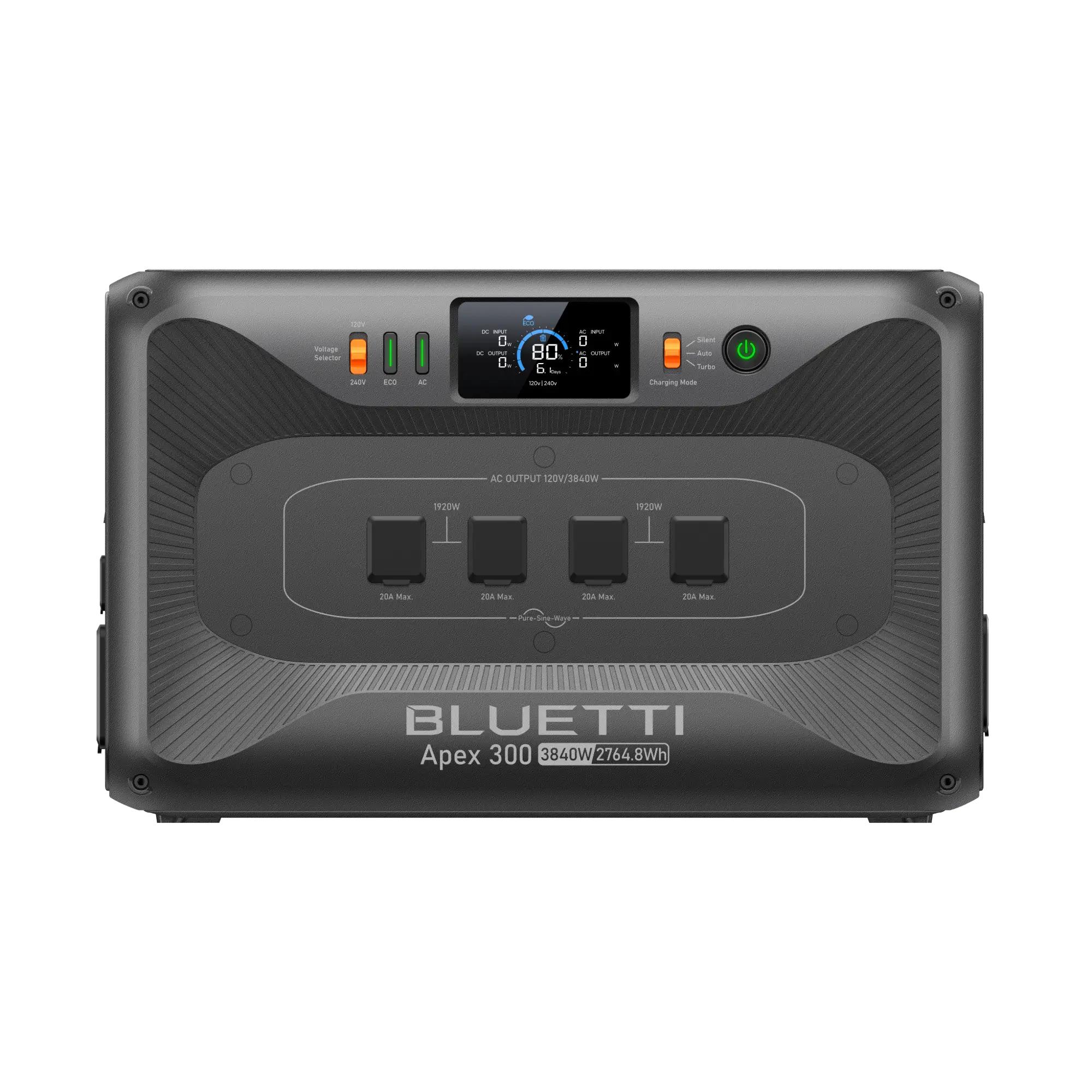
At $1,699 the Apex 300 costs $800 more than the $899 Pioneer Na, and it holds 2,765Wh against 900Wh. That gap settles four of the six scenarios on this page before chemistry gets a word in.
Then chemistry gets its word. The Pioneer Na is the first portable power station built on sodium-ion cellsB0B1, and sodium-ion keeps charging in the sub-freezing cold that plates lithium cells and permanently damages them. The Apex 300 has to get its pack above about 32°F/0°C before it accepts power at all. In January, in an unheated space, that turns 2,400W of solar input into a number on a sticker.
So there are two questions here, not one. What is the largest load you need to actually finish, and where does the unit spend the winter. Answer both and you're done reading.
What the Numbers Reveal
Each conclusion stated first — the numbers behind it on one line, the full analysis below.
solar input
In a cold snap the comparison stops being 2,765Wh against 900Wh and becomes a battery that can refill against one that can only spend. The Apex 300 will keep discharging in the cold quite happily. It just won't take anything back until it's warm, and the little sodium-ion unit is still topping up the whole time.
the Pioneer Na uses sodium-ion cells, which keep accepting a charge in sub-freezing coldcharging a lithium pack below about 32°F/0°C plates the cells and does permanent damage, so the Apex 300 has to warm up firstthe Apex 300 accepts up to 2,400W of solar input; the Pioneer Na accepts 500W
Why it mattersIf the station lives in an unheated garage, a winter cabin, or a van you sleep in during a cold snap, buy the Pioneer Na and size your loads to 900Wh.
A 145Wh shortfall would be a rounding error on a unit you could grow. On a sealed 900Wh pack it's permanent, and the fixes are a wall outlet you probably don't have or a second station, which costs more than buying the bigger unit once.
the Remote Workday profile needs 910Wh; the Pioneer Na has 765Wh usable after the flat 85% derate applied to every unit herethe Pioneer Na is sealed at 900Wh with no expansion paththe Apex 300 takes BLUETTI expansion batteries on top of its 2,765Wh
Why it mattersIf the load you care about is a full day of desk work away from mains power, the Pioneer Na is the wrong size and no accessory changes that.
rated cycles
That works out to ten cents per lifetime kilowatt-hour against twenty-five. The cheaper box is the expensive energy, and the $800 you keep at checkout buys a pack that will be spent while the other one is barely worn in.
$899 against $1,699, so the Pioneer Na saves $800 at checkout6,000 rated cycles minimum on the Apex 300 against 4,000 on the Pioneer Naa cycle moves 2,765Wh on one and 900Wh on the other: 16,589 kWh of rated lifetime energy against 3,600 kWh
Why it mattersAnyone planning to cycle the unit hard, on weekly camping trips or through regular outages, should buy on cost per kilowatt-hour, and that points at the Apex 300.
weight
The Pioneer Na wins game day as an object, right up to that 95Wh margin. A 95Wh cushion is a pass, not a buffer, so anything you add to the plan turns it into a fail. It's the right unit for that afternoon only as long as the afternoon stays small.
83.8 lbs for the Apex 300 against 37 lbs for the Pioneer Na, a difference of 46.8 lbsthe Tailgate Party profile needs 670Wh and peaks at 400W, and both units start and sustain itthe Pioneer Na finishes that one with 95Wh of its 765Wh usable left
Why it mattersLight loads you carry often: take the 37 lb box. Add a second appliance to the plan and you've bought the wrong one.
The specific dimensions that decide these two units — everything else is a tie.
Your Life, Your Pick
Selected because: The Pioneer Na finishes two of these six profiles, fails three, and shares one that beats both units. That pattern is the decision.
Two passes, three fails, and one row that beats both units. The Pioneer Na covers the CPAP night and game day, then comes up 1,335Wh short of a weekend's camping, 880Wh short of an eight-hour blackout, and 145Wh short of a workday. The Apex 300 finishes everything except the row nothing this size finishes.
Read the margins rather than the pass and fail. The Apex 300 clears the blackout with 705Wh still in the pack, which is the difference between covering the outage you planned for and covering the one that runs long. Van Life Daily is the row worth respecting: 4,685Wh a day is more than either unit holds, and the bigger one only reaches about half of it.
What the Specs Don't Tell You
Selected because: One card here can reverse the verdict: sodium-ion charges below about 32°F/0°C, and the Apex 300's lithium pack has to warm up before it will.
rated cycles
Sodium-ion is the one thing on this page that money can't fix. Charging a lithium pack below about 32°F/0°C plates the cells and damages them permanently, so the Apex 300 waits until it's warm. The Pioneer Na just charges. If the unit lives where January lives, that card outranks the capacity table above it.
Every other card points the other way, and one of them deserves a careful read. The Apex 300 surges to 7,680W over 3,840W continuous, a 2x ratio that clears the usual rule of thumb for motor startups, but what actually starts a given motor is the ceiling and not the ratio. The Pioneer Na's 2,250W is a real ceiling too. Check the startup draw of the heaviest motor you own against that figure instead of assuming the small unit trips.
Lifetime Value
Selected because: A cycle moves 2,765Wh on the Apex 300 and 900Wh on the Pioneer Na, which is how the cheaper unit ends up being the more expensive energy.
cost / lifetime kWh
The rated minimums come out to 16.4 years of daily cycling on the Apex 300 against 11 on the Pioneer Na, and neither number is a death date. A pack that reaches its cycle rating drops to roughly 80% of original capacity and keeps working, which means the Pioneer Na at the end of its rating is a 720Wh unit.
Run the same 80% on the Apex 300 and it's still about 2,212Wh, more than twice what a brand new Pioneer Na holds. If you're buying a unit to keep for a decade or more, that's the comparison that decides it, not the sticker.
Portability & Form Factor
Selected because: 83.8 lbs against 37 lbs is the Apex 300's real price, and the only argument for the smaller unit that has nothing to do with temperature.
weight
83.8 lbs is a two-hands, bent-knees, flat-ground lift. Reviewers who have tried say the handles and the modular battery design make it manageableA6, and also that it's heavy enough to defeat a solo lift onto a tableA8. Both are true, and which one you live with depends entirely on whether the route from the car is flat.
The Pioneer Na at 37 lbs is a carry you don't have to plan, and the buttons and ports are built to work with gloves onB4. If the box moves more often than it works hard, the smaller unit is the honest pick and the capacity table is beside the point.
Strengths & trade-offs
BLUETTI Apex 300
Strengths
- +Larger battery capacity
- +Higher AC output
- +Longer warranty
- +Faster solar charging
- +Rated for 6,000 charge cycles — much longer battery lifespan
Trade-offs
- –Substantially more expensive (+$800) than the Pioneer Na.
- –Significantly heavier (+46.8 lbs), making it harder to move.
- –Very heavy unit that may be difficult for one person to lift.
BLUETTI Pioneer Na
Strengths
- +Costs $800 less
- +Lighter by 46.8 lb
Trade-offs
- –Weaker inverter (-2,340W) limits appliance compatibility.
- –Sealed capacity — the Apex 300 can add batteries to grow past 900Wh; this one can't.
- –Shorter-lived battery — rated for 4,000 charge cycles vs the Apex 300's 6,000, so it wears out sooner.
Will It Power Your Gear?
Scenario math and per-appliance runtimes, modeled from the spec record.
Scenario verdicts
We ran the math on six real-world scenarios. Here's which unit survives your actual life.
SCN-01 · 2 nights · needs 2,100Wh
Weekend Camping
Two nights off-grid with essential comfort
Apex 300
The Pioneer Na doesn't finish — 765Wh usable against the 2,100Wh this needs leaves it 1,335Wh short, about 36% of the scenario covered. The Apex 300 covers it with 250Wh to spare.
Battery budget usedlower = more headroom
LOAD Phone Charger 15W×6h · LED Lights 40W×8h · Box Fan 75W×14h · CPAP Machine 40W×16h
SCN-02 · 8 hours · needs 1,645Wh
8-Hour Blackout
Keep the essentials running through a night without power
Apex 300
The Pioneer Na doesn't finish — 765Wh usable against the 1,645Wh this needs leaves it 880Wh short, about 47% of the scenario covered. The Apex 300 covers it with 705Wh to spare.
Battery budget usedlower = more headroom
LOAD Fridge 150W×8h · Router + Modem 20W×8h · LED Lights (4 bulbs) 40W×6h · Phone Charger 15W×3h
SCN-03 · 8 hours · needs 320Wh
CPAP Overnight
Sleep therapy without interruption — the #1 medical use case
Either unit
A 40W machine over eight hours is 320Wh, which is 14% of the Apex 300's usable energy and 42% of the Pioneer Na's. Both cover it, so the only real question is what else the unit has to do. Noise can't break this tie, since both carry the same 45dB rating and that rating is a manufacturer best-case floor rather than a measurement. Judge it on the box instead, 37 lbs at $899 against 83.8 lbs at $1,699, and if CPAP is the whole job the small one takes it.
Battery budget usedlower = more headroom
LOAD CPAP Machine 40W×8h
SCN-04 · 8 hours · needs 910Wh
Remote Workday
Full work day off-grid without power anxiety
Apex 300
This is the near miss that matters. The Pioneer Na covers 84% of a 910Wh workday and stops 145Wh short, which means it quits mid-afternoon rather than failing honestly at the start. The Apex 300 finishes with 1,440Wh untouched. A sealed 900Wh pack has no answer to a 145Wh gap except a wall outlet, and a wall outlet is the thing you didn't have.
Battery budget usedlower = more headroom
LOAD Laptop 60W×8h · External Monitor 30W×8h · Router + Modem 20W×8h · Phone Charger 15W×2h
SCN-05 · 4 hours · needs 670Wh
Tailgate Party
Game day power for the crew
Apex 300
Both run game day, and the Pioneer Na does it with 95Wh of its 765Wh usable left. That's a pass, not a cushion. The Apex 300 keeps 1,680Wh in reserve, but it also asks you to move 83.8 lbs across a parking lot against 37 lbs. Small plan, small unit. Add one more appliance and the margin is gone.
Battery budget usedlower = more headroom
LOAD Blender 400W×0.5h · LED TV (55") 80W×4h · Bluetooth Speaker 15W×4h · Phone Charger (×3) 45W×2h
SCN-06 · 24 hours · needs 4,685Wh
Van Life Daily
A full day of mobile living — the ultimate endurance test
Neither unit
4,685Wh a day is outside both of these. The Apex 300 reaches about half of it, the Pioneer Na about a sixth, and choosing between them changes nothing. Full-time van power is a larger station or a wired house system, and this row exists to tell you when to stop shopping in this size class.
Battery budget usedlower = more headroom
LOAD Mini-Fridge 150W×24h · Laptop 60W×4h · Phone Charger 15W×3h · LED Lights 40W×5h · Fan 75W×8h
The Load Test
RUNTIME = (Wh × 0.85) ÷ LOAD
None of the scenarios above exactly yours? Build it. Toggle what you'd plug in; both units are tested against the combined draw.
Essentials
Comfort & Convenience
High-Draw Appliances
Test duration
8h
Continuous draw
205W
Projected runtime
For this load: Apex 300 runs 11.5h vs 3.7h.
$1,699 list · direct from BLUETTI
Modeled from the spec record — same math as the tables below. Methodology
Runtime by appliance
Real-world runtime estimates for common appliances, modeled at 85% inverter efficiency.¹
Essentials
The basics you need runningscale 0–156.7hComfort & Convenience
Makes off-grid life actually enjoyablescale 0–31.3hHigh-Draw Appliances
These reveal the real limitsscale 0–2.4h¹ Runtime = (capacity × 0.85) ÷ appliance watts. Within each group, all bars share one time scale (the group's longest runtime), so lengths are comparable across appliances; identical runtimes collapse into a single blue/orange bar. Actual runtime varies with battery age, temperature, and simultaneous loads — see methodology.
Conclusion
September 13, 2026
Verdict: the Apex 300, on Power Score margin
Buy the Apex 300 at $1,699. It covers four profiles on this page that the Pioneer Na comes up short on, including an ordinary remote workday the 900Wh unit misses by 145Wh, and over its rated life it is the cheaper of the two to own per unit of energy. The Pioneer Na isn't a weak unit and it isn't beaten on chemistry: sodium-ion keeps accepting a charge below about 32°F/0°C, which the Apex 300's lithium pack can't do until it warms up. If your station lives in an unheated garage or a cabin you reach in January, that one fact outranks everything else here, and you buy the Pioneer Na knowing exactly which jobs it won't finish.
Today the Apex 300 is $1,499, $200 under its typical $1,699. The verdict weighs typical prices, not today's. Prices checked 1 day ago.
Editor-assigned confidence, based on cited owner research and spec analysis.
List prices as of September 13, 2026. The links below open BLUETTI's current price.
$1,499.00 · direct from BLUETTI
down from $1,699 · 12% below usual
Last checked 1 day ago. Prices move — check before you buy.
or check the Pioneer Na price$899.00 list
Written by Ian Schneider, Solar & Off-Grid Tester · Station Arena Test Desk · Updated September 13, 2026
Measured Data
Benchmark scores and the full spec record, side by side.
Benchmark scores
Not rated for both units (minimum threshold unmet): RV Living, Home Backup, CPAP, Tailgating, Food Truck, Apartment Balcony, Camping.
Full specifications
ᵈ Derived: price ÷ rated capacity. See the data behind our comparisons →
Comparison ToolAdd more power stations, side by sideOpen Tool →How these numbers are produced
Numeric verification
Every figure on this page traces to our spec database or arithmetic on it — no estimated numbers.
Owner claims
Statements about owner experience are cited to published reviews — see Sources & Research Notes below.
Runtime model
Runtime = (rated capacity × 0.85 inverter efficiency) ÷ device wattage. Solar recharge estimates assume panels deliver 70% of rated output. Cold weather, battery age, and stacked loads reduce real-world results.
Power Score
Computed from 14 published spec dimensions, weighted per use-case bench. Higher is better; a unit must meet a bench's minimum threshold to be rated.
See the full weight table and data sourcing on our methodology page →Class ranking (the star rating)
Each unit's star score is a category ranking, not customer reviews — no buyer opinions feed it. We score every station on size-independent quality (value, output, portability, endurance, ports, warranty, and more), then percentile-rank it against the other units in its capacity class, so a class-leading compact unit and a class-leading whole-home unit can both earn 5★. Here, Apex 300 rates 5.0/5 (99th percentile of 26 Large-class units), and Pioneer Na rates 3.9/5 (37th percentile of 20 Compact-class units).
How the class ranking is computed →Test Notes & Caveats
Hidden gotchas and advantages we spotted that you won't find on the product page.
83.8 lbs, and You'll Feel Every One
Two hands, bent knees, flat ground. The difference between these two units is 46.8 lbs, which is more than the entire 37 lb Pioneer Na weighs, so you're not carrying a slightly bigger box. You're carrying the small one twice. Stairs, soft sand and solo trips are where that bites. A garage floor and a hand cart are where it doesn't.
Noise: Identical on Paper, Unknown Under Load
Both units carry the same 45dB rating, so there's no gap here to argue about. Worth knowing what that number is, though: a manufacturer best-case floor, usually a quiet mode, not a measurement while the unit is working. Treat 45dB as the quietest either one will ever be and let something else decide this.
Pioneer Na: 900Wh Is the Ceiling
A sealed pack is only a real fault when the ceiling is close, and here it is: the Pioneer Na stops 145Wh short of an ordinary 910Wh workday with nowhere to go. The Apex 300 adds expansion batteries on top of 2,765Wh, a path that points toward partial-home backup rather than a longer weekend. Buy the Pioneer Na for the load you have today, not the one you're planning for.
Sodium-Ion: The One Card Money Can't Beat
Charge a lithium pack below about 32°F/0°C and you plate the cells and do permanent damage, which is why the Apex 300 warms up before it accepts power. The Pioneer Na's sodium-ion cells just take the charge. In a cold snap that inverts the page: the Apex 300 can still spend what it's holding, but it can't refill until things thaw, while the 900Wh unit keeps topping up at 500W. Unheated garage, winter cabin, February van. This is the spec you're buying.
Surge Power: Inverter Quality Indicator
The Apex 300 has a 2× surge-to-continuous ratio vs the Pioneer Na's 1.5×, and the higher absolute ceiling with it — 7,680W against 2,250W. At 2× it clears the 2× rule of thumb for absorbing motor startups — fridges, AC compressors and power tools briefly draw 2-3× their rated wattage. What decides whether a given motor starts is the ceiling, not the ratio: the Pioneer Na still surges to 2,250W, so check the startup draw of the heaviest thing you plan to run against that figure rather than assuming it trips.
UPS Switchover: ≤10ms vs ≤20ms
Both list a UPS mode, at different rated speeds. The Apex 300 is rated ≤10ms — quick enough on paper that desktop PCs and routers should ride through, treating that as the rating it is. The Pioneer Na is rated ≤20ms — fine on paper for routers and most electronics; the fussiest PC power supplies sit right at this line. If a computer with unsaved work is the thing being protected, the stated class is worth the attention; nothing here is a lab result.
Warranty: Read the Condition, Not the Years
BLUETTI's terms are maximums with strings attached. The long version assumes you buy direct or register the unit, and a reseller purchase runs two years whichever box you pick. Since both of these are the same brand's policy, the paper spread between them is a weak thing to choose on. If longevity is what you're actually buying, the cycle ratings are the harder number, 6,000 against 4,000, and they don't depend on filling in a form.
Battery Lifespan in Real Years
The Apex 300 is rated for 6,000 cycles vs 4,000. In real life: at daily use, that's 16.4 vs 11 years. At weekend use (twice a week), it's 58 vs 38 years. One caution reading years across different sizes: a cycle is 2,765Wh on the Apex 300 and 900Wh on the Pioneer Na, so count lifetime energy — roughly 16,589 kWh against 3,600 kWh over the rated life. After hitting the cycle limit, the battery doesn't die — it drops to ~80% of original capacity, which is still very usable.
Full record above — the Test Desk pick is the Apex 300.
Check Apex 300 price →or check the Pioneer Na priceOwnership Analysis
What happens after you buy — true cost of ownership, brand trust, and growth potential.
Lifetime value
Service lifeyears at one full cycle per day
Lifetime energy delivered
Cost per delivered kWh
│ warranty ends · Reaching the cycle rating means ~80% capacity remains — degraded, not dead.
Analyst note
The Pioneer Na is cheaper to buy, but the Apex 300 is cheaper to own. At $0.1/kWh over its lifetime vs $0.25/kWh, the Apex 300's higher cycle life and capacity make each dollar go further over the years.
Delivers each lifetime kWh for $0.15 less — check the Apex 300 price →
Growth path
Apex 300
EXPANDABLESupports BLUETTI expansion batteries, so you can add capacity later without replacing the base unit — useful if your needs may climb past 2,765Wh.
Accepts up to 2,400W of solar. Enough for a serious multi-panel array.
Generous port selection supports complex multi-device setups.
Expansion batteries are BLUETTI-specific. You're investing in the BLUETTI ecosystem.
Pioneer Na
FIXED CAPACITYFixed at 900Wh, with no expansion — so size it for your needs up front rather than planning to add capacity later.
Accepts up to 500W of solar. Suitable for a 1-2 panel setup.
Adequate ports for most setups, but heavy users may want a power strip.
Realistic full solar rechargeat 70% of rated panel output — see methodology
Analyst note
The Pioneer Na is sealed at 900Wh, which is fine if that covers you. The Apex 300 starts at 2,765Wh and can grow beyond it with BLUETTI expansion batteries — real headroom the Pioneer Na doesn't have if your needs climb toward partial-home backup.
What Owners Report
Patterns from published owner reports and long-term reviews — every claim cited to its source below.
BLUETTI Apex 300
Field data on the Apex 300 is thin and early. It launched around mid-to-late 2025, so most of what exists is press reviewers with test units rather than owners a year inA0. What owner reports there are cluster on one theme: firmware. Four separate accounts describe an update leaving the unit stuck in Backup mode, an Error 004 that halted charging at 97%, Bluetooth and Home Assistant connections dropping after an update, and an app that keeps offering an upgrade it has already installedA1A2A3A4. None of those are hardware faults and all are the kind of thing a later release can fix, but if you plan to run this unit through a home-automation integration, expect to babysit updates.
The reviewers are more useful on noise and ports. One reviewer who complains that some units sound like small jet engines under load calls the Apex 300's fans relatively tameA5, while the BLUETTI app is described as sluggish next to EcoFlow's and Anker'sA10. The port complaint needs a correction before you act on it: the Apex 300 does carry a 100W USB-C on the unit, and what's genuinely missing is a 12V DC socket, which the $300 Hub D1 addsA7A11. Tie two Apex 300s together and you're into a $699 parallel box as wellA12. Small thing worth knowing if you're planning around either accessory: the outlets sit under rubber bungs, which is good under a sink and annoying with oversized plugsA9.
“I was using Bluetti-bt until the latest Bluetti firmware update. I then started having disconnects.”
BLUETTI Pioneer Na
The Pioneer Na's ledger is thin too, and it's reviewers rather than long-term ownersB0. The one claim they actually test is the cold: the sodium-ion chemistry is built to charge and discharge in deep sub-freezing conditions, and the claims held up in real-world testingB2. Reviewers also report more than 4,000 charge cycles and roughly 35 minutes to 80% on AC and solarB3, and they praise the build, including buttons and ports you can operate with gloves onB4. That last detail tells you who this unit was designed for.
The counterweight comes from the same reviews: 900Wh is modest, and the unit is bulky for the capacityB4. The two spec sheets say the same thing in numbers, 900Wh in 37 lbs against 2,765Wh in 83.8 lbs, so the smaller unit carries less energy per pound and not simply less energy. Worth knowing before you decide the light one is the efficient one.
“The world's first sodium-ion portable power station — 900Wh, 1,500W output (2,250W surge) — enough for laptops, fridges, routers, and power tools.”
Sources
techradar.com · backuppowerhub.com · popsci.com · phonearena.com · trustedreviews.com · thesolarlab.com · scotsman.com
Sources & Research Notes
Every owner claim in this report is traceable to a published source. The bracketed references above resolve here.
Recurring owner themes
- Multiple owners report firmware updates causing app glitches, mode-lock issues, error codes, or Bluetooth/Home Assistant disconnects shortly after updating. [Apex 300 · 4 entries]
- Reviewers consistently flag the lack of built-in USB/DC ports as a design tradeoff requiring costly add-on accessories (Hub D1, Hub A1). [Apex 300 · 4 entries]
- The unit's extreme weight (~85 lbs) is repeatedly described as making it barely 'portable' and hard to carry alone. [Apex 300 · 2 entries]
- Sodium-ion delivers standout deep-cold operation and 4,000+ cycle longevity; trade-offs are modest capacity and some bulk. [Pioneer Na · 3 entries]
- A1
“I updated my Apex 300 to the latest firmware yesterday. Now it's stuck in 'Backup' mode... Now when I go into the app to try to change it back, it flashes to...”
BLUETTI Community forum — 'Apex 300 stuck in Backup mode after last firmware update' · 2025-11 · [negative]
- A2
“When the system reached 97% charge, I decided to install the firmware updates. After the update completed, the charging stopped and I received Error 004.”
BLUETTI Community forum — 'Error E004 Apex 300' · 2025-11 · [negative]
- A3
“I was using Bluetti-bt until the latest Bluetti firmware update. I then started having disconnects.”
GitHub bluetti-official/bluetti-home-assistant issue #95 — 'APEX 300 and Hub A! now working' · 2026-05 · [mixed]
- A4
“Problem is every time I connect to the power station it shows that I still have an update, and I need to tap to upgrade which then tells me I am up to date.”
BLUETTI Community forum — 'Check For Update App issue' · 2025-09 · [negative]
- A5
“Some units sound like small jet engines under load, but the Apex 300's fans are relatively tame.”
Techspective — 'Bluetti Apex 300 with B300K Review' · 2025-09 · [positive]
- A6
“It's heavy, no question, but the handles and modular battery design make it manageable.”
Techspective — 'Bluetti Apex 300 with B300K Review' · 2025-09 · [mixed]
- A7
“Not having DC or USB ports on the face is a tradeoff. The Hub D1 solves the problem—but it's an additional $300 accessory that you then have to bolt on after the fact.”
Techspective — 'Bluetti Apex 300 with B300K Review' · 2025-09 · [negative]
- A8
“In fact, it's so heavy I can hardly carry it more than a few feet at a time and have been unable to lift it onto a table.”
T3 — 'Bluetti Apex 300 review: transform your off-grid life' · 2025-11 · [negative]
- A9
“Each is protected by a rubber bung, which is good if you've got the Apex 300 below the sink in a utility room or RV. It can be annoying when it comes to inserting oversized plugs or adaptors, though.”
Trusted Reviews — 'Bluetti Apex 300 Review' · 2025-10 · [mixed]
- A10
“The Bluetti app is still a little sluggish compared to the EcoFlow or Anker apps, but it lets you toggle power modes, monitor stats, and tweak settings from a distance.”
TheSolarLab — 'Bluetti Apex 300 Review: Cheap, Practical Home Backup?' · unknown · [mixed]
- A11
“That Bluetti D1 Power Hub that gives you your DC and USB ports costs about $300, which is a steep price for what you're getting.”
TheSolarLab — 'Bluetti Apex 300 Review: Cheap, Practical Home Backup?' · unknown · [negative]
- A12
“Say you want to connect multiple Apex 300 power stations together, you'll need to buy the Bluetti Hub A1 Parallel Box, which retails for around $699!”
TheSolarLab — 'Bluetti Apex 300 Review: Cheap, Practical Home Backup?' · unknown · [negative]
- B1
“The world's first sodium-ion portable power station — 900Wh, 1,500W output (2,250W surge) — enough for laptops, fridges, routers, and power tools.”
techradar.com / backuppowerhub.com — Pioneer Na review · 2026 · [positive]
- B2
“Standout cold-weather performance — its sodium-ion chemistry is designed to charge and discharge in deep sub-freezing cold that lithium can't match, and the claims held up in real-world testing.”
popsci.com / phonearena.com — Pioneer Na review · 2026 · [positive]
- B3
“Over 4,000 charge cycles and an estimated 10-year lifespan; reaches 80% charge in about 35 minutes with AC and solar, with 86% efficiency.”
trustedreviews.com / thesolarlab.com — Pioneer Na review · 2026 · [positive]
- B4
“Solid build with glove-friendly tactile buttons and ports; the trade-offs are a modest 900Wh capacity and some bulk for that capacity.”
techradar.com / scotsman.com — Pioneer Na review · 2026 · [mixed]
Research compiled September 13, 2026.
Who Should Buy Which
Buy the Apex 300 if you…
- →The household that wants lights, fridge and router through an eight-hour outage and still has 705Wh in reserve when the power comes back.
- →Anyone whose needs are about to grow. The Apex 300 accepts expansion batteries, and from 2,765Wh that path points at partial-home backup rather than a slightly longer weekend.
- →Weekly campers and regular off-grid users, the people who will actually spend a 6,000-cycle rating and feel the lower cost per kilowatt-hour.
- →Anyone starting a motor. A 7,680W surge ceiling over 3,840W continuous means you can stop doing arithmetic about the fridge.
Buy the Pioneer Na if you…
- →The person whose station lives where it freezes: an unheated garage, a cabin reached in January, a van you sleep in during a cold snap. This is the only one of these two that will take a charge there.
- →The 37 lb carry. If the box moves more often than it works hard, and the load looks more like 670Wh than 2,100Wh, the Pioneer Na is the better object to own.
- →CPAP-first buyers who want the cheaper unit. A 320Wh night uses 42% of the Pioneer Na's usable energy, and that leaves plenty of room for a phone and a lamp.
If neither fits
If your day looks like the Van Life Daily profile, 4,685Wh every single day, neither of these is your unit. The Apex 300 covers about half of it and the Pioneer Na about a sixth, and bolting accessories onto either is an expensive route to a number a larger station starts at. Buy up a size, or wire a permanent house battery system and stop carrying anything.
The Bottom Line
Take the Apex 300. It finishes every profile here that can be finished, it's the cheaper unit per unit of energy across its rated life, and at 2,765Wh with expansion batteries behind it you're buying headroom instead of hoping 900Wh holds. The $800 you'd keep by going small buys a pack that stops 145Wh short of an ordinary workday and can never be grown past it.
One condition flips this, and it flips it completely. Sodium-ion charges below freezing and lithium doesn't, so if the unit's home is an unheated garage or a winter cabin, buy the Pioneer Na, size your loads to 900Wh, and don't feel short-changed. Everyone else: the heavy one.
Frequently Asked Questions
Answers drawn from the spec record and cited owner research.
Can the Pioneer Na run my fridge and lights through an eight-hour blackout?
No. That profile draws 1,645Wh and the Pioneer Na has 765Wh usable after the flat 85% derate applied to every unit here, so it finishes 880Wh short, under half the night. The Apex 300 covers the same eight hours with 705Wh to spare. If blackout backup is the reason you're shopping, 900Wh is the wrong size to start from.
Is sodium-ion really better in the cold, or is that just marketing?
It's real, and it's the reason to buy the Pioneer Na. Lithium cells plate and take permanent damage if you charge them below about 32°F/0°C, so the Apex 300 has to warm its pack before it accepts power, while sodium-ion simply charges. Reviewers who tested the cold claims found they held up. It changes nothing about the capacity gap, which is why it only decides this page when the station genuinely lives in the cold.
Can I add a battery to the Pioneer Na later?
No. It's sealed at 900Wh, so size it for the load you have rather than the one you're planning. The Apex 300 takes BLUETTI expansion batteries on top of 2,765Wh, which is the difference between buying a unit and starting a system.
Is the Apex 300 worth $800 more than the Pioneer Na?
$1,699 against $899 buys 2,765Wh against 900Wh, four more profiles finished, and a 6,000-cycle minimum rating against 4,000. Per unit of energy across the rated life the Apex 300 is actually the cheaper of the two, so the $800 only reads as a saving if 900Wh genuinely covers what you do.
Which one is better for running a CPAP overnight?
Either, and at that point buy on price and weight. A 40W machine over eight hours is about 320Wh, which is 14% of the Apex 300's usable energy and 42% of the Pioneer Na's, so both cover the night comfortably. Both are rated at 45dB, and since that figure is a manufacturer best-case floor rather than a measured result it can't separate them either. For a CPAP and nothing else, the 37 lb unit at $899 is the easy answer.
Where to buy
BLUETTI Apex 300Pick
$1,499.00
$1,499.00 · direct from BLUETTI
down from $1,699 · 12% below usual
Last checked 1 day ago. Prices move — check before you buy.
BLUETTI Pioneer Na
$899.00
$899.00 · direct from BLUETTI
Last checked 1 day ago. Prices move — check before you buy.
Prices may vary by retailer and are subject to change.