Head-to-head test
BLUETTI Apex 300 + 2×B500K vs BLUETTI EP800 + 2×B500
BLUETTI Apex 300 + 2×B500K vs BLUETTI EP800 + 2×B500: The pricier EP800 bolts to your breaker panel for good; the cheaper Apex holds nearly a third more energy and can still ride in a van, so the only question that decides this is whether your power stays home or travels with you.
Full profiles: BLUETTI Apex 300 + 2×B500K → · BLUETTI EP800 + 2×B500 →

Written by Gunner GustafsonUpdated
Whole-Home Backup Tester, Station Arena Test Desk
Spec deltas
Spend $5,399 on the Apex 300 + 2×B500K and you get 13,005Wh; spend $6,999 on the EP800 + 2×B500 and you get 9,920. The cheaper stack is the bigger one, and it wins the spec sheet before the argument starts.
But capacity was never really the question between these two. The EP800 + 2×B500 hardwires into your home's electrical panel: an electrician installs it, it backs up the building, and it does not leave. The Apex 300 + 2×B500K weighs a serious 282 lbs, yet it isn't bolted to anything, so it can go into a van build, an RV, or a cabin and come back out. What the EP800 buys in return is one thing the Apex can't match: 7,600W of continuous output, nearly double the Apex's 3,840W.
For most people landing on this page, the Apex is the buy: more energy, a lower lifetime cost per kilowatt-hour, a 5-year warranty term the EP800 configuration doesn't publish, and the freedom to put it where you need it. The EP800 earns its $1,600 premium in exactly one place, a permanent whole-home install that needs its continuous output or a solar array the Apex can't feed.
What the Numbers Reveal
Each conclusion stated first — the numbers behind it on one line, the full analysis below.
Typical price
Because both packs share the same 3,500-cycle minimum, the Apex's bigger bank becomes more lifetime energy too, 45,517 kWh against 34,720, which is why it lands at twelve cents a lifetime kilowatt-hour where the EP800 sits at twenty. On price, capacity, and cost to own, the same unit takes all three.
Apex 300 + 2×B500K: $5,399 for 13,005WhEP800 + 2×B500: $6,999 for 9,920Whcost per lifetime kWh $0.12 (Apex) vs $0.20 (EP800), both rated for at least 3,500 cycles
Why it mattersIf your decision is usable energy per dollar for backup and daily cycling, the Apex is the buy and it isn't close.
continuous output
That near-double continuous output is the real thing the premium buys, and a house pulling a well pump, central air, and a range at once needs it, where the Apex's 3,840W would clip. But that output only exists at the electrical panel it's wired to; it can't follow you to a van or a cabin.
EP800 continuous output 7,600WApex continuous output 3,840W, surge peak 7,680WEP800 is hardwired to a subpanel; the Apex is not bolted down
Why it mattersPay the EP800 premium only if the job is a permanent whole-home tie with big simultaneous loads; if the power ever has to move, its headroom is unreachable.
solar input
Both banks can grow, but only the EP800's intake grows with them; the Apex keeps feeding through a 2,400W straw no matter how large the bank gets. For a build that cycles hard on solar every day, intake is the spec that compounds.
EP800 solar input ceiling 9,000WApex solar input ceiling 2,400WEP800 bank 9,920Wh; Apex bank 13,005Wh; both take expansion batteries
Why it mattersIf you're going off-grid with a large rooftop or ground array, the EP800's solar ceiling is the one number the Apex can't argue around.
The specific dimensions that decide these two units — everything else is a tie.
Portability & Form Factor
Selected because: The spec that settles most of this: the EP800 is hardwired to a subpanel and never moves, while the 282-lb Apex isn't bolted down and can go in a van.
weight
The EP800 + 2×B500 hardwires into your electrical panel and stays there. It backs up the building and doesn't travel, which is why the engine won't even score it at a campsite or a tailgate; getting it there is the part that never happens. The Apex 300 + 2×B500K is no featherweight at 282 lbs, but it isn't bolted to anything: it can go into a van build, an RV, or a cabin and come back out again.
What the panel-tie buys you is output. The EP800 sustains 7,600W continuously, nearly double the Apex's 3,840W and within a whisker of the 7,680W the Apex can only touch as a momentary surge. For a house that might pull a well pump, central air, and a range at the same time, that headroom is the entire reason to accept a system that can't leave. One honest asterisk: the Apex publishes a clean 2× surge cushion, while the EP800 doesn't publish a surge figure at all, so if large motor startups are in your plans, that's the one number to get from BLUETTI before you wire it in.
Lifetime Value
Selected because: The Apex holds 13,005Wh for $5,399 at $0.12 per lifetime kWh; the EP800 holds 9,920Wh for $6,999 at $0.20. Cheaper and bigger at once.
cost / lifetime kWh
The cheaper stack is also the bigger one, which is the part that should stop you. The Apex 300 + 2×B500K is $5,399 for 13,005Wh; the EP800 + 2×B500 is $6,999 for 9,920Wh. You pay $1,600 more and get 3,085Wh less, so the Apex holds about 31% more energy for less money.
Stretch that across the rated life and the gap only widens. Both packs carry the same 3,500-cycle minimum, but the Apex's larger bank turns those cycles into 45,517 kWh of lifetime energy against the EP800's 34,720. More energy up front, more energy over the life, and a lower cost per lifetime kilowatt-hour to show for it, all from the unit that also costs less to buy. Add a 5-year warranty term the EP800 configuration doesn't publish, and you're paying the EP800 premium for something other than stored energy.
Growth Path
Selected because: Both expand, but the EP800's 9,000W solar ceiling is 3.75× the Apex's 2,400W, the one axis where the pricier unit clearly pulls ahead.
solar input
The EP800's one decisive win is what it can drink from the sun. Its solar input ceiling is 9,000W against the Apex's 2,400W, 3.75 times the array. On paper that refills its 9,920Wh bank in about an hour of strong sun, where the Apex needs roughly 5.5 hours to top up 13,005Wh at 2,400W. You'll never see full nameplate solar in the real world, but the ratio is the point: the EP800 is built to swallow a big rooftop or ground array, and the Apex isn't.
Both units take BLUETTI expansion batteries, so neither traps you at its starting capacity. The difference is the intake. Grow the Apex's bank and you're still feeding it through a 2,400W straw; grow the EP800's and its 9,000W ceiling grows into a serious off-grid array behind it. If the plan is a house that runs mostly on solar, that's the number that compounds.
What the Specs Don't Tell You
Selected because: Weight, fan noise, and UPS switchover class, the practical catches, including the fact that only the Apex publishes a noise figure at all.
rated cycles
Neither of these is a lift you do casually. The Apex 300 + 2×B500K is 282 lbs, a two-person, bent-knee job, and one reviewer flatly couldn't get it onto a tableA4. The EP800 + 2×B500 is heavier still at 361 lbs, but that weight is the installer's problem for one afternoon, and then it's bolted in place for good.
On noise, the Apex at least gives you a number: 45dB, a spec-sheet floor that climbs under load and lands around the volume of a running fridge. The EP800 publishes nothing, which isn't proof it's louder, only that there's no figure to hold it to and no way to compare the two without hearing them. On switchover, the Apex's ≤10ms rating leaves a hair more margin than the EP800's ≤20ms for a fussy desktop power supply, though both are manufacturer ratings rather than stopwatch results, and either is fine for routers and most electronics.
Strengths & trade-offs
BLUETTI Apex 300 + 2×B500K
Strengths
- +Costs $1,600 less
- +Lighter by 78.4 lb
- +Larger battery capacity
- +Rated for 6,000 charge cycles — much longer battery lifespan
Trade-offs
- –Weaker inverter (-3,760W) limits appliance compatibility.
- –Very heavy unit that may be difficult for one person to lift.
BLUETTI EP800 + 2×B500
Strengths
- +Higher AC output
- +Longer warranty
- +Faster solar charging
Trade-offs
- –Significantly heavier (+78.4 lbs), making it harder to move.
- –Very heavy unit that may be difficult for one person to lift.
- –Shorter-lived battery — rated for 3,500 charge cycles vs the Apex 300 + 2×B500K's 6,000, so it wears out sooner.
Will It Power Your Gear?
Scenario math and per-appliance runtimes, modeled from the spec record.
Scenario verdicts
We ran the math on six real-world scenarios. Here's which unit survives your actual life.
SCN-01 · 2 nights · needs 2,100Wh
Weekend Camping
Two nights off-grid with essential comfort
Neither unit
Scoring these two at a campsite is a category error: the Apex 300 + 2×B500K at 282.2 lbs is not a take-along — it rolls off a truck bed if it travels at all, and the EP800 + 2×B500 is installed at the electrical panel — it backs up the building and doesn't leave it. The 2,100Wh here is trivial for either — it's the going that doesn't happen. If you need power away from the building, you're shopping the wrong class.
Battery budget usedlower = more headroom
LOAD Phone Charger 15W×6h · LED Lights 40W×8h · Box Fan 75W×14h · CPAP Machine 40W×16h
SCN-02 · 8 hours · needs 1,645Wh
8-Hour Blackout
Keep the essentials running through a night without power
Either unit
Both stroll through an 8-hour outage; the 1,645Wh you'd pull is 15% of the Apex's usable bank and 20% of the EP800's. The tiebreak isn't capacity, it's switchover: the Apex is rated ≤10ms, the EP800 ≤20ms, both manufacturer ratings rather than stopwatch results. For a desktop with unsaved work, the Apex's rating leaves a little more room.
Battery budget usedlower = more headroom
LOAD Fridge 150W×8h · Router + Modem 20W×8h · LED Lights (4 bulbs) 40W×6h · Phone Charger 15W×3h
SCN-03 · 8 hours · needs 320Wh
CPAP Overnight
Sleep therapy without interruption — the #1 medical use case
Either unit
A CPAP is about 40W for eight hours, so both of these cover the night several times over — capacity isn't the question here. What would separate them is fan noise, but EP800 + 2×B500 doesn't publish a figure, so there's nothing to hold it to. Buy on price, weight, and whether you can live with a fan you haven't heard.
Battery budget usedlower = more headroom
LOAD CPAP Machine 40W×8h
SCN-04 · 8 hours · needs 910Wh
Remote Workday
Full work day off-grid without power anxiety
Either unit
Both power your workstation all day without strain, and their USB-C output is a wash — pick on weight, ports, or price.
Battery budget usedlower = more headroom
LOAD Laptop 60W×8h · External Monitor 30W×8h · Router + Modem 20W×8h · Phone Charger 15W×2h
SCN-05 · 4 hours · needs 670Wh
Tailgate Party
Game day power for the crew
Neither unit
Scoring these two at a tailgate is a category error: the Apex 300 + 2×B500K at 282.2 lbs is not a take-along — it rolls off a truck bed if it travels at all, and the EP800 + 2×B500 is installed at the electrical panel — it backs up the building and doesn't leave it. The 670Wh here is trivial for either — it's the going that doesn't happen. If you need power away from the building, you're shopping the wrong class.
Battery budget usedlower = more headroom
LOAD Blender 400W×0.5h · LED TV (55") 80W×4h · Bluetooth Speaker 15W×4h · Phone Charger (×3) 45W×2h
SCN-06 · 24 hours · needs 4,685Wh
Van Life Daily
A full day of mobile living — the ultimate endurance test
Apex 300 + 2×B500K
The EP800 is wired to a house you're driving away from, so this one's settled before capacity enters the room. The Apex covers the full 4,685Wh day and still holds 6,369Wh in reserve, most of a second day off-grid before you need sun or shore power.
Battery budget usedlower = more headroom
LOAD Mini-Fridge 150W×24h · Laptop 60W×4h · Phone Charger 15W×3h · LED Lights 40W×5h · Fan 75W×8h
The Load Test
RUNTIME = (Wh × 0.85) ÷ LOAD
None of the scenarios above exactly yours? Build it. Toggle what you'd plug in; both units are tested against the combined draw.
Essentials
Comfort & Convenience
High-Draw Appliances
Test duration
8h
Continuous draw
205W
Projected runtime
For this load: Apex 300 + 2×B500K runs 53.9h vs 41.1h.
$5,399 list · direct from BLUETTI
Planning for more than this? Describe your whole setup and get it sized →
Modeled from the spec record — same math as the tables below. Methodology
Runtime by appliance
Real-world runtime estimates for common appliances, modeled at 85% inverter efficiency.¹
Essentials
The basics you need runningscale 0–736.9hComfort & Convenience
Makes off-grid life actually enjoyablescale 0–147.4hHigh-Draw Appliances
These reveal the real limitsscale 0–11.1h¹ Runtime = (capacity × 0.85) ÷ appliance watts. Within each group, all bars share one time scale (the group's longest runtime), so lengths are comparable across appliances; identical runtimes collapse into a single blue/orange bar. Actual runtime varies with battery age, temperature, and simultaneous loads — see methodology.
Conclusion
August 30, 2026
Verdict: the Apex 300 + 2×B500K
Buy the Apex 300 + 2×B500K unless you're wiring in permanent whole-home backup. It costs $1,600 less, holds 3,085Wh more, delivers a lower cost per lifetime kilowatt-hour, lists up to a 5-year warranty term the EP800 configuration doesn't publish, and, the part that settles it for most, it isn't bolted to your panel, so it can move. The EP800's case is real but narrow: continuous output nearly double the Apex's and a solar ceiling 3.75× as high make it the right tool for a house running a well pump, AC, and a range together off a big array. If that's not your situation, the extra $1,600 buys you less energy that can never leave the wall.
Editor-assigned confidence, based on cited owner research and spec analysis.
List prices as of August 30, 2026. The links below open BLUETTI's current price.
$5,399.00 · direct from BLUETTI
Last checked 16 days ago. Prices move — check before you buy.
or check the EP800 + 2×B500 price$6,999.00 list
Written by Gunner Gustafson, Whole-Home Backup Tester · Station Arena Test Desk · Updated August 30, 2026
Black Friday · 38 days out
Prices to beat:Apex 300 + 2×B500K $4,999EP800 + 2×B500 $4,499
The lowest we have recorded for each. A Black Friday price above it is a sale that unit has already had.
Measured Data
Benchmark scores and the full spec record, side by side.
Benchmark scores
Full specifications
ᵈ Derived: price ÷ rated capacity. See the data behind our comparisons →
Comparison ToolAdd more power stations, side by sideOpen Tool →How these numbers are produced
Numeric verification
Every figure on this page traces to our spec database or arithmetic on it — no estimated numbers.
Owner claims
Statements about owner experience are cited to published reviews — see Sources & Research Notes below.
Runtime model
Runtime = (rated capacity × 0.85 inverter efficiency) ÷ device wattage. Solar recharge estimates assume panels deliver 70% of rated output. Cold weather, battery age, and stacked loads reduce real-world results.
Power Score
Computed from 14 published spec dimensions, weighted per use-case bench. Higher is better; a unit must meet a bench's minimum threshold to be rated.
See the full weight table and data sourcing on our methodology page →Class ranking (the star rating)
Each unit's star score is a category ranking, not customer reviews — no buyer opinions feed it. We score every station on size-independent quality (value, output, portability, endurance, ports, warranty, and more), then percentile-rank it against the other units in its capacity class, so a class-leading compact unit and a class-leading whole-home unit can both earn 5★. Here, Apex 300 + 2×B500K rates 3.5/5 (14th percentile of 29 Whole-Home / Off-Grid-class units), and EP800 + 2×B500 rates 3.6/5 (18th percentile of 29 Whole-Home / Off-Grid-class units).
How the class ranking is computed →Test Notes & Caveats
Hidden gotchas and advantages we spotted that you won't find on the product page.
Weight Reality Check
Neither unit is grab-and-go. The Apex 300 + 2×B500K (282.2 lbs) is spread across its boxes — no single lift, but nothing you reposition on a whim. The EP800 + 2×B500 (360.6 lbs) is a wall-installed system — its weight matters to the installer on day one, then never again.
Apex 300 + 2×B500K: 45dB Published
45dB is about as loud as a running refrigerator. It is BLUETTI's own rating rather than a reading on a shared bench — makers differ on whether they quote a best case or a figure under load, so treat it as a starting point rather than what you would hear at a bedside. For most people, fan noise around 45dB and up is where sleep starts to suffer.
Apex 300 + 2×B500K: Power Lifting to 7,680W
The Apex 300 + 2×B500K has BLUETTI's Power Lifting mode, which runs a resistive appliance rated up to 7,680W from its 3,840W inverter. It does that by delivering less power than the appliance asks for, not more than the inverter has: the heater still works, it just heats more slowly. Two things follow. BLUETTI scopes the mode to purely resistive loads — a heater, a kettle, an incandescent lamp — so it does nothing for a fridge compressor, a pump or a power tool, and this record publishes no surge figure at all, so read the mode as a resistive-load feature rather than as starting ability. And it is not a reason to size down, because running a load that big from 13,005Wh is a short session either way. Genuinely useful if a heater or a kettle is why you're buying; beside the point otherwise. Our record for the EP800 + 2×B500 carries no Power Lifting figure, so check BLUETTI's own spec sheet before reading this as something the EP800 + 2×B500 lacks.
UPS Switchover: ≤10ms vs ≤20ms
Both list a UPS mode, at different rated speeds. The Apex 300 + 2×B500K is rated ≤10ms — quick enough on paper that desktop PCs and routers should ride through, treating that as the rating it is. The EP800 + 2×B500 is rated ≤20ms — fine on paper for routers and most electronics; the fussiest PC power supplies sit right at this line. If a computer with unsaved work is the thing being protected, the stated class is worth the attention; nothing here is a lab result.
Warranty: 10 Years vs 5
The EP800 + 2×B500 is covered for 10 years against the Apex 300 + 2×B500K's 5 years. The Apex 300 + 2×B500K's figure is a maximum rather than a guarantee — it depends on buying direct from BLUETTI or registering the unit, since reseller purchases carry a shorter term. An underrated factor if you're keeping this unit for years.
Battery Lifespan in Real Years
The Apex 300 + 2×B500K is rated for 6,000 cycles vs 3,500. In real life: at daily use, that's 16.4 vs 9.6 years. At weekend use (twice a week), it's 58 vs 34 years. One caution reading years across different sizes: a cycle is 13,005Wh on the Apex 300 + 2×B500K and 9,920Wh on the EP800 + 2×B500, so count lifetime energy — roughly 78,029 kWh against 34,720 kWh over the rated life. After hitting the cycle limit, the battery doesn't die — it drops to ~80% of original capacity, which is still very usable.
EP800 + 2×B500: Noise Level Not Disclosed
The Apex 300 + 2×B500K publishes its noise level (45dB); the EP800 + 2×B500 doesn't publish one. That isn't evidence the EP800 + 2×B500 is louder — it means there's no figure to hold it to, and no way to compare the two on this without hearing them. If you're buying for a bedroom, a CPAP, or an apartment, treat the Apex 300 + 2×B500K's 45dB as the only published number on the table — a spec-sheet figure, not a measurement — and look for hands-on reports of the EP800 + 2×B500 before deciding.
Full record above — the Test Desk pick is the Apex 300 + 2×B500K.
Check Apex 300 + 2×B500K price →or check the EP800 + 2×B500 priceOwnership Analysis
What happens after you buy — true cost of ownership, brand trust, and growth potential.
Lifetime value
Service lifeyears at one full cycle per day
Lifetime energy delivered
Cost per delivered kWh
│ warranty ends · Reaching the cycle rating means ~80% capacity remains — degraded, not dead.
Analyst note
The Apex 300 + 2×B500K wins on both sticker price and long-term value. At $0.07/kWh over its lifetime, it's meaningfully cheaper to own. Clear value winner.
Delivers each lifetime kWh for $0.13 less — check the Apex 300 + 2×B500K price →
Growth path
Apex 300 + 2×B500K
EXPANDABLESupports BLUETTI expansion batteries, so you can add capacity later without replacing the base unit — useful if your needs may climb past 13,005Wh.
Accepts up to 2,400W of solar. Enough for a serious multi-panel array.
Limited ports. You'll likely need a power strip or splitter.
Expansion batteries are BLUETTI-specific. You're investing in the BLUETTI ecosystem.
EP800 + 2×B500
EXPANDABLESupports BLUETTI expansion batteries, so you can add capacity later without replacing the base unit — useful if your needs may climb past 9,920Wh.
Accepts up to 9,000W of solar. Enough for a serious multi-panel array.
Limited ports. You'll likely need a power strip or splitter.
Expansion batteries are BLUETTI-specific. You're investing in the BLUETTI ecosystem.
Realistic full solar rechargeat 70% of rated panel output — see methodology
Analyst note
Both expand, but the EP800 + 2×B500's higher solar ceiling (9,000W vs 2,400W) gives it the stronger off-grid growth path — more panels can feed a bigger bank as it grows.
What Owners Report
Patterns from published owner reports and long-term reviews — every claim cited to its source below.
BLUETTI Apex 300 + 2×B500K
Field data on this exact bundle is thin. The Apex 300 + 2×B500K is a recent, niche configuration, and most of what's online tests the Apex with the older B300K battery rather than the B500K, so treat those reviews as directional, not definitiveA0. The one genuine owner post naming the B500K pairing comes from a buyer running it on a 50A fifth-wheel RVA10, which at least confirms people are using this stack the mobile way rather than as a wall fixture.
What does come through consistently is the weight. One reviewer couldn't lift the unit onto a tableA4, and hands-on notes flag that there are no wheels, so plan on a cart if it will move at allA11, though that last note is from a sibling-config review, so weigh it as character rather than gospelA0. A smaller gripe: the recessed port covers can fight oversized plugs and adaptorsA5. None of it is a dealbreaker for a unit that mostly sits, but it underlines that portable here means relocatable, not grab-and-go.
“Some units sound like small jet engines under load, but the Apex 300's fans are relatively tame.”
Sources
techspective.net · thesolarlab.com · t3.com · trustedreviews.com · notebookcheck.net · bluettipower.com
BLUETTI EP800 + 2×B500
There are no long-term owner reviews of the exact EP800 + 2×B500 install. It's a costly, professionally installed whole-home system with low sales volume, so most of the commentary is prospective buyers on solar forums rather than people six months inB0. The recurring theme there is price: a strong product, but many buyers say the premium is simply out of reachB1B2. The one glowing hands-on account is a sibling EP760 install that switched over flawlessly with excellent build qualityB8, but that's a different inverter head unit, so it speaks to the platform, not this exact boxB0.
Two cautions surface repeatedly and both are worth heeding. Forum members flag BLUETTI's support reputation as a question markB3, and, more structurally, that if the inverter head ever fails, the batteries are stranded, unusable with any other inverterB4. For a five-figure system you expect to keep for a decade, that lock-in is a real consideration. On the plus side, one prospective owner's reason for choosing it holds up: unlike a Tesla or Enphase wall, this is a system you could conceivably take with you if you move houseB6.
“Haven't run accross any tests on this yet, but given the Bluetti marketing proclivity of over simplifying what it takes and how much energy it takes to power a house I have some doubts.”
Sources
solarquotes.com.au
Sources & Research Notes
Every owner claim in this report is traceable to a published source. The bracketed references above resolve here.
Recurring owner themes
- Reviewers consistently note the lack of built-in USB/DC ports, requiring a separate $300 Hub D1 accessory, as a notable and costly design compromise. [Apex 300 + 2×B500K · 3 entries]
- The unit's extreme weight (~85 lbs base, more with expansion batteries) makes it effectively immobile once placed, despite being marketed as 'portable.' [Apex 300 + 2×B500K · 3 entries]
- The modular ecosystem (Hub A1, Hub D1, expansion batteries) is praised for flexibility but criticized for high add-on costs relative to competitors. [Apex 300 + 2×B500K · 3 entries]
- Prospective buyers on DIY/solar forums consistently cite the EP800's price premium as the main barrier, even while acknowledging it's a strong product. [EP800 + 2×B500 · 2 entries]
- Forum members weighing a purchase voice skepticism about Bluetti's support reputation and the risk of proprietary battery lock-in if the inverter head unit ever fails. [EP800 + 2×B500 · 2 entries]
- Positive sentiment about the modular EP-series design centers on physical portability if relocating and, in a sibling EP760+B500 install, flawless build quality and switchover. [EP800 + 2×B500 · 2 entries]
- A4
“In fact, it's so heavy I can hardly carry it more than a few feet at a time and have been unable to lift it onto a table”
t3.com — Bluetti Apex 300 review · 2025-11 · [negative]
- A5
“Each is protected by a rubber bung... It can be annoying when it comes to inserting oversized plugs or adaptors, though.”
trustedreviews.com — Bluetti Apex 300 Review · 2025-10 · [negative]
- A10
“I recently purchased a Bluetti Apex 300 with a B500K expansion battery to help power our 50A Brinkley 5th wheel.”
BLUETTI Community forum — 'Apex 300 operating mode and settings?' · 2026-02 · [positive]
- A11
“No wheels though, so if you plan on moving it regularly, invest in a cart.”
thesolarlab.com — Bluetti Apex 300 Review · unknown · [negative]
- B1
“It's a good product, but... many guys wallet won't allow it.”
DIY Solar Power Forum — "Has anyone used the Bluetti EP800 System?" thread · 2024-06 · [negative]
- B2
“I feel that the premiums of the leading power station companies's products are too high... In the current economic environment, products with high cost performance are more suitable for most people.”
DIY Solar Power Forum — "Has anyone used the Bluetti EP800 System?" thread · 2024-06 · [negative]
- B3
“Reputation for support is not great.”
DIY Solar Power Forum — "Has anyone used the Bluetti EP800 System?" thread · 2024-06 · [negative]
- B4
“If the inverter fails, the batteries are unusable with any other Inverter.”
DIY Solar Power Forum — "Has anyone used the Bluetti EP800 System?" thread · 2024-06 · [negative]
- B6
“The ability to take it with you. Meaning if you move homes, it seems like it would be a easy move, vs Tesla/Enphase/Franklin/etc.”
DIY Solar Power Forum — "Has anyone used the Bluetti EP800 System?" thread · 2024-06 · [positive]
- B8
“Has performed flawlessly... switches seamlessly and reliably, with no issues whatsoever. Outstanding build quality and an intuitive app.”
SolarQuotes.com.au — "Bluetti | Battery Review: Pros, Cons & Final Verdict" (owner installed EP760 + 8×B500) · 2026-05 · [positive]
Research compiled August 30, 2026.
Who Should Buy Which
Buy the Apex 300 + 2×B500K if you…
- →The buyer who wants the most usable energy per dollar for home backup and daily cycling: 13,005Wh at $5,399 undercuts the EP800 on price while beating it on capacity.
- →The van, RV, or off-grid-cabin builder who needs a large bank that installs in a vehicle rather than a house; one owner already runs the B500K pairing in a 50A fifth wheelA10.
- →Anyone who wants a published noise figure and a stated warranty term, up to 5 years with registration, on the table before committing five figures.
Buy the EP800 + 2×B500 if you…
- →The homeowner wiring in permanent whole-home backup where big loads run together: 7,600W of continuous output is nearly double the Apex, and that headroom is the whole reason to accept a system that can't move.
- →The off-grid build feeding from a large solar array: the 9,000W input ceiling absorbs 3.75× what the Apex can take.
- →Buyers who go in clear-eyed on the tradeoffs: confirm warranty and support terms with the installer, and know that if the inverter head fails, the batteries are stranded with itB4.
If neither fits
If you're looking for something to carry to a campsite or a tailgate, both are the wrong class; 282 and 361 lbs don't travel, so shop a 1,000 to 2,000Wh portable instead. And if your real loads are modest, a fridge, some lights, and devices through the occasional outage, you're buying far more bank than you'll ever cycle. A single 2 to 3kWh unit does that job for a fraction of either price.
The Bottom Line
Strip away the shared badge and these are two different tools. The Apex 300 + 2×B500K is the one most people should buy: cheaper, nearly a third more energy, a lower lifetime cost per kilowatt-hour, a real warranty term, and light enough on its feet to ride in a van instead of living on a breaker panel. On every axis you can both measure and carry, it's ahead.
The EP800 + 2×B500 earns its premium in one place: a permanent whole-home install that needs the continuous output the Apex can only touch as a surge, or a solar array the Apex can't feed. That's a real buyer, just a specific one. If it isn't you, don't pay $1,600 more for less energy that can never leave the wall.
Frequently Asked Questions
Answers drawn from the spec record and cited owner research.
Can the Bluetti EP800 be used as a portable power station?
No. The EP800 + 2×B500 is a hardwired whole-home system that feeds a subpanel; an electrician installs it and it stays put. At 361 lbs it isn't a carry-along even setting the wiring aside. If you need power that moves, the Apex 300 + 2×B500K, heavy at 282 lbs but not hardwired, is the one that can travel.
Why is the cheaper Apex bigger than the pricier EP800?
The Apex 300 + 2×B500K stack lands at 13,005Wh for $5,399; the EP800 + 2×B500 at 9,920Wh for $6,999. You're not paying the EP800 premium for capacity. You're paying for its whole-home wiring, its 7,600W continuous output (nearly double the Apex's 3,840W), and a 9,000W solar ceiling. Capacity per dollar favors the Apex clearly.
Which one is better for whole-home backup?
The EP800, if you need to run several large loads at once. Its 7,600W continuous output sustains almost what the Apex can only hit as a momentary surge (7,680W), and it ties directly into your panel. The Apex can back up a home too, and both sail through an 8-hour outage, but it tops out at 3,840W continuous, so a house pulling a well pump, AC, and a range together can exceed it.
How long does each take to recharge from solar?
On paper the EP800 refills far faster: 9,920Wh at up to 9,000W of solar is about an hour of strong sun, versus roughly 5.5 hours for the Apex's 13,005Wh at up to 2,400W. Those are nameplate maximums you won't hit in the real world, but the ratio holds; the EP800 is built to swallow a much larger array.
Does the EP800 come with a warranty?
Our spec data lists up to a 5-year term, with registration, for the Apex stack, and no published term for the EP800 configuration. Confirm coverage with your installer before buying, since installed home systems are often warranted differently than plug-in units. Prospective buyers on solar forums have also flagged BLUETTI's support reputation as a question mark.
Where to buy

BLUETTI Apex 300 + 2×B500KPick
$5,399.00
$5,399.00 · direct from BLUETTI
Last checked 16 days ago. Prices move — check before you buy.
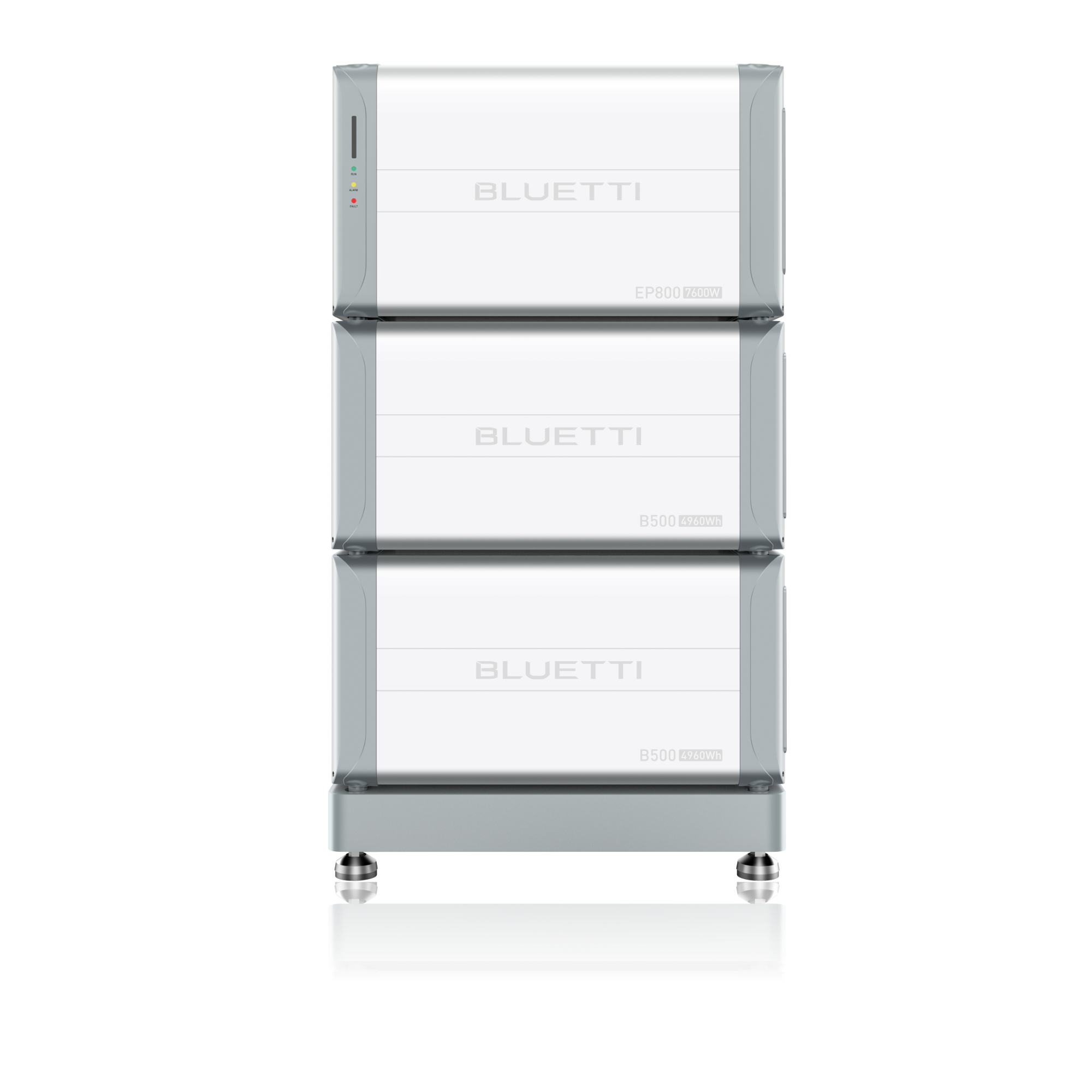
BLUETTI EP800 + 2×B500
$6,999.00
$6,999.00 · direct from BLUETTI
Last checked 16 days ago. Prices move — check before you buy.
Prices may vary by retailer and are subject to change.