Head-to-head test
BLUETTI Apex 300 + 2×B300K vs Jackery Explorer 2000 Plus
A penny per watt-hour separates these two, so price isn't the argument. The argument is whether you can name a day that drains more than 1,736Wh.
Full profiles: BLUETTI Apex 300 + 2×B300K → · Jackery Explorer 2000 Plus →

Written by Gunner GustafsonUpdated
Whole-Home Backup Tester, Station Arena Test Desk

$3,699.00 · direct from BLUETTI
Last checked 1 day ago. Prices move — check before you buy.
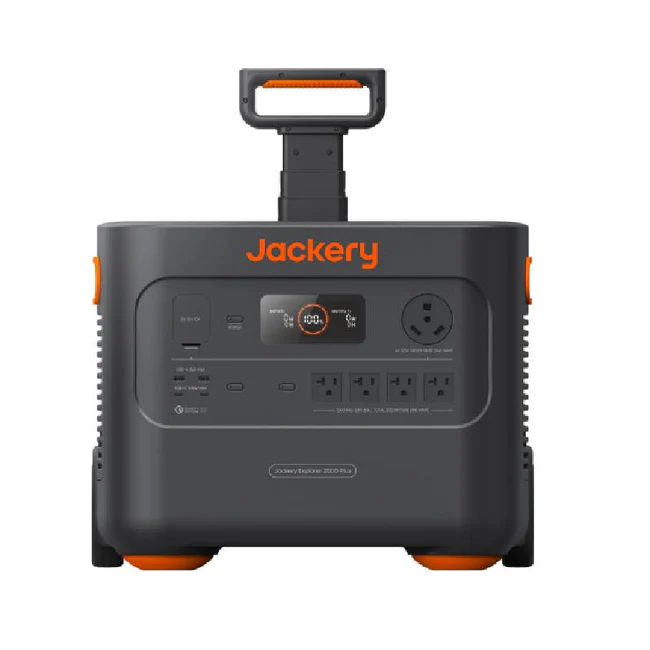
No longer sold
Jackery no longer sells the Explorer 2000 Plus as a standalone unit — the listing now carries only kits, the add-on battery and a refurbished unit. Its successor in the line is the HomePower 2000 Plus v2: the same 2 kWh class with a 2,400W inverter in the newer design.
HomePower 2000 Plus v2 · $1,199.00Spec deltas
Per watt-hour, these two are the same purchase. The Apex 300 with two B300K batteries works out to $0.45 per watt-hour ($3,699 divided by 8,294.4Wh). The Explorer 2000 Plus is $0.44 ($899 divided by 2,042.8Wh). Nobody is getting a bulk discount and nobody is paying a premium for the small box. You are choosing a quantity.
The quantities are 8,294.4Wh and 2,042.8Wh, which after the standard 15% inverter derate is 7,050Wh and 1,736Wh of energy you actually get out. That gap costs $2,800. The rest of the sheet is close enough to be noise: the same 5-year warranty, both expandable, and exactly 2x surge headroom on each (7,680W over 3,840W, 6,000W over 3,000W). The $899 unit is even rated for more cycles, 4,000 against 3,500.
So the question is your worst day, and for most people it fits inside 1,736Wh. The Apex earns its price on a van-life draw of 4,685Wh, where the Jackery falls 2,949Wh short and there is nothing to argue about. It earns it again on 240V, which one owner uses to charge a plug-in hybrid at 3.3kW when he stopsA5. If neither of those is you, the cheaper box wins and you keep $2,800.
What the Numbers Reveal
Each conclusion stated first — the numbers behind it on one line, the full analysis below.
Capacity
Scale normally buys a discount in this category and here it buys nothing at all. The bigger system costs marginally more per watt-hour and is rated for 500 fewer cycles, so the $2,800 gap is a pure quantity purchase with no efficiency bonus hiding inside it. There is no version of this comparison where the Apex is the smarter buy on economics.
Apex 300 + 2×B300K: $3,699 for 8,294.4WhExplorer 2000 Plus: $899 for 2,042.8WhRated cycles: 3,500 for the Apex system, 4,000 for the ExplorerCost per lifetime kWh: $0.13 vs $0.11
Why it mattersAnyone waiting for the big system's per-watt-hour math to justify the spend should stop waiting and go size their actual load instead.
solar input
The Apex finishes that night with 5,405Wh still in the bank, which means the real question was never whether the Jackery survives eight hours. It is what happens on day two. The Jackery's 1,200W of panel puts 2,042.8Wh back in under two hours of arithmetic, one good uninterrupted afternoon, and grey weather turns a 91Wh margin into a coin flip.
The 8-hour blackout model draws 1,645WhExplorer 2000 Plus usable energy: 1,736Wh (2,042.8Wh derated 15%)Explorer margin after that load: 91Wh; Apex margin: 5,405WhSolar input: 1,200W on the Explorer, 2,400W on the Apex
Why it mattersIf your outages come one evening at a time, the Jackery is sized correctly; if they run into a second overcast day, that 91Wh is the number that should worry you.
The Apex's headline advantage over the Jackery is a 2,400W solar ceiling, double the Explorer's 1,200W, and that ceiling is the exact spec its owners argue with hardest. One owner has asked BLUETTI for video of an Apex 300 charging above 1,200W and reports that none has been producedA2. The 8,294.4Wh of stored energy, by contrast, is the part nobody disputes.
This listing is an Apex 300 base plus two B300K batteries: 8,294.4Wh divided three ways is 2,764.8Wh per boxOwners report the packs charging at different rates, one at 100% while another sits at 50%A1BLUETTI support has told owners this is normal behaviorA3Owners call the 60V solar input ceiling the most-cited complaintA8, and a firmware bug drops solar detection until cables are unplugged and repluggedA9
Why it mattersBuy the Apex for the energy you can verify the week it arrives, not for the solar figure, and put the multi-battery charging through a full cycle inside the return window.
weight
Every advantage the Apex holds is an advantage belonging to something that gets wired in. Faster grid switchover matters for gear that never unplugs. A 2,400W solar ceiling matters for panels on a roof. Whole-day capacity matters for a fixed load in a fixed place. None of it helps in any scenario where the unit has to get somewhere first.
Apex 300 + 2×B300K: 213.9 lbs, spread across three boxesExplorer 2000 Plus: 61.5 lbs in one box, with wheels and a handleB3Apex switchover 10ms vs Explorer 20ms; Apex solar input 2,400W vs 1,200W
Why it mattersIf the box has to end up anywhere other than where you unpack it, the 61.5 lb one is the only portable unit in this comparison.
The specific dimensions that decide these two units — everything else is a tie.
Lifetime Value
Selected because: 13 cents per lifetime kWh against 11 cents is a two-cent gap, and it reframes the entire $2,800 price difference.
cost / lifetime kWh
Two cents per lifetime kilowatt-hour is the entire economic difference between an $899 box and a $3,699 system. Run the Apex through its rated 3,500 cycles at 8,294.4Wh and you have bought 29,030 kWh for $3,699. Run the Jackery through 4,000 cycles at 2,042.8Wh and you have bought 8,171 kWh for $899. Thirteen cents against eleven. Both are far cheaper than anything the grid will sell you, and neither is cheaper than the other in a way you would ever feel.
The per-year framing is where this gets misleading. $740 a year of warranty coverage against $180 makes the Apex look four times more expensive to own, which it is, in the same sense that a four-bedroom house is more expensive than a studio. You are not paying more per unit of anything. You are buying more units of it.
Your Life, Your Pick
Selected because: Six modeled days, and only two of them are days the Explorer 2000 Plus cannot finish.
The Jackery finishes four of the six modeled days and fails two: a 2,100Wh camping weekend by 364Wh, and a 4,685Wh van-life day by 2,949Wh. Those two failures are completely different animals. Missing by 364Wh is a scheduling problem, one fewer kettle or one afternoon of sun. Missing by 2,949Wh is a sizing problem, and nothing you change about how you use the unit will close it.
Treat the two outdoor scenarios with care, though. The scoring engine has no category for a unit that gets installed, so Weekend Camping and Tailgate Party grade a 213.9 lb three-box system as though it drove itself to the site and set itself up, and their logic rewards the lighter unit while handing the win to the heavier one. The Apex takes both on arithmetic. Whether either result describes a trip you would actually take is the question the table cannot ask.
Portability & Form Factor
Selected because: 213.9 lbs across three boxes against 61.5 lbs in one: the difference between installing a system and carrying a battery.
weight
213.9 lbs is a system total, not a lift. This listing is an Apex 300 plus two B300K batteries, three boxes at 2,764.8Wh each, and the job is placement rather than carrying: get them to one spot, cable them, leave them. One review puts the base unit on its own at around 85 lbs, which is the figure people quote when they call this thing portableA12A13. It is not the figure that arrives at your door.
The Jackery is 61.5 lbs on wheels with a handle, and reviewers still call stairs a two-person jobB3. That is the honest ceiling on the word portable in this matchup. Neither of these goes in a backpack. Only one of them goes in a car without a plan.
Growth Path
Selected because: Both units take expansion batteries, so starting at 2,042.8Wh doesn't lock you out of anything later.
solar input
Both units take expansion batteries, which quietly defuses the sizing anxiety that drives people toward the bigger purchase. Starting at 2,042.8Wh does not lock you out of a bigger bank later, and the expansion path is one of the things reviewers single out about the Explorer 2000 Plus, describing up to 12kWh on one unit and 24kWh with two pairedB2.
The case for the Apex's growth path is its 2,400W solar ceiling against the Jackery's 1,200W, and on the spec sheet that is real and it is double. It is also the number this unit's owners fight with most, over a 60V input limit they call misleadingA8 and a detection fault that needs an unplug and replug to clearA9. Treat the solar headroom as a claim to verify on your own roof, not as a reason to spend $2,800 up front.
Brand Trust
Selected because: Two brands with criticized support and inverted app scores, 4.5 out of 5 for BLUETTI against 2.3 to 3.3 for Jackery.
Both brands get criticized for support, and they fail in different directions. BLUETTI runs on email with China-timezone delays and outcomes that swing wildly: one Apex owner logged two weeks of troubleshooting, another week waiting on RMA approval, then 48 hours of silence on a follow-upA4, while other owners describe the same desk as helpfulA11. Jackery's is US-based and no better regarded, with scripted agents, strict receipt requirements on warranty claims and refurbished replacements for units that arrived broken. The difference is the escape hatch: Jackery sits in Costco, Home Depot, Best Buy and Amazon, and a retailer's return window is the one support channel that always answers.
The apps invert the hardware story completely. BLUETTI's scores 4.5 out of 5 and is among the best in the category; Jackery's runs 2.3 to 3.3, with reviewers calling it solid on the essentials like cycle counts and efficiency graphs but short on polishB4. If you are going to open an app every day for five years, that is a genuine point in the expensive unit's favor.
Strengths & trade-offs
BLUETTI Apex 300 + 2×B300K
Strengths
- +Larger battery capacity
- +Higher AC output
- +Faster solar charging
- +Rated for 6,000 charge cycles — much longer battery lifespan
Trade-offs
- –Substantially more expensive (+$2,800) than the Explorer 2000 Plus.
- –Significantly heavier (+152.4 lbs), making it harder to move.
- –Very heavy unit that may be difficult for one person to lift.
Jackery Explorer 2000 Plus
Strengths
- +Costs $2,800 less
- +Lighter by 152.4 lb
Trade-offs
- –Weaker inverter (-840W) limits appliance compatibility.
- –Shorter-lived battery — rated for 4,000 charge cycles vs the Apex 300 + 2×B300K's 6,000, so it wears out sooner.
Will It Power Your Gear?
Scenario math and per-appliance runtimes, modeled from the spec record.
Scenario verdicts
We ran the math on six real-world scenarios. Here's which unit survives your actual life.
SCN-01 · 2 nights · needs 2,100Wh
Weekend Camping
Two nights off-grid with essential comfort
Neither unit
The Jackery lands 364Wh short of a 2,100Wh weekend, so the Apex takes this one on arithmetic and finishes with 4,950Wh untouched. Worth being clear about what won: three boxes totaling 213.9 lbs that somebody loads, unloads and cables up at the site. The scoring does not charge for any of that. Closing a 364Wh gap is a smaller problem than moving 213.9 lbs, so read this as a sizing note rather than a camping recommendation.
Battery budget usedlower = more headroom
LOAD Phone Charger 15W×6h · LED Lights 40W×8h · Box Fan 75W×14h · CPAP Machine 40W×16h
SCN-02 · 8 hours · needs 1,645Wh
8-Hour Blackout
Keep the essentials running through a night without power
Apex 300 + 2×B300K
Both make it through the night, and the margins are not remotely comparable. The Apex ends at 23% used with 5,405Wh in reserve, enough for a second night without thinking about it. The Jackery ends at 95% with 91Wh left, which at this scenario's 206W average draw is under half an hour. One evening it handles comfortably. Two evenings and it needs sun.
Battery budget usedlower = more headroom
LOAD Fridge 150W×8h · Router + Modem 20W×8h · LED Lights (4 bulbs) 40W×6h · Phone Charger 15W×3h
SCN-03 · 8 hours · needs 320Wh
CPAP Overnight
Sleep therapy without interruption — the #1 medical use case
Explorer 2000 Plus
The Jackery takes this, and not on capacity: a 320Wh night is 18% of its usable energy and 5% of the Apex's, so either could run a CPAP most of a week. It takes it on what the job is worth. You do not spend $3,699 and install three boxes totaling 213.9 lbs to move 320Wh a night, when $899 and a 61.5 lb unit on wheels does the identical job and can follow you to a hotel.
Battery budget usedlower = more headroom
LOAD CPAP Machine 40W×8h
SCN-04 · 8 hours · needs 910Wh
Remote Workday
Full work day off-grid without power anxiety
Apex 300 + 2×B300K
910Wh of laptop, monitor and router is a light day for both machines. The Apex ends at 13% used, the Jackery at 52% with 826Wh in hand, just shy of a second full workday at the same draw. The Apex wins on reserve, and reserve only starts mattering when the workday becomes a work week with no wall socket in sight.
Battery budget usedlower = more headroom
LOAD Laptop 60W×8h · External Monitor 30W×8h · Router + Modem 20W×8h · Phone Charger 15W×2h
SCN-05 · 4 hours · needs 670Wh
Tailgate Party
Game day power for the crew
Explorer 2000 Plus
670Wh is a loafing load for both, and the Apex wins it with 6,380Wh still in the bank against the Jackery's 1,066Wh. Neither unit is close to stretched, which is exactly why the reserve figure is not what decides a tailgate. The spec that decides a parking lot is which box gets out of the car: 61.5 lbs on wheels, or three boxes totaling 213.9 lbs.
Battery budget usedlower = more headroom
LOAD Blender 400W×0.5h · LED TV (55") 80W×4h · Bluetooth Speaker 15W×4h · Phone Charger (×3) 45W×2h
SCN-06 · 24 hours · needs 4,685Wh
Van Life Daily
A full day of mobile living — the ultimate endurance test
Apex 300 + 2×B300K
This is the scenario the Apex exists for. A 4,685Wh day leaves the Jackery 2,949Wh short, and that is not a gap you close with careful habits or a better charge controller. The Apex covers it and still holds 2,365Wh in reserve. It is also the one place where 213.9 lbs across three boxes stops being a drawback, because a van conversion is an installation and the boxes get strapped down once.
Battery budget usedlower = more headroom
LOAD Mini-Fridge 150W×24h · Laptop 60W×4h · Phone Charger 15W×3h · LED Lights 40W×5h · Fan 75W×8h
The Load Test
RUNTIME = (Wh × 0.85) ÷ LOAD
None of the scenarios above exactly yours? Build it. Toggle what you'd plug in; both units are tested against the combined draw.
Essentials
Comfort & Convenience
High-Draw Appliances
Test duration
8h
Continuous draw
205W
Projected runtime
For this load: Apex 300 + 2×B300K runs 34.4h vs 8.5h.
$3,699 list · direct from BLUETTI
Modeled from the spec record — same math as the tables below. Methodology
Runtime by appliance
Real-world runtime estimates for common appliances, modeled at 85% inverter efficiency.¹
Essentials
The basics you need runningscale 0–470hComfort & Convenience
Makes off-grid life actually enjoyablescale 0–94hHigh-Draw Appliances
These reveal the real limitsscale 0–7.1h¹ Runtime = (capacity × 0.85) ÷ appliance watts. Within each group, all bars share one time scale (the group's longest runtime), so lengths are comparable across appliances; identical runtimes collapse into a single blue/orange bar. Actual runtime varies with battery age, temperature, and simultaneous loads — see methodology.
Conclusion
August 9, 2026
Verdict: the Jackery Explorer 2000 Plus
Take the Explorer 2000 Plus unless you can name the load that breaks it. These two are matched on everything that normally decides a comparison: $0.44 per watt-hour against $0.45 ($899 for 2,042.8Wh, $3,699 for 8,294.4Wh), the same 5-year warranty, both expandable, identical 2x surge headroom, and the cheaper unit carries the higher cycle rating at 4,000 against 3,500. The extra $2,800 buys quantity at list price, not a discount on quantity. That is worth paying when quantity is the whole point: a 4,685Wh van-life day leaves the Jackery 2,949Wh short, and no habit closes that. Short of a load like that, you would be installing a 213.9 lb three-box system to solve what one 61.5 lb box already solves, in a multi-battery configuration whose own owners report the packs charging out of sync with support calling it normalA1A3.
Editor-assigned confidence, based on cited owner research and spec analysis.
List prices as of August 9, 2026. The links below open BLUETTI's and Jackery's current prices.
$899.00 · direct from Jackery
Last checked 21 days ago. Prices move — check before you buy.
or check the Apex 300 + 2×B300K price$3,699.00 list
Written by Gunner Gustafson, Whole-Home Backup Tester · Station Arena Test Desk · Updated August 9, 2026
Measured Data
Benchmark scores and the full spec record, side by side.
Benchmark scores
Not rated for both units (minimum threshold unmet): UPS, RV Living, Solar Generator, Tailgating, Apartment Balcony.
Full specifications
ᵈ Derived: price ÷ rated capacity. See the data behind our comparisons →
Comparison ToolAdd more power stations, side by sideOpen Tool →How these numbers are produced
Numeric verification
Every figure on this page traces to our spec database or arithmetic on it — no estimated numbers.
Owner claims
Statements about owner experience are cited to published reviews — see Sources & Research Notes below.
Runtime model
Runtime = (rated capacity × 0.85 inverter efficiency) ÷ device wattage. Solar recharge estimates assume panels deliver 70% of rated output. Cold weather, battery age, and stacked loads reduce real-world results.
Power Score
Computed from 14 published spec dimensions, weighted per use-case bench. Higher is better; a unit must meet a bench's minimum threshold to be rated.
See the full weight table and data sourcing on our methodology page →Class ranking (the star rating)
Each unit's star score is a category ranking, not customer reviews — no buyer opinions feed it. We score every station on size-independent quality (value, output, portability, endurance, ports, warranty, and more), then percentile-rank it against the other units in its capacity class, so a class-leading compact unit and a class-leading whole-home unit can both earn 5★. Here, Apex 300 + 2×B300K rates 3.4/5 (7th percentile of 29 Whole-Home / Off-Grid-class units), and Explorer 2000 Plus rates 4.5/5 (68th percentile of 26 Large-class units).
How the class ranking is computed →Test Notes & Caveats
Hidden gotchas and advantages we spotted that you won't find on the product page.
Weight: A System, Not a Lift
213.9 lbs is an Apex 300 plus two B300K batteries added together, and nobody picks that up. Three boxes go where you put them, get cabled, and stay, so choose the spot before it ships: relocating later means undoing the install. The Explorer 2000 Plus is a different class of object at 61.5 lbs, one piece with wheels and a handle, which one person rolls across a garage and two people carry up stairs.
45dB Is the Loaded Number
45dB is the Apex's rating with its fans working, roughly a running refrigerator, against 30dB for the Explorer 2000 Plus. That is a real gap if the unit lives in the room you sleep in and spends the night working hard. It is also a full-load figure, and a CPAP or a router will not push either unit's fans near it. Judge this on where the box sits and what you will actually be drawing at 3 a.m., not on the two numbers by themselves.
UPS Switchover: ≤10ms vs ≤20ms
Both list a UPS mode, at different rated speeds. The Apex 300 + 2×B300K is rated ≤10ms — quick enough on paper that desktop PCs and routers should ride through, treating that as the rating it is. The Explorer 2000 Plus is rated ≤20ms — fine on paper for routers and most electronics; the fussiest PC power supplies sit right at this line. If a computer with unsaved work is the thing being protected, the stated class is worth the attention; nothing here is a lab result.
Warranty: No Difference
Both units carry the same 5-year warranty, so coverage isn't a tiebreaker here. Both figures are maximums rather than guarantees: BLUETTI's depends on buying direct from BLUETTI or registering the unit, since reseller purchases carry a shorter term; Jackery's on registering the unit with Jackery, which is what extends the base term to the full period. Worth saying because the per-dollar framing can suggest otherwise: the Explorer 2000 Plus works out at 5.6 years of cover per $1,000 spent against the Apex 300 + 2×B300K's 1.4, but that spread is the price gap, not the terms.
Battery Lifespan in Real Years
The Apex 300 + 2×B300K is rated for 6,000 cycles vs 4,000. In real life: at daily use, that's 16.4 vs 11 years. At weekend use (twice a week), it's 58 vs 38 years. One caution reading years across different sizes: a cycle is 8,294Wh on the Apex 300 + 2×B300K and 2,043Wh on the Explorer 2000 Plus, so count lifetime energy — roughly 49,766 kWh against 8,171 kWh over the rated life. After hitting the cycle limit, the battery doesn't die — it drops to ~80% of original capacity, which is still very usable.
Full record above — the Test Desk pick is the Explorer 2000 Plus.
Check Explorer 2000 Plus price →or check the Apex 300 + 2×B300K priceOwnership Analysis
What happens after you buy — true cost of ownership, brand trust, and growth potential.
Lifetime value
Service lifeyears at one full cycle per day
Lifetime energy delivered
Cost per delivered kWh
│ warranty ends · Reaching the cycle rating means ~80% capacity remains — degraded, not dead.
Analyst note
The Explorer 2000 Plus is cheaper to buy, but the Apex 300 + 2×B300K is cheaper to own. At $0.07/kWh over its lifetime vs $0.11/kWh, the Apex 300 + 2×B300K's higher cycle life and capacity make each dollar go further over the years.
Brand trust
BLUETTI
Ecosystem
One of the broadest lineups — 15-20+ models from budget (AC2A) to flagship portable (Apex 300, 2764.8Wh). Includes specialized products: vehicle solar hubs, sodium-ion cold-weather units, and balcony storage systems.
Support
BLUETTI support is the coin flip inside this purchase. It runs on email with China-timezone delays, and outcomes range from efficient to multi-week troubleshooting loops, discounts on new units offered in place of repairs, and tangled claims processes when you bought through a third party. Buying direct tends to produce better outcomes, which is worth weighing when you choose where to order.
Community
Active and growing — Reddit r/bluetti has a dedicated community. Second-largest after EcoFlow in engagement.
App experience
Rated 4.5/5 iOS and Android — tied for best app experience in the category. V3.0 UI redesign was well-received.
Unique strength
Among the best capacity-to-price ratios available — several Elite and Apex units are the lowest $/Wh in the catalog. Widest product diversity including industry-firsts like sodium-ion cold-weather units and dual solar+alternator vehicle hubs. LFP across the rest of the range, though rated cycle life spans 2,500 (EB3A) to 6,000, and it varies WITHIN the Elite range rather than tracking it — the Elite 300 and Elite 200 V2 are rated 6,000 while the Elite 30 V2, Elite 10 Mini, Elite 320 and Elite 400 are rated 3,000+ and the Elite 100 V2 4,000+, so check the specific model. Dual-voltage (120V/240V) in flagships.
Worth knowing
The lineup runs 15 to 20-plus models with LFP across the board, and this configuration sits at the bottom of BLUETTI's own cycle range at 3,500. Older discontinued units can also become unrepairable, because there is no spare-parts policy covering some models.
Jackery
Ecosystem
12-15+ models across Explorer (portable) and HomePower (home backup) series, plus SolarSaga panel ecosystem and innovative form factors
Support
Jackery's support is US-based and still the weak point: scripted agents, strict receipt requirements on warranty claims, and refurbished replacements sent for units that arrived defective. The mitigation is where you buy it. Costco, Home Depot, Best Buy and Amazon all carry it, and a retailer's return policy is the support channel that always answers.
Community
Smallest community of the major brands — Reddit r/Jackery has ~2,000 members. YouTube presence is solid due to brand recognition.
App experience
Rated 2.3-3.3/5 iOS and Android — the weakest app experience of the major brands. Multiple confusing apps (Jackery app vs Jackery Home) and mandatory login even offline.
Unique strength
Highest brand recognition and widest retail distribution (Costco, Home Depot, Best Buy, Amazon). The "Toyota" of power stations — dependable, proven, wide availability. Innovative form factors like the Solar Gazebo and Solar Mars Bot.
Worth knowing
A couple of older models still ship NMC chemistry with a shorter rated lifespan, so check the cycle rating on the specific unit — though most of the current line has moved to LFP. Generally perceived as overpriced for the specs offered compared to newer competitors. App experience is significantly behind rivals.
Analyst note
Neither brand wins on service, so pick the failure mode you can live with. Jackery gives you retail return windows as a backstop and the weakest app in the category at 2.3 to 3.3 out of 5. BLUETTI gives you the best app at 4.5 out of 5, the broadest lineup in the space, and a support desk whose outcomes vary more than any competitor's. On a $3,699 purchase that inconsistency costs more than it does on an $899 one.
Growth path
Apex 300 + 2×B300K
EXPANDABLESupports BLUETTI expansion batteries, so you can add capacity later without replacing the base unit — useful if your needs may climb past 8,294Wh.
Accepts up to 2,400W of solar. Enough for a serious multi-panel array.
Generous port selection supports complex multi-device setups.
Expansion batteries are BLUETTI-specific. You're investing in the BLUETTI ecosystem.
Explorer 2000 Plus
EXPANDABLESupports Jackery expansion batteries, so you can add capacity later without replacing the base unit — useful if your needs may climb past 2,043Wh.
Accepts up to 1,200W of solar. Enough for a serious multi-panel array.
Adequate ports for most setups, but heavy users may want a power strip.
Expansion batteries are Jackery-specific. You're investing in the Jackery ecosystem.
Realistic full solar rechargeat 70% of rated panel output — see methodology
Analyst note
Both expand, but the Apex 300 + 2×B300K's higher solar ceiling (2,400W vs 1,200W) gives it the stronger off-grid growth path — more panels can feed a bigger bank as it grows.
What Owners Report
Patterns from published owner reports and long-term reviews — every claim cited to its source below.
BLUETTI Apex 300 + 2×B300K
The Apex 300 launched in 2025 and the record reflects it: what exists comes from two DIY solar forum threads and professional hands-on reviews rather than long-term ownersA1A16, nothing runs past about six months, and nobody has reported back on cold-weather behavior at all. Read everything below as early evidence, not settled fact.
The complaints that matter cluster on multi-battery charging, which is exactly what this listing is. Owners report the packs filling at different rates, one sitting at 100% while another reads 50%, with BLUETTI support calling that normalA1A3, and one owner concluding it makes the system a poor choice for off-grid useA3. Another has repeatedly asked BLUETTI for video of an Apex 300 charging above 1,200W and says none has been producedA2. On the solar side, the 60V input ceiling draws the loudest criticismA8 and a firmware fault reportedly stops the unit seeing solar until the cables are pulled and reseatedA9.
The praise is substantive too. One reviewer running an Apex 300 with a B300K kept household essentials going for more than a full day without managing consumption the way smaller stations force you toA16. Another measured a 20W AC idle draw that meaningfully stretches a long outageA15, and a third found the fan tone even, with no pitch change or rattle, and usable near a sleeping areaA14. A van-conversion owner priced an equivalent DIY build with solar charger, split charger, shunt and inverter and landed at roughly the same money as the ApexA6, which is the most useful yardstick in the whole ledger.
One conflict we could not resolve, and you should know about it before ordering. Reviewers and owners describe the base unit as having no DC or USB ports on the face, with a roughly $300 Hub D1 accessory required to add them, and they are irritated about itA10A17. Our spec table lists 100W USB-C for this unit. Those two things cannot both be true, so confirm the port complement of the exact bundle you are buying rather than trusting either source. Support is the other coin flip, ranging from helpful to what owners describe as effectively non-existentA11.
“For me the 240V output is great. I can stick it in the back of my PHEV and use the 240V output to charge at 3.3KW when I stop.”
Jackery Explorer 2000 Plus
The Explorer 2000 Plus record is review-site coverage rather than long-term ownership, and it is consistent: dependable, easy to use, and quiet even under a 3,000W load, with compatibility that stretches from a CPAP to an electric grillB1. Reviewers also flag two MPPT inputs and IP65 sealing on the key ports, calling the build tank-likeB5. Solar input gets cited anywhere from about 1,200W to 1,400W across sourcesB5; our spec table uses the conservative 1,200W and so does every number on this page.
The caveats are weight and software. At around 61 to 62 lbs the wheels and handle work on smooth ground, but reviewers still call stairs a two-person liftB3. The app covers the essentials well, with cycle counts and efficiency graphs that reviewers describe as pro-level, while lacking the refinement of rivalsB4. Expansion is the standout note: up to 12kWh on a single unit, or 24kWh and 6000W output with two paired, which reviewers point at for RV and home-backup useB2.
“Reviewers describe it as dependable, easy to use, and relatively quiet even under a 3000W load, with universal compatibility for powering everything from CPAP machines to electric grills.”
Sources
outdoorgearlab.com · thesolarpit.com · jackery.com · voltagebasics.com · storagereview.com · thesolarlab.com · tipselite3s.com
Sources & Research Notes
Every owner claim in this report is traceable to a published source. The bracketed references above resolve here.
Recurring owner themes
- When multiple Apex 300 units (as in this 2x-B300K configuration) are charged together, owners report state-of-charge sync problems and solar input capped far below the advertised rating, which Bluetti support has called 'normal' behavior. [Apex 300 + 2×B300K · 3 entries]
- Customer/RMA support experience is inconsistent — some owners report smooth help, others describe multi-week delays and unresponsive tickets. [Apex 300 + 2×B300K · 2 entries]
- The base unit's 60V solar input ceiling and a firmware bug that drops solar detection (requiring an unplug/replug) are the two most-cited technical gripes among solar-focused owners. [Apex 300 + 2×B300K · 2 entries]
- Because the Apex 300 ships with no built-in DC/USB ports, owners and reviewers alike flag the mandatory ~$300 Hub D1 accessory as an unexpected added cost. [Apex 300 + 2×B300K · 2 entries]
- Despite being marketed as 'portable,' the unit's weight (~38kg/85lb base alone, more with B300K batteries) leads multiple sources to describe it as effectively a stationary/semi-permanent installation rather than something carried around. [Apex 300 + 2×B300K · 2 entries]
- Standout expandability (up to 24kWh dual), a rugged IP65 build with wheels, and dependable quiet operation are the praise; the heavy weight and an app that needs polish are the caveats. [Explorer 2000 Plus · 3 entries]
- A1
“When the units are charging from the grid they charge at different rates and not together... you may have one at 100% and one at 50%.”
DIY Solar Power Forum — thread 'Bluetti Apex 300 problems' · 2025-09 · [negative]
- A2
“I have requested a short video from Bluetti showing an APEX 300 actually charging more than 1200 watts. They have been unable to produce one.”
DIY Solar Power Forum — thread 'Bluetti Apex 300 problems' · 2025-09 · [negative]
- A3
“Bluetti support says this is normal... This makes them a bad choice for off grid applications.”
DIY Solar Power Forum — thread 'Bluetti Apex 300 problems' · 2025-09 · [negative]
- A4
“It has taken me 2 weeks of troubleshooting with them and a week to get an RMA approval... I have asked for updates with NO response 48 hours later.”
DIY Solar Power Forum — thread 'Apex 300 Support issues' · 2025-11 · [negative]
- A5
“For me the 240V output is great. I can stick it in the back of my PHEV and use the 240V output to charge at 3.3KW when I stop.”
DIY Solar Power Forum — thread 'Bluetti Apex 300 launched today… anyone have thoughts?' (page 2) · 2025-05 · [positive]
- A6
“It came in just shy of £1500... Pricing up a similar system from scratch with similar capacity, solar charger, split charger, smart shunt, inverter ect was all coming in at a similar if not slightly higher price.”
VW T6 Transporter Forum — thread 'Bluetti Apex 300' · 2025-07 · [positive]
- A8
“The 60V solar limit is the most common and vociferous complaint, with users calling it "misleading" and a "joke".”
BIKMAN TECH blog aggregating user/forum reports — 'Bluetti APEX 300 - Everything You Need to Know' · 2025-11 · [negative]
- A9
“the unit failing to detect solar input until the cables are physically unplugged and replugged. Bluetti support has reportedly acknowledged this as a known firmware issue”
BIKMAN TECH blog aggregating user/forum reports — 'Bluetti APEX 300 - Everything You Need to Know' · 2025-11 · [negative]
- A10
“widespread frustration over the "unbundling" strategy and the "hidden cost" of the Hub D1 for "missing" DC/USB ports.”
BIKMAN TECH blog aggregating user/forum reports — 'Bluetti APEX 300 - Everything You Need to Know' · 2025-11 · [negative]
- A11
“Customer support is dangerously polarized. User experiences range from "great" and "helpful" to "notoriously non-existent" and "a disaster".”
BIKMAN TECH blog aggregating user/forum reports — 'Bluetti APEX 300 - Everything You Need to Know' · 2025-11 · [mixed]
- A12
“it weighs in at 38kg, and is probably much too big and heavy for most people to carry alone.”
Trusted Reviews — 'Bluetti Apex 300 Review' · 2025-10 · [mixed]
- A13
“Even that is quite a lump though! Keep us posted @RacingSlow you may be the future of van electrics!”
VW T6 Transporter Forum — thread 'Bluetti Apex 300' (van-conversion owner discussion) · 2025-07 · [mixed]
- A14
“Fan noise remains even, with no distracting pitch or rattle. This makes the Apex 300 usable near sleeping areas or indoor workspaces without disturbance.”
Yanko Design — 'BLUETTI Apex 300 Review: The All-in-One Solar, Gas, and Battery Solution' · 2025-05 · [positive]
- A15
“Efficient 20W AC idle drain extends runtime significantly during extended outages.”
Yanko Design — 'BLUETTI Apex 300 Review: The All-in-One Solar, Gas, and Battery Solution' · 2025-05 · [positive]
- A16
“With some portable power stations, I'd have to ration power more carefully, but with this system, I could run essentials for more than a full day if I needed to.”
Techspective — 'Bluetti Apex 300 with B300K Review' · 2025-09 · [positive]
- A17
“Not having DC or USB ports on the face is a tradeoff. The Hub D1 solves the problem—but it's an additional $300 accessory that you then have to bolt on after the fact.”
Techspective — 'Bluetti Apex 300 with B300K Review' · 2025-09 · [mixed]
- B1
“Reviewers describe it as dependable, easy to use, and relatively quiet even under a 3000W load, with universal compatibility for powering everything from CPAP machines to electric grills.”
outdoorgearlab.com / thesolarpit.com — Jackery Explorer 2000 Plus review · 2026 · [positive]
- B2
“Massive expandability — each unit's battery expands up to 12kWh, and pairing two units gives 6000W output and up to 24kWh total, ideal for RVs, home backup, or serious off-grid setups.”
jackery.com / thesolarpit.com — Explorer 2000 Plus review · 2026 · [positive]
- B3
“Not light at around 61-62 lbs — included wheels and a handle help on smooth surfaces, but it still demands a two-person lift for stairs.”
outdoorgearlab.com / voltagebasics.com — Explorer 2000 Plus review · 2026 · [mixed]
- B4
“The app nails the essentials with pro-level insights like cycle counts and efficiency graphs, but it lacks some of the bells and whistles of rivals and still needs polishing.”
storagereview.com / thesolarlab.com — Explorer 2000 Plus review · 2026 · [mixed]
- B5
“Strong solar with two MPPT inputs (up to ~1,200-1,400W), plus a tank-like build with IP65 dust and water resistance on key ports.”
storagereview.com / tipselite3s.com — Explorer 2000 Plus review · 2026 · [positive]
Research compiled August 9, 2026.
Who Should Buy Which
Buy the Apex 300 + 2×B300K if you…
- →You are wiring a van, a cabin or a garage and the unit will live in one place for years. Three boxes and 213.9 lbs becomes a fitting problem rather than a carrying problem, and 7,050Wh of usable energy covers a 4,685Wh day with 2,365Wh still spare.
- →Your day genuinely exceeds 1,736Wh and you can name what is drawing it. That is the single condition under which $2,800 buys something the Jackery cannot deliver at any setting.
- →You need 240V. One owner runs a plug-in hybrid off the Apex's 240V output at 3.3kW during stopsA5, and nothing in the Explorer's spec answers that.
- →You were about to build a DIY bank anyway. A van owner priced the equivalent scratch build with charger, shunt and inverter and came out at similar moneyA6, and this arrives already integrated.
Buy the Explorer 2000 Plus if you…
- →Your worst night is a fridge, some lights, a router and phones. The 8-hour blackout model wants 1,645Wh and you have 1,736Wh usable, which clears it with 91Wh to spare. Add panels and day two takes care of itself.
- →You sleep next to it. A CPAP night is about 320Wh, 18% of the Jackery's usable energy, and there is no version of that job that justifies $3,699.
- →The unit has to move. Garage to kitchen, house to campsite, home to a job site: 61.5 lbs on wheels is the only one of these two that does that without a second person and a plan.
- →You want a return window more than you want a warranty. Jackery sits in Costco, Home Depot, Best Buy and Amazon, and given both brands' support records, that matters more than the paperwork.
This is you — check the Explorer 2000 Plus price
If neither fits
If you are backing up a whole house through a transfer switch, with a well pump and central air and a multi-day winter outage in mind, neither of these is the right shape. Both are plug-in boxes, and what that job wants is a fixed home battery or a standby generator sized by an electrician. Same answer if portable meant something you can pick up one-handed: 61.5 lbs is the light option in this comparison, so shop a tier down toward 1kWh and accept the smaller number cheerfully.
The Bottom Line
Take the Explorer 2000 Plus. Forty-four cents a watt-hour against forty-five means there is no discount waiting inside the bigger system, and the cheaper unit is also the one rated for more cycles, the one that weighs 61.5 lbs instead of 213.9, and the one whose worst field complaint is an app that needs polishB4. The extra $2,800 buys quantity at list price and nothing else.
The exception is clean enough to settle in an afternoon. Add up your worst day. If it clears 1,736Wh the way a 4,685Wh van-life draw does, the Jackery is 2,949Wh short and only a bigger bank fixes that, and the Apex is a fair price for one. If it does not clear 1,736Wh, you already have your answer and $2,800 that never needed spending.
Frequently Asked Questions
Answers drawn from the spec record and cited owner research.
Is the BLUETTI Apex 300 with two B300K batteries worth four times the price of the Jackery Explorer 2000 Plus?
It is 4.1 times the price ($3,699 against $899) for 4.1 times the energy (8,294.4Wh against 2,042.8Wh), so it is not a worse deal, just a bigger one. Per watt-hour they sit a penny apart at $0.45 and $0.44. Buy the Apex when your real load exceeds what 2,042.8Wh delivers, which after the standard 15% inverter derate is 1,736Wh of usable energy.
Will the Jackery Explorer 2000 Plus get me through an 8-hour power outage?
Yes, with 91Wh left over. The 8-hour blackout model draws 1,645Wh against the Explorer's 1,736Wh usable, so it ends the night at 95% used. That is comfortable for one evening and thin for anything longer, which is what solar is for: its 1,200W input replaces 2,042.8Wh in under two hours of arithmetic when the sun cooperates. The Apex finishes the same night at 23% used.
How heavy is the BLUETTI Apex 300 with two B300K batteries?
213.9 lbs, but that is the whole system rather than one object. It is an Apex 300 plus two B300K batteries, three boxes of 2,764.8Wh each, so you move them one at a time and then leave them alone. One review puts the base unit by itself at around 85 lbs, which is the number that makes it sound carryable. The Jackery is 61.5 lbs in a single piece with wheels.
Which is quieter, the Apex 300 or the Jackery Explorer 2000 Plus?
On the rating, the Jackery, at 30dB against 45dB. Read those as full-load numbers, because that is what they are, and a CPAP or a router will not push either unit's fans near that point. One reviewer found the Apex's fan tone even and steady enough to sit near a sleeping area, and reviewers call the Jackery quiet even under a 3,000W load.
Can I start with the Jackery and add capacity later?
Yes. Both units take expansion batteries, and reviewers describe the Explorer 2000 Plus reaching up to 12kWh on one unit, or 24kWh with two paired. That is the practical argument for starting small: the ceiling is not what constrains you at $899, and after one season you will know your real daily draw instead of guessing at it.
Check Explorer 2000 Plus price →
Brand matchup
BLUETTI vs Jackery: measured across every matchup →Where to buy
BLUETTI Apex 300 + 2×B300K
$3,699.00
$3,699.00 · direct from BLUETTI
Last checked 1 day ago. Prices move — check before you buy.
Jackery Explorer 2000 PlusPick
$899.00
$899.00 · direct from Jackery
Last checked 21 days ago. Prices move — check before you buy.
Prices may vary by retailer and are subject to change.