Head-to-head test
BLUETTI AC60P vs Goal Zero Yeti 6000X
If 428 usable watt-hours covers your night, buy the AC60P and stop reading; the Yeti 6000X is the only one of these two that can do more, and it's rated for 500 cycles against the AC60P's 3,000 while doing it.
Full profiles: BLUETTI AC60P → · Goal Zero Yeti 6000X →

Written by Gunner GustafsonUpdated
Whole-Home Backup Tester, Station Arena Test Desk

$749.00 · direct from BLUETTI
Last checked 1 day ago. Prices move — check before you buy.
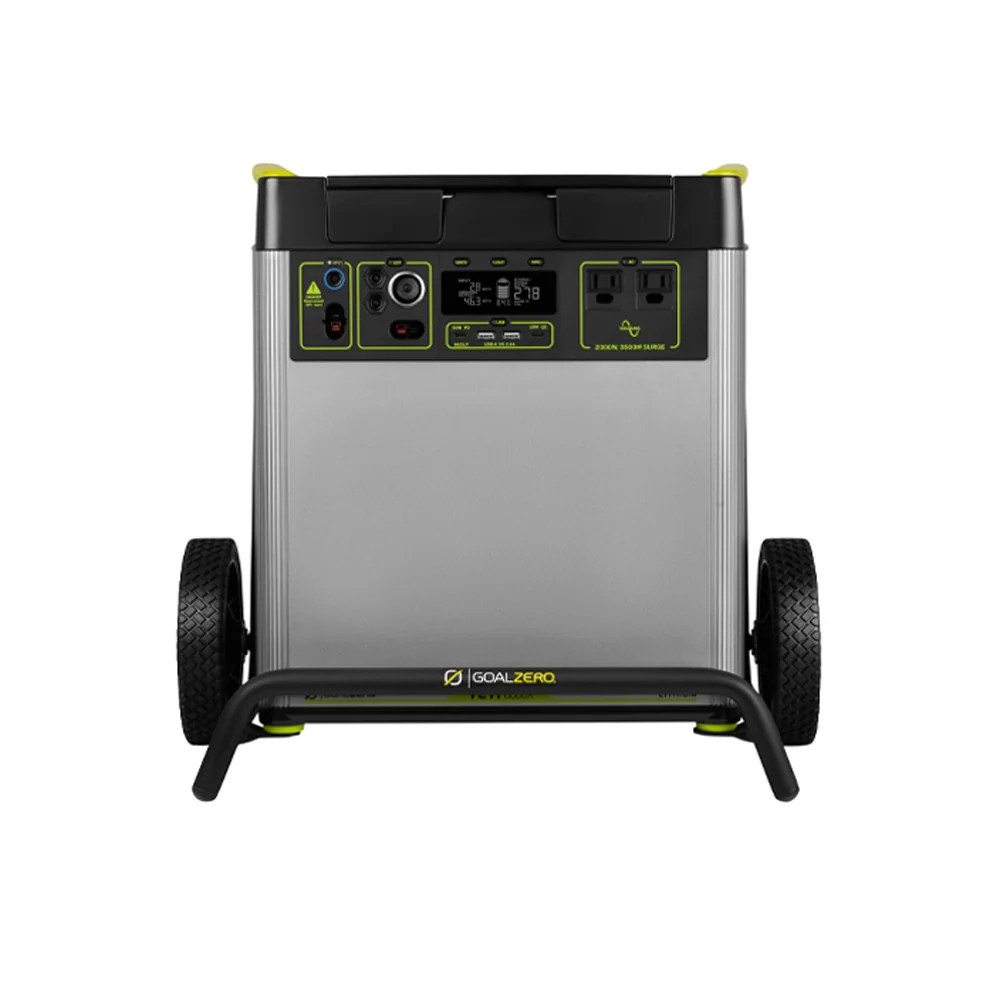
$3,999.95 · direct from Goal Zero
Last checked 1 day ago. Prices move — check before you buy.
Spec deltas
Take the AC60P, and take it knowing it fails five of the six load scenarios on this page. That reads like a contradiction until you price the sixth: a CPAP night asks 320Wh, the AC60P has 428Wh to hand over, and the Yeti 6000X does the identical job for $4,000 instead of $749 with 4,840Wh sitting idle.
The Yeti's case isn't weak. A 6,071Wh battery behind a 2,000W inverter is a different class of machine, and it's the only one of the two that finishes a weekend camp, an eight-hour outage or a van-life day. The AC60P stops 1,672Wh short of that weekend. No firmware update, no careful rationing and no expansion story you can price from this page closes a gap that size.
Where the Yeti falls apart is ownership. Its twelve-times-larger battery, 6,071Wh against 504Wh, returns only twice the lifetime energy, 3,036 kWh against 1,512 kWh, because 500 cycles against 3,000 is a sixth as many turns to deliver it in. The tank is much bigger. The mileage isn't.
What the Numbers Reveal
Each conclusion stated first — the numbers behind it on one line, the full analysis below.
Take 6,071Wh down to the 80% a 500-cycle rating ends at and you get about 4,857WhB4; apply the same flat 0.85 the table applies to everything and you get 4,128Wh against a 4,685Wh day, which is 557Wh short. At 500 cycles of daily use, 1.4 years by this same table, the Yeti stops passing the one scenario it was bought for, and the two-year warranty is still running when it happens.
Yeti 6000X: 6,071Wh rated, 500 cycles, and cycle ratings run to 80% of original capacityVan Life Daily needs 4,685Wh; the Yeti passes it at 91% used, 475Wh spare out of 5,160Wh usableThe scenario table applies a flat 0.85 usable factor to every unit rather than measuring each one
Why it mattersIf you'd cycle this thing every day, treat 6,071Wh as a year-one number and decide whether you'd still buy it at the year-two number.
cost / lifetime kWh
Dollars per watt-hour is the number every spec table leads with, and it is the one that misleads hardest here. $749 buys 1,512 kWh of lifetime energy at fifty cents a kilowatt-hour; $4,000 buys 3,036 kWh at a dollar thirty-two. Twice the energy for more than five times the money, and the ranking flips depending only on which column you read.
Sticker cost per watt-hour of capacity: $0.66 for the Yeti 6000X, $1.49 for the AC60PCost per lifetime kilowatt-hour: $1.32 for the Yeti, $0.50 for the AC60PTotal lifetime energy: 3,036 kWh for the Yeti, 1,512 kWh for the AC60P
Why it mattersAnyone weighing these on sticker dollars-per-watt-hour is reading the wrong column, and both cycle counts are ratings rather than anything measured.
continuous output
That distinction sorts the buyers. Where you can top up mid-use, the shortfalls are scheduling problems: 242Wh is about an hour and a quarter of the AC60P's 200W solar input, and tailgates happen in daylight. Where you can't, they're walls: an eight-hour outage asks 1,645Wh and 428Wh covers about the first two hours of it. And if the load itself pulls more than 600W continuously, topping up is irrelevant, because that's the Yeti's 2,000W inverter or nothing.
AC60P: 600W continuous, 1,200W surge, 428Wh usable, 200W solar inputTailgate Party asks 670Wh, the AC60P's closest miss at 242Wh shortYeti 6000X: 2,000W continuous, 3,500W surge
Why it mattersSize on watts before watt-hours. Anything over 600W continuous puts the AC60P out of the running no matter how the energy arithmetic looks.
weight
That's backwards from how these two get sold, and it settles one buyer outright. If the job is keeping a router, a PC or a CPAP alive through an outage, the AC60P is rated to take over in 20ms and the Yeti isn't rated to take over at all. The 20ms is a stated ceiling rather than a measurement, but a stated ceiling still beats an absent feature, and the capacity gap never enters the conversation because the load is 320Wh a night.
AC60P: rated 20ms switchover, 21.2 lbs, 100W USB-CYeti 6000X: no UPS mode and no switchover rating, 106 lbs, 60W USB-CCPAP Overnight: both cover the 320Wh night; the AC60P finishes with 108Wh of its 428Wh usable
Why it mattersIf your real fear is a two-second flicker taking down a desktop rather than a two-day blackout, you're buying the cheap one.
The specific dimensions that decide these two units — everything else is a tie.
Your Life, Your Pick
Selected because: Five of the six load profiles here are larger than the AC60P's 428Wh of usable energy, so this table is the whole decision.
Five losses and a draw isn't the humiliation it looks like. It's a sizing table. The set runs from a 320Wh CPAP night to a 4,685Wh van-life day, and the AC60P's 428Wh of usable energy sits at the very bottom of that range, so read down the watt-hours each row asks for and find your own evening in it. Land under 428Wh and every loss above you is noise.
One structural caveat, said once. The scoring model has no category for a unit that gets installed rather than carried, so a 106 lb appliance takes Weekend Camping and Tailgate Party on stored energy alone, with nothing in the metric for the fact that nobody walks it to a tent. Those two wins are sound arithmetic and hypothetical camping. The blackout and van-life rows are the ones to take at face value.
Lifetime Value
Selected because: 3,000 cycles against 500 is why 6,071Wh returns only 3,036 kWh over its life while 504Wh returns 1,512 kWh.
cost / lifetime kWh
Cycle count does all the work in this table, and both numbers are ratings to 80% of original capacity rather than death datesB4. Neither unit stops working; one reaches 80% after 1.4 years of daily cycling and the other after 8.2. Worth knowing what a cycle means on each side, though: it's 504Wh for the AC60P and 6,071Wh for the Yeti, so those year counts measure durability rather than service delivered. The lifetime-kilowatt-hour column is the one that folds capacity back in, and the AC60P still wins it on cost.
The figure that should move a decision is $125 per year of warranty coverage against $2,000. That isn't fair on its face, since a 6,071Wh box costs more per year of anything than a 504Wh one, but it does frame the exposure. You're spending $4,000 on a machine backed for two years by a brand our own assessment marks down for long waits and unanswered tickets. Buy it from a seller whose return window you'd actually rely on.
Portability & Form Factor
Selected because: 21.2 lbs you carry with one hand against 106 lbs you position once and leave there.
weight
Twenty-one pounds is a one-hand carry from the trunk to the campsite. A hundred and six is a two-person lift, or a one-person lift you regret, which is why the Yeti ships as a semi-stationary hub with a roll cartB2. That isn't a knock, it's a category: one of these is equipment you bring, the other is an appliance you install.
For one specific buyer the IP65 shell outranks the weight anywayA1: sealed against dust and low-pressure water from any direction, though not submersion. If the unit is going to live in a truck bed, on a job site or under a tarp at a trailhead, that rating plus 21.2 lbs is the entire argument, and 6,071Wh sitting in a garage doesn't answer it.
What the Specs Don't Tell You
Selected because: A rated 20ms UPS mode, a published 45dB and 6 years of warranty on one side; 106 lbs, 500 cycles, 2 years and no published noise figure on the other.
rated cycles
Read the UPS row carefully, because it's the one place the cheap unit has something the expensive one can't buy. The AC60P is rated to switch to battery within 20ms of losing the grid, a stated ceiling from the spec sheet rather than a stopwatch result, and the Yeti 6000X carries no switchover rating at all because Goal Zero's X series doesn't offer the mode. For a desktop, a router or a sump pump, rated-20ms against no-such-feature is the whole comparison.
The two noise cards point in opposite directions and both want reading with a squint. The AC60P publishes 45dB under load, roughly a running fridge, and that is the only measured noise figure anywhere on this page. The Yeti publishes nothing, which is evidence of nothing except that you can't check it. If you'll sleep near the unit, the honest state of knowledge is one number and one blank, and a blank isn't a pass.
Growth Path
Selected because: Both take expansion batteries, but 504Wh refills off 200W of solar in about 2.5 hours while 6,071Wh needs about 10 hours off 600W.
solar input
Both units take expansion batteries, so the interesting question isn't whether they grow but how fast you refill what you've grown. The Yeti's 600W solar ceiling is genuinely the higher one against the AC60P's 200W. Measured against what each has to fill, it inverts: 504Wh off 200W is about 2.5 hours of strong sun, and 6,071Wh off 600W is about 10. The big unit is the one that spends an entire good solar day getting back to full.
The catch on our own pick's side, said plainly: BLUETTI's own materials are the source for the expandability claimA3, and the expansion battery's capacity and price aren't in front of us, so you cannot cost out 'AC60P plus batteries' against a $4,000 Yeti from this page. Something that holds either way, though. Expansion adds watt-hours, not watts. Bolt on every battery BLUETTI sells and the AC60P's inverter is still 600W continuous.
Strengths & trade-offs
BLUETTI AC60P
Strengths
- +Costs $3,251 less
- +Lighter by 84.8 lb
- +Longer warranty
- +Rated for 3,000 charge cycles — much longer battery lifespan
Trade-offs
- –Weaker inverter (-1,400W) limits appliance compatibility.
Goal Zero Yeti 6000X
Strengths
- +Larger battery capacity
- +Higher AC output
- +Faster solar charging
Trade-offs
- –Substantially more expensive (+$3,251) than the AC60P.
- –Significantly heavier (+84.8 lbs), making it harder to move.
- –Very heavy unit that may be difficult for one person to lift.
- –Shorter-lived battery — rated for 500 charge cycles vs the AC60P's 3,000, so it wears out sooner.
Will It Power Your Gear?
Scenario math and per-appliance runtimes, modeled from the spec record.
Scenario verdicts
We ran the math on six real-world scenarios. Here's which unit survives your actual life.
SCN-01 · 2 nights · needs 2,100Wh
Weekend Camping
Two nights off-grid with essential comfort
Neither unit
The AC60P has 428Wh to hand over and this weekend asks 2,100Wh, so it isn't a near miss, it's 1,672Wh short. The Yeti finishes at 41% used with 3,060Wh untouched. Take the win as energy arithmetic rather than a camping recommendation.
Battery budget usedlower = more headroom
LOAD Phone Charger 15W×6h · LED Lights 40W×8h · Box Fan 75W×14h · CPAP Machine 40W×16h
SCN-02 · 8 hours · needs 1,645Wh
8-Hour Blackout
Keep the essentials running through a night without power
Yeti 6000X
An eight-hour outage wants 1,645Wh, and 428Wh of usable energy covers about the first two of those hours. The Yeti spends 32% of itself and shrugs. Note the inversion, though: the AC60P is the one with the rated UPS handover, so it keeps a desktop from rebooting even while it can't keep the lights on all night.
Battery budget usedlower = more headroom
LOAD Fridge 150W×8h · Router + Modem 20W×8h · LED Lights (4 bulbs) 40W×6h · Phone Charger 15W×3h
SCN-03 · 8 hours · needs 320Wh
CPAP Overnight
Sleep therapy without interruption — the #1 medical use case
Either unit
Both cover it, so capacity settles nothing: a 320Wh night leaves the AC60P 108Wh of its 428Wh usable and the Yeti 4,840Wh of its 5,160Wh. The AC60P's margin is one night rather than two, since 320Wh twice over is 640Wh against 428Wh. The real tiebreak is that one of these publishes 45dB and the other publishes no figure at all, so one you can research and the other you have to hear first.
Battery budget usedlower = more headroom
LOAD CPAP Machine 40W×8h
SCN-04 · 8 hours · needs 910Wh
Remote Workday
Full work day off-grid without power anxiety
Yeti 6000X
A 910Wh workday leaves the AC60P 482Wh short, more than half of it. The Yeti uses 18% of itself. If your workday is genuinely a laptop and a phone rather than the full 910Wh modelled here, run your own number before letting this row decide anything.
Battery budget usedlower = more headroom
LOAD Laptop 60W×8h · External Monitor 30W×8h · Router + Modem 20W×8h · Phone Charger 15W×2h
SCN-05 · 4 hours · needs 670Wh
Tailgate Party
Game day power for the crew
Neither unit
This is the AC60P's closest miss and it's still a miss: 670Wh asked against 428Wh usable, 242Wh short. It's also the one row where daylight rescues it, since 242Wh is about an hour and a quarter of the AC60P's 200W solar input and tailgates happen in the afternoon. The Yeti covers it outright at 13% used.
Battery budget usedlower = more headroom
LOAD Blender 400W×0.5h · LED TV (55") 80W×4h · Bluetooth Speaker 15W×4h · Phone Charger (×3) 45W×2h
SCN-06 · 24 hours · needs 4,685Wh
Van Life Daily
A full day of mobile living — the ultimate endurance test
Yeti 6000X
The Yeti takes the biggest row on the page and takes it narrowly: 4,685Wh asked, 475Wh spare out of 5,160Wh usable, 91% of itself gone. That's a brand-new-battery number. Cycle ratings run to 80% of original capacity, so 6,071Wh becomes about 4,857Wh, and the same flat 0.85 derate the table applies to everything leaves 4,128Wh, which is 557Wh short of this identical day. The AC60P was never in this row at 4,257Wh short.
Battery budget usedlower = more headroom
LOAD Mini-Fridge 150W×24h · Laptop 60W×4h · Phone Charger 15W×3h · LED Lights 40W×5h · Fan 75W×8h
The Load Test
RUNTIME = (Wh × 0.85) ÷ LOAD
None of the scenarios above exactly yours? Build it. Toggle what you'd plug in; both units are tested against the combined draw.
Essentials
Comfort & Convenience
High-Draw Appliances
Test duration
8h
Continuous draw
205W
Projected runtime
For this load: Yeti 6000X runs 25.2h vs 2.1h.
$3,999.95 list · direct from Goal Zero
Modeled from the spec record — same math as the tables below. Methodology
Runtime by appliance
Real-world runtime estimates for common appliances, modeled at 85% inverter efficiency.¹
Essentials
The basics you need runningscale 0–344hComfort & Convenience
Makes off-grid life actually enjoyablescale 0–68.8hHigh-Draw Appliances
These reveal the real limitsscale 0–5.2h¹ Runtime = (capacity × 0.85) ÷ appliance watts. Within each group, all bars share one time scale (the group's longest runtime), so lengths are comparable across appliances; identical runtimes collapse into a single blue/orange bar. Actual runtime varies with battery age, temperature, and simultaneous loads — see methodology.
Conclusion
August 9, 2026
Verdict: the BLUETTI AC60P
Buy the AC60P at $749. It's the cheaper machine to own by every measure in front of us: $0.50 per lifetime kilowatt-hour against $1.32, six years of warranty against two, 3,000 cycles against 500, and $125 per covered year against $2,000. It's also the only one of the two with a UPS mode and the only one with a published noise figure. The catch is real and you should hear it before the pitch: 428Wh of usable energy fails five of the six load scenarios on this page, missing even the tailgate by 242Wh. If your actual draw lives inside that, this is an easy call and the price gap is enormous. If it doesn't, the Yeti 6000X is genuinely the only one of the two that can do the job, and it does it on a 500-cycle NMC pack that reaches 80% of capacity before its own warranty expires under daily use, in which case the honest answer is a modern LFP unit sized to the day you actually run, not either box on this page.
Editor-assigned confidence, based on cited owner research and spec analysis.
List prices as of August 9, 2026. The links below open BLUETTI's and Goal Zero's current prices.
$749.00 · direct from BLUETTI
Last checked 1 day ago. Prices move — check before you buy.
or check the Yeti 6000X price$3,999.95 list
Written by Gunner Gustafson, Whole-Home Backup Tester · Station Arena Test Desk · Updated August 9, 2026
Measured Data
Benchmark scores and the full spec record, side by side.
Benchmark scores
Not rated for both units (minimum threshold unmet): UPS, Home Backup, CPAP, Tailgating, Food Truck, Apartment Balcony, Camping.
Full specifications
ᵈ Derived: price ÷ rated capacity. See the data behind our comparisons →
Comparison ToolAdd more power stations, side by sideOpen Tool →How these numbers are produced
Numeric verification
Every figure on this page traces to our spec database or arithmetic on it — no estimated numbers.
Owner claims
Statements about owner experience are cited to published reviews — see Sources & Research Notes below.
Runtime model
Runtime = (rated capacity × 0.85 inverter efficiency) ÷ device wattage. Solar recharge estimates assume panels deliver 70% of rated output. Cold weather, battery age, and stacked loads reduce real-world results.
Power Score
Computed from 14 published spec dimensions, weighted per use-case bench. Higher is better; a unit must meet a bench's minimum threshold to be rated.
See the full weight table and data sourcing on our methodology page →Class ranking (the star rating)
Each unit's star score is a category ranking, not customer reviews — no buyer opinions feed it. We score every station on size-independent quality (value, output, portability, endurance, ports, warranty, and more), then percentile-rank it against the other units in its capacity class, so a class-leading compact unit and a class-leading whole-home unit can both earn 5★. Here, AC60P rates 3.4/5 (5th percentile of 20 Compact-class units), and Yeti 6000X rates 3.3/5 (1st percentile of 16 Home Backup-class units).
How the class ranking is computed →Test Notes & Caveats
Hidden gotchas and advantages we spotted that you won't find on the product page.
106 lbs Against 21.2 lbs: Two Different Machines
A hundred and six pounds is a two-person lift, and once the Yeti is placed it stays placed, so choose the spot before you choose the unit. The AC60P is 21.2 lbs, which is one hand and no planning at all. This is less a flaw in either one than the line between equipment you carry and an appliance you install.
45dB on the AC60P, No Figure at All on the Yeti
The AC60P is rated at 45dB under load, roughly a running fridge, which is worth weighing if it's going beside your bed. Read the number precisely, though: 45dB is the rating itself, not something above it. And it's the only measured noise figure on this page, because the Yeti 6000X publishes none, so there is no comparison available here. One unit tells you and the other doesn't.
The AC60P Has a UPS Mode. The Yeti 6000X Has None.
The AC60P is rated to switch to battery within 20ms of losing the grid. Treat that as the manufacturer's stated ceiling rather than a measurement, since nobody timed it for you and whether your particular desktop rides through depends on the desktop. The Yeti 6000X has no equivalent at all: Goal Zero's X series doesn't offer the mode, so connected gear sees the interruption. A rated ceiling against an absent feature is still a real difference, and it belongs to the cheaper unit.
Warranty: 6 Years vs 2
The AC60P is covered for 6 years against the Yeti 6000X's 2 years. An underrated factor if you're keeping this unit for years.
3,000 Cycles Against 500, and What 80% Costs Here
Cycle ratings end at 80% of original capacity, and the standard reassurance is that 80% is still plenty of battery. On this pairing it specifically isn't: aged to 80%, the Yeti no longer covers the van-life day it covers new. The AC60P reaches that same 80% after 8.2 years of daily use rather than 1.4. That's the difference between a unit that ages and a unit that ages out of its own job.
Yeti 6000X: Noise Level Not Disclosed
The AC60P publishes its noise level (45dB); the Yeti 6000X doesn't publish one. That isn't evidence the Yeti 6000X is louder — it means there's no figure to hold it to, and no way to compare the two on this without hearing them. If you're buying for a bedroom, a CPAP, or an apartment, treat the AC60P's 45dB as the only published number on the table — a spec-sheet figure, not a measurement — and look for hands-on reports of the Yeti 6000X before deciding.
Full record above — the Test Desk pick is the AC60P.
Check AC60P price →or check the Yeti 6000X priceOwnership Analysis
What happens after you buy — true cost of ownership, brand trust, and growth potential.
Lifetime value
Service lifeyears at one full cycle per day
Lifetime energy delivered
Cost per delivered kWh
│ warranty ends · Reaching the cycle rating means ~80% capacity remains — degraded, not dead.
Analyst note
The AC60P wins on both sticker price and long-term value. At $0.5/kWh over its lifetime, it's meaningfully cheaper to own. Clear value winner. One caution on the lifespan row: the AC60P takes longer to reach its cycle rating, but a cycle moves a different amount of energy on each unit — the Yeti 6000X still delivers more over its shorter horizon (3,036 vs 1,512 kWh). Years measure wear, not usefulness.
Delivers each lifetime kWh for $0.82 less — check the AC60P price →
Brand trust
BLUETTI
Ecosystem
One of the broadest lineups — 15-20+ models from budget (AC2A) to flagship portable (Apex 300, 2764.8Wh). Includes specialized products: vehicle solar hubs, sodium-ion cold-weather units, and balcony storage systems.
Support
The weak spot, and the one to weigh against a 6-year warranty. Our brand assessment rates BLUETTI's support as the most inconsistent in the category: email-driven with timezone delays, outcomes ranging from quick to weeks of runaround, sometimes ending in a discount on a new unit instead of a repair. Buying direct tends to go better than buying through a marketplace, which is worth a few dollars at checkout.
Community
Active and growing — Reddit r/bluetti has a dedicated community. Second-largest after EcoFlow in engagement.
App experience
Rated 4.5/5 iOS and Android — tied for best app experience in the category. V3.0 UI redesign was well-received.
Unique strength
Breadth and price per watt-hour are the real edge: one of the widest lineups in the category, budget units through flagship portables, LFP throughout. Read the lineup-wide cycle range in the marketing with care, though, because it doesn't describe every SKU. This one is rated 3,000 cycles, and that's the figure to hold it to.
Worth knowing
The app rates 4.5/5 on both platforms, among the best in the category. Less cheerfully, older discontinued units can become unrepairable for want of spare parts, which is worth knowing if you're planning to hold this one for the full six years of cover.
Goal Zero
Ecosystem
Narrow by design: Yeti and Yeti Pro power stations, Alta coolers, Nomad and Ranger solar panels, vehicle integration kits. The 6000X is an X-series Yeti, so check accessory and expansion-battery compatibility against the X line specifically rather than assuming the Pro line's parts carry over.
Support
Premium support is the argument that historically justified premium prices, and our brand assessment no longer rates it that way: long waits, unanswered email, tickets sitting for weeks, and the official community forums shut down. On a $4,000 purchase carrying two years of cover, that's a cost rather than a footnote.
Community
Small and loyal, concentrated in overlanding and preparedness circles. The official forums closing removed the best place to find long-term reports on units like this one, which is part of why there's so little field evidence to draw on here.
App experience
Rated 4.4/5 iOS (~1,200 ratings) but recent reviews skew negative — recurring connectivity issues, crashes, and stability problems.
Unique strength
US-based in Salt Lake City, the longest heritage in the category, and ruggedized IPX4 designs with a genuine following among overlanders. If a US-headquartered maker matters to you, this is the pick on the page.
Worth knowing
Goal Zero's reputation is as the most expensive brand per watt-hour, which is worth checking against the actual sticker rather than repeating: on this page the Yeti is the cheaper of the two per watt-hour of capacity, $0.66 against $1.49. The reputation is about the category, not this matchup. Its app rates 4.4/5, with recent reviews skewing toward connectivity and stability complaints.
Analyst note
A value brand with unreliable support against a heritage brand whose support has slipped from its own standard. Neither reputation is worth much at the checkout; the warranty lengths on the spec table are the enforceable part, and they don't favour the expensive one.
Growth path
AC60P
EXPANDABLESupports BLUETTI expansion batteries, so you can add capacity later without replacing the base unit — useful if your needs may climb past 504Wh.
Accepts up to 200W of solar. Limited to a single portable panel.
Limited ports. You'll likely need a power strip or splitter.
Expansion batteries are BLUETTI-specific. You're investing in the BLUETTI ecosystem.
Yeti 6000X
EXPANDABLESupports Goal Zero expansion batteries, so you can add capacity later without replacing the base unit — useful if your needs may climb past 6,071Wh.
Accepts up to 600W of solar. Suitable for a 1-2 panel setup.
Adequate ports for most setups, but heavy users may want a power strip.
Expansion batteries are Goal Zero-specific. You're investing in the Goal Zero ecosystem.
Realistic full solar rechargeat 70% of rated panel output — see methodology
Analyst note
Both expand, but the Yeti 6000X's higher solar ceiling (600W vs 200W) gives it the stronger off-grid growth path — more panels can feed a bigger bank as it grows.
What Owners Report
Patterns from published owner reports and long-term reviews — every claim cited to its source below.
BLUETTI AC60P
The field record on the AC60P is thin, and most of what exists describes the platform rather than this 504Wh version specifically. Reviewers liked the IP65 shell and how easy it is to pick up, and called the AC60 family the 'Goldilocks' of portable chargingA4. The IP65 rating itself means sealed against dust and low-pressure water from any direction, not submersionA1.
The two claims a buyer would most want confirmed aren't confirmed by anyone independent. The roughly one-hour Turbo rechargeA2 and the expandabilityA3 both trace back to BLUETTI's own materials, and the recharge figure comes from coverage of the smaller AC60 rather than this model. Treat both as specifications rather than findings. There's nothing here that tells you how the unit behaves in year three.
“IP65 water- and dust-resistant — protected from dust and low-pressure water jets from any direction — though not fully waterproof; built on LiFePO4 chemistry.”
Sources
bluettipower.com · trustedreviews.com · joshwp.com · gearjunkie.com · fstoppers.com
Goal Zero Yeti 6000X
There is no owner record for the Yeti 6000X in what we have. Every entry is a specification restated by a review or retail site rather than someone reporting a year with the machine, and the two entries making the cycle-life point come from the same sourceB1B4, so read 'consistently reported' as 'consistently restated.'
What those entries do establish is the shape of it: NMC cells rated to 500 cycles to 80%, low against LFP rivals, leaving about 4,857Wh of the original 6,071Wh at that pointB1B4; about 106 lbs, sold as a semi-stationary hub and shipped with a roll cartB2; and a 2,000W inverter peaking to 3,500W that refills in 12 hours on the included 600W chargerB3. That last one at least survives a check, since 600W over 12 hours is 7,200Wh into a 6,071Wh pack, which is more than a lot of charge-time claims manage.
“Weighs about 106 lbs — not portable for most people; designed as a semi-stationary power hub, and comes with a roll cart.”
Sources
poweredportablesolar.com · bestgeneratorsolar.com · shopsolarkits.com · bhphotovideo.com · poweraic.com
Sources & Research Notes
Every owner claim in this report is traceable to a published source. The bracketed references above resolve here.
Recurring owner themes
- IP65 ruggedness (water-resistant, not waterproof), fast Turbo charging, expandability, and compact durability are the consistent praise. [AC60P · 3 entries]
- Large NMC capacity but a crippling 500-cycle rating, very heavy (~106 lbs), and slow charging are the recurring points. [Yeti 6000X · 3 entries]
- A1
“IP65 water- and dust-resistant — protected from dust and low-pressure water jets from any direction — though not fully waterproof; built on LiFePO4 chemistry.”
bluettipower.com / trustedreviews.com — AC60/AC60P review · 2026 · [mixed]
- A2
“Turbocharging reaches a full charge in about one hour.”
bluettipower.com / joshwp.com — AC60 review · 2026 · [positive]
- A3
“Expandable — the AC60P scales from its 504Wh base to a multi-kWh bank with add-on batteries.”
bluettipower.com — AC60P expandability · 2026 · [positive]
- A4
“Owners praise its IP65 durability and compact, easy-to-carry design; reviewers call the AC60 platform the 'Goldilocks' of portable charging.”
gearjunkie.com / fstoppers.com — AC60 review · 2026 · [positive]
- B1
“Uses lithium NMC cells with a 6,071Wh capacity but a cycle life of only 500 cycles to 80% — not high compared to competing LFP models.”
poweredportablesolar.com / bestgeneratorsolar.com — Yeti 6000X review · 2026 · [negative]
- B2
“Weighs about 106 lbs — not portable for most people; designed as a semi-stationary power hub, and comes with a roll cart.”
shopsolarkits.com / bhphotovideo.com — Yeti 6000X review · 2026 · [mixed]
- B3
“A 2,000W pure sine inverter peaking to 3,500W, fully rechargeable in 12 hours with the included 600W AC charger.”
bestgeneratorsolar.com / poweraic.com — Yeti 6000X review · 2026 · [mixed]
- B4
“After 500 cycles capacity drops to ~80%, so the 6,071Wh battery effectively becomes ~4,857Wh — a structural NMC disadvantage vs LFP.”
poweredportablesolar.com — Yeti 6000X review · 2026 · [negative]
Research compiled August 9, 2026.
Who Should Buy Which
Buy the AC60P if you…
- →You're running a CPAP. A 320Wh night leaves 108Wh in reserve, the unit publishes 45dB so you can research the noise before you buy rather than after, and it's rated to take over in 20ms if the grid drops at 3 a.m.
- →You want a UPS for the desk. It sits on a shelf behind the monitor at 21.2 lbs, feeds a laptop over 100W USB-C, and hands over in a rated 20ms that the Yeti has no equivalent to at any price.
- →You work outdoors. IP65 against dust and low-pressure waterA1, 21.2 lbs, 600W continuous. That's a tool you take to the weather, and 6,071Wh in a garage isn't.
- →You intend to still own it in a decade. 3,000 cycles is 8.2 years of daily use, the warranty runs 6 years, and that cover costs $125 a year.
Buy the Yeti 6000X if you…
- →Your load pulls more than 600W continuously. A 600W continuous, 1,200W surge inverter is a hard boundary no amount of battery fixes; 2,000W continuous and 3,500W surge is a different machine, and this is the only row where the Yeti wins on something other than size.
- →You need several kilowatt-hours in one box a handful of times a year rather than every day. At weekend use the Yeti's 500 cycles works out to 4.8 years; at daily use, 1.4. Duty cycle is the entire difference between a defensible purchase and a bad one.
- →You already own Goal Zero panels and vehicle kits and want the big box in the same family, with the caveat that the 6000X is an X-series Yeti, so check compatibility against the X line rather than the Pro line.
If neither fits
Living in the van, off-grid daily, or backing up a house: the AC60P was never in that conversation at 4,257Wh short of the van-life day, and the Yeti reaches 80% of capacity inside 1.4 years of that duty cycle, which is before its own two-year warranty runs out. Buy LFP sized to the day you actually run, the van-life row here being 4,685Wh, and you get the same energy from a chemistry that survives being used. At the other end, if all you ever charge is a phone, a laptop and a light, both of these are far more battery than you'll ever pay off, and the cheapest LFP unit with an AC outlet does that job.
The Bottom Line
The AC60P wins this on ownership and loses it on size, and only one of those two things is fixed by knowing your own load. Fifty cents a lifetime kilowatt-hour against a dollar thirty-two, six years of cover against two, 3,000 cycles against 500, and a rated UPS handover the Yeti doesn't offer at any price. If your night fits inside 428Wh, the Yeti is $4,000 of capacity you'll never reach the bottom of, on a battery rated to be at 80% before its warranty runs out.
And if your night doesn't fit inside 428Wh, take the warning rather than the Yeti. The 6000X really is the only one of these two that covers a blackout or a van-life day, which is a genuine thing to be, but it does it on a 500-cycle pack that stops covering that van-life day once it's aged to 80%. Size the load first. Then buy the small one, or buy a modern LFP unit sized to the day you actually run. Just don't split the difference by buying the big one because it's big.
Frequently Asked Questions
Answers drawn from the spec record and cited owner research.
Is the BLUETTI AC60P big enough for a power outage?
Not for a full one. The eight-hour blackout profile here asks 1,645Wh and the AC60P has 428Wh of usable energy, so it covers roughly the first two hours. What it does that the Yeti 6000X can't is act as a UPS, switching to battery in a rated 20ms so the desktop or router plugged into it never goes down at all. Think of it as outage-proofing specific devices rather than powering a household.
Does the Goal Zero Yeti 6000X have a UPS mode?
No. There's no switchover rating for it because the X series doesn't offer the feature, so anything plugged in sees the interruption when the grid drops. If uninterrupted power is the reason you're shopping, the AC60P settles this comparison on its own at $749 against $4,000. One caveat on the AC60P's side: its 20ms is a specification ceiling, not a figure anyone measured for you.
Is 500 cycles bad for a $4,000 power station?
It's the weakest number on the Yeti 6000X's sheet. Five hundred cycles works out to 1.4 years of daily use or 4.8 years of weekend use, and at that point the pack sits at about 80% of its original 6,071Wh, or roughly 4,857Wh. The AC60P is rated for 3,000 cycles and costs $749. If you plan to cycle the unit hard, that ratio outweighs any single spec on the page.
Can I add expansion batteries to the AC60P instead of buying the Yeti?
Partly. BLUETTI's own materials say the AC60P scales past its 504Wh base with add-on batteries, but the expansion battery's capacity and price aren't available here, so you can't build the cost comparison from this page. The more useful point is that expansion adds watt-hours and not watts: however many batteries you attach, the inverter stays at 600W continuous and 1,200W surge, so loads above 600W remain out of reach.
Which one is actually cheaper to own?
The AC60P, and it isn't close: fifty cents per lifetime kilowatt-hour against $1.32, and $125 per year of warranty coverage against $2,000. That inverts the sticker comparison, where the Yeti looks like the value at $0.66 per watt-hour of capacity against the AC60P's $1.49. Cycle life, 3,000 against 500, is the entire reason the two rankings disagree.
Where to buy
BLUETTI AC60PPick
$749.00
$749.00 · direct from BLUETTI
Last checked 1 day ago. Prices move — check before you buy.
Goal Zero Yeti 6000X
$3,999.95
$3,999.95 · direct from Goal Zero
Last checked 1 day ago. Prices move — check before you buy.
Prices may vary by retailer and are subject to change.