Head-to-head test
Anker SOLIX F2000 vs Anker SOLIX F3000
Anker SOLIX F2000 vs Anker SOLIX F3000: Buy the F3000 unless you're certain your heaviest day fits under the F2000's ceiling.
Full profiles: Anker SOLIX F2000 → · Anker SOLIX F3000 →

Written by Gunner GustafsonUpdated
Whole-Home Backup Tester, Station Arena Test Desk
Spec deltas
The F3000 wins almost every fight on the spec sheet — more capacity, a stronger surge ceiling, more cycles, a bigger solar ceiling — and then wins the one you'd expect it to lose. At $0.12 per lifetime kilowatt-hour against the F2000's $0.15, it's also the cheaper unit to own over its life. So why isn't this a blowout? Because you pay that lifetime savings up front, $1,500 against $900 (last listed price), and then carry it on your back, 91.5 lbs against 67.2.
The honest split is a sizing question. The F2000 delivers about 1,741Wh after conversion losses; the F3000 about 2,611Wh. If your loads live under the first number, these are functionally the same station and you should keep the $600 (on last listed prices). If they fall between the two — a 2,100Wh weekend, an outage that runs past one night — only the F3000 finishes.
So the F3000 is the pick if you have any doubt about your ceiling, expect to start motor loads, or want a real second-night cushion. The F2000 is the smarter buy the moment you're confident your heaviest day fits inside it. Work out that one number, your biggest day in watt-hours, and this comparison decides itself.
What the Numbers Reveal
Each conclusion stated first — the numbers behind it on one line, the full analysis below.
rated cycles
That $0.12 rate is a promise you only collect by draining all 12,288 kWh, which is 4,000 full cycles, or decades at a weekend pace. The $600 (on last listed prices) you save buying the F2000 is money in your pocket the day it ships.
F3000 costs $1,500 vs the F2000's $900 (last listed price)F3000 delivers 12,288 lifetime kWh (4,000 cycles x 3,072Wh) vs the F2000's 6,144 (3,000 x 2,048Wh)$0.12 per lifetime kWh vs $0.15
Why it mattersIf you cycle it hard and daily, the F3000 is truly cheaper to own; if you're an occasional or backup user, the F2000's lower sticker is the number that actually lands in your life.
Capacity
The 8-hour blackout sharpens it. The F2000 survives but ends at 94% used with 96Wh left, roughly 6% of a second evening; the F3000 ends at 63% with 966Wh, most of another night still banked.
F2000 usable ~1,741Wh (2,048Wh x 0.85)F3000 usable ~2,611Wh (3,072Wh x 0.85)Weekend Camping needs 2,100Wh; 8-hour blackout needs 1,645Wh
Why it mattersBuyers whose biggest session stays under about 1,700Wh usable lose nothing with the F2000; anyone flirting with 2,000Wh, or who wants a genuine second-night cushion, needs the F3000.
continuous output
Fridges, AC compressors, and power tools spike to 2-3x their running draw for the instant they start, and that thin 400W cushion is exactly where a big motor punches through. The F3000's headroom swallows the same kick, and one reviewer ran a Vitamix that pops 20A breakers elsewhere without a hiccupB9.
F2000 surge 2,800W on 2,400W continuous (1.2x)F3000 surge 7,200W on 3,600W continuous (2x)reviewer ran a Vitamix that trips 20A breakers elsewhere on the F3000 without issue
Why it mattersIf you'll start compressors or heavy tools, the F3000's surge is the margin between running and clicking off; for phones, laptops, lights, and a CPAP, the F2000's cushion is plenty.
weight
The 24 lbs reappears the moment you lift. At 92 lbs the F3000 'barely passed' one tester's own manual-lift test even with the handleB8; the lighter F2000 doesn't put your back in that position.
F2000 67.2 lbs vs F3000 91.5 lbs (24 lb gap)both roll on wheels with a retractable handleF3000 tester at 92 lbs said it 'barely passed' his manual-lift test
Why it mattersIf the unit rolls from garage to driveway, weight is a wash; if you'll lift it into a truck bed, down basement stairs, or over a gunwale, the F2000 is the one your back will thank you for.
The specific dimensions that decide these two units — everything else is a tie.
Runtime: Will It Power Your Gear?
Selected because: Capacity is the gating question: the F2000 delivers about 1,741Wh usable and the F3000 about 2,611Wh, and a 2,100Wh weekend falls in the gap only the F3000 clears.
continuous output
The number that splits these two is 870Wh of usable capacity: about 1,741Wh for the F2000, 2,611Wh for the F3000 after the flat 85% derate. That reads abstract until you put a weekend on it. A 2,100Wh camping load leaves the F2000 359Wh short and dark before morning, while the F3000 finishes with 511Wh still in the tank. Everything lighter than that weekend — a CPAP night, a remote workday, a tailgate — both cover without strain, which is the real tell: under roughly 1,700Wh, the F3000's extra capacity is headroom you paid for and won't touch.
The 8-hour blackout is where the gap stops being academic. Both survive the night, but the F2000 ends it 94% drained with 96Wh left, call it 6% of a second evening, while the F3000 coasts out at 63% with 966Wh, most of another night still in reserve. If your outages reliably end when the sun comes up, that's a distinction without a difference. If they don't, it's the whole reason to size up.
Lifetime Value
Selected because: The money splits two ways — $900 (last listed price) versus $1,500 up front, but $0.15 versus $0.12 per lifetime kWh — so which one is cheaper depends entirely on how hard you'll cycle it.
The F3000 costs 67% more up front and delivers energy cheaper, a sentence that only resolves once you see the cycle math. It's rated for 4,000 cycles of 3,072Wh, or 12,288 kWh over its life; the F2000's 3,000 cycles of 2,048Wh come to exactly half that, 6,144 kWh. Spread each price across those totals and the expensive F3000 lands at $0.12 per lifetime kilowatt-hour against the F2000's $0.15.
The catch is that the $0.12 rate is a bill you only collect by running the battery to its rated end — 4,000 full cycles, which at a weekend pace is decades out. The $600 (on last listed prices) you save on the F2000 is in your pocket the day it arrives. So the lifetime-cost argument is real for the daily, hard-cycling owner and mostly theoretical for the occasional one. Match the framing to how often you'll actually drain it.
Portability & Form Factor
Selected because: Weight is the F2000's real edge: 67.2 lbs against 91.5, a 24-pound difference you feel every time the unit is lifted rather than rolled.
weight
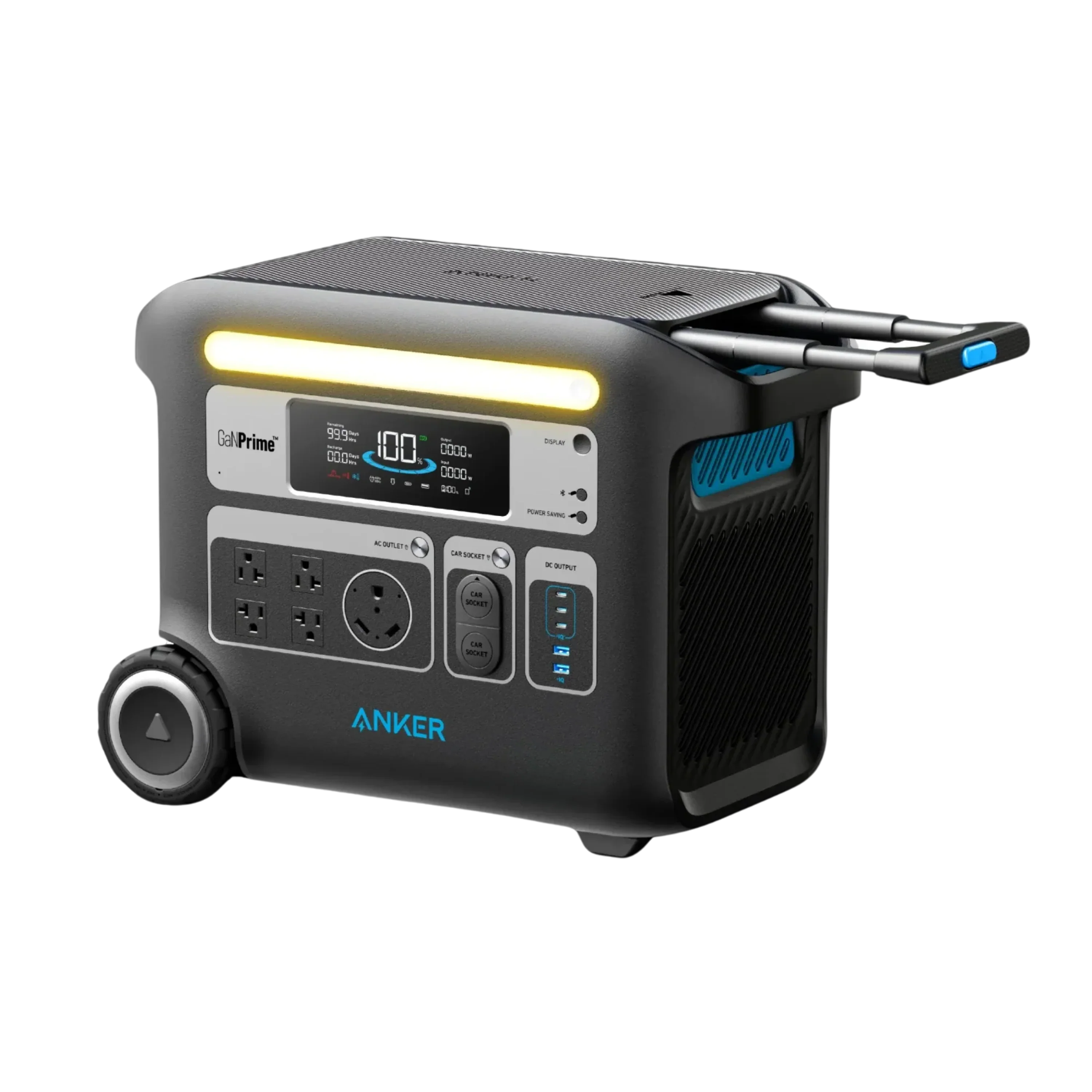
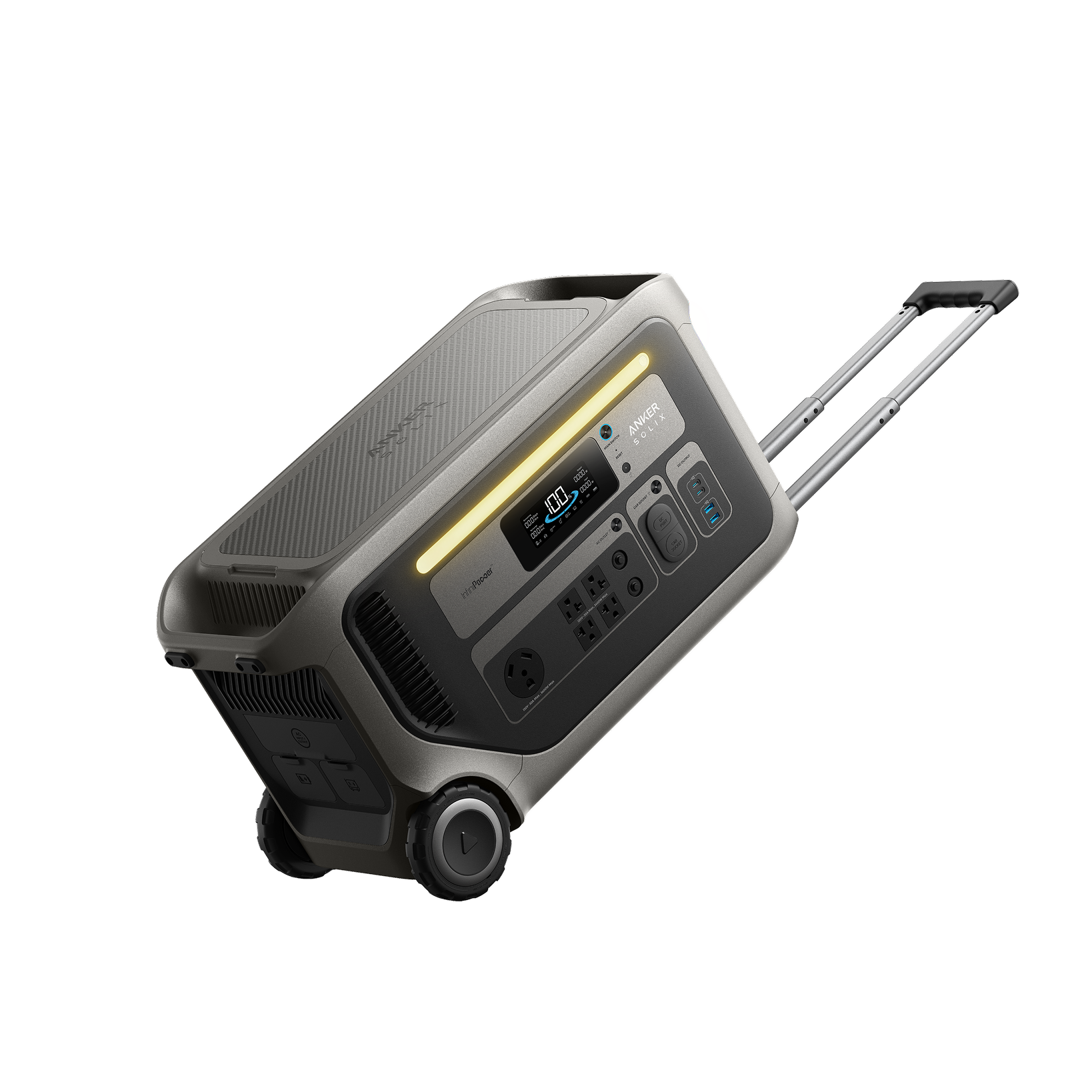
Twenty-four pounds separates them, 67.2 for the F2000 against 91.5 for the F3000, and both hide it behind wheels and a telescoping handle. On flat ground the difference barely registers: owners picked the F2000 largely for that roll-like-luggage designA1, and the F3000's reviewer found its wheels and handle just as solidB1. The weight reappears the instant you have to lift. One F3000 tester, at 92 lbs, said the unit 'barely passed' his own manual-lift test even with the handleB8, a warning the lighter F2000 never triggers.
So the portability question isn't whether you can move it, since both roll fine. It's whether you'll ever pick it up. Into a truck bed, down basement stairs, over a gunwale, onto a shelf: those are the moments that weight lands on one person's back, and there the F2000 is the easier machine to live with. If it only ever rolls from garage to driveway, call weight a wash and decide on capacity instead.
What the Specs Don't Tell You
Selected because: Surge headroom decides motor loads, the F3000's 7,200W against the F2000's 2,800W, and the F3000 carries its own real-world quirks worth knowing before you buy.
rated cycles
The surge ceiling is the spec that earns the F3000 its keep for motor loads. Its inverter tops out at 7,200W, double its 3,600W continuous rating, while the F2000's 2,800W surge sits just 400W above its own 2,400W. Fridges, AC compressors, and power tools spike to 2-3x their running draw for the instant they start, and that 400W cushion is exactly where a big compressor punches through; the F3000's headroom absorbs the same kick. One reviewer ran a Vitamix that trips 20A breakers elsewhere on the F3000 without a hiccupB9.
The F3000 carries its own quirks, and naming them is only fair before you spend more on it. It will shut itself off if you run two heavy appliances like an air fryer and a microwave at onceB2, its four AC outlets sit close enough that a fat adapter blocks its neighborsB6, and Anker moved to a bulky proprietary twist-lock charging plug that awkwardly tucks under the unitB7. None is a dealbreaker; together they're the kind of daily-use friction no spec sheet lists.
Strengths & trade-offs
Anker SOLIX F2000
Strengths
- +Lighter by 24.3 lb
Trade-offs
- –Weaker inverter (-1,200W) limits appliance compatibility.
- –Shorter-lived battery — rated for 3,000 charge cycles vs the SOLIX F3000's 4,000, so it wears out sooner.
Anker SOLIX F3000
Strengths
- +Larger battery capacity
- +Higher AC output
- +Faster solar charging
- +Rated for 4,000 charge cycles — much longer battery lifespan
Trade-offs
- –Significantly heavier (+24.3 lbs), making it harder to move.
- –Very heavy unit that may be difficult for one person to lift.
Will It Power Your Gear?
Scenario math and per-appliance runtimes, modeled from the spec record.
Scenario verdicts
We ran the math on six real-world scenarios. Here's which unit survives your actual life.
SCN-01 · 2 nights · needs 2,100Wh
Weekend Camping
Two nights off-grid with essential comfort
SOLIX F3000
This is the one scenario that cleanly separates them. The 2,100Wh a camping weekend asks for lands just past the F2000's 1,741Wh usable, so it stops 359Wh short somewhere in the small hours of night two. The F3000 clears the same load with 511Wh to spare. If a full weekend off-grid is your actual use, this scenario is the whole argument.
Battery budget usedlower = more headroom
LOAD Phone Charger 15W×6h · LED Lights 40W×8h · Box Fan 75W×14h · CPAP Machine 40W×16h
SCN-02 · 8 hours · needs 1,645Wh
8-Hour Blackout
Keep the essentials running through a night without power
SOLIX F3000
Both make it through the night; the difference is what's left at dawn. The F2000 ends at 94% drained with 96Wh in reserve, enough to restart a router and not much more. The F3000 finishes at 63% with 966Wh, most of a second evening still banked. Buy on how long your outages actually tend to run.
Battery budget usedlower = more headroom
LOAD Fridge 150W×8h · Router + Modem 20W×8h · LED Lights (4 bulbs) 40W×6h · Phone Charger 15W×3h
SCN-03 · 8 hours · needs 320Wh
CPAP Overnight
Sleep therapy without interruption — the #1 medical use case
Either unit
A CPAP pulls about 40W, so eight hours barely touches either — 18% off the F2000, 12% off the F3000. Capacity decides nothing here; both have nights of headroom. Neither Anker publishes a noise figure, so the fan you might hear at 3 a.m. is the one thing you can't check from this page — settle it on price and weight, because on runtime this is a dead heat.
Battery budget usedlower = more headroom
LOAD CPAP Machine 40W×8h
SCN-04 · 8 hours · needs 910Wh
Remote Workday
Full work day off-grid without power anxiety
SOLIX F3000
Both clock out with plenty to spare; this is a light day for either. The F2000 ends a 910Wh workday at 52% with 831Wh of slack, the F3000 at 35% with 1,701Wh. Unless your desk hides a space heater, the extra reserve here is bragging rights rather than necessity — let the heavier scenarios decide.
Battery budget usedlower = more headroom
LOAD Laptop 60W×8h · External Monitor 30W×8h · Router + Modem 20W×8h · Phone Charger 15W×2h
SCN-05 · 4 hours · needs 670Wh
Tailgate Party
Game day power for the crew
SOLIX F3000
Game day is a light electrical load and a heavy carrying one. Both cover the 670Wh easily, the F2000 at 38% used and the F3000 at 26%, so the number you'll actually feel is the walk from the truck: 67.2 lbs versus 91.5. On a tailgate, the lighter unit tends to win the day it's needed.
Battery budget usedlower = more headroom
LOAD Blender 400W×0.5h · LED TV (55") 80W×4h · Bluetooth Speaker 15W×4h · Phone Charger (×3) 45W×2h
SCN-06 · 24 hours · needs 4,685Wh
Van Life Daily
A full day of mobile living — the ultimate endurance test
Neither unit
Neither unit is a full-time van's daily driver. A 4,685Wh day leaves the F2000 2,944Wh short and the F3000 2,074Wh short, 37% and 56% covered. Run one as an essentials bank for the fridge, lights, and devices and plan to recharge hard off solar, or step up to a larger system built for the whole load.
Battery budget usedlower = more headroom
LOAD Mini-Fridge 150W×24h · Laptop 60W×4h · Phone Charger 15W×3h · LED Lights 40W×5h · Fan 75W×8h
The Load Test
RUNTIME = (Wh × 0.85) ÷ LOAD
None of the scenarios above exactly yours? Build it. Toggle what you'd plug in; both units are tested against the combined draw.
Essentials
Comfort & Convenience
High-Draw Appliances
Test duration
8h
Continuous draw
205W
Projected runtime
For this load: SOLIX F3000 runs 12.7h vs 8.5h.
Sold on Amazon
Planning for more than this? Describe your whole setup and get it sized →
Modeled from the spec record — same math as the tables below. Methodology
Runtime by appliance
Real-world runtime estimates for common appliances, modeled at 85% inverter efficiency.¹
Essentials
The basics you need runningscale 0–174.1hComfort & Convenience
Makes off-grid life actually enjoyablescale 0–34.8hHigh-Draw Appliances
These reveal the real limitsscale 0–2.6h¹ Runtime = (capacity × 0.85) ÷ appliance watts. Within each group, all bars share one time scale (the group's longest runtime), so lengths are comparable across appliances; identical runtimes collapse into a single blue/orange bar. Actual runtime varies with battery age, temperature, and simultaneous loads — see methodology.
Conclusion
August 30, 2026
Verdict: the SOLIX F3000, on Power Score margin
Buy the F3000 unless you're certain your heaviest day fits under the F2000's ceiling. It's the only one of the two that finishes a 2,100Wh camping weekend, it walks out of an 8-hour blackout with 966Wh in reserve against the F2000's 96Wh, its 7,200W surge starts motor loads the F2000's 2,800W might stall, and across its rated life it delivers energy cheaper at $0.12 per kWh versus $0.15. The F2000's case is real but narrower: if your loads sit under about 1,700Wh usable and you'd rather keep $600 (on last listed prices) and carry 24 fewer pounds, it does that job identically. Moderate confidence, because a large share of buyers genuinely land on the F2000's side of that line.
Editor-assigned confidence, based on cited owner research and spec analysis.
List prices as of August 30, 2026. The links below open Anker's current price.
Sold on Amazon · today’s price is on the listing
Written by Gunner Gustafson, Whole-Home Backup Tester · Station Arena Test Desk · Updated August 30, 2026
Measured Data
Benchmark scores and the full spec record, side by side.
Benchmark scores
Not rated for both units (minimum threshold unmet): Tailgating, Apartment Balcony.
Full specifications
ᵈ Derived: price ÷ rated capacity. See the data behind our comparisons →
Comparison ToolAdd more power stations, side by sideOpen Tool →How these numbers are produced
Numeric verification
Every figure on this page traces to our spec database or arithmetic on it — no estimated numbers.
Owner claims
Statements about owner experience are cited to published reviews — see Sources & Research Notes below.
Runtime model
Runtime = (rated capacity × 0.85 inverter efficiency) ÷ device wattage. Solar recharge estimates assume panels deliver 70% of rated output. Cold weather, battery age, and stacked loads reduce real-world results.
Power Score
Computed from 14 published spec dimensions, weighted per use-case bench. Higher is better; a unit must meet a bench's minimum threshold to be rated.
See the full weight table and data sourcing on our methodology page →Class ranking (the star rating)
Each unit's star score is a category ranking, not customer reviews — no buyer opinions feed it. We score every station on size-independent quality (value, output, portability, endurance, ports, warranty, and more), then percentile-rank it against the other units in its capacity class, so a class-leading compact unit and a class-leading whole-home unit can both earn 5★. Here, SOLIX F2000 rates 3.7/5 (24th percentile of 26 Large-class units), and SOLIX F3000 rates 4.8/5 (88th percentile of 26 Large-class units).
How the class ranking is computed →Test Notes & Caveats
Hidden gotchas and advantages we spotted that you won't find on the product page.
24 Pounds, and When You'll Feel It
Both roll on wheels, so the 24-pound gap between the 67.2-lb F2000 and the 91.5-lb F3000 all but vanishes on flat ground. It comes back the instant you lift — a truck bed, basement stairs, a boat — where it lands on one back rather than two. If the unit mostly rolls, ignore this line; if it climbs, the lighter F2000 is the easier one to live with.
Surge Headroom: Why the F3000 Starts Motors
The F3000 surges to 7,200W, double its 3,600W continuous rating, while the F2000's 2,800W surge sits just 400W above its own 2,400W. Motors — fridges, pumps, compressors — briefly pull 2-3x their running draw at startup, and that thin cushion is where the F2000 is likeliest to trip. If starting motor loads is on your list, this is the F3000's clearest advantage.
Warranty: No Difference
Both units carry the same 5-year warranty, so coverage isn't a tiebreaker here.
Battery Lifespan in Real Years
The SOLIX F3000 is rated for 4,000 cycles vs 3,000. In real life: at daily use, that's 11 vs 8.2 years. At weekend use (twice a week), it's 38 vs 29 years. One caution reading years across different sizes: a cycle is 3,072Wh on the SOLIX F3000 and 2,048Wh on the SOLIX F2000, so count lifetime energy — roughly 12,288 kWh against 6,144 kWh over the rated life. After hitting the cycle limit, the battery doesn't die — it drops to ~80% of original capacity, which is still very usable.
Full record above — the Test Desk pick is the SOLIX F3000.
Check SOLIX F3000 price →Ownership Analysis
What happens after you buy — true cost of ownership, brand trust, and growth potential.
Lifetime value
Service lifeyears at one full cycle per day
Lifetime energy delivered
Cost per delivered kWh
│ warranty ends · Reaching the cycle rating means ~80% capacity remains — degraded, not dead.
Analyst note
The SOLIX F2000 is no longer sold, so there is no price to work its cost per kWh from, and this comparison doesn't quote one. On what you can actually buy today, the SOLIX F3000 works out at $0.12/kWh over its rated life. If you already own the SOLIX F2000, the hardware comparison still holds: over its rated life the SOLIX F2000 delivers about 6,144 kWh and the SOLIX F3000 about 12,288 kWh.
Growth path
SOLIX F2000
EXPANDABLESupports Anker expansion batteries, so you can add capacity later without replacing the base unit — useful if your needs may climb past 2,048Wh.
Accepts up to 1,000W of solar. Enough for a serious multi-panel array.
Adequate ports for most setups, but heavy users may want a power strip.
Expansion batteries are Anker-specific. You're investing in the Anker ecosystem.
SOLIX F3000
EXPANDABLESupports Anker expansion batteries, so you can add capacity later without replacing the base unit — useful if your needs may climb past 3,072Wh.
Accepts up to 2,400W of solar. Enough for a serious multi-panel array.
Limited ports. You'll likely need a power strip or splitter.
Expansion batteries are Anker-specific. You're investing in the Anker ecosystem.
Realistic full solar rechargeat 70% of rated panel output — see methodology
Analyst note
Growth only counts if you can still buy in, and the SOLIX F2000 is no longer sold (Anker points owners to the SOLIX C2000 Gen 2). That leaves the SOLIX F3000: it starts at 3,072Wh and takes Anker expansion batteries, so the ceiling moves if your needs do. The SOLIX F2000's expandability still matters if you already own one, but it isn't a reason to pick it over the SOLIX F3000.
What Owners Report
Patterns from published owner reports and long-term reviews — every claim cited to its source below.
Anker SOLIX F2000
The F2000's field picture is review-sourced rather than forum-deep, so read it as solid but shallowA0. What comes through consistently is the hardware you touch first: the 4.72-inch wheels and retractable EasyTow handle are the headline, and the most-cited reason owners picked it over similar-spec rivalsA1. The app draws praise for monitoring, and a meaningful number of owners report Anker proactively fixing issues with firmware updates or replacementsA2.
For the everyday RV stack — fridge, CPAP, lights, fans, internet, TV, small kitchen appliances — reviewers call it quiet, capable, and quick to deployA3, running the same LFP chemistry rated past 3,000 cycles that Anker uses across the lineA4. It's a positive record, just not a deep one: plenty of review coverage, fewer long-haul owner reports to lean onA0.
“It's big and full of heavy batteries, but the durable 4.72-inch wheels and retractable EasyTow handle make it surprisingly easy to lug around — most positive reviews cite the wheels and telescoping handle as a top reason owners chose it over similar-spec competitors.”
Sources
rvoutfitting.com · trustedreviews.com · ankersolix.com · storagereview.com · generatorpeak.com
Anker SOLIX F3000
The F3000 has about a year of field exposure and several hands-on tested reviews behind itB0, and two themes dominate. It runs quiet — one reviewer called it 'practically silent even under heavy loads'B5 — and it barely sips at idle, with a lab measuring 20.5W against Anker's own 25W spec, so it can sit in standby for days without draining itselfB4. Build quality reads solid too: the handle doesn't wiggle, the wheels roll smoothly, and one reviewer lifted it alone without straining after a two-hour drive to a picnicB1.
The catches are specific and worth knowing before you buy. It will shut itself off if you run an air fryer and a microwave together, so heavy loads have to be staggeredB2. The four AC outlets sit close enough that a fat adapter blocks its neighborsB6, Anker switched to a bulky proprietary twist-lock charging plug that barely tucks under the unitB7, and one tester couldn't charge a Cybertruck because the outlet isn't groundedB10. None is a dealbreaker; all are the kind of thing you'd rather learn here than in your driveway.
“Nothing feels cheap or loose — the handle doesn't wiggle and the wheels roll smoothly; the reviewer could lift it alone without straining after taking it to a family picnic two hours away.”
Sources
androidauthority.com · thesolarlab.com · cleantechnica.com
Sources & Research Notes
Every owner claim in this report is traceable to a published source. The bracketed references above resolve here.
Recurring owner themes
- The wheels + retractable handle are the standout, repeatedly-cited reason owners pick the F2000; app monitoring and responsive Anker support are also praised. [SOLIX F2000 · 2 entries]
- Low idle draw and quiet operation are repeatedly cited as the biggest improvements over earlier Anker SOLIX models (F3800/F2600), which reviewers said struggled on both fronts. [SOLIX F3000 · 2 entries]
- Wheels and a deployable handle make the ~90 lb unit manageable to move, but reviewers still describe manually lifting it as a real effort. [SOLIX F3000 · 2 entries]
- Reviewers hit real-world output limits the spec sheet doesn't convey — simultaneous heavy appliance loads and ungrounded high-draw EV charging both triggered shutoffs/failures. [SOLIX F3000 · 2 entries]
- The outlet layout and the switch to a proprietary twist-lock AC charging plug are the most consistent physical-design complaints. [SOLIX F3000 · 2 entries]
- A1
“It's big and full of heavy batteries, but the durable 4.72-inch wheels and retractable EasyTow handle make it surprisingly easy to lug around — most positive reviews cite the wheels and telescoping handle as a top reason owners chose it over similar-spec competitors.”
rvoutfitting.com / trustedreviews.com — Anker SOLIX F2000 (PowerHouse 767) review · 2025-2026 · [positive]
- A2
“WiFi and Bluetooth app lets you monitor battery, charging, and customize power usage; a meaningful number of owners reported Anker proactively solving issues with firmware updates or replacements.”
ankersolix.com / storagereview.com — F2000 review · 2025-2026 · [positive]
- A3
“For the loads RVers run most — fridge, CPAP, lights, fans, internet, TV, small kitchen appliances — the F2000 is usually quiet, capable, and easy to deploy fast.”
rvoutfitting.com — Anker SOLIX F2000 review · 2026 · [positive]
- A4
“Uses the same long-lasting LFP battery reliability as Anker's other models, rated over 3,000 cycles for years of off-grid or backup use.”
trustedreviews.com / generatorpeak.com — F2000 review · 2025-2026 · [positive]
- B1
“Nothing feels cheap or loose — the handle doesn't wiggle and the wheels roll smoothly; the reviewer could lift it alone without straining after taking it to a family picnic two hours away.”
androidauthority.com — Anker SOLIX F3000 review · 2025-08 · [positive]
- B2
“The battery will often turn itself off if you try to run an air fryer and a microwave at the same time, so simultaneous heavy loads need to be staggered rather than run together.”
androidauthority.com — Anker SOLIX F3000 review · 2025-08 · [mixed]
- B4
“Measured idle draw was 20.5W with only the inverter active — beating Anker's own 25W spec — so it can sit in standby for days without chewing through the battery.”
thesolarlab.com — Anker F3000 Review: Does It Finally Get It Right? · 2025 (exact date unknown) · [positive]
- B5
“Practically silent even under heavy loads — a marked improvement over earlier Anker models that struggled with fan noise.”
thesolarlab.com — Anker F3000 Review: Does It Finally Get It Right? · 2025 (exact date unknown) · [positive]
- B6
“The four standard AC outlets are a bit too close together — plugging in larger adapters or chargers can block the others.”
thesolarlab.com — Anker F3000 Review: Does It Finally Get It Right? · 2025 (exact date unknown) · [negative]
- B7
“Anker switched to a proprietary twist-lock AC charging plug; positioned upright, the bulky plug barely fits underneath the unit.”
thesolarlab.com — Anker F3000 Review: Does It Finally Get It Right? · 2025 (exact date unknown) · [negative]
- B8
“At 92 lbs the built-in wheels and extendable handle make it more portable, but it 'barely passed' the reviewer's own manual-lift test.”
thesolarlab.com — Anker F3000 Review: Does It Finally Get It Right? · 2025 (exact date unknown) · [mixed]
- B9
“Ran a high-power Vitamix blender that pops 20A breakers elsewhere without issue during testing.”
cleantechnica.com — Anker SOLIX F3000 Portable Power Station: CleanTechnica Tested · 2025-08 · [positive]
- B10
“Charging a Cybertruck from the F3000 was not successful because the outlet isn't grounded — a real-world limitation the spec sheet doesn't flag.”
cleantechnica.com — Anker SOLIX F3000 Portable Power Station: CleanTechnica Tested · 2025-08 · [negative]
Research compiled August 30, 2026.
What Owners Actually Report
Drawn from 36 comments on independent review channels — not from retailer reviews, which skew to the first week of ownership. Each line is our summary of one commenter's claim, linked to the original. We record what they said, including where it contradicts the spec sheet.
Anker SOLIX F2000
21 claims from 12 comments · 13 from owners · 3 with figures
- Price & value
- 6 · 10% negative
- Runtime
- 1 · 0% negative
- Solar input
- 3 · 100% negative
- Noise
- 2 · 0% negative
- Inverter & surge
- 1 · 0% negative
What owners complain about
The 60V solar charging limit is the main bummer holding it back.
Solar inputowner3 agreedsource →
Reconnecting grid power briefly shut down all AC outputs, so he returned it.
UPS switchoverowner1 agreedsource →
His two-year-old SOLIX F2000 died last week and cannot be owner-diagnosed or repaired.
Durabilityownerafter 24 months1 agreedsource →
What owners praise
Ordered the F2000 with three 400W panels, each piece over 30% off on Black Friday.
Price & valuemeasuredowner5 agreedsource →
With the expansion battery it ran a small fan for two days and powers a gaming setup 8-10 hours.
Runtimemeasuredowner3 agreedsource →
Runs anything in the 1-2400W range with roughly 3000W surge.
Inverter & surgeowner3 agreedsource →
Anker SOLIX F3000
37 claims from 24 comments · 28 from owners · 8 with figures
- Runtime
- 4 · 0% negative
- Solar input
- 7 · 0% negative
- Other
- 6 · 14% negative
- Price & value
- 4 · 74% negative
- Build quality
- 4 · 0% negative
What owners complain about
Bought near $2000 at launch in a panel bundle; price has since fallen to about $1200.
Price & valuemeasuredowner115 agreedsource →
Bidirectional adapter caps output at 15A on one phase, effectively halving the F3000.
Inverter & surgemeasuredowner10 agreedsource →
On grid loss the bidirectional adapter shuts down, so backup is not automatic.
UPS switchoverowner10 agreedsource →
What owners praise
One F3000 on an inlet switch ran everything but 240V loads for 5 days on one tank of generator gas.
Runtimemeasuredowner122 agreedsource →
F3000 has been great with a 3600W inverter and 1600W solar input.
Solar inputowner7 agreedsource →
Replaced the AC200L with an F3000 for its 30A in and 30A out capability.
Otherowner5 agreedsource →
Claims are weighted by how specific they are, whether the commenter owns the unit, and how many readers agreed. Comments that mention a product under a rival's review count for more, because the commenter had no reason to be there. This is what buyers report, not our test results — for measurements we ran ourselves, see the methodology.
Who Should Buy Which
Buy the SOLIX F2000 if you…
- →The weekend camper or occasional-backup buyer whose biggest day stays under about 1,700Wh usable, who gets the same LFP platform and five-year warranty for $600 less (on last listed prices).
- →Anyone who'll routinely lift the unit into a truck bed, down to a basement, or onto a boat, where 24 fewer pounds is felt on every trip.
- →The budget-capped buyer who wants a 2,400W station and is happy to stage heavy appliances rather than run them all at once.
Buy the SOLIX F3000 if you…
- →The buyer whose sessions cross about 2,000Wh or who wants a real second-night blackout cushion: only the F3000 finishes the 2,100Wh weekend and ends the 8-hour night with 966Wh to spare.
- →Anyone starting motor loads — a fridge plus AC, a well pump, big power tools — where the 7,200W surge ceiling is the margin between running and tripping.
- →The daily or heavy cycler chasing lowest lifetime cost, at $0.12 per lifetime kWh across 12,288 kWh, with a 2,400W solar ceiling for faster off-grid refills.
If neither fits
If your daily draw runs up around the 4,685Wh of a full off-grid day — a residential fridge plus induction cooking plus AC around the clock — neither finishes; the F2000 falls 2,944Wh short and the F3000 2,074Wh. Look at a larger dedicated system or a two-battery setup built for that load instead.
The Bottom Line
The F3000 is the better machine and, against intuition, the cheaper one to own over its life: roughly double the lifetime energy for 67% more money nets out to $0.12 a kilowatt-hour against $0.15. It clears the loads the F2000 chokes on, starts the motors the F2000 might stall, and runs quiet doing itB5.
But better and right-for-you aren't the same question. If your biggest day fits under about 1,700Wh usable and you're not staging a fridge-and-AC startup, the F2000 does that job for $600 less (on last listed prices) and 24 fewer pounds, on the same five-year warranty and the same LFP platform. Size the unit to your heaviest real day, not the one you imagine, and if the smaller number covers it, keep the $600 (on last listed prices).
Frequently Asked Questions
Answers drawn from the spec record and cited owner research.
Is the Anker SOLIX F3000 worth $600 more (on last listed prices) than the F2000?
If your loads cross about 1,700Wh usable or you want a second-night blackout buffer, yes — the F3000 is the only one that finishes a 2,100Wh weekend, and it's cheaper per lifetime kilowatt-hour at $0.12 versus $0.15. If your biggest day stays comfortably under that, no — the F2000 does the same work for $600 less (on last listed prices).
What's the real capacity difference between the F2000 and F3000?
Nameplate is 2,048Wh versus 3,072Wh, but you actually use about 85% of that after conversion losses: roughly 1,741Wh against 2,611Wh. That 870Wh of usable difference is what decides whether a 2,100Wh weekend gets covered or comes up short.
Can either one run a full-size fridge and AC at the same time?
The F3000 is built for it: its 7,200W surge is double its 3,600W continuous rating, enough to absorb the compressor startup spikes that hit 2-3x running draw. The F2000's 2,800W surge sits only 400W above its continuous rating, so it's likelier to trip on a big motor start. Even the F3000 will shut off if you stack two heavy appliances like an air fryer and a microwave at once.
Which Anker SOLIX is quieter for CPAP or bedroom use?
Neither publishes a dBA figure, so there's nothing official to compare. Field reports call the F3000 'practically silent even under heavy loads', while the F2000 is described as usually quiet but without measurements. A CPAP only pulls about 40W, so both have capacity to spare — the real unknown is fan behavior you can't read off a spec sheet.
How long will each one last?
The F2000 is rated for 3,000 charge cycles and the F3000 for 4,000 — about 8.2 versus 11 years at daily use, or 29 versus 38 years at a twice-a-week weekend pace. Counted as energy, that's 6,144 versus 12,288 kWh over the rated life. Neither dies at the end; they settle to about 80% of original capacity and keep going.
Where to buy
Anker SOLIX F2000
No longer sold
Anker SOLIX F3000Pick
Sold on Amazon · today’s price is on the listing
Prices may vary by retailer and are subject to change.