Head-to-head test
Anker SOLIX C800X vs Anker SOLIX S2000
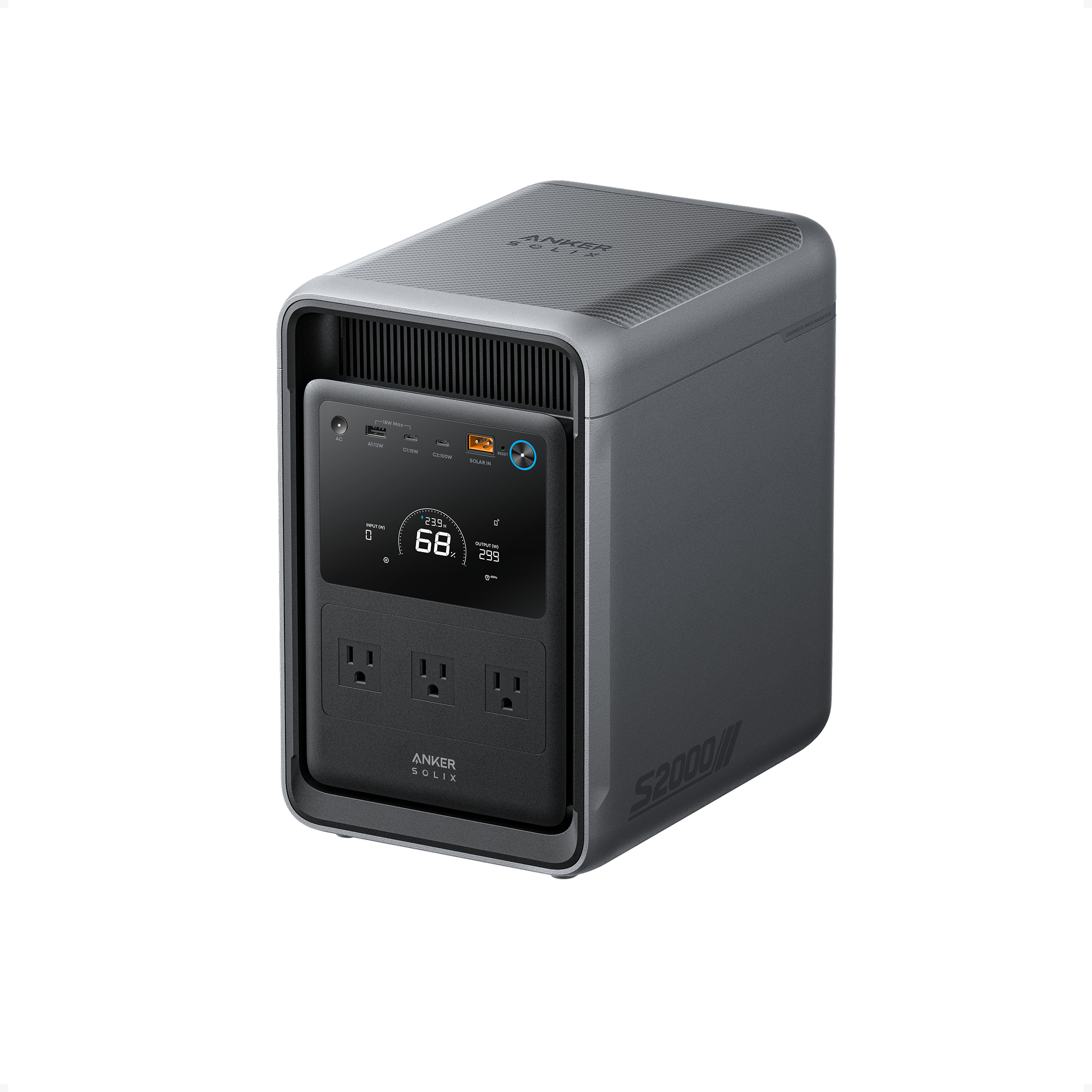
Anker SOLIX C800X vs Anker SOLIX S2000: the S2000 carries 2,009.6Wh to the C800X's 768Wh, doubles the surge ceiling to 3,000W, and is rated for at least 10,000 cycles against 3,000. Take the S2000 unless you'll carry it more than you run it, where the C800X's 24 pounds against 35.7 settles it.
Full profiles: Anker SOLIX C800X → · Anker SOLIX S2000 →

Written by Ian SchneiderUpdated
Solar & Off-Grid Tester, Station Arena Test Desk
Spec deltas
The S2000 holds 2,009.6Wh to the C800X's 768Wh, and on the six load profiles below that gap decides five of them. The C800X finishes exactly one, the CPAP night, and comes up 17Wh short on a tailgate, 257Wh short on a remote workday, and 992Wh short of an eight-hour blackout. $250 more buys the box that gets to the end of four.
The part that isn't about capacity is the part worth reading. The C800X runs 1,200W continuously but peaks at only 1,600W, and motors pull two to three times their running wattage at the instant they start. Do that division: the biggest motor it can count on starting draws about 800W, which is four hundred watts below what the inverter is rated to hold. So there's a strip of loads it will run all afternoon and stall on when you flip the switch. The S2000's 3,000W peak is exactly double its 1,500W rating, and that strip closes.
Buy the C800X if you're the one carrying it. At 24 lbs it's a one-hand lift against 35.7, it refills from 300W of sun in about two and a half hours rather than five, and the CPAP it was probably bought for uses half of what it can usably deliver. Everywhere else here, the bigger box is the one that finishes the job.
What the Numbers Reveal
Each conclusion stated first — the numbers behind it on one line, the full analysis below.
continuous output
The S2000's peak is exactly twice its rating, so at the same 2x multiplier the band is zero wide: anything it can run, it can start. Push the multiplier to 3x and both units have a gap, but the C800X's opens at about 530W, which is ordinary-appliance territory, where the S2000's doesn't open until 1,000W.
C800X: 1,200W rated output, 1,600W published peak, a 1.3x ratioS2000: 1,500W rated output, 3,000W published peak, a 2x ratioFridges, AC compressors and power tools briefly draw 2-3x their rated wattage at startup
Why it mattersAnyone with a compressor or a motor on their list should size against the surge ceiling rather than the continuous rating, and on the C800X that ceiling starts biting well below the number printed on the box.
rated cycles
The years figures actually understate it. At daily use the ratings come out at 27.4 years against 8.2, but a cycle isn't the same thing on the two boxes: the smaller unit gets fewer cycles and each one moves less than half as much energy. Both cycle ratings are minimums, so the spread is a floor rather than a forecast, and neither pack dies at the limit. It settles to about 80% of what it started with.
C800X: at least 3,000 cycles at 768Wh, for 2,304 kWh of rated lifetime energyS2000: at least 10,000 cycles at 2,009.6Wh, for 20,096 kWhBoth units carry the same 5-year warranty
Why it mattersIf the unit is going to live in a closet and come out four times a year, the price gap is the whole argument for the C800X, and the lifetime arithmetic is what dissolves it.
weight
What noise figure exists for the C800X traces to a single affiliate site's unverified in-house testA16A0, while two independent hands-on reviews of the S2000 separately found its fans silent at idle and spinning up only under heavy load or the fastest charging modeB1B2. So the lighter, cheaper box is the one you'd be buying on faith, in the exact application where faith is the wrong instrument.
CPAP Overnight needs 320Wh; the C800X spends 49% of its usable capacity on it, the S2000 19%The S2000 publishes a 30dB noise figure; Anker publishes none for the C800XC800X 24 lbs against the S2000's 35.7
Why it mattersThe CPAP buyer reaching for the smaller unit should hear one first, or take the box that at least prints a number.
solar input
On a camping weekend neither unit simply lasts, so both are recharging anyway, and the question stops being which holds more and becomes which gets back to full faster between loads. That's the one axis on this page where the C800X leads, and it leads by roughly half.
C800X: 768Wh over a 300W solar inputS2000: 2,009.6Wh over a 400W solar inputWeekend Camping needs 2,100Wh; the S2000 covers 81% of it, the C800X 31%
Why it mattersSolar-only campers running a short list of small loads are the buyers for whom the C800X is the right answer rather than the cheaper one.
The specific dimensions that decide these two units — everything else is a tie.
Your Life, Your Pick
Selected because: The C800X clears one of the six load profiles below and misses a second by 17Wh; the S2000 clears four. That spread is the purchase decision.
One pass out of six, and the pass is a night a CPAP spends drawing about 40W. That's the C800X's record here, and it describes what 768Wh is rather than indicting the unit: a long evening, not a day. The misses aren't all the same size, though, and the difference matters. Being 17Wh short on a tailgate is an editing problem. Being 992Wh short of an eight-hour blackout is a category error.
The S2000 takes four and loses the same two the C800X does: the 2,100Wh camping weekend, where it's 392Wh short, and the 4,685Wh van-life day, where it's 2,977Wh short. Read that as the outer edge of this whole pairing. Above roughly two kilowatt-hours of daily draw, the answer is a bigger station, not either of these two.
What the Specs Don't Tell You
Selected because: Two cards here decide more than the spec table does: a 1,600W surge ceiling sitting on a 1,200W inverter, and a noise figure only one of these units publishes.
rated cycles
The surge card is the one to read twice. Everything else on this page is about how much energy you get out; that one is about whether the thing you plug in will start at all. It's also the only spec where the C800X's number is worse than its own rating implies, because 1,600W of peak on a 1,200W inverter leaves 400W of headroom and a compressor wants two to three times its running draw for the first half-second.
The noise card cuts the opposite way to how it looks. The S2000 publishes 30dB and the C800X publishes nothing, which is a disclosure gap rather than a measurement, and it lands hardest on precisely the buyer who'd otherwise take the smaller unit. Shop for a bedroom and you get a number from one box and a shrug from the other.
Lifetime Value
Selected because: Identical 5-year warranties, but 2,304 kWh of rated lifetime energy against 20,096 kWh, which is where the price difference actually goes.
cost / lifetime kWh
Three cents a kilowatt-hour against twenty. Read that once and you can skip the rest: the S2000 is rated for at least 10,000 cycles of 2,009.6Wh, the C800X for at least 3,000 of 768Wh, and both carry the same five years of cover from the same brand.
The per-dollar framing in the table runs the other direction, and it's worth knowing why it means nothing. The C800X shows more years of cover per thousand dollars only because it costs less, not because Anker covers it any longer. Both terms are five years. If this unit is going to sit in a closet and come out four times a year, $250 is the entire argument for the smaller box, and the lifetime energy is the reason the argument doesn't hold.
Portability & Form Factor
Selected because: 24 lbs against 35.7 is the one line on this page that argues for the smaller unit, and it argues hard.
weight
24 lbs is a one-hand pickup off a tailgate. 35.7 is both hands and a plan, and reviewers at two different outlets independently flagged the same thing about the S2000: there's no dedicated handle for carrying it one-handed, so those 11.7 extra pounds land heavier than the figure suggestsB7B8. That's the honest catch against this page's pick, and it's the C800X's strongest card.
The small box also refills faster, which is the same advantage in different clothes. 768Wh through a 300W solar input is about two and a half hours of strong sun; the S2000 needs roughly five to move 2,009.6Wh through 400W. Carrying it and refilling it are the two things you do to a power station that aren't powering anything, and the C800X wins both. Whether that beats finishing the job depends entirely on how far from the car you're going.
Strengths & trade-offs
Anker SOLIX C800X
Strengths
- +Costs $250 less
- +Lighter by 11.7 lb
Trade-offs
- –Shorter-lived battery — rated for 3,000 charge cycles vs the SOLIX S2000's 10,000, so it wears out sooner.
Anker SOLIX S2000
Strengths
- +Larger battery capacity
- +Higher AC output
- +Faster solar charging
- +Rated for 10,000 charge cycles — much longer battery lifespan
Trade-offs
- –Substantially more expensive (+$250) than the SOLIX C800X.
- –Significantly heavier (+11.7 lbs), making it harder to move.
Will It Power Your Gear?
Scenario math and per-appliance runtimes, modeled from the spec record.
Scenario verdicts
We ran the math on six real-world scenarios. Here's which unit survives your actual life.
SCN-01 · 2 nights · needs 2,100Wh
Weekend Camping
Two nights off-grid with essential comfort
Neither unit
Neither box covers 2,100Wh: the S2000 gets 81% of the way there, the C800X 31%. Those are two different failures, not a tie. The S2000 misses the last stretch; the C800X misses most of the weekend. Which is where the small one earns something back, because 768Wh over a 300W solar input is about two and a half hours of strong sun for a full refill against roughly five for the S2000. If the sky is clear and your list is short, the C800X keeps up by refilling faster than it empties.
Battery budget usedlower = more headroom
LOAD Phone Charger 15W×6h · LED Lights 40W×8h · Box Fan 75W×14h · CPAP Machine 40W×16h
SCN-02 · 8 hours · needs 1,645Wh
8-Hour Blackout
Keep the essentials running through a night without power
SOLIX S2000
The S2000 finishes this with 63Wh left out of 1,708Wh usable, which is a win and a warning in the same figure. It covers the eight hours and arrives at the far end effectively empty, so plan the ninth hour before you need it. The C800X isn't in this conversation: 653Wh usable against the 1,645Wh needed is about 40% of the night, and it stops 992Wh short.
Battery budget usedlower = more headroom
LOAD Fridge 150W×8h · Router + Modem 20W×8h · LED Lights (4 bulbs) 40W×6h · Phone Charger 15W×3h
SCN-03 · 8 hours · needs 320Wh
CPAP Overnight
Sleep therapy without interruption — the #1 medical use case
Either unit
Both cover this and it isn't close. A CPAP is about 40W for eight hours, so the C800X spends 49% of what it can usably deliver and the S2000 19%, and capacity decides nothing. The fan decides it, and only one of these two publishes a noise figure, which makes the cheaper, lighter box the one you'd be buying on faith at the exact distance where faith doesn't help. If you can hear one before you buy, hear it.
Battery budget usedlower = more headroom
LOAD CPAP Machine 40W×8h
SCN-04 · 8 hours · needs 910Wh
Remote Workday
Full work day off-grid without power anxiety
SOLIX S2000
The SOLIX C800X doesn't finish — 653Wh usable against the 910Wh this needs leaves it 257Wh short, about 72% of the scenario covered. The SOLIX S2000 covers it with 798Wh to spare.
Battery budget usedlower = more headroom
LOAD Laptop 60W×8h · External Monitor 30W×8h · Router + Modem 20W×8h · Phone Charger 15W×2h
SCN-05 · 4 hours · needs 670Wh
Tailgate Party
Game day power for the crew
SOLIX S2000
The C800X loses this by 17Wh. Its nameplate 768Wh clears the 670Wh the profile needs, and the flat 15% conversion allowance applied to every unit on this site is what pushes it under, to 653Wh usable. So it's a miss you could fix by leaving one small appliance in the car. The S2000 never gets near the arithmetic, finishing with 1,038Wh spare.
Battery budget usedlower = more headroom
LOAD Blender 400W×0.5h · LED TV (55") 80W×4h · Bluetooth Speaker 15W×4h · Phone Charger (×3) 45W×2h
SCN-06 · 24 hours · needs 4,685Wh
Van Life Daily
A full day of mobile living — the ultimate endurance test
Neither unit
Neither unit covers this scenario's 4,685Wh: the SOLIX C800X comes up 4,032Wh short (about 14% covered), the SOLIX S2000 2,977Wh (36%). This is well outside what either unit is for; the right answer here is a larger station, not a choice between these two.
Battery budget usedlower = more headroom
LOAD Mini-Fridge 150W×24h · Laptop 60W×4h · Phone Charger 15W×3h · LED Lights 40W×5h · Fan 75W×8h
The Load Test
RUNTIME = (Wh × 0.85) ÷ LOAD
None of the scenarios above exactly yours? Build it. Toggle what you'd plug in; both units are tested against the combined draw.
Essentials
Comfort & Convenience
High-Draw Appliances
Test duration
8h
Continuous draw
205W
Projected runtime
For this load: SOLIX S2000 runs 8.3h vs 3.2h.
Sold on Amazon
Planning for more than this? Describe your whole setup and get it sized →
Modeled from the spec record — same math as the tables below. Methodology
Runtime by appliance
Real-world runtime estimates for common appliances, modeled at 85% inverter efficiency.¹
Essentials
The basics you need runningscale 0–113.9hComfort & Convenience
Makes off-grid life actually enjoyablescale 0–22.8hHigh-Draw Appliances
These reveal the real limitsscale 0–1.7h¹ Runtime = (capacity × 0.85) ÷ appliance watts. Within each group, all bars share one time scale (the group's longest runtime), so lengths are comparable across appliances; identical runtimes collapse into a single blue/orange bar. Actual runtime varies with battery age, temperature, and simultaneous loads — see methodology.
Conclusion
September 19, 2026
Verdict: the SOLIX S2000, on Power Score margin
Take the S2000. It covers the eight-hour blackout profile, the remote workday and the tailgate outright, where the C800X covers none of the three. Its 3,000W peak is exactly twice its 1,500W rating, so every load it can run it can also start. And 10,000 rated cycles at 2,009.6Wh against 3,000 at 768Wh works out to nearly nine times the lifetime energy for $250 more up front, under the same 5-year warranty on both. The C800X isn't a bad unit, it's a smaller one, and the case for it is physical: 24 lbs against 35.7, and a full solar refill in roughly half the time. If the box mostly stays put, that case doesn't survive the first outage.
Editor-assigned confidence, based on cited owner research and spec analysis.
List prices as of September 19, 2026. The links below open Anker's current price.
Sold on Amazon · today’s price is on the listing
or check the SOLIX C800X price$449.99 list
Written by Ian Schneider, Solar & Off-Grid Tester · Station Arena Test Desk · Updated September 19, 2026
Black Friday · 38 days out
Price to beat:SOLIX C800X $450
We have never seen it discounted, so any real cut would be a first.
Measured Data
Benchmark scores and the full spec record, side by side.
Benchmark scores
Not rated for both units (minimum threshold unmet): Home Backup.
Full specifications
ᵈ Derived: price ÷ rated capacity. See the data behind our comparisons →
Comparison ToolAdd more power stations, side by sideOpen Tool →How these numbers are produced
Numeric verification
Every figure on this page traces to our spec database or arithmetic on it — no estimated numbers.
Owner claims
Statements about owner experience are cited to published reviews — see Sources & Research Notes below.
Runtime model
Runtime = (rated capacity × 0.85 inverter efficiency) ÷ device wattage. Solar recharge estimates assume panels deliver 70% of rated output. Cold weather, battery age, and stacked loads reduce real-world results.
Power Score
Computed from 14 published spec dimensions, weighted per use-case bench. Higher is better; a unit must meet a bench's minimum threshold to be rated.
See the full weight table and data sourcing on our methodology page →Class ranking (the star rating)
Each unit's star score is a category ranking, not customer reviews — no buyer opinions feed it. We score every station on size-independent quality (value, output, portability, endurance, ports, warranty, and more), then percentile-rank it against the other units in its capacity class, so a class-leading compact unit and a class-leading whole-home unit can both earn 5★. Here, SOLIX C800X rates 4.3/5 (58th percentile of 20 Compact-class units), and SOLIX S2000 rates 5.0/5 (99th percentile of 26 Large-class units).
How the class ranking is computed →Test Notes & Caveats
Hidden gotchas and advantages we spotted that you won't find on the product page.
The loads it runs but won't start
The S2000 peaks at 3,000W on a 1,500W rating, exactly double, and double is the number that matters because motors pull two to three times their running wattage at startup. The C800X peaks at 1,600W on a 1,200W rating. Divide 1,600 by two and the biggest motor it can count on starting draws about 800W, while the inverter itself is rated to hold 1,200W. That 400W strip is a band of loads the C800X will run all afternoon and stall on when you flip the switch. Push the multiplier to three and both units have a band, but the C800X's opens at about 530W, ordinary-appliance territory, where the S2000's doesn't open until 1,000W. Check the startup draw of the heaviest motor on your list against 1,600W, not against 1,200W.
UPS Switchover: ≤10ms vs ≤20ms
Both list a UPS mode, at different rated speeds. The SOLIX S2000 is rated ≤10ms — quick enough on paper that desktop PCs and routers should ride through, treating that as the rating it is. The SOLIX C800X is rated ≤20ms — fine on paper for routers and most electronics; the fussiest PC power supplies sit right at this line. If a computer with unsaved work is the thing being protected, the stated class is worth the attention; nothing here is a lab result.
Warranty: No Difference
Both units carry the same 5-year warranty, so coverage isn't a tiebreaker here. Worth saying because the per-dollar framing can suggest otherwise: the SOLIX C800X works out at 11.1 years of cover per $1,000 spent against the SOLIX S2000's 7.1, but that spread is the price gap, not the terms.
Count the energy, not the years
At daily use the ratings work out to 27.4 years for the S2000 against 8.2 for the C800X, and the years understate the gap, because a cycle isn't the same thing on the two boxes. One S2000 cycle is 2,009.6Wh; one C800X cycle is 768Wh. Over their rated lives that's 20,096 kWh against 2,304 kWh, near enough nine times the energy. Both cycle figures are minimums, so the spread is a floor rather than a promise. And hitting the limit isn't death: the pack settles to about 80% of the capacity it started with and carries on.
Only one of these publishes a fan number
Anker publishes 30dB for the S2000 and nothing at all for the C800X. That isn't evidence the C800X is louder. It means there's no figure to hold it to and no way to compare the two here short of hearing them. Treat the 30dB as what it is, a spec-sheet number, and on most makers' sheets that is a best-case floor rather than what you'll hear at full charge. It still beats a blank. If this unit is going eighteen inches from your head all night, the blank is the spec that matters, and it's the one you can't look up.
Full record above — the Test Desk pick is the SOLIX S2000.
Check SOLIX S2000 price →or check the SOLIX C800X priceOwnership Analysis
What happens after you buy — true cost of ownership, brand trust, and growth potential.
Lifetime value
Service lifeyears at one full cycle per day
Lifetime energy delivered
Cost per delivered kWh
│ warranty ends · Reaching the cycle rating means ~80% capacity remains — degraded, not dead.
Analyst note
The SOLIX C800X is cheaper to buy, but the SOLIX S2000 is cheaper to own. At $0.03/kWh over its lifetime vs $0.20/kWh, the SOLIX S2000's higher cycle life and capacity make each dollar go further over the years.
Delivers each lifetime kWh for $0.17 less — check the SOLIX S2000 price →
Growth path
SOLIX C800X
FIXED CAPACITYFixed at 768Wh, with no expansion — so size it for your needs up front rather than planning to add capacity later.
Accepts up to 300W of solar. Limited to a single portable panel.
Adequate ports for most setups, but heavy users may want a power strip.
SOLIX S2000
FIXED CAPACITYFixed at 2,010Wh — a sealed, complete system rather than a starting point. There's no expansion port, so that figure is the ceiling: check it against your longest unplugged stretch before you buy.
Accepts up to 400W of solar. Suitable for a 1-2 panel setup.
Adequate ports for most setups, but heavy users may want a power strip.
Realistic full solar rechargeat 70% of rated panel output — see methodology
Analyst note
Neither expands, and that's no knock on either — each is a complete unit at a fixed size. Buy the capacity that covers your needs now (the SOLIX S2000 gives you the larger ceiling); you can't add to either later.
What Owners Report
Patterns from published owner reports and long-term reviews — every claim cited to its source below.
Anker SOLIX C800X
Field evidence on the C800X is thin and lopsided. Nearly all of it sits in comment threads under one YouTube channel's two videos, and the highest-traffic C800X review of the lot contains no measurements at all, as its own viewers pointed outA0A15. Every dB figure, fridge runtime and cold-weather number in circulation for this unit traces back to a single affiliate site claiming an in-house test nobody can verifyA16A17A18A0. That includes the one claim of it starting a 1,400W air conditionerA18. Read those as claims, not results.
What owners consistently report is confusion about which box they boughtA1A2A11. Buyers can't tell the C800X from the C800 and the C800 Plus, and the only difference anyone can name is a telescoping light pole in the top compartment, which as one owner notes costs you the storage cubby you'd otherwise fill with your own lights and cablesA11A2. Some feed an external LiFePO4 pack into the XT-60 solar input as a homemade expansion, and more experienced posters counter that it costs MPPT conversion losses and ties up the only charging input the unit hasA12A13. The hardware faults on record, an inverter shutting off on a false low-temperature reading indoors and a reverse-polarity AC outlet on early stock, are 2024 reports on threads the researcher couldn't pin to this exact model, so treat them as family history rather than a current verdictA7A9. One owner also spotted the C800X listed as Final Sale on Anker's Canadian site, which may mean nothing and may mean check stock before orderingA5.
“I am confused the Anker C800x isn't supposed to have the lights in the top compartment? Those are supposed to be in the Anker solix C800 plus.”
Sources
battenhomesecurity.com
Anker SOLIX S2000
The S2000 is new enough that everything here is weeks old rather than months, with no long-term owner reports in existence yetB0. What does exist is two independent hands-on tests rather than recycled press copy, and they agree on the thing that matters at night: the fans spin up only under heavy load or the fastest charging mode, and at idle the unit is silentB1B2. Both also measured standby draw separately, at about 6W with the AC ports armed and nothing plugged in, and around 2W with the outputs offB3B4. Against 2,009.6Wh, 6W of idle is roughly 335 hours, so about two weeks sitting armed before it empties itself.
The UPS behaviour was tested rather than quoted: office equipment rode through a simulated outage without interruption, and one reviewer ran a fridge and kitchen gear past 60 hours on a single chargeB9B10B12. A refill from a standard 20-amp household circuit reached 80% in about 1.2 hours and full in roughly 1.7B5. The complaint both outlets landed on is the carry handle, or the absence of oneB7B8. One reviewer also noted a warm-electronics smell in a closed home office during the first hours of sustained load, which faded after a dayB6.
“Fans only spin up under real load or fast charging, and at idle the unit is silent.”
Sources
ess-news.com · geardiary.com
Sources & Research Notes
Every owner claim in this report is traceable to a published source. The bracketed references above resolve here.
Recurring owner themes
- Buyers cannot tell the C800X apart from the C800 and C800 Plus; the top-compartment light pole is the only difference anyone can name, and owners say Anker's own materials never spell the lineup out. [SOLIX C800X · 4 entries]
- Anker's after-sales handling is polarised: one owner describes an order/RMA that Anker would not correct, another a no-quibble USB-C warranty repair returned within three days. [SOLIX C800X · 2 entries]
- Owners work around the absence of an expansion battery by feeding an external LiFePO4 pack into the 11-60V XT-60 solar input; experienced users counter that it costs MPPT conversion losses and occupies the only charge input. [SOLIX C800X · 2 entries]
- The hardware faults on record are all from 2024 units - a false low-temperature reading that shut the inverter off despite current firmware, and a reported reverse-polarity AC outlet on early stock - so they may not describe current production. [SOLIX C800X · 2 entries]
- Owners who kept the unit report it doing exactly the job they bought it for - UPS for a router and PCs, a heater on low, a toaster - with no reliability complaint after roughly a year. [SOLIX C800X · 2 entries]
- Every measured figure in circulation for this unit traces back to one affiliate site's unverified test; the highest-traffic C800X video review contains no measurements at all and viewers called it out. [SOLIX C800X · 4 entries]
- Two independent hands-on reviews both found near-silent idle operation, with fans spinning up only under heavy load or the fastest charging mode. [SOLIX S2000 · 2 entries]
- OptiSave's low-idle-draw claim held up under independent testing, with both reviewers separately measuring single-digit-watt standby draw. [SOLIX S2000 · 2 entries]
- Both reviewers praised fast, reliable UPS switchover that connected electronics didn't notice. [SOLIX S2000 · 2 entries]
- Despite otherwise solid build quality, reviewers from two different outlets independently flagged the single/absent carry handle as awkward for one-person transport. [SOLIX S2000 · 2 entries]
- A1
“I am confused the Anker C800x isn't supposed to have the lights in the top compartment? Those are supposed to be in the Anker solix C800 plus.”
youtube The Solar Lab — comment on "Anker C800X - Finally, a REAL Power Station for $499?" · 2025-11 · [mixed]
- A2
“I have same question re: the 800, 800X and 800 Plus. So far, only thing I know fir sure is that the X & + versions have flashlights & telescoping rod in top compartment, while the 800 does not... Anker doesn't spell it out anywhere I can find.”
youtube The Solar Lab — comment reply on "Anker C800X - Finally, a REAL Power Station for $499?" · 2024-10 · [negative]
- A5
“The C800X is showing as "Final Sale" on the Canadian site, so it sounds like it may be phased out soon.”
youtube The Solar Lab — comment on "What Power Station Do You Actually Need? - Anker SOLIX Edition" · 2026-07 · [mixed]
- A7
“I have the latest firmware on the C800, the temp drops suddenly from room temp (19C 66 F) to 4C 39 F and sometimes below freezing 0 C 32 F shutting off the AC inverter....this is when its inside my living room the entire time.”
youtube The Solar Lab — comment on "Anker C800X - Finally, a REAL Power Station for $499?" · 2024-12 · [negative]
- A9
“The first units they sent out were defective, ( reverse polarity ) on the 110 ac outlet! Ruined my window ac !”
youtube The Solar Lab — comment reply on "Anker C800X - Finally, a REAL Power Station for $499?" · 2024-09 · [negative]
- A11
“I already have flashlights and lanterns that take 18650 and 21700 lithium batteries, so I opted for the C800 without the lights for $429. I would rather have the extra storage space on top for my own lights, chargers and cables.”
youtube The Solar Lab — comment on "Anker C800X - Finally, a REAL Power Station for $499?" · 2024-07 · [mixed]
- A12
“Can't expand? Get a 5k to 15k rack mount battery. A cable to attach it to the solar input, done. Expanded... The rack mount battery is 52.1 volts and the solar input on the Anker can handle 60.”
youtube The Solar Lab — comment on "Anker C800X - Finally, a REAL Power Station for $499?" · 2024-08 · [positive]
- A13
“Yes its expandable××there losses going into the solar charge controller and then extra wear on the batteries as you're charging the internal batteries first then discharging them. Plus you're limited to the capacity of the mppt and you can no longer use it to charge the unit.”
youtube The Solar Lab — reply rebutting the XT-60 expansion workaround, on "Anker C800X - Finally, a REAL Power Station for $499?" · 2025-07 · [mixed]
- A15
“You are called 'The Solar Lab' but this video didn't have any tests or performance info? Maybe you should be called the 'Unsponsored Unboxers'.”
youtube The Solar Lab — top comment on "Anker C800X - Finally, a REAL Power Station for $499?" (129k views, the highest-traffic C800X review) · 2024-03 · [negative]
- A16
“Fan noise stayed below 30dB, allowing comfortable indoor use. Multi-device testing at a 290W combined load showed stable long-duration performance.”
battenhomesecurity.com — "Anker SOLIX C800X Review: Serious Emergency Power Station", byline Fabian Raemy; affiliate site claiming a 45-day in-house test (test claim unverified) · 2025-12 · [positive]
- A17
“95°F testing caused no throttling, while 28°F cold testing reduced capacity by only 8%.”
battenhomesecurity.com — "Anker SOLIX C800X Review: Serious Emergency Power Station", byline Fabian Raemy; affiliate site claiming a 45-day in-house test (test claim unverified) · 2025-12 · [positive]
- A18
“Simulated 48-hour winter outage... refrigerator runtime of 24-30 hours. SurgePad supported brief surges, including a 1400W air conditioner startup.”
battenhomesecurity.com — "Anker SOLIX C800X Review: Serious Emergency Power Station", byline Fabian Raemy; affiliate site claiming a 45-day in-house test (test claim unverified) · 2025-12 · [positive]
- B1
“Fans only spin up under real load or fast charging, and at idle the unit is silent.”
ess-news.com — Anker Solix S2000 review: 2 kWh power station built for the long haul · 2026-05 · [positive]
- B2
“The fans only spin up when pulling a heavy load or using the fastest charging mode — otherwise it stays very quiet.”
geardiary.com — Anker SOLIX S2000 Review · 2026-07 · [positive]
- B3
“Charged fully, disconnected from wall power with AC output enabled and no loads attached, then monitored for 10 hours: state of charge dropped only to 99%, implying about 2W average draw — matching Anker's spec.”
ess-news.com — Anker Solix S2000 review: 2 kWh power station built for the long haul · 2026-05 · [positive]
- B4
“With AC ports on but unused, consumption is about 6W; with everything disabled it drops to just 2W.”
geardiary.com — Anker SOLIX S2000 Review · 2026-07 · [positive]
- B5
“Real-world recharge from a standard 20-amp household circuit hit 80% in roughly 1.2 hours and full capacity in about 1.7 hours, matching the manufacturer's claims.”
ess-news.com — Anker Solix S2000 review: 2 kWh power station built for the long haul · 2026-05 · [positive]
- B6
“Under sustained AC load in a small, closed home office there was a slight warm-electronics smell within a few feet of the unit during the first several hours of operation; it faded after one day with no safety concern.”
ess-news.com — Anker Solix S2000 review: 2 kWh power station built for the long haul · 2026-05 · [mixed]
- B7
“At 35.7 lbs the weight is manageable but noticeable — a second handle would be welcome for carrying it up stairs.”
ess-news.com — Anker Solix S2000 review: 2 kWh power station built for the long haul · 2026-05 · [mixed]
- B8
“Lacks a dedicated handle for carrying with one hand, making transport less convenient despite the relatively compact 35.7 lb weight.”
geardiary.com — Anker SOLIX S2000 Review · 2026-07 · [negative]
- B9
“In a simulated outage, connected office equipment rode through the switchover without interruption.”
ess-news.com — Anker Solix S2000 review: 2 kWh power station built for the long haul · 2026-05 · [positive]
- B10
“A 10ms switchover time means a computer or internet router won't even flicker if the grid goes down.”
geardiary.com — Anker SOLIX S2000 Review · 2026-07 · [positive]
- B12
“Easily powered a fridge and various kitchen gadgets for over 60 hours without needing a recharge.”
geardiary.com — Anker SOLIX S2000 Review · 2026-07 · [positive]
Research compiled September 19, 2026.
Who Should Buy Which
Buy the SOLIX C800X if you…
- →You carry it more than you run it. Campsite to trunk to shed, one hand, 24 lbs, several times a trip.
- →Your whole list is a CPAP, phones, a laptop and lights. That CPAP night spends 49% of what the C800X can usably deliver, and everything else on the list is rounding.
- →You're solar-only on short trips and would rather have it back to full in about two and a half hours of strong sun than five.
Buy the SOLIX S2000 if you…
- →You're buying this because the grid goes down. It's the only one of the two that finishes the eight-hour blackout profile, and it does it on a rated ≤10ms switchover, so the desk shouldn't notice the handover.
- →Something on your list has a motor in it. 3,000W of peak on a 1,500W rating is the margin that starts compressors; 1,600W on 1,200W is the margin that argues with them.
- →The unit will live in one place and get used often. At a minimum 10,000 cycles it outlasts the reason you bought it, and at 2,009.6Wh each of those cycles is worth having.
If neither fits
If your day looks like the van-life profile, 4,685Wh every day and indefinitely, both of these are the wrong shape: the S2000 covers about a third of it and the C800X about a seventh. Same answer for the 2,100Wh camping weekend if you can't recharge mid-trip. Go up a class to a station rated in the several-kilowatt-hour range, or to one that accepts an expansion battery, because neither of these does.
The Bottom Line
Take the S2000. It clears four of the six load profiles here against the C800X's one, it starts anything it can run because its peak is exactly double its rating, and it carries nearly nine times the lifetime energy under an identical five-year warranty. Three cents a kilowatt-hour against twenty isn't a gap you argue with.
The C800X has one real argument and it's a good one: 24 lbs, one hand, and a full solar refill in roughly half the time. If the unit's job is to be carried, that's worth $250. If its job is to be there when the lights go out, it comes up 992Wh short of the night and the argument is over.
Frequently Asked Questions
Answers drawn from the spec record and cited owner research.
Is the Anker SOLIX C800X enough to get through a power outage?
Not the one modelled here. The eight-hour blackout profile needs 1,645Wh, and the C800X has 653Wh usable after the flat 15% conversion allowance, so it covers about 40% of the night and stops 992Wh short. The S2000 covers the same profile and finishes with 63Wh left, which is a pass rather than a comfortable one. If outages are why you're shopping, size up instead of hoping the outages are short.
Will the SOLIX C800X start a fridge or an air conditioner?
Check the startup draw rather than the running draw. The C800X holds 1,200W continuously but peaks at 1,600W, and motors pull two to three times their rated wattage the moment they start, so the biggest motor it can count on starting runs at roughly 800W, not 1,200W. The S2000 peaks at 3,000W on a 1,500W rating, which is exactly the doubled margin that rule of thumb asks for. The only field claim of the C800X starting something large comes from an affiliate site's unverified test.
Which one is quieter, the C800X or the S2000?
Nobody can tell you, and that is the answer. Anker publishes 30dB for the S2000 and no figure at all for the C800X, so there's no paper comparison to make, and a published figure is a spec-sheet number in any case rather than something measured in your room. Two independent hands-on reviews of the S2000 found its fans silent at idle, spinning up only under heavy load or fast charging. The single noise number circulating for the C800X comes from one affiliate site's unverified test.
Can either of these be expanded later?
No. Both are fixed at what you buy, 768Wh and 2,009.6Wh, with no expansion port on either, so treat the capacity you choose as the ceiling. Owners do improvise by feeding an external LiFePO4 pack into the XT-60 solar input, and more experienced posters point out that this costs MPPT conversion losses and occupies the only charging input the unit has. Size it correctly the first time.
Is the SOLIX S2000 worth the extra money over the C800X?
On lifetime energy it isn't close: three cents a kilowatt-hour against twenty, from at least 10,000 cycles of 2,009.6Wh versus 3,000 of 768Wh, under the same five-year warranty. The case against is physical rather than electrical, being 11.7 fewer pounds and a solar refill in about half the time. If the unit mostly waits for something to go wrong, buy the S2000. If it mostly rides in a trunk, the C800X earns its keep.
Where to buy

Anker SOLIX C800X
$449.99
$449.99 · direct from Anker
Last checked 16 days ago. Prices move — check before you buy.
Anker SOLIX S2000Pick
Sold on Amazon · today’s price is on the listing
Prices may vary by retailer and are subject to change.