Head-to-head test
Anker SOLIX C800 Plus vs BLUETTI Apex 300 + B300K
One of these you carry with one hand and one you install like an appliance, so the decision isn't capacity or price, it's whether your power ever has to leave the room.
Full profiles: Anker SOLIX C800 Plus → · BLUETTI Apex 300 + B300K →

Written by Gunner GustafsonUpdated
Whole-Home Backup Tester, Station Arena Test Desk
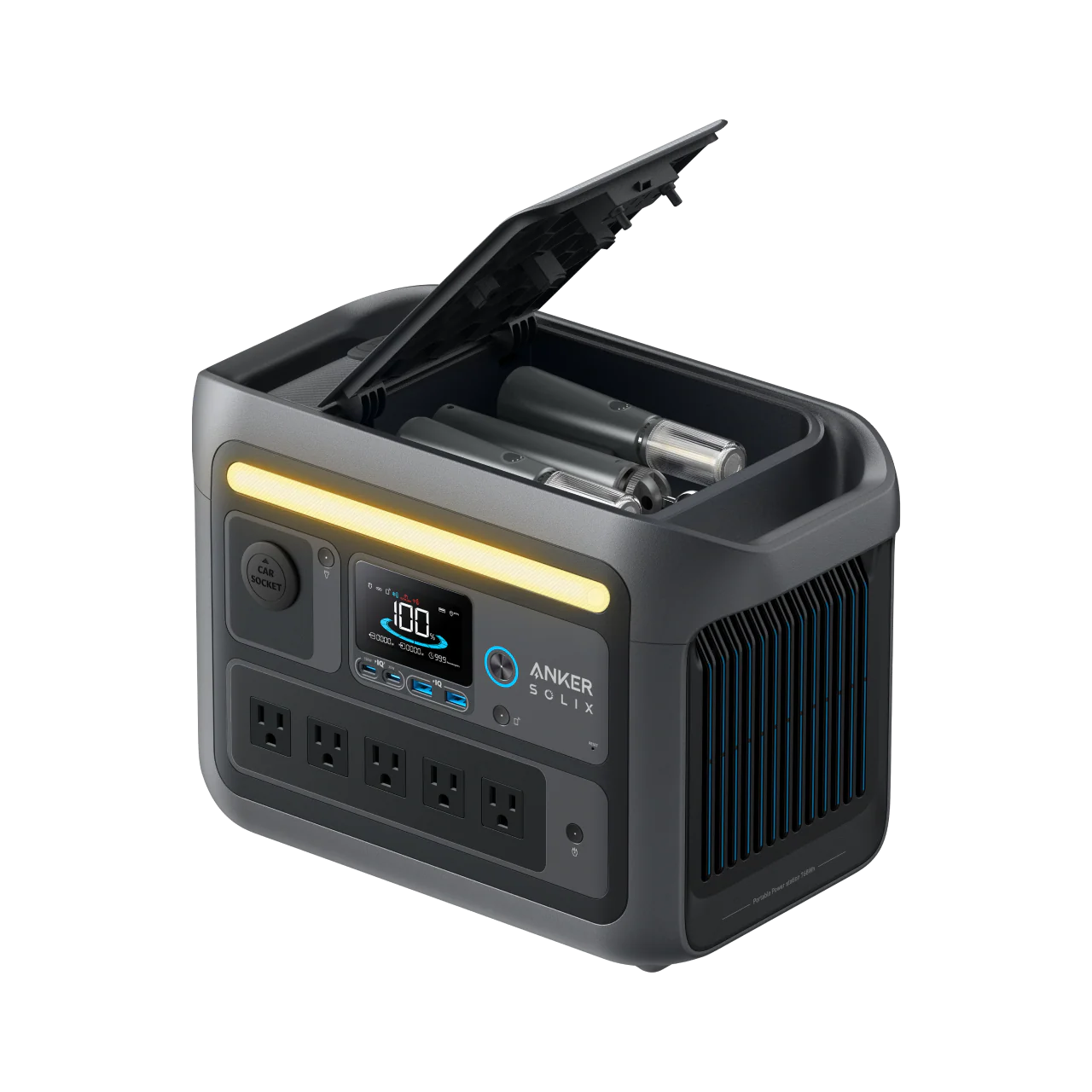
$649.00 · direct from Anker
Last checked 1 day ago. Prices move — check before you buy.

$2,599.00 · direct from BLUETTI
Last checked 1 day ago. Prices move — check before you buy.
Spec deltas
One of these you carry to the campsite with one hand. The other is a 149-pound appliance you set down once and leave for good. The Anker SOLIX C800 Plus packs 768Wh into a 24-pound box for $649; the BLUETTI Apex 300 + B300K stacks 5,530Wh into 149 pounds for $2,599. They share this page and almost nothing else.
So the verdict is a fork, not a ranking. If your power ever has to move, a tent, a nightstand, the back of a car, the C800 is the answer and you keep the better part of two thousand dollars. If it has to carry a house through a blackout or run a van off-grid, the C800 physically can't finish and the Apex is the only one of the two that does.
There is no middle here where you agonize between them. The weight sorts you before the spec sheet gets a word in. Figure out which kind of buyer you are and the box is already chosen.
What the Numbers Reveal
Each conclusion stated first — the numbers behind it on one line, the full analysis below.
weight
That means the portable jobs and the big jobs never overlap. The C800 handles the nights you carry it to, a CPAP or a trimmed-down tailgate it covers within 3%, and the Apex handles the nights that need real energy, and each is disqualified from the other's list by physics, not by a few percent of spec.
SOLIX C800 Plus: 768Wh, 24 lbsApex 300 + B300K: 5,529.6Wh, 148.8 lbsTailgate (670Wh): the 149-lb Apex doesn't travel; the C800 lands within 3%
Why it mattersDecide by whether the box ever has to move; that one fact eliminates one of these outright before price or capacity enters the room.
Typical price
But that 14-cent figure is only collected by a buyer who actually cycles those 19,354 kWh. Run a 320Wh CPAP off it and you'd need on the order of 160 years of nights to get there (19,354 divided by 0.32kWh), so the per-kWh advantage is a number a light user never lives to see, while the $1,950 of extra upfront is real on day one.
C800: $649, $0.28 per lifetime kWh (2,304 kWh total)Apex: $2,599, $0.14 per lifetime kWh (19,354 kWh total)CPAP load about 320Wh per night
Why it mattersHeavy daily users, van life or home backup, bank the lifetime savings; anyone running light or occasional loads should buy the C800 and keep the $1,950.
continuous output
In a multi-day outage those two specs compound. You're both starting compressors and recharging from the sun every day, and the Apex starts the loads and puts a day's energy back in a morning, while the C800 needs most of a strong solar day just to refill 768Wh through a port reviewers say isn't built for big panelsA9. That's a survival-spec gap, not a convenience one.
Apex surge 7,680W over 3,840W continuous (2x)C800 surge 1,600W over 1,200W continuous (1.3x)Apex solar input 2,400W vs C800 300Wreviewers: the C800's 300W input isn't meant for large static panelsA9
Why it mattersAnyone buying for outage or off-grid backup should treat the C800's 300W solar and 1.3x surge as disqualifying for compressor loads; gadget-and-lights users won't notice either limit.
The specific dimensions that decide these two units — everything else is a tie.
Portability & Form Factor
Selected because: The starting fork: 24 lbs you carry versus 148.8 lbs you install. It decides this matchup before capacity or price do.
weight
Twenty-four pounds is a one-hand, grab-the-handle, carry-it-to-the-tent lift. A hundred and forty-nine is a two-person set-down that picks its spot and stays there. The C800 goes where you go; the Apex goes where you put it, once. If the box ever has to move, this section has already chosen your unit, and no capacity number on the next screen is going to change its mind.
Your Life, Your Pick
Selected because: Where each unit actually lands across six real use-cases: the C800 covers the portable ones and misses the big loads (about 40% of an 8-hour blackout), the Apex is the reverse.
Run the six use-cases and they fall into two piles with nothing in the overlap. The C800 covers the small, portable nights and misses the big ones: about 40% of an 8-hour blackout, 72% of a remote workday, 14% of a van's daily 4,685Wh. The Apex covers all of those with room to spare and misses only the ones that require picking it up, landing nowhere near a tailgate because it can't get to the parking lot. Whichever pile describes your life is the unit you buy; there's no scenario where you're honestly torn between them.
Lifetime Value
Selected because: The counterintuitive money: the $2,599 Apex costs about $0.14 per lifetime kWh against the C800's $0.28, but only for a buyer who uses the energy.
cost / lifetime kWh
Here's the counterintuitive part: the $2,599 box is the cheap one per kilowatt-hour. Spread each price over the energy the pack delivers across its rated life and the Apex costs about 14 cents per kWh against the C800's 28, half as much. That discount is real, but you only collect it by actually pushing 19,354 kWh through the thing. At one CPAP's 0.32kWh a night that's roughly 160 years of sleep, which is to say never. Heavy daily users bank the savings; light users are pre-paying four times over for energy they'll never turn into cycles.
Growth Path
Selected because: Whether the number can grow: the C800 is sealed at 768Wh, the Apex adds B300K packs toward partial-home backup.
solar input
The C800's 768Wh is the last number it will ever show. It's sealed. Outgrow it and the upgrade path is buying a second unit, not a bigger battery. The Apex starts at 5,530Wh and adds B300K packs from there, which at this size points at genuine partial-home backup. If you can't yet name your load two years out, the one that grows is the safer bet. If you already know exactly what you need and it fits in 768Wh, don't pay for a door you'll never open.
Strengths & trade-offs
Anker SOLIX C800 Plus
Strengths
- +Costs $1,950 less
- +Lighter by 124.8 lb
Trade-offs
- –Weaker inverter (-2,640W) limits appliance compatibility.
- –Sealed capacity — the Apex 300 + B300K can add batteries to grow past 768Wh; this one can't.
- –Shorter-lived battery — rated for 3,000 charge cycles vs the Apex 300 + B300K's 6,000, so it wears out sooner.
BLUETTI Apex 300 + B300K
Strengths
- +Larger battery capacity
- +Higher AC output
- +Faster solar charging
- +Rated for 6,000 charge cycles — much longer battery lifespan
Trade-offs
- –Substantially more expensive (+$1,950) than the SOLIX C800 Plus.
- –Significantly heavier (+124.8 lbs), making it harder to move.
- –Very heavy unit that may be difficult for one person to lift.
Will It Power Your Gear?
Scenario math and per-appliance runtimes, modeled from the spec record.
Scenario verdicts
We ran the math on six real-world scenarios. Here's which unit survives your actual life.
SCN-01 · 2 nights · needs 2,100Wh
Weekend Camping
Two nights off-grid with essential comfort
Neither unit
Neither gives you a powered weekend: the Apex 300 + B300K has the energy but doesn't travel, and the SOLIX C800 Plus covers about 31% of the 2,100Wh. One can't go; the other can't finish.
Battery budget usedlower = more headroom
LOAD Phone Charger 15W×6h · LED Lights 40W×8h · Box Fan 75W×14h · CPAP Machine 40W×16h
SCN-02 · 8 hours · needs 1,645Wh
8-Hour Blackout
Keep the essentials running through a night without power
Apex 300 + B300K
The SOLIX C800 Plus doesn't finish — 653Wh usable against the 1,645Wh this needs leaves it 992Wh short, about 40% of the scenario covered. The Apex 300 + B300K covers it with 3,055Wh to spare.
Battery budget usedlower = more headroom
LOAD Fridge 150W×8h · Router + Modem 20W×8h · LED Lights (4 bulbs) 40W×6h · Phone Charger 15W×3h
SCN-03 · 8 hours · needs 320Wh
CPAP Overnight
Sleep therapy without interruption — the #1 medical use case
Either unit
A CPAP sips about 320Wh a night, under half the C800's usable energy and a rounding error for the Apex, so both coast through untroubled. Their dB ratings are identical, so noise breaks nothing. What breaks the tie is that one weighs 24 pounds and costs $649 and the other weighs 149 and costs $2,599. For the box on your nightstand, that's not a close call.
Battery budget usedlower = more headroom
LOAD CPAP Machine 40W×8h
SCN-04 · 8 hours · needs 910Wh
Remote Workday
Full work day off-grid without power anxiety
Apex 300 + B300K
The SOLIX C800 Plus doesn't finish — 653Wh usable against the 910Wh this needs leaves it 257Wh short, about 72% of the scenario covered. The Apex 300 + B300K covers it with 3,790Wh to spare.
Battery budget usedlower = more headroom
LOAD Laptop 60W×8h · External Monitor 30W×8h · Router + Modem 20W×8h · Phone Charger 15W×2h
SCN-05 · 4 hours · needs 670Wh
Tailgate Party
Game day power for the crew
Neither unit
The Apex doesn't tailgate. At 149 pounds it rolls off a truck bed if it moves at all, and mostly it doesn't move. The C800 actually goes, and lands within 3% of the 670Wh this needs; drop one appliance and it carries the whole party alone. Neither is a clean pass on paper, but only one of them was ever getting to the parking lot.
Battery budget usedlower = more headroom
LOAD Blender 400W×0.5h · LED TV (55") 80W×4h · Bluetooth Speaker 15W×4h · Phone Charger (×3) 45W×2h
SCN-06 · 24 hours · needs 4,685Wh
Van Life Daily
A full day of mobile living — the ultimate endurance test
Apex 300 + B300K
At roughly 4,685Wh a day the C800 taps out around 14% in, and the Apex is the only one of the two that finishes the day. Worth saying plainly: it finishes by 15Wh. This is the Apex run right to its ceiling, so if your van's daily draw has any headroom at all, plan on a second B300K pack rather than counting on that margin.
Battery budget usedlower = more headroom
LOAD Mini-Fridge 150W×24h · Laptop 60W×4h · Phone Charger 15W×3h · LED Lights 40W×5h · Fan 75W×8h
The Load Test
RUNTIME = (Wh × 0.85) ÷ LOAD
None of the scenarios above exactly yours? Build it. Toggle what you'd plug in; both units are tested against the combined draw.
Essentials
Comfort & Convenience
High-Draw Appliances
Test duration
8h
Continuous draw
205W
Projected runtime
For this load: Apex 300 + B300K runs 22.9h vs 3.2h.
$2,599 list · direct from BLUETTI
Modeled from the spec record — same math as the tables below. Methodology
Runtime by appliance
Real-world runtime estimates for common appliances, modeled at 85% inverter efficiency.¹
Essentials
The basics you need runningscale 0–313.3hComfort & Convenience
Makes off-grid life actually enjoyablescale 0–62.7hHigh-Draw Appliances
These reveal the real limitsscale 0–4.7h¹ Runtime = (capacity × 0.85) ÷ appliance watts. Within each group, all bars share one time scale (the group's longest runtime), so lengths are comparable across appliances; identical runtimes collapse into a single blue/orange bar. Actual runtime varies with battery age, temperature, and simultaneous loads — see methodology.
Conclusion
August 30, 2026
Verdict: the Apex 300 + B300K, on Power Score margin
Call it a tie, because neither unit wins for everyone, but for any single buyer it's a blowout. The decision runs on one fact: does your power have to be portable? If yes, the 24-pound C800 Plus is the pick and the Apex was never really in the running; spending $2,599 to haul 149 pounds you can't lift is the wrong kind of mistake. If your loads are a blackout's worth of house or a van's daily draw, the C800 taps out well short and the Apex finishes every time, for less per kWh over its life. Match the box to whether it moves; getting that one question right is the whole decision.
Editor-assigned confidence, based on cited owner research and spec analysis.
Written by Gunner Gustafson, Whole-Home Backup Tester · Station Arena Test Desk · Updated August 30, 2026
Measured Data
Benchmark scores and the full spec record, side by side.
Benchmark scores
Not rated for both units (minimum threshold unmet): UPS, Home Backup, CPAP, Tailgating, Food Truck, Apartment Balcony, Camping.
Full specifications
ᵈ Derived: price ÷ rated capacity. See the data behind our comparisons →
Comparison ToolAdd more power stations, side by sideOpen Tool →How these numbers are produced
Numeric verification
Every figure on this page traces to our spec database or arithmetic on it — no estimated numbers.
Owner claims
Statements about owner experience are cited to published reviews — see Sources & Research Notes below.
Runtime model
Runtime = (rated capacity × 0.85 inverter efficiency) ÷ device wattage. Solar recharge estimates assume panels deliver 70% of rated output. Cold weather, battery age, and stacked loads reduce real-world results.
Power Score
Computed from 14 published spec dimensions, weighted per use-case bench. Higher is better; a unit must meet a bench's minimum threshold to be rated.
See the full weight table and data sourcing on our methodology page →Class ranking (the star rating)
Each unit's star score is a category ranking, not customer reviews — no buyer opinions feed it. We score every station on size-independent quality (value, output, portability, endurance, ports, warranty, and more), then percentile-rank it against the other units in its capacity class, so a class-leading compact unit and a class-leading whole-home unit can both earn 5★. Here, SOLIX C800 Plus rates 3.8/5 (32nd percentile of 20 Compact-class units), and Apex 300 + B300K rates 4.4/5 (67th percentile of 16 Home Backup-class units).
How the class ranking is computed →Test Notes & Caveats
Hidden gotchas and advantages we spotted that you won't find on the product page.
Apex 300 + B300K: 148.8 lbs Is a Commitment
At 148.8 lbs across its boxes, no one piece is the whole problem — but this is hardware you site, not hardware you carry. Once it's set up, you won't want to move it. It's a semi-permanent appliance. Pick your spot.
Fan Noise: Line Ball
Both units are rated at the same 45dB — like a running refrigerator. One published figure, twice, so noise shouldn't decide this one.
The C800's Ceiling Is the Price of Admission
The C800 Plus is sealed at 768Wh. That's fine right up until it isn't: outgrow it and your upgrade path is a whole second unit, not a bigger battery. The Apex bolts on B300K packs and climbs toward partial-home backup from there. If you already know 768Wh covers you, this never bites. If you suspect your needs are creeping upward, it's the C800's one real wall.
Surge Headroom: Who Starts the Fridge
The Apex holds 7,680W of surge over 3,840W of continuous output, a 2x cushion. The C800's 1,600W sits just 1.3x above its 1,200W. A fridge, AC or pump that briefly pulls two to three times its rated wattage at startup is exactly the load that eats a thin cushion, so for motor-driven appliances the Apex starts what the C800 can trip on. For phones, lights and laptops, neither ceiling ever comes up.
UPS Switchover: ≤10ms vs ≤20ms
Both list a UPS mode, at different rated speeds. The Apex 300 + B300K is rated ≤10ms — quick enough on paper that desktop PCs and routers should ride through, treating that as the rating it is. The SOLIX C800 Plus is rated ≤20ms — fine on paper for routers and most electronics; the fussiest PC power supplies sit right at this line. If a computer with unsaved work is the thing being protected, the stated class is worth the attention; nothing here is a lab result.
Warranty: No Difference
Both units carry the same 5-year warranty, so coverage isn't a tiebreaker here. The Apex 300 + B300K's figure is a maximum rather than a guarantee — it depends on buying direct from BLUETTI or registering the unit, since reseller purchases carry a shorter term. Worth saying because the per-dollar framing can suggest otherwise: the SOLIX C800 Plus works out at 7.7 years of cover per $1,000 spent against the Apex 300 + B300K's 1.9, but that spread is the price gap, not the terms.
Battery Lifespan in Real Years
The Apex 300 + B300K is rated for 6,000 cycles vs 3,000. In real life: at daily use, that's 16.4 vs 8.2 years. At weekend use (twice a week), it's 58 vs 29 years. One caution reading years across different sizes: a cycle is 5,530Wh on the Apex 300 + B300K and 768Wh on the SOLIX C800 Plus, so count lifetime energy — roughly 33,178 kWh against 2,304 kWh over the rated life. After hitting the cycle limit, the battery doesn't die — it drops to ~80% of original capacity, which is still very usable.
Ownership Analysis
What happens after you buy — true cost of ownership, brand trust, and growth potential.
Lifetime value
Service lifeyears at one full cycle per day
Lifetime energy delivered
Cost per delivered kWh
│ warranty ends · Reaching the cycle rating means ~80% capacity remains — degraded, not dead.
Analyst note
The SOLIX C800 Plus is cheaper to buy, but the Apex 300 + B300K is cheaper to own. At $0.08/kWh over its lifetime vs $0.28/kWh, the Apex 300 + B300K's higher cycle life and capacity make each dollar go further over the years.
Brand trust
Anker
Ecosystem
7-8 SOLIX portable power stations across C-series (compact) and F-series (flagship), plus the X1 home energy system
Support
US-based, and historically excellent at no-hassle replacements. Recent reports describe more AI-scripted first responses and painful hazmat return logistics on heavy units, so the SOLIX-specific experience is trending down from Anker's old standard, even as the parent brand stays strong.
Community
Moderate — active Reddit (r/Anker, r/AnkerSOLIXCommunity) and growing. Benefits from Anker's massive consumer electronics brand awareness.
App experience
Rated 4.5/5 iOS (~1,100 ratings) · 4.3/5 Android
Unique strength
Anker's consumer-electronics reputation and a polished, well-reviewed app, plus genuinely strong value in its mid and larger units.
Worth knowing
Firmware updates have occasionally removed features without much warning. If one specific function is the reason you're buying, it's worth confirming it's sticking around.
BLUETTI
Ecosystem
One of the broadest lineups — 15-20+ models from budget (AC2A) to flagship portable (Apex 300, 2764.8Wh). Includes specialized products: vehicle solar hubs, sodium-ion cold-weather units, and balcony storage systems.
Support
The most inconsistent support in the category, mostly email with timezone lag. Some buyers sail through; others report weeks of runaround or an offer of a discount on a new unit instead of a repair. Buying direct from BLUETTI tends to go better than through a reseller.
Community
Active and growing — Reddit r/bluetti has a dedicated community. Second-largest after EcoFlow in engagement.
App experience
Rated 4.5/5 iOS and Android — tied for best app experience in the category. V3.0 UI redesign was well-received.
Unique strength
Among the best capacity-per-dollar available and one of the widest lineups, which is why the B300K expansion path is a real, supported road rather than a dead-end accessory.
Worth knowing
On a $2,599 system the after-sale matters as much as the spec sheet. Register it, keep proof of purchase, and buy where a warranty claim will be cleanest.
Analyst note
Neither support story should flip this decision; the carry-versus-install question already settles it. But if you do land on the Apex, buy it direct and register it. The hardware isn't the variable here; the support is.
Growth path
SOLIX C800 Plus
FIXED CAPACITYFixed at 768Wh, with no expansion — so size it for your needs up front rather than planning to add capacity later.
Accepts up to 300W of solar. Limited to a single portable panel.
Adequate ports for most setups, but heavy users may want a power strip.
Apex 300 + B300K
EXPANDABLESupports BLUETTI expansion batteries, so you can add capacity later without replacing the base unit — useful if your needs may climb past 5,530Wh.
Accepts up to 2,400W of solar. Enough for a serious multi-panel array.
Generous port selection supports complex multi-device setups.
Expansion batteries are BLUETTI-specific. You're investing in the BLUETTI ecosystem.
Realistic full solar rechargeat 70% of rated panel output — see methodology
Analyst note
The SOLIX C800 Plus is sealed at 768Wh, which is fine if that covers you. The Apex 300 + B300K starts at 5,530Wh and can grow beyond it with BLUETTI expansion batteries — real headroom the SOLIX C800 Plus doesn't have if your needs climb toward partial-home backup.
What Owners Report
Patterns from published owner reports and long-term reviews — every claim cited to its source below.
Anker SOLIX C800 Plus
Field notes on the C800 Plus come from professional reviewers rather than long-term owners; no six-month or CPAP-specific owner reports surfacedA0. The consistent thread is fan behavior: quiet at low load but clearly audible once the room warms past 80F under sustained draw around 1,030WA1, though another tester found it manageable at arm's length during fast chargingA11. Capacity is the recurring gripe, with reviewers calling 768Wh a middling amount that struggles with kettles and coffee makers and trails a same-price EcoFlowA12A10A5, even as light loads impressed, one reviewer's fridge-freezer using only 10% over eight hoursA6.
The app draws repeated praise for monitoring and firmware updatesA7A15, and a simulated outage cut over without a flicker in one testA4. Read it as a well-liked camping and light-backup unit whose single admitted limit is how much it holds.
“The pole light felt is a little over the top and unnecessary.”
Sources
dustinabbott.net
BLUETTI Apex 300 + B300K
The Apex 300 + B300K is newer still, so its ledger is early-reviewer, not owner; no long-term or fan-noise data specific to this bundle exists yetB0. What testers report is muscle: a system that could genuinely replace a generator without the noise or fumesB4, a sub-hour rechargeB12, and real household loads, with a wash cycle pulling it from full down to 65% and a heat-pump dryer taking it on to 20%B9B10.
The catch reviewers keep raising is ports and weight. The base Apex 300 is mostly AC outlets and high-voltage connectors with almost no USB or DC, so those arrive via a separate roughly $300 D1 hub, and the B300K's own USB-C managed only about 8W in one testB1B2B6. And everyone flags the mass, near 150 pounds and too heavy for most people to carry aloneB14B5. Buy it for what it is: a fixed power plant, not a carry-along.
“The Apex 300 doesn't have USB ports, DC ports, or much of anything beyond its six AC plugs and high-voltage connectors.”
Sources
thesolarlab.com · techspective.net · digitalreviews.net · thesolarpit.com · cleantechnica.com · trustedreviews.com
Sources & Research Notes
Every owner claim in this report is traceable to a published source. The bracketed references above resolve here.
Recurring owner themes
- Fan noise is consistently reported as noticeable during fast AC charging or high sustained wattage, though most reviewers call it 'manageable' rather than a dealbreaker. [SOLIX C800 Plus · 2 entries]
- The companion app is repeatedly praised for remote monitoring/control and firmware delivery, with no reviewers reporting connectivity or crash complaints. [SOLIX C800 Plus · 3 entries]
- 768Wh capacity is flagged by multiple reviewers as the unit's main limitation for heavy appliances and against same-price competitors, even though real-world light loads (fridge, gadgets) performed well. [SOLIX C800 Plus · 4 entries]
- The signature 'Plus' camping-light pole/torches are polarizing: some reviewers call the feature genuinely useful and a lantern-replacement, others call it an unnecessary gimmick that sacrifices the C800's cable-storage cubby. [SOLIX C800 Plus · 3 entries]
- Reviewers consistently flag that the base Apex 300 has no USB/DC ports and requires a separate paid Hub D1 accessory, which some feel is overpriced for what it offers. [Apex 300 + B300K · 3 entries]
- Multiple sources note the extreme weight/bulk of the stacked Apex 300 + B300K system, making 'portable' a stretch despite handles/trolley options. [Apex 300 + B300K · 2 entries]
- Reviewers praise fast recharge and the system's ability to genuinely replace a generator for home backup and heavy loads like washers/dryers. [Apex 300 + B300K · 4 entries]
- A1
“Once the temperature rose above 80F with a 1,030 average wattage, the fan noise was unavoidable and quite present in a quiet house.”
How-To Geek — 'Anker Solix C800 Plus Review: A Power Station Prepared to Illuminate Nighttime' · 2024-03 · [negative]
- A4
“Unplugged the power supply to the C800 Plus to simulate a power outage. No reaction on the monitor, no flicker, just continued operating.”
DustinAbbott.net — 'Anker Solix C800 Plus Power Station Review' · 2024-03 · [positive]
- A5
“My lone concern on this front is whether or not the battery capacity is sufficient.”
DustinAbbott.net — 'Anker Solix C800 Plus Power Station Review' · 2024-03 · [mixed]
- A6
“I connected the Anker and in 8 hours, my frig/freezer used 10% of the power.”
The Gadgeteer — 'Anker SOLIX C800 Plus power station review' · 2024-04 · [positive]
- A7
“My other power stations do not have a companion phone app. But after the first trip, I saw how this feature would come in handy.”
The Gadgeteer — 'Anker SOLIX C800 Plus power station review' · 2024-04 · [positive]
- A9
“With a maximum solar input of 300W at 11-60V, it's not designed to be used with large static panels.”
MakeUseOf — 'Anker Solix C800 Plus Review: The Ultimate Emergency and Camping Companion' · 2024-05 · [mixed]
- A10
“it doesn't have the outright storage or power to tackle more heavy duty appliances like kettles or some coffee machines.”
Trusted Reviews — 'Anker SOLIX C800 Plus Review: A great camping companion' · 2024-04 · [negative]
- A11
“The fan does ramp up during fast charging, but the noise is manageable at roughly arm's length.”
The Power Pick — 'Anker SOLIX C800 Plus Review: Camping Lights Meet Serious Power' · 2026-02 · [mixed]
- A12
“The 768Wh capacity sits in an awkward middle ground. It is significantly less than the 1,024Wh offered by the EcoFlow DELTA 3 Plus at the same $649 price.”
The Power Pick — 'Anker SOLIX C800 Plus Review: Camping Lights Meet Serious Power' · 2026-02 · [negative]
- A15
“Through the app, you can easily install firmware updates that may include performance enhancements, bug fixes, or new functionalities.”
Greener Ideal — 'Anker SOLIX C800 Plus Portable Power Station Review' · 2024-08 · [positive]
- B1
“The Apex 300 doesn't have USB ports, DC ports, or much of anything beyond its six AC plugs and high-voltage connectors.”
thesolarlab.com — Bluetti Apex 300 Review: Cheap, Practical Home Backup? · unknown (2025/2026) · [mixed]
- B2
“That Bluetti D1 Power Hub that gives you your DC and USB ports costs about $300, which is a steep price for what you're getting.”
thesolarlab.com — Bluetti Apex 300 Review: Cheap, Practical Home Backup? · unknown (2025/2026) · [negative]
- B4
“It's one of the few systems I've tested that feels like it could genuinely replace a generator, without the noise, fumes, or maintenance.”
techspective.net — Bluetti Apex 300 with B300K Review · 2025-09-21 · [positive]
- B5
“Stacked, you're near 150 pounds of lithium iron phosphate and inverter muscle—movable with the built-in handles or a trolley... but not something you'll casually lug to a picnic.”
techspective.net — Bluetti Apex 300 with B300K Review · 2025-09-21 · [mixed]
- B6
“I just wonder why Bluetti did not include a USB-C port with some decent output, like 100 or 140W as I only got a measly 8W charge out of it for my phone.”
digitalreviews.net — Bluetti B300K Expansion Battery Review · 2025-12 · [negative]
- B9
“Results: 1 wash took about 1 hour and drained the Apex from 100% down to 65%.”
digitalreviews.net — Bluetti Apex 300 Power Station Tests (Australia) Part II · 2025-09 · [positive]
- B10
“Just for fun we then turned on our heat pump dryer to see that over 1½ hours it would further drain it down to 20%.”
digitalreviews.net — Bluetti Apex 300 Power Station Tests (Australia) Part II · 2025-09 · [mixed]
- B12
“During my testing, the recharge speed was astonishing. In under an hour, I had a system ready to go again.”
thesolarpit.com — Bluetti Apex 300 Review · 2025-10-28 · [positive]
- B13
“For van lifers, the Apex 300 is a great base station, and the ability to add another 2.7kWh of capacity by simply purchasing another B300K expansion pack is a game-changer.”
cleantechnica.com — The Bluetti Apex 300 & B300K Portable Power Station Tested · 2025-08-05 · [positive]
- B14
“As will you: it weighs in at 38kg, and is probably much too big and heavy for most people to carry alone.”
trustedreviews.com — Bluetti Apex 300 Review · 2025-10-10 · [negative]
Research compiled August 30, 2026.
Who Should Buy Which
Buy the SOLIX C800 Plus if you…
- →The camper or tailgater who carries power by hand: at 24 lbs it actually goes, and it lands within 3% of a 670Wh tailgate on its own if you drop one appliance.
- →The CPAP sleeper: a roughly 320Wh night is under half the C800's usable energy, and the unit travels to the tent or hotel without a second person.
- →Anyone whose real loads are gadgets, lights and a fridge for a few hours, who'd rather keep $1,950 than haul capacity they'll never cycle.
Buy the Apex 300 + B300K if you…
- →The blackout-prepper who needs a full 1,645Wh evening and then some, and wants to put 2,400W of solar back the next morning.
- →The van-lifer pulling roughly 4,685Wh a day who wants a base that can add another B300K pack later as needs climbB13.
- →The generator-replacer who wants washer, dryer and pump loads without fumesB4, and has a permanent 149-pound spot to leave it in.
If neither fits
If you want one box that's both genuinely portable and able to run the whole house through a multi-day outage, neither is it; that's two purchases. If you just want a single do-most unit, look one size up from the C800 at a mid-size 1-2kWh portable, reviewers note the same-price EcoFlow DELTA 3 Plus offers 1,024WhA12, rather than paying Apex money for capacity you won't carry.
The Bottom Line
It comes down to one question, and it isn't a spec: does your power have to move? If yes, the 24-pound C800 Plus is the buy and the 149-pound Apex was never a real rival; you'd be spending $2,599 to haul energy you can't lift. If your loads are a blackout's worth of house or a van's daily draw, the C800 taps out well short and the Apex is the only one of the two that finishes, at less per kWh over its life.
So it's a tie only on paper. For any actual buyer it's a rout in one direction. Pick the box by whether it ever leaves the room; you've already done the rest of the math.
Frequently Asked Questions
Answers drawn from the spec record and cited owner research.
Is the BLUETTI Apex 300 + B300K portable?
Not in any real sense. Stacked, the pair is about 149 pounds, which reviewers call too heavy for most people to carry alone. It has handles and an optional trolley, but it's a set-it-down-and-leave-it appliance. If you need to pick your power up, the 24-pound C800 Plus is the one that moves.
Why is the Apex cheaper per kWh when it costs four times as much?
Cost-per-kWh spreads the purchase price over all the energy the pack can deliver in its life: about $0.14 for the Apex versus $0.28 for the C800. That only pays back if you actually push big loads through it. A light or occasional user never cycles enough energy to collect the difference, and pays roughly $1,950 more upfront to not collect it.
Can the Anker C800 Plus run my house during a blackout?
For a few hours of essentials, partly; for a full evening, no. Against a typical 1,645Wh 8-hour blackout it runs about 992Wh short, covering only around 40%. The Apex covers the same night with roughly 3,055Wh to spare and starts a fridge without straining. If whole-evening backup is the job, the C800 is the wrong size.
Does the Apex 300 have USB ports?
Barely, on its own. Reviewers note the base unit is mostly AC outlets and high-voltage connectors; USB and DC come through a separate roughly $300 D1 hub, and the B300K's built-in USB-C put out only about 8W in testing. If you live on USB-C, budget for the hub. The C800 Plus, by contrast, has a 100W USB-C port built in.
Which one should I buy for CPAP?
The C800 Plus, almost certainly. A CPAP draws around 320Wh a night, under half the C800's usable energy and a rounding error for the Apex, so capacity isn't the deciding factor; price and portability are. The C800 is about a quarter the cost and a sixth the weight, and both units are the same 45dBA, so noise breaks nothing.
Where to buy
Anker SOLIX C800 Plus
$649.00
$649.00 · direct from Anker
Last checked 1 day ago. Prices move — check before you buy.
BLUETTI Apex 300 + B300K
$2,599.00
$2,599.00 · direct from BLUETTI
Last checked 1 day ago. Prices move — check before you buy.
Prices may vary by retailer and are subject to change.