Head-to-head test
Anker SOLIX C800 Plus vs BLUETTI Apex 300 + 2×B300K
One is a 24-lb box you carry and the other a 214-lb appliance you bolt down, so whether your power has to travel is the whole decision, and it eliminates one of these before you read a single spec.
Full profiles: Anker SOLIX C800 Plus → · BLUETTI Apex 300 + 2×B300K →

Written by Gunner GustafsonUpdated
Whole-Home Backup Tester, Station Arena Test Desk
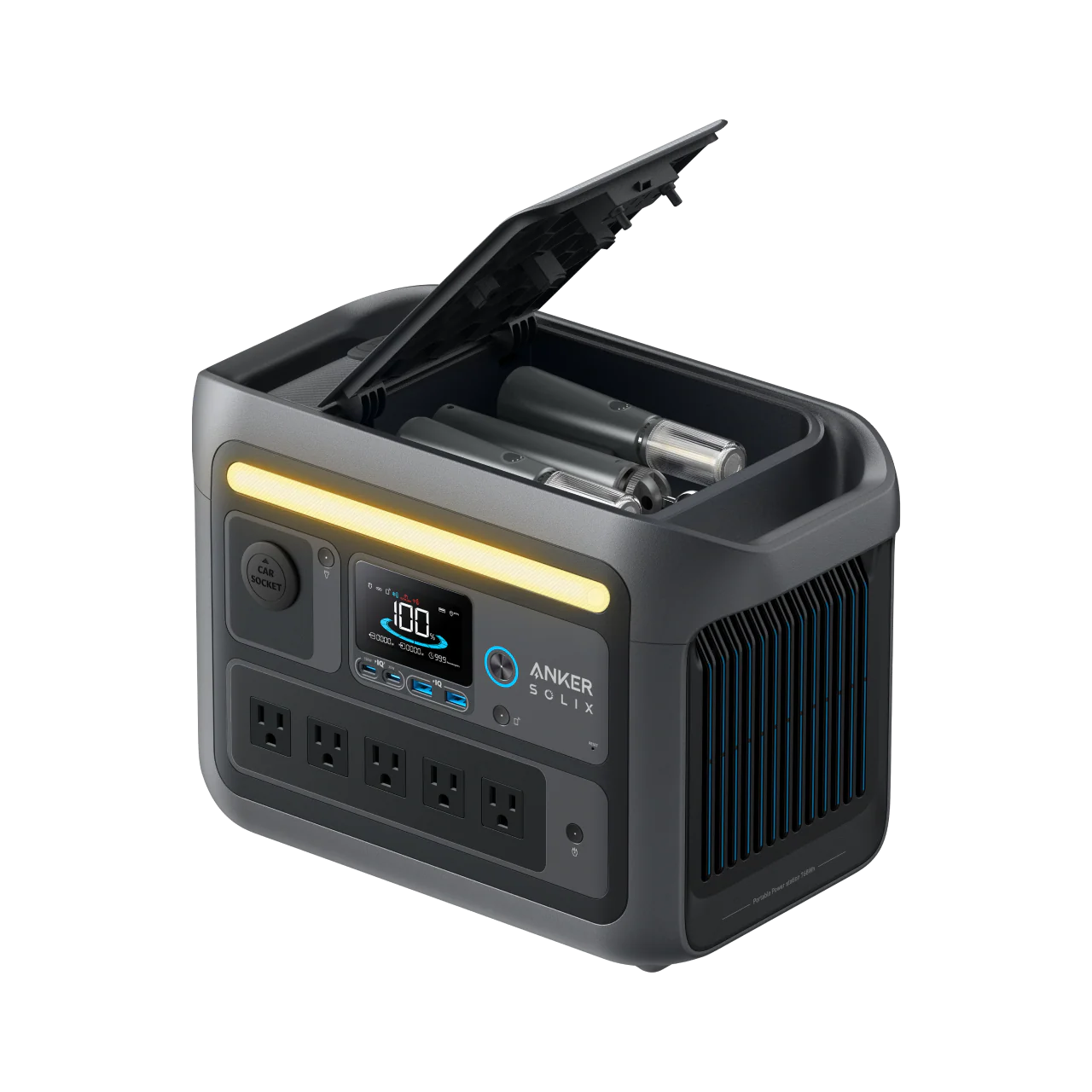
$649.00 · direct from Anker
Last checked 8 hours ago. Prices move — check before you buy.

$3,699.00 · direct from BLUETTI
Last checked 8 hours ago. Prices move — check before you buy.
Spec deltas
One of these weighs 24 pounds and rides shotgun to the campsite; the other weighs 214 and gets bolted into a corner it never leaves again. The Anker SOLIX C800 Plus is a $649 box holding 768Wh. The BLUETTI Apex 300 with two B300K batteries is a $3,699 system holding 8,294Wh. Calling this a head-to-head is generous, since they share a battery chemistry and almost nothing else.
There's no universal winner here, and pretending otherwise costs you money. If your power has to travel, camping, a tailgate, a CPAP you haul to the in-laws', the Apex is out before you read a single spec, and the little Anker is the whole answer. If your power stays put, a van you're wiring, a house you're backing up, the little Anker empties before the first evening ends, and the Apex is playing a game it can't buy into.
The one real surprise runs backward: the pricier Apex is the cheaper unit to own per kilowatt-hour, but only if you actually cycle 8kWh of living through it, which most people cross-shopping these two won't. They want something near a kilowatt-hour they can still carry, and both of these are the wrong answer for that person. So this page isn't really about which is better. It's about which job you're buying for, because the job settles it completely.
What the Numbers Reveal
Each conclusion stated first — the numbers behind it on one line, the full analysis below.
weight
Capacity and portability aren't trading off along a smooth curve here; they're two separate products. The Apex tops the sheet by never leaving the room, and the moment a job requires the box to move, its 8,294Wh becomes irrelevant because it simply isn't there.
C800 Plus: 24 lbs, 768WhApex 300 + 2×B300K: 213.9 lbs, 8,294WhWeekend Camping and Tailgate Party both compute to winner 'neither' because the Apex can't travel to them
Why it mattersDecide whether your power has to travel before you compare a single other spec; that one answer deletes one of these two outright.
That makes 'cheaper per kWh' a reward for throughput, not a discount you get at checkout. Cycle a van or a house through the Apex daily and it genuinely undercuts the Anker on every kilowatt-hour; trickle a CPAP through it and you've paid four figures a year of ownership to move a few hundred watt-hours a night.
Apex cost per lifetime kWh $0.13 vs C800 $0.28Apex cost per warranty year $740 vs C800 $130
Why it mattersOnly a heavy, regular user should let the per-kWh number sway them; an occasional user should read the sticker, because that's what they'll actually pay.
The C800 has none of those failure modes because it has none of those parts, one sealed brick with nothing to desync. The Apex's capacity is real and so is its tax: more watt-hours, more surge, and more things that can behave oddly in the first firmware year.
Apex surge 2x to 7,680W vs C800 1.3x to 1,600WOwners of the 2-battery Apex report the packs charge out of sync and solar reads below rating, called 'normal' by supportB1B2B3One reviewer's C800 rode through a simulated outage without a flickerA4
Why it mattersIf you want power that just works the day it lands, the simpler box has fewer ways to surprise you; if you need the 8kWh, budget some patience for a brand-new system.
The specific dimensions that decide these two units — everything else is a tie.
Portability & Form Factor
Selected because: The 24-lb Anker travels and the 214-lb Apex doesn't, and whether your power has to move is the entire decision.
weight
Everything on this page falls out of one question you can answer without a spec sheet: can you lift it? The C800 Plus is 24 pounds, a one-hand grab off a shelf. The Apex with both batteries is 213.9, a two-person, bent-knees lift you perform exactly once, into the spot it holds for years.
So the Anker exists to leave the house with you and the Apex exists to never leave one corner of it. The C800 you pick up; the Apex you commit to a floor. Those are two categories, not two sizes, and once you know which one you're buying, the scenario table below stops being a contest and turns into a checklist.
Your Life, Your Pick
Selected because: Six real loads sort into two piles, carried and installed, and that sorting, not a score, is what picks your unit.
The scenario split is cleaner than the win-loss tally makes it look. The Apex takes the blackout, the remote workday, and van life, but read why it wins all three: each is a job where 768Wh simply runs out, and none of them asks you to move the box. The two the engine marks 'neither', weekend camping and the tailgate, are precisely the two where you'd carry it, and there the Apex isn't losing so much as failing to attend.
Watch the tailgate to see the real shape of this. The C800 Plus lands within 17Wh of the 670Wh load; trim one appliance and it runs the party solo, while the Apex, holding more than ten times the energy, sits at a curb it can't leave. The table isn't ranking two rivals. It's sorting jobs into two bins, carried and installed, and handing each bin a different unit.
Lifetime Value
Selected because: Per lifetime kilowatt-hour the Apex is the cheaper box, thirteen cents to the Anker's twenty-eight, but only if you actually cycle the capacity you paid for.
cost / lifetime kWh
Here's the counterintuitive one, stated once so it sticks: the $3,699 unit costs less per kilowatt-hour of its life than the $649 one. Rate the Apex for at least 3,500 cycles across 8,294Wh and it delivers about 29,030 kWh over its life; spread the price across that and it's thirteen cents a kilowatt-hour, against the C800 Plus's twenty-eight. That's not a checkout discount, though. It's a throughput reward.
It only cashes out if you push energy through the pack, day after day, the way a wired van or a backed-up house does. Sip a CPAP or a laptop from it and the giant denominator never fills, so you paid the sticker and got a fraction of the value the number promised. The per-kWh figure flatters the heavy user and quietly punishes the light one, which is why knowing which you are is worth more than the figure itself.
What the Specs Don't Tell You
Selected because: Surge headroom, a stated UPS rating of no worse than 10ms, and expansion all favor the Apex; the sealed Anker answers with fewer parts to desync or bolt on.
rated cycles
Stack the spec-level catches and they lean Apex, with one honest exception. Its inverter runs a 2x surge ratio to a 7,680W peak against the Anker's 1.3x and 1,600W, so it starts the fridge and AC compressors the C800 Plus can trip on; its UPS is rated no worse than 10ms to the Anker's 20ms; and it can add batteries where the C800 Plus is sealed at its 768Wh. If the checklist were only about capability, it wouldn't be close.
But 'more capable' carries a bill past the price. The Apex is the two-person install you don't relocate, and, the part that rarely prints, it's a young, multi-part system: two packs owners report don't charge in syncB1B3, and a face with no DC or USB ports until you bolt on the roughly $300 Hub D1B17. The C800 Plus has none of those headaches because it has none of those parts. Sealed at 768Wh is a genuine ceiling, but for a buyer who only needs a portable, a box with nothing to desync and nothing to bolt on is exactly what the job wants.
Strengths & trade-offs
Anker SOLIX C800 Plus
Strengths
- +Costs $3,050 less
- +Lighter by 189.9 lb
Trade-offs
- –Weaker inverter (-2,640W) limits appliance compatibility.
- –Sealed capacity — the Apex 300 + 2×B300K can add batteries to grow past 768Wh; this one can't.
- –Shorter-lived battery — rated for 3,000 charge cycles vs the Apex 300 + 2×B300K's 6,000, so it wears out sooner.
BLUETTI Apex 300 + 2×B300K
Strengths
- +Larger battery capacity
- +Higher AC output
- +Faster solar charging
- +Rated for 6,000 charge cycles — much longer battery lifespan
Trade-offs
- –Substantially more expensive (+$3,050) than the SOLIX C800 Plus.
- –Significantly heavier (+189.9 lbs), making it harder to move.
- –Very heavy unit that may be difficult for one person to lift.
Will It Power Your Gear?
Scenario math and per-appliance runtimes, modeled from the spec record.
Scenario verdicts
We ran the math on six real-world scenarios. Here's which unit survives your actual life.
SCN-01 · 2 nights · needs 2,100Wh
Weekend Camping
Two nights off-grid with essential comfort
Neither unit
Neither gives you a powered weekend: the Apex 300 + 2×B300K has the energy but doesn't travel, and the SOLIX C800 Plus covers about 31% of the 2,100Wh. One can't go; the other can't finish.
Battery budget usedlower = more headroom
LOAD Phone Charger 15W×6h · LED Lights 40W×8h · Box Fan 75W×14h · CPAP Machine 40W×16h
SCN-02 · 8 hours · needs 1,645Wh
8-Hour Blackout
Keep the essentials running through a night without power
Apex 300 + 2×B300K
This is the Apex's home turf, and a blackout is the one job that never asks it to move. The C800 Plus covers only about 40% of a 1,645Wh essentials night before it taps out 992Wh short; the Apex carries the whole night with 5,405Wh still in reserve. If riding out a full outage is why you're reading this, the small box was never sized for the job.
Battery budget usedlower = more headroom
LOAD Fridge 150W×8h · Router + Modem 20W×8h · LED Lights (4 bulbs) 40W×6h · Phone Charger 15W×3h
SCN-03 · 8 hours · needs 320Wh
CPAP Overnight
Sleep therapy without interruption — the #1 medical use case
Either unit
Both batteries cover a CPAP night with absurd room to spare: a 40W machine over eight hours is about 320Wh, a rounding error against either. Capacity doesn't decide this, and neither does noise, since both sit at roughly the same quiet floor, so that spec can't break the tie either. What's left is price and what you can lift at bedtime, and by both a 24-lb box beats a 214-lb one. Using the Apex to run a bedside CPAP is renting a moving truck to carry a grocery bag; take the Anker.
Battery budget usedlower = more headroom
LOAD CPAP Machine 40W×8h
SCN-04 · 8 hours · needs 910Wh
Remote Workday
Full work day off-grid without power anxiety
Apex 300 + 2×B300K
The SOLIX C800 Plus doesn't finish — 653Wh usable against the 910Wh this needs leaves it 257Wh short, about 72% of the scenario covered. The Apex 300 + 2×B300K covers it with 6,140Wh to spare.
Battery budget usedlower = more headroom
LOAD Laptop 60W×8h · External Monitor 30W×8h · Router + Modem 20W×8h · Phone Charger 15W×2h
SCN-05 · 4 hours · needs 670Wh
Tailgate Party
Game day power for the crew
Neither unit
The Apex 300 + 2×B300K at 213.9 lbs is not a take-along — it rolls off a truck bed if it travels at all. The SOLIX C800 Plus actually goes, and lands within 3% of the 670Wh — trim one appliance and it does the job alone. That trimmed kit is the honest answer here; the Apex 300 + 2×B300K was never in this scenario at all.
Battery budget usedlower = more headroom
LOAD Blender 400W×0.5h · LED TV (55") 80W×4h · Bluetooth Speaker 15W×4h · Phone Charger (×3) 45W×2h
SCN-06 · 24 hours · needs 4,685Wh
Van Life Daily
A full day of mobile living — the ultimate endurance test
Apex 300 + 2×B300K
A day of van living here is 4,685Wh, think six full C800 Plus batteries lined up end to end. The Anker covers about 14% of that before it's flat; the Apex runs the day and keeps roughly 2,365Wh spare. This is the precise job an 8kWh installed system is for, and the precise job a 768Wh portable can't fake.
Battery budget usedlower = more headroom
LOAD Mini-Fridge 150W×24h · Laptop 60W×4h · Phone Charger 15W×3h · LED Lights 40W×5h · Fan 75W×8h
The Load Test
RUNTIME = (Wh × 0.85) ÷ LOAD
None of the scenarios above exactly yours? Build it. Toggle what you'd plug in; both units are tested against the combined draw.
Essentials
Comfort & Convenience
High-Draw Appliances
Test duration
8h
Continuous draw
205W
Projected runtime
For this load: Apex 300 + 2×B300K runs 34.4h vs 3.2h.
$3,699 list · direct from BLUETTI
Modeled from the spec record — same math as the tables below. Methodology
Runtime by appliance
Real-world runtime estimates for common appliances, modeled at 85% inverter efficiency.¹
Essentials
The basics you need runningscale 0–470hComfort & Convenience
Makes off-grid life actually enjoyablescale 0–94hHigh-Draw Appliances
These reveal the real limitsscale 0–7.1h¹ Runtime = (capacity × 0.85) ÷ appliance watts. Within each group, all bars share one time scale (the group's longest runtime), so lengths are comparable across appliances; identical runtimes collapse into a single blue/orange bar. Actual runtime varies with battery age, temperature, and simultaneous loads — see methodology.
Conclusion
August 30, 2026
Verdict: the Apex 300 + 2×B300K, on Power Score margin
It's a tie only because they don't compete, and that's the finding, not a dodge. One is a portable you carry; the other is an installation you don't, nearly six times the price and roughly eleven times the capacity apart. Name your job and it picks the unit outright. If your power moves, it's the Anker C800 Plus, every time. If it stays put and has to run a van or a home, it's the Apex, which, cycled hard, also costs less per lifetime kilowatt-hour. The only real mistake is choosing before you've decided whether you carry your power or install it; get that backwards and you've bought either a boat anchor you can't lift or a battery that quits by dinner.
Editor-assigned confidence, based on cited owner research and spec analysis.
Written by Gunner Gustafson, Whole-Home Backup Tester · Station Arena Test Desk · Updated August 30, 2026
Measured Data
Benchmark scores and the full spec record, side by side.
Benchmark scores
Not rated for both units (minimum threshold unmet): UPS, Home Backup, CPAP, Solar Generator, Tailgating, Food Truck, Apartment Balcony, Camping.
Full specifications
ᵈ Derived: price ÷ rated capacity. See the data behind our comparisons →
Comparison ToolAdd more power stations, side by sideOpen Tool →How these numbers are produced
Numeric verification
Every figure on this page traces to our spec database or arithmetic on it — no estimated numbers.
Owner claims
Statements about owner experience are cited to published reviews — see Sources & Research Notes below.
Runtime model
Runtime = (rated capacity × 0.85 inverter efficiency) ÷ device wattage. Solar recharge estimates assume panels deliver 70% of rated output. Cold weather, battery age, and stacked loads reduce real-world results.
Power Score
Computed from 14 published spec dimensions, weighted per use-case bench. Higher is better; a unit must meet a bench's minimum threshold to be rated.
See the full weight table and data sourcing on our methodology page →Class ranking (the star rating)
Each unit's star score is a category ranking, not customer reviews — no buyer opinions feed it. We score every station on size-independent quality (value, output, portability, endurance, ports, warranty, and more), then percentile-rank it against the other units in its capacity class, so a class-leading compact unit and a class-leading whole-home unit can both earn 5★. Here, SOLIX C800 Plus rates 3.8/5 (32nd percentile of 20 Compact-class units), and Apex 300 + 2×B300K rates 3.4/5 (7th percentile of 29 Whole-Home / Off-Grid-class units).
How the class ranking is computed →Test Notes & Caveats
Hidden gotchas and advantages we spotted that you won't find on the product page.
213.9 pounds, and it stays where you set it
Loaded with both batteries the Apex is 213.9 lbs, a two-person, bent-knees lift you do exactly once, into the spot it will keep. The C800 Plus is 24 and rides one-handed. The instant a job needs the unit to move, this line has already chosen for you.
Fan Noise: Line Ball
Both units are rated at the same 45dB — like a running refrigerator. One published figure, twice, so noise shouldn't decide this one.
Sealed is the right shape for the little one
The C800 Plus is fixed at 768Wh, with no expansion port, so what you buy is the ceiling. On the Apex that ceiling lifts: add batteries and it climbs toward partial-home backup. But a portable you carry doesn't want a battery stack hanging off it, so for the Anker's actual job the sealed design is correct rather than a limitation. Just size it right up front.
Starting a fridge, not just running one
The Apex holds a 2x surge ratio to a 7,680W peak; the C800 Plus is 1.3x to 1,600W. Fridge and AC compressors yank two to three times their rated watts for a fraction of a second at startup, and that headroom is what absorbs the spike without tripping. For a stationary backup that has to start a compressor, the Apex has margin the Anker doesn't.
UPS Switchover: ≤10ms vs ≤20ms
Both list a UPS mode, at different rated speeds. The Apex 300 + 2×B300K is rated ≤10ms — quick enough on paper that desktop PCs and routers should ride through, treating that as the rating it is. The SOLIX C800 Plus is rated ≤20ms — fine on paper for routers and most electronics; the fussiest PC power supplies sit right at this line. If a computer with unsaved work is the thing being protected, the stated class is worth the attention; nothing here is a lab result.
Warranty: No Difference
Both units carry the same 5-year warranty, so coverage isn't a tiebreaker here. The Apex 300 + 2×B300K's figure is a maximum rather than a guarantee — it depends on buying direct from BLUETTI or registering the unit, since reseller purchases carry a shorter term. Worth saying because the per-dollar framing can suggest otherwise: the SOLIX C800 Plus works out at 7.7 years of cover per $1,000 spent against the Apex 300 + 2×B300K's 1.4, but that spread is the price gap, not the terms.
Battery Lifespan in Real Years
The Apex 300 + 2×B300K is rated for 6,000 cycles vs 3,000. In real life: at daily use, that's 16.4 vs 8.2 years. At weekend use (twice a week), it's 58 vs 29 years. One caution reading years across different sizes: a cycle is 8,294Wh on the Apex 300 + 2×B300K and 768Wh on the SOLIX C800 Plus, so count lifetime energy — roughly 49,766 kWh against 2,304 kWh over the rated life. After hitting the cycle limit, the battery doesn't die — it drops to ~80% of original capacity, which is still very usable.
Ownership Analysis
What happens after you buy — true cost of ownership, brand trust, and growth potential.
Lifetime value
Service lifeyears at one full cycle per day
Lifetime energy delivered
Cost per delivered kWh
│ warranty ends · Reaching the cycle rating means ~80% capacity remains — degraded, not dead.
Analyst note
The SOLIX C800 Plus is cheaper to buy, but the Apex 300 + 2×B300K is cheaper to own. At $0.07/kWh over its lifetime vs $0.28/kWh, the Apex 300 + 2×B300K's higher cycle life and capacity make each dollar go further over the years.
Brand trust
Anker
Ecosystem
7-8 SOLIX portable power stations across C-series (compact) and F-series (flagship), plus the X1 home energy system
Support
US-based support. Historically known for incredible no-hassle replacements, but recent reports describe AI-driven support agents giving generic responses and complex return logistics for heavy units (hazmat shipping). The Anker brand reputation is still strong, but SOLIX-specific support quality is trending down.
Community
Moderate — active Reddit (r/Anker, r/AnkerSOLIXCommunity) and growing. Benefits from Anker's massive consumer electronics brand awareness.
App experience
Rated 4.5/5 iOS (~1,100 ratings) · 4.3/5 Android
Unique strength
Parent brand trust from Anker's consumer electronics dominance. InfiniPower technology for long cycle life. Strong $/Wh value in the mid-size and larger units — the S2000, F2600 and C1000 are among the better buys per watt-hour in the catalog.
Worth knowing
Anker's reputation was built on no-hassle replacements; on the SOLIX line that service is drifting toward AI-first responses and hazmat-shipping friction on heavy returns. The brand is still strong, it's just no longer the automatic reason to pick this one.
BLUETTI
Ecosystem
One of the broadest lineups — 15-20+ models from budget (AC2A) to flagship portable (Apex 300, 2764.8Wh). Includes specialized products: vehicle solar hubs, sodium-ion cold-weather units, and balcony storage systems.
Support
The most inconsistent support in the space. Heavily email-based with China timezone delays. Some users get smooth, efficient service; others report weeks of troubleshooting runarounds, being offered discounts on new units instead of repairs, and confusing third-party purchase claim processes. Buying direct from Bluetti's website tends to produce better support outcomes.
Community
Active and growing — Reddit r/bluetti has a dedicated community. Second-largest after EcoFlow in engagement.
App experience
Rated 4.5/5 iOS and Android — tied for best app experience in the category. V3.0 UI redesign was well-received.
Unique strength
Among the best capacity-to-price ratios available — several Elite and Apex units are the lowest $/Wh in the catalog. Widest product diversity including industry-firsts like sodium-ion cold-weather units and dual solar+alternator vehicle hubs. LFP across the rest of the range, though rated cycle life spans 2,500 (EB3A) to 6,000, and it varies WITHIN the Elite range rather than tracking it — the Elite 300 and Elite 200 V2 are rated 6,000 while the Elite 30 V2, Elite 10 Mini, Elite 320 and Elite 400 are rated 3,000+ and the Elite 100 V2 4,000+, so check the specific model. Dual-voltage (120V/240V) in flagships.
Worth knowing
BLUETTI's support is the most inconsistent in the category, smooth for some buyers and weeks of runaround for others. That variance bites hardest exactly here, on a heavy, expensive unit you can't box up and hand back over a counter.
Analyst note
Both brands are financially sound, with active communities and well-liked apps. The live difference is support: Anker's is slipping from a high bar, BLUETTI's is a genuine coin flip, and support matters more the more you're spending and the less you can move what you bought, which is the Apex's weight to carry.
Growth path
SOLIX C800 Plus
FIXED CAPACITYFixed at 768Wh, with no expansion — so size it for your needs up front rather than planning to add capacity later.
Accepts up to 300W of solar. Limited to a single portable panel.
Adequate ports for most setups, but heavy users may want a power strip.
Apex 300 + 2×B300K
EXPANDABLESupports BLUETTI expansion batteries, so you can add capacity later without replacing the base unit — useful if your needs may climb past 8,294Wh.
Accepts up to 2,400W of solar. Enough for a serious multi-panel array.
Generous port selection supports complex multi-device setups.
Expansion batteries are BLUETTI-specific. You're investing in the BLUETTI ecosystem.
Realistic full solar rechargeat 70% of rated panel output — see methodology
Analyst note
The SOLIX C800 Plus is sealed at 768Wh, which is fine if that covers you. The Apex 300 + 2×B300K starts at 8,294Wh and can grow beyond it with BLUETTI expansion batteries — real headroom the SOLIX C800 Plus doesn't have if your needs climb toward partial-home backup.
What Owners Report
Patterns from published owner reports and long-term reviews — every claim cited to its source below.
Anker SOLIX C800 Plus
Field data on the C800 Plus comes from hands-on reviewers, not long-term owners; no dedicated forum threads for this exact model surfaced, so treat six-month durability as untested rather than provenA0. On the points reviewers do agree: the fan is audible once you push sustained high wattage or fast-charge it, but described as manageable at arm's length rather than a dealbreakerA1A11. The companion app earns its keep for remote monitoring and firmware updatesA7A15, and one reviewer pulled the wall plug to fake an outage and watched the unit carry its load without a flickerA4.
The one consistent gripe is capacity: multiple reviewers call 768Wh an awkward middle that runs short on heavier appliances and undersells against same-price rivalsA5A10A12. Nobody reports it failing at the light loads it's actually built for, a fridge and freezer used only about 10% overnight in one testA6, but if your loads are big or growing, that ceiling is the thing they'd warn you about first.
“The pole light felt is a little over the top and unnecessary.”
Sources
dustinabbott.net
BLUETTI Apex 300 + 2×B300K
The Apex is a 2025 launch, so genuine long-term ownership data barely exists yet; read these as early signals, not a track recordB0. The signal that matters most for this two-battery config: owners report the packs charge at different rates and don't stay in sync, and that solar input lands well under the rating, with BLUETTI support calling it normalB1B2B3. Support itself is the recurring risk, with experiences swinging from smooth to multi-week RMA silenceB4B11, which bites harder on a four-figure unit you can't just box up and drop at a returns counter.
The praise is real too. Reviewers single out an even, quiet fan that's fine near a sleeping areaB14, a low 20W idle draw that stretches a long outageB15, and one tester ran household essentials for more than a full day without rationingB16; a van-conversion owner priced a DIY equivalent and found the Apex came in at or below itB6. Budget for one asterisk, though: the Apex ships without DC or USB ports on its face, so the roughly $300 Hub D1 is effectively part of the purchaseB10B17.
“For me the 240V output is great. I can stick it in the back of my PHEV and use the 240V output to charge at 3.3KW when I stop.”
Sources & Research Notes
Every owner claim in this report is traceable to a published source. The bracketed references above resolve here.
Recurring owner themes
- Fan noise is consistently reported as noticeable during fast AC charging or high sustained wattage, though most reviewers call it 'manageable' rather than a dealbreaker. [SOLIX C800 Plus · 2 entries]
- The companion app is repeatedly praised for remote monitoring/control and firmware delivery, with no reviewers reporting connectivity or crash complaints. [SOLIX C800 Plus · 3 entries]
- 768Wh capacity is flagged by multiple reviewers as the unit's main limitation for heavy appliances and against same-price competitors, even though real-world light loads (fridge, gadgets) performed well. [SOLIX C800 Plus · 4 entries]
- The signature 'Plus' camping-light pole/torches are polarizing: some reviewers call the feature genuinely useful and a lantern-replacement, others call it an unnecessary gimmick that sacrifices the C800's cable-storage cubby. [SOLIX C800 Plus · 3 entries]
- When multiple Apex 300 units (as in this 2x-B300K configuration) are charged together, owners report state-of-charge sync problems and solar input capped far below the advertised rating, which Bluetti support has called 'normal' behavior. [Apex 300 + 2×B300K · 3 entries]
- Customer/RMA support experience is inconsistent — some owners report smooth help, others describe multi-week delays and unresponsive tickets. [Apex 300 + 2×B300K · 2 entries]
- The base unit's 60V solar input ceiling and a firmware bug that drops solar detection (requiring an unplug/replug) are the two most-cited technical gripes among solar-focused owners. [Apex 300 + 2×B300K · 2 entries]
- Because the Apex 300 ships with no built-in DC/USB ports, owners and reviewers alike flag the mandatory ~$300 Hub D1 accessory as an unexpected added cost. [Apex 300 + 2×B300K · 2 entries]
- Despite being marketed as 'portable,' the unit's weight (~38kg/85lb base alone, more with B300K batteries) leads multiple sources to describe it as effectively a stationary/semi-permanent installation rather than something carried around. [Apex 300 + 2×B300K · 2 entries]
- A1
“Once the temperature rose above 80F with a 1,030 average wattage, the fan noise was unavoidable and quite present in a quiet house.”
How-To Geek — 'Anker Solix C800 Plus Review: A Power Station Prepared to Illuminate Nighttime' · 2024-03 · [negative]
- A4
“Unplugged the power supply to the C800 Plus to simulate a power outage. No reaction on the monitor, no flicker, just continued operating.”
DustinAbbott.net — 'Anker Solix C800 Plus Power Station Review' · 2024-03 · [positive]
- A5
“My lone concern on this front is whether or not the battery capacity is sufficient.”
DustinAbbott.net — 'Anker Solix C800 Plus Power Station Review' · 2024-03 · [mixed]
- A6
“I connected the Anker and in 8 hours, my frig/freezer used 10% of the power.”
The Gadgeteer — 'Anker SOLIX C800 Plus power station review' · 2024-04 · [positive]
- A7
“My other power stations do not have a companion phone app. But after the first trip, I saw how this feature would come in handy.”
The Gadgeteer — 'Anker SOLIX C800 Plus power station review' · 2024-04 · [positive]
- A9
“With a maximum solar input of 300W at 11-60V, it's not designed to be used with large static panels.”
MakeUseOf — 'Anker Solix C800 Plus Review: The Ultimate Emergency and Camping Companion' · 2024-05 · [mixed]
- A10
“it doesn't have the outright storage or power to tackle more heavy duty appliances like kettles or some coffee machines.”
Trusted Reviews — 'Anker SOLIX C800 Plus Review: A great camping companion' · 2024-04 · [negative]
- A11
“The fan does ramp up during fast charging, but the noise is manageable at roughly arm's length.”
The Power Pick — 'Anker SOLIX C800 Plus Review: Camping Lights Meet Serious Power' · 2026-02 · [mixed]
- A12
“The 768Wh capacity sits in an awkward middle ground. It is significantly less than the 1,024Wh offered by the EcoFlow DELTA 3 Plus at the same $649 price.”
The Power Pick — 'Anker SOLIX C800 Plus Review: Camping Lights Meet Serious Power' · 2026-02 · [negative]
- A15
“Through the app, you can easily install firmware updates that may include performance enhancements, bug fixes, or new functionalities.”
Greener Ideal — 'Anker SOLIX C800 Plus Portable Power Station Review' · 2024-08 · [positive]
- B1
“When the units are charging from the grid they charge at different rates and not together... you may have one at 100% and one at 50%.”
DIY Solar Power Forum — thread 'Bluetti Apex 300 problems' · 2025-09 · [negative]
- B2
“I have requested a short video from Bluetti showing an APEX 300 actually charging more than 1200 watts. They have been unable to produce one.”
DIY Solar Power Forum — thread 'Bluetti Apex 300 problems' · 2025-09 · [negative]
- B3
“Bluetti support says this is normal... This makes them a bad choice for off grid applications.”
DIY Solar Power Forum — thread 'Bluetti Apex 300 problems' · 2025-09 · [negative]
- B4
“It has taken me 2 weeks of troubleshooting with them and a week to get an RMA approval... I have asked for updates with NO response 48 hours later.”
DIY Solar Power Forum — thread 'Apex 300 Support issues' · 2025-11 · [negative]
- B5
“For me the 240V output is great. I can stick it in the back of my PHEV and use the 240V output to charge at 3.3KW when I stop.”
DIY Solar Power Forum — thread 'Bluetti Apex 300 launched today… anyone have thoughts?' (page 2) · 2025-05 · [positive]
- B6
“It came in just shy of £1500... Pricing up a similar system from scratch with similar capacity, solar charger, split charger, smart shunt, inverter ect was all coming in at a similar if not slightly higher price.”
VW T6 Transporter Forum — thread 'Bluetti Apex 300' · 2025-07 · [positive]
- B8
“The 60V solar limit is the most common and vociferous complaint, with users calling it "misleading" and a "joke".”
BIKMAN TECH blog aggregating user/forum reports — 'Bluetti APEX 300 - Everything You Need to Know' · 2025-11 · [negative]
- B9
“the unit failing to detect solar input until the cables are physically unplugged and replugged. Bluetti support has reportedly acknowledged this as a known firmware issue”
BIKMAN TECH blog aggregating user/forum reports — 'Bluetti APEX 300 - Everything You Need to Know' · 2025-11 · [negative]
- B10
“widespread frustration over the "unbundling" strategy and the "hidden cost" of the Hub D1 for "missing" DC/USB ports.”
BIKMAN TECH blog aggregating user/forum reports — 'Bluetti APEX 300 - Everything You Need to Know' · 2025-11 · [negative]
- B11
“Customer support is dangerously polarized. User experiences range from "great" and "helpful" to "notoriously non-existent" and "a disaster".”
BIKMAN TECH blog aggregating user/forum reports — 'Bluetti APEX 300 - Everything You Need to Know' · 2025-11 · [mixed]
- B14
“Fan noise remains even, with no distracting pitch or rattle. This makes the Apex 300 usable near sleeping areas or indoor workspaces without disturbance.”
Yanko Design — 'BLUETTI Apex 300 Review: The All-in-One Solar, Gas, and Battery Solution' · 2025-05 · [positive]
- B15
“Efficient 20W AC idle drain extends runtime significantly during extended outages.”
Yanko Design — 'BLUETTI Apex 300 Review: The All-in-One Solar, Gas, and Battery Solution' · 2025-05 · [positive]
- B16
“With some portable power stations, I'd have to ration power more carefully, but with this system, I could run essentials for more than a full day if I needed to.”
Techspective — 'Bluetti Apex 300 with B300K Review' · 2025-09 · [positive]
- B17
“Not having DC or USB ports on the face is a tradeoff. The Hub D1 solves the problem—but it's an additional $300 accessory that you then have to bolt on after the fact.”
Techspective — 'Bluetti Apex 300 with B300K Review' · 2025-09 · [mixed]
Research compiled August 30, 2026.
Who Should Buy Which
Buy the SOLIX C800 Plus if you…
- →The camper or tailgater who carries their power. At 24 lbs it rides in the trunk and lands within 17Wh of a 670Wh tailgate load; trim one appliance and it runs the whole thing on its own.
- →The CPAP traveler. A 40W machine overnight is about 320Wh, a small fraction of 768Wh, and one reviewer confirmed the unit rides through a pulled plug without a flickerA4. Paying for 214 pounds to do this is the wrong tool.
- →The grab-and-go emergency user who wants one sealed box, nothing to configure, that they can actually lift onto a shelf by themselves.
Buy the Apex 300 + 2×B300K if you…
- →The van-lifer wiring a rig. A 4,685Wh day is six C800s end to end; the Apex covers it, and one owner uses its 240V output to charge a PHEV on the roadB5.
- →The homeowner after real partial-home backup: 8kWh, a 7,680W surge that starts a fridge and a well pump, and a UPS rated no worse than 10ms for the desktop, none of which the C800 can play.
- →The heavy daily cycler chasing the lowest cost per kilowatt-hour, who will actually push multiple kWh through it every day and cash in the thirteen-cents figure.
If neither fits
Anyone who wants around a kilowatt-hour they can still lift with one hand. The Apex is an install you'd never take anywhere; the C800's 768Wh is the exact awkward middle reviewers flag, short even of a 1,024Wh unit at the same $649A12. That buyer should skip both and shop 1 to 1.5kWh portables, enough for a weekend or a blackout's essentials, light enough to carry, without paying for capacity you can't move.
The Bottom Line
The tie is the useful part, not a hedge. These two don't overlap, one you carry, one you install, so the winner is simply whichever fits the job you're buying for, and the job leaves no daylight for argument. If you're torn between them, the thing you actually haven't settled is the job; settle it and the page is over.
So settle it. If the power has to move, the Anker is the only real candidate and the Apex was never in the running. If it stays put and has to carry a van or a house, the Apex delivers the energy the Anker runs out of by evening and costs less per kilowatt-hour doing it. And if what you wanted all along was a one-hand-liftable box near a kilowatt-hour, close the tab and go buy one of those, because neither of these was built for your hands.
Frequently Asked Questions
Answers drawn from the spec record and cited owner research.
Can the BLUETTI Apex 300 go camping or tailgating like the Anker C800 Plus?
Not realistically. Fully loaded with both batteries it's 213.9 lbs, a two-person lift you set up once and leave, not something you carry to a campsite. The 24-lb C800 Plus is the one built to travel; for anything you have to pick up and move, it's effectively the only choice of these two.
Why does the more expensive Apex cost less per kilowatt-hour?
Because cost per lifetime kilowatt-hour divides the price by all the energy the pack will ever deliver, not by the sticker. The Apex spreads $3,699 over roughly 29,030 kWh of rated lifetime energy, about thirteen cents each, while the C800 Plus spreads $649 over about 2,304 kWh, or twenty-eight. The catch is that this only pays off if you regularly cycle the big capacity; run a CPAP or a laptop off it and you'll never move enough energy to feel the discount.
Is the Anker C800 Plus enough to get through a home blackout?
For a light, short one, yes, but not a full night of essentials. Its 768Wh gives about 653Wh usable after the standard 15% derate, which covers a 320Wh CPAP night many times over but falls about 992Wh short of a 1,645Wh eight-hour essentials load, roughly 40% of it. If you want a whole outage, fridge, lights, and devices, covered with margin, that's the Apex's job, not the C800's.
What's the catch with the Apex 300's two-battery setup?
Owners of this exact two-battery configuration report the packs charge at different rates and don't stay in sync, and that solar comes in under the rating, with BLUETTI support reportedly calling this normal. The unit also ships with no DC or USB ports on its face, so plan on the roughly $300 Hub D1 accessory to get them. None of it sinks a stationary install, but it's real, and the single-battery C800 Plus simply can't have the sync problem.
How do these two compare on solar charging?
Very differently, and it matters most for the big one. The C800 Plus caps at 300W of solar, a couple of portable panels rather than a roof array, which is plenty for 768Wh. The Apex accepts up to 2,400W because it has to, since 8,294Wh would crawl on a small array. That eightfold input gap is a requirement of the Apex's size, not a luxury.
Where to buy
Anker SOLIX C800 Plus
$649.00
$649.00 · direct from Anker
Last checked 8 hours ago. Prices move — check before you buy.
BLUETTI Apex 300 + 2×B300K
$3,699.00
$3,699.00 · direct from BLUETTI
Last checked 8 hours ago. Prices move — check before you buy.
Prices may vary by retailer and are subject to change.