Head-to-head test
Anker SOLIX C800 Plus vs BLUETTI AC180
Paying $150 more for 384Wh less gets you exactly one thing on the Anker: 11.3 pounds you don't have to lift.
Full profiles: Anker SOLIX C800 Plus → · BLUETTI AC180 →

Written by Ian SchneiderUpdated
Solar & Off-Grid Tester, Station Arena Test Desk
$649.00 · direct from Anker
Last checked 1 day ago. Prices move — check before you buy.

$449.00 · direct from BLUETTI
down from $499 · 10% below usual
Last checked 1 day ago. Prices move — check before you buy.
Spec deltas
The BLUETTI AC180 costs $499 and holds 1,152Wh. The Anker SOLIX C800 Plus costs $649 and holds 768Wh. Every other row on the spec table either agrees with those two lines or is too small to argue with them.
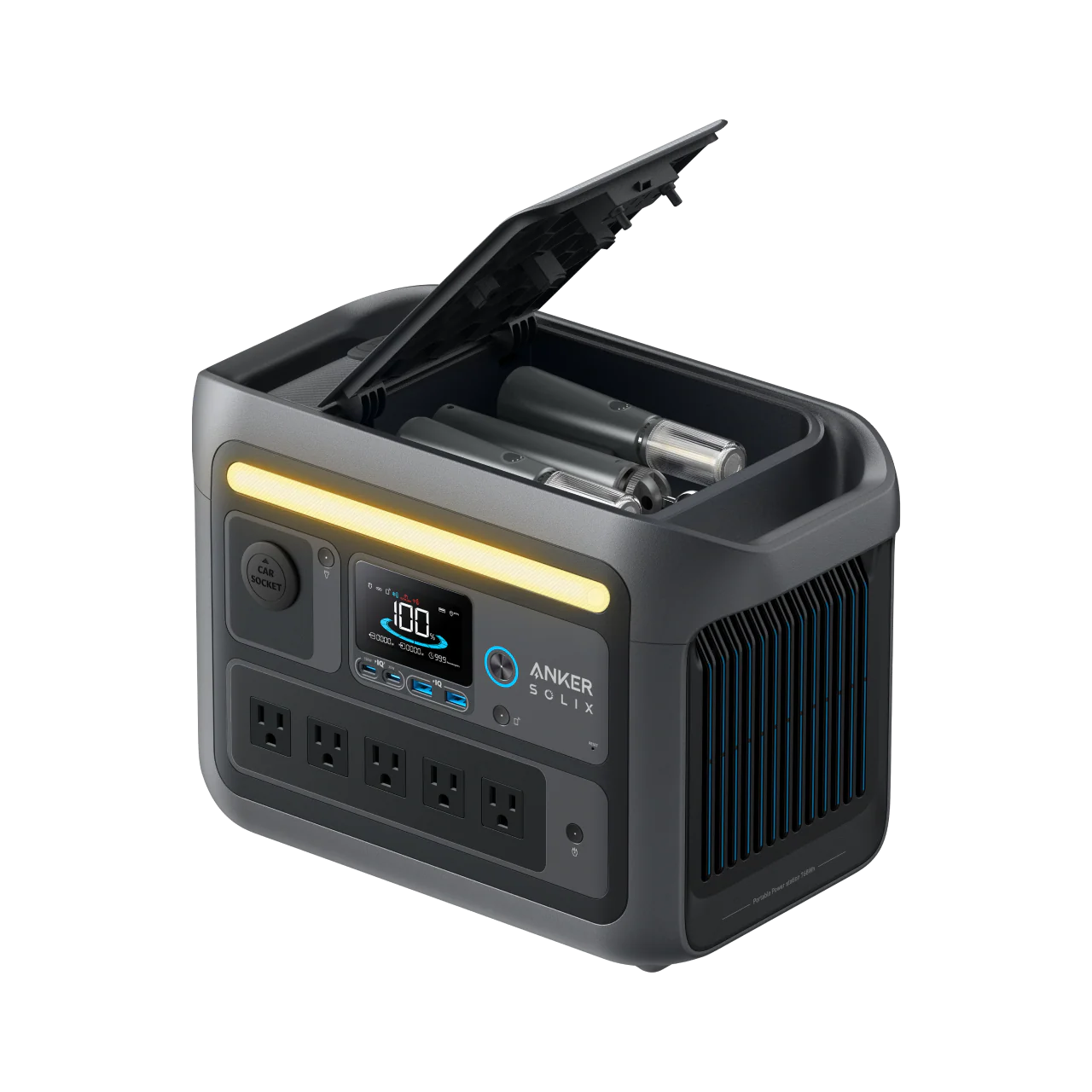
The Anker does win one column, and it's a real one. At 24 lb it's a one-hand-per-side lift you make without thinking about it; the 35.3 lb BLUETTI is the kind you set down to re-grip, and one reviewer named the weight their single biggest frustration with the thingB2. The C800 Plus also has the light pole, which is either a lantern replacement or a flourish that ate the cable cubby, depending on who you askA2A3A14.
Buy the AC180. It holds half again as much, starts harder loads, takes more sun, and is rated for more cycles while doing it, all for less money. The C800 Plus is the right call for one buyer only: the person whose deciding question is what the box weighs in their hands, who has already looked at the price gap and shrugged.
What the Numbers Reveal
Each conclusion stated first — the numbers behind it on one line, the full analysis below.
rated cycles
Cycle life multiplies that rather than softening it. 768Wh across 3,000 cycles is 2,304 kWh of energy over the Anker's whole life; 1,152Wh across 3,500 cycles is 4,032 kWh out of the BLUETTI. Same five-year warranty, same wall socket, and one of them delivers roughly three-quarters again as much total energy while costing $150 less at the register.
C800 Plus: $649 for 768Wh, 3,000 cyclesAC180: $499 for 1,152Wh, 3,500 cyclesPurchase cost per watt-hour: $.85 on the C800 Plus, $.43 on the AC180
Why it mattersIf price is anywhere in your decision, the decision is finished: the cheaper unit here is also the bigger one and the longer-lived one.
weight
So light doesn't mean better engineered here, and it isn't free. The 11.3 lb you save is 384Wh you don't get, and you pay $150 for the privilege of not getting it. Weight is a legitimate reason to choose the C800 Plus. It's also the entire reason, and it's priced like a feature rather than a consequence.
C800 Plus: 24 lb carrying 768WhAC180: 35.3 lb carrying 1,152WhThe Anker is 11.3 lb lighter
Why it mattersThe camper who carries the unit any real distance from the car should pick the Anker on purpose. Anyone who mostly slides it off a garage shelf is paying for a carry they never make.
continuous output
Then stack runtime on top. Neither unit carries the full outage list, but dividing the 8 hours by each shortfall (252% and 168%) leaves the Anker covering about 3 of those hours and the BLUETTI about 5. In the exact situation people buy these for, the C800 Plus starts fewer of your appliances and then runs the ones it does start two hours less.
C800 Plus: 1,200W continuous, 1,600W surgeAC180: 1,800W continuous, 2,700W surgeThe 8-Hour Blackout profile needs 1,645Wh; neither unit covers it (C800 Plus 252%, AC180 168%)
Why it mattersIf this is a blackout box, don't pay a premium for the smaller inverter attached to the smaller battery.
The specific dimensions that decide these two units — everything else is a tie.
Lifetime Value
Selected because: The AC180 costs $150 less and stores 384Wh more, which settles the value question before any other section gets a vote.
cost / lifetime kWh
The gap here compounds instead of adding, because the BLUETTI wins both halves of the same equation. More watt-hours in each cycle, and more cycles to spend them on. That's why the lifetime-energy spread ends up wider than the capacity spread that causes it.
Don't over-weight the figure, though. At a weekend cadence the Anker's cells are good for 28.8 years and the BLUETTI's for 33.7, and neither of those is a plan anybody actually makes. The lifetime number isn't a prophecy. It's a way of pricing what's in the box today, and today the cheaper box is the larger one.
Portability & Form Factor
Selected because: Weight is the only column the C800 Plus wins, 24 lb against 35.3, so its whole case lives or dies here.
weight
Twenty-four pounds goes over a tailgate without a second thought. Thirty-five is the weight where you check your footing first, and one reviewer called moving the AC180 around their biggest frustration with itB2. If your unit lives in a hall closet and comes out twice a year, that difference never bills you. If it goes to a campsite most weekends, it bills you every trip.
The catch on the Anker's side is that the carry is the whole case, and the case gets narrower the longer you look. Reviewers split hard on the pole light: a genuine lantern replacement to some, an unnecessary flourish to others, and it took the C800's cable cubby with it, so there's nowhere to stow the cordsA2A3A14. That's the extras column, and it's a wash at best against 384Wh.
Your Life, Your Pick
Selected because: This is where the capacity gap turns into hours: the AC180 clears the remote-workday and tailgate loads that the C800 Plus misses.
Half of these profiles are wins for nobody. Weekend camping, the 8-hour blackout and van-life daily all ask for more energy than either box holds, and no amount of clever packing fixes that. Where the two do separate it gets ugly for the Anker: the tailgate load leaves it at 103% of what it can usably deliver. Three percent short is worse than thirty, because you'll plan the whole afternoon as though it fits.
Recharge is the other half of any multi-day outage, and it lands the same way. Roughly two and a half hours of strong sun fills either unit from empty (1,152Wh at 500W, 768Wh at 300W). The C800 Plus caps at 300W and isn't designed to sit under large static panelsA9, so the same solar day hands the BLUETTI owner a meaningfully bigger battery at sundown.
Brand Trust
Selected because: Both units carry the same five-year warranty, so what actually separates them is which support desk picks up when you need to use it.
Five years on both, and the apps are a wash at 4.5 out of 5 on iOS each. Which leaves the brand column resting on the one thing nobody checks before buying: what happens the day you have to open a ticket.
Neither answer is comforting. Anker's SOLIX support is sliding from a genuinely excellent baseline, with AI agents returning generic answers and hazmat freight rather than a prepaid label when a heavy unit has to go back. BLUETTI's is the most inconsistent in the category, email-driven across a China time zone, and noticeably better when you bought direct from BLUETTI instead of through a marketplace. That last detail is worth more than any spec on this page: order the AC180 direct, keep the record, and you've bought down the largest single risk in this recommendation.
Strengths & trade-offs
Anker SOLIX C800 Plus
Strengths
- +Lighter by 11.3 lb
Trade-offs
- –Substantially more expensive (+$150) than the AC180.
- –Weaker inverter (-600W) limits appliance compatibility.
BLUETTI AC180
Strengths
- +Costs $150 less
- +Larger battery capacity
- +Higher AC output
- +Faster solar charging
Trade-offs
- –Significantly heavier (+11.3 lbs), making it harder to move.
Will It Power Your Gear?
Scenario math and per-appliance runtimes, modeled from the spec record.
Scenario verdicts
We ran the math on six real-world scenarios. Here's which unit survives your actual life.
SCN-01 · 2 nights · needs 2,100Wh
Weekend Camping
Two nights off-grid with essential comfort
Neither unit
A 2,100Wh weekend is more than either of these carries, so nobody wins this one. The Anker would need a bit over three of itself and the BLUETTI a bit over two. Plan a solar day into the middle of the trip, or plan on a bigger unit.
Battery budget usedlower = more headroom
LOAD Phone Charger 15W×6h · LED Lights 40W×8h · Box Fan 75W×14h · CPAP Machine 40W×16h
SCN-02 · 8 hours · needs 1,645Wh
8-Hour Blackout
Keep the essentials running through a night without power
Neither unit
Neither box covers the full eight hours of this load. The BLUETTI gets you about five of them, the Anker about three, which is a real difference somewhere around hour four but still a partial answer either way. Treat both as bridge power, not backup power.
Battery budget usedlower = more headroom
LOAD Fridge 150W×8h · Router + Modem 20W×8h · LED Lights (4 bulbs) 40W×6h · Phone Charger 15W×3h
SCN-03 · 8 hours · needs 320Wh
CPAP Overnight
Sleep therapy without interruption — the #1 medical use case
AC180
The BLUETTI takes it, spending about a third of its usable capacity on a 320Wh night against roughly half of the Anker's. It's also the lower-rated unit for noise at 40dB, and that's the spec that counts when the machine is on the nightstand and the power station is underneath it.
Battery budget usedlower = more headroom
LOAD CPAP Machine 40W×8h
SCN-04 · 8 hours · needs 910Wh
Remote Workday
Full work day off-grid without power anxiety
AC180
The BLUETTI finishes the day at 93% of usable capacity. The Anker needs 139% of its own, which means it doesn't finish the day. That's the entire result.
Battery budget usedlower = more headroom
LOAD Laptop 60W×8h · External Monitor 30W×8h · Router + Modem 20W×8h · Phone Charger 15W×2h
SCN-05 · 4 hours · needs 670Wh
Tailgate Party
Game day power for the crew
AC180
The BLUETTI covers this at 68% and never breaks a sweat. The Anker lands at 103% of usable capacity, which is the worst possible place to land: close enough that you'd plan around it, short enough that the speakers cut out before the game does.
Battery budget usedlower = more headroom
LOAD Blender 400W×0.5h · LED TV (55") 80W×4h · Bluetooth Speaker 15W×4h · Phone Charger (×3) 45W×2h
SCN-06 · 24 hours · needs 4,685Wh
Van Life Daily
A full day of mobile living — the ultimate endurance test
Neither unit
Both lose this by a wide margin. A daily draw this size wants more than four times what the BLUETTI holds and the Anker is further back again. This is a house-bank problem wearing a portable-power-station costume.
Battery budget usedlower = more headroom
LOAD Mini-Fridge 150W×24h · Laptop 60W×4h · Phone Charger 15W×3h · LED Lights 40W×5h · Fan 75W×8h
The Load Test
RUNTIME = (Wh × 0.85) ÷ LOAD
None of the scenarios above exactly yours? Build it. Toggle what you'd plug in; both units are tested against the combined draw.
Essentials
Comfort & Convenience
High-Draw Appliances
Test duration
8h
Continuous draw
205W
Projected runtime
For this load: AC180 runs 4.8h vs 3.2h.
$499 list · direct from BLUETTI
Modeled from the spec record — same math as the tables below. Methodology
Runtime by appliance
Real-world runtime estimates for common appliances, modeled at 85% inverter efficiency.¹
Essentials
The basics you need runningscale 0–65.3hComfort & Convenience
Makes off-grid life actually enjoyablescale 0–13.1hHigh-Draw Appliances
These reveal the real limitsscale 0–1h¹ Runtime = (capacity × 0.85) ÷ appliance watts. Within each group, all bars share one time scale (the group's longest runtime), so lengths are comparable across appliances; identical runtimes collapse into a single blue/orange bar. Actual runtime varies with battery age, temperature, and simultaneous loads — see methodology.
Conclusion
August 9, 2026
Verdict: the AC180
Take the AC180. It costs $150 less and does more of everything that decides a purchase: half again the capacity, 600W more continuous output, 1,100W more surge headroom, 200W more solar input, and 500 more rated cycles. Warranty, USB-C ceiling and UPS switchover are identical on both, so the C800 Plus has no column left to win the money back with. The one honest reservation is the desk behind the pick: BLUETTI's support is the most inconsistent in the category, and buying direct from BLUETTI rather than through a marketplace tends to produce the better outcome on a claim. If you carry your power station on foot more often than you plug things into it, the 24 lb Anker earns its premium. Otherwise it doesn't.
Today the AC180 is $449, $50 under its typical $499. The verdict weighs typical prices, not today's. Prices checked 1 day ago.
Editor-assigned confidence, based on cited owner research and spec analysis.
List prices as of August 9, 2026. The links below open Anker's and BLUETTI's current prices.
$449.00 · direct from BLUETTI
down from $499 · 10% below usual
Last checked 1 day ago. Prices move — check before you buy.
or check the SOLIX C800 Plus price$649.00 list
Written by Ian Schneider, Solar & Off-Grid Tester · Station Arena Test Desk · Updated August 9, 2026
Measured Data
Benchmark scores and the full spec record, side by side.
Benchmark scores
Not rated for both units (minimum threshold unmet): RV Living, Home Backup, Food Truck.
Full specifications
ᵈ Derived: price ÷ rated capacity. See the data behind our comparisons →
Comparison ToolAdd more power stations, side by sideOpen Tool →How these numbers are produced
Numeric verification
Every figure on this page traces to our spec database or arithmetic on it — no estimated numbers.
Owner claims
Statements about owner experience are cited to published reviews — see Sources & Research Notes below.
Runtime model
Runtime = (rated capacity × 0.85 inverter efficiency) ÷ device wattage. Solar recharge estimates assume panels deliver 70% of rated output. Cold weather, battery age, and stacked loads reduce real-world results.
Power Score
Computed from 14 published spec dimensions, weighted per use-case bench. Higher is better; a unit must meet a bench's minimum threshold to be rated.
See the full weight table and data sourcing on our methodology page →Class ranking (the star rating)
Each unit's star score is a category ranking, not customer reviews — no buyer opinions feed it. We score every station on size-independent quality (value, output, portability, endurance, ports, warranty, and more), then percentile-rank it against the other units in its capacity class, so a class-leading compact unit and a class-leading whole-home unit can both earn 5★. Here, SOLIX C800 Plus rates 3.8/5 (32nd percentile of 20 Compact-class units), and AC180 rates 4.3/5 (58th percentile of 27 Everyday-class units).
How the class ranking is computed →Test Notes & Caveats
Hidden gotchas and advantages we spotted that you won't find on the product page.
45dB Against 40dB, and Where That Lands
Five decibels separates these two on paper and the C800 Plus is on the wrong side of it. At a tailgate that's a footnote. At 3 a.m. with the unit two feet from a pillow it's the decision. Worth saying plainly: 40dB isn't silence either, and both units get louder with load and louder again on a fast charge. If quiet overnight is the requirement, charge before bed rather than during it.
Same Five Years, Different Price Per Year
Both cover five years, so the terms are a tie. What isn't tied is what each of those years costs: $130 a year on the Anker against $100 on the BLUETTI for identical coverage. And a warranty is only as good as the desk that honors it, which is the one place the BLUETTI gives ground. Buy direct from BLUETTI and file the receipt somewhere you'll still find it in year four.
Full record above — the Test Desk pick is the AC180.
Check AC180 price →or check the SOLIX C800 Plus priceOwnership Analysis
What happens after you buy — true cost of ownership, brand trust, and growth potential.
Lifetime value
Service lifeyears at one full cycle per day
Lifetime energy delivered
Cost per delivered kWh
│ warranty ends · Reaching the cycle rating means ~80% capacity remains — degraded, not dead.
Analyst note
The AC180 wins on both sticker price and long-term value. At $0.12/kWh over its lifetime, it's meaningfully cheaper to own. Clear value winner.
Delivers each lifetime kWh for $0.16 less — check the AC180 price →
Brand trust
Anker
Ecosystem
7-8 SOLIX portable power stations across C-series (compact) and F-series (flagship), plus the X1 home energy system
Support
US-based, and historically the best no-hassle replacement policy in the category. The trend is the problem: SOLIX tickets increasingly land on AI agents returning generic answers, and sending a heavy unit back means hazmat freight rather than a prepaid label.
Community
Moderate — active Reddit (r/Anker, r/AnkerSOLIXCommunity) and growing. Benefits from Anker's massive consumer electronics brand awareness.
App experience
Rated 4.5/5 iOS (~1,100 ratings) · 4.3/5 Android
Unique strength
Parent brand trust from Anker's consumer electronics dominance. InfiniPower technology for long cycle life. Strong $/Wh value in the mid-size and larger units — the S2000, F2600 and C1000 are among the better buys per watt-hour in the catalog.
Worth knowing
Firmware updates have removed features without notice, and the expansion ecosystem is thinner than EcoFlow's. Neither bites you on a fixed-size unit like this one, but it's the pattern behind the brand.
BLUETTI
Ecosystem
One of the broadest lineups — 15-20+ models from budget (AC2A) to flagship portable (Apex 300, 2764.8Wh). Includes specialized products: vehicle solar hubs, sodium-ion cold-weather units, and balcony storage systems.
Support
The most inconsistent support in the category, and the single largest risk in buying this unit. It runs on email across a China time zone: some claims resolve smoothly, others turn into weeks of runaround or an offer of a discount on a new unit instead of a repair. Buying direct from BLUETTI rather than a third-party marketplace tends to produce the better outcome.
Community
Active and growing — Reddit r/bluetti has a dedicated community. Second-largest after EcoFlow in engagement.
App experience
Rated 4.5/5 iOS and Android — tied for best app experience in the category. V3.0 UI redesign was well-received.
Unique strength
Among the best capacity-to-price ratios available — several Elite and Apex units are the lowest $/Wh in the catalog. Widest product diversity including industry-firsts like sodium-ion cold-weather units and dual solar+alternator vehicle hubs. LFP across the rest of the range, though rated cycle life spans 2,500 (EB3A) to 6,000, and it varies WITHIN the Elite range rather than tracking it — the Elite 300 and Elite 200 V2 are rated 6,000 while the Elite 30 V2, Elite 10 Mini, Elite 320 and Elite 400 are rated 3,000+ and the Elite 100 V2 4,000+, so check the specific model. Dual-voltage (120V/240V) in flagships.
Worth knowing
Discontinued models can become unrepairable, because there's no spare-parts policy covering some of them. The flip side is why you're here: BLUETTI's capacity per dollar is among the best in the catalog, and all but one unit in the lineup is LFP, though the rated cycle life varies model by model.
Analyst note
Anker sells you the better-known name attached to support that's sliding. BLUETTI sells you the better hardware attached to support that was never dependable. The apps are a wash at 4.5 out of 5 on iOS for both, so they don't break the tie. If the support gap makes you uneasy, the fix isn't switching units, it's buying the BLUETTI direct so a claim has a clean path home.
Growth path
SOLIX C800 Plus
FIXED CAPACITYFixed at 768Wh, with no expansion — so size it for your needs up front rather than planning to add capacity later.
Accepts up to 300W of solar. Limited to a single portable panel.
Adequate ports for most setups, but heavy users may want a power strip.
AC180
FIXED CAPACITYFixed at 1,152Wh, with no expansion — so size it for your needs up front rather than planning to add capacity later.
Accepts up to 500W of solar. Suitable for a 1-2 panel setup.
Adequate ports for most setups, but heavy users may want a power strip.
Realistic full solar rechargeat 70% of rated panel output — see methodology
Analyst note
Neither expands, and that's no knock on either — each is a complete unit at a fixed size. Buy the capacity that covers your needs now (the AC180 gives you the larger ceiling); you can't add to either later.
What Owners Report
Patterns from published owner reports and long-term reviews — every claim cited to its source below.
Anker SOLIX C800 Plus
There are no long-term owner threads on the C800 Plus specifically; what exists comes from reviewers working through test units rather than people who have lived with one for a yearA1A13. Read the field record as a first impression, not a durability report.
Inside that limit it's consistent. The fan is the recurring note: unavoidable and clearly present in a quiet house once ambient temperature passed 80F with about 1,030W flowing, though another reviewer called it manageable at roughly arm's length during a fast chargeA1A11. Capacity is the other: 768Wh gets flagged as thin for the money against same-price rivals and specifically short for kettles and coffee machinesA5A10A12. Light loads are fine, and one tester's fridge and freezer took 10% of the battery over 8 hoursA6. Another pulled the wall plug mid-session and got no flicker at all on the monitorA4. The app draws steady praise for remote monitoring and firmware delivery with no connectivity complaints in the recordA7A15.
“The pole light felt is a little over the top and unnecessary.”
Sources
dustinabbott.net
BLUETTI AC180
The AC180's record is thin but unanimous on the point that matters: it's the value pick, called the best bang-for-buck in the mid-range at its price, on LiFePO4 cells rated past 3,500 full cycles behind a five-year warrantyB3B4.
The two complaints are the ones the spec sheet predicts. Weight is the first, cited between 35 and 37 pounds and named the biggest frustration in moving itB2. Fans are the second, and the accounts genuinely split: fine from a few feet away to some, aggressive and loud under charge to others, with a silent charging mode that caps the noise by slowing the chargeB1. That trade is worth knowing about before the night you need a fast refill.
“Fan noise draws mixed reports — some find it fairly quiet from a few feet, others call the fans aggressive and loud, especially during charging; a silent charging mode caps the noise by limiting charge speed.”
Sources
outdoorgearlab.com · storagereview.com · kenrockwell.com · voltagebasics.com · bluettipower.com · backuppowerhub.com · solarwithwatts.com · pcworld.com
Sources & Research Notes
Every owner claim in this report is traceable to a published source. The bracketed references above resolve here.
Recurring owner themes
- Fan noise is consistently reported as noticeable during fast AC charging or high sustained wattage, though most reviewers call it 'manageable' rather than a dealbreaker. [SOLIX C800 Plus · 2 entries]
- The companion app is repeatedly praised for remote monitoring/control and firmware delivery, with no reviewers reporting connectivity or crash complaints. [SOLIX C800 Plus · 3 entries]
- 768Wh capacity is flagged by multiple reviewers as the unit's main limitation for heavy appliances and against same-price competitors, even though real-world light loads (fridge, gadgets) performed well. [SOLIX C800 Plus · 4 entries]
- The signature 'Plus' camping-light pole/torches are polarizing: some reviewers call the feature genuinely useful and a lantern-replacement, others call it an unnecessary gimmick that sacrifices the C800's cable-storage cubby. [SOLIX C800 Plus · 3 entries]
- Best-in-class value and capacity-per-dollar are the consistent praise; the weight and aggressive fans under load are the recurring caveats. [AC180 · 2 entries]
- A1
“Once the temperature rose above 80F with a 1,030 average wattage, the fan noise was unavoidable and quite present in a quiet house.”
How-To Geek — 'Anker Solix C800 Plus Review: A Power Station Prepared to Illuminate Nighttime' · 2024-03 · [negative]
- A2
“The pole light felt is a little over the top and unnecessary.”
How-To Geek — 'Anker Solix C800 Plus Review: A Power Station Prepared to Illuminate Nighttime' · 2024-03 · [mixed]
- A3
“As it is, there's nowhere to keep the cords when not using them.”
How-To Geek — 'Anker Solix C800 Plus Review: A Power Station Prepared to Illuminate Nighttime' · 2024-03 · [negative]
- A4
“Unplugged the power supply to the C800 Plus to simulate a power outage. No reaction on the monitor, no flicker, just continued operating.”
DustinAbbott.net — 'Anker Solix C800 Plus Power Station Review' · 2024-03 · [positive]
- A5
“My lone concern on this front is whether or not the battery capacity is sufficient.”
DustinAbbott.net — 'Anker Solix C800 Plus Power Station Review' · 2024-03 · [mixed]
- A6
“I connected the Anker and in 8 hours, my frig/freezer used 10% of the power.”
The Gadgeteer — 'Anker SOLIX C800 Plus power station review' · 2024-04 · [positive]
- A7
“My other power stations do not have a companion phone app. But after the first trip, I saw how this feature would come in handy.”
The Gadgeteer — 'Anker SOLIX C800 Plus power station review' · 2024-04 · [positive]
- A9
“With a maximum solar input of 300W at 11-60V, it's not designed to be used with large static panels.”
MakeUseOf — 'Anker Solix C800 Plus Review: The Ultimate Emergency and Camping Companion' · 2024-05 · [mixed]
- A10
“it doesn't have the outright storage or power to tackle more heavy duty appliances like kettles or some coffee machines.”
Trusted Reviews — 'Anker SOLIX C800 Plus Review: A great camping companion' · 2024-04 · [negative]
- A11
“The fan does ramp up during fast charging, but the noise is manageable at roughly arm's length.”
The Power Pick — 'Anker SOLIX C800 Plus Review: Camping Lights Meet Serious Power' · 2026-02 · [mixed]
- A12
“The 768Wh capacity sits in an awkward middle ground. It is significantly less than the 1,024Wh offered by the EcoFlow DELTA 3 Plus at the same $649 price.”
The Power Pick — 'Anker SOLIX C800 Plus Review: Camping Lights Meet Serious Power' · 2026-02 · [negative]
- A13
“I've come away from my time with the Anker SOLIX C800 Plus extremely impressed.”
AndroidGuys — 'Anker SOLIX C800 Plus Power Station Review' · 2024-05 · [positive]
- A14
“We stopped packing separate lanterns after the first week, streamlining our camping setup noticeably.”
BackupPowerHub — 'Anker SOLIX C800 Plus Review: Best Mid-Range with Camping Lights' (45-day, 8-trip field test) · 2026 (article ~1 week old at time of research) · [positive]
- A15
“Through the app, you can easily install firmware updates that may include performance enhancements, bug fixes, or new functionalities.”
Greener Ideal — 'Anker SOLIX C800 Plus Portable Power Station Review' · 2024-08 · [positive]
- B1
“Fan noise draws mixed reports — some find it fairly quiet from a few feet, others call the fans aggressive and loud, especially during charging; a silent charging mode caps the noise by limiting charge speed.”
outdoorgearlab.com / storagereview.com — BLUETTI AC180 review · 2025-2026 · [mixed]
- B2
“At roughly 35-37 lbs it's heavy for its class — one reviewer named the weight their biggest frustration when moving it around.”
kenrockwell.com / voltagebasics.com — AC180 review · 2025-2026 · [negative]
- B3
“Quality LiFePO4 cells rated for 3,500-plus full cycles before capacity degrades to 80%, backed by a 5-year warranty.”
bluettipower.com / backuppowerhub.com — AC180 review · 2025-2026 · [positive]
- B4
“The definition of bang for buck — not the lightest or smartest, but the most raw power and capacity for the price; widely called the best value in the mid-range at around $499.”
solarwithwatts.com / pcworld.com — BLUETTI AC180 review · 2025-2026 · [positive]
Research compiled August 9, 2026.
Who Should Buy Which
Buy the SOLIX C800 Plus if you…
- →You carry the power station on foot, and 24 lb is the version you'll actually bring. Eleven pounds is the difference between a unit that stays in the car and one that makes it to the site.
- →Your loads are small and known: laptop, phones, camp lights, a fridge overnight. One tester's fridge-freezer drew 10% of the battery in 8 hours, which is exactly the shape of use this unit is good atA6.
- →You want the pole light and you know you want it. Reviewers split on whether it's a lantern replacement or a flourish that cost the cable storageA2A3A14, but the AC180 has no answer to it either way.
Buy the AC180 if you…
- →You're buying a blackout box. More surge to restart the fridge, more hours once it's running, and more solar input to claw it back the next morning.
- →You want the most watt-hours per dollar in this price band and you don't need to carry them upstairs. That's this unit, and it isn't close.
- →You work a full day off the battery. The remote-workday load lands at 93% of the AC180's usable capacity and 139% of the Anker's, and only one of those finishes the day.
If neither fits
If your real daily draw runs into multiple kilowatt-hours, both of these are the wrong size. The van-life profile here asks for 4,685Wh against the AC180's 1,152Wh, more than four times what it holds, and the Anker is further behind still. Skip the mid-range entirely and shop the expandable class that can be grown toward the 4,685Wh this profile actually asks for, or build a proper house bank. Buying the larger of two units that are both too small is just a slower way to run out.
The Bottom Line
Buy the AC180. Cheaper at the register, larger in the box, stronger at the outlet, and rated for more cycles than the unit asking $150 more for the privilege. Same warranty, same USB-C ceiling, same UPS switchover, so there's no column where the Anker quietly wins the money back.
The exception is honest and narrow. If your deciding question is what this weighs while you're carrying it, the 24 lb Anker is a genuinely different object from the 35.3 lb BLUETTI and it's fair to pay for that. Just be clear that's what you're paying for. Everyone else: order the AC180 direct from BLUETTI so a warranty claim has somewhere clean to land, and put the savings toward a panel.
Frequently Asked Questions
Answers drawn from the spec record and cited owner research.
Is the Anker SOLIX C800 Plus worth $150 more than the BLUETTI AC180?
Only if you're carrying it. The C800 Plus is 24 lb against the AC180's 35.3, and that's the whole case for the premium. On capacity, output, surge, solar input and cycle life the AC180 takes every column, and it costs less doing it.
Which one is better for running a CPAP overnight?
The AC180, comfortably. A 320Wh night uses about a third of its usable capacity against roughly half of the Anker's, so you're never watching the gauge. It's also the quieter unit on paper at 40dB to 45dB, which matters more than capacity when the thing is sitting beside your bed.
Will either of these get me through an 8-hour blackout?
Not a full one, if your outage list looks like the 1,645Wh profile here. Neither covers it: the AC180 gets you roughly 5 of the 8 hours and the C800 Plus roughly 3. The AC180 also brings 2,700W of surge to restart a fridge compressor against the Anker's 1,600W, so it fails later and less often.
Can I add a second battery to the C800 Plus or the AC180?
No, and that isn't a mark against either one. Both are complete units at a fixed size, so the capacity you buy is the capacity you keep. Size for what you need now: the AC180's 1,152Wh is the higher ceiling of the two, and if that still isn't enough you want a different class of unit, not an add-on.
Is the BLUETTI AC180 loud?
It's rated at 40dB, quieter on paper than the C800 Plus's 45dB, but the accounts split: fine from a few feet to some people, aggressive under charge to others. There's a silent charging mode that keeps the noise down by slowing the charge rate, which is the right setting for an overnight in a bedroom and the wrong one when you need a fast refill.
Where to buy
Anker SOLIX C800 Plus
$649.00
$649.00 · direct from Anker
Last checked 1 day ago. Prices move — check before you buy.
BLUETTI AC180Pick
$449.00
$449.00 · direct from BLUETTI
down from $499 · 10% below usual
Last checked 1 day ago. Prices move — check before you buy.
Prices may vary by retailer and are subject to change.