Head-to-head test
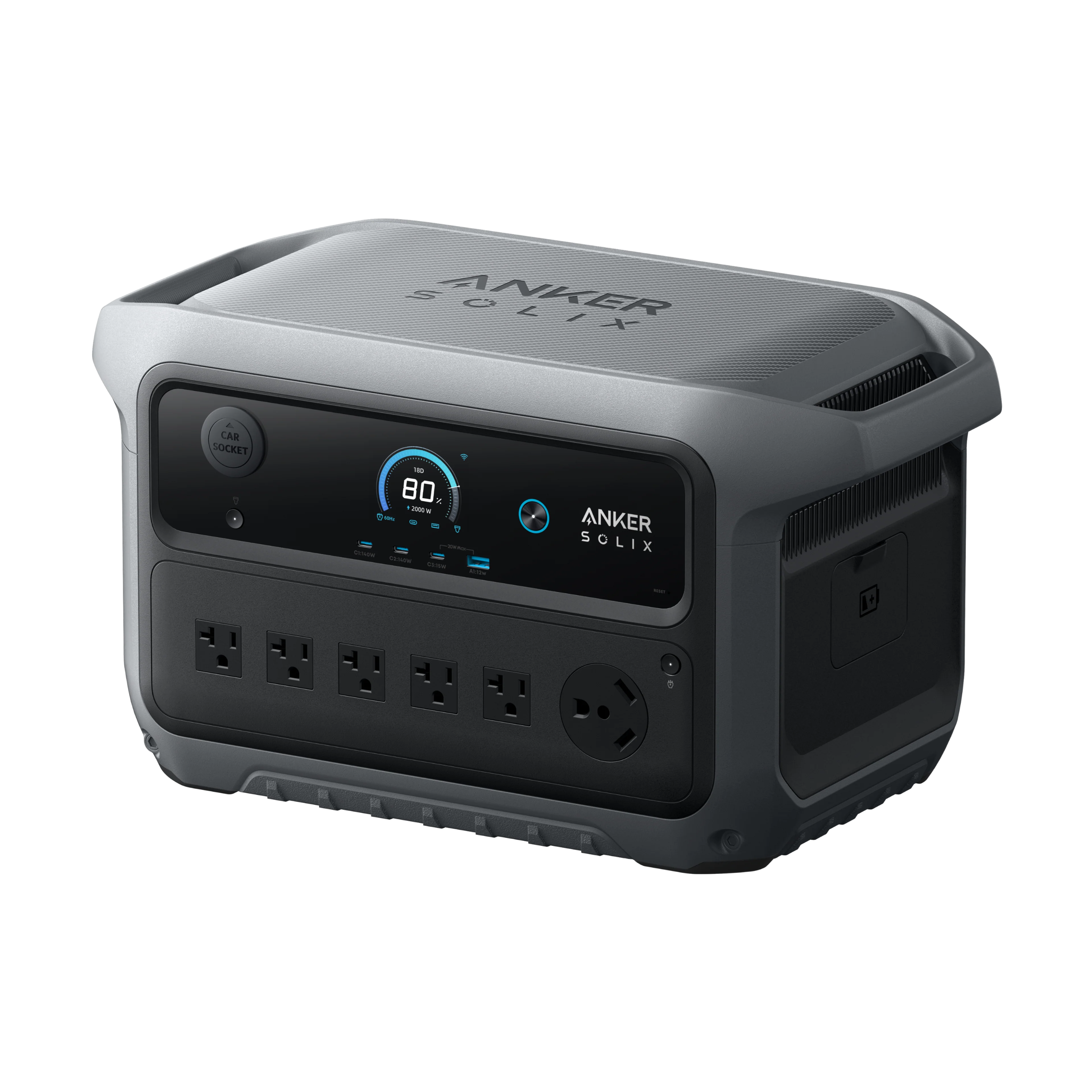
Anker SOLIX C2000 Gen 2 vs BLUETTI Pioneer MD AC180T
The $201 you save on the BLUETTI buys you 615Wh less, 16.7 lb more to carry and a fan you can hear, which is only a good trade if you genuinely need to swap in a fresh battery pack mid-shift.
Full profiles: Anker SOLIX C2000 Gen 2 → · BLUETTI Pioneer MD AC180T →

Written by Ian SchneiderUpdated
Solar & Off-Grid Tester, Station Arena Test Desk
$999.99 · direct from Anker
Last checked 1 day ago. Prices move — check before you buy.

$799.00 · direct from BLUETTI
Last checked 1 day ago. Prices move — check before you buy.
Spec deltas
The Anker costs $201 more and is the lighter unit, the quieter unit, the bigger unit and the longer-lived one. That is not how price premiums usually work.
$1,000 buys 2,048Wh in a 41.7-lb box. $799 buys 1,433Wh in a 58.4-lb one. Divide either way and the cheaper station is the more expensive energy: 56 cents a watt-hour against 49 on the sticker, and 19 cents against 12 across the life of the pack. There is no angle from which the AC180T is the value pick on capacity.
What $799 does buy is a battery that comes apart. The AC180T's two B70 packs slide out and hot-swap while the unit is running, without the connected devices noticingB1, so runtime stops being a function of how big the box is and becomes a function of how many packs you own. That is a genuinely different product, and for one specific buyer it is the right one. For everyone else, the C2000 Gen 2 wins on the axis they actually came here about.
What the Numbers Reveal
Each conclusion stated first — the numbers behind it on one line, the full analysis below.
weight
So the weight penalty is not a manufacturing miss, it is the price of the feature, and it only pays back for someone who cannot manage a single lift. Break the AC180T apart and you can walk it up basement stairs in stages. Carry it whole and you have hauled 16.7 extra pounds to arrive with less battery than you started the comparison wanting.
SOLIX C2000 Gen 2: 2,048Wh at 41.7 lbPioneer MD AC180T: 1,433Wh at 58.4 lbthe AC180T's mass is two removable B70 packs in a slotted enclosure, and reviewers note you can lighten or distribute the load by pulling themB4
Why it mattersIf you can lift a 41.7-lb box in one go, weight is an argument for the Anker rather than a reason to hesitate over it.
In a blackout the socket is precisely what is gone, which turns hot-swap from a runtime feature into a pre-outage chore you have to have remembered on a night nobody scheduled. The C2000 covers the same eight hours out of one box with 6% of its usable reserve left over, no second purchase, nothing to have remembered.
an 8-hour blackout needs 1,645Wh: 94% of the C2000's usable reserve, 135% of the AC180T'sB70 packs hot-swap mid-operation without interrupting connected devicesB1a flat B70 refills from the wall in about an hourB3, or from the AC180T's 500W solar input
Why it mattersIf you are buying for outages, buy capacity. Hot-swap is for the person who left the socket behind on purpose.
rated cycles
Both of those are well past the five years either brand will stand behind, so if you cycle this thing twenty times a year the cycle gap is a rounding error and you will replace the unit for other reasons long before you run out of cycles. The gap converts into real money only for a daily solar loop, an off-grid cabin or a van.
4,000 cycles across 2,048Wh gives the C2000 8,192 kWh of lifetime energy3,000 cycles across 1,433Wh gives the AC180T 4,299 kWhboth carry a 5-year warranty
Why it mattersDo not buy the C2000 for its cycle count unless you actually cycle daily. Buy it for the capacity, the weight and the fan, and treat the longevity as a bonus that mostly pays the off-grid crowd.
Both figures are under-load ratings and a CPAP is not much of a load, so neither station spends the night at its ceiling. But the ceiling is what you hear the moment anything joins the circuit, a phone on fast charge or the fridge you also plugged in, and 45 dB is the number that has you awake at 3 a.m. solving a problem you did not have.
C2000 Gen 2 rated 30 dBA under load, AC180T rated 45 dBAa CPAP night draws 320Wh: 18% of the C2000's usable reserve, 26% of the AC180T'stesters describe the C2000's fans as a subdued whirr that backgrounds easily even when it is working hardA1
Why it mattersAnyone buying this as medical backup should stop reading the capacity column and decide on the noise spec.
The specific dimensions that decide these two units — everything else is a tie.
Lifetime Value
Selected because: the $201 sticker gap points one way and every per-watt-hour figure points the other.
cost / lifetime kWh
Twelve cents per lifetime kilowatt-hour against nineteen, and the reason is boring: more cells, rated for more cycles, so the same dollar buys almost twice the energy across the life of the pack. The sticker difference is the smallest number in this comparison and the only one that favours the BLUETTI.
The honest limit on that argument is the warranty, which is a dead heat at five years each. Longevity is a benefit you have to survive the coverage period to start collecting, and on the part that is actually guaranteed, the AC180T is the cheaper commitment: $160 a year of coverage against $201.
Growth Path
Selected because: these two grow in opposite directions, one raising its own ceiling and one swapping in a fresh pack, and that difference is most of the decision.
solar input
The C2000 raises its own ceiling and keeps it raised. The AC180T holds 1,433Wh forever and instead lets you carry the extra in the back of the car. Those are not two flavours of one feature, they are answers to different questions. How much can this hold has one answer. How long can I stay out has the other.
Which is why the word expandable is doing more harm than good here. If your reserve lives in a basement waiting for weather, you want the number on the unit to go up. If it rides to a job site, you want a charged spare in a milk crate. Buy the one that matches where the battery spends its life, not the one with the better-sounding feature list.
Your Life, Your Pick
Selected because: an 8-hour blackout is where the 615Wh capacity gap stops being abstract.
The blackout row decides purchases. Eight hours of the loads people actually run comes to 1,645Wh, which the C2000 delivers from what is usable and the AC180T does not, needing 135% of everything it can safely give. Everything below that line, the CPAP night, the workday, the tailgate, both units handle without breathing hard.
Two rows go to neither of them. A full weekend of camping wants 2,100Wh and a day of van life wants 4,685Wh, and the C2000 sits at 121% and 269% of usable respectively with the AC180T further back. If either of those is your real use, the answer on this page is neither, and the next size up is where you should be shopping.
Portability & Form Factor
Selected because: the heavier unit here is the one holding less.
weight
41.7 lb is a lift you do once without thinking about it. 58.4 lb is the one where you look around for a second person. The odd part is which of them holds more.
The AC180T's counter is real and worth saying plainly: it comes apart. Pull the packs and it moves in stages, which is the one situation where the heavier station is genuinely the easier one, whether that is a narrow staircase, a bad back or a boat. The C2000 is a single object. Whatever it weighs, it weighs all at once.
What the Specs Don't Tell You
Selected because: noise, switchover speed and cycle life are where these two diverge once capacity is settled.
rated cycles
Fifteen decibels separates these two under load, and noise is the spec people skip until the unit is living in the room with them. Thirty is a quiet room. Forty-five is someone talking in it.
The other cards mostly cancel. Both warranties run five years, and both handoffs are quick enough that anything with its own battery never notices the power went away. Cycle life is the one difference that stays real, and only for someone cycling daily.
Strengths & trade-offs
Anker SOLIX C2000 Gen 2
Strengths
- +Lighter by 16.7 lb
- +Larger battery capacity
- +Higher AC output
- +Faster solar charging
- +Rated for 4,000 charge cycles — much longer battery lifespan
Trade-offs
- –No major technical downsides compared to rival.
BLUETTI Pioneer MD AC180T
Strengths
- +Costs $201 less
Trade-offs
- –Significantly heavier (+16.7 lbs), making it harder to move.
- –Weaker inverter (-600W) limits appliance compatibility.
- –Sealed capacity — the SOLIX C2000 Gen 2 can add batteries to grow past 1,433Wh; this one can't.
- –Shorter-lived battery — rated for 3,000 charge cycles vs the SOLIX C2000 Gen 2's 4,000, so it wears out sooner.
Will It Power Your Gear?
Scenario math and per-appliance runtimes, modeled from the spec record.
Scenario verdicts
We ran the math on six real-world scenarios. Here's which unit survives your actual life.
SCN-01 · 2 nights · needs 2,100Wh
Weekend Camping
Two nights off-grid with essential comfort
Neither unit
Neither, and not narrowly. A full weekend wants 2,100Wh, which is 121% of what the C2000 can usably give and 172% of the AC180T. Panels are what change this, and the C2000 takes 800W of solar against the AC180T's 500W, so if you are covering the shortfall with sun it closes the gap faster.
Battery budget usedlower = more headroom
LOAD Phone Charger 15W×6h · LED Lights 40W×8h · Box Fan 75W×14h · CPAP Machine 40W×16h
SCN-02 · 8 hours · needs 1,645Wh
8-Hour Blackout
Keep the essentials running through a night without power
SOLIX C2000 Gen 2
The C2000 takes this one on the strength of simply finishing: 94% of its usable reserve, close but on the right side of the line. The AC180T needs 135% of what it can usably deliver and comes up short unless you own a charged spare pack and thought to charge it before the power went out.
Battery budget usedlower = more headroom
LOAD Fridge 150W×8h · Router + Modem 20W×8h · LED Lights (4 bulbs) 40W×6h · Phone Charger 15W×3h
SCN-03 · 8 hours · needs 320Wh
CPAP Overnight
Sleep therapy without interruption — the #1 medical use case
SOLIX C2000 Gen 2
Both cover this many times over, so ignore the percentages and read the noise column instead. The C2000 is rated 30 dBA against the AC180T's 45, and at 3 a.m. eighteen inches from your head that is the only spec here that changes anything.
Battery budget usedlower = more headroom
LOAD CPAP Machine 40W×8h
SCN-04 · 8 hours · needs 910Wh
Remote Workday
Full work day off-grid without power anxiety
SOLIX C2000 Gen 2
Both run a full day of laptop, monitor and phone without strain, at 52% and 75% of usable reserve. The C2000 takes it on the port rather than the battery: 140W of USB-C against 100W means a large laptop charges at full speed while you are using it instead of slowly losing ground.
Battery budget usedlower = more headroom
LOAD Laptop 60W×8h · External Monitor 30W×8h · Router + Modem 20W×8h · Phone Charger 15W×2h
SCN-05 · 4 hours · needs 670Wh
Tailgate Party
Game day power for the crew
SOLIX C2000 Gen 2
Both handle game day; the SOLIX C2000 Gen 2 keeps more in reserve (38% used vs 55%). Tailgating is a light load, though, so the number you'll feel is weight: 41.7 lbs for the SOLIX C2000 Gen 2 against 58.4 lbs for the Pioneer MD AC180T, from the trunk to the setup spot.
Battery budget usedlower = more headroom
LOAD Blender 400W×0.5h · LED TV (55") 80W×4h · Bluetooth Speaker 15W×4h · Phone Charger (×3) 45W×2h
SCN-06 · 24 hours · needs 4,685Wh
Van Life Daily
A full day of mobile living — the ultimate endurance test
Neither unit
Neither, by a wide margin. Full-time van draw runs 4,685Wh a day, which is 269% of everything the C2000 can usably deliver and 385% of the AC180T. This is a house-battery question wearing a power-station costume. Size the system above the 4,685Wh you are actually using and wire it in, rather than looking for a box with a handle.
Battery budget usedlower = more headroom
LOAD Mini-Fridge 150W×24h · Laptop 60W×4h · Phone Charger 15W×3h · LED Lights 40W×5h · Fan 75W×8h
The Load Test
RUNTIME = (Wh × 0.85) ÷ LOAD
None of the scenarios above exactly yours? Build it. Toggle what you'd plug in; both units are tested against the combined draw.
Essentials
Comfort & Convenience
High-Draw Appliances
Test duration
8h
Continuous draw
205W
Projected runtime
For this load: SOLIX C2000 Gen 2 runs 8.5h vs 5.9h.
$999.99 list · direct from Anker
Modeled from the spec record — same math as the tables below. Methodology
Runtime by appliance
Real-world runtime estimates for common appliances, modeled at 85% inverter efficiency.¹
Essentials
The basics you need runningscale 0–116.1hComfort & Convenience
Makes off-grid life actually enjoyablescale 0–23.2hHigh-Draw Appliances
These reveal the real limitsscale 0–1.7h¹ Runtime = (capacity × 0.85) ÷ appliance watts. Within each group, all bars share one time scale (the group's longest runtime), so lengths are comparable across appliances; identical runtimes collapse into a single blue/orange bar. Actual runtime varies with battery age, temperature, and simultaneous loads — see methodology.
Conclusion
August 9, 2026
Verdict: the SOLIX C2000 Gen 2
Buy the SOLIX C2000 Gen 2. At $1,000 against $799 it is the cheaper station per watt-hour, 49 cents to 56, it covers an 8-hour blackout out of one charge where the AC180T runs out at 135% of its usable reserve, and it does all of that 16.7 lb lighter and 15 dB quieter. The AC180T earns its keep for exactly one buyer: the person whose constraint is a socket they will not see all day. Its B70 packs hot-swap without cutting power to what is plugged inB1, and no amount of capacity replicates that. If that is not your day, the $201 is the cheapest part of this decision.
Editor-assigned confidence, based on cited owner research and spec analysis.
List prices as of August 9, 2026. The links below open Anker's and BLUETTI's current prices.
$999.99 · direct from Anker
Last checked 1 day ago. Prices move — check before you buy.
or check the Pioneer MD AC180T price$799.00 list
Written by Ian Schneider, Solar & Off-Grid Tester · Station Arena Test Desk · Updated August 9, 2026
Measured Data
Benchmark scores and the full spec record, side by side.
Benchmark scores
Not rated for both units (minimum threshold unmet): Camping.
Full specifications
ᵈ Derived: price ÷ rated capacity. See the data behind our comparisons →
Comparison ToolAdd more power stations, side by sideOpen Tool →How these numbers are produced
Numeric verification
Every figure on this page traces to our spec database or arithmetic on it — no estimated numbers.
Owner claims
Statements about owner experience are cited to published reviews — see Sources & Research Notes below.
Runtime model
Runtime = (rated capacity × 0.85 inverter efficiency) ÷ device wattage. Solar recharge estimates assume panels deliver 70% of rated output. Cold weather, battery age, and stacked loads reduce real-world results.
Power Score
Computed from 14 published spec dimensions, weighted per use-case bench. Higher is better; a unit must meet a bench's minimum threshold to be rated.
See the full weight table and data sourcing on our methodology page →Class ranking (the star rating)
Each unit's star score is a category ranking, not customer reviews — no buyer opinions feed it. We score every station on size-independent quality (value, output, portability, endurance, ports, warranty, and more), then percentile-rank it against the other units in its capacity class, so a class-leading compact unit and a class-leading whole-home unit can both earn 5★. Here, SOLIX C2000 Gen 2 rates 4.1/5 (48th percentile of 26 Large-class units), and Pioneer MD AC180T rates 3.6/5 (19th percentile of 27 Everyday-class units).
How the class ranking is computed →Test Notes & Caveats
Hidden gotchas and advantages we spotted that you won't find on the product page.
45 dB Is Someone Talking in the Room
This is the AC180T's rated figure under load rather than at idle, so a phone charger will not provoke it. But 45 dB against the C2000's 30 is the difference between a station you forget is running and one you are aware of, and you find out which you bought the moment a fridge or a fast charge joins the circuit. If it is going in a bedroom, an office or a small cabin, treat this as a primary spec rather than a footnote.
10ms vs 20ms: Real, and Probably Not Yours
Both handoffs are fast enough that anything carrying its own battery, which is every laptop and phone you own, will never know the power went away. The difference only shows up on hardware with no internal buffer, a desktop tower or a pump motor, and even then it is the kind of thing you discover once. Worth a tiebreak, not worth $201 on its own.
Five Years Each, But Not the Same Five Years
The coverage is a dead heat, so the tiebreak is who picks up the phone. Anker runs US-based support off a strong parent-brand record, though SOLIX service quality has been trending down toward AI-first agents and generic answers, and firmware updates have removed features without notice. BLUETTI's support is the most inconsistent in the category: email-led with timezone delays, smooth for some buyers and a multi-week runaround for others, and measurably better if you bought direct rather than through a third party. Per year of coverage the AC180T is the cheaper commitment at $160 against $201, which is a saving right up until you need to make the call.
Both Outlive You on Weekends
Rated for daily cycling, the C2000's pack is good for about 11 years and the AC180T's for about 8.2. Cycle a station most weekends and neither figure is what ends its service life, since you will replace it for capacity or a dead port long before the cells run out of cycles. The gap turns into real money only on a daily solar loop, an off-grid cabin or a van, where the count actually accumulates.
Full record above — the Test Desk pick is the SOLIX C2000 Gen 2.
Check SOLIX C2000 Gen 2 price →or check the Pioneer MD AC180T priceOwnership Analysis
What happens after you buy — true cost of ownership, brand trust, and growth potential.
Lifetime value
Service lifeyears at one full cycle per day
Lifetime energy delivered
Cost per delivered kWh
│ warranty ends · Reaching the cycle rating means ~80% capacity remains — degraded, not dead.
Analyst note
The Pioneer MD AC180T is cheaper to buy, but the SOLIX C2000 Gen 2 is cheaper to own. At $0.12/kWh over its lifetime vs $0.19/kWh, the SOLIX C2000 Gen 2's higher cycle life and capacity make each dollar go further over the years.
Brand trust
Anker
Ecosystem
7-8 SOLIX portable power stations across C-series (compact) and F-series (flagship), plus the X1 home energy system
Support
US-based, and historically the best no-hassle replacement record in the category. The current picture is more mixed: SOLIX service now leans on AI-first agents that hand back generic answers, and returning a 41.7-lb unit means hazmat shipping logistics rather than a prepaid label. Firmware updates have also removed features without warning. Still probably the easier of these two to get a human answer out of, just no longer the sure thing it was.
Community
Moderate — active Reddit (r/Anker, r/AnkerSOLIXCommunity) and growing. Benefits from Anker's massive consumer electronics brand awareness.
App experience
Rated 4.5/5 iOS (~1,100 ratings) · 4.3/5 Android
Unique strength
Parent brand trust from Anker's consumer electronics dominance. InfiniPower technology for long cycle life. Strong $/Wh value in the mid-size and larger units — the S2000, F2600 and C1000 are among the better buys per watt-hour in the catalog.
Worth knowing
The expansion ecosystem is smaller than EcoFlow's, so if the plan is to keep bolting things on for years, read the accessory catalogue before you commit to the platform.
BLUETTI
Ecosystem
One of the broadest lineups — 15-20+ models from budget (AC2A) to flagship portable (Apex 300, 2764.8Wh). Includes specialized products: vehicle solar hubs, sodium-ion cold-weather units, and balcony storage systems.
Support
The single biggest risk in buying this unit. Support is email-led with China-timezone delays and outcomes vary wildly, from a quick efficient fix to weeks of troubleshooting, an offer of a discount on a new unit instead of a repair, and confusing claim processes for third-party purchases. Buying direct from BLUETTI improves the odds noticeably. Older discontinued models have also gone unrepairable for want of spare parts.
Community
Active and growing — Reddit r/bluetti has a dedicated community. Second-largest after EcoFlow in engagement.
App experience
Rated 4.5/5 iOS and Android — tied for best app experience in the category. V3.0 UI redesign was well-received.
Unique strength
BLUETTI's range is the broadest in the category, from budget units up to flagship portables, plus hardware nobody else bothers to build: sodium-ion cold-weather stations, dual solar-and-alternator vehicle hubs, balcony storage. The AC180T's hot-swap packs come out of that same willingness to try a format rather than ship one box at four sizes. Worth knowing that this particular unit is rated 3,000 cycles, which is below the range BLUETTI quotes for its LFP lineup generally.
Worth knowing
Customer support inconsistency is the #1 risk factor. Older/discontinued units may become unrepairable — no spare parts policy for some models. Some reports of erratic communication from support agents.
Analyst note
Both apps sit at 4.5 on iOS, so that is a wash. The split is what happens when something breaks: Anker gives you US-based support declining from an excellent baseline, BLUETTI gives you a lottery that pays out considerably better if you bought direct. Neither should overrule the hardware, but if you think there is any chance of needing warranty service on a heavy object, factor in who you would rather be emailing.
Growth path
SOLIX C2000 Gen 2
EXPANDABLESupports Anker expansion batteries, so you can add capacity later without replacing the base unit — useful if your needs may climb past 2,048Wh.
Accepts up to 800W of solar. Suitable for a 1-2 panel setup.
Generous port selection supports complex multi-device setups.
Expansion batteries are Anker-specific. You're investing in the Anker ecosystem.
Pioneer MD AC180T
SWAPPABLEThe battery packs slide out and swap like power-tool batteries: run one flat, drop in a charged one, keep going with no wait to recharge. That makes runtime a question of how many packs you own and are willing to carry, not how big the unit is. What it does not do is raise the 1,433Wh the unit itself holds.
Accepts up to 500W of solar. Suitable for a 1-2 panel setup.
Adequate ports for most setups, but heavy users may want a power strip.
Not applicable (no expansion available).
Realistic full solar rechargeat 70% of rated panel output — see methodology
Analyst note
These two grow in different directions, and the difference matters more than the shared "expandable" label. The SOLIX C2000 Gen 2 adds capacity to the unit itself, so its ceiling rises past 2,048Wh and stays raised. The Pioneer MD AC180T keeps its 1,433Wh and instead lets you swap in a fresh pack when one runs flat — better for going all day away from a socket, no help at all if you need one big reserve sitting at home.
What Owners Report
Patterns from published owner reports and long-term reviews — every claim cited to its source below.
Anker SOLIX C2000 Gen 2
Coverage on the C2000 Gen 2 is all reviewer and no veteran: hands-on testers rate it as one of the more convincing 2kWh units they have handled, with few criticisms to logA4, but no six-month owner reports surfaced this pass, so nobody has yet told us how it ages. Treat the enthusiasm as informed first impressions rather than proof of durability.
What the testers do agree on is the temperament. The fans stay a backgrounded whirr even when it is working hardA1, it is plug-in-and-go with no firmware ritual or odd voltage behaviour to work aroundA2, and the app does the monitoring job over Bluetooth or Wi-Fi without anyone complaining about itA3. The Gen 2 also shed real weight against the original C2000A5, which is how a 2,048Wh station ends up being the lighter box in this matchup.
“Even at full power it's far quieter than any other powerful Anker station tested — the fans never rise above a subdued, easily-backgrounded whirr, working largely silently and only occasionally reaching a pleasantly quiet ~35 dB at 1 m under high load.”
Sources
notebookcheck.net · thesolarlab.com · trustedreviews.com · androidguys.com
BLUETTI Pioneer MD AC180T
The swap system works as advertised. Reviewers confirm you can pull a B70 and drop in a charged one mid-operation without the connected devices dropping out, as long as you are not doing it under a heavy loadB1. That is the AC180T's entire thesis and it holds up.
Two honest counterweights come from the same coverage. Recharge is quick, roughly 45 minutes to 80% and about an hour to fullB3, and 1,800W covers the appliances people actually plug in, from coffee makers through to induction cooktopsB2. But Solar Reviews grades it a B, naming the modular design as the reason it costs what it costs and calling the individual packs heavyB4.
“Owner-swappable batteries that can be hot-swapped during operation without interrupting power to devices (avoid swapping above a moderate load); two slots for hot-swappable B70 packs.”
Sources
bluettipower.com · dustinabbott.net · bestgeneratorsolar.com · rv.com · amazon.com · techradar.com · solarreviews.com
Sources & Research Notes
Every owner claim in this report is traceable to a published source. The bracketed references above resolve here.
Recurring owner themes
- Reviewers consistently praise quiet operation, fast charging, premium build, and no-fuss plug-and-play simplicity. [SOLIX C2000 Gen 2 · 3 entries]
- The hot-swappable modular B70 battery system is the standout — enabling continuous power and distributable weight; the trade-offs are a price premium and heavy individual batteries. [Pioneer MD AC180T · 2 entries]
- A1
“Even at full power it's far quieter than any other powerful Anker station tested — the fans never rise above a subdued, easily-backgrounded whirr, working largely silently and only occasionally reaching a pleasantly quiet ~35 dB at 1 m under high load.”
notebookcheck.net / thesolarlab.com — Anker SOLIX C2000 Gen 2 review · 2026 · [positive]
- A2
“Really simple to use — no need to download firmware or deal with weird voltage drops; you just turn it on, plug in, and go. Rapid charging and premium build.”
trustedreviews.com / thesolarlab.com — Anker SOLIX C2000 Gen 2 review · 2026 · [positive]
- A3
“The Anker Solix app is a good way to monitor the station during charging and use over Bluetooth or Wi-Fi; reviewers appreciated the monitoring functionality.”
androidguys.com — Anker SOLIX C2000 Gen 2 review · 2026 · [positive]
- A4
“Delivers a convincing performance with few points of criticism — undoubtedly one of the most attractive 2 kWh power stations on the market.”
notebookcheck.net — Anker SOLIX C2000 Gen 2 review · 2026 · [positive]
- A5
“Substantially lighter than its predecessor — the Gen 2 shed a large amount of weight versus the original C2000, making it notably easier to carry for its capacity.”
notebookcheck.net — '11.6 kg lighter than its predecessor' review · 2026 · [positive]
- B1
“Owner-swappable batteries that can be hot-swapped during operation without interrupting power to devices (avoid swapping above a moderate load); two slots for hot-swappable B70 packs.”
bluettipower.com / dustinabbott.net — AC180T review · 2026 · [positive]
- B2
“The 1,800W output covers nearly all common appliances — coffee makers, laptops, TVs, microwaves, and induction cooktops.”
bestgeneratorsolar.com / rv.com — AC180T review · 2026 · [positive]
- B3
“Reaches 80% charge in about 45 minutes and fully charges in roughly 1.1 hours.”
amazon.com / techradar.com — AC180T review · 2026 · [positive]
- B4
“58.4 lbs fully loaded, but the removable B70 batteries let you lighten or distribute the load; reviewers grade it a B, noting the swappable-battery design drives the price up and the individual batteries are heavy.”
solarreviews.com / rv.com — AC180T review · 2026 · [mixed]
Research compiled August 9, 2026.
Who Should Buy Which
Buy the SOLIX C2000 Gen 2 if you…
- →You are buying for outages and want one box that covers an eight-hour night without a plan B. 2,048Wh does that from a single charge; the alternative on this page does not.
- →The station is going to live in a bedroom, a home office or a small cabin where you will hear it. 30 dBA against 45 is the entire argument, and it is enough of one.
- →You load and unload it yourself. 41.7 lb is a one-person lift, and it happens to be the lighter of the two despite being the bigger battery.
- →You run a daily solar loop, or you expect your needs to climb and want to add capacity to the unit rather than buy a second one. The 4,000-cycle rating and the expansion path both pay off for you specifically.
Buy the Pioneer MD AC180T if you…
- →Your problem is a socket you will not see all day, on a job site or a long shoot. Buy the AC180T, buy spare B70 packs, and runtime stops being a spec you have to plan aroundB1.
- →You cannot manage a single 41.7-lb lift but you can make two trips. The AC180T's packs come out so it moves in pieces; the C2000 has to go up the stairs in one.
- →You need it back to full fast and often. About 45 minutes to 80% is quick enough to top up over lunch and go againB3.
If neither fits
If you are camping a full weekend off one charge or living in a van, close this page: 2,100Wh and 4,685Wh a day are both past what either station can usably deliver, and the fix is not the better of two mid-size boxes, it is a bigger battery or a smaller one paired with real solar. Same advice from the other direction if your whole load is a phone, a laptop and some lights. You would be buying capacity you will never touch, and a much smaller unit does that job for a fraction of the money.
The Bottom Line
Buy the SOLIX C2000 Gen 2. It holds more, weighs less, runs quieter and costs less per watt-hour, and the $201 comes back the first time you need the capacity the AC180T does not have: an eight-hour outage covered from one charge, with nothing extra bought and nothing to have remembered.
The AC180T is not a bad station, it is a specialist. If your day involves being further from a socket than any single battery lasts, its swappable packs solve that in a way raw capacity cannot, and you should buy it on purpose for that reason. If you are reading this because the power goes out where you live, take the Anker and stop thinking about the $201. It is the least interesting number on the page.
Frequently Asked Questions
Answers drawn from the spec record and cited owner research.
Is the Anker SOLIX C2000 Gen 2 worth $201 more than the BLUETTI AC180T?
Yes, unless you specifically need swappable batteries. The extra money buys 615Wh of capacity, 16.7 lb less to carry, a fan 15 dB quieter and 1,000 more rated cycles, which is why the pricier station is also the cheaper one per watt-hour. A gap that small rarely comes with a sweep this one-sided.
Can the BLUETTI AC180T get me through an 8-hour power outage?
Not on a single charge. Eight hours of typical outage loads works out to 1,645Wh and the AC180T can usably deliver less than that, so you would finish the night short. It can get there if you own a second B70 pack and it happens to be charged, but that is an extra purchase plus the discipline of keeping it topped up ahead of weather you did not schedule.
Are hot-swappable batteries actually worth it?
They are worth it if your problem is being away from power rather than losing power. Pulling a flat B70 and dropping in a charged one without interrupting your devices is genuinely useful on a job site or a long shoot. In a blackout it helps less than it sounds, because recharging the spare needs either the wall socket that just went out or a good day of sun.
Which one is quieter for a bedroom or a CPAP?
The Anker, by 15 dB under load: 30 dBA against 45. Testers describe its fans as a whirr that fades into the background even while it works. Both units carry far more capacity than a night of CPAP needs, so noise is the spec that should actually decide it.
Which is easier to carry?
The Anker in one piece, the BLUETTI in two. 41.7 lb against 58.4 lb is a real difference in a single lift, but the AC180T's packs come out so you can move it in stages. Stairs and a bad back are the one situation where the heavier station is the easier one.
Where to buy
Anker SOLIX C2000 Gen 2Pick
$999.99
$999.99 · direct from Anker
Last checked 1 day ago. Prices move — check before you buy.
BLUETTI Pioneer MD AC180T
$799.00
$799.00 · direct from BLUETTI
Last checked 1 day ago. Prices move — check before you buy.
Prices may vary by retailer and are subject to change.