Head-to-head test
Anker SOLIX C1000 vs BLUETTI Apex 300 + 2×B300K
These aren't two answers to one question: the C1000 goes where you go and the Apex stays where you install it, and since they cost within a penny per lifetime kilowatt-hour, the only thing left to decide is whether your power has to move.
Full profiles: Anker SOLIX C1000 → · BLUETTI Apex 300 + 2×B300K →

Written by Gunner GustafsonUpdated
Whole-Home Backup Tester, Station Arena Test Desk
Spec deltas
A 28-pound box you lift with one hand, against a 214-pound system you install once and never move again. These two aren't rivals so much as answers to different questions. The Anker SOLIX C1000 is 1,056Wh you can carry anywhere for about $449; the BLUETTI Apex 300 with two B300K packs is 8,294Wh you site in a corner for $3,699.
The surprise is the price per unit of energy. Spread each one's cost across every kilowatt-hour it will ever deliver, and the C1000 lands at about fourteen cents while the Apex lands at thirteen. Eight times the sticker, a penny apart in value. So the money isn't the deciding axis here, because neither is meaningfully cheaper to own than the other. What's left is need.
One question settles it: does the box have to move? If it does, for camping, a tailgate, a jobsite, anywhere but a fixed corner of your home, the Apex is out at 214 pounds before capacity even enters the conversation, and the C1000 is your unit. If it never moves and the load is whole-home or off-grid, the C1000's 898Wh usable taps out fast and the Apex is the only one of the two that does the job. There's no overlap where both fit.
What the Numbers Reveal
Each conclusion stated first — the numbers behind it on one line, the full analysis below.
Typical price
Because 3,000-plus cycles on the C1000 and 3,500 on the Apex spread each unit's price across comparable lifetime throughput, neither is the better deal per unit of energy. Value can't break this tie, which strips the decision down to the two things that actually differ: how much energy you need, and whether you can lift it.
C1000: about $449 for 1,056WhApex: $3,699 for 8,294Whcost per lifetime kWh: $0.14 (C1000) vs $0.13 (Apex)rated cycles: 3,000 vs 3,500
Why it mattersAnyone weighing the Apex as overpriced or the C1000 as the value pick is on the wrong axis. Both are efficient. Decide on capacity and mobility instead.
The Apex's capacity only exists wherever you set it down; the C1000's exists wherever you're standing. So the moment a use case asks the unit to move, the matchup flips and the C1000 wins by walking out the door. The fork is mobility, not capacity.
C1000 weighs 28.4 lbsApex weighs 214 lbs (two-person lift, stationary)Tailgate Party: C1000 wins by default, the Apex can't travelWeekend Camping: neither, the Apex has the energy but can't go
Why it mattersIf your power has to travel, the Apex is disqualified before capacity is even discussed. Buy the C1000. If it never moves, capacity comes back onto the table.
That 898Wh usable is a one-appliance, part-of-a-day buffer, while the Apex's 7,050Wh usable is whole-home-for-a-day territory. There's no middle ground between them: you're either regularly under about 900Wh or you genuinely need the big bank, and nothing the C1000 does closes a 3,787Wh van-life gap.
C1000: 898Wh usableApex: 7,050Wh usable8-Hour Blackout needs 1,645Wh: C1000 short 747Wh, Apex spare 5,405WhVan Life Daily needs 4,685Wh: C1000 short 3,787WhRemote Workday needs 910Wh: C1000 short 12Wh
Why it mattersIf your real load is a full day of home backup or life in a van, the C1000 leaves you dark and the Apex is the only one of the two that finishes. Match the box to the load.
The specific dimensions that decide these two units — everything else is a tie.
Portability & Form Factor
Selected because: The whole decision pivots on one lift: 28.4 lbs you carry in one hand versus 214 lbs you install once and leave, which is a difference of category, not degree.
weight
The entire matchup turns on a single lift. 28.4 lbs is a one-hand grab off a shelf; 214 lbs is a two-person, set-it-and-forget-it appliance you position once and stop thinking about. That's not a portability advantage for the C1000, it's a different category of object.
The Apex's 8,294Wh only exists wherever you install it. The C1000's 1,056Wh exists wherever you're standing. So before capacity, before price, ask whether the power has to come with you. If it does, the Apex is already out, because 214 pounds doesn't load into a trunk or ride to a campsite. It stays home and waits for you to come back to it.
Your Life, Your Pick
Selected because: The load-fit split is clean: the C1000 owns everything that travels (it takes a 670Wh tailgate with 228Wh to spare), the Apex owns everything that stays home and runs big (5,405Wh to spare on an 8-hour blackout).
The scenario split reads like two different products because it is. Anywhere the unit has to travel, the C1000 wins by default: it takes the 670Wh tailgate with 228Wh to spare while the Apex can't reach the parking lot. Anywhere it stays home and the load climbs, the Apex runs away with it, covering an 8-hour blackout with 5,405Wh left over and a 4,685Wh van-life day with 2,365Wh to spare, both of which leave the C1000 thousands of watt-hours short.
The tell is the Remote Workday. The C1000 misses a single day at a desk by 12Wh, a rounding error that the flat 15% usable derate is enough to cause, since its 1,056Wh nameplate clears the 910Wh but its 898Wh usable doesn't. That's the ceiling of a 1kWh box. It's a one-appliance, part-of-a-day tool, and every scenario that asks for more belongs to the Apex.
Lifetime Value
Selected because: Per lifetime kilowatt-hour the two land a penny apart, $0.14 against $0.13, so the eight-times price gap is scale, not markup, and value can't pick a winner.
cost / lifetime kWh
Fourteen cents per lifetime kilowatt-hour for the C1000, thirteen for the Apex. An eight-times price gap, and they land a penny apart. That's because value here isn't the sticker, it's price spread across every kilowatt-hour the pack will ever deliver, and both are efficient at it, with 3,000-plus cycles on the C1000 and 3,500 on the Apex.
So drop the instinct that the Apex is expensive or the C1000 is the deal. Neither is. You pay for the energy you need, at about the same rate per unit, whichever size you buy, which is exactly why the decision has to be made on need and mobility rather than on which one is the better bargain.
What the Specs Don't Tell You
Selected because: The Apex brings the stronger inverter (7,680W surge vs 2,400W) but a two-person install and a base without built-in DC/USB ports; the C1000's one gap is that it publishes no noise figure at all.
rated cycles
Two catches deserve your attention, and they cut in opposite directions. The Apex's inverter is the stronger one: a 2x surge ratio and a 7,680W ceiling against the C1000's 1.3x and 2,400W, which is the difference between shrugging off a fridge or AC compressor's startup spike and tripping on it. But the Apex asks for things back. At $3,699 it's a two-person install, and its base ships without DC/USB ports on the face, so the roughly $300 Hub D1 add-on is effectively part of the priceB10B17.
The one honest gap on the C1000's side is noise. It publishes no figure at all, while the Apex at least lists 45dB. That isn't proof the C1000 is louder, it's that there's nothing to hold it to, so if a quiet room matters, treat it as a listen-before-you-commit flag rather than a spec you can trust.
Brand Trust
Selected because: Both carry the same 5-year warranty, so support quality is the real differentiator, and it matters more on the $3,699 unit than the $449 one.
Both units carry the same 5-year warranty, so coverage isn't the tiebreaker; support quality is. Anker's floor is higher, US-based and backed by a still-strong parent brand, but the SOLIX-specific service is drifting toward AI-driven canned replies, and returning a heavy unit means hazmat shipping logistics. BLUETTI's support is the category's most inconsistent, email-heavy with a China time-zone lag, and owners describe experiences ranging from smooth help to multi-week RMA runaroundsB4B11.
That inconsistency matters more on the Apex precisely because it's the $3,699 purchase. A coin-flip support experience is cheap to risk on a $449 box and expensive on one that costs eight times as much. If you go big, buy the Apex direct rather than through a reseller, since direct purchases tend to produce the better outcomes.
Strengths & trade-offs
Anker SOLIX C1000
Strengths
- +Costs $3,250 less
- +Lighter by 185.5 lb
Trade-offs
- –Weaker inverter (-2,040W) limits appliance compatibility.
- –Shorter-lived battery — rated for 3,000 charge cycles vs the Apex 300 + 2×B300K's 6,000, so it wears out sooner.
BLUETTI Apex 300 + 2×B300K
Strengths
- +Larger battery capacity
- +Higher AC output
- +Faster solar charging
- +Rated for 6,000 charge cycles — much longer battery lifespan
Trade-offs
- –Substantially more expensive (+$3,250) than the SOLIX C1000.
- –Significantly heavier (+185.5 lbs), making it harder to move.
- –Very heavy unit that may be difficult for one person to lift.
Will It Power Your Gear?
Scenario math and per-appliance runtimes, modeled from the spec record.
Scenario verdicts
We ran the math on six real-world scenarios. Here's which unit survives your actual life.
SCN-01 · 2 nights · needs 2,100Wh
Weekend Camping
Two nights off-grid with essential comfort
Neither unit
Neither gives you a powered weekend, for opposite reasons. The Apex has the energy, 7,050Wh usable against the 2,100Wh a weekend asks, and no way to bring it, since 214 pounds doesn't ride to a campsite. The C1000 comes along easily and taps out around 43% of the way through. A camping trip needs both traits in one box. Neither of these is that box.
Battery budget usedlower = more headroom
LOAD Phone Charger 15W×6h · LED Lights 40W×8h · Box Fan 75W×14h · CPAP Machine 40W×16h
SCN-02 · 8 hours · needs 1,645Wh
8-Hour Blackout
Keep the essentials running through a night without power
Apex 300 + 2×B300K
The SOLIX C1000 doesn't finish — 898Wh usable against the 1,645Wh this needs leaves it 747Wh short, about 55% of the scenario covered. The Apex 300 + 2×B300K covers it with 5,405Wh to spare.
Battery budget usedlower = more headroom
LOAD Fridge 150W×8h · Router + Modem 20W×8h · LED Lights (4 bulbs) 40W×6h · Phone Charger 15W×3h
SCN-03 · 8 hours · needs 320Wh
CPAP Overnight
Sleep therapy without interruption — the #1 medical use case
Either unit
A CPAP is about 40W for eight hours, so both of these cover the night at least twice over — capacity isn't the question here. What would separate them is fan noise, but SOLIX C1000 doesn't publish a figure, so there's nothing to hold it to. Buy on price, weight, and whether you can live with a fan you haven't heard.
Battery budget usedlower = more headroom
LOAD CPAP Machine 40W×8h
SCN-04 · 8 hours · needs 910Wh
Remote Workday
Full work day off-grid without power anxiety
Apex 300 + 2×B300K
The C1000 misses a full day at a desk by 12Wh, the width of a phone top-up, and it's the flat 15% usable derate rather than the nameplate that tips it under: the 1,056Wh label clears the 910Wh, but 898Wh usable doesn't. Trim one small appliance's worth across the day and it finishes. The Apex covers the load outright with 6,140Wh to spare and never noticed it.
Battery budget usedlower = more headroom
LOAD Laptop 60W×8h · External Monitor 30W×8h · Router + Modem 20W×8h · Phone Charger 15W×2h
SCN-05 · 4 hours · needs 670Wh
Tailgate Party
Game day power for the crew
SOLIX C1000
This one goes to the C1000 by forfeit, then it earns the win outright. The Apex has plenty of power and will never see a parking lot, because 214 pounds doesn't tailgate. The C1000 rides in one hand and covers the 670Wh spread with 228Wh to spare. Capacity was never the Apex's problem here. Getting there was.
Battery budget usedlower = more headroom
LOAD Blender 400W×0.5h · LED TV (55") 80W×4h · Bluetooth Speaker 15W×4h · Phone Charger (×3) 45W×2h
SCN-06 · 24 hours · needs 4,685Wh
Van Life Daily
A full day of mobile living — the ultimate endurance test
Apex 300 + 2×B300K
A 4,685Wh day is simply past what a 1kWh box was built for. The C1000 finishes about 19% of it and comes up 3,787Wh short, which isn't rationing, it's the wrong tool. The Apex closes the day with 2,365Wh to spare. If you're living out of the vehicle, this was always the Apex's scenario.
Battery budget usedlower = more headroom
LOAD Mini-Fridge 150W×24h · Laptop 60W×4h · Phone Charger 15W×3h · LED Lights 40W×5h · Fan 75W×8h
The Load Test
RUNTIME = (Wh × 0.85) ÷ LOAD
None of the scenarios above exactly yours? Build it. Toggle what you'd plug in; both units are tested against the combined draw.
Essentials
Comfort & Convenience
High-Draw Appliances
Test duration
8h
Continuous draw
205W
Projected runtime
For this load: Apex 300 + 2×B300K runs 34.4h vs 4.4h.
$3,699 list · direct from BLUETTI
Planning for more than this? Describe your whole setup and get it sized →
Modeled from the spec record — same math as the tables below. Methodology
Runtime by appliance
Real-world runtime estimates for common appliances, modeled at 85% inverter efficiency.¹
Essentials
The basics you need runningscale 0–470hComfort & Convenience
Makes off-grid life actually enjoyablescale 0–94hHigh-Draw Appliances
These reveal the real limitsscale 0–7.1h¹ Runtime = (capacity × 0.85) ÷ appliance watts. Within each group, all bars share one time scale (the group's longest runtime), so lengths are comparable across appliances; identical runtimes collapse into a single blue/orange bar. Actual runtime varies with battery age, temperature, and simultaneous loads — see methodology.
Conclusion
August 30, 2026
Verdict: the Apex 300 + 2×B300K, on Power Score margin
Call it a tie, but not because they're interchangeable. They never compete for the same job. Per lifetime kilowatt-hour they cost the same, about fourteen cents against thirteen, so value doesn't separate them. Weight does: 28 pounds goes where you go, 214 pounds stays where you put it. Need to carry it? The C1000, no contest. Powering a house or living off-grid from a spot it never leaves? The C1000's roughly 900Wh usable runs out before a single workday closes, and the Apex is the only one of these two that finishes. Buy for the job, not the spec sheet.
Editor-assigned confidence, based on cited owner research and spec analysis.
Written by Gunner Gustafson, Whole-Home Backup Tester · Station Arena Test Desk · Updated August 30, 2026
Black Friday · 38 days out
Price to beat:Apex 300 + 2×B300K $3,699
We have never seen it discounted, so any real cut would be a first.
Measured Data
Benchmark scores and the full spec record, side by side.
Benchmark scores
Not rated for both units (minimum threshold unmet): UPS, RV Living, CPAP, Solar Generator, Tailgating, Apartment Balcony, Camping.
Full specifications
ᵈ Derived: price ÷ rated capacity. See the data behind our comparisons →
Comparison ToolAdd more power stations, side by sideOpen Tool →How these numbers are produced
Numeric verification
Every figure on this page traces to our spec database or arithmetic on it — no estimated numbers.
Owner claims
Statements about owner experience are cited to published reviews — see Sources & Research Notes below.
Runtime model
Runtime = (rated capacity × 0.85 inverter efficiency) ÷ device wattage. Solar recharge estimates assume panels deliver 70% of rated output. Cold weather, battery age, and stacked loads reduce real-world results.
Power Score
Computed from 14 published spec dimensions, weighted per use-case bench. Higher is better; a unit must meet a bench's minimum threshold to be rated.
See the full weight table and data sourcing on our methodology page →Class ranking (the star rating)
Each unit's star score is a category ranking, not customer reviews — no buyer opinions feed it. We score every station on size-independent quality (value, output, portability, endurance, ports, warranty, and more), then percentile-rank it against the other units in its capacity class, so a class-leading compact unit and a class-leading whole-home unit can both earn 5★. Here, SOLIX C1000 rates 4.7/5 (81st percentile of 27 Everyday-class units), and Apex 300 + 2×B300K rates 3.4/5 (7th percentile of 29 Whole-Home / Off-Grid-class units).
How the class ranking is computed →Test Notes & Caveats
Hidden gotchas and advantages we spotted that you won't find on the product page.
Apex 300 + 2×B300K: 213.9 lbs Is a Commitment
At 213.9 lbs across its boxes, no one piece is the whole problem — but this is hardware you site, not hardware you carry. Once it's set up, you won't want to move it. It's a semi-permanent appliance. Pick your spot.
Apex 300 + 2×B300K: 45dB Published
45dB is about as loud as a running refrigerator. It is BLUETTI's own rating rather than a reading on a shared bench — makers differ on whether they quote a best case or a figure under load, so treat it as a starting point rather than what you would hear at a bedside. For most people, fan noise around 45dB and up is where sleep starts to suffer.
Apex 300 + 2×B300K: Power Lifting to 7,680W
The Apex 300 + 2×B300K has BLUETTI's Power Lifting mode, which runs a resistive appliance rated up to 7,680W from its 3,840W inverter. It does that by delivering less power than the appliance asks for, not more than the inverter has: the heater still works, it just heats more slowly. Two things follow. BLUETTI scopes the mode to purely resistive loads — a heater, a kettle, an incandescent lamp — so it does nothing for a fridge compressor, a pump or a power tool, and this record publishes no surge figure at all, so read the mode as a resistive-load feature rather than as starting ability. And it is not a reason to size down, because running a load that big from 8,294Wh is a short session either way. Genuinely useful if a heater or a kettle is why you're buying; beside the point otherwise. The SOLIX C1000 publishes no equivalent.
UPS Switchover: ≤10ms vs ≤20ms
Both list a UPS mode, at different rated speeds. The Apex 300 + 2×B300K is rated ≤10ms — quick enough on paper that desktop PCs and routers should ride through, treating that as the rating it is. The SOLIX C1000 is rated ≤20ms — fine on paper for routers and most electronics; the fussiest PC power supplies sit right at this line. If a computer with unsaved work is the thing being protected, the stated class is worth the attention; nothing here is a lab result.
Same five years, so ignore the per-dollar math
Both carry a 5-year warranty, so coverage isn't a tiebreaker. The per-dollar framing can fool you, since the C1000 works out to 11.1 years of cover per $1,000 spent against the Apex's 1.4, but that spread is just the price gap wearing a warranty costume. The terms are identical.
Battery Lifespan in Real Years
The Apex 300 + 2×B300K is rated for 6,000 cycles vs 3,000. In real life: at daily use, that's 16.4 vs 8.2 years. At weekend use (twice a week), it's 58 vs 29 years. One caution reading years across different sizes: a cycle is 8,294Wh on the Apex 300 + 2×B300K and 1,056Wh on the SOLIX C1000, so count lifetime energy — roughly 49,766 kWh against 3,168 kWh over the rated life. After hitting the cycle limit, the battery doesn't die — it drops to ~80% of original capacity, which is still very usable.
One of these publishes a noise number. One doesn't.
The Apex lists 45dB; the C1000 lists nothing. That isn't evidence the C1000 is louder, it means there's no figure to hold it to and no way to compare them on paper. If it's going in a bedroom or next to a CPAP, treat the Apex's 45dB as the only published number here, a spec-sheet floor rather than a measurement, and go find hands-on impressions of the C1000 before you commit.
Ownership Analysis
What happens after you buy — true cost of ownership, brand trust, and growth potential.
Lifetime value
Service lifeyears at one full cycle per day
Lifetime energy delivered
Cost per delivered kWh
│ warranty ends · Reaching the cycle rating means ~80% capacity remains — degraded, not dead.
Analyst note
The SOLIX C1000 is cheaper to buy, but the Apex 300 + 2×B300K is cheaper to own. At $0.07/kWh over its lifetime vs $0.14/kWh, the Apex 300 + 2×B300K's higher cycle life and capacity make each dollar go further over the years.
Brand trust
Anker
Ecosystem
7-8 SOLIX portable power stations across C-series (compact) and F-series (flagship), plus the X1 home energy system
Support
US-based, and historically the gold standard for no-hassle replacements. The trend is the worry: SOLIX-specific service is drifting toward AI-driven canned answers, and returning a heavy unit means hazmat shipping logistics. The brand is still strong; the service is softer than it was.
Community
Moderate — active Reddit (r/Anker, r/AnkerSOLIXCommunity) and growing. Benefits from Anker's massive consumer electronics brand awareness.
App experience
Rated 4.5/5 iOS (~1,100 ratings) · 4.3/5 Android
Unique strength
Parent-brand trust from Anker's consumer-electronics track record, plus genuinely strong dollar-per-watt-hour in the mid-size units. The C1000 is one of the better value buys in the catalog on a per-Wh basis.
Worth knowing
Firmware updates have quietly removed features before, and the expansion ecosystem is smaller than the biggest rivals'. Neither is likely to bite a single-unit C1000 owner, but know it going in.
BLUETTI
Ecosystem
One of the broadest lineups — 15-20+ models from budget (AC2A) to flagship portable (Apex 300, 2764.8Wh). Includes specialized products: vehicle solar hubs, sodium-ion cold-weather units, and balcony storage systems.
Support
The most inconsistent support in the category, and it's the Apex's number-one risk. It's email-heavy with a China time-zone lag; some owners get smooth service, others get weeks of runaround. Buying direct rather than through a reseller tends to produce the better outcomes.
Community
Active and growing — Reddit r/bluetti has a dedicated community. Second-largest after EcoFlow in engagement.
App experience
Rated 4.5/5 iOS and Android — tied for best app experience in the category. V3.0 UI redesign was well-received.
Unique strength
Among the best capacity-to-price ratios you can buy, and the widest lineup in the space, including 240V output and industry-first designs. If raw watt-hours per dollar at scale is the goal, this is the brand that specializes in it.
Worth knowing
Older or discontinued units can become hard to repair, and support communication can be erratic. On a $3,699 system you're betting on multi-year serviceability, so factor the inconsistency into the price.
Analyst note
Both brands make support you'd rather not have to test, but the failure modes differ. Anker's floor is higher and sliding; BLUETTI's is a coin flip that swings from great to grim. That coin flip is cheap to risk on a $449 C1000 and expensive on a $3,699 Apex, so if you go big, buy direct and keep your paperwork.
Growth path
SOLIX C1000
EXPANDABLESupports Anker expansion batteries, so you can add capacity later without replacing the base unit — useful if your needs may climb past 1,056Wh.
Accepts up to 600W of solar. Suitable for a 1-2 panel setup.
Generous port selection supports complex multi-device setups.
Expansion batteries are Anker-specific. You're investing in the Anker ecosystem.
Apex 300 + 2×B300K
EXPANDABLESupports BLUETTI expansion batteries, so you can add capacity later without replacing the base unit — useful if your needs may climb past 8,294Wh.
Accepts up to 2,400W of solar. Enough for a serious multi-panel array.
Limited ports. You'll likely need a power strip or splitter.
Expansion batteries are BLUETTI-specific. You're investing in the BLUETTI ecosystem.
Realistic full solar rechargeat 70% of rated panel output — see methodology
Analyst note
Both expand, but the Apex 300 + 2×B300K's higher solar ceiling (2,400W vs 600W) gives it the stronger off-grid growth path — more panels can feed a bigger bank as it grows.
What Owners Report
Patterns from published owner reports and long-term reviews — every claim cited to its source below.
Anker SOLIX C1000
Field data on the C1000 is genuinely strong, including a rare long-term data point: one reviewer ran the unit for over a year with no issues and about 97% of original capacity retained, and in a 30-day home-office UPS test it rode out seven brief outages with no equipment shutdowns or data lossA2. The consistent knock is fan noise, the fans spin up audibly during fast charging or heavy output near the unit's limit, comparable to a desktop fan at speed, though below roughly 500W it's nearly silentA1. Reviewers otherwise credit it for nailing the 1kWh fundamentals, fast AC recharge, a strong short-burst inverter, practical size, and useful app monitoringA3, and note it handles virtually any household appliance short of central AC and electric dryersA4.
“One reviewer used their unit for over a year with zero issues and minimal battery degradation — about 97% of original capacity. In a 30-day home-office UPS test it handled 7 brief outages with no equipment shutdowns or data loss.”
Sources
outdoorgearlab.com · lifenhancer.com · rvoutfitting.com · outdoortechlab.com · wattsontheroof.com · technerdo.com · teqclub.com
BLUETTI Apex 300 + 2×B300K
This is a 2025-launch system, so long-term owner data is thin, with nothing past about six months and no cold-weather reports at allB0. What exists skews toward a specific complaint about exactly this multi-battery configuration: owners charging the packs from the grid report they fill at different rates and fall out of sync, one at 100% and one at 50%, and BLUETTI support has called that normal behaviorB1B3. Solar-focused owners are the loudest, citing a 60V input ceiling they call misleading and a firmware bug that drops solar detection until you physically unplug and replug the cablesB8B9, and support experiences run polarized from smooth to weeks-long runaroundsB4B11. On the credit side, reviewers like the low, even fan note that stays usable near a workspaceB14, the efficient roughly 20W idle drain that stretches an outageB15, and the sheer run-a-day-of-essentials capacityB16. One recurring gotcha: the base ships without DC/USB ports on the face, so the roughly $300 Hub D1 is a near-mandatory add-onB10B17.
“For me the 240V output is great. I can stick it in the back of my PHEV and use the 240V output to charge at 3.3KW when I stop.”
Sources
bluettipower.com
Sources & Research Notes
Every owner claim in this report is traceable to a published source. The bracketed references above resolve here.
Recurring owner themes
- Fan noise under fast charging or heavy load is the consistent knock; otherwise strong reliability, fast recharge, and practical size earn broad praise. [SOLIX C1000 · 3 entries]
- When multiple Apex 300 units (as in this 2x-B300K configuration) are charged together, owners report state-of-charge sync problems and solar input capped far below the advertised rating, which Bluetti support has called 'normal' behavior. [Apex 300 + 2×B300K · 3 entries]
- Customer/RMA support experience is inconsistent — some owners report smooth help, others describe multi-week delays and unresponsive tickets. [Apex 300 + 2×B300K · 2 entries]
- The base unit's 60V solar input ceiling and a firmware bug that drops solar detection (requiring an unplug/replug) are the two most-cited technical gripes among solar-focused owners. [Apex 300 + 2×B300K · 2 entries]
- Because the Apex 300 ships with no built-in DC/USB ports, owners and reviewers alike flag the mandatory ~$300 Hub D1 accessory as an unexpected added cost. [Apex 300 + 2×B300K · 2 entries]
- Despite being marketed as 'portable,' the unit's weight (~38kg/85lb base alone, more with B300K batteries) leads multiple sources to describe it as effectively a stationary/semi-permanent installation rather than something carried around. [Apex 300 + 2×B300K · 2 entries]
- A1
“Fan noise is the single most common complaint — the fans spin up audibly during fast charging or heavy output near the unit's limit, comparable to a desktop computer fan at speed. Under light loads (below ~500W) it's nearly silent.”
outdoorgearlab.com / lifenhancer.com — Anker SOLIX C1000 review · 2026 · [negative]
- A2
“One reviewer used their unit for over a year with zero issues and minimal battery degradation — about 97% of original capacity. In a 30-day home-office UPS test it handled 7 brief outages with no equipment shutdowns or data loss.”
rvoutfitting.com / outdoortechlab.com — Anker SOLIX C1000 long-term notes · 2026 · [positive]
- A3
“Nails the fundamentals: fast AC recharge, strong inverter performance for short bursts, practical size and weight for a 1kWh unit, and genuinely useful app monitoring.”
wattsontheroof.com / technerdo.com — Anker SOLIX C1000 review · 2026 · [positive]
- A4
“Handles virtually any household appliance except central AC and electric dryers; a popular 'sweet spot' 1kWh unit for RV and home backup.”
rvoutfitting.com / teqclub.com — Anker SOLIX C1000 review · 2026 · [positive]
- B1
“When the units are charging from the grid they charge at different rates and not together... you may have one at 100% and one at 50%.”
DIY Solar Power Forum — thread 'Bluetti Apex 300 problems' · 2025-09 · [negative]
- B3
“Bluetti support says this is normal... This makes them a bad choice for off grid applications.”
DIY Solar Power Forum — thread 'Bluetti Apex 300 problems' · 2025-09 · [negative]
- B4
“It has taken me 2 weeks of troubleshooting with them and a week to get an RMA approval... I have asked for updates with NO response 48 hours later.”
DIY Solar Power Forum — thread 'Apex 300 Support issues' · 2025-11 · [negative]
- B8
“The 60V solar limit is the most common and vociferous complaint, with users calling it "misleading" and a "joke".”
BIKMAN TECH blog aggregating user/forum reports — 'Bluetti APEX 300 - Everything You Need to Know' · 2025-11 · [negative]
- B9
“the unit failing to detect solar input until the cables are physically unplugged and replugged. Bluetti support has reportedly acknowledged this as a known firmware issue”
BIKMAN TECH blog aggregating user/forum reports — 'Bluetti APEX 300 - Everything You Need to Know' · 2025-11 · [negative]
- B10
“widespread frustration over the "unbundling" strategy and the "hidden cost" of the Hub D1 for "missing" DC/USB ports.”
BIKMAN TECH blog aggregating user/forum reports — 'Bluetti APEX 300 - Everything You Need to Know' · 2025-11 · [negative]
- B11
“Customer support is dangerously polarized. User experiences range from "great" and "helpful" to "notoriously non-existent" and "a disaster".”
BIKMAN TECH blog aggregating user/forum reports — 'Bluetti APEX 300 - Everything You Need to Know' · 2025-11 · [mixed]
- B12
“it weighs in at 38kg, and is probably much too big and heavy for most people to carry alone.”
Trusted Reviews — 'Bluetti Apex 300 Review' · 2025-10 · [mixed]
- B13
“Even that is quite a lump though! Keep us posted @RacingSlow you may be the future of van electrics!”
VW T6 Transporter Forum — thread 'Bluetti Apex 300' (van-conversion owner discussion) · 2025-07 · [mixed]
- B14
“Fan noise remains even, with no distracting pitch or rattle. This makes the Apex 300 usable near sleeping areas or indoor workspaces without disturbance.”
Yanko Design — 'BLUETTI Apex 300 Review: The All-in-One Solar, Gas, and Battery Solution' · 2025-05 · [positive]
- B15
“Efficient 20W AC idle drain extends runtime significantly during extended outages.”
Yanko Design — 'BLUETTI Apex 300 Review: The All-in-One Solar, Gas, and Battery Solution' · 2025-05 · [positive]
- B16
“With some portable power stations, I'd have to ration power more carefully, but with this system, I could run essentials for more than a full day if I needed to.”
Techspective — 'Bluetti Apex 300 with B300K Review' · 2025-09 · [positive]
- B17
“Not having DC or USB ports on the face is a tradeoff. The Hub D1 solves the problem—but it's an additional $300 accessory that you then have to bolt on after the fact.”
Techspective — 'Bluetti Apex 300 with B300K Review' · 2025-09 · [mixed]
Research compiled August 30, 2026.
Who Should Buy Which
Buy the SOLIX C1000 if you…
- →The camper, tailgater, or road-tripper who needs power that travels. At 28 pounds it rides in one hand and covers a 670Wh tailgate with 228Wh to spare.
- →The apartment dweller or first-time buyer who wants a 1kWh cushion for phones, a laptop, a CPAP, and short outages without spending $3,699 or homing a 214-pound appliance.
- →Anyone whose real daily draw stays under about 900Wh usable and who values being able to grab the unit and go.
Buy the Apex 300 + 2×B300K if you…
- →The homeowner who wants genuine whole-home-for-a-day backup. 7,050Wh usable rides out an 8-hour blackout with 5,405Wh to spare, from a spot it never leaves.
- →The van-lifer or off-gridder with a 4,000Wh-plus daily draw, a fixed install location, and up to 2,400W of solar to feed it.
- →The buyer who needs 240V output or plans to grow the bank later and has a permanent home for a two-person-lift system.
If neither fits
If your need lives in the awkward middle, a real powered weekend away from the wall (2,000Wh and up) that you also have to carry, neither of these fits. The Apex can't travel and the C1000 can't finish. Look instead at a 2-3kWh portable in the 40-60 lb, one-cart-trip class that splits the difference.
The Bottom Line
These two never compete for the same buyer, and the only real mistake here is pretending they do. Per lifetime kilowatt-hour they cost within a penny of each other, so this was never a value contest. It comes down to one question: does the box have to move? Twenty-eight pounds goes with you. Two hundred fourteen stays where you set it.
Need to carry it, for camping, a tailgate, a work truck, a small apartment? Buy the C1000 and don't glance back at the Apex; it was never making the trip. Need to power a home or live off-grid from a fixed corner where 900Wh usable runs dry before lunch? The Apex is the only one of the two that finishes the day. Match the box to the job and either one is the right answer. Match it wrong and you're left holding a unit you can't lift or can't outlast.
Frequently Asked Questions
Answers drawn from the spec record and cited owner research.
Can the Anker SOLIX C1000 back up my whole house?
No. It's 1,056Wh, about 898Wh usable after the standard derate, which is enough for phones, a laptop, a CPAP, or a few hours of a fridge, not a house. An 8-hour blackout that needs about 1,645Wh leaves it roughly 747Wh short. For whole-home backup you want the Apex's 8,294Wh or another large system.
Is the BLUETTI Apex 300 actually portable?
Only in the sense that it isn't bolted down. At 214 pounds it's a two-person lift and a semi-permanent install, and reviewers routinely describe it as effectively stationary. Plan to pick a spot and leave it. If you need to move power around, that's the C1000's job.
Why does the Apex cost eight times more but nearly the same per kilowatt-hour?
Because you're buying about eight times the energy (8,294Wh vs 1,056Wh) and roughly 17% more rated cycles (3,500 vs 3,000). Spread over lifetime throughput, the C1000 works out to about $0.14 per kWh and the Apex about $0.13, nearly identical. The price gap is scale, not markup.
Which is quieter for a bedroom or CPAP?
You can't say for certain. The Apex publishes 45dB as a best-case floor and reviewers call its fan note even and unobtrusive near a sleeping area; the C1000 publishes no figure, and its one consistent complaint is fans spinning up under load, though it's nearly silent below about 500W. At a roughly 40W CPAP draw both sit in their quiet range, so this one comes down to hearing them yourself.
Do I need the extra Hub D1 accessory with the Apex?
Probably. The Apex base ships without DC or USB ports on the face, so most owners add the roughly $300 Hub D1 to get them. Budget for it as part of the system price. The C1000 has its ports built in.
Where to buy
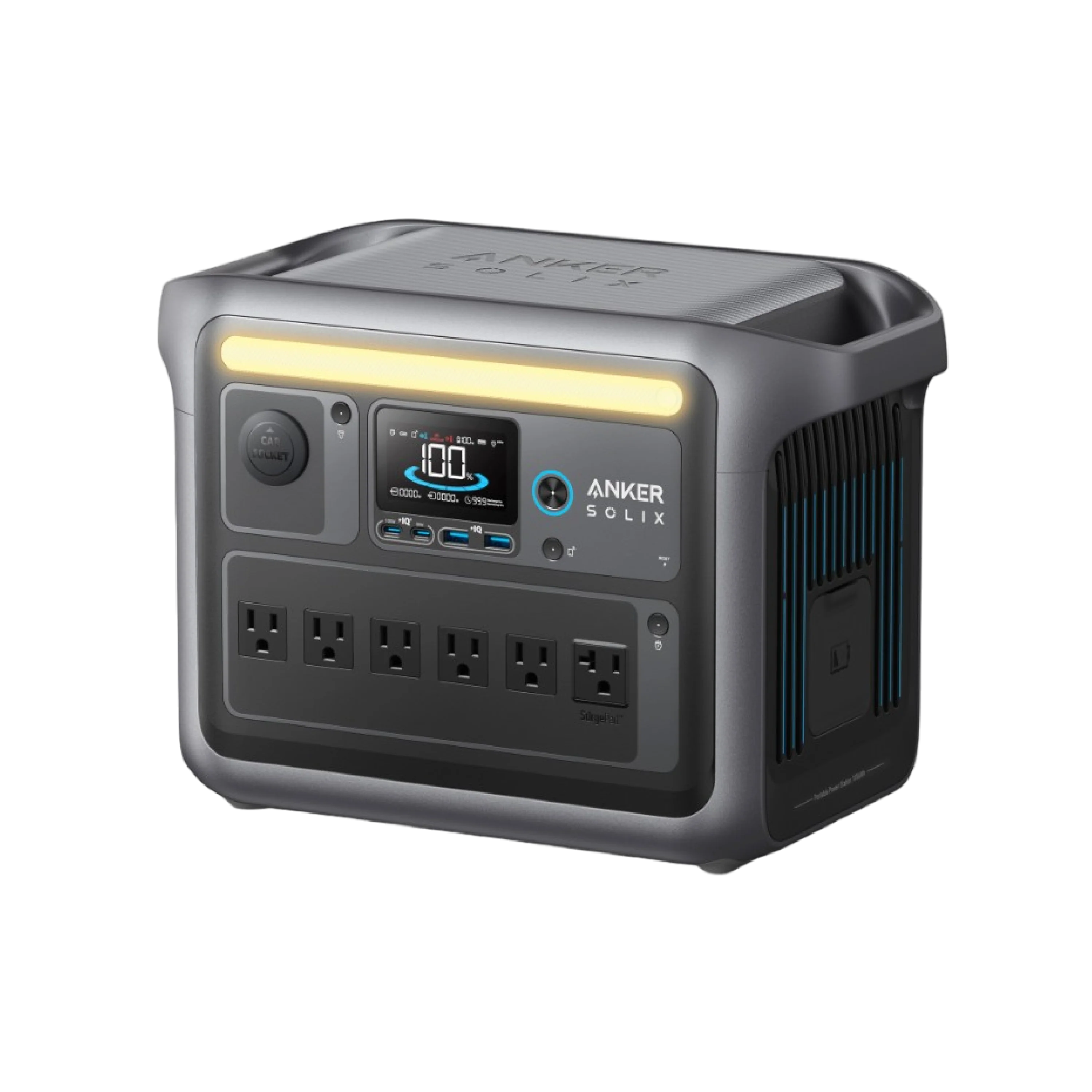
Anker SOLIX C1000
Sold on Amazon · today’s price is on the listing

BLUETTI Apex 300 + 2×B300K
$3,899.00
$3,899.00 · direct from BLUETTI
Last checked 16 days ago. Prices move — check before you buy.
Prices may vary by retailer and are subject to change.