Head-to-head test
Anker SOLIX C1000 vs BLUETTI AC200L
These two sell watt-hours at the same rate, about 43 cents against about 44, so this was never a value question: it's whether your worst night needs 1,741Wh badly enough to carry 62.4 lbs for it.
Full profiles: Anker SOLIX C1000 → · BLUETTI AC200L →

Written by Ian SchneiderUpdated
Solar & Off-Grid Tester, Station Arena Test Desk
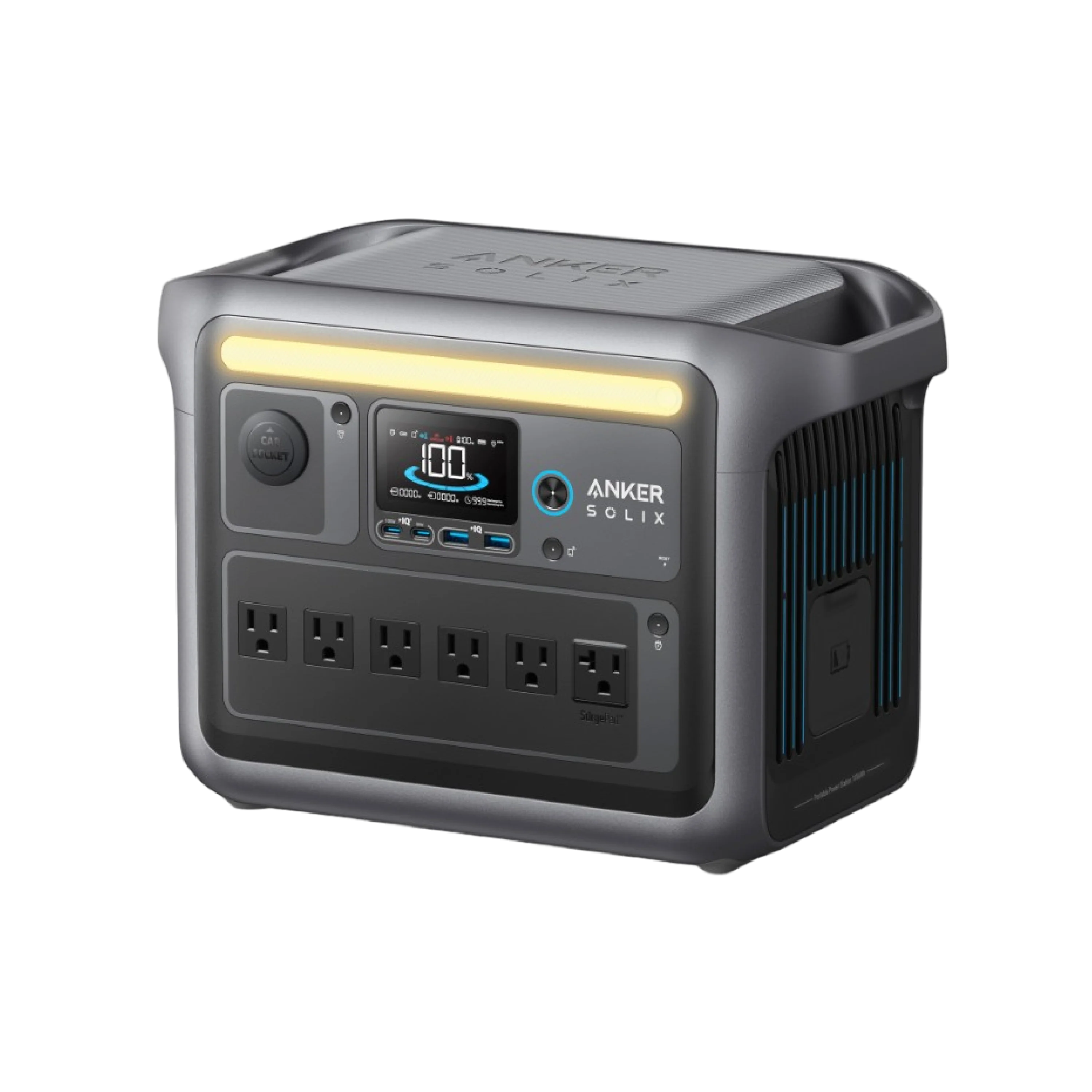
$599.99 · direct from Anker
Last checked 1 day ago. Prices move — check before you buy.

$899.00 · direct from BLUETTI
Last checked 1 day ago. Prices move — check before you buy.
Spec deltas
$449 buys 1,056Wh and $899 buys 2,048Wh, which works out to about 43 cents a watt-hour against about 44. Same rate. The rest of the sheet matches too: 3,000 cycles each, five-year warranties, 20ms UPS switchover, 100W USB-C. You aren't choosing between a cheap unit and a good one. You're choosing how much of the same thing to buy.
So the decision reduces to two questions, and neither one is about price. How many watt-hours does your worst realistic night need, and will you carry 62.4 lbs to have them? After the 85% inverter derate the C1000 has 898Wh usable and the AC200L has 1,741Wh. Everything below is about which side of that line you live on.
Our pick is the AC200L, with a caveat we'll say loudly rather than bury: it clears the eight-hour blackout by 96Wh and not a watt-hour more, and it weighs more than twice what the Anker does. If your unit spends its life in a trunk instead of a closet, the C1000 is the right answer and the $450 you didn't spend is real money.
What the Numbers Reveal
Each conclusion stated first — the numbers behind it on one line, the full analysis below.
Capacity
There's no value winner to find. The $450 between them buys watt-hours at the going price and nothing more: not better cells, not a longer term, not a faster switchover. The question a review normally answers, which of these is the better buy, has no answer on this page. The only live question is how many watt-hours your worst night actually needs.
Anker SOLIX C1000: $449 for 1,056WhBLUETTI AC200L: $899 for 2,048WhBoth rated 3,000 cycles, five-year warranty, 20ms UPS switchover, 100W maximum USB-C
Why it mattersIf you came here to work out which one is better value, stop and go add up your loads instead. That number decides this, and nothing on the price tag does.
The AC200L wins the scenario people actually buy these units for, and it wins by almost nothing. A ninth hour costs about 206Wh at that same average and there are 96Wh in the tank. So it's the right box for a single-night outage and the wrong box for a region where the lights stay off into the next day.
8-Hour Blackout profile needs 1,645WhAC200L usable energy: 1,741Wh (2,048Wh at the 85% inverter derate)C1000 usable energy: 898Wh (1,056Wh at the same derate)
Why it mattersIf your utility takes a full day to restore power, budget an expansion battery into the AC200L at purchase, or skip both of these and shop a size up.
continuous output
That reframes what the extra money buys. Capacity decides how long you run; the continuous rating decides whether you run at all. A load above 1,800W doesn't make for a short night on the C1000, it makes for a load the C1000 isn't rated to hold, and the 898Wh-against-1,741Wh comparison never gets to happen.
C1000: 1,800W continuous, 2,400W surgeAC200L: 2,400W continuous, 3,600W surgeUsable capacity: 898Wh against 1,741Wh
Why it mattersCheck your single biggest draw before you check your daily total. One of these two can rule itself out on the first number.
solar input
On any outage past the first night that matters more than the capacity gap does. With 96Wh of margin on a single eight-hour blackout, the AC200L's real defence against day two isn't its tank, it's that 1,200W of panel can refill that tank in a morning. The C1000 refills just as quickly in proportion, but it starts each morning from a tank that was already 747Wh short of the night before.
C1000: 1,056Wh capacity, 600W maximum solar inputAC200L: 2,048Wh capacity, 1,200W maximum solar inputAC200L clears the 1,645Wh eight-hour blackout with 96Wh left
Why it mattersBuying for multi-day outages means weighting the solar ceiling over the badge on the battery, and buying the panels at the same time as the unit rather than next spring.
The specific dimensions that decide these two units — everything else is a tie.
Your Life, Your Pick
Selected because: Six load profiles, and the 898Wh-against-1,741Wh usable gap is the only spec that moves any of them.
The six profiles sort into three piles and only the middle pile is a decision. Both units walk the CPAP night at 320Wh, using 36% of the C1000's usable energy and 18% of the AC200L's, and both cover a tailgate. Neither one touches van life at 4,685Wh a day; the AC200L gets through 37% of it. What's left in between is an eight-hour blackout at 1,645Wh, which only the AC200L finishes, and a remote workday at 910Wh, which the C1000 misses by 12Wh.
That 12Wh miss is worth staring at, because it's the difference between a spec and a fact. The 898Wh figure is 1,056Wh derated by 85% for inverter losses, a convention rather than a measurement of your particular Tuesday. A C1000 will very likely finish that workday. It will not finish the blackout: 747Wh short is roughly three and a half hours of a night that averages 206W, and no amount of careful use closes that.
Portability & Form Factor
Selected because: 28.4 lbs against 62.4 lbs is the single axis where the cheaper unit wins outright.
weight
62.4 lbs against 28.4 lbs is more than double, and past a certain point weight stops being a convenience note and starts changing what the object is. 28.4 lbs is a thing you pick up on the way past. 62.4 lbs is a thing you plan a route for: which door, which stairs, whether someone's home to take the other end.
This is the C1000's only outright win and it's a large one if it applies to you. It's also the one gap that can never be closed later. You can bolt capacity onto either unit; nothing subtracts pounds. Work out where the unit is going to live before you work out how big it should be.
Lifetime Value
Selected because: Fourteen cents a lifetime kilowatt-hour against fifteen, which is far too close for price to settle anything.
cost / lifetime kWh
Fourteen cents a lifetime kilowatt-hour against fifteen. Both units run 3,000 cycles, so the C1000's $449 spreads across 3,168 kWh and the AC200L's $899 across 6,144 kWh, and the penny between them is the whole cost-of-ownership story. Neither of these is the expensive one.
The warranty figures look like they say more, and they don't. Both terms are five years. Dividing five years by two different prices produces a number that favours the cheaper unit for the sole reason that it is cheaper, which is the price tag talking about itself in a costume. Spend the attention on capacity instead.
Growth Path
Selected because: Both take expansion batteries, so guessing low is fixable; only one of them can feed a growing bank at 1,200W of solar.
solar input
Both take manufacturer expansion batteries, which quietly lowers the stakes on this entire page: guess low today and you can add later. What you can't add later is solar throughput. The AC200L accepts 1,200W of panel input to the C1000's 600W, and once a bank grows past the base unit, the ceiling on refilling it is the spec that bites.
One honest wrinkle against our own pick. An owner reported their AC200L failing to detect the B230 expansion battery that arrived alongside itB4, and the connectivity complaints around this unit are consistent enough that you should expect to spend an afternoon on setupB2B3B14. The path is real. It isn't always plug-and-go.
What the Specs Don't Tell You
Selected because: Four cards fire, and the warranty one is the $449-against-$899 price gap wearing a coverage costume.
Four cards fire and one of them is noise about noise. The warranty comparison takes an identical five-year term, divides it by two different prices, and reports the result as a difference in coverage. It isn't one. Read that card as the price gap restated and move past it.
The two that matter both point at the AC200L: 62.4 lbs, and the only published decibel figure in this matchup. The second deserves care, because Anker doesn't publish a noise rating for the C1000 at all, so the AC200L gets marked down for the sole reason that it answered the question. Absence of a number isn't quiet.
Strengths & trade-offs
Anker SOLIX C1000
Strengths
- +Costs $450 less
- +Lighter by 34 lb
Trade-offs
- –Weaker inverter (-600W) limits appliance compatibility.
BLUETTI AC200L
Strengths
- +Larger battery capacity
- +Higher AC output
- +Faster solar charging
Trade-offs
- –Substantially more expensive (+$450) than the SOLIX C1000.
- –Significantly heavier (+34 lbs), making it harder to move.
Will It Power Your Gear?
Scenario math and per-appliance runtimes, modeled from the spec record.
Scenario verdicts
We ran the math on six real-world scenarios. Here's which unit survives your actual life.
SCN-01 · 2 nights · needs 2,100Wh
Weekend Camping
Two nights off-grid with essential comfort
Neither unit
Neither unit covers this scenario's 2,100Wh: the SOLIX C1000 comes up 1,202Wh short (about 43% covered), the AC200L 359Wh (83%). Treat this as partial cover — enough for the essentials in it, not the whole list.
Battery budget usedlower = more headroom
LOAD Phone Charger 15W×6h · LED Lights 40W×8h · Box Fan 75W×14h · CPAP Machine 40W×16h
SCN-02 · 8 hours · needs 1,645Wh
8-Hour Blackout
Keep the essentials running through a night without power
AC200L
The C1000 has 898Wh usable against 1,645Wh of load, so it goes dark after about four and a half hours at the 206W this night averages (1,645Wh over eight hours). The AC200L finishes it, and finishes it by 96Wh, under 6% of the draw. Worth holding onto: a ninth hour costs another 206Wh at that average, and there are 96 in hand. It wins this night. It does not win a longer one.
Battery budget usedlower = more headroom
LOAD Fridge 150W×8h · Router + Modem 20W×8h · LED Lights (4 bulbs) 40W×6h · Phone Charger 15W×3h
SCN-03 · 8 hours · needs 320Wh
CPAP Overnight
Sleep therapy without interruption — the #1 medical use case
Either unit
A CPAP is about 40W for eight hours, so both cover the night with room to spare and capacity decides nothing. Fan noise would — but SOLIX C1000 doesn't publish a figure, so there's nothing to hold it to. Buy on price, weight, and whether you can live with a fan you haven't heard.
Battery budget usedlower = more headroom
LOAD CPAP Machine 40W×8h
SCN-04 · 8 hours · needs 910Wh
Remote Workday
Full work day off-grid without power anxiety
AC200L
The C1000 lands 12Wh short: 898Wh usable against 910Wh of work. That's inside the rounding error of the 85% derate itself, and a skipped phone top-up closes it, which is exactly why this profile shouldn't decide anything on its own. On the numbers the AC200L is the unit that finishes the day without you watching the percentage, at 52% of its usable energy spent.
Battery budget usedlower = more headroom
LOAD Laptop 60W×8h · External Monitor 30W×8h · Router + Modem 20W×8h · Phone Charger 15W×2h
SCN-05 · 4 hours · needs 670Wh
Tailgate Party
Game day power for the crew
AC200L
Both cover game day, so the AC200L's reserve, 38% of its usable energy spent against the C1000's 75%, is money in an account you won't draw on. What you'll actually feel is the walk in from the car: 62.4 lbs against 28.4 lbs, more than double. The AC200L wins this on the numbers. Whether that's the win you want depends on how far away you parked.
Battery budget usedlower = more headroom
LOAD Blender 400W×0.5h · LED TV (55") 80W×4h · Bluetooth Speaker 15W×4h · Phone Charger (×3) 45W×2h
SCN-06 · 24 hours · needs 4,685Wh
Van Life Daily
A full day of mobile living — the ultimate endurance test
Neither unit
Neither unit covers this scenario's 4,685Wh: the SOLIX C1000 comes up 3,787Wh short (about 19% covered), the AC200L 2,944Wh (37%). This is well outside what either unit is for; the right answer here is a larger station, not a choice between these two.
Battery budget usedlower = more headroom
LOAD Mini-Fridge 150W×24h · Laptop 60W×4h · Phone Charger 15W×3h · LED Lights 40W×5h · Fan 75W×8h
The Load Test
RUNTIME = (Wh × 0.85) ÷ LOAD
None of the scenarios above exactly yours? Build it. Toggle what you'd plug in; both units are tested against the combined draw.
Essentials
Comfort & Convenience
High-Draw Appliances
Test duration
8h
Continuous draw
205W
Projected runtime
For this load: AC200L runs 8.5h vs 4.4h.
$899 list · direct from BLUETTI
Modeled from the spec record — same math as the tables below. Methodology
Runtime by appliance
Real-world runtime estimates for common appliances, modeled at 85% inverter efficiency.¹
Essentials
The basics you need runningscale 0–116.1hComfort & Convenience
Makes off-grid life actually enjoyablescale 0–23.2hHigh-Draw Appliances
These reveal the real limitsscale 0–1.7h¹ Runtime = (capacity × 0.85) ÷ appliance watts. Within each group, all bars share one time scale (the group's longest runtime), so lengths are comparable across appliances; identical runtimes collapse into a single blue/orange bar. Actual runtime varies with battery age, temperature, and simultaneous loads — see methodology.
Conclusion
August 9, 2026
Verdict: the AC200L, on Power Score margin
Take the AC200L, for a narrower reason than the spec gap suggests. The two are priced at the same rate per watt-hour, about 43 cents against about 44, and they match on cycles (3,000 each), warranty (five years each), UPS switchover (20ms each) and USB-C (100W each). The extra $450 buys capacity and nothing else. Capacity is also the only thing that decides anything here: with 898Wh usable the C1000 misses the 1,645Wh eight-hour blackout by 747Wh, and the AC200L covers it. The catch, and it's a real one, is that it covers it by 96Wh at a curb weight of 62.4 lbs. If the unit travels more than it sits, the C1000's 28.4 lbs and $449 make it the better buy and this verdict flips cleanly.
Editor-assigned confidence, based on cited owner research and spec analysis.
List prices as of August 9, 2026. The links below open Anker's and BLUETTI's current prices.
$899.00 · direct from BLUETTI
Last checked 1 day ago. Prices move — check before you buy.
or check the SOLIX C1000 price$599.99 list
Written by Ian Schneider, Solar & Off-Grid Tester · Station Arena Test Desk · Updated August 9, 2026
Measured Data
Benchmark scores and the full spec record, side by side.
Benchmark scores
Not rated for both units (minimum threshold unmet): CPAP, Camping.
Full specifications
ᵈ Derived: price ÷ rated capacity. See the data behind our comparisons →
Comparison ToolAdd more power stations, side by sideOpen Tool →How these numbers are produced
Numeric verification
Every figure on this page traces to our spec database or arithmetic on it — no estimated numbers.
Owner claims
Statements about owner experience are cited to published reviews — see Sources & Research Notes below.
Runtime model
Runtime = (rated capacity × 0.85 inverter efficiency) ÷ device wattage. Solar recharge estimates assume panels deliver 70% of rated output. Cold weather, battery age, and stacked loads reduce real-world results.
Power Score
Computed from 14 published spec dimensions, weighted per use-case bench. Higher is better; a unit must meet a bench's minimum threshold to be rated.
See the full weight table and data sourcing on our methodology page →Class ranking (the star rating)
Each unit's star score is a category ranking, not customer reviews — no buyer opinions feed it. We score every station on size-independent quality (value, output, portability, endurance, ports, warranty, and more), then percentile-rank it against the other units in its capacity class, so a class-leading compact unit and a class-leading whole-home unit can both earn 5★. Here, SOLIX C1000 rates 4.7/5 (81st percentile of 27 Everyday-class units), and AC200L rates 3.9/5 (36th percentile of 26 Large-class units).
How the class ranking is computed →Test Notes & Caveats
Hidden gotchas and advantages we spotted that you won't find on the product page.
AC200L: 62.4 lbs, and No Way Around It
62.4 lbs against the C1000's 28.4, more than double. That's a both-hands, bent-knees lift out of a trunk, and a two-person job onto a truck bed or down basement stairs. It's also the one number on this page that never improves with time or money: capacity you can add later, weight you can't subtract.
AC200L: 50dB Is the Only Published Figure Here
50dB is what BLUETTI publishes for the AC200L under load, and it's a load-dependent number. Fans work hardest when the unit is charging fast or running near its 2,400W ceiling, not when it's trickling a laptop. Keep the figure in proportion: it's the only noise rating either of these two put on paper, so it reads as a mark against the AC200L largely because the AC200L answered the question.
Both Warranties Are Five Years
The per-dollar framing here is the price tag wearing a different hat. Both units carry a five-year warranty, identical term, identical length. Dividing five years by each price only restates that the C1000 costs $449 and the AC200L costs $899. Nothing about the coverage differs, so if warranty is your deciding factor, these two tied before you started.
SOLIX C1000: No Published Noise Figure
Anker doesn't publish a decibel rating for the C1000, so there is nothing to set against the AC200L's 50dB. Absence isn't evidence: the C1000 isn't louder for having stayed quiet about it. But if this unit is going in a bedroom or beside a CPAP, an unpublished number is one you'll be discovering yourself at 2 a.m.
Full record above — the Test Desk pick is the AC200L.
Check AC200L price →or check the SOLIX C1000 priceOwnership Analysis
What happens after you buy — true cost of ownership, brand trust, and growth potential.
Lifetime value
Service lifeyears at one full cycle per day
Lifetime energy delivered
Cost per delivered kWh
│ warranty ends · Reaching the cycle rating means ~80% capacity remains — degraded, not dead.
Analyst note
Both units have similar long-term ownership costs ($0.14/kWh vs $0.15/kWh). The price difference is what you see on the sticker — neither is a hidden bargain or rip-off. One thing to know reading the table: both carry the same 3,000-cycle rating, so the lifetime rows are sticker price and capacity in disguise — the wear horizon is identical and decides nothing here.
Brand trust
Anker
Ecosystem
7-8 SOLIX portable power stations across C-series (compact) and F-series (flagship), plus the X1 home energy system
Support
US-based, and Anker's replacement-first reputation is real history rather than marketing. The current picture is softer: AI-driven first responses on tickets, and returning a unit this size means hazmat shipping logistics rather than dropping a mailer at the post office. Still the stronger of the two on paper, and the gap is narrower than the brand names would lead you to expect.
Community
Moderate — active Reddit (r/Anker, r/AnkerSOLIXCommunity) and growing. Benefits from Anker's massive consumer electronics brand awareness.
App experience
Rated 4.5/5 iOS (~1,100 ratings) · 4.3/5 Android
Unique strength
Parent brand trust from Anker's consumer electronics dominance. InfiniPower technology for long cycle life. Strong $/Wh value in the mid-size and larger units — the S2000, F2600 and C1000 are among the better buys per watt-hour in the catalog.
Worth knowing
Anker has shipped firmware updates that removed features without notice. Worth knowing if you're buying this specifically for one behaviour rather than for the battery.
BLUETTI
Ecosystem
One of the broadest lineups — 15-20+ models from budget (AC2A) to flagship portable (Apex 300, 2764.8Wh). Includes specialized products: vehicle solar hubs, sodium-ion cold-weather units, and balcony storage systems.
Support
The weakest part of the package. Email-based, with timezone delays and wildly inconsistent outcomes: some claims resolve quickly, others turn into weeks of scripted troubleshooting or an offer of a discount on a new unit in place of a repair. Buying direct from BLUETTI rather than through a third party tends to improve your odds when something goes wrong.
Community
Active and growing — Reddit r/bluetti has a dedicated community. Second-largest after EcoFlow in engagement.
App experience
Rated 4.5/5 iOS and Android — tied for best app experience in the category. V3.0 UI redesign was well-received.
Unique strength
One of the widest lineups in the category, from budget units up to dual-voltage flagships, including genuine oddities like sodium-ion cold-weather stations. On cycle life, go by the model rather than the brand: the AC200L is rated 3,000 cycles, the same as the C1000 and below the lineup-wide numbers BLUETTI quotes.
Worth knowing
Customer support inconsistency is the #1 risk factor. Older/discontinued units may become unrepairable — no spare parts policy for some models. Some reports of erratic communication from support agents.
Analyst note
Two different failure modes. Anker's support is sliding down from a genuinely excellent baseline; BLUETTI's has been inconsistent throughout and depends partly on where you bought the unit. Neither is a reason to pick one of these boxes over the other. But if you're taking the AC200L, buy it from BLUETTI directly.
Growth path
SOLIX C1000
EXPANDABLESupports Anker expansion batteries, so you can add capacity later without replacing the base unit — useful if your needs may climb past 1,056Wh.
Accepts up to 600W of solar. Suitable for a 1-2 panel setup.
Generous port selection supports complex multi-device setups.
Expansion batteries are Anker-specific. You're investing in the Anker ecosystem.
AC200L
EXPANDABLESupports BLUETTI expansion batteries, so you can add capacity later without replacing the base unit — useful if your needs may climb past 2,048Wh.
Accepts up to 1,200W of solar. Enough for a serious multi-panel array.
Adequate ports for most setups, but heavy users may want a power strip.
Expansion batteries are BLUETTI-specific. You're investing in the BLUETTI ecosystem.
Realistic full solar rechargeat 70% of rated panel output — see methodology
Analyst note
Both expand, but the AC200L's higher solar ceiling (1,200W vs 600W) gives it the stronger off-grid growth path — more panels can feed a bigger bank as it grows.
What Owners Report
Patterns from published owner reports and long-term reviews — every claim cited to its source below.
Anker SOLIX C1000
Field data on the C1000 is unusually good for a unit this size, and the one consistent knock is the fan. Owners and reviewers report the fans spinning up audibly during fast charging or when output sits near the unit's limit, and going nearly silent below roughly 500WA1. Set against that, a reviewer who ran one for over a year measured about 97% of original capacity remaining, and a 30-day home-office UPS test rode out seven brief outages with no equipment shutdowns and no lost dataA2.
The rest of the coverage keeps landing on the same three things: fast AC recharge, strong inverter performance in short bursts, and a size and weight that are genuinely practical for a 1kWh unit. Reviewers describe it handling essentially any household appliance short of central air and an electric dryerA3A4.
“One reviewer used their unit for over a year with zero issues and minimal battery degradation — about 97% of original capacity. In a 30-day home-office UPS test it handled 7 brief outages with no equipment shutdowns or data loss.”
Sources
outdoorgearlab.com · lifenhancer.com · rvoutfitting.com · outdoortechlab.com · wattsontheroof.com · technerdo.com · teqclub.com
BLUETTI AC200L
The AC200L's complaint file is almost entirely software. Owners report failed WiFi pairing, an iOS app that drops its cloud connection whenever they're off the home network, and support replies that loop back through steps they'd already triedB2B3B5. One owner spent three days unable to get the unit to detect the B230 expansion battery he'd bought with itB4. There's no remote monitoring outside Bluetooth range, which is a pointed limitation on a unit bought to cover outages you might not be home forB14.
The hardware measurements are a different story. A hands-on tester clocked the UPS switchover at 13.1ms against a 20ms spec, and ran a full-size refrigerator for 32 hours from full with 7% still showingB7B9. The same tester measured the fans at around 40dB on the low speed and 48dB on the high speed from three feetB8, which sits below the 50dB BLUETTI publishes. One owner does report the fan switching on for 25 seconds out of every 60, plus a PV relay clicking at sunrise and sunsetB1. A six-month check reading 97% capacity after 183 cycles is encouraging but comes from a source this ledger itself flags as low-reliability, so treat it as directional rather than evidenceB16.
“The BLUETTI app works well to give one all of the relevant info on a BLUETTI power system...after almost a year of use...the account for logging into the app is not the same as the BLUETTI web account.”
Sources
reviews.matanich.co · portablepowernerd.com · backuppowerhub.com
Sources & Research Notes
Every owner claim in this report is traceable to a published source. The bracketed references above resolve here.
Recurring owner themes
- Fan noise under fast charging or heavy load is the consistent knock; otherwise strong reliability, fast recharge, and practical size earn broad praise. [SOLIX C1000 · 3 entries]
- App/WiFi connectivity is a recurring pain point — owners report failed WiFi pairing, cloud disconnects, and no remote (non-Bluetooth) monitoring option. [AC200L · 4 entries]
- Fan/relay cycling behavior gets mixed reports: some owners flag frequent on/off cycling at idle/solar cutover, while a hands-on tester measured the fans as relatively quiet under load. [AC200L · 2 entries]
- UPS switchover is fast and reliable in practical tests, but reviewers note the 20ms spec (vs newer 10ms competitors) could risk flicker for very sensitive electronics. [AC200L · 2 entries]
- Independent runtime/capacity and cycle-health tests have generally matched or come close to the advertised 2048Wh rating and cycle-life claims. [AC200L · 3 entries]
- Weight and lack of wheels/accessory-integration quirks are recurring physical/practical gripes despite otherwise positive reception. [AC200L · 2 entries]
- A1
“Fan noise is the single most common complaint — the fans spin up audibly during fast charging or heavy output near the unit's limit, comparable to a desktop computer fan at speed. Under light loads (below ~500W) it's nearly silent.”
outdoorgearlab.com / lifenhancer.com — Anker SOLIX C1000 review · 2026 · [negative]
- A2
“One reviewer used their unit for over a year with zero issues and minimal battery degradation — about 97% of original capacity. In a 30-day home-office UPS test it handled 7 brief outages with no equipment shutdowns or data loss.”
rvoutfitting.com / outdoortechlab.com — Anker SOLIX C1000 long-term notes · 2026 · [positive]
- A3
“Nails the fundamentals: fast AC recharge, strong inverter performance for short bursts, practical size and weight for a 1kWh unit, and genuinely useful app monitoring.”
wattsontheroof.com / technerdo.com — Anker SOLIX C1000 review · 2026 · [positive]
- A4
“Handles virtually any household appliance except central AC and electric dryers; a popular 'sweet spot' 1kWh unit for RV and home backup.”
rvoutfitting.com / teqclub.com — Anker SOLIX C1000 review · 2026 · [positive]
- B1
“I own a AC200L (US)...one is the common PV relay clicking at sunset/sunrise and the other is the fan turning on for 25 seconds every 60 seconds or so.”
BLUETTI Community forum — 'ac200L PV relay and fan turning on every minute' · 2024-05 · [negative]
- B2
“WIFI WIFI! I can't get my new AC200L to log into my WIFI network. Have reached out to company they keep telling me to do the same things I have already done.”
BLUETTI Community forum — 'AC200L trouble' · 2025-11 · [negative]
- B3
“The IOS app for my AC200L will disconnect from the cloud on a consistent basis when I'm away from my home network...wants me to return the 65lb battery for an app issue.”
BLUETTI Community forum — 'AC200L IOS app Cloud login not working' · 2025-03 · [negative]
- B4
“I just received my AC200L and B230 but I'm struggling since 3 days because the AC200L does not detect the B230.”
BLUETTI Community forum — 'AC200L not detecting B230 / nothing on the APP' · 2024-08 · [negative]
- B5
“You are better off buying a Ecoflow or Anker! Bluetti app is not stable enough. It disconnects from my WiFi every month or two without warning.”
Apple App Store — BLUETTI App reviews · unknown · [negative]
- B7
“It's advertised to switch from wall power to battery power within 20 milliseconds, but I measured it at just 13.1 milliseconds! This is one of the fastest UPS modes I've seen.”
Lifenhancer — 'Bluetti AC200L Review' · 2024-03 · [positive]
- B8
“The AC200L's fans surprised me with their quietness. They have two variable speeds...At 3 feet away, I measured around 40dB at the lower speed and 48dB at the higher speed.”
Lifenhancer — 'Bluetti AC200L Review' · 2024-03 · [positive]
- B9
“I then tested how long the AC200L would run a full-size refrigerator. Starting at 100% charge, it powered the refrigerator for 32 hours and still had 7% of the capacity remaining.”
Lifenhancer — 'Bluetti AC200L Review' · 2024-03 · [positive]
- B12
“With a 20ms switching speed, some sensitive electronics might flicker or restart during a power changeover...Many power stations now support 10ms switching speed.”
reviews.matanich.com — 'BLUETTI AC200L Review: Portable Power Station' · 2026-04 · [mixed]
- B14
“The lack of Wi-Fi is our biggest gripe...with the AC200L, you need to be within Bluetooth range (about 30 feet practically). For home backup use where you might be away when an outage hits, this is a real limitation.”
portablepowernerd.com — 'Bluetti AC200L Tested: 4-Month Honest Review' · 2026-02 · [negative]
- B16
“I checked the battery health in the Bluetti app six months later in September. After 183 full cycles the capacity read 97% of original.”
GridFree Guide — 'The Workhorse Standard: Bluetti AC200L Review' · 2026-04 · [positive]
Research compiled August 9, 2026.
What Owners Actually Report
Drawn from 82 comments on independent review channels — not from retailer reviews, which skew to the first week of ownership. Each line is our summary of one commenter's claim, linked to the original. We record what they said, including where it contradicts the spec sheet.
Anker SOLIX C1000
85 claims from 55 comments · 60 from owners · 21 with figures
- Price & value
- 16 · 6% negative
- Runtime
- 10 · 20% negative
- Solar input
- 12 · 43% negative
- Warranty & support
- 8 · 23% negative
- Charging
- 4 · 5% negative
What owners complain about
Has to add a Victron controller to each Anker station, adding cost and complexity.
Solar inputowner44 agreedsource →
Dropped to 87% after about three hours running only a lamp, then to 70% the next night.
Runtimemeasuredowner3 agreedsource →
Having handled both, calls the Anker app a complete joke next to the EcoFlow app.
App & firmwareowner2 agreedsource →
What owners praise
Bought the C1000 for $488 and calls it one of his best investments living off grid.
Price & valuemeasuredowner72 agreedsource →
Ultra fast charging at 1300-1400W was left out of the review chart.
Chargingmeasuredowner198 agreedsource →
C1000 app showed 440-473W from a 450W panel and 80W under full cloud.
Solar inputmeasuredowner20 agreedsource →
BLUETTI AC200L
41 claims from 27 comments · 30 from owners · 12 with figures
- Solar input
- 6 · 0% negative
- Price & value
- 6 · 0% negative
- Build quality
- 5 · 5% negative
- Charging
- 4 · 17% negative
- Runtime
- 2 · 43% negative
What owners complain about
His Nomadic X2 air conditioner would drain the 2048Wh AC200L in about an hour.
Runtimemeasuredownersource →
His crosscut saw plus dust collector keeps kicking off the 2400W inverter.
Inverter & surgeownersource →
So heavy it took two people to move; not something he would carry around.
Size & weightownersource →
What owners praise
Runs everything else on the AC200L, which uses very little idle consumption.
Idle drainowner11 agreedsource →
Recharges from 65% to full by 1pm on a portable 350W array, so he stopped tracking it.
Solar inputmeasuredownerafter 2 months4 agreedsource →
Just bought an AC200L for $1200 and calls it much better price-to-performance than solid state.
Price & valuemeasuredowner2 agreedsource →
Claims are weighted by how specific they are, whether the commenter owns the unit, and how many readers agreed. Comments that mention a product under a rival's review count for more, because the commenter had no reason to be there. This is what buyers report, not our test results — for measurements we ran ourselves, see the methodology.
Who Should Buy Which
Buy the SOLIX C1000 if you…
- →The unit goes in and out of a car most weekends. 28.4 lbs is a one-handed lift and a shrug; 62.4 lbs is a plan you make in advance.
- →Your worst realistic night is a CPAP and some phones. That's 320Wh, or 36% of what the C1000 has usable, and you'd be paying $899 to use 18% of a bigger one instead.
- →You'd rather start at 1,056Wh for $449 and add an expansion battery once you know what you actually draw, instead of guessing high on day one.
- →Nothing on your list draws more than 1,800W continuously, so the C1000's inverter is never the constraint and only runtime is.
Buy the AC200L if you…
- →The unit lives in a closet or a van build and comes out when the power does. It clears the 1,645Wh eight-hour blackout that the C1000 misses by 747Wh, and that single night is why most people buy one of these.
- →You already own panels or you're buying them with the unit. 1,200W of solar input refills 2,048Wh in just under two hours of full-rated sun, and that's what makes this a multi-day box rather than merely a bigger one.
- →Something on your list holds above 1,800W for real stretches. The AC200L is rated to run 2,400W continuously, which is precisely the C1000's momentary surge ceiling.
- →You want headroom on a light load rather than an exact fit. A 670Wh tailgate leaves 1,071Wh in the AC200L and 228Wh in the C1000, and that reserve is what absorbs the extra draw nobody planned for.
If neither fits
If your day looks like the van-life profile at 4,685Wh, or you routinely lose power for longer than a single night, close this tab. The AC200L covers 37% of that day and the C1000 covers 19%, and no amount of careful load management turns a 37% unit into a 100% one. You're shopping a size class above both of these, or a base unit bought together with an expansion battery on the same order rather than as a someday upgrade.
The Bottom Line
The AC200L is the pick and the reason is narrow. It's the only one of the two that finishes the eight-hour blackout, and the $450 that gets you there is charged at the same rate per watt-hour as everything the C1000 sells you. Nothing else on the sheet moves: same 3,000 cycles, same five-year term, same 20ms switchover, same 100W USB-C.
Just be clear about what you're buying. Ninety-six watt-hours of margin on that blackout, and 62.4 lbs to carry. If the box is going to live in a closet and come out when the lights go, that's a fine trade and you'll never think about it again. If it's going in and out of a trunk every weekend, buy the C1000. The 28.4 lbs you'll lift for years beats 96Wh you'll use once.
Frequently Asked Questions
Answers drawn from the spec record and cited owner research.
Is the AC200L worth double the price of the C1000?
It isn't double the price for the same thing, it's double the price for 1.94 times the capacity at essentially the same rate. $449 over 1,056Wh is about 43 cents a watt-hour and $899 over 2,048Wh is about 44. Everything that could justify a premium tier is identical on both: 3,000 cycles, a five-year warranty, 20ms UPS switchover, 100W USB-C. So worth isn't really the question; how many watt-hours you need is.
Can the Anker SOLIX C1000 get me through an 8-hour blackout?
Not the full one we model. It holds 898Wh usable (1,056Wh at the standard 85% inverter derate) against 1,645Wh for an eight-hour outage, so it covers a bit over half of it. It will carry the essentials for part of the night; it won't reach morning on the whole list. The AC200L clears the same night, though only by 96Wh.
Which of these two is quieter?
Nobody can tell you from a spec sheet, and that's the honest answer. BLUETTI publishes 50dB for the AC200L under load and Anker publishes nothing at all for the C1000. Hands-on measurement put the AC200L's fans at about 40dB on low and 48dB on high from three feet, while the C1000's fans are reported to spin up under fast charging and go nearly silent below roughly 500W. Treat noise as a tiebreak you'll have to settle in person.
Both say they're expandable. Does that change the answer?
It softens it. Both accept manufacturer expansion batteries, so guessing low today is a fixable mistake rather than a permanent one. What differs is how fast you can refill the bigger bank afterwards: the AC200L takes 1,200W of solar to the C1000's 600W. Budget setup time either way, since one owner reported the AC200L failing to detect its B230 expansion battery out of the box.
Is 20ms switchover fast enough to run a desktop or home server?
For most gear, yes, and it isn't a differentiator here because both units spec exactly 20ms. A hands-on measurement put the AC200L at 13.1ms in practice, and a C1000 owner ran a 30-day home-office UPS test through seven brief outages with no shutdowns or data loss. Genuinely sensitive equipment is where reviewers start arguing about 20ms, and the answer there is a true online UPS rather than either of these.
Where to buy
Anker SOLIX C1000
$599.99
$599.99 · direct from Anker
Last checked 1 day ago. Prices move — check before you buy.
BLUETTI AC200LPick
$899.00
$899.00 · direct from BLUETTI
Last checked 1 day ago. Prices move — check before you buy.
Prices may vary by retailer and are subject to change.