Head-to-head test
Anker SOLIX C2000 Gen 2 vs BLUETTI AC200L
The C2000 Gen 2 no longer comes cheap — at $101 more than the AC200L, it earns its keep only through 4,000 cycles to 3,000, which still makes it 12 cents per lifetime kWh against BLUETTI's 15.
Full profiles: Anker SOLIX C2000 Gen 2 → · BLUETTI AC200L →

Written by Gunner GustafsonUpdated
Whole-Home Backup Tester, Station Arena Test Desk
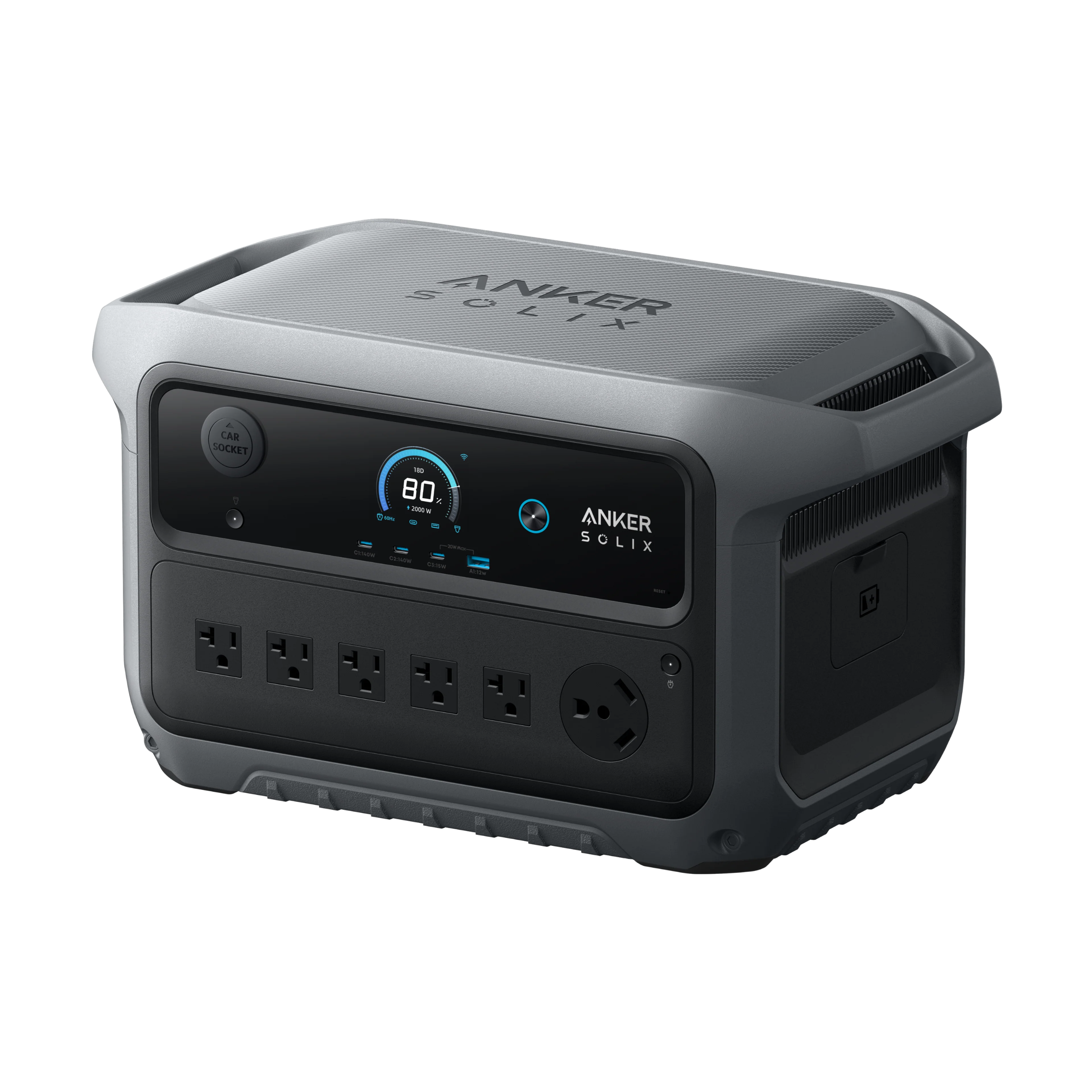
$999.99 · direct from Anker
Last checked 1 day ago. Prices move — check before you buy.

$899.00 · direct from BLUETTI
Last checked 1 day ago. Prices move — check before you buy.
Spec deltas
The Anker SOLIX C2000 Gen 2 now lists at $1,000; the BLUETTI AC200L is $899 — a $101 gap, and the Anker is on the wrong side of it this time. The value argument that used to make this an easy call is gone. What's left is a real trade.
The C2000 Gen 2 still wins the spec sheet: 41.7 lbs to the AC200L's 62.4, 30dB to 50, a 10 ms UPS switchover to 20, and 4,000 charge cycles to 3,000. That cycle-life gap is why it's still the cheaper unit to own over its life — 12 cents per lifetime kWh against 15 — even though it now costs more to buy.
The AC200L counters with more than a lower price: 1,200W of solar input to the C2000's 800, a lower cost per watt-hour ($0.44 vs $0.49), and a deeper track record of independent hands-on testing. If you want the lighter, quieter, longer-lived unit and don't mind paying $101 more for it, take the C2000. If you want to spend less today and charge harder from the sun, take the AC200L.
What the Numbers Reveal
Each conclusion stated first — the numbers behind it on one line, the full analysis below.
cost / lifetime kWh
A third more charge cycles (4,000 vs 3,000) means the extra $101 gets paid back and then some across the unit's life: 12 cents per kWh against BLUETTI's 15. Paying more upfront here isn't paying for worse value — it's buying a longer runway.
C2000 Gen 2 now $1,000 vs AC200L $899C2000 4,000 cycles vs AC200L 3,000C2000 $0.12 per lifetime kWh vs AC200L $0.15
Why it mattersBuyers judging this purely by sticker price are using the wrong number; cost per lifetime kWh still favors the pricier Anker.
weight
You're now paying $101 to shed 20.7 lbs and 20dB of noise — real, everyday differences, but no longer a freebie stacked on a lower price. The C2000 is worth the premium only if you'll feel those differences: carrying it, or sitting near it.
C2000 41.7 lbs vs AC200L 62.4C2000 30dB vs AC200L 50dBC2000 now $1,000 vs AC200L $899
Why it mattersSomeone who never moves the unit or doesn't mind fan noise has no real reason to pay the $101 premium.
solar input
None of that was true when the C2000 was the cheaper unit — back then BLUETTI's solar edge was its only card against a cheaper, lighter, quieter rival. Now it's cheaper, cheaper per Wh, and still takes 50% more solar. The case for it stands on its own, not just on solar.
AC200L 1,200W solar vs C2000 800WAC200L now $899 vs C2000 $1,000AC200L $0.44 per Wh vs C2000 $0.49
Why it mattersSolar-focused or budget-capped buyers should weight the AC200L more heavily than they used to.
The AC200L's price didn't move, so its $180-per-warranty-year cost didn't either; the C2000's rose to $200 purely because its sticker price rose. That's a real ding on our own pick — the extra $101 buys lighter, quieter, and longer-lived, not better warranty economics.
Both carry a 5-year warrantyC2000 costs $200 per warranty year vs AC200L's $180AC200L's price held steady while the C2000's rose
Why it mattersA reader weighing warranty value in isolation should note the AC200L is now the cheaper-protected unit, dollar for dollar.
The specific dimensions that decide these two units — everything else is a tie.
Lifetime Value
Selected because: Price flipped: Anker is now pricier upfront, so whether it's still cheaper to own is the first question.
cost / lifetime kWh
This is where the story changed. At $1,000 the C2000 Gen 2 costs $101 more than the AC200L's $899 — a reversal of the gap this page used to describe in the Anker's favor. Judged on sticker price alone, the AC200L is now the value pick.
But cost per lifetime kWh still favors the Anker: 12 cents against BLUETTI's 15, because 4,000 cycles beats 3,000 by a third. Over the life of the unit, the extra $101 earns itself back. The AC200L is cheaper to buy and cheaper per warranty year ($180 vs $200); the C2000 is cheaper to own across its full lifespan. Which number matters depends on how long you plan to run this thing.
Portability & Form Factor
Selected because: The 20.7-lb weight gap is unchanged and is the most tangible reason to pay the premium.
weight
Weight didn't move with price, and it's still the widest gap on this page: 41.7 lbs against 62.4, a 20.7-lb difference in the same 2,048Wh class. That's the one advantage the C2000 keeps no matter what either unit costs.
The AC200L remains a 60-plus-pound unit that owners flag as awkward to reposition without integrated wheelsB17. If you're hauling this to a campsite or up basement stairs more than once, that 20.7 lbs is worth paying for; if the unit lives permanently in one spot, it's $101 you didn't need to spend.
What the Specs Don't Tell You
Selected because: Noise, UPS speed, and cycle life still favor the Anker and explain why it costs more.
rated cycles
Three of the four gotchas here still favor the Anker, price aside. It's rated 30dB to the AC200L's 50, and it switches over in 10 ms to the AC200L's 20 (though a reviewer measured the AC200L at a faster-than-spec 13.1 msB7). Its 4,000-cycle rating beats the AC200L's 3,000 by a third, which is the entire reason it still wins on lifetime cost despite costing more upfront.
None of that has changed since the C2000 was the cheaper unit to buy — what's changed is that you now pay for these wins instead of getting them free. If quiet, fast switchover, and long cycle life matter to your setup, they haven't gotten any less true; they've just gotten a $101 price tag.
Brand Trust
Selected because: BLUETTI's stronger field track record carries more relative weight now that price no longer settles it.
With price no longer doing the deciding, the brand and field-evidence gap matters more. The AC200L has the deeper hands-on record: independent testers measured a 13.1 ms UPS switchoverB7, ran a full-size fridge for 32 hours on one chargeB9, and found 97% capacity remaining after 183 cycles at a six-month checkB16. The C2000 Gen 2's coverage is thinner — strong review-site praise for its quiet operationA1 and plug-and-play simplicityA2, but no long-term owner reports have turned up yet.
Both brands have real weak points: Anker's SOLIX support is reportedly declining, and BLUETTI's is the most inconsistent in the category, with owners repeatedly flagging WiFi pairing failures and app cloud disconnectsB2B3B5. Neither is a reason to avoid either unit, but if a proven track record matters as much to you as spec-sheet wins, the AC200L currently has more of it on the page.
Strengths & trade-offs
Anker SOLIX C2000 Gen 2
Strengths
- +Lighter by 20.7 lb
- +Rated for 4,000 charge cycles — much longer battery lifespan
Trade-offs
- –No major technical downsides compared to rival.
BLUETTI AC200L
Strengths
- +Costs $101 less
- +Faster solar charging
Trade-offs
- –Significantly heavier (+20.7 lbs), making it harder to move.
- –Shorter-lived battery — rated for 3,000 charge cycles vs the SOLIX C2000 Gen 2's 4,000, so it wears out sooner.
Will It Power Your Gear?
Scenario math and per-appliance runtimes, modeled from the spec record.
Scenario verdicts
We ran the math on six real-world scenarios. Here's which unit survives your actual life.
SCN-01 · 2 nights · needs 2,100Wh
Weekend Camping
Two nights off-grid with essential comfort
Neither unit
A full weekend draws about 2,100Wh, just enough to tip either 2,048Wh unit over its base capacity at 121% each — neither covers a whole trip without expanding. Where they differ is what you're hauling to the site: the C2000 Gen 2 is 20.7 lbs lighter (41.7 vs 62.4), while the AC200L takes 50% more solar (1,200W vs 800W) to refill between days. Carry-it-yourself campers should still lean C2000 even at its higher price; solar-heavy campsites lean AC200L, which is now the cheaper buy too.
Battery budget usedlower = more headroom
LOAD Phone Charger 15W×6h · LED Lights 40W×8h · Box Fan 75W×14h · CPAP Machine 40W×16h
SCN-02 · 8 hours · needs 1,645Wh
8-Hour Blackout
Keep the essentials running through a night without power
Either unit
An 8-hour outage draws about 1,645Wh, comfortably inside either 2,048Wh unit at 94% — capacity is a wash. Both switch over cleanly, the C2000 rated for a faster 10 ms against the AC200L's 20, and the C2000 also runs 20dB quieter (30 vs 50) — worth something if you're home while the power's out. The AC200L is the cheaper unit to buy right now ($899 vs $1,000), so this scenario comes down to whether you'd pay $101 for the quieter, faster-switching unit or bank it.
Battery budget usedlower = more headroom
LOAD Fridge 150W×8h · Router + Modem 20W×8h · LED Lights (4 bulbs) 40W×6h · Phone Charger 15W×3h
SCN-03 · 8 hours · needs 320Wh
CPAP Overnight
Sleep therapy without interruption — the #1 medical use case
SOLIX C2000 Gen 2
A CPAP draws about 320Wh overnight, only 18% of either unit's base — capacity was never the constraint. Noise is: the C2000 is rated 30dB to the AC200L's 50, which matters more when the unit is a few feet from your bed all night. That's the one thing worth the C2000's extra $101 here; if a fan a room away doesn't bother you, the AC200L is now the cheaper choice.
Battery budget usedlower = more headroom
LOAD CPAP Machine 40W×8h
SCN-04 · 8 hours · needs 910Wh
Remote Workday
Full work day off-grid without power anxiety
Either unit
A full workday draws about 910Wh, 52% of either unit's base capacity — both handle it easily. The C2000's 140W USB-C charges a laptop faster than the AC200L's 100W, and its lighter 41.7-lb body travels better between a desk and a car. The AC200L pulls ahead on price ($899 vs $1,000) and takes more solar (1,200W vs 800W) if the desk is off-grid.
Battery budget usedlower = more headroom
LOAD Laptop 60W×8h · External Monitor 30W×8h · Router + Modem 20W×8h · Phone Charger 15W×2h
SCN-05 · 4 hours · needs 670Wh
Tailgate Party
Game day power for the crew
Either unit
Game day uses about 670Wh, only 38% of either unit — plenty of headroom on both. The C2000 is 20.7 lbs lighter to haul to the lot and rated for more surge (4,000W vs 3,600W); the AC200L is heavier but now the cheaper unit to buy and takes more solar for an all-day setup. For a single event, portability is the C2000's case; budget is the AC200L's.
Battery budget usedlower = more headroom
LOAD Blender 400W×0.5h · LED TV (55") 80W×4h · Bluetooth Speaker 15W×4h · Phone Charger (×3) 45W×2h
SCN-06 · 24 hours · needs 4,685Wh
Van Life Daily
A full day of mobile living — the ultimate endurance test
Neither unit
Van life wants about 4,685Wh a day, well past either 2,048Wh base at 269% each — both need to expand, or you need a bigger unit outright. On the base alone, the AC200L's 1,200W solar ceiling and lower $899 price suit a budget-conscious solar build, while the C2000's 41.7-lb weight and 4,000-cycle life suit a build where space and longevity matter more than sticker price.
Battery budget usedlower = more headroom
LOAD Mini-Fridge 150W×24h · Laptop 60W×4h · Phone Charger 15W×3h · LED Lights 40W×5h · Fan 75W×8h
The Load Test
RUNTIME = (Wh × 0.85) ÷ LOAD
None of the scenarios above exactly yours? Build it. Toggle what you'd plug in; both units are tested against the combined draw.
Essentials
Comfort & Convenience
High-Draw Appliances
Test duration
8h
Continuous draw
205W
Projected runtime
Dead heat — both run this 205W load for roughly 8.5h. Pick on price, weight, or ports.
Modeled from the spec record — same math as the tables below. Methodology
Runtime by appliance
Real-world runtime estimates for common appliances, modeled at 85% inverter efficiency.¹
Essentials
The basics you need runningscale 0–116.1hComfort & Convenience
Makes off-grid life actually enjoyablescale 0–23.2hHigh-Draw Appliances
These reveal the real limitsscale 0–1.7h¹ Runtime = (capacity × 0.85) ÷ appliance watts. Within each group, all bars share one time scale (the group's longest runtime), so lengths are comparable across appliances; identical runtimes collapse into a single blue/orange bar. Actual runtime varies with battery age, temperature, and simultaneous loads — see methodology.
Conclusion
July 26, 2026
Verdict: the Anker SOLIX C2000 Gen 2
Take the C2000 Gen 2, but know what you're paying for. It now costs $1,000 to the AC200L's $899 — $101 more, the reverse of the discount that used to run in its favor — so this isn't the free win it once was. What survives the flip is the physical case: at 41.7 lbs it's 20.7 lbs lighter than the AC200L's 62.4, it's rated 20dB quieter (30 vs 50), it switches over twice as fast (10 ms vs 20), and its 4,000-cycle life against 3,000 means it's still cheaper to own over its lifetime — 12 cents per kWh to the AC200L's 15 — despite the higher sticker. The AC200L answers with 1,200W of solar to the C2000's 800, a lower cost per watt-hour ($0.44 vs $0.49), and a cheaper warranty-year cost ($180 vs $200) since its own price didn't move. If you'll actually carry this unit, keep it near where you sleep, or care about long-run cost per kWh, the extra $101 buys real things. If you're solar-heavy, budget-capped today, or want the more field-tested unit, the AC200L is the honest pick instead.
Editor-assigned confidence, based on cited owner research and spec analysis.
List prices as of July 26, 2026. The links below open Anker's and BLUETTI's current prices.
$999.99 · direct from Anker
Last checked 1 day ago. Prices move — check before you buy.
or check the AC200L price$899.00 list
Written by Gunner Gustafson, Whole-Home Backup Tester · Station Arena Test Desk · Updated July 26, 2026
Measured Data
Benchmark scores and the full spec record, side by side.
Benchmark scores
Not rated for both units (minimum threshold unmet): CPAP, Camping.
Full specifications
ᵈ Derived: price ÷ rated capacity. See the data behind our comparisons →
Comparison ToolAdd more power stations, side by sideOpen Tool →How these numbers are produced
Numeric verification
Every figure on this page traces to our spec database or arithmetic on it — no estimated numbers.
Owner claims
Statements about owner experience are cited to published reviews — see Sources & Research Notes below.
Runtime model
Runtime = (rated capacity × 0.85 inverter efficiency) ÷ device wattage. Solar recharge estimates assume panels deliver 70% of rated output. Cold weather, battery age, and stacked loads reduce real-world results.
Power Score
Computed from 14 published spec dimensions, weighted per use-case bench. Higher is better; a unit must meet a bench's minimum threshold to be rated.
See the full weight table and data sourcing on our methodology page →Class ranking (the star rating)
Each unit's star score is a category ranking, not customer reviews — no buyer opinions feed it. We score every station on size-independent quality (value, output, portability, endurance, ports, warranty, and more), then percentile-rank it against the other units in its capacity class, so a class-leading compact unit and a class-leading whole-home unit can both earn 5★. Here, SOLIX C2000 Gen 2 rates 4.1/5 (48th percentile of 26 Large-class units), and AC200L rates 3.9/5 (36th percentile of 26 Large-class units).
How the class ranking is computed →Test Notes & Caveats
Hidden gotchas and advantages we spotted that you won't find on the product page.
41.7 Lbs vs 62.4 — a 20.7-Lb Gap
The Anker C2000 Gen 2 weighs 41.7 lbs; the BLUETTI AC200L weighs 62.4 — a 20.7-lb difference in the same 2,048Wh class. That gap hasn't moved even though the prices have: it remains the C2000's clearest everyday advantage, now bought at a premium instead of alongside a discount. If you'll carry this unit more than occasionally, the lighter body is worth something regardless of what either one costs.
30dB vs 50dB — Still the Quieter Unit
The C2000 Gen 2 is rated for 30dB; the AC200L for 50. That 20dB gap is unchanged by the price move and matters most up close — a desk, a bedside table, a living room during an outage. It's one of the clearest reasons to pay more for the Anker, if quiet is something you'll actually notice.
10ms vs 20ms — Twice as Fast on Paper
The C2000 Gen 2 is rated for a 10 ms UPS switchover; the AC200L for 20. Both will keep sensitive electronics running through most outages, but the C2000's tighter spec is the safer bet for gear that can't tolerate any flicker. That advantage now costs more than it used to, since the C2000's price has risen while the AC200L's hasn't.
Warranty: No Difference
Both units carry the same 5-year warranty, so coverage isn't a tiebreaker here. The AC200L's figure is a maximum rather than a guarantee — it depends on buying direct from BLUETTI or registering the unit, since reseller purchases carry a shorter term.
4,000 Cycles vs 3,000 — Why It's Still Cheaper to Own
The C2000 Gen 2 is rated for 4,000 charge cycles to the AC200L's 3,000 — a third more. That's the whole reason the C2000 remains cheaper per lifetime kWh (12 cents vs 15) even now that it costs more to buy: it simply lasts longer, so the higher price gets spread across more use. Take away the extra cycles and there'd be no case left for paying more.
Full record above — the Test Desk pick is the SOLIX C2000 Gen 2.
Check SOLIX C2000 Gen 2 price →or check the AC200L priceOwnership Analysis
What happens after you buy — true cost of ownership, brand trust, and growth potential.
Lifetime value
Service lifeyears at one full cycle per day
Lifetime energy delivered
Cost per delivered kWh
│ warranty ends · Reaching the cycle rating means ~80% capacity remains — degraded, not dead.
Analyst note
The AC200L is cheaper to buy, but the SOLIX C2000 Gen 2 is cheaper to own. At $0.12/kWh over its lifetime vs $0.15/kWh, the SOLIX C2000 Gen 2's higher cycle life and capacity make each dollar go further over the years.
Brand trust
Anker
Ecosystem
7-8 SOLIX portable power stations across C-series (compact) and F-series (flagship), plus the X1 home energy system
Support
US-based support. Historically known for incredible no-hassle replacements, but recent reports describe AI-driven support agents giving generic responses and complex return logistics for heavy units (hazmat shipping). The Anker brand reputation is still strong, but SOLIX-specific support quality is trending down.
Community
Moderate — active Reddit (r/Anker, r/AnkerSOLIXCommunity) and growing. Benefits from Anker's massive consumer electronics brand awareness.
App experience
Rated 4.5/5 iOS (~1,100 ratings) · 4.3/5 Android
Unique strength
Anker's SOLIX lineup carries the parent brand's consumer-electronics polish, and Gen 2 pricing is still competitive on cost per Wh even after this increase.
Worth knowing
SOLIX-specific support is reportedly trending down from Anker's historically excellent reputation, and firmware updates have quietly removed features before.
BLUETTI
Ecosystem
One of the broadest lineups — 15-20+ models from budget (AC2A) to flagship portable (Apex 300, 2764.8Wh). Includes specialized products: vehicle solar hubs, sodium-ion cold-weather units, and balcony storage systems.
Support
The most inconsistent support in the space. Heavily email-based with China timezone delays. Some users get smooth, efficient service; others report weeks of troubleshooting runarounds, being offered discounts on new units instead of repairs, and confusing third-party purchase claim processes. Buying direct from Bluetti's website tends to produce better support outcomes.
Community
Active and growing — Reddit r/bluetti has a dedicated community. Second-largest after EcoFlow in engagement.
App experience
Rated 4.5/5 iOS and Android — tied for best app experience in the category. V3.0 UI redesign was well-received.
Unique strength
BLUETTI's lineup is one of the broadest in the market, with full LFP standardization across the range and a track record of independent testing to match.
Worth knowing
Support is the most inconsistent in the category — some owners get smooth service, others describe weeks of runaround — so buying direct from BLUETTI tends to produce better outcomes than third-party channels.
Analyst note
This used to be a comparison where Anker also won on price. Now the AC200L is the cheaper buy-in of the two, so BLUETTI's broader lineup and stronger field record carry more relative weight than they did before. Anker still leads on the physical spec sheet — weight, noise, cycle life — and on cost per lifetime kWh; BLUETTI leads on price today, solar ceiling, and depth of independent testing. Support quality is a wash: both brands have real, well-documented weak points.
Growth path
SOLIX C2000 Gen 2
EXPANDABLESupports Anker expansion batteries, so you can add capacity later without replacing the base unit — useful if your needs may climb past 2,048Wh.
Accepts up to 800W of solar. Suitable for a 1-2 panel setup.
Generous port selection supports complex multi-device setups.
Expansion batteries are Anker-specific. You're investing in the Anker ecosystem.
AC200L
EXPANDABLESupports BLUETTI expansion batteries, so you can add capacity later without replacing the base unit — useful if your needs may climb past 2,048Wh.
Accepts up to 1,200W of solar. Enough for a serious multi-panel array.
Adequate ports for most setups, but heavy users may want a power strip.
Expansion batteries are BLUETTI-specific. You're investing in the BLUETTI ecosystem.
Realistic full solar rechargeat 70% of rated panel output — see methodology
Analyst note
Both expand, but the AC200L's higher solar ceiling (1,200W vs 800W) gives it the stronger off-grid growth path — more panels can feed a bigger bank as it grows.
What Owners Report
Patterns from published owner reports and long-term reviews — every claim cited to its source below.
Anker SOLIX C2000 Gen 2
The independent review coverage on the C2000 Gen 2 is strong and uniformly positive, though it comes from hands-on review sites rather than long-term owner forums — no six-month-plus reports have turned up yet. Reviewers describe it as far quieter than any other powerful Anker station tested, with fans that rarely rise above a subdued whirr even at roughly 35dB under high loadA1, and praise how simple it is to use: no firmware fuss, just plug in and go, with fast charging and a premium buildA2.
The SOLIX app draws praise for monitoring the unit over Bluetooth or WiFiA3, and one review called it one of the most attractive 2kWh stations on the market with few real criticismsA4. The most repeated theme is how much weight the Gen 2 shed versus its predecessor — reviewers note it's now genuinely easy to carry for its capacityA5, which lines up with the 41.7-lb spec.
“Even at full power it's far quieter than any other powerful Anker station tested — the fans never rise above a subdued, easily-backgrounded whirr, working largely silently and only occasionally reaching a pleasantly quiet ~35 dB at 1 m under high load.”
Sources
notebookcheck.net · thesolarlab.com · trustedreviews.com · androidguys.com
BLUETTI AC200L
The AC200L has a deeper practical track record. One tester measured its UPS switchover at 13.1 ms, faster than its own 20 ms specB7, clocked its fans at a moderate 40-48dBB8, and ran a full-size refrigerator for 32 hours off a single chargeB9; a six-month check found 97% of capacity remaining after 183 cyclesB16. The hardware holds up under real use.
Connectivity is the recurring complaint: owners report failed WiFi pairing and app cloud disconnectsB2B3B5, and the unit has no WiFi monitoring at all — only Bluetooth, at a practical range of about 30 feet, which one reviewer called a real limitation for home backup you're away fromB14. At its weight, and with no integrated wheels, owners flag it as awkward to repositionB17.
“The BLUETTI app works well to give one all of the relevant info on a BLUETTI power system...after almost a year of use...the account for logging into the app is not the same as the BLUETTI web account.”
Sources
reviews.matanich.co · portablepowernerd.com · backuppowerhub.com
Sources & Research Notes
Every owner claim in this report is traceable to a published source. The bracketed references above resolve here.
Recurring owner themes
- Reviewers consistently praise quiet operation, fast charging, premium build, and no-fuss plug-and-play simplicity. [SOLIX C2000 Gen 2 · 3 entries]
- App/WiFi connectivity is a recurring pain point — owners report failed WiFi pairing, cloud disconnects, and no remote (non-Bluetooth) monitoring option. [AC200L · 4 entries]
- Fan/relay cycling behavior gets mixed reports: some owners flag frequent on/off cycling at idle/solar cutover, while a hands-on tester measured the fans as relatively quiet under load. [AC200L · 2 entries]
- UPS switchover is fast and reliable in practical tests, but reviewers note the 20ms spec (vs newer 10ms competitors) could risk flicker for very sensitive electronics. [AC200L · 2 entries]
- Independent runtime/capacity and cycle-health tests have generally matched or come close to the advertised 2048Wh rating and cycle-life claims. [AC200L · 3 entries]
- Weight and lack of wheels/accessory-integration quirks are recurring physical/practical gripes despite otherwise positive reception. [AC200L · 2 entries]
- A1
“Even at full power it's far quieter than any other powerful Anker station tested — the fans never rise above a subdued, easily-backgrounded whirr, working largely silently and only occasionally reaching a pleasantly quiet ~35 dB at 1 m under high load.”
notebookcheck.net / thesolarlab.com — Anker SOLIX C2000 Gen 2 review · 2026 · [positive]
- A2
“Really simple to use — no need to download firmware or deal with weird voltage drops; you just turn it on, plug in, and go. Rapid charging and premium build.”
trustedreviews.com / thesolarlab.com — Anker SOLIX C2000 Gen 2 review · 2026 · [positive]
- A3
“The Anker Solix app is a good way to monitor the station during charging and use over Bluetooth or Wi-Fi; reviewers appreciated the monitoring functionality.”
androidguys.com — Anker SOLIX C2000 Gen 2 review · 2026 · [positive]
- A4
“Delivers a convincing performance with few points of criticism — undoubtedly one of the most attractive 2 kWh power stations on the market.”
notebookcheck.net — Anker SOLIX C2000 Gen 2 review · 2026 · [positive]
- A5
“Substantially lighter than its predecessor — the Gen 2 shed a large amount of weight versus the original C2000, making it notably easier to carry for its capacity.”
notebookcheck.net — '11.6 kg lighter than its predecessor' review · 2026 · [positive]
- B2
“WIFI WIFI! I can't get my new AC200L to log into my WIFI network. Have reached out to company they keep telling me to do the same things I have already done.”
BLUETTI Community forum — 'AC200L trouble' · 2025-11 · [negative]
- B3
“The IOS app for my AC200L will disconnect from the cloud on a consistent basis when I'm away from my home network...wants me to return the 65lb battery for an app issue.”
BLUETTI Community forum — 'AC200L IOS app Cloud login not working' · 2025-03 · [negative]
- B5
“You are better off buying a Ecoflow or Anker! Bluetti app is not stable enough. It disconnects from my WiFi every month or two without warning.”
Apple App Store — BLUETTI App reviews · unknown · [negative]
- B7
“It's advertised to switch from wall power to battery power within 20 milliseconds, but I measured it at just 13.1 milliseconds! This is one of the fastest UPS modes I've seen.”
Lifenhancer — 'Bluetti AC200L Review' · 2024-03 · [positive]
- B8
“The AC200L's fans surprised me with their quietness. They have two variable speeds...At 3 feet away, I measured around 40dB at the lower speed and 48dB at the higher speed.”
Lifenhancer — 'Bluetti AC200L Review' · 2024-03 · [positive]
- B9
“I then tested how long the AC200L would run a full-size refrigerator. Starting at 100% charge, it powered the refrigerator for 32 hours and still had 7% of the capacity remaining.”
Lifenhancer — 'Bluetti AC200L Review' · 2024-03 · [positive]
- B14
“The lack of Wi-Fi is our biggest gripe...with the AC200L, you need to be within Bluetooth range (about 30 feet practically). For home backup use where you might be away when an outage hits, this is a real limitation.”
portablepowernerd.com — 'Bluetti AC200L Tested: 4-Month Honest Review' · 2026-02 · [negative]
- B16
“I checked the battery health in the Bluetti app six months later in September. After 183 full cycles the capacity read 97% of original.”
GridFree Guide — 'The Workhorse Standard: Bluetti AC200L Review' · 2026-04 · [positive]
- B17
“the unit's 62.4 lbs weight with no integrated wheels makes repositioning awkward. Users with mobility constraints or who need to move the unit frequently will want to factor that in.”
backuppowerhub.com — 'Bluetti AC200L Review: Expandable Power Station Worth It' · 2026 (approx, '3 weeks ago' at time of search) · [negative]
Research compiled July 26, 2026.
What Owners Actually Report
Drawn from 35 comments on independent review channels — not from retailer reviews, which skew to the first week of ownership. Each line is our summary of one commenter's claim, linked to the original. We record what they said, including where it contradicts the spec sheet.
Anker SOLIX C2000 Gen 2
15 claims from 8 comments · 11 from owners · 4 with figures
- Expandability
- 2 · 0% negative
- Size & weight
- 1 · 0% negative
- Price & value
- 3 · 0% negative
- Idle drain
- 2 · 0% negative
- App & firmware
- 1 · 0% negative
What owners complain about
Says the 800W max claim is limited by a 60V, 17A window, so real peak input is well under the rating.
Solar input2 agreedsource →
What owners praise
BLUETTI AC200L
41 claims from 27 comments · 30 from owners · 12 with figures
- Solar input
- 6 · 0% negative
- Price & value
- 6 · 0% negative
- Build quality
- 5 · 5% negative
- Charging
- 4 · 17% negative
- Runtime
- 2 · 43% negative
What owners complain about
His Nomadic X2 air conditioner would drain the 2048Wh AC200L in about an hour.
Runtimemeasuredownersource →
His crosscut saw plus dust collector keeps kicking off the 2400W inverter.
Inverter & surgeownersource →
So heavy it took two people to move; not something he would carry around.
Size & weightownersource →
What owners praise
Runs everything else on the AC200L, which uses very little idle consumption.
Idle drainowner11 agreedsource →
Recharges from 65% to full by 1pm on a portable 350W array, so he stopped tracking it.
Solar inputmeasuredownerafter 2 months4 agreedsource →
Just bought an AC200L for $1200 and calls it much better price-to-performance than solid state.
Price & valuemeasuredowner2 agreedsource →
Claims are weighted by how specific they are, whether the commenter owns the unit, and how many readers agreed. Comments that mention a product under a rival's review count for more, because the commenter had no reason to be there. This is what buyers report, not our test results — for measurements we ran ourselves, see the methodology.
Who Should Buy Which
Buy the SOLIX C2000 Gen 2 if you…
- →You'll actually move it — camping trips, tailgates, up and down stairs — where 20.7 fewer pounds (41.7 vs 62.4) is felt every time.
- →It sits near where you sleep or work, where 30dB beats 50 and a 10 ms UPS switchover beats 20.
- →You're keeping it for years — 4,000 cycles to 3,000 means it's still cheaper per lifetime kWh (12 cents vs 15) despite costing $101 more today.
Buy the AC200L if you…
- →Price today is the deciding factor — at $899 it's $101 cheaper than the C2000 Gen 2's $1,000.
- →You're building a solar-heavy setup — 1,200W of input to the C2000's 800 is a genuine 50% edge.
- →You want the more field-tested unit — independently measured switchover, fridge runtime, and cycle-health numbersB7B9B16 beat the C2000's thinner, review-site-only coverage.
If neither fits
Both are 2,048Wh units — a full weekend of camping (2,100Wh) tips either one over at 121%, and a van-life day (4,685Wh) blows past both at 269%. Both expand rather than fail outright, but if you need that much from day one, size up instead of stretching either base unit.
The Bottom Line
The C2000 Gen 2 used to be the free lunch on this page — cheaper and better. That's gone: it now costs $1,000 to the AC200L's $899, a $101 premium instead of the discount it used to carry. What survives the flip is the physical case: 20.7 lbs lighter, 20dB quieter, and — because 4,000 cycles beats 3,000 — still 12 cents per lifetime kWh against BLUETTI's 15, despite the higher price tag.
That's still enough to recommend the C2000 Gen 2 to anyone who'll actually carry it, keep it near where they sleep, or run it for years. But it's no longer the obvious pick for everyone — if you want the lower price today, more solar input, or the more field-tested unit, the AC200L is the honest answer, not a consolation prize.
Frequently Asked Questions
Answers drawn from the spec record and cited owner research.
Anker SOLIX C2000 Gen 2 or BLUETTI AC200L — which should I buy?
The Anker SOLIX C2000 Gen 2 for most buyers, even though it's no longer the cheaper option: at $1,000 to the AC200L's $899, it costs $101 more, but it's still lighter (41.7 vs 62.4 lbs), quieter (30dB vs 50), and cheaper per lifetime kWh (12 cents vs 15) thanks to 4,000 cycles against 3,000. Choose the AC200L instead if you want the lower price today, more solar input (1,200W vs 800W), or its deeper record of independent hands-on testing.
Which is cheaper?
The BLUETTI AC200L, now — at $899 it's $101 less than the Anker C2000 Gen 2's $1,000. That's a reversal from when the C2000 was the discounted, cheaper unit; today, upfront price favors BLUETTI. The C2000 still costs less to own over its full lifespan (12 cents per kWh vs 15), but the cheaper unit to buy today is the AC200L.
Which is lighter?
The Anker C2000 Gen 2, by a wide margin — 41.7 lbs to the AC200L's 62.4, a 20.7-lb difference. That gap hasn't changed and remains the C2000's clearest everyday advantage: it's the one you can actually carry without planning for it, while the AC200L has no integrated wheels and owners call it awkward to reposition.
Which has better solar charging?
The BLUETTI AC200L — it accepts 1,200W of solar input to the C2000 Gen 2's 800W, 50% more. That edge is unchanged by the recent price moves and remains the AC200L's strongest technical case, especially now that it's also the cheaper unit to buy ($899 vs $1,000).
Is the Anker C2000 Gen 2 worth the extra money now?
Only if you'll use what the extra $101 buys. The C2000 Gen 2 is now pricier than the AC200L ($1,000 vs $899), but it's still 20.7 lbs lighter, 20dB quieter (30 vs 50), and — thanks to 4,000 cycles against 3,000 — cheaper per lifetime kWh (12 cents vs 15) despite the higher sticker. If you won't move it much and don't mind the fan, the AC200L's lower price and stronger solar input (1,200W vs 800W) make more sense.
Where to buy
Anker SOLIX C2000 Gen 2Pick
$999.99
$999.99 · direct from Anker
Last checked 1 day ago. Prices move — check before you buy.
BLUETTI AC200L
$899.00
$899.00 · direct from BLUETTI
Last checked 1 day ago. Prices move — check before you buy.
Prices may vary by retailer and are subject to change.