Head-to-head test
Anker SOLIX C1000 Gen 2 vs BLUETTI 2×EP900 + 8×B500
This isn't a spec fight, it's a category question: a $530 box that rides in your trunk or a $35,196 system wired to your electrical panel, and once you know which job you're hiring for the winner picks itself.
Full profiles: Anker SOLIX C1000 Gen 2 →

Written by Gunner GustafsonUpdated
Whole-Home Backup Tester, Station Arena Test Desk
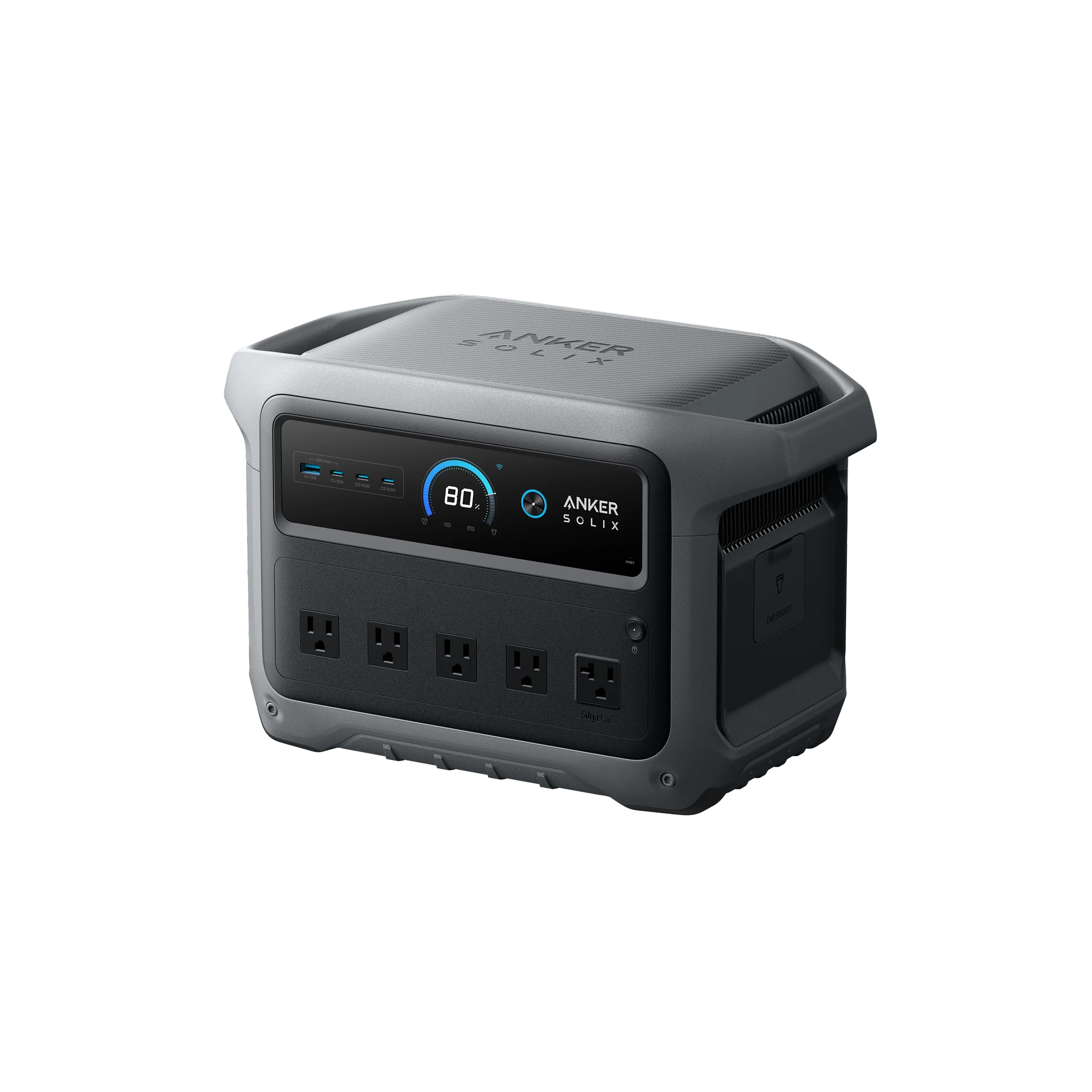
$529.99 · direct from Anker
Last checked 1 day ago. Prices move — check before you buy.

BLUETTI
2×EP900 + 8×B500
27,317Power Score · Grid-Independent
$35,196.00 · direct from BLUETTI
Last checked 43 days ago. Prices move — check before you buy.
Spec deltas
$530 buys the Anker SOLIX C1000 Gen 2. $35,196 buys the BLUETTI stack of two EP900 inverters and eight B500 batteries, about 64 times as much, which is your first clue these two were never on the same shopping list. One is 24.9 lbs you lift out of a trunk with one hand. The other is 1,178 lbs an electrician bolts to your electrical panel.
The C1000 Gen 2 is a 1,024Wh portable that runs a CPAP all night, powers a tailgate, and covers most of a short blackout. The EP900 + B500 stack is 39,680Wh of whole-home backup wired into the house, and it never leaves. Neither can do the other's job: the big system can't attend a campsite, and the small one can't keep a house running for days. So there's no winner in the usual sense, only whichever question you showed up asking.
For almost everyone comparing these, the answer is the C1000. It's the one that fits what portable power station means, at a price you'd actually spend on a maybe. The EP900 stack is right for exactly one buyer, and if that's not you, the price gap is the sound of money leaving for capacity you'll never draw down.
What the Numbers Reveal
Each conclusion stated first — the numbers behind it on one line, the full analysis below.
weight
The scenario table makes the split literal. The EP900 stack backs an 8-hour blackout with 32,083Wh to spare yet can't attend the tailgate the C1000 covers with 200Wh left, because it doesn't leave the house, and the C1000 can go anywhere but runs dry at about 41% of a camping weekend's 2,100Wh. Each wins exactly the nights shaped like itself.
SOLIX C1000 Gen 2: 24.9 lbs, not hardwired, travels2×EP900 + 8×B500: 1,178 lbs, hardwired and stationary, installed at the electrical panel
Why it mattersDecide whether you're powering a campsite or a circuit panel before you read another spec; that one fact picks the unit.
cost / lifetime kWh
So the $35,196 isn't a markup; it's what 39,680Wh of installed LFP costs. But cheap-per-kWh only helps if you spend the kWh. Buy the stack without a whole-house load to feed and you've paid a fortune up front for energy that sits there, while the C1000 stores 1,024Wh for $530 and you'll cycle all of it.
price: $530 vs $35,196capacity: 1,024Wh vs 39,680Whrated cycles: 4,000 vs 6,000cost per lifetime kWh: $0.13 vs $0.15
Why it mattersDon't let the near-matching per-kWh rate upsell you into 39,680Wh; buy the capacity you'll actually draw down.
Capacity
A first C1000 expansion battery mostly buys back capacity the stack shipped with. Its expandability only becomes a real edge past 39,680Wh, a load essentially nobody shopping a 1kWh-class unit is carrying, so in this matchup expandable versus fixed tips the decision in neither direction.
SOLIX C1000 Gen 2: expandable, starts at 1,024Wh2×EP900 + 8×B500: fixed at 39,680Wh
Why it mattersIgnore the expandability row here; against most rivals it's a genuine C1000 advantage, against this one it's answering a question neither buyer asked.
The specific dimensions that decide these two units — everything else is a tie.
Portability & Form Factor
Selected because: The one axis that decides everything: 24.9 lbs that travels against 1,178 lbs wired to your panel. Settle this and the rest is detail.
weight
Two boxes, and only one of them owns a front door key. The C1000 Gen 2 is 24.9 lbs with a handle: trunk, tailgate, basement, back out again. The EP900 + B500 stack is 1,178 lbs an electrician mounts at your panel, where its weight matters exactly once, on install day, and never again because it isn't going anywhere.
That single fact ends the which-is-more-portable question before it opens, and it quietly ends a lot of others. Anything that happens away from the house, a campsite, a job site, a friend's driveway, is the C1000's by default, because the stack can't be there. Anything that means backing up the whole house through a multi-day outage is the stack's, because the C1000 can't reach it. Work out which of those two lives is yours.
Your Life, Your Pick
Selected because: The clearest proof they aren't substitutes. The C1000 takes the tailgate and the CPAP night, the stack takes the whole-home blackout, and neither fully covers a camping weekend.
The scenario table is the matchup in miniature. The C1000 takes the Tailgate Party, covering 670Wh with 200Wh to spare, and takes the CPAP night, where 320Wh is a rounding error on either box. The stack takes the 8-Hour Blackout, covering the 1,645Wh load with 32,083Wh left over. Nobody's stealing anybody's win; they're winning different nights.
The two neither results are the honest part. A camping weekend wants 2,100Wh and van life wants 4,685Wh, and the C1000 gets you 41% and 19% of the way, while the stack has the energy for both several times over but can't leave the driveway. The small one can't stay the course; the big one can't get to the trailhead. Watch the Remote Workday too: the C1000's nameplate 1,024Wh clears the 910Wh, and only the flat 15% usable-energy derate drops it 40Wh short. Trim one small load and it's a pass, not a fail.
Lifetime Value
Selected because: Why the enormous price gap still lands within two cents per lifetime kWh, and why that near-match is a trap rather than a reason to size up.
cost / lifetime kWh
The strangest number on this page is how close these two are to own. $0.13 per lifetime kWh for the C1000, $0.15 for the stack, two cents apart. The stack gets there by delivering about 58 times the lifetime energy, 238,080 kWh against 4,096, so its price buys a proportional pile of kilowatt-hours rather than a premium rate.
Which is exactly the trap. A good per-kWh rate is only good if you spend the kWh, and 39,680Wh is a lot of nights to fill. The C1000's $110 per warranty year against the stack's $3,520 is the number that actually reaches your bank account. Unless a whole house is drawing on those 39,680Wh, the cheaper rate is a rate you never collect.
Growth Path
Selected because: The C1000's expandability looks like a tiebreaker and isn't: it expands up from 1,024Wh, and the stack already sits at 39,680Wh.
solar input
The C1000's headline advantage over the stack is a mirage. It's the expandable one, yes, but it expands up from 1,024Wh, and the stack already ships at 39,680Wh. Your first Anker expansion battery is mostly spent buying back capacity the BLUETTI included in the box.
Expandability would only put the C1000 ahead if you meant to climb past 39,680Wh, and if that's your load you're not really shopping a 1kWh unit anymore. Against most competitors the C1000's growth path is a real selling point. Against 39,680Wh of fixed capacity, it's a solution shopping for a problem.
Strengths & trade-offs
Anker SOLIX C1000 Gen 2
Strengths
- +Costs $34,666 less
- +Lighter by 1,153.1 lb
Trade-offs
- –Weaker inverter (-16,000W) limits appliance compatibility.
- –Shorter-lived battery — rated for 4,000 charge cycles vs the 2×EP900 + 8×B500's 6,000, so it wears out sooner.
BLUETTI 2×EP900 + 8×B500
Strengths
- +Larger battery capacity
- +Higher AC output
- +Longer warranty
- +Faster solar charging
- +Rated for 6,000 charge cycles — much longer battery lifespan
Trade-offs
- –Substantially more expensive (+$34,666) than the SOLIX C1000 Gen 2.
- –Significantly heavier (+1,153.1 lbs), making it harder to move.
- –Very heavy unit that may be difficult for one person to lift.
Will It Power Your Gear?
Scenario math and per-appliance runtimes, modeled from the spec record.
Scenario verdicts
We ran the math on six real-world scenarios. Here's which unit survives your actual life.
SCN-01 · 2 nights · needs 2,100Wh
Weekend Camping
Two nights off-grid with essential comfort
Neither unit
Neither gives you a powered weekend: the 2×EP900 + 8×B500 has the energy but is wired to the building, and the SOLIX C1000 Gen 2 covers about 41% of the 2,100Wh. One can't go; the other can't finish.
Battery budget usedlower = more headroom
LOAD Phone Charger 15W×6h · LED Lights 40W×8h · Box Fan 75W×14h · CPAP Machine 40W×16h
SCN-02 · 8 hours · needs 1,645Wh
8-Hour Blackout
Keep the essentials running through a night without power
2×EP900 + 8×B500
The SOLIX C1000 Gen 2 doesn't finish — 870Wh usable against the 1,645Wh this needs leaves it 775Wh short, about 53% of the scenario covered. The 2×EP900 + 8×B500 covers it with 32,083Wh to spare.
Battery budget usedlower = more headroom
LOAD Fridge 150W×8h · Router + Modem 20W×8h · LED Lights (4 bulbs) 40W×6h · Phone Charger 15W×3h
SCN-03 · 8 hours · needs 320Wh
CPAP Overnight
Sleep therapy without interruption — the #1 medical use case
SOLIX C1000 Gen 2
A CPAP pulls about 40W, so 320Wh over a full night is a rounding error on a 1,024Wh box and a 39,680Wh house battery alike. Capacity doesn't decide this one; placement does. The C1000 is the box you can actually set on the nightstand, and nobody wires a 1,178 lb panel system to run a bedside machine. Take the Anker, and if it ever becomes your only outage plan, the CPAP is the last thing it'll struggle with.
Battery budget usedlower = more headroom
LOAD CPAP Machine 40W×8h
SCN-04 · 8 hours · needs 910Wh
Remote Workday
Full work day off-grid without power anxiety
2×EP900 + 8×B500
The SOLIX C1000 Gen 2 comes up just short — it needs 910Wh and has 870Wh usable, a 40Wh gap (its nameplate 1,024Wh actually clears this — the flat 15% conversion allowance is what tips it under). Trim that much — one small appliance's worth across the day — and it finishes. The 2×EP900 + 8×B500 covers it outright with 32,818Wh to spare.
Battery budget usedlower = more headroom
LOAD Laptop 60W×8h · External Monitor 30W×8h · Router + Modem 20W×8h · Phone Charger 15W×2h
SCN-05 · 4 hours · needs 670Wh
Tailgate Party
Game day power for the crew
SOLIX C1000 Gen 2
The 2×EP900 + 8×B500 is installed at the electrical panel — it backs up the building and doesn't leave it, so this scenario belongs to the SOLIX C1000 Gen 2 by default — and it earns it, covering the 670Wh with 200Wh to spare. Capacity was never the 2×EP900 + 8×B500's problem here; getting to a tailgate was.
Battery budget usedlower = more headroom
LOAD Blender 400W×0.5h · LED TV (55") 80W×4h · Bluetooth Speaker 15W×4h · Phone Charger (×3) 45W×2h
SCN-06 · 24 hours · needs 4,685Wh
Van Life Daily
A full day of mobile living — the ultimate endurance test
Neither unit
A van day here wants 4,685Wh, more than four times what the C1000 holds and a fraction of what the stack does. So the small one runs dry before lunch and the big one has energy to spare but is bolted to a wall a long drive from the trailhead. This is the whole mismatch in one scenario: van life needs a 2 to 5kWh box that moves, and neither of these is that. Look at a mid-size portable instead.
Battery budget usedlower = more headroom
LOAD Mini-Fridge 150W×24h · Laptop 60W×4h · Phone Charger 15W×3h · LED Lights 40W×5h · Fan 75W×8h
The Load Test
RUNTIME = (Wh × 0.85) ÷ LOAD
None of the scenarios above exactly yours? Build it. Toggle what you'd plug in; both units are tested against the combined draw.
Essentials
Comfort & Convenience
High-Draw Appliances
Test duration
8h
Continuous draw
205W
Projected runtime
For this load: 2×EP900 + 8×B500 runs 164.5h vs 4.2h.
$35,196 list · direct from BLUETTI
Modeled from the spec record — same math as the tables below. Methodology
Runtime by appliance
Real-world runtime estimates for common appliances, modeled at 85% inverter efficiency.¹
Essentials
The basics you need runningscale 0–2248.5hComfort & Convenience
Makes off-grid life actually enjoyablescale 0–449.7hHigh-Draw Appliances
These reveal the real limitsscale 0–33.7h¹ Runtime = (capacity × 0.85) ÷ appliance watts. Within each group, all bars share one time scale (the group's longest runtime), so lengths are comparable across appliances; identical runtimes collapse into a single blue/orange bar. Actual runtime varies with battery age, temperature, and simultaneous loads — see methodology.
Conclusion
August 30, 2026
Verdict: the Anker SOLIX C1000 Gen 2
Take the C1000 Gen 2 unless you're specifically wiring whole-home backup, in which case only the EP900 + B500 stack can do it and the Anker isn't in the conversation. For everyone else, the C1000 answers what pairing these two usually means, portable 1kWh-class power, at $530 against $35,196, covers the everyday scenarios the 1,178 lb stack physically can't attend, and even edges it on cost per lifetime kWh. The BLUETTI isn't the worse product; it's a different project, 39,680Wh bolted to your panel by an electrician. Need days of off-grid whole-house power and it's the answer. Don't, and you'd be spending five figures to solve a problem you don't have.
Editor-assigned confidence, based on cited owner research and spec analysis.
List prices as of August 30, 2026. The links below open Anker's and BLUETTI's current prices.
$529.99 · direct from Anker
Last checked 1 day ago. Prices move — check before you buy.
or check the 2×EP900 + 8×B500 price$35,196.00 list
Written by Gunner Gustafson, Whole-Home Backup Tester · Station Arena Test Desk · Updated August 30, 2026
Measured Data
Benchmark scores and the full spec record, side by side.
Benchmark scores
Not rated for both units (minimum threshold unmet): UPS, RV Living, CPAP, Solar Generator, Tailgating, Apartment Balcony, Camping.
Full specifications
ᵈ Derived: price ÷ rated capacity. See the data behind our comparisons →
Comparison ToolAdd more power stations, side by sideOpen Tool →How these numbers are produced
Numeric verification
Every figure on this page traces to our spec database or arithmetic on it — no estimated numbers.
Owner claims
Statements about owner experience are cited to published reviews — see Sources & Research Notes below.
Runtime model
Runtime = (rated capacity × 0.85 inverter efficiency) ÷ device wattage. Solar recharge estimates assume panels deliver 70% of rated output. Cold weather, battery age, and stacked loads reduce real-world results.
Power Score
Computed from 14 published spec dimensions, weighted per use-case bench. Higher is better; a unit must meet a bench's minimum threshold to be rated.
See the full weight table and data sourcing on our methodology page →Class ranking (the star rating)
Each unit's star score is a category ranking, not customer reviews — no buyer opinions feed it. We score every station on size-independent quality (value, output, portability, endurance, ports, warranty, and more), then percentile-rank it against the other units in its capacity class, so a class-leading compact unit and a class-leading whole-home unit can both earn 5★. Here, SOLIX C1000 Gen 2 rates 4.9/5 (96th percentile of 27 Everyday-class units), and 2×EP900 + 8×B500 rates 4.9/5 (96th percentile of 29 Whole-Home / Off-Grid-class units).
How the class ranking is computed →Test Notes & Caveats
Hidden gotchas and advantages we spotted that you won't find on the product page.
1,178 lbs, weighed once
This isn't a heavy power station, it's an installed appliance. An electrician mounts the 1,178 lb stack at your electrical panel, it gets weighed on install day, and then it never moves again. The C1000's 24.9 lbs is a one-hand lift into the trunk. If the box has to travel, only one of these can, and no amount of the other's capacity changes that.
2×EP900 + 8×B500: 50dB Published
50dB is about as loud as moderate rainfall. The SOLIX C1000 Gen 2 is rated 35dB — lower, but published by a different maker measuring its own way, so the two figures are not a like-for-like gap. For most people, fan noise around 45dB and up is where sleep starts to suffer.
Expandable into a hole
The C1000 is the expandable unit here, and in this matchup that barely matters. Its add-on batteries build up from 1,024Wh, while the stack already sits at 39,680Wh, so your first expansion pack mostly rebuys capacity the BLUETTI shipped with. It only pulls ahead past 39,680Wh, far beyond where a 1kWh-class buyer lives. Against most rivals this is a real C1000 edge. Against this one it's a feature with no job.
Warranty: 10 Years vs 5
The 2×EP900 + 8×B500 is covered for 10 years against the SOLIX C1000 Gen 2's 5 years. The cheaper SOLIX C1000 Gen 2 does buy more warranty per dollar (9.4 years per $1,000 against 0.3), but that is a statement about price, not about coverage — if a fault appears in year 6, only one of these is still covered. An underrated factor if you're keeping this unit for years.
Battery Lifespan in Real Years
The 2×EP900 + 8×B500 is rated for 6,000 cycles vs 4,000. In real life: at daily use, that's 16.4 vs 11 years. At weekend use (twice a week), it's 58 vs 38 years. One caution reading years across different sizes: a cycle is 39,680Wh on the 2×EP900 + 8×B500 and 1,024Wh on the SOLIX C1000 Gen 2, so count lifetime energy — roughly 238,080 kWh against 4,096 kWh over the rated life. After hitting the cycle limit, the battery doesn't die — it drops to ~80% of original capacity, which is still very usable.
Full record above — the Test Desk pick is the SOLIX C1000 Gen 2.
Check SOLIX C1000 Gen 2 price →or check the 2×EP900 + 8×B500 priceOwnership Analysis
What happens after you buy — true cost of ownership, brand trust, and growth potential.
Lifetime value
Service lifeyears at one full cycle per day
Lifetime energy delivered
Cost per delivered kWh
│ warranty ends · Reaching the cycle rating means ~80% capacity remains — degraded, not dead.
Analyst note
Both units have similar long-term ownership costs ($0.13/kWh vs $0.15/kWh). The price difference is what you see on the sticker — neither is a hidden bargain or rip-off.
Brand trust
Anker
Ecosystem
7-8 SOLIX portable power stations across C-series (compact) and F-series (flagship), plus the X1 home energy system
Support
US-based, and historically Anker's calling card was no-hassle replacements. Lately SOLIX service looks less rosy: AI-driven first-line agents give generic answers, and a heavy unit means hazmat return logistics if something goes wrong. Still a strong brand, but SOLIX support is trending down from its old standard.
Community
Moderate — active Reddit (r/Anker, r/AnkerSOLIXCommunity) and growing. Benefits from Anker's massive consumer electronics brand awareness.
App experience
Rated 4.5/5 iOS (~1,100 ratings) · 4.3/5 Android
Unique strength
Anker's mid-size units are among the better dollar-per-Wh buys in the catalog, and the C1000 is squarely one of them, a lot of dependable 1kWh for the money.
Worth knowing
Firmware updates have removed features without warning, and the expansion ecosystem is smaller than EcoFlow's. Worth a glance if you plan to grow the system.
BLUETTI
Ecosystem
One of the broadest lineups — 15-20+ models from budget (AC2A) to flagship portable (Apex 300, 2764.8Wh). Includes specialized products: vehicle solar hubs, sodium-ion cold-weather units, and balcony storage systems.
Support
The single biggest variable at this price. BLUETTI's support is the most inconsistent in the category: email-based with China-timezone delays, smooth for some and weeks of runaround for others, sometimes offering a discount on a new unit instead of a repair. Buying direct tends to produce better outcomes. On a $35,196 hardwired install, this is the risk you're actually underwriting.
Community
Active and growing — Reddit r/bluetti has a dedicated community. Second-largest after EcoFlow in engagement.
App experience
Rated 4.5/5 iOS and Android — tied for best app experience in the category. V3.0 UI redesign was well-received.
Unique strength
Among the best capacity-to-price ratios in the category, the widest lineup in the space, and full LFP throughout, with dual-voltage in the flagships. If raw kWh per dollar is the goal, BLUETTI competes hard.
Worth knowing
Support inconsistency is the number-one risk factor, and some older or discontinued units have become effectively unrepairable with no spare-parts path. Buy direct and keep your paperwork.
Analyst note
Both companies ship excellent apps, so that's a wash. The brand question that matters here isn't ecosystem, it's who picks up when a five-figure wired system faults in year four, and BLUETTI's support is the least predictable in the space. That's a much heavier bet on a hardwired $35,196 install than on a $530 box you could simply replace if it ever sulked. Anker's SOLIX support is slipping too, but at the C1000's price a warranty headache is an annoyance, not a project.
Growth path
SOLIX C1000 Gen 2
EXPANDABLESupports Anker expansion batteries, so you can add capacity later without replacing the base unit — useful if your needs may climb past 1,024Wh.
Accepts up to 600W of solar. Suitable for a 1-2 panel setup.
Generous port selection supports complex multi-device setups.
Expansion batteries are Anker-specific. You're investing in the Anker ecosystem.
2×EP900 + 8×B500
FIXED CAPACITYFixed at 39,680Wh — a sealed, complete system rather than a starting point. There's no expansion port, so that figure is the ceiling: check it against your longest unplugged stretch before you buy.
Accepts up to 18,000W of solar. Enough for a serious multi-panel array.
Limited ports. You'll likely need a power strip or splitter.
Realistic full solar rechargeat 70% of rated panel output — see methodology
Analyst note
Don't read the SOLIX C1000 Gen 2's expandability as a straight win here: it starts at 1,024Wh, below the 2×EP900 + 8×B500's 39,680Wh, so a first expansion battery largely buys back capacity the 2×EP900 + 8×B500 already includes. It only pulls ahead if you'd grow past 39,680Wh — short of that, the 2×EP900 + 8×B500's larger fixed capacity is the simpler value.
What Owners Report
Patterns from published owner reports and long-term reviews — every claim cited to its source below.
Anker SOLIX C1000 Gen 2
Reviewers treat the C1000 Gen 2 as the mid-size 1kWh unit to beat, a refined, fast-charging update to a popular platformA0A4. The standout is speed: a full HyperFlash recharge in roughly 49 minutesA1, with enough continuous output to run a 1,500W space heater with headroom to spareA3. The one recurring complaint is fan noise, near-silent under about 200W but ramping up audibly during fast charging or heavy output, reported around 55dB at 1,000W and aboveA2. It's quiet where it counts for a CPAP and loud where it doesn't, mid-recharge.
“Fast HyperFlash charging — a full recharge in roughly 49 minutes, noticeably quicker than the original C1000's ~58-80 minutes.”
Sources
thepowerpick.com · macrumors.com · outdoorgearlab.com · technerdo.com · mensjournal.com · powerstationadvisor.com
BLUETTI 2×EP900 + 8×B500
Field data on this exact stack is thin, and it's worth saying so plainly: two EP900 inverters with eight B500 batteries is a niche installer and DIY-solar product, and almost no long-term owner reports specific to this configuration exist yetB0. What's out there is mostly prospective buyers and installers. One installer hit documentation gaps wiring a dual-EP900 setup to the AT1 Smart Panel, with manuals that didn't match the hardware in front of themB3B4. DIY-solar posters like the tidy new battery-cable systemB5 but openly doubt how it holds up in desert heat or sub-freezing coldB7B8, and question whether BLUETTI's support can carry a complex multi-unit installB1. One poster did report responsive email support resolving a firmware issue in under a day, though which model they meant isn't certainB2. Treat all of it as preliminaryB0.
“on paper it's a dream but who knows with Bluetti tech support?”
Sources
diysolarforum.com · community.bluettipower.co
Sources & Research Notes
Every owner claim in this report is traceable to a published source. The bracketed references above resolve here.
Recurring owner themes
- Fast charging and higher output over the original are the standout gains; fan noise under load or fast charging is the top complaint. [SOLIX C1000 Gen 2 · 3 entries]
- Prospective buyers are drawn to the modular multi-EP900/B500 stacking concept for whole-home backup but express skepticism about real-world reliability versus marketing claims, especially in temperature extremes. [2×EP900 + 8×B500 · 3 entries]
- Installers report unresolved technical/documentation gaps specific to multi-unit (dual EP900) configurations, including mismatched manuals between EP900 and the larger EP13K system. [2×EP900 + 8×B500 · 3 entries]
- Mixed views on customer support: some report fast, helpful responses while others question whether support can handle a complex multi-unit install. [2×EP900 + 8×B500 · 2 entries]
- A1
“Fast HyperFlash charging — a full recharge in roughly 49 minutes, noticeably quicker than the original C1000's ~58-80 minutes.”
thepowerpick.com / macrumors.com — Anker SOLIX C1000 Gen 2 review · 2026 · [positive]
- A2
“Fan noise is the single most common complaint — nearly silent at low load (about 35 dB under 200W), but the fans ramp up audibly during fast charging or heavy output, reaching around 55 dB at 1,000W-plus.”
outdoorgearlab.com / technerdo.com — C1000 Gen 2 review · 2026 · [negative]
- A3
“The higher continuous output crosses a useful threshold over the original — enough to run a standard 1,500W space heater with headroom to spare.”
thepowerpick.com / mensjournal.com — C1000 Gen 2 review · 2026 · [positive]
- A4
“Reviewers describe it as a refined, powerful, fast-charging update to a popular 1kWh platform, widely rated the mid-size unit to beat in 2026.”
thepowerpick.com / powerstationadvisor.com — C1000 Gen 2 review · 2026 · [positive]
- B1
“on paper it's a dream but who knows with Bluetti tech support?”
diysolarforum.com — 'Bluetti EP900' thread · 2023-04 · [mixed]
- B2
“customer service for EP800/900 ESS can be reached directly through this number... Their email support is also very responsive, and last time it took less than 24 hours to resolve a firmware issue”
diysolarforum.com — 'Bluetti EP900' thread · 2023-04 · [positive]
- B3
“I recently purchased and just installed the AT1 Smart Panel, after I was told by Bluetti Engineering that it was compatible with a dual EP900 setup”
community.bluettipower.com — 'Dual EP900 and AT1 installation issues' · 2025-12 · [negative]
- B4
“However during the setup I noticed differences in the EP900 layout to the EP13K, and cannot f...”
community.bluettipower.com — 'Dual EP900 and AT1 installation issues' · 2025-12 · [negative]
- B5
“Nice that Bluetti finally came up with a battery cable system between it's batteries that isn't a giant bulky obtrusive cable sticking a foot out. Well done.”
diysolarforum.com — 'Bluetti EP900 to Power your House' · 2023-04 · [positive]
- B7
“Sunshine on it, it'll get hot. 110-118f las vegas or CA desert temps, good luck... Sub freezing temps, good luck.”
diysolarforum.com — 'Bluetti EP900 to Power your House' · 2023-04 · [negative]
- B8
“It may have temperature protections, or even internal heat, but if you need to use it in real heat, or real cold... I wouldn't count on it if it's installed outside. Imho, Bluetti marketing is quite unrealistic.”
diysolarforum.com — 'Bluetti EP900 to Power your House' · 2023-04 · [negative]
Research compiled August 30, 2026.
Who Should Buy Which
Buy the SOLIX C1000 Gen 2 if you…
- →The camper, tailgater, or road-tripper who wants one box that runs a fridge, tops up phones and a laptop, and lifts out of the trunk one-handed. At 24.9 lbs and 1,024Wh, that's the whole job description.
- →The renter or apartment dweller who wants outage insurance for the fridge, the phones, and a CPAP overnight, without an electrician, a permit, or a five-figure budget.
- →Anyone whose real ceiling is about a kilowatt-hour at a time, which is the common reason these two names end up in the same search box.
Buy the 2×EP900 + 8×B500 if you…
- →The homeowner backing up a whole panel, well pump, furnace blower, fridge, lights, through multi-day outages, who's already committed to an electrician and a permit. This is the load the 39,680Wh stack is built for and the C1000 can't touch.
- →The off-grid or heavy-solar build pairing serious arrays with 18,000W of solar input and 39,680Wh of storage. If that's the project, the C1000 was never a candidate.
If neither fits
If you need more than a 1kWh box can carry but you're nowhere near wiring a 39,680Wh system into your house, both of these miss you, and the gap between them is enormous. That's the 2 to 5kWh middle: a larger portable like an Anker F-series or a BLUETTI AC200-class or Elite unit, or a single EP900 with fewer batteries. Buying the C1000 leaves you short on a real outage; buying the full stack is tens of thousands for capacity you'll never cycle.
The Bottom Line
Take the C1000 Gen 2, unless you're specifically wiring whole-home backup, where the EP900 + B500 stack is the only one of these that can do the job and the Anker isn't in the running. The scenario table tells the story: the stack covers an 8-hour blackout with 32,083Wh to spare and still can't attend a tailgate the C1000 handles with room left, because one is bolted to your panel and the other rides in your trunk. Each wins the nights shaped like itself.
So don't shop these as rivals. Work out whether you're furnishing a campsite or a circuit panel, and the box follows from that answer. For the buyer who showed up comparing power stations, it's the $530 one, and the roughly $34,000 difference is better spent almost anywhere else.
Frequently Asked Questions
Answers drawn from the spec record and cited owner research.
Is the Anker SOLIX C1000 Gen 2 enough to back up my whole house?
Not a whole house, no. Its 1,024Wh covers a fridge, phones, lights, and a CPAP for a night, and it handles about half of a typical 1,645Wh eight-hour-blackout load on its own. For fridge-and-essentials outage insurance it's plenty. For the entire panel, including a well pump or furnace, you need a wired system like the EP900 + B500 stack.
Why does the BLUETTI EP900 + B500 system cost so much more?
It's 39,680Wh of installed, whole-home storage against the C1000's 1,024Wh, roughly 39 times the energy, feeding your electrical panel through an inverter an electrician has to wire in. Per lifetime kWh the two are close, $0.15 against $0.13. The price is capacity and installation, not a markup.
Can the EP900 + B500 stack be used as a portable power station?
No. At 1,178 lbs it's hardwired to your electrical panel and stays there. If you want power at a campsite, a tailgate, or a job site, that's the C1000's role. The stack physically can't come along, no matter how much energy it holds.
Should I just buy the C1000 Gen 2 and expand it later instead of a big system?
Only if your needs stay near 1kWh. Its expansion batteries build up from 1,024Wh, so you'd stack several just to reach the territory the EP900 system starts at, and none of that path reaches whole-home backup. Expansion is worth it if you creep toward 2 to 4kWh. It isn't a substitute for a wired install.
Where to buy
Anker SOLIX C1000 Gen 2Pick
$529.99
$529.99 · direct from Anker
Last checked 1 day ago. Prices move — check before you buy.
BLUETTI 2×EP900 + 8×B500
$35,196.00
$35,196.00 · direct from BLUETTI
Last checked 43 days ago. Prices move — check before you buy.
Prices may vary by retailer and are subject to change.