Head-to-head test
Anker 535 PowerHouse vs Jackery Explorer 600 Plus
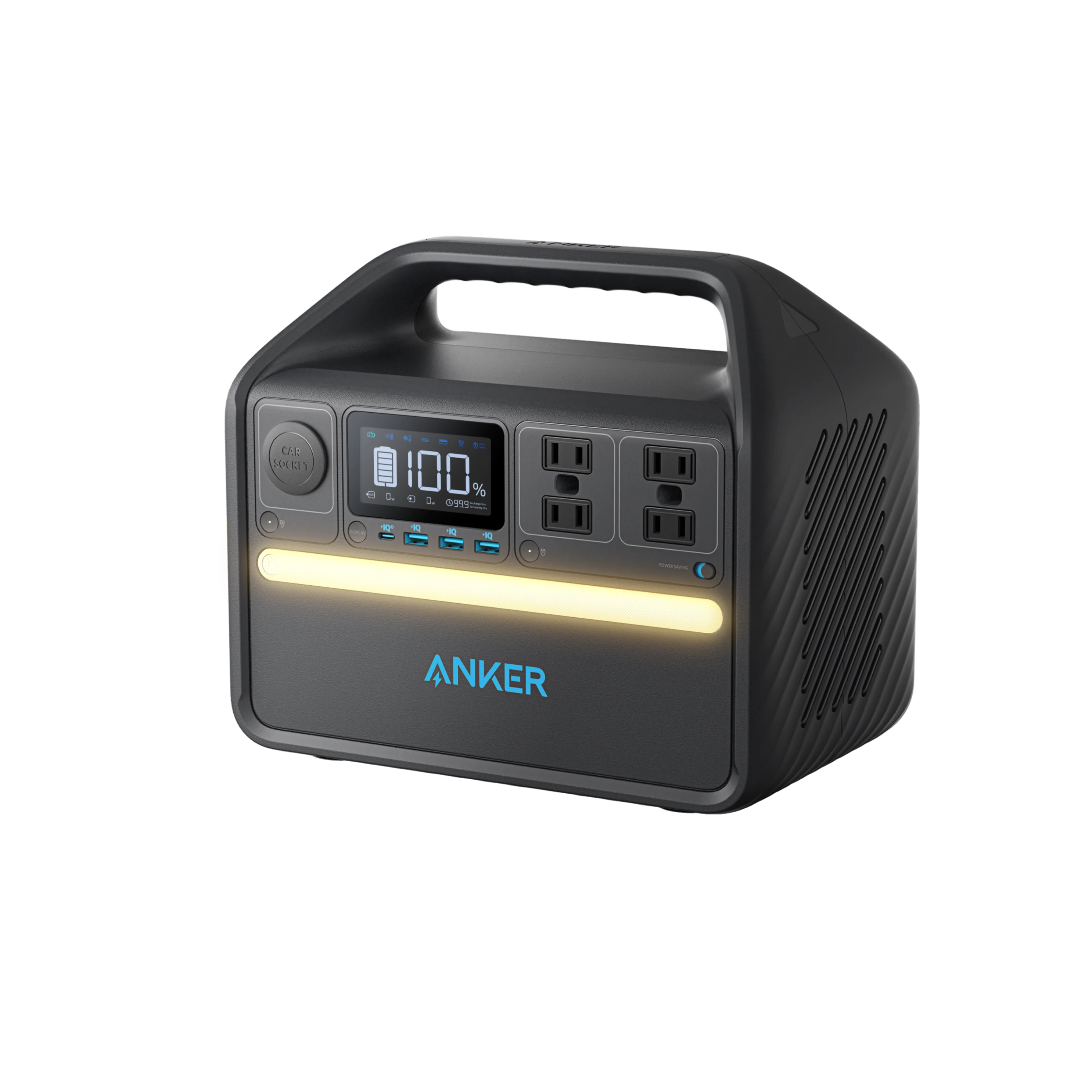
For $129 more the Explorer 600 Plus gives you 300W more output, a 20ms UPS the Anker simply doesn't have, an app, and near-instant surge headroom — the 535 PowerHouse only makes sense if $300 is a hard ceiling and nothing you plug in ever needs to start a motor.
Full profiles: Anker 535 PowerHouse → · Jackery Explorer 600 Plus →

Written by Wenny ZhengUpdated
Portable Power Tester, Station Arena Test Desk
$299.99 · direct from Anker
Last checked 1 day ago. Prices move — check before you buy.

$429.00 · direct from Jackery
Last checked 14 days ago. Prices move — check before you buy.
Spec deltas
The Explorer 600 Plus costs $429 and the Anker 535 PowerHouse costs $300, and that $129 buys a genuinely more capable machine. The Jackery outputs 800W to the Anker's 500W, holds 632Wh to 512Wh, and adds a 20ms UPS switchover the 535 doesn't offer at all.
Where they're even is cost to own. Both run 3,000-cycle LiFePO4 packs under a 5-year warranty, and they land within a penny of each other per lifetime kWh, $0.18 for the Jackery and $0.19 for the Anker. So don't shop this pair on value; shop it on what each one can actually do.
The 535 isn't a bad unit. It's a durable, efficient weekend battery that runs cool at its rated output. It's just the older, plainer design here, and the 600 Plus does more of the things people actually buy a power station for.
What the Numbers Reveal
Each conclusion stated first — the numbers behind it on one line, the full analysis below.
continuous output
The 600 Plus's 1,600W surge gives it room to start a compressor the 535 would trip on, and its 800W continuous runs more once it's going — the Anker can power devices, but it stalls on the loads that actually need starting current.
Anker 535 PowerHouse outputs 500W with no listed surge ratingExplorer 600 Plus outputs 800W with a 1,600W surge
Why it mattersAnyone plugging in a fridge, a pump, or a corded tool should skip the 535; the 600 Plus is the one that starts the load instead of clicking off.
The 600 Plus catches an outage in 20 milliseconds and keeps that machine running; the 535 has no such mode, so it's a battery you switch to, not a seamless backup.
Only the Explorer 600 Plus offers a 20ms UPS switchoverThe 535 PowerHouse lists no switchover time
Why it mattersIf the job is protecting a CPAP or a desktop during a cut, the 600 Plus is the only one of the two that qualifies; if you're just topping up phones, the difference never shows.
Capacity
That penny means value can't decide this matchup, which throws the whole decision onto features, and there the 600 Plus holds every meaningful card: output, surge, UPS, solar, USB-C.
Anker 535 PowerHouse: $300, 3,000 cycles, 512Wh, $0.19 per lifetime kWhExplorer 600 Plus: $429, 3,000 cycles, 632Wh, $0.18 per lifetime kWh
Why it mattersDon't let the 535's $129 lower price read as the better deal; you're paying the same per kWh and getting less machine.
The specific dimensions that decide these two units — everything else is a tie.
PowerScore Breakdown
Selected because: The output and surge gap (800W/1,600W vs 500W/none) is the core capability difference.
overall power score
The 600 Plus scores 2,313 to the 535's 1,815, and output is the reason. It runs 800W continuous with a 1,600W surge; the 535 lists 500W and no surge rating, which is the spec that quietly decides what each can run.
In practice that's the line between a fridge and a phone charger. The 535 is efficient and stays cool delivering its full 500W, but 500W with no surge margin won't start a compressor, while the 600 Plus's 1,600W spike ceiling will.
Lifetime Value
Selected because: Near-identical cost per lifetime kWh means value is a tie and can't decide the matchup.
cost / lifetime kWh
This is the rare pair where value is genuinely a wash. Both run 3,000-cycle LiFePO4 packs under a 5-year warranty, and they finish within a penny of each other: $0.18 per lifetime kWh for the 600 Plus, $0.19 for the 535.
Cost per warranty year is just as close, $70 against $60, tracking the small price difference and nothing more. When two units cost the same to own, the money stops being the argument and the feature set becomes the whole case.
What the Specs Don't Tell You
Selected because: UPS, app control, solar-recharge time, and undisclosed noise all fire here and mostly favor the Jackery.
Four flags fire here and three lean Jackery. The 600 Plus has a 20ms UPS the 535 lacks, doubles solar input to 200W where the Anker caps at 120W (a slow 6.1-hour recharge), and it has an app for monitoring where the 535 has none. The 535's noise level isn't published, which is worth noting for anyone who'll sleep near it.
The one place the 535's simplicity is a quiet plus is the missing app: nothing to log into, no cloud dependency in the outage you bought it for. That's a fair point for a set-and-forget weekend unit, but it doesn't offset the UPS, the surge headroom, and the faster solar the 600 Plus brings.
Your Life, Your Pick
Selected because: CPAP is the one scenario that splits them; the rest defeat both.
CPAP Overnight is the only scenario that splits them, and the 600 Plus takes it: a machine needs about 320Wh, which the 535's 512Wh covers on paper, but the Jackery pairs the capacity with the 20ms UPS that keeps the machine alive through a grid blink. For anything at the bedside, that combination wins.
Everything bigger beats both. Weekend Camping wants roughly 2,100Wh, an 8-hour blackout about 1,645Wh, even a tailgate around 670Wh — all past what either 500-ish-Wh unit holds. These are weekend and device-charging batteries, and sized as such, the 600 Plus is simply the more useful one.
Brand Trust
Selected because: Cross-brand pair — Anker's declining SOLIX support vs Jackery's wide retail return protection is a real tiebreaker.
Anker still carries real parent-brand trust from its consumer-electronics business, and the 535's InfiniPower LFP is built for long cycle life. The caution is that SOLIX-specific support has been trending down, with reports of scripted AI agents and awkward return logistics for heavy units.
Jackery's own support draws criticism too, which is why the practical advice with the 600 Plus is to buy it from a retailer with strong return protection like Costco or Amazon. Jackery's edge is exactly that reach — it's the widely-stocked, easy-to-return option, even if its app is the weakest of the major brands.
Strengths & trade-offs
Anker 535 PowerHouse
Strengths
- +Costs $129 less
Trade-offs
- –Lacks smartphone app control for remote monitoring.
Jackery Explorer 600 Plus
Strengths
- +Lighter by 0.6 lb
- +Larger battery capacity
- +Higher AC output
- +Faster solar charging
Trade-offs
- –Substantially more expensive (+$129) than the 535 PowerHouse.
Will It Power Your Gear?
Scenario math and per-appliance runtimes, modeled from the spec record.
Scenario verdicts
We ran the math on six real-world scenarios. Here's which unit survives your actual life.
SCN-01 · 2 nights · needs 2,100Wh
Weekend Camping
Two nights off-grid with essential comfort
Neither unit
Neither unit covers this scenario's 2,100Wh: the 535 PowerHouse comes up 1,665Wh short (about 21% covered), the Explorer 600 Plus 1,563Wh (26%). This is well outside what either unit is for; the right answer here is a larger station, not a choice between these two.
Battery budget usedlower = more headroom
LOAD Phone Charger 15W×6h · LED Lights 40W×8h · Box Fan 75W×14h · CPAP Machine 40W×16h
SCN-02 · 8 hours · needs 1,645Wh
8-Hour Blackout
Keep the essentials running through a night without power
Neither unit
Neither unit covers this scenario's 1,645Wh: the 535 PowerHouse comes up 1,210Wh short (about 26% covered), the Explorer 600 Plus 1,108Wh (33%). Treat this as partial cover — enough for the essentials in it, not the whole list.
Battery budget usedlower = more headroom
LOAD Fridge 150W×8h · Router + Modem 20W×8h · LED Lights (4 bulbs) 40W×6h · Phone Charger 15W×3h
SCN-03 · 8 hours · needs 320Wh
CPAP Overnight
Sleep therapy without interruption — the #1 medical use case
Either unit
The 600 Plus takes the bedside. A CPAP draws about 320Wh, which both units hold, but only the Jackery adds a 20ms UPS that keeps the machine breathing through a grid blink. Capacity gets you through the night; the switchover is what keeps a mid-sleep outage from waking you.
Battery budget usedlower = more headroom
LOAD CPAP Machine 40W×8h
SCN-04 · 8 hours · needs 910Wh
Remote Workday
Full work day off-grid without power anxiety
Neither unit
Neither unit covers this scenario's 910Wh: the 535 PowerHouse comes up 475Wh short (about 48% covered), the Explorer 600 Plus 373Wh (59%). Treat this as partial cover — enough for the essentials in it, not the whole list.
Battery budget usedlower = more headroom
LOAD Laptop 60W×8h · External Monitor 30W×8h · Router + Modem 20W×8h · Phone Charger 15W×2h
SCN-05 · 4 hours · needs 670Wh
Tailgate Party
Game day power for the crew
Neither unit
Neither unit covers this scenario's 670Wh: the 535 PowerHouse comes up 235Wh short (about 65% covered), the Explorer 600 Plus 133Wh (80%). Either gets you most of the way, so this is a scenario you plan around rather than one you should rule them out for.
Battery budget usedlower = more headroom
LOAD Blender 400W×0.5h · LED TV (55") 80W×4h · Bluetooth Speaker 15W×4h · Phone Charger (×3) 45W×2h
SCN-06 · 24 hours · needs 4,685Wh
Van Life Daily
A full day of mobile living — the ultimate endurance test
Neither unit
Neither unit covers this scenario's 4,685Wh: the 535 PowerHouse comes up 4,250Wh short (about 9% covered), the Explorer 600 Plus 4,148Wh (11%). This is well outside what either unit is for; the right answer here is a larger station, not a choice between these two.
Battery budget usedlower = more headroom
LOAD Mini-Fridge 150W×24h · Laptop 60W×4h · Phone Charger 15W×3h · LED Lights 40W×5h · Fan 75W×8h
The Load Test
RUNTIME = (Wh × 0.85) ÷ LOAD
None of the scenarios above exactly yours? Build it. Toggle what you'd plug in; both units are tested against the combined draw.
Essentials
Comfort & Convenience
High-Draw Appliances
Test duration
8h
Continuous draw
205W
Projected runtime
For this load: Explorer 600 Plus runs 2.6h vs 2.1h.
$429 list · direct from Jackery
Modeled from the spec record — same math as the tables below. Methodology
Runtime by appliance
Real-world runtime estimates for common appliances, modeled at 85% inverter efficiency.¹
Essentials
The basics you need runningscale 0–35.8hComfort & Convenience
Makes off-grid life actually enjoyablescale 0–7.2hHigh-Draw Appliances
These reveal the real limits¹ Runtime = (capacity × 0.85) ÷ appliance watts. Within each group, all bars share one time scale (the group's longest runtime), so lengths are comparable across appliances; identical runtimes collapse into a single blue/orange bar. Actual runtime varies with battery age, temperature, and simultaneous loads — see methodology.
Conclusion
July 16, 2026
Verdict: the Explorer 600 Plus
The two cost almost the same to own — $0.18 per lifetime kWh for the Jackery against $0.19 for the Anker, on identical 3,000-cycle LFP packs — so this isn't a value fight, it's a features fight, and the 600 Plus wins it on nearly every axis that matters. It outputs 800W to the 535's 500W, adds a 1,600W surge where the Anker lists none, carries a 20ms UPS switchover the 535 lacks entirely, doubles the solar input to 200W, and pushes 100W over USB-C against 60W. The 535's honest edges are a $129 lower price, a near-identical 16.7 lb, and no app to depend on. For most buyers the extra $129 buys more capability than it should, and the 600 Plus is the pick.
Editor-assigned confidence, based on cited owner research and spec analysis.
List prices as of July 16, 2026. The links below open Anker's and Jackery's current prices.
$429.00 · direct from Jackery
Last checked 14 days ago. Prices move — check before you buy.
or check the 535 PowerHouse price$299.99 list
Written by Wenny Zheng, Portable Power Tester · Station Arena Test Desk · Updated July 16, 2026
Measured Data
Benchmark scores and the full spec record, side by side.
Benchmark scores
Not rated for both units (minimum threshold unmet): UPS, CPAP, Solar Generator.
Full specifications
ᵈ Derived: price ÷ rated capacity. See the data behind our comparisons →
Comparison ToolAdd more power stations, side by sideOpen Tool →How these numbers are produced
Numeric verification
Every figure on this page traces to our spec database or arithmetic on it — no estimated numbers.
Owner claims
Statements about owner experience are cited to published reviews — see Sources & Research Notes below.
Runtime model
Runtime = (rated capacity × 0.85 inverter efficiency) ÷ device wattage. Solar recharge estimates assume panels deliver 70% of rated output. Cold weather, battery age, and stacked loads reduce real-world results.
Power Score
Computed from 14 published spec dimensions, weighted per use-case bench. Higher is better; a unit must meet a bench's minimum threshold to be rated.
See the full weight table and data sourcing on our methodology page →Class ranking (the star rating)
Each unit's star score is a category ranking, not customer reviews — no buyer opinions feed it. We score every station on size-independent quality (value, output, portability, endurance, ports, warranty, and more), then percentile-rank it against the other units in its capacity class, so a class-leading compact unit and a class-leading whole-home unit can both earn 5★. Here, 535 PowerHouse rates 3.7/5 (21st percentile of 20 Compact-class units), and Explorer 600 Plus rates 4.0/5 (42nd percentile of 20 Compact-class units).
How the class ranking is computed →Test Notes & Caveats
Hidden gotchas and advantages we spotted that you won't find on the product page.
535 PowerHouse: Solar Recharge Takes 4.3h+
At its 120W rated solar ceiling, refilling the full 512Wh takes about 4.3 hours of sun — as a floor, since the rated figure assumes ideal panel angle and clear sky, and real days deliver less. Not practical as the primary charge source for daily off-grid use; treat solar as a top-up and plan on a wall outlet or generator.
No app: half a knock, half a point
The 535 has no app, and that cuts both ways. You lose remote monitoring and charge-limit control the 600 Plus offers, but you also lose the login and cloud dependency that can get in the way during the exact blackout you bought the thing for. For a set-and-forget weekend unit it's closer to a wash than a flaw.
Only the 600 Plus catches a blink
The Explorer 600 Plus switches to battery in 20 milliseconds; the 535 lists no UPS mode at all. That gap is invisible for phones and lights and decisive for a CPAP or a desktop, the loads that hard-reset on even a momentary gap. If nothing you run cares about a blink, ignore this line entirely.
Warranty: No Difference
Both units carry the same 5-year warranty, so coverage isn't a tiebreaker here. The Explorer 600 Plus's figure is a maximum rather than a guarantee — it depends on registering the unit with Jackery, which is what extends the base term to the full period. Worth saying because the per-dollar framing can suggest otherwise: the 535 PowerHouse works out at 16.7 years of cover per $1,000 spent against the Explorer 600 Plus's 11.7, but that spread is the price gap, not the terms.
535 PowerHouse: Noise Level Not Disclosed
The Explorer 600 Plus publishes its noise level (30dB); the 535 PowerHouse doesn't publish one. That isn't evidence the 535 PowerHouse is louder — it means there's no figure to hold it to, and no way to compare the two on this without hearing them. If you're buying for a bedroom, a CPAP, or an apartment, treat the Explorer 600 Plus's 30dB as the only published number on the table — a spec-sheet figure, not a measurement — and look for hands-on reports of the 535 PowerHouse before deciding.
Full record above — the Test Desk pick is the Explorer 600 Plus.
Check Explorer 600 Plus price →or check the 535 PowerHouse priceOwnership Analysis
What happens after you buy — true cost of ownership, brand trust, and growth potential.
Lifetime value
Service lifeyears at one full cycle per day
Lifetime energy delivered
Cost per delivered kWh
│ warranty ends · Reaching the cycle rating means ~80% capacity remains — degraded, not dead.
Analyst note
Both units have similar long-term ownership costs ($0.2/kWh vs $0.23/kWh). The price difference is what you see on the sticker — neither is a hidden bargain or rip-off. One thing to know reading the table: both carry the same 3,000-cycle rating, so the lifetime rows are sticker price and capacity in disguise — the wear horizon is identical and decides nothing here.
Brand trust
Anker
Ecosystem
Anker's SOLIX line spans compact C-series units up to the F-series and the X1 home system, all riding the parent brand's consumer-electronics reputation.
Support
Historically Anker was the no-hassle-replacement brand, but recent SOLIX-specific reports describe AI-driven agents and awkward hazmat return logistics for heavier units. The reputation is still good; the trend is worth watching.
Community
Moderate — active Reddit (r/Anker, r/AnkerSOLIXCommunity) and growing. Benefits from Anker's massive consumer electronics brand awareness.
App experience
Rated 4.5/5 iOS (~1,100 ratings) · 4.3/5 Android
Unique strength
Parent-brand trust and InfiniPower LFP built for long cycle life, at some of the better dollar-per-Wh value in the category.
Worth knowing
Support quality appears to be slipping from its former standard, and firmware updates have quietly removed features before.
Jackery
Ecosystem
Jackery runs the widest lineup and retail footprint of the major brands — Explorer portables, HomePower backup, and SolarSaga panels, stocked at Costco, Home Depot, Best Buy, and Amazon.
Support
Direct support draws real criticism, so the practical move is to buy from a retailer with strong return protection. The upside is that Jackery's reach makes that easy to do.
Community
Smallest community of the major brands — Reddit r/Jackery has ~2,000 members. YouTube presence is solid due to brand recognition.
App experience
Rated 2.3-3.3/5 iOS and Android — the weakest app experience of the major brands. Multiple confusing apps (Jackery app vs Jackery Home) and mandatory login even offline.
Unique strength
The widest availability and highest brand recognition in the category — the dependable, everywhere-stocked default.
Worth knowing
The app is the weakest of the major brands, and Jackery has been slower than rivals to move some models to LFP, though the 600 Plus is already there.
Analyst note
Both brands have softer direct support than their reputations suggest, so buy either from a retailer with easy returns. Anker brings slightly better dollar-per-Wh pedigree; Jackery brings unmatched availability and, on this pair, the stronger feature set.
Growth path
535 PowerHouse
FIXED CAPACITYFixed at 512Wh, with no expansion — so size it for your needs up front rather than planning to add capacity later.
Accepts up to 120W of solar. Limited to a single portable panel.
Adequate ports for most setups, but heavy users may want a power strip.
Explorer 600 Plus
FIXED CAPACITYFixed at 632Wh, with no expansion — so size it for your needs up front rather than planning to add capacity later.
Accepts up to 200W of solar. Limited to a single portable panel.
Limited ports. You'll likely need a power strip or splitter.
Realistic full solar rechargeat 70% of rated panel output — see methodology
Analyst note
Neither expands, and that's no knock on either — each is a complete unit at a fixed size. Buy the capacity that covers your needs now (the Explorer 600 Plus gives you the larger ceiling); you can't add to either later.
What Owners Report
Patterns from published owner reports and long-term reviews — every claim cited to its source below.
Anker 535 PowerHouse
Reviewers treat the 535 as a durable, efficient weekend unit that has aged well: 512Wh of LiFePO4 rated for 3,000-plus cycles and a 10-year design life, under a 5-year warrantyA1. Under load it earns quiet respect, holding stable and cool while delivering its full 500W AC output at high round-trip efficiencyA3.
The consistent caveat is charging from the sun. Solar input caps at 120W and realistically lands lower, so panel recharging is slow — a unit you top up from the wall in a couple of hours, not one you keep full off-gridA4.
“512Wh capacity with 500W output on LiFePO4 cells rated for 3,000+ cycles and a 10-year lifespan, backed by a 5-year warranty.”
Sources
ankersolix.com · trustedreviews.com · macrumors.com · batteryessence.com
Jackery Explorer 600 Plus
What owners of the 600 Plus keep coming back to is how easy it is to live with: fast charging, a genuinely good app for the class, and a compact build they describe as durable and well-made — a reliable, convenient companion rather than a science projectB2. It's among the smaller, lighter units in its class, with a foldable handleB4.
The capability behind that ease is the 800W pure-sine inverter, which owners say runs small appliances, portable fridges, and CPAP machines without strain — the spec that lets the 600 Plus do things a 500W unit can'tB1.
“Its 800W pure sine wave inverter can handle small appliances, portable fridges, CPAP machines, and most electronics with ease.”
Sources
bestgeneratorsolar.com · jackery.com · bestbuy.com · homedepot.com · solarwaypoint.com
Sources & Research Notes
Every owner claim in this report is traceable to a published source. The bracketed references above resolve here.
Recurring owner themes
- Durable LFP (3,000+ cycles, 5-yr warranty), efficient, and compact for weekend camping; slow solar input is the caveat. [535 PowerHouse · 2 entries]
- Strong 800W output for the class, fast charging, a well-received app among owners of this unit, and compact well-made build are the consistent praise. [Explorer 600 Plus · 3 entries]
- A1
“512Wh capacity with 500W output on LiFePO4 cells rated for 3,000+ cycles and a 10-year lifespan, backed by a 5-year warranty.”
ankersolix.com / trustedreviews.com — 535 PowerHouse review · 2026 · [positive]
- A3
“Demonstrated 89% round-trip efficiency and stayed stable and cool while delivering its full 500W AC output.”
batteryessence.com — 535 PowerHouse review · 2026 · [positive]
- A4
“AC charging to 80% takes about 2.5 hours; solar input caps at 120W (realistically 60-75W), so panel charging is slow.”
batteryessence.com — 535 PowerHouse review · 2026 · [mixed]
- B1
“Its 800W pure sine wave inverter can handle small appliances, portable fridges, CPAP machines, and most electronics with ease.”
bestgeneratorsolar.com / jackery.com — Explorer 600 Plus buyer's guide · 2026 · [positive]
- B2
“Owners report it charges fast, and rate the app well in retail reviews of this unit — against a line-wide store average that is the lowest of the major brands, so read this as sentiment about the Explorer 600 Plus rather than about Jackery software generally. A reliable, convenient camping companion with a compact, lightweight design that feels durable and well-made.”
bestbuy.com / homedepot.com owner reviews — Explorer 600 Plus · 2026 · [positive]
- B4
“LiFePO4 chemistry rated for 3,000+ life cycles, lasting roughly 5-10 years depending on use; among the smaller, lighter units in its class with a foldable handle.”
bestgeneratorsolar.com / solarwaypoint.com — Explorer 600 Plus review · 2026 · [positive]
Research compiled July 16, 2026.
Who Should Buy Which
Buy the 535 PowerHouse if you…
- →$300 is a firm ceiling and you only ever charge phones, laptops, and lights — loads that never need starting current.
- →You want the simplest possible unit with no app or account to deal with, as a set-and-forget weekend or emergency battery.
Buy the Explorer 600 Plus if you…
- →You'll run something with a motor or compressor, or want the surge headroom to start one; the 800W/1,600W inverter handles it.
- →You want UPS protection for a CPAP or desktop, plus faster 200W solar and an app — the extra $129 buys all of it.
If neither fits
Neither unit clears a real overnight or camping load: an 8-hour blackout needs about 1,645Wh and a camping weekend around 2,100Wh, both well past either 500-ish-Wh battery. If that's your use, look at a 1,000Wh-class unit or larger instead.
The Bottom Line
These two cost nearly the same to own, within a penny per lifetime kWh, so this was never a value question — it's a capability question, and the 600 Plus answers it. It outputs 800W to the 535's 500W, adds a 1,600W surge and a 20ms UPS the Anker doesn't have, and doubles the solar input, all for $129 more.
Buy the 535 only if $300 is a hard ceiling and your loads never grow past phones and laptops, or if you specifically want a unit with no app to fuss over. Everyone else gets meaningfully more machine from the 600 Plus, ideally bought somewhere with easy returns.
Frequently Asked Questions
Answers drawn from the spec record and cited owner research.
Is the Jackery Explorer 600 Plus worth $129 more than the Anker 535?
For most buyers, yes. The extra $129 adds 300W of output, a 1,600W surge the Anker lacks, a 20ms UPS, double the solar input, and an app — and the two cost nearly the same per lifetime kWh, $0.18 against $0.19. The 535 only makes more sense if $300 is a hard limit and you never run anything that needs surge current.
Can the Anker 535 run a refrigerator?
It's risky. The 535 outputs 500W with no listed surge rating, and fridge compressors spike two to three times their running draw at startup, so it may refuse to start one. The 600 Plus's 800W output and 1,600W surge give it the headroom the 535 lacks.
Which one is better for a CPAP?
The 600 Plus. Both hold enough capacity for a night — a CPAP needs about 320Wh — but only the Jackery has a 20ms UPS switchover that keeps the machine running through a power blink. That makes it the safer bedside choice.
Do they cost the same to run over time?
Effectively yes. Both use 3,000-cycle LiFePO4 packs under a 5-year warranty and land within a penny per lifetime kWh, $0.18 for the Jackery and $0.19 for the Anker. Because value is a tie, the decision really comes down to features.
Where to buy
Anker 535 PowerHouse
$299.99
$299.99 · direct from Anker
Last checked 1 day ago. Prices move — check before you buy.
Jackery Explorer 600 PlusPick
$429.00
$429.00 · direct from Jackery
Last checked 14 days ago. Prices move — check before you buy.
Prices may vary by retailer and are subject to change.